A Multimodal Framework for Computer
Mediated Learning: The Reshaping of
Curriculum Knowledge and Learning
Carey
J
ewitt
Abstract
In this thesis I tum the lens of multimodality on technology-mediated learning in classrooms. I analyse the representational and communicative modes that a range of computer applications make available to students including still image, movement, speech, sound-effect, and writing.
Two central aims inform the thesis. The first aim is to provide a better theoretical understanding of the relationship between the multi modal meaning making resources made available by new technologies, school knowledge and practices. The second aim is to contribute to the development of multi modal theory through its application to technology-mediated learning. In the process I comment on the questions that this raises for conceptions of literacy.
Table of Contents
List of Figures
List of Tables
The Organisation of the Thesis
Part I:
A Multimodal Framework for
Technology-Mediated Learning
1.
2.
Multimodality and the Screen
The Purpose of the Thesis Background
Research Questions and Themes
The Multimodal Character of New Technologies The De-centring of Speech and Writing
The Interaction of Modes on Screen
Multimodal Engagement with New Technology Multimodal Learning
Multimodal Literacy
The Contribution of this Thesis
Turning a Multimodal Lens on Technology-Mediated
Learning
Introduction
Functional Load 43
The Designed Interaction of Modes 43
Semiotic Resource 45
Sign 49
Motivated Sign 49
Signs and Transformation 55
External Signs, Mind and Learning 57
Multimodal Learning 59
Texts and Practices as One Evidence of Learning 61
Summary 62
3. Towards a Multimodal Analysis 64
Introduction 64
Theoretical Concepts and Analytical Procedures 65
The Semiotic Resources of the Mode of Image 68
The Semiotic Resources of the Mode of Colour 74
The Semiotic Resources of Sound 75
The Semiotic Resources of the Modes of Movement and Gesture 76
The Semiotic Resources of the Mode of Gaze 78
The Interaction of Modes 80
Medium and Screen 81
The Concept of Sign 87
Multimodal Data Collection, Sampling and Transcription 89
Part II:
Multimodality and Technology-Mediated
Learning
97
4. The Multimodal Reshaping of Curriculum Entities in
School English in the Move from Page to Screen
Introduction
98
The Notion of 'Character' in School English 98
Overview of the CD-ROM 100
The Novel as CD-ROM 102
From Writing to Multimodal Video Text 105
Written Text to Visual Text 115
The Compositional Relationship between Image and Writing 118
The Character Guide 122
Student Interaction with the 'Novel as CD-ROM' 125 The Multimodal Reshaping of Character in the Dossier Section 128 Students' Multimodal 'Readings' of the Dossier 136
Multimodality, New Media, and Learning 139
Conclusion 143
5.
Mathematics and the Multimodal Construction of145
'Rule' and 'Bounce' on Screen
Introduction 145
Using Toontalk and School Mathematics 146
Part 1: A Multimodal Analysis of Toontalk 147
Toontalk Game Mode 148
Discussion 156
Ready Made Game Level 159
Toontalk 'Behaviour' Level 159
Discussion 166
Program Mode 168
Discussion of Program Mode and Rule 174
Part 2: Designing and Making a Game in Toontalk 178
Designing the Game on Paper 179
Designing the Game on Screen 183
Discussion 202
6. The Multimodal Construction of the School Science Entities 'states of matter' and 'particles' on Screen
210
Introduction 210
'States of Matter' and the Science Curriculum 210 The Representation of 'States of Matter' on Page 211
The CD-ROM, Screen and its Characteristics 214
The Elements of the Screen: The 'Frame' 217 The Elements of the Screen: The 'Screen within the Screen' 220 The Construction of the Entity 'States of Matter' on the Screen 221 The Engagement of Students with the Resources of the CD-ROM 229
The Students 'Individual' Work with the CD-ROM 229 The CD-ROM on the Interactive Whiteboard
Conclusion
246 260
Part III: New Technology, Multimodal Learning,
Literacy and Design across the Curriculum
262
7.
New Technology and LearningIntroduction
The Multimodal Reshaping of Knowledge and Practice
8.
Reshaping of Curriculum Entities in School English 264 Reshaping the Practices of Students in School English 266 Reshaping of Curriculum Entities in School Mathematics 267 Reshaping the Practices of Students in School Mathematics 271 Reshaping of Curriculum Entities in School Science 273 Reshaping the Practices of Students in School Science 275 Analytical Themes as Tools
The Multimodal Character of New Technologies De-centring Language
The Interaction of Modes on Screen The Multimodal Engagement of Students Multimodal Literacy
The Multimodal Character of Learning
The Development of Multimodal Theory
A Coherent Framework Clarification of terms From Roles to Resources
Incorporating Text and Practices with Texts Epistemological Issues
Theorising Learning
279
280
281
283
286
288
292
295
295
297
298
300
301
305
List of Figures
Chapter 2
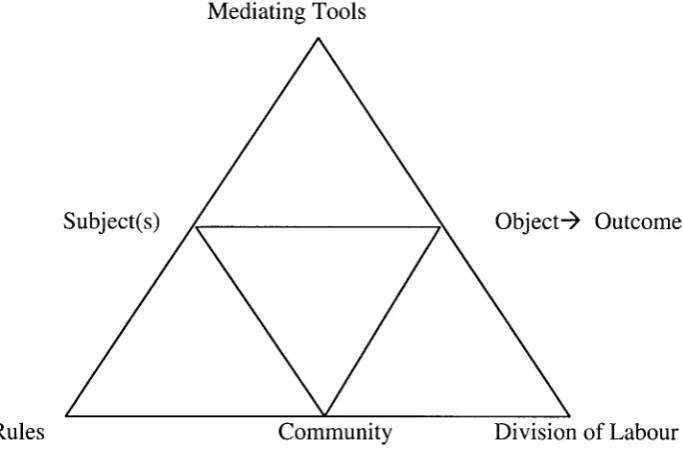
Figure 2.1 An activity system 53
Chapter 3
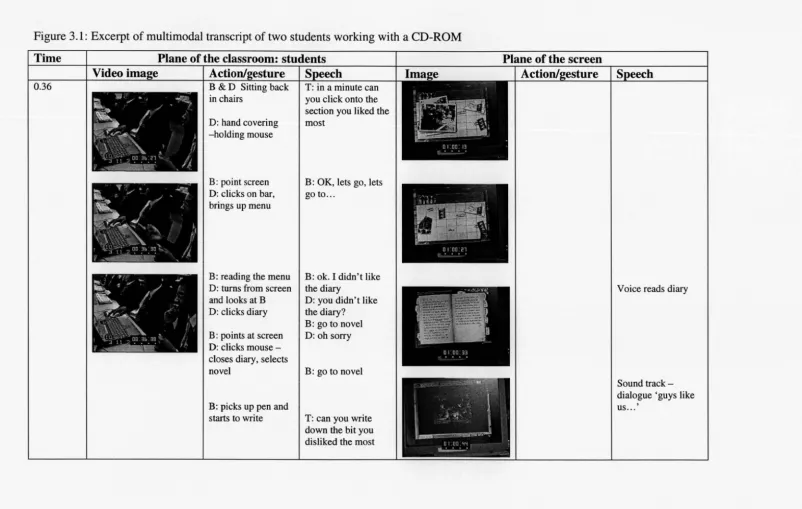
Figure 3.1 Excerpt of multi modal transcript of two students working 94 with a CD-ROM
Chapter 4
Figure 4.1 Map of the CD-ROM 101
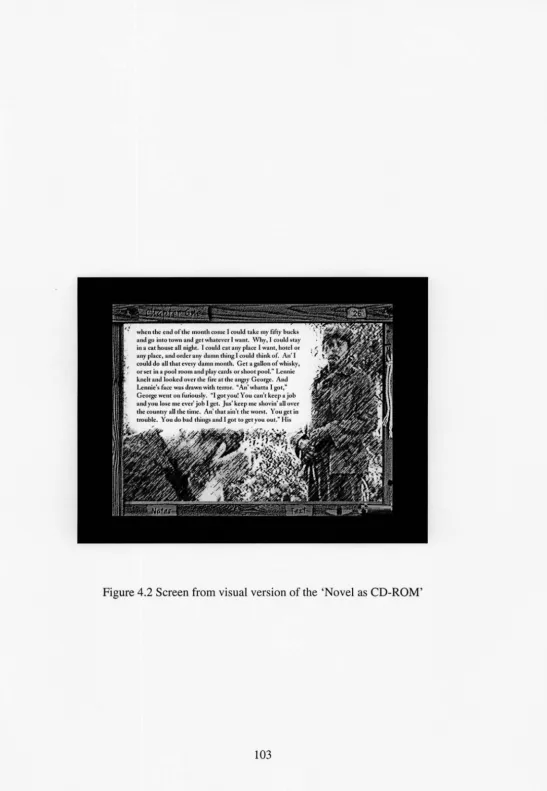
Figure 4.2 Screen from visual version of the 'Novel as CD-ROM' 103 Figure 4.3 The structure of Chapter One of the 'Novel as CD-ROM' 105 Figure 4.4 The relation of image and writing over three screens in the 121
'Novel as CD-ROM'
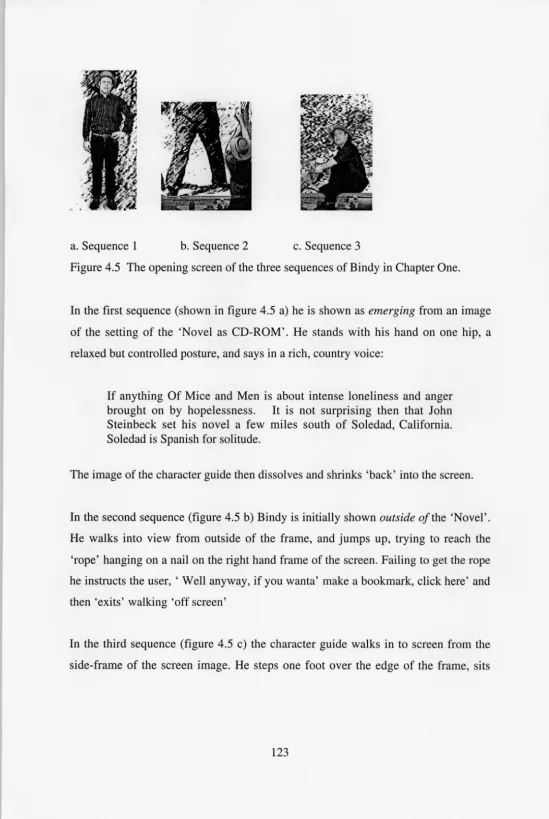
Figure 4.5 The opening screen of the three sequences of Bindy 123 Figure 4.6 Curly's Wife's dossier file an example of the screen of a 130
character dossier file
Figure 4.7 Curly's Wife's dossier file an example of a link screen in 130
a character dossier file which uses a plainer font and scroll
Figure 4.8 The Dossier menu screen 131
Chapter 5
Figure 5.1 The opening screen of Toontalk: the City Level 150 Figure 5.2 Toontalk representation of the City at the Level of the 150
Street as the user lands the helicopter
Figure 5.3 Toontalk representation Inside of a City House: Standing 154 Figure 5.4 Toontalk Representation Inside of a City House: Kneeling 154 Figure 5.5 Two Toontalk tools, Dusty and Pumpy in animated 161
(programming mode) and static forms (game mode)
Figure 5.6 a. The bouncing anima-gadget 162
right when the control key is pressed: program mode
Figure 5.9 Multimodal representation of 'move' behaviour 172 Figure 5.10 The students' design of the game on paper 182 Figure 5.11 The visual design of the game on Screen 184 Figure 5.12 A diagram of the students' gestures with the screen 191 Figure 5.13 Placing the 'I bounce left and right' on the bullet 199
Chapter 6
Figure 6.1 Text book representation of 'Particles' and 213 'states of matter' in the form of diagrams
Figure 6.2 Text book representation of 'Particles' and 213 'states of matter' in the form of photographic images
Figure 6.3 Typical teacher representation of 'states' in classroom 213 Figure 6.4 The opening 'Hide Particles' option screen of the topic 215
'states of matter' in Multimedia Science School
Figure 6.5 The opening 'View Particles' option screen of the 215 topic 'states of matter' in Multimedia Science School
Figure 6.6 The outer 'frame' of the screen represented in grey scale 218 Figure 6.7 The 'screen within the screen' shown in grey-scale 221 Figure 6.8 Three images from the stages in the transformation 224
from solid to liquid, with the 'Hide Particles' viewing option Figure 6.9 The transformation from a solid to a liquid, with the 228
'View Particles' option
Figure 6.10 The opening screen of the transformation liquid to solid 234 in the 'Hide particles' viewing option of the CD-ROM
Figure 6.11 The transformation of a gas to a liquid in the 'Hide 249 Particles' viewing option
Figure 6.12 The transformation of a gas to a liquid in the 'View 249 Particles' viewing option
List of Tables
Table 4.1 Percent of screen allocated to image by 119 the number of screens
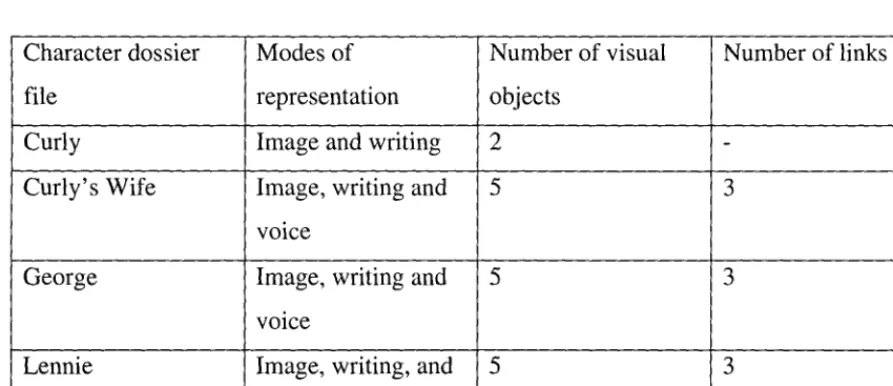
Table 4.2 Comparison of the modes and links 135
in the dossier files of the characters Curly's wife, Lennie, George, and Curly
Table 5.1 The ratio of screen to compositional space at the different 156 sub-levels of the Toontalk city
Table 5.2 Summary of the representation of the elements of rule 174 in Toontalk
Table 5.3 The modal affordances and epistemological 204 commitment in the students' written, drawn and
The Organisation of the Thesis
The thesis is organised in three parts. Part I consists of chapters One through to Three and in these chapters I provide an introduction and overview to the thesis, its aims, the questions and themes that inform it, and outline the theoretical concepts and methodological approach that informs it. In Part II, consisting of Chapters Four, Five
and Chapter Six, I explore the semiotic potentials of new technologies for learning. I do so through the analysis of three examples of technology-mediated learning each of which explores an instance of teaching and learning with a specific computer application set in the English, Mathematics, and Science classroom respectively. In
each chapter I show how the resources of screen re-shaped curriculum knowledge and classroom practice. Part III consists of Chapters Seven and Eight, in each of these
chapters I return to the two aims of the thesis. In Chapter Seven I draw on the
findings of the analysis to discuss literacy, knowledge practices and the implications for technology-mediated learning more broadly. In my concluding chapter, Chapter
Eight I discuss the contribution of the thesis to the development of multi modal theory.
Part I: A MuItimodal Framework for Technology-Mediated
Learning
1.
Multimodality and the Screen
In Chapter One I describe the focus of the thesis, its aims, and the research questions
2.
Turning a Multimodal Lens on Technology-Mediated
Learning
In Chapter Two I describe the theoretical perspective of the thesis. I bring together a social semiotic theory of representation and communication (Halliday, 1978, 1985; Hodge and Kress, 1988; Kress, et. aI, 2001;Kress and van Leeuwen, 2001), and a social-cultural theory of learning (Engestrom, 1999; Daniels, 2001; Russell, 2002). I introduce and discuss the concepts that inform the theoretical framework of the thesis including semiotic mediation, activity system, sign, mode, materiality, modal affordance, and site of display and design. I conclude the chapter by exploring the implications of these concepts for learning.
3.
Towards a Multimodal Analysis
The ways in which these theoretical concepts are applied to the context of technology-mediated learning in the thesis are outlined in Chapter Three. More specifically I describe the dimensions for the analysis of visual communication, colour, animated movement, sound, and gaze in some detail. I briefly describe the data analysed in the thesis, and discuss the issues data collection, the use of video as a method of collecting data, sampling, and transcription.
Part II: Multimodality and Technology-Mediated Learning
classroom via the computer applications in each chapter I go on to analyse student interaction with these resources. I examine the ways in which these multi modal resources reshape knowledge, their impact on the practices of students and more broadly what this might mean for technology-mediated learning. I develop the themes outlined in Chapter One throughout this analysis.
4.
The Multimodal Reshaping of Curriculum Entities in School
English in the Move from Page to Screen
In Chapter Four I focus on the use of the CD-ROM Of Mice and Men (1996) of the
Steinbeck novel Of Mice and Men (Steinbeck, 1937) in a secondary school English classroom. I explore how, in the move from page to screen, a range of representational modes (including image, movement, gesture, and voice) are available as meaning-making resources. The concept of 'character' is one of the central concepts in the National Curriculum for English (DFEE, 1999) and working with this concept I show how the shift from the written page to the multi modal screen entails a shift in the construction of 'character'. Through detailed multimodal analysis of several students' engagement with the CD-ROM I argue that student interaction with the resources of the CD-ROM as a visual multi modal text demand that 'reading' and the process of learning within school English be thought of as more or other than a linguistic accomplishment.
5.
Mathematics and the Multimodal Construction of 'Rule' and
'Bounce' on Screen
In Chapter Five I focus on a computer programming application 'Toontalk' and its
use in a Primary school computer club. Toontalk aims to give children access to a conceptual understanding of maths through the process of building computer games.
In the first part of the chapter I analyse the modal resources that the application
makes available to the user. In order to demonstrate that these are the result of a
of the choice of medium in and of itself, I compare the application with two others, Logo Imagine, and Pathways. Logo Imagine can be crudely characterised as a writing system, and Pathways as a visual object orientated system. While in the first part of the chapter I focus on the potentials of the medium and modal resources of the programmes, in the second part of the chapter I focus on how two students engaged with the modal potentials of Toontalk in building a game. Through a detailed multi modal analysis of the students making their game I look at two students' construction of the entity 'bounce'. The analysis centres on the impact of modes (including still image, gesture, posture, speech, animated movement and writing) on the emergence of the mathematical concept of 'bounce'. I show that the modal resources that the application makes available to the user enables them to realise the entity 'bounce' in quite different ways. The chapter concludes that the choice of representational modes in the design of a program is central to the engagement of the user with it.
6.
The Multimodal Construction of the School Science Entities
'states of matter' and 'particles' on Screen
In chapter six I explore how the multi modal resources of the computer screen reshape
Part III: New Technology, Multimodal Learning, Literacy and
Design across the Curriculum
7.
New Technology and Learning
The final part of the thesis consists of Chapter Seven, in which I draw on the theoretical discussion in Part I and the analysis and findings presented in Part II in order to discuss student learning, literacy and new technologies in education more generally. I present a discussion of themes generated by the analysis. I address the ways in which modes are used in different curricular subjects, in particular the
question of the specialised use of modes to shape knowledge. The arrangement of modes on the computer screen, the configuration of modes to mean and the interaction of modes on screen are also discussed. I explore the need to re-think the concept of literacy in the multi modal context of technology-mediated learning, in particular the implications for what it means to be literate, and for the assessment of literacy within the school. Further, I discuss the practices involved when learning is mediated by new technology and the potential for modes other than language to contribute to learning as 'multi modal design' .
8.
The Development of Multimodal Theory
Part I:
A Multimodal Framework for
1.
Multimodality and the Screen
In this chapter I set out the aims of the thesis, the research questions that it addresses and the themes that it develops. These themes are discussed in relation to the literature on technology-mediated learning in order to place the arguments developed in the thesis in context.
The Purpose of the Thesis
In this thesis I turn a multimodallens on technology-mediated learning in the school classroom. In other words I analyse the representational and communicative modes that technology-mediated learning makes available to students in the school classroom including still image, movement, speech, sound-effect, and writing. In
order to do this I focus on three specific computer applications - two CD-ROMs, and a computer programming application. Two aims inform the thesis. The first and central aim of the thesis is to provide a better theoretical understanding of the relationship on the one hand between the multimodal meaning making resources made available by technology, and school knowledge, learning and notions of literacy on the other. The second aim of the thesis is to contribute to the development of multimodal theory through its application to technology-mediated learning. It
Multimodality is an emergent theory, and while there is a small (but significant) body of work on multimodal theory that sets out to address the theoretical questions that it raises many of the theoretical concepts and tools remain unsettled (e.g. Kress and van Leeuwen, 1996; Kress and van Leeuwen, 2001; Finnegan, 2002). Despite this, educational researchers have actively taken up multimodal theory across a wide range of learning contexts. This includes, among others, pre-school learning (Lancaster, 2001; Pahl, 1999), bilingual language learners (Kenner, 2000), literacy (Moss 2001; Street, 1998), English education (SEP, 2002), and science education (Kress et al. 2001; Q'Halloran, 1998). Multimodality has generated much interest among designers, academics and educational practitioners working in the area of new technologies and technology-mediated learning. However, with a few notable exceptions (e.g. Burn and Parker, 2001; Lemke, 2002; van Leeuwen, 1998) there has been little multimodal research in the field of technology-mediated learning.
Background
The ideas and questions that inform this thesis emerged from watching the children of friends and my own daughter, 'play' and 'work' on computers. I watched them 'read' books, 'play' music, write, draw, build and destroy cities, and kill armies. I listened to the sound-effects of the software, watched the visual display of animated (revolving) icons and characters, the use of colour on screen, the spatial construction of the screen environment, and all the time I wondered what was going on. The children sat at the computer, they looked intently at the screen, moved the mouse, clicked on icons, pressed keys, and pointed at things on the screen. In these moments I wondered
Although the topic of this thesis originated from my interest in children's computer use in the home it evolved to focus on students' use of new technologies in the school. The decision to focus on students' use of new technology in the school (rather than in the home) reflects my interest in school knowledge and practices, in particular, the way in which curriculum subjects are realised differently in different modes and media. Focusing the thesis on technology-mediated learning in the school enables the potential tensions between traditional notions of literacy and learning within formal school education and what it means to be literate in the digital environment of the Twenty-first Century to be explored. There are many differences between children's use of computers in the home and in the school, including that each utilises different media (Facer et. aI, 2001; Harrison, et. aI, 2001;Somekh et. aI.,
2001ay' Nevertheless, like children at home, students using new technologies in the school are engaged with a range of representational and communicative modes. New technologies that are used in some school classrooms include simulation applications, virtual reality learning environments, electronic books, discussion forum applications, spreadsheets, and hypertext. These applications use a range of representational modes including still image, movement, colour, sound-effect, music, speech (voice) and writing - making both the home and the school equally suitable sites for the purpose of developing multimodal theory and examining the relationship between mode and learning.
end of 2001 99 percent of secondary schools, 96 percent of primary schools, and 97 percent of special schools were connected to the internet (Somekh, 2001a). There is, however, plenty of evidence that schools find it problematic to incorporate ICT into the curriculum. For instance, OFSTED reports indicate that Information Technology is the weakest national curriculum subject. The most frequent use of new technology in both primary and secondary schools is for word processing, producing 'smart-looking' copies of writing - often for display (Harrison et. aI, 2001).
The initial enthusiasm for the use of information and communication technology to enhance student learning has been moderated by the effects of the complex issues that have arisen for the effective use of this technology in schools. The usual approach of transposing existing pedagogic practices into a context where new technologies are used has (once again) proved to be inadequate. Research into the attitude and skills of teachers to the integration of ICT has found that some teachers have little confidence, skills, and limited access to resources in relation to new technologies (e.g. Cox 1997). Against this backdrop new technologies are usually fitted into old frameworks for learning in the classroom, they are confined to the relatively superficial, and they are bolted-on to lessons (Becta, 1998; Crook, 1999). Amongst teachers there appears to be a level of uncertainty about their role in the classroom in relation to technology-mediated learning and the majority adopt the role of classroom manager or withdraw (Noss, 1991). Beyond accessing 'information' there appears to be no real sense of how new technologies transform (or might transform) schooled knowledge and learning.
Having sketched the purpose of the thesis and given a sense of the interests that it emerged from, in the next section I discuss the research questions that inform it, and the themes that emerged from the analysis and are developed throughout the following chapters.
Research Questions and Themes
The interests and aims outlined in the previous section are addressed throughout the
thesis by asking three interconnected research questions.
1. How do the multi modal resources (as they appear on screen) made available by technology-mediated learning shape curriculum knowledge?
2. How does student engagement with these multi modal resources shape school practice (e.g. reading) and what it means to be a learner?
3. What contribution to learning might students' use of the multi modal resources of new technologies make?
The process of applying these three questions to data of instances of technology-mediated learning enables both aims of the thesis to be achieved simultaneously. The analytical process requires the development of multimodal theory to the specific context of technology-mediated learning, and at the same time yields insights into how the multi modal resources of these technologies contribute to the shaping of curriculum knowledge, practices and learning.
six themes are outlined below and then each theme is discussed more fully. The first three themes focus on the representational and communicational modes of new technology. The second three themes focus on student engagement and practices with
such applications.
The first theme is the multi modal character of new technology. I focus on the range of modes used in different applications, and the compositional arrangement of these modes on screen to explore how these shape learning. In particular I show that modes are central to the shaping of curriculum entities, to what it means to be a learner, and to classroom practices. The second theme that I develop in the thesis is the role of language (speech and writing) in many new technology applications. I examine the role of writing and the role of speech as these appear on the computer screen to show that writing is increasingly drawn on as a visual resource and that the role of language is less central to the screen than it has been on the page. The third theme that runs through the thesis is the design of modal relations on screen. I explore how the arrangement of different modes in the applications analysed in this thesis attends to different aspects of the construction of curriculum entities.
thesis. I demonstrate that traditional conceptions of literacy are reshaped and expanded in the multi modal learning environment of technology-mediated learning (and elsewhere) and I argue that literacy can more usefully be thought of as a process
of multi modal design.
In the following section, In order to situate the thesis clearly in the fields of multi modal theory and technology-mediated learning, I discuss the themes introduced above in the context of the relevant literature.
The Multimodal Character of New Technologies
Representation and communication on the computer screen are increasingly realised through the complex interplay of still image, colour, moving-image, writing, sound-effect, speech, and music. In other words representation and communication on the computer screen are multimodal (Kress, 1998; Kress and van Leeuwen, 2001). Multimodal communication is central to the design and use of the majority of new technologies (such as CD-ROM and Hypertext).
Visual representation is considered especially important, particularly in School Science and Mathematics, as it is thought to make some concepts more easily accessible to students in the classroom, thereby making inquiry and learning 'easier' (Ligorio, 2001). Indeed, visual communication, it has been said, is expanding to the extent that the written elements on screen are now merely what cannot be done in images (Bolter, 1998). Images on the world-wide-web often enter into co-operative relations with words in which images function as 'characters' that link screens. An element's salience on the screen, for example, the use of vectors, symbolic processes, and gaze can draw attention to it as a linking tool.
In order to produce a product that attracts and appeals to the target
population, a product's visual image, sound, and content all must blend together to provide users with the sensory information that they need to interpret and respond to the program. We are developing information environments.
(Hakansson, 1990: 129)
This computer usability and design literature (e.g. Laurel, 1990; Neilsen, 2000; Shriver, 1997) identifies a number of roles for image, sound, and moving image on the screen. However, it tends to remain at the level of description and the interpersonal and does not give a sense of how or why different representational modes might function in the way that they do or their role in the construction of information. Nor, most importantly for this thesis, does the literature highlight the potentials of different modes for learning. Nonetheless the literature on usability and design does offer some interesting routes for the analysis I present in this thesis by suggesting the roles that different modes on screen often occupy.
The usability and design literature suggests that still image can be effectively used to highlight overall patterns and trends, to demonstrate complex notions, to depict spatial relations, to depict objects, and to visually create 'mood' and immediacy (Clarke, 1997; Rivilin et. aI, 1990). Similarly, colour has been found to be a potentially powerful tool to direct attention, maintain attention, interest and motivation, to increase retention of learning materials, and to show relations between (that is, to link) items (Clarke, 1997). This literature also emphasises the role of modal arrangements on screen and informational structures in screen design (Rivlin et. aI, 1990). In particular, elements can be visually grouped or separated through
The role of movement (often discussed in relation to the genre of animation) as a resource in interface design is noted in the literature on computer usability and design. Movement, the literature suggests, can be used to display changes over time, to simulate experiences, to show environments that it is not possible to experience, to illustrate interaction between people, and to show depth (Laurel, 1990; Clarke, 1997). The literature on the function of the mode of movement is limited, especially in relation to learning. With a few exceptions, when movement is discussed in the design and usability literature this tends to be at a rather superficial descriptive level. There is a clear need for software and interface design to move beyond the use of animation in the gratuitous enhancement of the interface and to make movement more integral in achieving interface goals. Some research on simulation programs demonstrates that movement can provide students with access to complex phenomena, as well as the opportunity to observe the unobservable and to manipulate models and concepts (Sayeki et aI, 1991;Ronen and Liahu, 2000). The potential of animated micro-worlds to demonstrate the differences between everyday understandings of movement and those acceptable to physics in different ways than other technologies has also been shown (Saljo, 1999). However, the role of movement and the other modes made available in these applications is not explored in any detail and the question of how movement might contribute to learning is not explored.
liquid reaching the top of a glass), or to show events in space (like the use of footsteps to indicate social distance) (Mountford and Gaver, 1990).
Semiotic theory has been applied to new technology, principally in the fields of graphical user interface design (Callahan, 1994) and human computer interaction (Andersen 2000; Nadin, 1985). Indeed Nadin argues that human computer interaction is semiotics applied. This work has attempted to mobilise semiotics in the characterisation of human computer interaction through viewing the relationship between software designer and user and seeing the interface as the linking medium (Laurel, 1990).
There has been some research into the multimodal character of new technology within social semiotics that does begin to explore the potential role of modes in meaning making but to a lesser extent learning.
The semiotic character of hypertexts and hypertext links are discussed in this literature. Lemke explores the potential of hypertext to realise new interactions between word, image and sound (Lemke, 2002). In particular the multiple combinations of resources within hypertext can provide a resource for the construction of meaning relations between modes on web-site screens. The semantic functions of links in hypertexts have been explored and classified by Harrison (2002) as authorizing, commenting, enhancing, exemplifying, referencing/citing, or self-selecting information on screen. The meaning of the structure of a CD-ROM are analysed by van Leeuwen (1998) who concludes that:
The analysis of the structure of an interface is therefore one way to bring the ideology, hidden agenda or curriculum of an application into the 'open'. The way in which image, writing, sound and video are designed to actualise information and ideology in CD-ROMs has also been explored (Zammit and Callow, 2000). These papers offer interesting insights and starting points for the social semiotic analysis of new technologies in this thesis. However these papers and indeed the majority of work from a semiotic and social semiotic perspective tend to focus on the resources of the computer screen as a text and do not explore what happens when users engage with these resources. There are a few notable exceptions to this, for instance in their analysis of a short animation made by secondary school students Bum and Parker (in press) explore the students use of the resources of digital drawing and animation software in media education.
One of the goals of my thesis is to contribute to a better understanding of how the design and ideological positions of multi modal texts as they appear on the screen might influence, shape and reshape, people's use of them. To this end I argue for the
need to look not only at the screen as a text but also to look beyond the screen to the practices of students.
The De-centring of Speech and Writing
It is almost a cliche to say that the form of a sign shapes its meaning but 'the medium
image, writing and movement, and so on, as they appear on the computer screen is increasingly recognised as central to learning (Lankshear et. aI, 2002).
Writing on the computer screen (and other screens including the mobile phone screens, game boys and so on) appears to be regaining its visual character, its image-quality (Lanham, 2001: Elkins, 2000). Indeed it has been stated that:
We are entering a historical epoch in which the image will take over from the written word.
(Gombrich, 1996: 41).
While this prediction may be as 'off the mark' as predictions that computers heralded the demise of the book, visual communication does appear to be increasingly foregrounded in educational texts - whatever the technology. The increased use of visual and other modes of communication is epitomised by (but not restricted to) new technologies.
Theories of the relationship between word and image include the potential for images to extend the meaning of words (i.e. 'relay'), or to be independent of them (Barthes, 1977). The dominant theory of the relationship between word and image had been one of 'anchorage' - in which words anchor the meaning of an image (Barthes, 1977). The complexity of the relationship between image and word in the multi modal environment together with the increase in visual communication that is entirely free of words suggests that in many cases a view of image as reliant on word is no longer relevant (van Leeuwen, 2000).
Multimodal research on the construction of School Science and English shows that even in classrooms where speech is in the foreground a wide range of modes contribute to the construction of knowledge and the processes of learning (Kress et. aI, 2001; SEP 2002; Bourne and Jewitt, in press). It shows that speech and writing are not always central to teaching and learning and the meanings made through speech and writing rely on the other modes that they are embedded within (Jewitt et al. 2001). In this thesis I argue that the exclusive focus on language in technology-mediated learning serves to maintain the centrality of speech and writing in the analytical process. I suggest that ignoring (negating) the multimodal character of technology-mediated learning results in a failure to grasp the potential impact of new technologies on teaching and learning.
The Interaction of Modes on Screen
When several modes are involved in an event of communication then all of these modes together will represent significant aspects of a message's meaning (e.g. Kress et aI., 2001; SEP, 2002). The meaning of a message is distributed across all of these
extremely negative, it portrayed young men as predatory, sexually irresponsible and dangerous. In short, the visual and written discourses in the leaflets stood in stark
contrast to one another and attended to the realisation of two distinct discourses of maSCUlinity. The discourse of masculinity that could be 'legitimately' (socially and professionally) expressed and was realised in written mode, while the discourse that could not be legitimately expressed was realised visually.
Multimodal Engagement with New Technology
Within the literature on technology-mediated learning there is work that shows how computers organise classroom talk into distinctive patterns of interaction. For example, Mercer et aI. (1999) identify three kinds of talk in the context of collaborative computer work - disputational, cumulative and exploratory, and suggest that each offers different ways of thinking and different potentials for learning. The role of computers in the construction of shared meaning has also been investigated (Wegerif and Scrimshaw, 1997). In particular the role of computers on the joint
construction of understanding and the negotiation of meaning in collaborative problem solving has been examined (Looi and Ang, 2000). Research on collaborative learning highlights the potential of computers to mediate (new forms) of social interaction between students, and between students and teacher in the classroom and to create new learning environments (e.g. Healy, Pozzi, and Hoyles, 1995; Littleton and Light, 1999; Crook, 1990; Hoyles et aI., in press). However, this research focuses almost exclusively on talk.
Littleton and Light, 1999). This work has led to dialogic and collaborative principles in relation to technologies in education and the assertion that new technologies need to be understood in terms of mediation rather than transmission. The analytical focus in the majority of this research is on linguistic interaction - talk around the screen.
Some research has attempted to combine an interest in the practices and interaction of students and the resources on screen. Building on research into the distinctive patterns of interaction and talk some research studies have explored how the different structures embedded in computer software affect talk (Baxter and Preece, 1999; Anderson et. aI, 1999). Nonetheless the analytical approach to screen remains rooted in language - either spoken or written, and the multi modal resources of screen rarely come into the realm of the analysis. The structure of computer applications is, however, one area that has received some attention in this field. For instance, computer learning programs with open and closed task structures have been shown to affect patterns of collaboration and interaction differently (Anderson et. aI, 1999). Computer characters and interventions have been designed in order to mediate specific kinds of talk between students (Mercer and Wegerif, 2002). The ways in which different structures of interactive multimedia can be designed to impact on user autonomy, pupil motivated avenues to learning, and to support essential aspects of learning has also been examined (Plowman, 1996a; Plowman, 1996b;Laurillard, 1998).
IS 'good or bad mark making' and 'design' has been shown to increase pupil motivation (Lachs, 1999; Sinker, 1999) and to improve the 'quality of learning'.
Multimodal Learning
The multi modal character of technology-mediated learning, the 'de-centring' of language, and the interaction of modes as they appear on the computer screen all raise important questions for what it means to interact with the resources of new technology and learning more generally.
Learning, especially school learning, is usually understood as a linguistic accomplishment. Language (speech and writing) is seen as central to communication in general and learning in particular. In part this is because language has been
considered the only fully articulate means of representation. It is considered fundamental to thinking, and therefore to rationality, in which talk is a social mode of thinking (Mercer, 2002). That is, everything that can be thought can be thought in language, and everything that can be represented, can be represented in language. From that theoretical perspective other forms of communication have been characterised as either irrelevant or merely supportive of language.
Many commentators have, however, pointed out that visual communication In learning is increasingly prevalent (Messaris, 1994; Sharples, 1998; Buckingham, 2000; Kress and van Leeuwen, 1996, 2001). I argue in this thesis that looking at learning through a multi modal lens to account for all modes does not offer a 'better' view of the 'same' picture carried in language (speech and writing) - it offers a different view.
about and make sense of the world. From this perspective, computer 'intelligence' is seen as radically extending and altering what people think of as human imagination, intelligence, problem solving skills, and the capacity to see our own thoughts in action and replay them for our reflection. The potential of computers to reify or to 'make concrete one's own thinking, and to do so in a manner that has never before been possible.' (Sewell, 1990: 21) places new technologies in the role of 'liberator' giving the learner more independence and reducing mental drudgery. This research acknowledges the multi modal potential of new technologies, but does not ask how its multimodal character might contribute to learning.
Many claims and predictions have been made about the power of new technologies to change learning - and the world. However some computer applications provide little that is new for learning and teaching. The replication of formalist approaches to the arts in paint box applications, for instance, continues to focus on line, tone, and colour and in doing so replicates traditional teaching in a new medium (Sinker, 2000). The traditions of 'drill and skill' rote learning are embedded in the design of much current educational software (e.g. success maker), which breaks the desired learning goals into small steps and relies on reward, repetition, and contingent incrementation of difficulty levels to impart skills (Littleton and Light, 1999). While the conditions for learning can be improved by new technology in the classroom, it is clear from the literature that this potential is not always realised. Indeed, Davis and colleagues (1997) comment on the potential for teachers to use new technology to 'create a new set of mundane tasks' that fail to make use of the opportunities for learning offered by new technologies.
Multimodal Literacy
Government educational policy (e.g. The Literacy Strategy and the National Curriculum) does not address the problematic and contentious character of literacy and the struggle over its meaning (Brookes and Goodwyn, 1998). While recent government initiatives seem determined to focus on the concept of literacy in its most restricted sense, outside of the school young people are" 'reading' and 'writing' across a new terrain, redefining what literacy might mean." (Raney, 1998: 37). In this thesis I argue that there is a need to conceptualise literacy more broadly as a matter of multimodal design.
While the visual and the linguistic can be treated as distinct versions of literacy to be attended to, that is visual literacy and written literacy, what is needed I argue in this thesis is not the addition of the visual but the re-thinking of the whole complex of representation. Kress (2000) argues for the need to have a concept of literacy as a multimodal process in which all modes are critically interpreted, and their interactions considered. This leads to a shift from a conception of competence in literacy to one of literacy as multimodal 'design'. There is a need for a means of talking about this 'new literacy' about what we do when we read and produce images (Kress and van Leeuwen, 1996). New technologies make available a whole range of multimodal possibilities for individuals' production of documents (layout, colour, scanned images, use of tables, word art, sound, and so on) and allow new kinds of 'reading' of texts (Bum and Reed, 1999). The learning processes when working with new technologies require 'substantially different literacies' which relate to the different character of texts that students need to work with (Downes and Zammit, 2000). To continue to think of learning only in terms of writing and speech is therefore problematic.
saturated environment', it is important to be able to 'construct, control, and manipulate visual texts and symbols' (Luke, 1996). The ability of flexible, interactive fluid hypertext to redefine reader, author, and text relations (as the reader constructs the text in reading it) this demands new ways of thinking about forms of literacy, new skills of linking, decomposing, reorganising elements (Bolter, 1999; Lemke, 1998b; Beavis, 1998). New technologies bring-forth different kinds of cultural forms (e.g. computer game, cyber-linked web-site) and have changed some existing cultural forms (such as sampling - non-linear editing). All of these demand an expansion of traditional notions of literacy. Sefton- Green and Reiss (1999) argue that this should include:
... an ability to work across text, image, sound and moving image with equal fluency, exploiting each dimension separately and making connections between these historically discrete domains.
(Sefton-Green and Reiss, 1999:2).
Many of these skills already exist in the realms of work and education; what is new is the speed and ease at which these tasks can be conducted, and the technological environment in which they are facilitated (Lemke, 1998b).
A multi modal approach to theories of literacy stress communication through a wide range of forms and materials; the agency and interest of individuals in the making of messages; and genres and other forms to be reshaped (Anderson et al., 1999). What it means to be literate is, I argue, becoming increasingly 'complex and elusive' (Beavis, 1998).
The Contribution of this Thesis
It contributes to the field of technology-mediated learning in three ways. First, the thesis moves beyond talk in order to account for the complex relationships between representational and communicational modes in the construction of meaning and learning. Second, the thesis focuses on literacy as a multimodal concept and asks what it means to be literate in across the school curriculum in a digital era. Third, it contributes to a better understanding of how the multimodal character of new technologies re-mediates school knowledge and practices.
The thesis contributes to the development of multimodality in two ways. First the thesis moves beyond the text to analyse people's situated practices with texts, and the relationship between text and practice. Second, the thesis expands multimodal theory beyond the page into the domain of the screen. Third, the thesis offers a coherent approach for looking at a range of modes and the interaction between them on screen .
•
For the reasons outlined in this chapter I approach technology-mediated learning from a theoretical perspective that moves beyond talk - a multi modal social semiotic perspective. This theoretical approach is described in the following chapter, Chapter Two. The application of multimodal theory to technology-mediated learning is the focus of Chapter Three.
i On average children spend three times as long on computers in the home as they do in school
2.
Turning a Multimodal Lens on Technology-Mediated
Learning
Introduction
In order to understand the relationship between the multimodal semiotic resources that new technologies make available in the classroom, and knowledge, literacy, design and learning, I turn to social semiotic theory as it theorises the relationship between semiotic resources and people's meaning making. Halliday's (1978) social semiotic theory focuses primarily on the semiotic resources of language (speech and writing). However, I argue that the prominent role of visual semiotic resources on the computer screen (and elsewhere) and the multimodal character of learning requires a theory of meaning making that moves beyond language. For this reason I take a multimodal approach to the analysis of technology-mediated learning which builds on the theoretical concepts of social semiotics in order to account for the semiotic resources of a range of modes including still image, colour, animated movement, writing, sound-effect, and speech.
In bringing together the concepts of multimodality and activity theory my intention is to reconfigure both of these theoretical approaches in significant ways for learning. By focusing on the multimodal resources of screen and the multimodal character of learning more generally I challenge activity theory to look beyond language. I argue that the semiotic resources of a range of modes, a multimodal ensemble of which language (speech and writing) is only a part, shape semiotic mediation and the process of internalisation. In moving beyond the individual sign maker to understand meaning making as situated within a system of activity (in this thesis the school classroom) I refocus multimodality by 'filling in' the social and historical forces that underpin and shape learning.
In this chapter I address four points. First I discuss the way in which social semiotics theorises meaning making as a relationship between the social and 'semiotic resources', a concept that is central to social semiotics and to this thesis. Second, I describe how a multimodal approach expands the concept of semiotic resource to a range of representational and communicational modes beyond language. Third, I argue that combining a multi modal social semiotic approach and activity theory offers a better understanding of the dynamic social relationship between sign, the agency of the sign maker, semiotic resource and the social context of making meaning. Fourth, I then discuss the ways in which these theoretical concepts inform the view of learning taken in this thesis.
Multimodal Meaning Making
functions to marshal communicative acts into (communicative) texts that realise specific social practices. These three kinds of meaning functions are held by the grammar and by the words (the Lexical-grammar) of language.
Social semiotic theory was developed in relation to language and has until recently focused almost exclusively on speech and writing, with a few notable exceptions (Hodge and Kress, 1988). Multimodality extends the concept of metafunctions beyond language (speech and writing) to all communicative modes. It asserts that through the cultural shaping of the affordances of modes in the work of semiosis distinct and different potentials for meaning become developed in all semiotic modes (speech, gesture, visual communication, music, and so on). The need to understand the meaning of speech and writing in their multimodal context has however been acknowledged, such as the potential of gestures to contribute to a holistic picture of communication (Halliday, 1978: 37). Recently social semiotic research has begun to take account of modes and systems of making meaning other than language, including music, speech and sound (van Leeuwen, 1999), action (Martinec, 2000), as well as visual communication (O'Toole 1994; Kress and van Leeuwen, 1996). Most recently, work in the Hallidayan functional linguistic tradition, and in social semiotics, has increasingly viewed the social production of systems of signs and meanings as a multimodal phenomenon (Kress et. aI, 2001, Kress and van Leeuwen, 2001; Martin and Veel, 1998; Baldry, 2001).
the realisation of meaning through modes. While modes have different potentials for realising meaning all modes are resources available to realise meaning, all modes can represent the world, represent interactions, and can be used to form messages. The representational and communicational affordance of modes is the outcome of complex social shaping of the materiality of modes in their social usage (resulting in functional specialisation and load) and the designed relationships between modes.
Mode
A mode can be thought of as any regularized organized set of semiotic resources for articulating meaning. Modes are broadly understood to be the result of the effect of the work of culture in shaping material into resources for representation. These resources display regularities due to that cultural work and due to their more or less frequent use in social (inter) action. The more work a culture has put into such a resource, for whatever reasons, and the more it has been used in the social life of a particular community, the more fully and finely articulated it will have become. Through this use the semiotic resources of modes come to have regularities of use. These regularities are what have been called 'grammars' traditionally.
For instance, the resources of the visual mode (e.g. diagrams, pictures, icons, and symbols) offer a collection of potentials or resources for making meaning. These include the depiction of participants, vectors, setting - the type and the degree of contextualisation, visual props, the use of angle and perspective, detail or absence of detail, depth, the position of elements in space, salience, and framing. Through people's use of them these resources have come to have meaning. (The semiotic resources of still image, colour, animated movement, gaze, and so on, are discussed in detail in Chapter Three.)
Materiality
comes to have meanings as a culture selects and draws these into meaning making. These materials (e.g. sound and light) have qualities that affect how they can be culturally shaped into modes, how they can realise meanings. The materiality of a mode contributes to how a mode is shaped through people's social use of it; and this has led to the concept of modal affordance.
Modal Affordance
The affordance of a mode can be understood as what it is possible to express and represent readily, and easily with a mode given its materiality and given its cultural and social history - what it has been used to do (mean). Where a mode 'comes from' in its history of cultural work, its provenance, is understood by members of that culture, and becomes a part of its affordance. The affordances of image, in the form of graphic marks on a two-dimensional surface for example, offer different potentials for the expression and representation of meaning than the affordances of speech, in the form of sounds over time. The specific semiotic resources of modes are 'essentially incommensurable' (Lemke, 2002).
No [written] text is an image. No text or visual representation means in all and only the same ways that text can mean. It is this essential in commensurability that enables genuine new meanings to be made from the combinations of modalities.
(Lemke,2002: 303)
possibilities for putting things first or last, or somewhere else in a sequence. The mode of speech is governed by the logic of time. (Still) images are governed by the logic of space and simultaneity. A sign-maker has to display what they wish to show in the space available for their representation, be it the page or the screen. All of the elements that they wish to display have to be simultaneously present, and their relations in meaning have to be spatially indicated: close to or far away, below or above, centrally or marginal. Modal affordances are used differently in different communities of practices, they have come to be shaped differently through their social use in specific communities of practices. The resource of modes and their affordances has led to the functional specialisation of modes.
Functional Specialisation
Functional specialisation of modes is a feature of multimodal representation: it is an effect both of the affordances of modes (i.e. this mode is can more easily represent something than another mode can), and of design decisions in relation to the audience. Such design decisions include the effect of power, as when the elite make a mode into the preferred resource as has been the case with the mode of writing. The specialisation of modes refers to the long-term effect of cultural valuation: if a culture values a mode highly, much work will inevitably go into its elaboration, through its constant use by members of a social group. Its constant use in relation to specific purposes will make modes come to be specialised for representing and communicating particular meanings in particular social contexts. As a result not every mode will be equally 'useable' for a particular task:
It is possible to envisage the whole field of everything that can be 'meant' in a given sociocultural domain at a given moment of its development (which, in my view, is not co-extensive with the semantics of language) and then to also envisage how that sociocultural domain will have a certain distribution of different semiotic modes across that field, in such a way that some things can be signified visually as well as verbally, others only visually, others only verbally, others both verbally and musically but not visually, and so on.
Functional Load
Functional load of modes is related to, but distinct and (independently variable) from, functional specialisation. The term functional specialisation of modes refers to how modes are shaped by societies' usage of them to realise particular kinds of meaning, at a general level. The term functional load of modes refers specifically to the use of a mode in a particular occasion of communication: whether most of the informational load is carried by speech, by image, or by gesture or by all three modes together (Jewitt et. aI, 2000). On a computer screen the curricular content (depending on the school-subject at issue) might be carried by writing (i.e. the functional load would be on the mode of writing) or by image, or it might be distributed evenly between the two.
I use the concept of functional specialisation and load to explore how modes in technology-mediated learning realise particular kinds of meaning, when modes are used and what they are used for.
The Designed Interaction of Modes
Modes never occur alone in a text (Kress and van Leeuwen, 1996). Even the practices of writing and reading are multimodal practices, drawing on visual and actional modes in particular the resources of spatiality and directionality (Kenner, in press). How modes are orchestrated to make meaning is therefore central to a multimodal approach. In any communicational event one mode may be fore grounded and others not. Within a multi modal approach to communication an assumption is that any mode may become fore grounded or backgrounded. The fore grounding of different modes in the multimodal ensemble shapes curricular knowledge in particular ways.
We move away from the idea that the different modes in multimodal texts have strictly bounded and framed specialist tasks, as in a film where images may provide the action, sync sounds a sense of realism, music a layer of emotion, and so on, with the editing process supplying the 'integration code', the means for synchronising the elements through a common rhythm (van Leeuwen, 1985). Instead we move towards a view of multimodality in which common semiotic principles operate in and across different modes, and in which it is therefore quite possible for music to encode action, or images to encode emotion.
(Kress and van Leeuwen, 2001: 2)
Kress and van Leeuwen (2001) put forward four interconnected semiotic principles for consideration in multimodal analysis including discourse, design, production, and distribution. I draw on these as analytical tools throughout the thesis.
Discourse is used to refer to 'socially situated forms of knowledge about (aspects of) reality' (Kress and van Leeuwen, 2001: 20). Different discourses are available to people in relating a particular event and they use the discourse that is most apt to express their interests in the communicational situation that they are in. These discourses construct knowledge through the inclusion and exclusion of participants and events, and the links that are made with other events and discourses. Discourses can only be realised in semiotic modes and this introduces the concept of design.
Design is a process that stands between content and expression and is used to refer to 'conceptualisations of the form of semiotic products and events' (Kress and van Leeuwen, 2001: 21). Design involves the formulation of discourse in a particular social context through the combining of semiotic modes in a particular way. In short, design is the means for the realisation of discourse and is separate from the actual material product.
is the material semiotic organisation and expression of the design in the form of a communicative event or text. The design is itself transformed in the production via the meanings brought forth by the process of articulation and the semiotic resources of the materials and modes that are used.
Alongside production stands Distribution, 'the technical 're-coding' of semiotic products and events, for purposes of recording (e.g. tape recording, digital recording) and/or distribution (e.g. radio and television transmission, telephony)' (Kress and van Leeuwen, 2001: 21). The point made here is that the process of distribution (the medium) is semiotic and can add additional layers of meaning in the way that a song for instance is technically recorded. The distribution of worksheets or images in schools is an interesting example of the semiotic character of distribution. As people photocopy and pass them on the image-quality deteriorates, details are lost, colour becomes grey scale, images are transformed, page numbers and the origins of worksheets are slowly removed by the hasty positioning of papers in the machine and so on. In other words, the medium of a 'message' shapes the semiotic potentials it makes available and how these are actualised:
Technology enters fundamentally into the semiotic process: through the kinds of meaning which it facilitates or favours, and through the differential access to the means of productions and reception which it provides.
(Kress and van Leeuwen, 1996: 233)
The facilities of new technology, discussed in Chapter Three, are drawn into the analysis of the thesis.
Semiotic Resource
or more people have understood the same code they would therefore be able to connect the same meanings to the same sounds or graphic patterns, and be able to understand each other. In such theories of sign, the semiotic system is simply 'there'.
It can be used but it can not be changed in any way. The starting point for social semiotics is meaning. Signs are viewed as the product of a social process of sign making in which the signifier and signified are independent of each other, rather than understanding the sign as a pre-existing conjunction of a signifier and signified, an element in a code, to be understood and used. The sign maker brings signifier and signified together to make a sign. Sign makers have a meaning (the signified) which they want to express and they express it through the most apt semiotic resources available to them at that moment (the signifier).
The dog is programmed to move from side to side, a restricted movement that again signifies its weakness. The students use the most apt signifiers available to them (in this case through image and animated movement) to realise the meaning they want to express, that is the vulnerability of the character. As this example demonstrates the distinction between code and resource has implications for the understanding the agency of sign makers and the concept of sign.
To map the meaning potentials of language Halliday (1978) uses a style of diagramming called 'system networks'. These system networks map the meaning potentials of semiotic resources and the relations between them. System networks have been used to explore the resources and the 'grammar' of visual communication (Kress and van Leeuwen, 1996), sound (van Leeuwen, 1999), and action (Martinec, 2000). This work theorizes the networks of semiotic alternatives from a variety of communicative modes that constitute the multimodal meaning potential of a culture, that is, what can be meant.
The ideational metafunction of a semiotic system enables people to construct representations of 'what goes on in the world': their experience of the world (external and internal). The linguistic resources for doing this include words, which 'stand for' the 'participants' (people, places, things in the world), and the system of transitivity, which enables the creation of different relationships between these participants, in terms of actor and goal, reactor. Kress and van Leeuwen (1996) have extended the ideational metafunction to analyse visual representation and communication. Ideational meanings can also be realised through the semiotic potentials of the resources of gesture (Jew itt and Kress, 2002a), gaze (Lancaster, 2001), movement (Martinec, 2000), animated movement (Burn and Parker, in press), music (van Leeuwen, 1999) and so on.