Advances in Medical Education and Practice
Dovepress
O r i g i n A L r E S E A r c h
open access to scientific and medical research
Open Access Full Text Article
Student performance and their perception
of a patient-oriented problem-solving
approach with audiovisual aids in teaching
pathology: a comparison with traditional lectures
Arjun Singh
Department of Pathology, Sri Venkateshwara Medical college hospital and research centre, Pondicherry, india
correspondence: Arjun Singh Department of Pathology, Sri Venkateshwara Medical college hospital and research centre, Pondicherry, india 605102 Tel +91 992 6877714
Fax +91 0413-2644476 Email [email protected]
Purpose: We use different methods to train our undergraduates. The patient-oriented problem-solving (POPS) system is an innovative teaching–learning method that imparts knowledge, enhances intrinsic motivation, promotes self learning, encourages clinical reasoning, and develops long-lasting memory. The aim of this study was to develop POPS in teaching pathol-ogy, assess its effectiveness, and assess students’ preference for POPS over didactic lectures.
Method: One hundred fifty second-year MBBS students were divided into two groups: A and B. Group A was taught by POPS while group B was taught by traditional lectures. Pre- and post-test numerical scores of both groups were evaluated and compared. Students then completed a self-structured feedback questionnaire for analysis.
Results: The mean (SD) difference in pre- and post-test scores of groups A and B was 15.98 (3.18) and 7.79 (2.52), respectively. The significance of the difference between scores of group A and group B teaching methods was 16.62 (P , 0.0001), as determined by the z-test. Improvement in post-test performance of group A was significantly greater than of group B, demonstrating the effectiveness of POPS. Students responded that POPS facilitates self-learning, helps in understanding topics, creates interest, and is a scientific approach to teaching. Feedback response on POPS was strong in 57.52% of students, moderate in 35.67%, and negative in only 6.81%, showing that 93.19% students favored POPS over simple lectures.
Conclusion: It is not feasible to enforce the PBL method of teaching throughout the entire curriculum; However, POPS can be incorporated along with audiovisual aids to break the monotony of dialectic lectures and as alternative to PBL.
Keywords: medical education, problem-solving exercise, problem-based learning
The goal of medical education is to produce the physician we would like to see if we are sick.
–Melinkof
Introduction
The above goal can be achieved only when we train medical students in such a way that they obtain knowledge and can retrieve it whenever required. The way in which a topic is taught will influence how students comprehend subjects and manage clinical problems. Teachers face a variety of challenges such as different learning abilities of students, varia-tions in course content, and difference across learning settings.1 We use different methods to train our undergraduates. The patient-oriented problem-solving (POPS) system is an
Advances in Medical Education and Practice downloaded from https://www.dovepress.com/ by 118.70.13.36 on 19-Aug-2020
For personal use only.
Number of times this article has been viewed
This article was published in the following Dove Press journal: Advances in Medical Education and Practice
Dovepress Singh
innovative teaching learning method that imparts knowledge, enhances intrinsic motivation, promotes self learning, encourages clinical reasoning, and develops long-lasting memory. The three principles for acquiring new information, all of which are applied in POPS, are activation of prior knowledge, encoding specificity, and elaboration of knowledge.2 Many studies have been conducted in Asian and developing countries on the application of POPS in various subjects, in various forms.3–5 The objective of all these studies was to find an alternative to problem-based learning (PBL) for developing countries.
PBL was originally introduced and developed by the McMaster University Medical School in Canada during 1969.6,7 Since then, it has become the method of choice in medical colleges. Currently, in the United States about 82% of medical schools have some element of PBL in their curriculum.8 In Asia PBL has been adopted by various newly established medical colleges in, for example, Nepal, China, Singapore, Hong Kong, and Malaysia.9,10 In India, after 4 decades, PBL is still in its infancy, and it use is limited to particular subject or topics of a few premier institutions.11
Medical education in India and other developing coun-tries faces different problems to those of other developed countries.12–14 Hence, the direct and outright application of Western educational models may not be applicable for India and other Asian developing countries.9
We need to develop teaching methodology and curriculum changes that meet the requirements of the Indian medical education system. The problems in the implementation and introduction of PBL in India are various:
1. Attitude of the faculty members: Resistance from elderly, experienced faculty who did not favor self-directed learning by students, probably due to fear of losing their importance and identity.3
2. Faculty shortage: The number of medical faculties in India is 30% to 40% less than optimum.15 High student-to-teacher ratios are a problem in implementing PBL. 3. Lack of resources: Library facilities, books, and
inter-net access are insufficient in most Indian medical colleges.3
4. Departmental autonomy: The traditional curriculum is teacher-centered and discipline-based, and all decisions are made by the head of department. In contrast, in PBL, all decision are made by the central curriculum committee. Hence, departmental autonomy is compromised.16 5. Lack of proper knowledge and training: PBL
implementa-tion requires special training of faculties because the role of faculties changes from that of knowledge provider to facilitator.3
POPS with audiovisual aids (AVA) could be a better option over didactic lecture to teach our undergraduate students, where we have a very high student-to-teacher ratio.
Objectives
The aim of this study was to develop POPS for pathology teaching, assess its effectiveness, and assess student percep-tions about POPS to determine their preference for POPS over didactic lectures.
Materials and methods
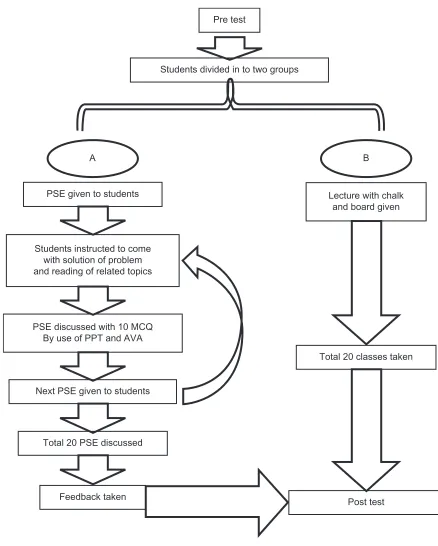
This study was conducted at Sri Venkateshwara Medical College Hospital and Research Centre, Pondicherry, India on 150 second-year MBBS (Bachelor of Medicine, Bachelor of Surgery) students. The pre-test containing 25 questions on hematology was performed to assess students’ current knowledge on the subject. The students were then divided into two groups, group A and group B. Group A was taught by a POPS method developed by the author. Group B was also taught by the author using simple traditional lectures. We also compiled a POPS exercise in hematology. For group A students, a short history with clinical data and laboratory findings was presented 1 day before the class. A class on the same topic was taken on the second day by the author using an AVA PowerPoint (Microsoft, Redmond, WA) presentation with the help of 10 multiple-choice questions (MCQ). The POPS exercise was also presented to the next class with instructions to study the POPS before finishing class. A total of 20 classes on hematology was taught by this method as per the MBBS curriculum of the Medical Council of India. After finishing 20 classes, a post-test questionnaire of 25 questions was administered to both groups A and B. A self-structured questionnaire paper with 10 questions and one open question was also given to group A students and their feedback requested. The feedback forms were strictly anonymous (Figure 1).
The results of the 25-question post-test questionnaire were encoded in numerical variables and analyzed by the Statistical Package of Social Sciences software (version 16.0; SPSS Inc., Chicago, IL). The z-test was used to determine significance of differences in group A and B performance. An example of the problem-solving exercise is given in Appendix A.
Results
On the day that post-test and feedback was taken only 142 students were present in class. All 142 students participated in post-test evaluation. Seventy-three students were present in
Advances in Medical Education and Practice downloaded from https://www.dovepress.com/ by 118.70.13.36 on 19-Aug-2020
Dovepress Patient-oriented problem-solving approach in teaching pathology
group A, all of whom returned feedback forms. Group B did not return feedback because they did not undergo POPS.
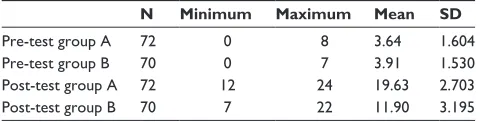
The mean age of students was 20 ± 0.64 years with a female:male ratio of 1.6:1. Group A and group B pre-test results showed a mean (standard deviation [SD]) of 3.64 (1.604) and 3.91 (1.530), respectively. Group A group B
post-test results were 19.62 (2.703) and 11.90 (3.195), respectively. Group A and B differences in post-test and pre-test were 15.98 (3.18) and 7.79 (2.52), respectively. The z-pre-test was done to determine the significance between performance of group A (POPS) and group B (lecture) methods. The z test value was 16.62 (P , 0.0001) (Table 1a, b).
Pre test
Students divided in to two groups
A B
PSE given to students
Students instructed to come with solution of problem and reading of related topics
PSE discussed with 10 MCQ By use of PPT and AVA
Next PSE given to students
Total 20 PSE discussed
Feedback taken Post test
Total 20 classes taken Lecture with chalk
and board given
Figure 1 Flow chart of POPS method.
Abbreviations: PSE,solving exercise; McQ, multiple choice questions; PPT, PowerPoint presentation; AVA, audiovisual aids; POPS, patient-oriented problem-solving systems.
Advances in Medical Education and Practice downloaded from https://www.dovepress.com/ by 118.70.13.36 on 19-Aug-2020
Dovepress Singh
There was significant improvement in post-test of group A compared with group B, demonstrating the effec-tiveness of POPS.
Post-test scores of groups A and B differed significantly. Group A performed better than group B though both groups were taught by the same teacher, but with different methods. This results indicates that POPS with AVA definitely helps in the understanding of subjects and long-term retention of memory.
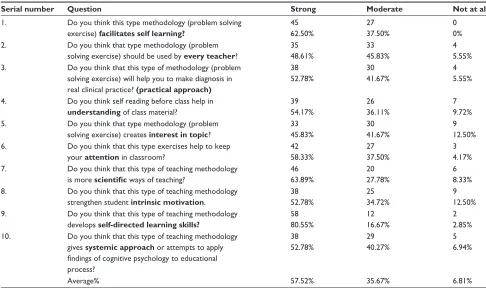
The feedback results from group A students showed that most of students were in favor of the new method of teach-ing and they strongly preferred it to didactic teachteach-ing. These students had already experienced traditional lectures from the author and other faculty. Students responded that POPS facilitates self learning, helps in the understanding of topics, creates interest and attention, and is a systemic and scientific approach to teaching. Feedback response on POPS was strong in 57.52% of students, moderate in 35.67%, and negative in only 6.81%, showing that 93.19% students favored POPS over simple lectures. Analysis of question responses question by question, showed that students in general indicated that at least there is no harm in teaching by this approach (Table 2).
In terms of overall student satisfaction with POPS com-pared with didactic lectures (Table 3), 84.72% of students expressed 71% to 100% satisfaction and 63.89% students expressed 91% to 100% satisfaction.
Discussion
In a controlled trail, Gonnella et al found that after gradua-tion physicians had difficulty using acquired informagradua-tion in a practical context.17 Fifty percent of doctors and residents of a large general hospital were unable to perform critical screening activities on suspected cases of pyelonephritis. When tested on the subject by means of MCQ the same group
performed very well (mean score on test 82%), demonstrat-ing that people can possess knowledge which they seem unable to apply.17
The reason for this lack of ability is mainly because medical undergraduates in India are trained using traditional instructional methods. Teaching through didactic lectures is a method by which by factual information is presented sepa-rately for each discipline, and the students are expected to apply this information to solve problems later. This method has been criticized by many research educationists.4,18–20 In recent years many medical colleges, especially in the West, have used PBL in their curriculum which is a very innova-tive technique in medical education.8,21,22 In problem-based learning, students taught are from the very beginning in small groups under the direct supervision of tutors or teachers.23 In PBL, the student taught by PBL have many advantages over those taught by traditional methods. In PBL, students learn to use various sources of information effectively and are trained in rapid retrieval of relevant information.
These skills are important for medical professionals, and they improve their social skills such as the ability to discuss, express thoughts and ideas, summarize a discussion and information, and argue and listen. PBL teaches students to structure information and acquire skills in reporting new information in relation to existing data.16 A modification of PBL, namely POPS, is also used in some institutions. We use POPS to teach our undergraduate students, since PBL requires change to the entire curriculum. PBL can be used only at an institutional level, which requires well planned strategies, high motivation, and adequate resources.
According to the medical educationist, Ananthakrishnan, the shortage of medical teachers throughout India are 30% to 40% below the optimum level, which leads to unethical practices that do not meet the prescribed norms at the time of Medical Council of India inspections.15 There will definitely be problems in introducing PBL, except some premier medi-cal institutions, because PBL requires one tutor for every 5 to 10 students, which is an impossible task, especially for private medical institutions.
Staff shortages have developed mainly because of a rapid increase in Indian medical colleges over the past 5 years;24 therefore, some new techniques must be introduced that require fewer faculties than does PBL, yet can give better results and outcomes than traditional lectures. PBL may be helpful in this regard. Another benefit of this method is that it provides an adequate number of MCQ questions which were beneficial for students taking the MBBS examination and the post-graduation entrance examination Many universities have Table 1a Pre- and post-test mean and SD of group A and B
N Minimum Maximum Mean SD
Pre-test group A 72 0 8 3.64 1.604
Pre-test group B 70 0 7 3.91 1.530
Post-test group A 72 12 24 19.63 2.703
Post-test group B 70 7 22 11.90 3.195
Abbreviations: n, number; SD, standard deviation.
Table 1b Paired difference correlations
N Mean SD
Post-test group A – pre-test group A 72 15.9861 3.18223 Post-test group B – pre-test group B 70 7.9857 2.52806
Notes: z= 16.62, P, 0.001 significant.
Abbreviations: n, number; SD, standard deviation; z, z-test.
Advances in Medical Education and Practice downloaded from https://www.dovepress.com/ by 118.70.13.36 on 19-Aug-2020
Dovepress Patient-oriented problem-solving approach in teaching pathology
now introduced MCQ in their MBBS examinations, such as Pondicherry University.
AVA PowerPoint presentations have been shown to be more acceptable to students than simple chalk and board lectures.25 In the study reported here, we used POPS in pathology teaching and compared it with lectures, which are used by most of the faculty of the institution. The difference in post-test performance between the POPS and non-POPS groups clearly indicates that POPS with AVA is superior to conven-tional lectures. The questionnaire data also clearly indicate that
POPS with AVA is preferred by student over conventional lectures. Other research has also shown it is better and more useful than conventional lecture methods.4,26–28
Limitations
The study has the following limitations:
1. The author taught both groups, which raises the possibil-ity of teaching bias.
2. The study was limited to one system of teaching in pathology.
3. Post-tests were taken before the students passed their final pathology exam, so students’ fear and respect of teachers may have biased their perceptions.
recommendation
This study should be conducted for a longer duration to observe changes in significant performance as a result of using POPS.
Conclusion
The results clearly show that the POPS group performed better than the non-POPS group. POPS was also preferred by students over traditional lectures. Because PBL requires one tutor for each small tutorial group, it is not feasible to enforce the PBL method of teaching throughout the entire curriculum, because of the large number of students and limited staff in Table 3 Student’s satisfaction by POPS over the lecture
Percentage of satisfaction
No. students
Percentage of total students
1 to 10 0 0
11 to 20 0 0
21 to 30 0 0
31 to 40 0 0
41 to 50 1 1.38
51 to 60 3 4.16
61 to 70 5 6.94
71 to 80 8 11.11
81 to 90 7 9.72
91 to 100 46 63.89
no response 2 2.78
n = 72 100
Abbreviations: n, number; %, percentage; POPS, patient-oriented problem-solving systems.
Table 2 Students’ response to POPS
Serial number Question Strong Moderate Not at all
1. Do you think this type methodology (problem solving exercise) facilitates self learning?
45 62.50% 27 37.50% 0 0% 2. Do you think that type methodology (problem
solving exercise) should be used by every teacher?
35 48.61% 33 45.83% 4 5.55% 3. Do you think that this type of methodology (problem
solving exercise) will help you to make diagnosis in real clinical practice? (practical approach)
38 52.78% 30 41.67% 4 5.55%
4. Do you think self reading before class help in understanding of class material?
39 54.17% 26 36.11% 7 9.72% 5. Do you think that type methodology (problem
solving exercise) creates interest in topic?
33 45.83% 30 41.67% 9 12.50% 6. Do you think that this type exercises help to keep
your attention in classroom?
42 58.33% 27 37.50% 3 4.17% 7. Do you think that this type of teaching methodology
is more scientific ways of teaching?
46 63.89% 20 27.78% 6 8.33% 8. Do you think that this type of teaching methodology
strengthen student intrinsic motivation.
38 52.78% 25 34.72% 9 12.50% 9. Do you think that this type of teaching methodology
develops self-directed learning skills?
58 80.55% 12 16.67% 2 2.85% 10. Do you think that this type of teaching methodology
gives systemic approach or attempts to apply findings of cognitive psychology to educational process? 38 52.78% 29 40.27% 5 6.94%
Average% 57.52% 35.67% 6.81%
Advances in Medical Education and Practice downloaded from https://www.dovepress.com/ by 118.70.13.36 on 19-Aug-2020
Dovepress Singh
India. However, POPS can be incorporated along with AVA to break the monotony of dialectic lectures and to help stu-dents meet the demands of their professional life.
Acknowledgments
I want to express thanks and gratitude to the Head of Department of Pathology, Professor Dr Balakrishanan, for allowing me to conduct this study and his motivational support during study.
Disclosure
The author reports no conflicts of interest in this work.
References
1. Kelliher GJ, Sachdeva AK, Fleetwood J. Preserving the best of the art of teaching. Acad Med. 1996;71:248–250.
2. Office of Research in Medical Education. Report to the Faculty. Urbana, IL: University of Illinois, College of Medicine. 1964.
3. Ghosh S. Combination of didactic lectures and case-oriented problem solving tutorials toward better learning: perceptions of students from a conventional medical curriculum. Adv Physiol Educ. 2007;31: 193–197.
4. Ernest K, Anand KN, Kanagasabapathy N, Chandy SJ, Kuruvilla A, Thomas M. Patient oriented problem solving (POPS) approach and audio-visual aided (AVA) lectures in teaching pharmacology – A comparative study. Indian J Pharmacol. 1998;30:97–101.
5. Das N, Sinha S. Patient oriented small group discussion in the teaching of biochemistry laboratory practicals. Biochem Educ. 2000;28:154–155. 6. Neufeld VR, Barrows HS. The “McMaster Philosophy”: an approach
to medical education. J Med Educ. 1974;49:1040–1050.
7. Neufeld VR, Norman GR, Feightner JW, Barrows HS. Clinical problem-solving by medical students: a cross-sectional and longitudinal analysis. Med Educ. 1981;15:315–322.
8. Joans HS, Etsel SI, Fisel SI, Barzansky B. Undergraduate medical education. JAMA. 1989;262:1011–1019.
9. Lam PT, Lam BYY. Medical education reforms: the Asian experience. Acad Med. 2009;84:1313–1317.
10. Shankar PR. Integrating subjects through Problem- based learning: A south Asian perspective. Med Educ Online. 2006;12:1–3.
11. Bhattacharya N, Shankar N, Khaliq F, Rajesh CS, Tandon OP. Introducing problem-based learning in physiology in the conventional Indian medical curriculum. Natl Med J India. 2005;18:92–95.
12. Majumder MA, D’Souza U, Rahman S. trends in medical education: Challenges and directions for need based reforms of medical training in South East Asia. Indian J Med Sci. 2004;58:369–380.
13. Majumder MA. Today’s students tomorrow’s physician: Emerging challenges for undergraduate medical education. Bangladesh Med J. 2003;32:84–87.
14. Majumder MA. Medical education in Bangladesh: past successes, future challenges. Bangladesh Med J. 2003;32:37–39.
15. Ananthakrishnan N. Medical education in India: Is it still pos-sible to reverse the downhill trend? Natl Med J India. 2007;20: 25–29.
16. De Goeij AF. Problem-based learning: what is it? What is it not? What about the basic sciences? Biochem Soc Trans. 1997;25: 288–293.
17. Gonnella JS, Goran MJ, Williamson JW, Cotsonas NJ Jr. Evaluation of patient care. An approach. JAMA. 1970;214:2040–2043.
18. Sadlo G. Problem based learning. Tertiary Education News. 1995;5:8–10. 19. Gigliotti E. Let me entertain – er – teach you: gaining attention through
the use of slide shows. J Contin Educ Nurs. 1995;26:31–34. 20. Veerapen K, McAleer S. Students’ perception of the learning
environ-ment in a distributed medical programme. Med Educ Online. 2010;15: 51–68.
21. Abraham RR, Vinod P, Kamath MG, Asha K, Ramnarayan K. Learn-ing approaches of undergraduates medical students to physiology in a non- PBL and partially PBL oriented curriculum. Adv Physiol Educ. 2008;32:35–37.
22. Schwartz RW, Donnelly MB, Nash PP, Young B. Developing students’ cognitive skills in a Problem-based-surgery clerkship. Acad Med. 1992; 67:694–696.
23. Ananthanarayanan PH. Problem Based Learning, in Medical Educa-tion: Principles and Practice. Alumini Association of National Teach-ers Training Centre, 2nd edition. Pondicherry, India: JIPMER; 2000: 89–92.
24. Ananthakrishnan N. Acute shortage of teachers in medical colleges: existing problems and possible solutions. Natl Med J India. 2007;23: 156–160.
25. Seth V, Upadhyaya P, Ahmad M, Kumar V. Impact of various lecture delivery methods in pharmacology. EXCLI Journal. 2010;9:96–101. 26. Burford HJ, Ingenito AJ, Williams PB. Development and evaluation
of patient oriented problem solving materials in pharmacology. Acad Med. 1990;65:689–693.
27. Coles CR. Difference between conventional and problem based cur-ricula in their student’s approaches to studying. Med Educ. 1985;19: 308–309.
28. Leinster SJ, Rogers K. Is new always better? A comparison of an established teaching method with a new teaching method in a surgical course. Med Educ. 1982;16:208–211.
Advances in Medical Education and Practice downloaded from https://www.dovepress.com/ by 118.70.13.36 on 19-Aug-2020
Advances in Medical Education and Practice
Publish your work in this journal
Submit your manuscript here: http://www.dovepress.com/advances-in-medical-education-and-practice-journal Advances in Medical Education and Practice is an international,
peer-reviewed, open access journal that aims to present and publish research on Medical Education covering medical, dental, nursing and allied healthcare professional education. The journal covers undergraduate education, postgraduate training and continuing medical education
including emerging trends and innovative models linking education, research, and healthcare services. The manuscript management system is completely online and includes a very quick and fair peer-review system. Visit http://www.dovepress.com/testimonials.php to read real quotes from published authors.
Dovepress
Dovepress
Dovepress
Patient-oriented problem-solving approach in teaching pathology
Appendix A
Example of a problem-solving exercise
and McQ on same topic
• A 32-year-old pregnant woman feels tiredness and weakness. On physical examination, she is afebrile with no remarkable findings. Complete hemogram shows Hb 7.2 g/dL, RBC count 2.8 million/cmm, platelet count 220,000/cmm, WBC count 7,200/cmm. Smear shows presence of Microcytic and hypochromic RBC with preponderance of pencil and tear drop cells.
Q1. What is the probable diagnosis? (A) Iron deficiency anemia (B) Hemolytic anemia (C) Megaloblastic anemia (D) Aplastic anemia (E) Anemia of chronic loss
Q2. Most common cause of the above condition is (A) Increased blood loss
(B) Impaired absorption of iron (C) Dietary deficiency of iron (D) Increased demands
(E) Impaired hemoglobin synthesis
Q3. Which of the following factors does not promote iron absorption of iron?
(A) HCl of stomach (B) Ascorbic acid (C) Haem iron (D) Phytates of cereals (E) None of the above
Q4. Which of the following conditions does not have a microcytic hypochromic blood picture?
(A) Thalassemia major (B) Anemia of chronic disorder (C) Sideroblastic anemia (D) Megaloblastic anemia (E) Lead poisoning
Q5. Which of the following is not true about the above conditions?
(A) Serum iron: decreased (B) Serum ferritin: decreased
(C) Total iron binding capacity: decreased (D) Transferrin saturation: decreased (E) HbA2 level: decreased
Q6. Which of the following are not iron compounds? (A) Catalase
(B) Myoglobin (C) Cytochrome (D) Hydrolase (E) Peroxidase
Q7. In which of the following conditions is hemosiderosis not present?
(A) Hemolytic anemia (B) Megaloblastic anemia (C) Iron deficiency anemia (D) Sideroblastic anemia (E) Chronic renal failure anemia
Q8. Average life span of the red blood corpuscules is (A) 80 days
(B) 100 days (C) 120 days (D) 140 days (E) 160 days
Q9. Unit for the mean corpuscular volume is (A) pg
(B) g/dL (C) gm/L (D) fl (E) µm/L
Q10. Which of the following is false? (A) HbA: α2β2
(B) HbA2: α2δ2 (C) HbF: α2γ2 (D) Hb Bart’s: γ4 (E) None of the above
Advances in Medical Education and Practice downloaded from https://www.dovepress.com/ by 118.70.13.36 on 19-Aug-2020