R E S E A R C H
Open Access
Distributed weighted sum-rate maximization
with multi-cell uplink-downlink throughput
duality
Zeming Hu
1,2,3, Yuanping Zhu
1,2*, Jing Xu
1,2, Jiang Wang
1,2and Yang Yang
1,2Abstract
The weighted sum-rate maximization (WSRMax) problem is important for the radio resource allocation in wireless networks. In this paper, we focus on solving the WSRMax optimization problem in a Home eNodeB (HeNB) wireless network for the multiple input single output (MISO) downlink transmission. Based on an ameliorated max-min multi-cell uplink-downlink throughput duality, we design a distributed algorithm which contains Loop1 and Loop2 associating with the max-min procedure, respectively. Especially, in Loop2 procedure, we propose a new distributed iteration scheme with the complete proof. During the implementation of the proposed algorithm, randomly deployed HeNBs only need to share information with their neighboring nodes. Simulation results show that the two processes can converge to a stable state, and the network capacity is dramatically improved with the coordination among HeNBs.
Keywords: HeNB network; Beamforming; Power control; Distributed optimization
1 Introduction
Since macro networks show poor indoor coverage capa-bility, Home eNodeB (HeNB) network has been advocated to remedy this defect. Benefiting from the close proxim-ity of transmitters and receivers, the HeNB network can provide high link quality for users. On the other hand, the deployment of HeNBs is flexible in accordance with consumers’ requirements. However, it is difficult to man-age such a flexible network in a centralized manner. Thus, radio resource allocation with distributed coordinations among HeNBs is expected. Furthermore, as a promis-ing technology, multi-antenna can improve the network throughput dramatically, while resulting in a more com-plex interference management problem [1-3]. Therefore, it is a challenging task to optimize the resource allocation in HeNB networks equipped with multiple antennas. It is worth noting that the radio resource allocation problem
*Correspondence: [email protected]
1Key Lab of Wireless Sensor Network & Communication, Shanghai Institute of Microsystem and Information Technology (SIMIT), Chinese Academy of Sciences (CAS), 10/F No.5 Building, 865 Chang Ning Road, Shanghai 200050, People’s Republic of China
2Shanghai Research Center for Wireless Communications, 4/F No.8 Building, 100 Haike Road, Pudong District, Shanghai 201210, China People’s Republic of China
Full list of author information is available at the end of the article
is generally formulated as a weighted sum-rate maximiza-tion (WSRMax) problem, which has attracted a lot of attentions recently.
Literature review. Several approaches to optimize the WSRMax problem in multi-antenna systems have been proposed. Some of them are centralized meth-ods which include the monotonic optimization method [4,5], uplink-downlink signal-to-interference-plus-noise-ratio (SINR) duality [6-8], and branch-and-bound tech-nique [9]. Nowadays, a great interest has been sparked in developing distributed methods. In [10-12], the problem is solved in distributed ways based on the pricing mech-anism. However, the method in [10] splits the channel allocation process with beamforming and power opti-mization, and both methods in [11,12] are restricted to single user per cell scenario. In [13], the method iterative coordinated beamforming (ICBF) makes use of the neces-sary optimality condition for the WSRMax to design dis-tributed solutions without completed theoretical proofs, and its results elucidate that the coordination can provide considerable gains. With the block coordinate descent (BCD) method proposed in [14,15], a single base station is optimized while others are fixed at each iteration. In [16], a distributed algorithm relying on weighted mini-mum mean square error (WMMSE) problem is proposed.
In order to execute the WMMSE algorithm, each termi-nal needs to estimate the sigtermi-nal covariance and feed back certain prices to the base station. Authors in [17] incorpo-rate primal decomposition subgradient method with the second-order cone programming (SOCP) and propose a distributed approach. In this algorithm, each base station has to complete the complexity SOCP programming in certain procedure. These previous works show that the coordinated beamforming is beneficial for system perfor-mance. Recently, the multi-cell uplink-downlink through-put duality theory is proposed as a novel tool to solve the WSRMax problem in [18] for the first time. With such duality, the downlink beamforming can be optimized with low complexity according to the virtual uplink struc-ture [19,20]. However, as far as we know, a distributed approach for solving the WSRMax problem with the dual-ity is still vacant.
In this paper, by utilizing the novel duality theory, we optimize the multi-antenna HeNB network’s capacity with a coordinated beamforming strategy. To avoid too much information exchange during coordinations, HeNBs are constrained to only share information with their neigh-bors. The detailed contributions of this paper are stated as follows.
1) We ameliorate multi-cell uplink-downlink throughput duality into the multi-cell multi-user multi-channel network with an undirected graph. 2) The non-deterministic polynomial time (NP)-hard
property of WSRMax problem [1] impedes the use of convex methods as well as the virtual uplink
structure. Therefore, we use the successive convex approximation technique and the ameliorated virtual
uplink structure to circumvent the non-convexity. With the max-min dual structure, we design a distributed algorithm with two loops. In Loop1, the distributed algorithm based on Lagrangian
primal-dual subgradient (DLPDS) algorithm [21] is utilized to maximize the virtual uplink power problem. In Loop2, we propose a new distributed iteration scheme to solve the virtual uplink noise programming which posses a separable structure. With the above two process, we not only optimize the beamforming vector with low complexity Rayleigh-Ritz quotient criterion but also find a feasible virtual uplink SINR. With the virtual uplink SINR, the real feasible downlink SINR can be accessed for the strong duality between them.
The remainder of this paper is organized as follows. Section 2 is devoted to the system model and problem formulation. In Section 3, the distributed algorithm is pro-posed and analyzed in detail. Numerical results confirm the convergence of the proposed algorithm in Section 4. Section 5 concludes this article.
2 System model and problem formulation
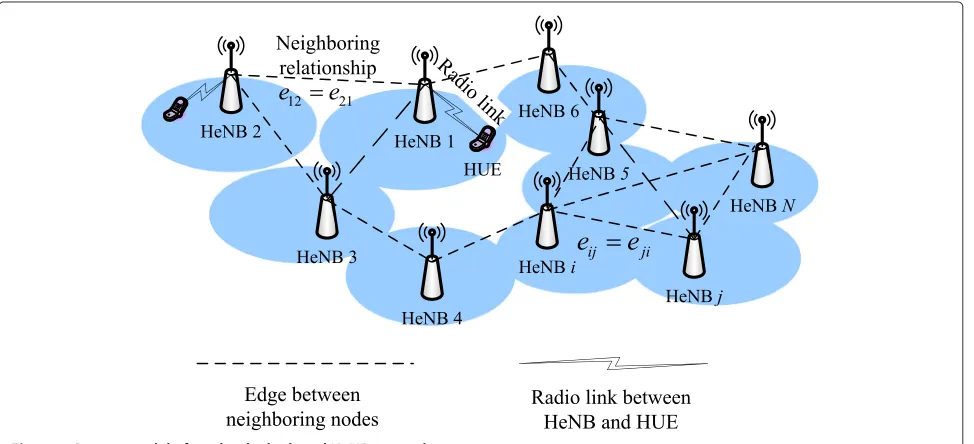
In Figure 1, a HeNB network is depicted as an undirected
graphG(υ,ε), where the set of HeNBs is denoted asυ =
{1, 2,. . .,N}andε⊂υ×υis the set of edges. With a given interference threshold, each HeNB maintains neighbor-ing relationships with other nodes, i.e, if the interference between two HeNBs exceeds the threshold, their neighbor relationships will be established. In this bipartite network,
an edge eil = eli ∈ ε denotes HeNB i and HeNB l
are neighbors, where i,l ∈ υ. Neighboring HeNBs can
exchange information with each other on this edge. For
simplicity, the neighbor set of HeNBi (including itself )
is defined as subsetNi, and the corresponding
cardinal-ity isNi = |Ni|. Each HeNB is assumed to be equipped
withNt transmit antennas, while each home user
equip-ment (HUE) has a single receiving antenna. Both HeNBs and HUEs are randomly deployed, and the whole network works in time division duplex (TDD) mode. For HeNB
i, there areKi connected HUEs. Thus, the total number
of HUEs can be expressed asK = Ni=1Ki. Each HeNB
manages Q downlink channels, and the channel state
information (CSI) is assumed to be perfectly known by HUEs. All HUEs can reuse the same frequency resource, and the received signalyi,j(q)at thejth HUE served by the
ith HeNB onqth channel is given by:
yi,j(q)=
pi,j(q)hiH,i,j(q)wi,j(q)si,j(q)+zi,j(q)
+Ki
l=j
pi,l(q)hHi,i,j(q)wi,l(q)si,l(q)
+ Ni
m=i Km
n
pm,n(q)hHm,i,j(q)wm,n(q)sm,n(q),
(1)
whereqis the channel index,pi,j(q)is the transmit power
sent from theith HeNB to thejth HUE on theqth channel,
wi,j(q)∈CNt×1represents the corresponding beamform-ing vector, hm,i,j(q) ∈ CNt×1 is the associated channel
between the mth HeNB and thejth HUE served by the
ith HeNB, andzi,j(q)is the additive white Gaussian noise with the varianceEzi,j2
=σ2
n.
The downlink WSRMax problem with power constrains is generally defined as:
max
p,w N
i Q
q Ki
j log 1+γ
DL
i,j (q)
s.tQ
q Ki
j pi,j(q)≤Pmax, ∀i=1,. . .,N; trwHi,jwi,j
=1, pi,j(q)≥0,
∀i=1,. . .,N; ∀j=1,. . .,K; ∀q=1,. . .,Q,
(2)
where the downlink SINRγiDL,j (q)is:
γDL i,j (q)=
pi,j(q)hHi,i,j(q)wi,j(q) 2
σ2 n+
Ni m=1
Km
(m,n)=(i,j)pm,n(q)
hHm,i,j(q)wm,n(q) 2,
andPmaxis the upper bound of the total transmit power.
Problem (2) is proved to be an NP-hard problem, so it is very difficult to solve the beamforming vector directly.
3 Distributed algorithm derivation
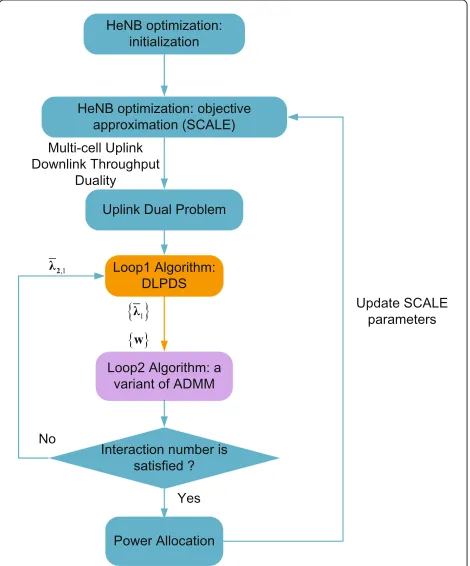
Due to the NP-hard feature of the WSRMax problem shown in (2), the global optimal cannot be guaran-teed [1]. We sequentially try to solve problem (2) with a lower bound approximation. Nevertheless, the lower bound approximation is still non-convex for the coupled beamforming vectors in the individual HeNB objective function. Furthermore, we transform the approximation into a virtual uplink structure with the uplink-downlink throughput duality. Because virtual uplink problem can be transformed into log-sum-exp (LSE) convex problem, it can be solved more efficiently. Moreover, the downlink beamforming vector can be updated with a low complex-ity Rayleigh-Ritz quotient criterion. Based on the max-min virtual uplink problem, we first apply DLPDS into Loop1 and propose a new distributed iteration scheme in Loop2 with the complete proof. After that, each HeNB not only obtains the downlink beamforming vectors for its HUEs but also calculates the feasible optimal downlink SINR as a result of the strong duality. With the feasi-ble downlink SINR, each HeNB can assign the downlink transmit power easily. For the clarity of the exposition, the proposed algorithm is denoted as distributed joint power, channel, and beamforming optimization (DJPCBO), and the structure is shown in Figure 2.
3.1 SCALE approximation of virtual dual uplink problem
As shown in [22], a lower bound approximation of log(1+
z)is presented as follows:
log(1+z)≥αlog(z)+β,
optimal valuez∗of the lower bound is found, parameters
α,β can be updated according toz0 = z∗. Based on (3),
the network sum-rate can be relaxed as:
max
Lemma 1. The Lagrangian dual problem of multi-cell multi-user downlink beamforming problem can be defined as: variables associated with power constraint C4. Therefore, the dual problem can be interpreted as a virtual uplink problem whereλ1¯ is the virtual uplink transmit power, and
¯
λ2is the virtual uplink thermal noise. The strong duality is held between(4)and(5); consequently, the downlink and dual uplink problem can achieve the same optimal point.
The proof of Lemma 1 is presented in Appendix A. Since the HeNB network is assumed to work in TDD mode where the uplink and downlink channels are recip-rocal, the downlink channel information can be estimated via uplink measurement. When the optimal variables
In the following subsections, we will implement Loop1 algorithm to the maximization process and design Loop2 algorithm to figure out the minimization procedure.
3.2 Loop1 design: uplink power and beamforming optimization
In Loop1, the maximization problem about the virtual
uplink powerλ¯1and the beamforming vectorwunder the
fixed virtual noiseλ¯2can be interpreted as:
max
function. Nevertheless, it can be transformed into a LSE problem, which is known as geometric programming [23], by substitutingλ¯1,i,j(q)=exi,j(q).
The constraint C3 can be deemed as the global
con-straint which is copied across HeNBs according to DLPDS
algorithm. Furthermore, it can be observed thatx∈CK×Q
is a global variable coupling among different objective
functions and the constraint C3 in (8). The Lagrangian
function of (8) can be expressed as:
L(x,y)=N
i Li(x,y), (9)
with the individual Lagrangian function of HeNBi
where yis the Lagrange multiplier associated with the
global constraintC3in (8). With the above discussion, the
DLPDS can be applied into (9) as follows:
⎧
ating with the Lagrangian multiplieryj(k)at thekth
itera-tion.φ (k)is the diminishing step size with the increasing
iterationk. A fast linear non-negative weightaij(satisfying
1Ta =1T,1a =1,1∈CN×1) is adopted to approach the
average(1/N)jN=1xj(k)such that HeNBs only
commu-nicate with their neighbors.PXandPY denote Euclidean
projection onto set X = {x|xi,j(q) ≤ log(NPmax),i =
DLPDS algorithm can converge to the global optimal state
such that each HeNBican obtain the optimal matrixxvia
the consensus process. After obtaining the optimal uplink power, the optimal beamforming vector can be achieved
according to quasiconcave Rayleigh-Ritz quotient pro-gramming regardless of strong duality [18-20]:
w∗i,j(q)∝
where vmax(·) is the dominant eigenvector that
corre-sponds to the maximum eigenvalue of the inner matrix. With the relevant channel information, beamforming vec-tor can be updated with the low complexity linear
oper-ation according to (12). The convergence betweenxand
win Loop1 can be interpreted by the block coordinate
descent theory (P271 [24]). As shown in (10), HeNBionly
needs to share matrixxiand Lagrange multiplierywithin
its subset.
3.3 Loop2 design: uplink noise optimization
The aim of Loop2 algorithm is to optimize the virtual noiseλ¯2under fixedλ¯∗1andw∗which are outputted from
Loop1 by solving the underlying minimization problem with the closed subsetχi = λ¯2,i0≤ ¯λ2,i≤Nσn2
represents a local objective function of
HeNBiand is given by:
The convexity of fi
¯
λ2,i
can be proved by checking its positive Hessian matrix, and the pointwise sum of a convex function is still convex. The coupling constraint
C4 and separable structure of (13) prompt us to apply
distributed alternating direction method of multipliers (ADMM) algorithm [25] into its dual problem. The dual problem of (13) can be explicitly expressed as:
wheregi(y)= min
is the dual
prob-lem of (13) with Lagrange multiplier y, and ci
¯
artificial parameter{zi}is introduced into (14) as a copy of
y. Then, the following equivalent form is derived.
max
We aim to design a distributed algorithm to solve the separable convex programming given by (13). To facilitate the derivation of the proposed algorithm, the neighbors
of HeNBiare partitioned into two sets, which are called
predecessors and successors. The set of predecessors of
HeNBiincludes the neighbors whose indexes are smaller
thani, i.e.,P(i) = {l|eli ∈ ε,l < i}, and the cardinality
is |P(i)| = Pi. The set of successors of HeNB i
con-sists of the neighbors with the indexes which are larger thani, i.e.,S(i) = {l|eil ∈ ε,i < l}with the cardinality
|S(i)| = Si. Then, we apply the distributed ADMM to the
dual function shown in (15), and we obtain (16).
⎧
In the distributed ADMM algorithm, the dual
vari-able λil with the constraint zi = zl on edge is defined.
Each HeNBi only own the dual variableλmi form < i
and updates the dual variable. Nevertheless, the optimal {¯λ2,i}{i=1,...,N} are the objectives that we concern about,
and the next lemma reveals the connection betweenλ¯2,i
andzi.
Lemma 2.Let (16a) be satisfied, then λ¯k2,+i1 can be uniquely attained by solving the following convex problem:
¯
where Aiand Biare defined as follows: ⎧
The proof is given in Appendix B. Lemma 2 indicates
that each HeNB can update its ownλ¯2,i by executing the
ameliorated distributed ADMM algorithm. In order to gain further insight of the new algorithm, we summarized the proposed algorithm as follows.
Algorithm 1Distributed ADMM with coupling constraint
1: Initialization:each HeNB chooses an arbitraryz0i for
i=1,. . .,N.
2: Fork≥0,
a Each HeNBi executes the iteration in a sequential order and gathers information from neighbors according toAiandBi.
b HeNBi updatesλ¯k2,iandzki with
As shown in Algorithm 1, HeNBs execute the update
process in a sequential way, i.e., at iteration k, HeNB i
updates before HeNBlifl∈S(i). In order to calculateAi andBi, HeNBihas to receive the informationzkl,λkilfrom
l∈S(i), and gatherzlk+1froml∈P(i), respectively. In fact,
the analysis in this proposed algorithm can be extended to the case wherefi(·)andci(·)are multi-dimensional
func-tions. Meanwhile, the coupling constraintci(·)is convex
3.4 Power allocation strategy
Of particular interest is the fact that each HeNB can calcu-late its own uplink SINRγiUL*,j (q)by acknowledgingλ¯∗1,λ¯∗2
andw∗. Due to the strong duality, the underlying equality
is established:
p∗i,j(q)hHi,i,j(q)w∗i,j(q)2
γi,j(q)
− Ni
m=1
Km
(m,n)=(i,j)
p∗m,n(q)hHm,i,j(q)w∗m,n(q)2=σn2.
(19)
In order to acquire the power, we define the underlying vectors:
⎧ ⎪ ⎨ ⎪ ⎩
p∗i (q)=p∗i,1(q),p∗i,2(q),· · ·,p∗i,Ki(q)T,
p∗(q)= p∗1(q)T,p∗2(q)T,· · ·,p∗N(q)TT. (20)
Based on (19) and (20), the downlink power can be obtained by taking the inverse of the following matrix
F(q).
p∗(q)=F−1(q)1σn2, (21)
where1∈CK×1is all-ones vector andF(q)∈CK×K is:
F(q)=
⎡ ⎢ ⎢ ⎢ ⎣
F11(q) F12(q) · · · F1N(q)
F21(q) F22(q) · · · F2N(q)
..
. ... . .. ...
FN1(q) FN2(q) · · · FNN(q)
⎤ ⎥ ⎥ ⎥
⎦, (22)
where thej,nth entry of sub-matrixFim(q)∈CKi×Kmis
defined as:
Fimjn (q)=
⎧ ⎪ ⎪ ⎪ ⎪ ⎪ ⎪ ⎪ ⎪ ⎪ ⎪ ⎪ ⎨ ⎪ ⎪ ⎪ ⎪ ⎪ ⎪ ⎪ ⎪ ⎪ ⎪ ⎪ ⎩
hHi,i,j(q)w∗i,j(q)2
γUL*
i,j (q)
,m=iandn=j
−hHi,i,j(q)w∗i,n(q)2,m=iandn=j
−hHm,i,j(q)w∗m,n(q)2,m=ibutm∈Ni 0, others.
(23)
3.5 Distributed algorithm
As discussed above, the proposed DJPCBO algorithm is summarized in Algorithm 2. The outer circle is the succes-sive convex approximation process. Loop1 and Loop2 are
executed to find the optimalγiUL,j ∗of each approximated
problem. With the optimal virtual uplink SINR γiUL,j ∗ of
each approximate problem, parameters α andβ can be
updated according to (3) and (6).
Algorithm 2DJPCBO algorithm
1: Initialization:
(a) HUEs measure downlink signal channel and interference channel from other HeNBs in their subsets and send measure reports to their serving HeNBs. HeNBs initialize the downlink transmit power and beamforming vector.
(b) HeNBs calculate virtual uplink SINR for target HUEs and initialize SCALE parametersαandβaccording to zij0(q)=γiDL,j (q).
2: forkouter=1,. . ., SCAmaxdo SCAmax: SCALE iteration num
3: forkinner=0,. . ., Altmaxdo Altmax: Loop1 and Loop2 alternative num 4: ifkinner==0then
5: HeNBiinitializesλ¯2,i
and implements Loop1 algorithm.
6: else
7: HeNBiloadsλ¯∗2,ifrom Loop2 and implements Loop1 algorithm.
8: end if
9: HeNBiloadsλ¯∗1,{w∗}from Loop1 and executes Loop2 algorithm.
10: end for
It is noted that this proposed algorithm successfully
updates λ¯1, w, and λ¯2 by using the alternating
opti-mization (AO) principle. Through checking the positive Hessian matrix, for any fixedλ¯1,w,f
¯
λ2|¯λ1,w
is convex. Therefore, according to the pointwise maximum prop-erty [26], f(λ¯2) = maxλ1,wf(λ¯2,λ¯1,w) is still convex,
which is also adopted in the convergence proof of [19] (its Appendix B). By developing AO, we can search the saddle
point by optimizingλ¯2while keeping the rest unchanged
and vice versa.
4 Numerical results
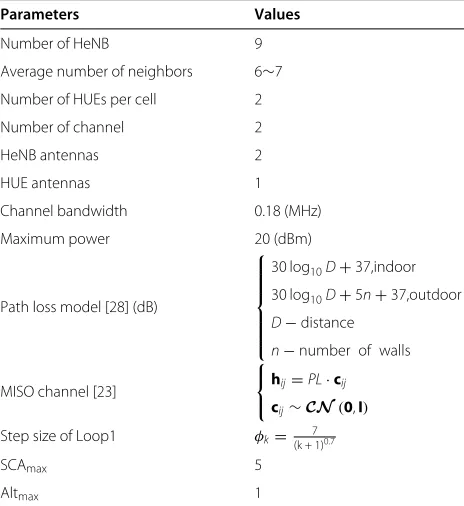
Extensive simulations are conducted to evaluate the per-formance of the proposed algorithm in this section, and the detailed configurations of involved system parameters are presented in Table 1.
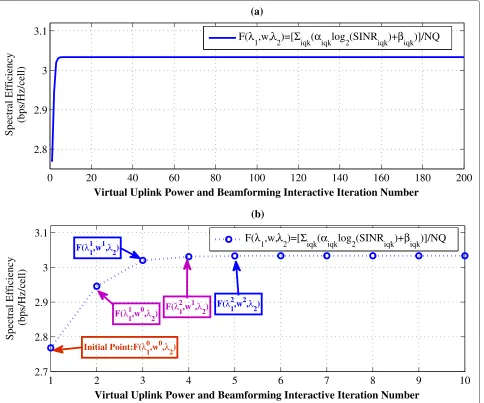
The alternative optimization process of the virtual uplink transmitting power and beamforming in Loop1 is presented in Figure 3. Apparently, the convergence of the optimization process is fast and stable as shown in Figure 3a. In Figure 3b, the detailed convergence process for the first ten iterations is shown more clearly, which demonstrates that the objective function in Loop1 can be promoted effectively by optimizing virtual uplink power (purple block) and beamforming vector (blue block) in turn. Therefore, it could be deduced that a large number of alternative updating processes are not necessary. Specifi-cally, it is enough to set the alternative num as 1 or 2, and the reason will be interpreted later.
Table 1 Parameter configuration
Parameters Values
Number of HeNB 9
Average number of neighbors 6∼7
Number of HUEs per cell 2
Number of channel 2
HeNB antennas 2
HUE antennas 1
Channel bandwidth 0.18 (MHz)
Maximum power 20 (dBm)
Path loss model [28] (dB)
⎧ ⎪ ⎪ ⎪ ⎪ ⎪ ⎨ ⎪ ⎪ ⎪ ⎪ ⎪ ⎩
30 log10D+37,indoor
30 log10D+5n+37,outdoor
D−distance n−number of walls
MISO channel [23]
⎧ ⎨ ⎩
hij=PL·cij
cij∼CN(0,I)
Step size of Loop1 φk=(k + 1)70.7
SCAmax 5
Altmax 1
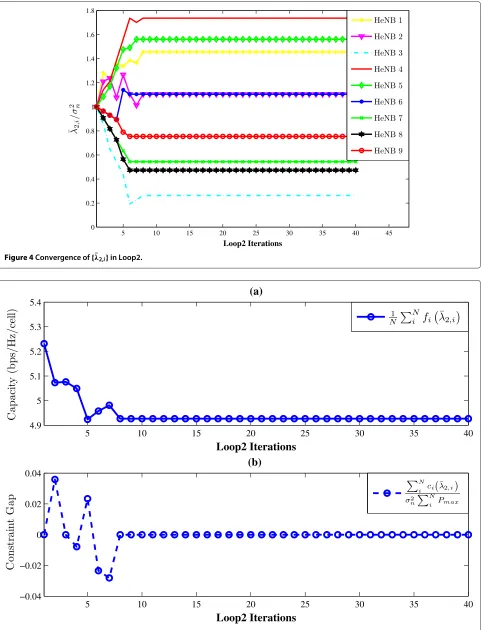
As shown in Figure 4, each HeNB can converge to its own optimal state by executing the Loop2 of the proposed algorithm with local individual action. In other words, with the application of the distributed ADMM to the dual
problem (15), each HeNB can find its own optimal λ¯2,i
by using Lemma 2. In Figure 5a, it proves that the con-vex problem (13) can converge to the optimal state by a few iterations. Furthermore, the inequality constraint gap
measured by N
ici(λ¯2,i)
σ2
n
N
iPmax will converge to zero as shown in
Figure 5b. This can be interpreted thatfi(λ¯2,i)is a
decreas-ing function for each λ¯2,i, and each HeNB aims to find
its own λ¯2,i as large as possible, while not violating the
coupling constraintNi ci ¯
λ2,i
≤0.
From Figure 6a, it demonstrates that the average spec-tral efficiency of each cell converges rapidly with the alternative iteration process of Loop1 and Loop2. And the detail of the first 20 alternative iterations is shown in Figure 6b. We can see that the Loop1 represented by blue block has successfully maximize problem (8), and the Loop2 indicated by purple block has accomplished the minimization procedure of (13). Through alternatively manipulating the two loops, the lower bound of network capacity can converge to a saddle point which is equal to the optimal point of (4). Because the accuracy of the solution of approximated problem (5) is irrelevant with the original problem, it is more beneficial to refine the successive approximation often, rather than solving the approximated problem (5) to a high accuracy. As a result, it is not necessary to alternatively execute the Loop1 and Loop2 for many times.
From Figure 7, it is obvious that the average spectral effi-ciency can be improved remarkably and converge to a sta-ble state with the increase of the SCALE iteration number. Furthermore, a larger number of cooperating neighbors will improve the DJPCBO performance. Because a larger cooperating set means that each HeNB with stronger measurement capability can monitor more interference sources, and the more precise SINR term can be obtained. However, the cooperating overhead will increase with the number of cooperating neighbors in each set. In addition, the average network spectral efficiency under the pro-posed DJPCBO algorithm is compared with that under the following two non-cooperating beamforming techniques in Figure 8.
1) Channel-matched (CM) beamforming: the
beamforming vectors matched to the users’ channel are selected without considering intra-cell and inter-cell interference, i.e.,
wi,j(q)= )
Pmax KiQ
Figure 3Alternative update of virtual uplink power and beamforming.(a)First 200 iterations.(b)First 10 iterations.
2) Intra-cell zero-forcing (ICZF) beamforming: the set of beams is designed so as to eliminate intra-cell interference, i.e.,
wi,j(q)=δi,j(q) )
Pmax KiQ
⎛ ⎝Ki
l
hi,i,l(q)hHi,i,l(q) ⎞ ⎠
−1
hi,i,j(q)
As shown in Figure 8, the CM strategy is not a good choice in multi-cell multi-antenna scenario, for the poor average network capacity resulted from ignoring the co-channel interference. Comparatively, ICZF scheme is better than the CM strategy by utilizing orthogonal beamforming vec-tors in single cell. However, its capability is still limited. Due to that the proposed DJPCBO takes the inter-cell interference into account, much gain can be achieved from the coordination among HeNBs. Thus, it validates that the proposed DJPCBO algorithm outperforms the
two existing benchmark techniques a lot. Moreover, we also compare the DJPCBO algorithm with the cooperating strategy ICBF [13], under the same initial beamforming state, and we have found DJPCBO is better than ICBF algorithm. It is worth noting that the initial beamform-ing state will affect the algorithm performance due to the nature of SCALE approximation [22], i.e., a good initial state presents an excellent gain. We consequently choose the ICZF strategy as the initial state in the simulation.
Figure 4Convergence of{¯λ2,i}in Loop2.
Figure 6Convergence of Loop1 and Loop2 with alternatively updating.(a)First 200 iterations.(b)First 20 iterations.
because the quality of service (QoS) has not been taken into account. In our future works, the QoS guarantee will be considered as an additional constraint.
5 Conclusions
In this paper, the NP-hard WSRMax problem in multi-ple input single output (MISO) HeNB network is studied. With an ameliorated max-min multi-cell uplink-downlink throughput duality, a distributed algorithm based on two loops is proposed to solve this problem. In Loop1, we apply DLPDS algorithm to solve the virtual uplink pro-gramming. Furthermore, we propose a new iteration scheme to optimize the virtual noise problem with sepa-rable structure in Loop2. Numerical results show the two loops can converge to a stable state, and the network per-formance is dramatically improved with the coordinations among HeNBs. Thus, it can be seen that multi-cell uplink-downlink throughput duality is a powerful tool to solve
WSRMax problem. In the future, we will apply this tool into multi-input multi-output scenarios and take the QoS into consideration.
Appendix A: proof of Lemma 1
The proof of Lemma 1 is similar with the proof in [18], and we provide it here for completeness reason. The primal problem (1) can be reformulated into an equivalent form:
⎧ ⎪ ⎪ ⎪ ⎪ ⎪ ⎪ ⎪ ⎪ ⎨ ⎪ ⎪ ⎪ ⎪ ⎪ ⎪ ⎪ ⎪ ⎩
max p,w
N i
Q q
Ki
j
αi,j(q)log2
γi,j(q)
+βi,j(q)
s.t C1: γi,j(q)≤
pi,j(q)hHi,i,j(q)wi,j(q)
2
σ2
n+
Ni
m=1
Km
(m,n)=(i,j)pm,n(q)
hH
m,i,j(q)wm,n(q)
2
C2:
Q q
Ki
j pi,j(q)≤Pmax
C3: pi,j(q)≥0 ∀i,i=1,. . .N;∀q,q=1,. . .Q;∀j,j=1,. . .K,
Figure 7System performance with the increasing SCALE iteration.
Figure 9Spectral efficiency performance for HeNBs 1 to 9.
where γi,j(q) is the lower bound of downlink SINR. By
rearranging the C1 constraint in (24), the Lagrangian
function is given by:
L(γ,p,w,λ1,λ2,λ3)
=Ni QqKi
j
αi,j(q)log2
γi,j(q)+βi,j(q)
−Ni QqKi
j λ1,i,j(q)
⎛ ⎜
⎝Kl=ijpi,l(q)hHi,i,j(q)wi,l(q) 2
+ Ni
m=i Km
n
pm,n(q)hHm,i,j(q)wm,n(q) 2
− pi,j(q)
hHi,i,j(q)wi,j(q) 2
γi,j(q) +σ 2 n
⎞ ⎟ ⎠
−N
i λ2,i
,Q q
Ki
j pi,j(q)−Pmax
-+Ni QqKi
j λ3,i,j(q)pi,j(q),
(25)
where {λ1},{λ2},{λ3} are the Lagrangian multipliers
associating with constraint C1,C2,C3, respectively. The
following equality can be obtained by rearranging (25):
L(γ,p,w,λ1,λ2,λ3)
= N
i Q
q Ki
j
αi,j(q)log2
γi,j(q)
+βi,j(q)
− N
i Q
q Ki
j
λ1,i,j(q)σn2+ N
i λ2,iPmax
+Ni QqKi
j pi,j(q) &
λ1,i,j(q)wHi,j(q)hi,i,j(q)
2
−Ni
m Km
n λ1,m,n(q)
wHi,j(q)hi,m,n(q)
2
+ λ1,i,j(q)
wHi,j(q)hi,i,j(q)
2
γi,j(q) −λ2,i+λ3,i,j(
q)
'
.
(26)
The corresponding dual objective problem can be expressed as:
g(λ1,λ2,λ3)= max
γ,p,{w}L(γ,p,w,λ1,λ2,λ3).
According to the KKT condition,∂p∂L
With (27) and (28), the dual problem can be explicitly expressed as: tion in (29) can be moved into the constraint set by
introducing a Lagrange multiplierχ, and the equivalent
problem is: is presented as follows:
⎧
and the equivalent dual problem can be stated as
⎧
χcan be considered as a dual multiplier of the constraint
N
Pmax ≤0, and for other fixed variables,
optimization overλ¯2,iis a convex problem that guarantees
strong duality. By changing (32) as primal problem over ¯
λ2,i with a constraint, the corresponding equivalent dual
problem is:
Since the optimization is met with equality for fixed γi,j(q),λ¯2,i,wi,j(q), reversal of the SINR constraint and the
reversal of theC1 minimization as a maximization over
¯
λ1,i,j(q) do not change the optimization problem. Thus,
the modified dual problem can be stated as:
⎧
Moreover, as the virtual uplink sum power {λ1,i,j} is
upper bounded by real downlink powerPmax, and
accord-ing to the duality theory [26], the optimal value of the dual objective function is lower bounded by the maximum value of the primal maximization problem (4). The strong duality is analyzed in [18] and is further applied in [19] successfully.
Appendix B: proof of Lemma 2
We substitutegi(·)into (16a) withzi=yand obtain:
If the solution set is non-empty and bounded, then the function fi(·), ci(·) and the set χi have no direction of recession in the sense of ([27], p. 61 and p. 69). It can be
deduced that the convex function K(·,zi) has no
direc-tion of recession of for anyzi ≥0, while the convex
func-tion −Kλ¯2,i,·
has no direction of recession for any ¯
Moreover, since the value of the saddle point will not change by adding constant terms, we could obtain:
max
Consequently, for fixed anyλ¯2,i, the maximum on the
right side of (41) is uniquely attained by:
zi=max
We substitute (39) into the right side of (38) to eliminate
zi. Due to (39) is a piecewise function, two cases need to
be considered respectively: Case 1: ifzi=0, we obtain:
We substitute (42) (43) into (38) and obtain:
¯
We complete the proof by taking (40) and (44) into con-sideration jointly.
Competing interests
Acknowledgments
This work is supported by the 863 Project under grant 2014AA012107, the National Natural Science Foundation of China (NSFC) under grant 61471347, the International S&T Cooperation Program of China under grant
2012DFG11580, and the National Science and Technology Major Project under grant 2015ZX03001032.
Author details
1Key Lab of Wireless Sensor Network & Communication, Shanghai Institute of
Microsystem and Information Technology (SIMIT), Chinese Academy of Sciences (CAS), 10/F No.5 Building, 865 Chang Ning Road, Shanghai 200050, People’s Republic of China.2Shanghai Research Center for Wireless
Communications, 4/F No.8 Building, 100 Haike Road, Pudong District, Shanghai 201210, China People’s Republic of China.3University of Chinese
Academy of Sciences, 100049 Beijing, People’s Republic of China.
Received: 6 June 2014 Accepted: 2 March 2015
References
1. M Hong, ZQ Luo, Chapter 8 - Signal Processing and Optimal Resource Allocation for the Interference Channel. Academic Press Library in Signal Processing.2(3), 409–469 (2014)
2. C Kosta, B Hunt, AU Quddus, R Tafazolli, On interference avoidance through inter-cell interference coordination (ICIC) based on OFDMA mobile systems. IEEE Commun. Surveys Tutorials.15(3), 973–995 (2013) 3. X Tao, X Xu, Q Cui, An overview of cooperative communications. IEEE
Commun. Mag.50(6), 65–71 (2012)
4. Y Wang, W Feng, L Xiao, Y Zhao, S Zhou, Coordinated multi-cell transmission for distributed antenna systems with partial CSIT. IEEE Commun. Lett.16(7), 1044–1047 (2012)
5. H Tuy, Monotonic optimization: problems and solution approaches. SIAM J. Optimization.11(2), 464–494 (2006)
6. M Codreanu, A Tolli, M Juntti, M Latva-aho, Joint design of Tx-Rx beamformers in MIMO downlink channel. IEEE Trans. Signal Process. 55(9), 4639–4655 (2007)
7. G Zheng, K-K Wong, T-S Ng, Throughput maximization in linear multiuser MIMO-OFDM downlink systems. IEEE Transactions on Vehicular Technology.57(3), 1993–1998 (2008)
8. Y Huang, G Zheng, M Bengtsson, K-K Wong, L Yang, B Ottersten, Distributed multicell beamforming design approaching Pareto boundary with max-min fairness. IEEE Transactions on Wireless Communications. 11(8), 2921–2933 (2012)
9. S Boyd, J Mattingley, Branch-and-bound methods (2007). available online: http://see.stanford.edu/materials/lsocoee364b/17-bb_notes.pdf 10. A Agustin, J Vidal, O Munoz-Medina, JR Fonollosa, inProceedings of 2011
IEEE GLOBECOM Workshops (GC Wkshps). Decentralized weighted sum rate maximization in MIMO-OFDMA femtocell networks (IEEE, Houston, 2011), pp. 270–274
11. S-H Park, H Park, I Lee, Distributed beamforming techniques for weighted sum-rate maximization in MISO interference channels. IEEE
Communications Letters.14(12), 1131–1133 (2010)
12. M Rossi, AM Tulino, O Simeone, AM Haimovich, in2011 IEEE International Conference on Acoustics, Speech and Signal Processing (ICASSP). Non-convex utility maximization in Gaussian MISO broadcast and interference channels (IEEE, Prague, 2011), pp. 2960–2963 13. L Venturino, N Prasad, X Wang, Coordinated linear beamforming in
downlink multi-cell wireless networks. IEEE Transactions on Wireless Communications.9(4), 1451–1461 (2010)
14. M Razaviyayn, M Hong, ZQ Luo, A unified convergence analysis of block successive minimization methods for nonsmooth optimization. SIAM Journal on Optimization.23(2), 1126–1153 (2013)
15. Y-F Liu, Y-H Dai, Z-Q Luo, Coordinated beamforming for MISO interference channel: complexity analysis and efficient algorithms. IEEE Transactions on Signal Processing.59(3), 1142–1157 (2011)
16. Q Shi, M Razaviyayn, Z-Q Luo, C He, An iteratively weighted MMSE approach to distributed sum-utility maximization for a MIMO interfering broadcast channel. IEEE Transactions on Signal Processing.59(9), 4331–4340 (2011)
17. PC Weeraddana, M Codreanu, M Latva-aho, A Ephremides, Multicell MISO downlink weighted sum-rate maximization: a distributed approach. IEEE Transactions on Signal Processing.61(3), 556–570 (2013)
18. J Yang, D-K Kim, Multi-cell uplink-downlink beamforming throughput duality based on Lagrangian duality with per-base station power constraints. IEEE Communications Letters.12(4), 277–279 (2008) 19. S He, Y Huang, L Yang, A Nallanathan, P Liu, A multi-cell beamforming
design by uplink-downlink max-min SINR duality. IEEE Transactions on Wireless Communications.11(8), 2858–2867 (2012)
20. F Huang, Y Wang, J Geng, D Yang, Multi-cell optimal downlink beamforming algorithm with per-base station power constraints. Wireless Personal Communications.62(4), 893–906 (2012)
21. M Zhu, S Martinez, On distributed convex optimization under inequality and equality constraints. IEEE Transactions on Automatic Control.57(1), 151–164 (2012)
22. L Venturino, N Prasad, X Wang, inCISS 2008. 42nd Annual Conference on information Sciences and Systems. A successive convex approximation algorithm for weighted sum-rate maximization in downlink OFDMA networks (IEEE, Princeton, 2008), pp. 379–384
23. M Chiang, C-W Tan, DP Palomar, D O’Neill, D Julian, Power control by geometric programming. IEEE Transactions on Wireless Communications. 6(7), 2640–2651 (2007)
24. DP Bertsekas,Nonlinear Programming. (Athena Scientific, Belmont, MA, 1999)
25. E Wei, A Ozdaglar, inProceedings of 2012 IEEE 51st Annual Conference on Decision and Control (CDC). Distributed alternating direction method of multipliers (IEEE Maui, 2012), pp. 5445–5450
26. SP Boyd, L Vandenberghe,Convex Optimization. (Cambridge university press, University Printing House, UK, 2004)
27. RT Rockafellar,Convex Analysis. (Princeton University Press, Princeton, NJ, 1997)
28. Alcatel-Lucent, picoChip Design, Vodafone, R4-092042: Simulation assumptions and parameters for FDD HeNB RF requirements. 3GPP TSG RAN WG4 Meeting #51 (2009)
Submit your manuscript to a
journal and benefi t from:
7 Convenient online submission
7 Rigorous peer review
7 Immediate publication on acceptance
7 Open access: articles freely available online
7 High visibility within the fi eld
7 Retaining the copyright to your article