Open Access
Short report
Evidence for a novel coding sequence overlapping the 5'-terminal
~90 codons of the Gill-associated and Yellow head okavirus
envelope glycoprotein gene
Andrew E Firth*
1and John F Atkins*
1,2Address: 1BioSciences Institute, University College Cork, Cork, Ireland and 2Department of Human Genetics, University of Utah, Salt Lake City,
UT 84112-5330, USA
Email: Andrew E Firth* - [email protected]; John F Atkins* - [email protected] * Corresponding authors
Abstract
The genus Okavirus (order Nidovirales) includes a number of viruses that infect crustaceans, causing major losses in the shrimp industry. These viruses have a linear positive-sense ssRNA genome of ~26-27 kb, encoding a large replicase polyprotein that is expressed from the genomic RNA, and several additional proteins that are expressed from a nested set of 3'-coterminal subgenomic RNAs. In this brief report, we describe the bioinformatic discovery of a new, apparently coding, ORF that overlaps the 5' end of the envelope glycoprotein encoding sequence, ORF3, in the +2 reading frame. The new ORF has a strong coding signature and, in fact, is more conserved at the amino acid level than the overlapping region of ORF3. We propose that translation of the new ORF initiates at a conserved AUG codon separated by just 2 nt from the ORF3 AUG initiation codon, resulting in a novel 86 amino acid protein.
Findings
The genus Okavirus belongs to the family Roniviridae in the order Nidovirales. Members include Gill-associated virus (GAV) and Yellow head virus (YHV), both of which infect
Penaeus monodon shrimp. GAV and YHV are currently clas-sified as two of six or more genotypes of the single species
Gill-associated virus or the Yellow head complex. As with other members of the order Nidovirales, these viruses have a linear positive-sense ssRNA genome encoding a large replicase polyprotein that is expressed from the genomic RNA (ORF1a and, via ribosomal frameshifting, an ORF1aORF1b fusion product), and a number of other proteins -including the structural proteins - which are translated from a nested set of 3'-coterminal sub-genomic RNAs [1-4]. In the case of the okaviruses, the 3' ORFs encode a polyprotein (ORF3; ~1650 codons) that is cleaved to
pro-duce three mature proteins (envelope glycoproteins gp116 and gp64, and an ~25 kDa N-terminal fragment), a nucleocapsid (ORF2; ~145 codons), and possibly an addi-tional short ORF (ORF4) encoded by the sequence 3' of ORF3 (Figure 1A) [4-10].
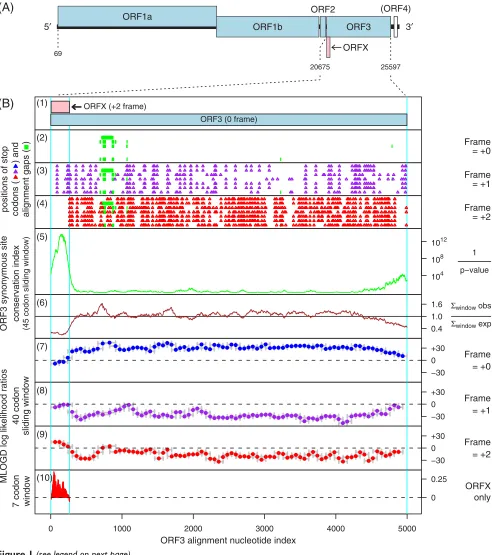
Overlapping genes are common in RNA viruses where they serve as a mechanism to optimize the coding poten-tial of compact genomes. However, annotation of over-lapping genes can be difficult using conventional gene-finding software [11]. Recently we have been using a number of complementary approaches to systematically identify new overlapping genes in virus genomes [11-15]. When we applied these methods to the okaviruses, we found strong evidence for a new coding sequence - hereaf-ter ORFX - overlapping the 5'-hereaf-terminal 88 codons of ORF3 Published: 17 December 2009
Virology Journal 2009, 6:222 doi:10.1186/1743-422X-6-222
Received: 1 October 2009 Accepted: 17 December 2009
This article is available from: http://www.virologyj.com/content/6/1/222
© 2009 Firth and Atkins; licensee BioMed Central Ltd.
Figure 1 (see legend on next page)
(A)
5′ 3′
ORFX
20675 25597
69
ORF1a
ORF1b
ORF2
ORF3
(ORF4)
(B)
ORF3 (0 frame) ORFX (+2 frame)
(1)
positions of stop codons ( ) and alignment gaps ( )
(2) Frame
= +0
(3) Frame
= +1
(4) Frame
= +2
ORF3 synonymous site
conservation index
(45 codon sliding window)
104 108 1012
(5)
1 p−value
0.4 1.0 1.6
(6) Σ
window obs
Σwindow exp
MLOGD log likelihood ratios
40 codon
sliding window
7 codon window
−30 0 +30
(7)
Frame = +0
−30 0 +30
(8)
Frame = +1
−30 0 +30
(9)
Frame = +2
0 1000 2000 3000 4000 5000 0 0.25
(10)
ORFX only
in the +2 reading frame (Figure 1). Here we describe the bioinformatic analyses.
Okavirus sequences in GenBank with full-length coverage of ORF3 were identified by applying tblastn [16] to the ORF3 amino acid sequence from one GAV isolate Bank:AF227196] and one YHV isolate [Gen-Bank:EU487200], resulting in the additional sequences [GenBank:EF156405], [GenBank:FJ848673], Bank:FJ194949], [GenBank:EU785042] and [Gen-Bank:EU785043]. The ORF3 regions were extracted, translated, aligned with CLUSTALW [17], and back-trans-lated to give a nucleotide sequence alignment for ORF3.
The alignment was analysed for conservation at synony-mous sites, as described in [15]. The procedure takes into account whether synonymous site codons are 1-, 2-, 3-, 4-or 6-fold degenerate and the differing probabilities of transitions and transversions. The analysis revealed a striking, and highly statistically significant (p < 10-21 for the total conservation within ORFX), peak in synonymous site conservation at the 5' end of ORF3 (Figure 1B, panels 5-6). Such conservation peaks are indicative of overlap-ping functional elements, though such elements may be either coding or non-coding. However, in this case, coin-ciding with the conserved region there was a conserved absence of stop codons in the +2 reading frame (Figure 1B; panel 4), thus suggesting an overlapping coding sequence in the +2 frame as a possible explanation for the enhanced conservation at ORF3-frame synonymous sites.
Inspection of an additional 33 sequences (FJ438530-FJ438532, FJ428584-FJ428613; [18]) with only partial coverage of ORF3, but nearly complete coverage of the ORFX region, again revealed the complete absence of +2 frame stop codons in ORFX. One further partial sequence, [GenBank:DQ978360], differed in having a single nucle-otide deletion ~15 codons into ORFX. The effect of this
deletion is to fuse the 5' end of ORFX with the down-stream ORF3: ribosomes initiating at the ORF3 initiation codon terminate early while ribosomes initiating at the ORFX initiation codon (see below) go on to translate an ORFX-ORF3 fusion. In fact, except for this deletion, the 717 nt DQ978360 is identical to the corresponding region of FJ848673, so it is possible that this deletion is simply due to a sequencing error or a defective sequence.
Given the short length of ORFX, conservation alone is per-haps not sufficient evidence for a coding assignment. Therefore, the alignment was also analysed with MLOGD - a gene-finding program which was designed specifically for identifying overlapping coding sequences, and which includes explicit models for sequence evolution in multi-ply-coding regions [11,12]. In contrast to the synonymous site conservation index above, MLOGD, when applied in the 'sliding window' mode, does not depend on the degree of conservation per se (the sequence divergence parameter is fitted independently for each window). When applied to the ORF3 alignment, MLOGD detected a strong coding signature for ORFX - with positively scor-ing windows throughout the ORFX region in the +2 frame - indicating directly that ORFX is indeed a coding sequence (Figure 1B, panel 9). In fact, the MLOGD score in the +2/ORFX frame within the ORFX region was signif-icantly greater than the score in the +0/ORF3 frame, indi-cating that the ORFX product is subject to stronger functional constraints than the product of the overlapping region of ORF3 (which indeed has a negative MLOGD score towards the 5'-terminal half of the ORFX region; Fig-ure 1B, panel 7). Consistently, a comparison of GAV AF227196 with YHV EU487200 showed that, in the region where ORFX and ORF3 overlap, ORFX has higher amino acid conservation than ORF3 (71/86 identities for ORFX, 62/86 identities for ORF3).
Coding potential statistics for okavirus ORF3 and the overlapping ORFX
Figure 1 (see previous page)
When MLOGD was applied in the 'test query ORF' mode (Figure 1B, panel 10), the number of independent base variations across the alignment within the ORFX region was calculated to be Nvar ~ 57, and the total MLOGD score was log(LR) ~ 33.0 (see [12] for details). Although MLOGD has a significant false negative rate (i.e. there are known overlapping genes that it fails to detect - particu-larly ones that are less conserved than the genes they over-lap), the false positive rate (with appropriate thresholds) is low. In particular, extensive tests with known single-coding and double-single-coding virus sequence alignments indicate that 'Nvar t 20' and 'log(LR) t × Nvar' signals robust detection (<1% false positive rate) of an overlap-ping same-strand CDS [12] (and unpublished data).
As of 27 Sep 2009, we located 11 okavirus sequences with coverage of the ORF3 initiation codon, 10 of which also included coverage of the ~35 nt ORF3 sgRNA 5'UTR [8]. Inspection of these sequences showed that all 11 pos-sessed a +2/ORFX-frame AUG codon downstream of, and separated by just 2 nt from, the ORF3 AUG initiation codon (Figure 2A). Both the ORF3-frame and ORFX-frame AUG codons generally have a 'G' at -3 and a pyrimi-dine at +4, resulting in a medium rather than strong Kozak context. In Turnip yellow mosaic tymovirus, the AUG initiation codons of the overlapping p69 and p206 coding sequences are also closely spaced (4 nt
separa-tion). In this case, it has been demonstrated with mutant sequences that, provided the two AUG codons are sepa-rated by not more than ~10 nt, the efficiency of initiation at the second AUG codon is greatly enhanced compared with the efficiency obtained for canonical leaky scanning (i.e. for greater separations) given the same Kozak con-texts [19]. Moreover, initiation is competitively coupled in the sense that mutation of the downstream AUG codon increases the efficiency of initiation at the upstream AUG codon, and vice versa. Thus, initiation at the okavirus ORFX-frame AUG codon is likely to be significantly more efficient than would be expected for normal leaky scan-ning. Only two of the 11 okavirus sequences have addi-tional upstream AUG codons (Figure 2A). EU785043 has an additional ORF3-frame AUG codon two codons upstream - apparently due to a duplication of the nucle-otides 'AUGCAA'. This does not affect our interpretation, however, since the proximity of the ORFX-frame AUG codon to the first ORF3-frame AUG codon (8 nt separa-tion) is within the bounds for the translation initiation coupling mechanism of Ref. [19]. EU785042, on the other hand, has an apparent duplication of the nucleotides 'AUGCA', resulting in an upstream AUG codon in-frame with neither ORF3 nor ORFX. Again all three AUG codons are separated by no more than 7 nt, thus presumably allowing efficient initiation on all three; however, the total number of ribosomes translating ORF3 and ORFX will be depleted due to those that initiate on the first AUG codon (31 codon ORF).
1 6
Nucleotide and amino acid sequence alignments
Figure 2
Nucleotide and amino acid sequence alignments. (A) Nucleotide alignment of the 5'-terminal region of the ORF3 sgRNA. All currently available and non-identical okavirus sequences with coverage of this region are shown. A further four sequences (DQ978360, FJ194949, FJ848673 and EF156405) are locally identical to EU487200. Genotype designations within the Yellow head complex are based on the ORF3 phylogeny of Ref. [18]. Spaces separate +0/ORF3-frame codons. All AUG codons are indicated in capitals. Colour coding is as follows: light blue - ORF3 initiation codon(s); green - proposed +2/ORFX-frame initiation codon; dark blue - upstream +1 +2/ORFX-frame AUG codon (31 codon ORF); orange - last upstream ORFX-+2/ORFX-frame stop codons. (B) Amino acid alignment of the translated ORFX for representative okavirus sequences.
Publish with BioMed Central and every scientist can read your work free of charge "BioMed Central will be the most significant development for disseminating the results of biomedical researc h in our lifetime."
Sir Paul Nurse, Cancer Research UK
Your research papers will be:
available free of charge to the entire biomedical community
peer reviewed and published immediately upon acceptance
cited in PubMed and archived on PubMed Central
yours — you keep the copyright
Submit your manuscript here: BioMedcentral Initiation at the proposed AUG codon would give ORFX
the nucleotide coordinates 20680..20937 in AF227196 (GAV) and 20990..21247 in EU487200 (YHV), resulting in an 86 amino acid product with a molecular mass of 10 kDa. The full predicted amino acid sequences are shown in Figure 2B. Application of blastp [16] to the amino acid sequences revealed no similar sequences in GenBank - as expected for a gene created de novo via out-of-frame 'over-printing' of a preexisting gene [20,21]. Application of InterProScan [22] predicted an N-terminal signal peptide/ transmembrane region, and an additional transmem-brane region comprising amino acids 34 to 54. Applica-tion of SignalP 3.0 [23] predicted an N-terminal signal anchor or signal peptide. If the latter, cleavage of the sig-nal peptide - mostly probably between residues 25 and 26 - would leave a 61 amino acid, 7.3 kDa ORFX product.
Overlapping genes are difficult to identify and are often overlooked. However, it is important to be aware of such genes as early as possible in order to avoid confusion (oth-erwise functions of the overlapping gene may be wrongly ascribed to the gene they overlap), and also so that the functions of the overlapping gene may be investigated in their own right. We hope that presentation of this bioin-formatic analysis will help fullfil these goals. Initial verifi-cation of ORFX product could be by means of immunoblotting with ORFX-specific antibodies.
Competing interests
The authors declare that they have no competing interests.
Authors' contributions
AEF carried out the bioinformatic analysis and wrote the manuscript. Both authors edited and approved the final manuscript.
Acknowledgements
This work was supported by National Institutes of Health Grant R01 GM079523 and an award from Science Foundation Ireland, both to JFA.
References
1. Cowley JA, Dimmock CM, Walker PJ: Gill-associated nidovirus of Penaeus monodon prawns transcribes 3'-coterminal subge-nomic mRNAs that do not possess 5'-leader sequences. J Gen Virol 2002, 83:927-935.
2. Gorbalenya AE, Enjuanes L, Ziebuhr J, Snijder EJ: Nidovirales: evolving the largest RNA virus genome. Virus Res 2006, 117:17-37.
3. Pasternak AO, Spaan WJ, Snijder EJ: Nidovirus transcription: how to make sense...? J Gen Virol 2006, 87:1403-1421.
4. Sittidilokratna N, Dangtip S, Cowley JA, Walker PJ: RNA transcrip-tion analysis and completranscrip-tion of the genome sequence of yel-low head nidovirus. Virus Res 2008, 136:157-165.
5. Cowley JA, Walker PJ: The complete genome sequence of gill-associated virus of Penaeus monodon prawns indicates a gene organisation unique among nidoviruses. Arch Virol 2002, 147:1977-1987.
6. Jitrapakdee S, Unajak S, Sittidilokratna N, Hodgson RA, Cowley JA, Walker PJ, Panyim S, Boonsaeng V: Identification and analysis of gp116 and gp64 structural glycoproteins of yellow head nido-virus of Penaeus monodon shrimp. J Gen Virol 2003, 84:863-873.
7. Cowley JA, Cadogan LC, Spann KM, Sittidilokratna N, Walker PJ: The gene encoding the nucleocapsid protein of Gill-associated nidovirus of Penaeus monodon prawns is located upstream of the glycoprotein gene. J Virol 2004, 78:8935-8941.
8. Wijegoonawardane PK, Cowley JA, Phan T, Hodgson RA, Nielsen L, Kiatpathomchai W, Walker PJ: Genetic diversity in the yellow head nidovirus complex. Virology 2008, 380:213-225.
9. Sittidilokratna N, Chotwiwatthanakun C, Wijegoonawardane PK, Unajak S, Boonnad A, Wangnai W, Jitrapakdee S, Cowley JA, Walker PJ: A virulent isolate of yellow head nidovirus contains a deformed envelope glycoprotein gp116. Virology 2009, 384:192-200.
10. Gangnonngiw W, Anantasomboon G, Sang-oum W, Sriurairatana S, Sritunyalucksana K, Flegel TW: Non-virulence of a recombinant shrimp nidovirus is associated with its non structural gene sequence and not a large structural gene deletion. Virology 2009, 385:161-168.
11. Firth AE, Brown CM: Detecting overlapping coding sequences with pairwise alignments. Bioinformatics 2005, 21:282-292. 12. Firth AE, Brown CM: Detecting overlapping coding sequences
in virus genomes. BMC Bioinformatics 2006, 7:75.
13. Chung BYW, Miller WA, Atkins JF, Firth AE: An overlapping essential gene in the Potyviridae. Proc Natl Acad Sci USA 2008, 105:5897-5902.
14. Firth AE, Chung BY, Fleeton MN, Atkins JF: Discovery of frameshifting in Alphavirus 6K resolves a 20-year enigma. Virol J 2008, 5:108.
15. Firth AE, Atkins JF: A conserved predicted pseudoknot in the NS2A-encoding sequence of West Nile and Japanese encephalitis flaviviruses suggests NS1' may derive from ribosomal frameshifting. Virol J 2009, 6:14.
16. Altschul SF, Gish W, Miller W, Myers EW, Lipman DJ: Basic local alignment search tool. J Mol Biol 1990, 215:403-410.
17. Thompson JD, Higgins DG, Gibson TJ: CLUSTAL W: improving the sensitivity of progressive multiple sequence alignment through sequence weighting, position-specific gap penalties and weight matrix choice. Nucleic Acids Res 1994, 22:4673-4680. 18. Wijegoonawardane PK, Sittidilokratna N, Petchampai N, Cowley JA, Gudkovs N, Walker PJ: Homologous genetic recombination in the yellow head complex of nidoviruses infecting Penaeus monodon shrimp. Virology 2009, 390:79-88.
19. Matsuda D, Dreher TW: Close spacing of AUG initiation codons confers dicistronic character on a eukaryotic mRNA. RNA 2006, 12:1338-1349.
20. Belshaw R, Pybus OG, Rambaut A: The evolution of genome compression and genomic novelty in RNA viruses. Genome Res 2007, 17:1496-1504.
21. Rancurel C, Khosravi M, Dunker KA, Romero PR, Karlin D: Over-lapping genes produce proteins with unusual sequence prop-erties and offer insight into de novo protein creation. J Virol 2009, 83:10719-10736.
22. Zdobnov EM, Apweiler R: InterProScan - an integration plat-form for the signature-recognition methods in InterPro. Bio-informatics 2001, 17:847-848.