LanguageCrawl: A Generic Tool for Building Language Models Upon
Common-Crawl
Szymon Roziewski, Wojciech Stokowiec
National Information Processing Institute Natural Language Processing Laboratory, Warsaw, Poland[email protected], [email protected]
Abstract
The web data contains immense amount of data, hundreds of billion words are waiting to be extracted and used for language research. In this work we introduce our toolLanguageCrawlwhich allows Natural Language Processing (NLP) researchers to easily construct web-scale corpus the from Common Crawl Archive: a petabyte scale open repository of web crawl information. Three use-cases are presented: filtering Polish websites, building N-gram corpora and training continuous skip-gram language model with hierarchical softmax. Each of them has been implemented within the LanguageCrawl toolkit, with the possibility to adjust specified language and N-gram ranks. Special effort has been put on high computing efficiency, by applying highly concurrent multitasking. We make our tool publicly available to enrich NLP resources. We strongly believe that our work will help to facilitate NLP research, especially in under-resourced languages, where the lack of appropriately sized corpora is a serious hindrance to applying data-intensive methods, such as deep neural networks.
Keywords:Polish Web Corpus, Common Crawl, Word2Vec
1.
Introduction
The Internet is the largest and most diverse collection of textual information in human history, it covers almost all known subjects and languages. It constitutes an appealing resource for extraction of large-scale corpora for language modelling. However, until recently, it was highly unlikely that language researchers in the academia would have had access to the necessary infrastructure needed to process the Internet in an effort to build a language corpus. With the re-cent improvements of computing power, storage availabil-ity and powerful, highly efficient scalable processing and computing frameworks, it has become feasible to build a large scale corpus using commodity hardware1and publicly available web-archives.
Our toolLanguageCrawlenables NLP researchers to eas-ily construct large-scale corpus of a given language filtered directly from the Common Crawl Archive. We believe that the linguistic community could benefit from our work: precomputed N-grams or distributed word representations could be used for example to boost the accuracy of machine translation systems (Buck et al., 2014).
In this work our primary objective is to illustrate the use cases for LanguageCrawl: filtering Polish Websites from the Common Crawl Archive and subsequently building N-gram corpora and training continuous Skip-N-gram language model. As far as we know, nobody has formed out such a collection made from the Polish Internet. We are interested in Polish language since we would like to use our results for further NLP research for Polish, and to enrich general knowledge about it, i.e. models and data. Both, source code and the language models will be made publicly available by the time this paper is published.
1
By this term we understand a piece of fairly standard hard-ware that can be purchased at retail, such as low-cost desktop computers.
1.1.
Data Set
Common Crawl Archive2, on which our tool has been based, is an open repository of web crawl information con-taining petabytes of data.
As most NLP tasks require only textual information, we have decided to build our tool around WET files containing plaintext with minimal amount of metadata. Our use-cases have been based on corpora extracted from January Crawl Archive, which is approximately 140 TB in size and con-tains 1.82 billion web pages.
Processing data from the Common Crawl Archive is a mas-sive task, very limited to the Internet bandwidth connec-tion, which is a severe bottleneck for data fetching. In our case it took weeks to download enough data to build a reasonable Polish website corpora. Our LanguageCrawl toolkit provides highly concurrent actor-based architecture for building local Common Crawl Archive and N-gram col-lection for a specified language. Textual data processing, cleaning and N-gram building are accomplished within the same aforementioned, effective resource undemanding sys-tem. We have used 36 actors3, which are run on an efficient computing machine, to perform these tasks.
1.2.
Actor Model
In order to facilitate data processing, Common Crawl Foun-dation have divided each of it’s crawl archives into several 140 MB gz-compressed files. Since textual information re-sides in disjoint files, it is straightforward to process data in parallel. Due to the fact, that processing web-scale data re-quires not only passing millions of messages concurrently, but also handling multiple failures (e.g. data store unavail-ability or network failures), we have decided to use Akka
2http://commoncrawl.org/
3Higher level of abstraction objects, crucial parts of Actor
framework4: a high-performing, resilient, actor-based run-time for managing concurrency.
Actors are objects which encapsulate state and behaviour and communicate with each other by exchanging messages. Theoretical underpinnings for actor model, a mathematical model of concurrent computation, are described in (Hewitt et al., 1973). In Akka, actors are organized in hierarchi-cal structure known as actor system which is equipped with supervisor strategy, i.e. a straightforward mechanism for defining fault-tolerant service.
In our application, ActorSystem creates FileMaster, an ac-tor responsible for iterating over list of WET files and dis-patching their URL paths to individual FileWorkers. In an effort to avoid context-switching we have decided to limit the number of FileWorkers to the number of cores available in the cluster on which program has been run.
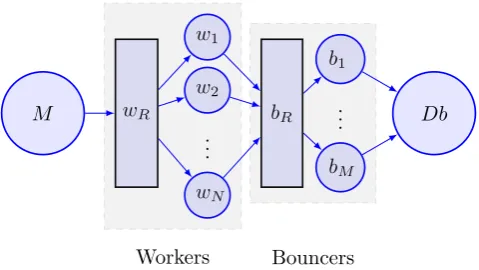
In Figure 1 a message passing diagram is shown. ActorSys-tem begins the processing flow by sending a message to FileMaster. Afterwards, FileMaster processes URLs link-ing to the data in Common Crawl Archive, creates its File-Workers (workers) and feeds them with one URL until all links are fetched. In the mean while, workers process given URL by downloading data and extracting textual content. Subsequently, they recognize individual pages and send a specimen of each for language recognition to available Bouncer Actors.
The language detection module uses a very efficient and accurate package, optimized for space and speed, which is Compact Language Detector 2 (CLD2) package5. It is based on a probabilistic model – a Naive Bayes clas-sifier. As the input for CLD2, first one hundred words from the current document, are used. The CLD2 pack-age has several embellishments for the algorithm improve-ment. Web-specific words containing no language infor-mation has been truncated: page, click, link, copyright, etc. Repetitive words that could affect the scoring like jpg, foo.png, bar.gif, have been stripped away.
After content written in predefined language has been de-tected, Bouncers perform simple spelling correction6 on each word from the text and subsequently write the cor-rected content to the Cassandra Database.
2.
Related Work
There are a few studies on using Common Crawl Data for N-gram generation, which corresponds to concepts and en-tities in NLP. One of them is presented in the paper (Kan-erva et al., 2014), which gives an overview on possible ap-plications of Common Crawl Data. They have obtained both linear and syntactic N-gram Collection from a Finnish Internet Crawl, and made them publicly available. Some more technical issues have been demonstrated, specifically
4
http://akka.io
5
Language detection is conducted with the Chromium Com-pact Language Detector 2
6
We correct words with edit distance equal or smaller than 2. Vocabulary of correct words is build on subset of literary texts taken fromNational Corpus of Polish(Przepi´orkowski et al., 2008), (Institute of Computer Science at the Polish Academy of Sciences, 2010).
M wR
w1
w2
.. .
wN
Workers
Db
bR ...
b1
bM
Bouncers
Figure 1: Message passing diagram. FileMaster (M) sends message to its FileWorkers (w1, . . . , wN) wrapped in the router wR. FileWorkers needs Bouncers (b1, . . . , bM) as helpers for language detection and writing data to Cassan-dra Storage. bRis a router for Bouncer Actors. Dbis Cas-sandra Storage.
raw textual data processing and language detection. An-other study (Buck et al., 2014) concerning N-gram counts and language models formed on Common Crawl Archive is broader by the number of languages analysed. In this study, the authors stress the importance of data duplication and normalization. Additionally, they compare perplexity of N-gram language models trained on corpora allowed by the constrained condition of the 2014 Workshop on Statistical Machine Translation and report that the lowest perplexity was achieved on their model. Moreover, the authors report that adding the language models presented in their work to a Machine Translation (MT) system improves BLEU score between 0.5 and 1.5 percentage points.
In (Zi´ołko et al., 2010) a few Polish corpora have been stud-ied, statistics for N-grams have been computed, and a tool for manual N-gram error correction have been proposed. The authors pre-processed textual data more carefully with respect to Polish diacritical marks. They also used mor-phological analyser for better word recognition. Obtained N-gram model is used to automatic speech recognition. The authors of paper (Ginter and Kanerva, 2014) train word2vec skip-gram model on 5-grams both from the Finnish Corpus extracted from the Common Crawl Inter-net crawl dataset, and Google-Books n-gram collection. Among others, they concern word similarity and transla-tion tasks. In the first task semantic and syntactic queries are used to recover word similarities. The second task it-self is about testing the ability of word2vec representation to simple linear transformation from one language vector space to another. Training word2vec models on N-gram collection has the advantage of its compactness. Speedup for English N-gram corpus is increased nearly 400 times, what means it is possible to do the computations even on a single machine.
Unlike the above approaches, we are more focused on Pol-ish language and present the following:
• LanguageCrawl (our NLP toolkit),
• word2vec model trained on Polish Internet Crawl based on Common Crawl Archive.
We provide more statistical information about Polish lan-guage and show N-gram counts and their distribution, which is built on the basis of the huge Polish Internet Crawl, much greater in size than corpora analysed in (Zi´ołko et al., 2010). Additionally, this study improves on previous works by using actor model, which enables us to take advantage of all available cores by highly parallelizing the corpus build-ing process. As a result, LanguageCrawl scales well with the increase in the number of worker nodes.
3.
Use Cases
3.1.
N-gram Language Model
Based on Common Crawl Data that we have scraped and processed, an N-gram model has been constructed. After sorting out non-Polish content websites, we pre-processed the data by: converting to lowercase letters, splitting into sentences by using tokenizer from NLTK Python toolkit (Loper and Bird, 2002), removing non-alphanumerical characters, truncating fused and misprinted words whose lengths were relatively long and were be-yond the spell-corrector’s skills. Polish diacritical marks and stop words have been preserved, because they are use-ful for phrase search (Zi´ołko et al., 2010). After creat-ing the N-gram model, duplicated N-grams have been re-moved. As a result, data set size has been reduced by ap-proximately 99.4%. In the same time, removing fused and misprinted words reduced data volume by63%. This indi-cates, that raw common crawl data are highly duplicated. It is therefore worth investigating how early deduplication, e.g. removing copyright notices, influences resulting cor-pora. Our Polish N-gram corpora are formed out of five N-gram types, starting from unigrams and ending on five-grams.
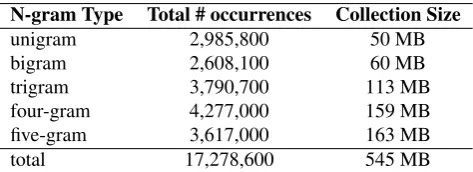
Table 1 summarizes the corpora by the means of N-grams occurrences and their sizes given in MB with respect to N-gram type. Our Polish N-N-gram collection extends above 17M entries. Nonetheless, this data set could have been made much larger, simply by processing additional crawl archives.
N-gram Type Total # occurrences Collection Size
unigram 2,985,800 50 MB
bigram 2,608,100 60 MB
trigram 3,790,700 113 MB
four-gram 4,277,000 159 MB
five-gram 3,617,000 163 MB
total 17,278,600 545 MB
Table 1: Overview of the total numbers of unique N-grams and their weights after truncating of misprints and fused words
A survey of the length of the different N-grams might be teresting for language researchers. We offer additional in-sights on the topic, beyond what can be found in the typical dictionary, thanks to the bigger size of the corpus we anal-ysed, the statistical measures we provided and the unique textual data source we gathered from websites. We believe
that all of that may enrich Polish language characteristics and shed new light on its analysis.
Table 2 presents several statistics of the N-gram length for each N-gram type i.e. mean, standard error, median, and two percentiles: 10th and 90th. It has been inferred that the average Polish word is 8 letters long, what seems to be fairly overestimated due to the fact that a number of fused words are still undetected and remain in the N-gram cor-pora. Thus all of the statistics may be affected with this issue more or less.
N-gram Type Mean SE Median 10th 90th
unigram 8.79 3.07 9 5 13
bigram 15.35 4.61 15 10 21
trigram 22.32 6.03 22 15 30
four-gram 30.03 7.33 29 21 39
five-gram 38.34 8.46 38 28 49
Table 2: Statistics of unique N-grams’ lengths
In Figure 2, we show N-gram occurrences for each N-gram type with respect to its length. A few interesting phenom-ena concerning Polish N-gram corpora can be seen: the number of occurrences have the same order of magnitude; for higher order N-grams, chart’s shapes are more bell-curve-like, broadening with increasing N-gram rank; charts are more right-skewed and becoming flatten with greater N-gram order; the mean and median are shifted to growing N-gram length, what is caused by long right tail of curves. The elongated tails for bigger N-gram length may exist be-cause of undetected words concatenation. The chart show-ing unigrams distribution is different in particular from the others, having two local maxima. The first maximum may be the result of stop words existence in the N-gram cor-pora, whereas the second one, should be the most frequent word length in Polish language based on Common Crawl Data, which is 6. Stop words are frequently occurring in the corpora, roughly 44% out of 274 (the number of all Polish stop words) first most recurring unigrams in our corpora are stop words. We have estimated this ratio by compar-ing both numbers of: the most frequent unique unigrams (only stop words), and Polish stop words, which have been extracted from NLTK Python tool (Loper and Bird, 2002). The average length of those 44% unigrams is 3.32, which is in agreement with the first lower maximum in Figure 2. We can recognize that the maxima for higher-rank N-grams are shifted roughly by 6. We may infer from this fact that the average length of Polish word is about that value, depend-ing on Polish N-gram corpora.
0 10 20 30 40 50
×108 N-gram occurrences
0 10 20 30 40 50
Figure 2: The N-gram curves show counts of each N-gram type with respect to its length by the means of characters, and illustrate the data from Table 1. The line chart for un-igrams shows two maxima, the first one is related to stop words and the second one is for the most frequent size of Polish word which is 6. The curves of the N-gram occur-rence functions for bigrams, trigrams, four- and five-grams are right-skewed bell-curve-like, with long tails widening with increasing N-gram length. The chart curvatures lessen with increasing N-gram rank. The maxima are right-shifted by the value of 5.
×107 N-gram occurrences
0 10 20 30 40 50 60 70 80 90 100
Figure 3: The N-gram charts summarize occurrences each of N-gram type for the most frequent 100 N-grams. The line charts show changes in gram counts from the N-gram frequency table. The shapes of N-N-gram occurrence functions are more steep for unigrams, bigrams and tri-grams, whereas for four- and five-grams the curvature is more flat, with long tails widening to the end of the N-gram collection. The general trend is asymptotic downwards for the first three charts and a smooth decay for the others.
3.2.
Word2Vec
Word2Vec computes distributional vector representation of words which has been shown to help learning algorithms to boost their scores in natural language processing tasks (Mikolov et al., 2013). Continuous bag-of-words and skip-gram architectures yield vector representations of words, which are useful in various natural language processing ap-plications such as machine translation, named-entity recog-nition, word sense disambiguation, tagging, parsing etc. Skip-gram model is an idea of learning word vector rep-resentations which are useful in predicting its sense in the same sentence. The aim of the skip-gram model is to max-imize the function of average log-likelihood, given a se-quence of training wordsw1, w2, . . . , wT:
wherekstands for the size of the training window. Each wordwcorresponds to two vectorsuwandvwthat are vec-tor representations ofwas word and sense accordingly. The probability of accurately predicting wordwigivenwjis de-scribed by the softmax model
p(wi|wj) =
where V is the size of vocabulary. The skip-gram model featured with softmax is computational expensive, comput-inglogp(wi|wj)is proportional to vocabulary size, which can reach size of billion. For boosting model efficiency, we use hierarchical softmax with lower computation demands bounded byO(log(V))as shown in (Mikolov et al., 2013). In our service we have used the Gensim ( ˇReh˚uˇrek and So-jka, 2010) implementation of word2vec. Gensim imple-mentation is fast enough to process the filtered corpus in less than one day. Additionally, in an effort to reduce mem-ory usage, our training pipeline takes advantage of iterators. The model is being trained in on-line fashion, by fetching documents one after another from the database. Finally, the resulting model is about 5 GB large, which makes it pos-sible to train it even on machines with modest amount of available RAM.
In Table 3 words with entries closest in meaning are pre-sented. The output is considered to be semantically coher-ent.
Table 3: Examples of semantic similarities based on word2vec trained on Polish Internet Corpora.
Word Most Similar Distance
kr´ol (king) cesarz (emperor) 0.73 Tusk (former PM) Donald (his name) 0.74 kobieta (woman) dziewczyna (girl) 0.80 me˙zczyzna (man) chłopak (boy) 0.85 dziewczyna (girl) rozochocna (horny) 0.82
apple tablety (tablets) 0.79
Dublin Blessington 0.85
Sushi Pizza 0.76
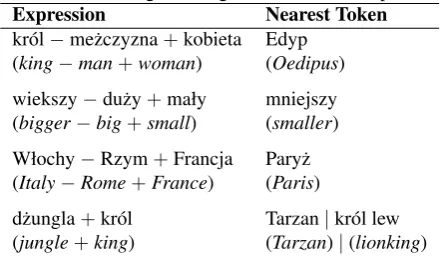
word2vec we have a direct link between the mathematical representation and the semantic meaning of a word.
Table 4: Linguistic regularities in vector space.
Expression Nearest Token
kr´ol−me˙zczyzna+kobieta Edyp (king−man+woman) (Oedipus)
wiekszy−du˙zy+mały mniejszy (bigger−big+small) (smaller)
Włochy−Rzym+Francja Pary˙z (Italy−Rome+France) (Paris)
d˙zungla+kr´ol Tarzan|kr´ol lew (jungle+king) (Tarzan)|(lionking)
4.
Possible Applications, Conclusions and
Future Work
We have demonstrated the abilities of our LanguageCrawl tool, which are mainly scraping Common Crawl Archive with respect to a given language, and both building N-gram model and training word2vec on that data. The N-gram model can be incorporated into machine translation sys-tem to boost its performance, as has been shown in (Buck et al., 2014). Researchers may benefit from well-trained word2vec model on large-scale Polish corpora.
Statistics over a large Polish Internet corpora provide inter-esting insights. In this study, we have shown Polish five N-gram types distributions, estimated the mean length of Polish words, and provided their statistical characteristics. As a future work, we would like to enrich our toolkit with syntactic N-grams and train word2vec on both linear and syntactic N-gram collections.
5.
Acknowledgements
I am personally very grateful to Dr. Irina Temnikova for her precious bright remarks and insights.
6.
Bibliographical References
Buck, C., Heafield, K., and van Ooyen, B. (2014). N-gram counts and language models from the common crawl. In Proceedings of the Language Resources and Evaluation Conference, Reykjavk, Icelandik, Iceland, May.
Ginter, F. and Kanerva, J. (2014). Fast training of word2vec representations using n-gram corpora. In Link¨oping Electronic Conference Proceedings, Uppsala University, November.
Hewitt, C., Bishop, P., and Steiger, R. (1973). A univer-sal modular actor formalism for artificial intelligence. In Proceedings of the 3rd International Joint Conference on Artificial Intelligence, IJCAI’73, pages 235–245, San Francisco, CA, USA. Morgan Kaufmann Publishers Inc. Kanerva, J., Luotolahti, J., Laippala, V., and Ginter, F. (2014). Syntactic n-gram collection from a large-scale corpus of internet finnish. In Grigonyt G. Kapoˇcit-Dzikien J. Vaiˇcenonien J. Utka, A., editor, Frontiers in Artificial Intelligence and Applications (Volume 268): Human Language Technologies – The Baltic Perspective, pages 184–191. IOS Press.
Loper, E. and Bird, S. (2002). NLTK: The natural lan-guage toolkit. InProceedings of the ACL-02 Workshop on Effective Tools and Methodologies for Teaching Nat-ural Language Processing and Computational Linguis-tics - Volume 1, ETMTNLP ’02, pages 63–70, Strouds-burg, PA, USA. Association for Computational Linguis-tics. http://www.nltk.org/.
Mikolov, T., Sutskever, I., Chen, K., Corrado, G. S., and Dean, J. (2013). Distributed representations of words and phrases and their compositionality. In C.J.C. Burges, et al., editors,Advances in Neural Information Process-ing Systems 26, pages 3111–3119. Curran Associates, Inc.
Przepi´orkowski, A., G´orski, R. L., Lewandowska-Tomaszczyk, B., and Ła´zinski, M. (2008). Towards the National Corpus of Polish. In Proceedings of the Sixth International Conference on Language Resources and Evaluation, LREC 2008, Marrakech. ELRA.
ˇ
Reh˚uˇrek, R. and Sojka, P. (2010). Software Frame-work for Topic Modelling with Large Corpora. In Proceedings of the LREC 2010 Workshop on New Challenges for NLP Frameworks, pages 45–50, Val-letta, Malta, May. ELRA. http://is.muni.cz/
publication/884893/en.
Zi´ołko, B., Skurzok, D., and Michalska, M. (2010). Pol-ish n-grams and their correction process. In4th Interna-tional Conference on Multimedia and Ubiquitous Engi-neering. IEEE, August.