On Developing Resources for Patient
-
level Information Retrieval
Stephen Wu
1, Tamara Timmons
1, Amy Yates
1, Meikun Wang
1, Steven Bedrick
1, William
Hersh
1, Hongfang Liu
21Oregon Health & Science University 2Mayo Clinic
Portland, OR Rochester, MN
E-mail: [email protected] [email protected]
Abstract
Privacy concerns have often served as an insurmountable barrier for the production of research and resources in clinical information retrieval (IR). We believe that both clinical IR research innovation and legitimate privacy concerns can be served by the creation of intra-institutional, fully protected resources. In this paper, we provide some principles and tools for IR resource-building in the unique problem setting of patient-level IR, following the tradition of the Cranfield paradigm.
Keywords: clinical information retrieval, privacy, information retrieval evaluation
1.
Introduction
Privacy concerns have often served as an insurmountable barrier for the production of research and resources in clinical information retrieval (IR). Restrictions on the use of patients’ private health information are a vastly different resource landscape than the more public traditional domains for IR (e.g., web).
We believe that both clinical IR research innovation and legitimate privacy concerns can be served by the creation of intra-institutional, fully protected resources. Thus, we have begun creating such resources at two sites: Oregon Health & Science University (OHSU) and Mayo Clinic. In future work, other institutions may choose to adopt these resource development practices; additionally, access could be provided through a privacy-preserving interface, such as with Evaluation-as-a-service (1).
In this paper, we provide some principles and tools for resource-building in the unique problem setting of patient-level IR. We follow the long tradition in IR of test collections and challenge evaluations, specifically structuring our resources for Cranfield-style IR evaluations (2, 3). Cranfield evaluations require (i) a test collection, (ii) a set of test topics, expressed as queries, and (iii) judgments of whether documents are relevant, for each query.
Each of these 3 collection components needs to be re-envisioned for its role in patient-level IR. In the remainder of our paper, we will walk through the 3 components and provide principles for their design, highlighting how they differ from a “traditional” test collection. We will also describe the implementation of these principles in our own multi-institutional resource-building project. We also introduce the Patient Relevance Assessment Interface (PRAI), a tool for producing relevance judgments for patient-level IR.
2.
Related Work
The Pittsburgh NLP Repository, distributed exclusively for the 2011-2012 TREC Medical Records Tracks (4, 5),
sought to address this problem by providing a de-identified clinical IR collection usable by the research community (albeit with limited availability) for a patient cohort retrieval task. By design, searching this collection bore the marks of patient confidentiality concerns: retrieve hospital visits – as a stand-in for patients – in response to a query. While this was an important step forward in that it moved beyond document retrieval, it did not (and could not) fully embrace patient-level IR.
Other research resources and challenges have taken alternative approaches rather than de-identifying protected health information. The CLEF eHealth tasks since 2013 (6) have included patient data (discharge summaries) paired with queries mimicking those a lay person might search for on the web. This problem setting bears more similarities to traditional web search, and differs from ours in that it focuses on consumer health -- the patient, not the provider, is seeking health information. Multimodal and image search in medical records, e.g., the EU-sponsored VISCERAL project (www.visceral.eu), can somewhat sidestep these problems by preprocessing the identified text and giving term lists, essentially providing an immutable upstream NLP process. None of these publicly available corpora are able to support the connectedness and granularity of information that is possible in the intra-institutional corpora that we propose here.
3.
Patient-Level Test Collections
3.1
Unit of Retrieval: Patient Electronic Health
Records (EHRs)
Patient-level IR is about finding patients, not just documents. Any source of information might be relevant
to a patient’s medical history or condition – e.g., lab values and clinical notes in the EHR (or more broadly, a wearable fitness device and a patient’s social media presence).
In our initial work at OHSU, we limit ourselves to patient-level retrieval based on EHRs. Patient-level
structure is provided by linking all documents for each
text and other structured data generated by medical professionals documenting patient encounters. Thus,
there are typically many documents per patient.
The data provided was initially collected from Epic, OHSU’s electronic health record, and stored in the
corresponding Clarity database. Selected medically relevant tables were then extracted and provided to the research team as XML.
1.1
Shareability: Intra-institutional collections
Data is protected by laws of the Health Insurance Portability and Accountability Act (HIPAA), and therefore cannot be shared outside the secure servers of a healthcare institution. Test collections should therefore be built within institutions, and shareability achieved at a different point in the research life cycle.
We have built preliminary test collections at OHSU and Mayo Clinic, while the tooling and infrastructure has been provided by OHSU. We primarily list statistics and details from the OHSU corpus and tooling.
1.2
Significance: Collections represent patient
populations
Since a test collection is a collection of patients, it represents a patient population. Thus, in patient-level IR, the choice of which patient records to include is of potential medical and public health significance. Further,
boolean retrieval results may be considered patient cohorts.
At OHSU, patients were included in the pool if they had inpatient or outpatient encounters with primary care departments (Internal Medicine, Family Medicine, or Pediatrics), with 3 or more encounters and 5 or more text entries, between 1/1/2009 and 12/31/2013. This resulted in a pool of 99,965 unique patients and 6,273,137 unique encounters.
The patient population at Mayo Clinic is still under
development, but a preliminary set has 15,486,886 notes corresponding to 138,228 patients, spanning a period of
15 years (1998–2013), and covering both inpatient and
outpatient data.
1.3
Distributedness: Relevant evidence is
dispersed across diverse document types
As mentioned in Section 2.1, a natural consequence to
looking at whole patients is that diverse types of data
records must be considered.
Document types from OHSU include both text and structured data: clinical notes, order result comments, demographics, ambulatory encounters, hospital encounters, encounter diagnoses, problem list, medications (ordered, current, recorded administrations),
lab results, surgeries, vital signs, microbiology results,
procedures, and imaging.
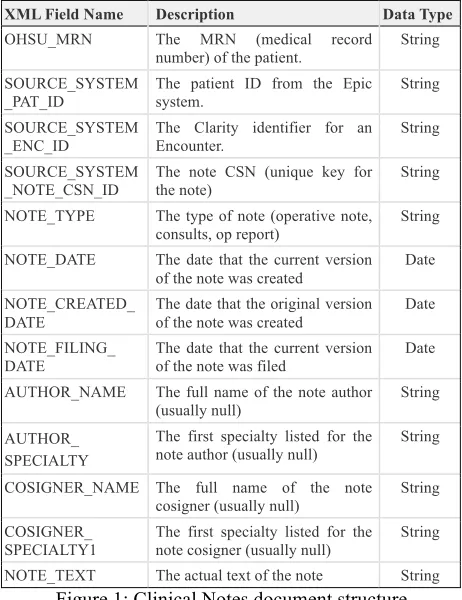
Within each of these documents there are multiple fields that contain data such as medical record number, note text, lab results, or diagnosis. For example, Figure 1 shows the document structure for the provider Notes; fields are either in string format or in date format.
XML Field Name Description Data Type OHSU_MRN The MRN (medical record
number) of the patient.
String
SOURCE_SYSTEM _PAT_ID
The patient ID from the Epic system.
String
SOURCE_SYSTEM
_ENC_ID
The Clarity identifier for an Encounter.
String
SOURCE_SYSTEM _NOTE_CSN_ID
The note CSN (unique key for the note)
String
NOTE_TYPE The type of note (operative note, consults, op report) String
NOTE_DATE The date that the current version of the note was created
Date
NOTE_CREATED_ DATE
The date that the original version of the note was created
Date
NOTE_FILING_
DATE The date that the current veof the note was filed rsion Date
AUTHOR_NAME The full name of the note author (usually null) String
AUTHOR_ SPECIALTY
The first specialty listed for the note author (usually null)
String
COSIGNER_NAME The full name of the note
cosigner (usually null)
String
COSIGNER_
SPECIALTY1
The first specialty listed for the
note cosigner (usually null)
String
[image:2.595.306.537.71.371.2]NOTE_TEXT The actual text of the note String Figure 1: Clinical Notes document structure
The number of records of each type varied widely. There were 10,111,930 clinical notes (approximately 100 notes per patient), but 31,997,402 current medications
(~300 medications per patient), versus 31,889 surgeries (~1 surgery for every 3 people).
2.
Patient-
level Test Topics
2.1
Sources: Diverse, practical topics sources
We have adopted the task of cohort identification for our patient-level IR evaluation topics. Use cases for such cohorts include research study recruitment, preliminary
screening for a later manual review, evidence-based
clinical care, and characterization of population health in
epidemiological studies; in development of test topics, we aimed to reflect this diversity of use cases and
represent real-world information needs.
A total of 56 test topics were developed based on
defined patient cohorts drawn from 5 sources, illustrating a variety of use cases. Cohort descriptions from these sources, generally composed of eligibility criteria, serve as models for test topics.
Clinical study data requests, as submitted by
researchers to the Oregon Clinical and Translational Research Institute (OCTRI), OHSU’s Research Data Warehouse (RDW), provided the basis for 29 topics. One data request, out of the 30 provided by OCTRI, was excluded from development since it specified retrieval of
clinic notes rather than an individual patient. Additional
topics were modeled after cohorts from the Phenotype KnowledgeBase (PheKB) (7 topics), Rochester
provided cohort descriptions from its own RDW to create 2 topics. Cohorts with similar characteristics were merged during topic development to avoid redundancy (1 OHSU/REP topic, and 2 OHSU/PheKB topics), resulting
in the total of 56 topics.
There is a significant level of variation in length, format, level of detail, and complexity among the cohort descriptions from these sources. Adapting these into a common framework allows for consistency among
topics; maintaining the general eligibility criteria and
objectives from the source description results in cohorts differing in subject matter, complexity, and precision.
The test topics produced through this process are therefore representative of diverse use cases and
real-world information needs, with varied subjects and complexity presented in a consistent manner.
2.2
Format: Diverse topic representations
Including different representations of topics allows for hypothetical queries from different use cases.
We provide the 56 topics in 3 different formats for
possible queries: 1) summary statement; 2) brief summary and clinical – a shorter summary statement
plus a mock clinical case incorporating a patient and scenario which typify the topic criteria; 3) brief summary
plus structured data – a summary statement plus criteria listed as defined or structured data fieldvalues.
For example, a topic concerning adults with
rheumatoid arthritis is formatted in Figure 2:
Figure 2: 3 representations for Topic 15
3.
Patient-
level Relevance Judgments
3.1
Judges: Medical expert relevance judges
Relevance judgments are the rate-limiting portion of IR resource development, since they must be done by
human assessors. Furthermore, chart reviews require
specialized medical knowledge to be meaningful, and patient privacy concerns prevent the sharing of documents from a patient’s EHR.
Thus, in our work, crowd-sourcing relevance
judgments was not an option; rather, we have employed
intra-institutional medical experts to take on the costly
step of chart review to make patient-level relevance judgments.
3.2
Task and tools: Relevance assessment as
Chart review
With a test collection of patients, the assessment of relevance to a query is equivalent to the problem of manual medical record (chart) review. Unlike traditional IR assessment (on a single document), many pieces of information (possibly thousands of text and/or structured data documents corresponding to a single patient) must
be considered in making a judgment on relevance.
Chart review in medical research is often done with a
clinician’s full EHR interface, elaborate spreadsheets, and manual record-keeping. We found that this patient-level IR setting required a new tool for relevance
assessment, to which we devote the rest of this paper.
Patient Relevance Assessment Interface
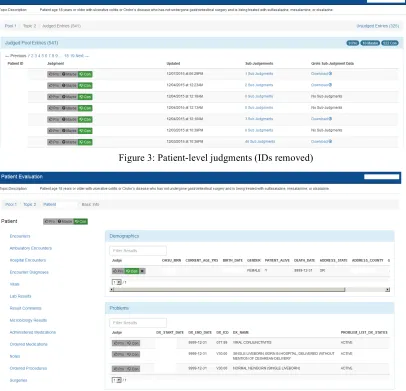
To support this process of patient-level relevance assessment, we have designed the EHR Patient Relevance Assessment Interface (PRAI). PRAI is a web application written in Rails; it is connected to a
PostgreSQL database for tracking judgments and to Elasticsearch for retrieving patient data.
PRAI Interface and Usage
Patients selected for relevance judgment constitute a
topic’s patient pool in PRAI. The PRAI interface enables
users to browse patient data much like they would in an
EHR system, navigating within and between document
types with the ability to search, filter and sort.
PRAI allows users to record patient-level relevance
judgments for a given topic and patient (see Figure 3). It also introduces the ability to perform “Sub Judgments” (document-level judgments, see Figure 4), whereby a single piece of data is marked as providing evidence in the overall judgment for the patient. A given sub judgment may concern criteria for patient inclusion or exclusion, and may support or contradict the patient’s inclusion in the topic’s cohort.
Patient- and document-level judgments are easily recorded by clicking on the relevant icon, and can be
modified through the same process. Patient-level
judgments can be recorded at multiple points enabling
the medical expert to quickly make patient-level judgments when the criteria have been met.
Preliminary relevance assessments for five topics
A first round of relevance judgments on full patient pools was performed for five topics.
The first topic, “non-smoking women in 3rd trimester
of pregnancy without a DSM-IV axis 1 diagnosis” (the same topic as used for preliminary assessment), had 1161 patients in the judgment pool. Relevance judgments for
this topic required an average of 2 minutes per patient. The judgment pool for Topic 2, “adults with IBD being managed medically,” included 866 patients, and about 4 a. Adults under age 65 with rheumatoid arthritis who have
cyclic citrullinated peptide antibodies >40
b. Adults under age 65 with rheumatoid arthritis with
positive cyclic citrullinated peptide antibodies.
i. 58 year old female presents with morning stiffness and
joint pain in her hands, especially her fingers, which improves but does not remit fully after approximately 30 minutes. On examination she is found to have ulnar deviation, decreased grip strength, and joint tenderness over the MCP and PIP joints. She has a positive rheumatoid factor and Anti-CCP Ab level is 45.
c. Adults under age 65 with rheumatoid arthritis with positive cyclic citrullinated peptide antibodies.
i. Demographics: 18-64 years old, alive, not on genetic opt-out list
ii. Encounter: date within last 2 years
minutes per patient-level judgment. Each patient-level judgment for the 3rd topic, “adults with a measured vitamin D (25-hydroxycholecalciferol) level,” was completed in just over 1 minute on average, with a pool of 833 patients. Topic 4, “adults with post-herpetic neuralgia using Qutenza (capsaicin 8% patch),” had a pool of 714 patients for judgment, taking the medical expert approximately 2.3 minutes to complete each patient-level judgment. Lastly, 767 patients were included the judgment pool for the topic “pregnant women in 3rd trimester seen in outpatient women’s health clinic,” and each patient-level judgment was completed in 4.2 minutes on average.
Based on our preliminary relevance judgments, we expected the average time required per patient-level judgment to exhibit significant variation between topics. Relevance assessments of these 5 topics showed over 4-fold variation in the average time per patient-level judgment between topics.
The main variable noted to affect the time required to perform a patient-level judgment was whether the information required to evaluate topic criteria was present in structured data or as free text.
4.
Conclusion & Future Work
We have considered at length the relatively novel problem of patient-level IR, and discussed some principles for developing resources in this domain. Additionally, we have included details on an implementation of these concepts at OHSU: a patient-level test collection, diverse topics, and the PRAI web interface for chart review-based relevance judgments.Future work includes making it easier to replicate our study; building off of our experience with using the chart review interface with Mayo Clinic data, we plan to eventually release PRAI as an open source project. Furthermore, we may consider modern approaches to shareability such as Evaluation-as-a-Service (1).
5.
Bibliographical References
1. Lin J, Efron M, editors. Evaluation as a service for information retrieval. ACM SIGIR Forum; 2013: ACM. 2. Cleverdon CW, Keen M. Aslib Cranfield research project-Factors determining the performance of indexing systems; Volume 2, Test results. 1966.
[image:4.595.77.483.71.462.2]3. Voorhees E, Harman DK, National Institute of Figure 3: Patient-level judgments (IDs removed)
Standards and Technology (U.S.). TREC : experiment and evaluation in information retrieval. Cambridge, Mass.: MIT Press; 2005. x, 462p. p.
4. Voorhees E, Hersh W, editors. Overview of the
TREC 2012 medical records track. The Twenty-first Text REtrieval Conference Proceedings TREC; 2012; Gaithersburg, MD: National Institute of Standards and Technology.
5. Voorhees E, Tong R, editors. Overview of the
TREC 2011 medical records track. The Twentieth Text
REtrieval Conference Proceedings TREC; 2011;
Gaithersburg, MD: National Institute of Standards and Technology.
6. Goeuriot L, Jones GJ, Kelly L, Leveling J, Hanbury
A, Müller H, et al. ShARe/CLEF eHealth Evaluation Lab
2013, Task 3: Information retrieval to address patients'