Open Access
Research
Characterization of the Lassa virus GP1 ectodomain shedding:
implications for improved diagnostic platforms
Luis M Branco
1,2and Robert F Garry*
1Address: 1Tulane University Health Sciences Center, New Orleans, LA, USA and 2Autoimmune Technologies, LLC, New Orleans, LA, USA Email: Luis M Branco - [email protected]; Robert F Garry* - [email protected]
* Corresponding author
Abstract
Background: There is a significant requirement for the development and acquisition of reagents that will facilitate effective diagnosis, treatment, and prevention of Lassa fever. In this regard, detection of early markers of Lassa virus (LASV) infection may improve diagnosis and ultimately successful treatment with antivirals. Characterization of LASV GP1 ectodomain shedding is an important step toward developing sensitive diagnostics to detect circulating levels of this viral glycoprotein in infected patient sera.
Results: Secretion of GP1 from mammalian cells expressing a native LASV GPC gene was not mediated by proteolytic cleavage, as determined by treatment with a panel of matrix metalloprotease (MMP) inhibitors. The shedding of GP1 was also not the result of over-expression of GPC under the control of a strong intron-A containing CMV promoter, as the soluble component could be immunoprecipitated from supernatants of cells expressing low levels of GPC under the control of an intronless promoter. Cells transfected with GPC retained surface membrane-associated expression of GP1 as determined by immunofluorescence assay, in addition to secreting the glycoprotein.
Secreted GP1 derived from GPC expression has a higher content of high mannose N-linked glycosylation than sGP1 expressed independently from the GP2 portion of the protein. Neither GP1 isoform contains sialylated N-glycans, O-linked carbohydrate chains, or galactose-β (1-4)-N-acetylglucosamine commonly present in complex and hybrid N-glycan structures.
Conclusion: These results demonstrate the non-proteolytic secretory nature of GP1 shedding during expression of the arenaviral glycoprotein complex. This phenomenon parallels shedding of a secretory glycoprotein component in filovirus replication. The glycosylation pattern of soluble GP1 resulting from expression of GPC was different from that of a soluble GP1 construct (sGP1-RRAA-FLAG), highlighting the intricately orchestrated post translational processing of the LASV glycoprotein complex.
Background
Lassa virus, a member of the Arenaviridae family, is the eti-ologic agent of Lassa fever, which is an acute and often
fatal illness endemic to West Africa. There are an esti-mated 300,000 - 500,000 cases of Lassa fever each year [1-3], with a mortality rate of 15%-20% for hospitalized Published: 24 September 2009
Virology Journal 2009, 6:147 doi:10.1186/1743-422X-6-147
Received: 10 September 2009 Accepted: 24 September 2009
This article is available from: http://www.virologyj.com/content/6/1/147
© 2009 Branco and Garry; licensee BioMed Central Ltd.
patients and as high as 50% during epidemics [4,5]. Pres-ently, there is no licensed vaccine or immunotherapy available for preventing or treating this disease. Although the antiviral drug ribavirin is beneficial, it must be admin-istered at an early stage of infection to successfully alter disease outcome, thereby limiting its utility [6]. Further-more, there is no commercially available Lassa fever diag-nostic assay, thus preventing early detection and rapid implementation of existing treatment regimens (e.g. riba-virin administration). The lack of adequate countermeas-ures and means of detection, coupled with the severity of disease, contributed to the classification of LASV as a National Institutes of Allergy and Infectious Diseases (NIAID) Category A pathogen and biosafety level-4 (BSL-4) agent.
The LASV genome is comprised of two ambisense, single-stranded RNA molecules, designated small (S) and large (L) [7]. Two genes on the S segment encode the nucleo-protein (NP) and two envelope glyconucleo-proteins (GP1 and GP2); whereas, the L segment encodes the viral polymer-ase (L protein) and RING finger Z matrix protein. GP1 and GP2 subunits result from post-translational cleavage of a precursor glycoprotein (GPC) by the protease SKI-1/S1P [8]. GP1 serves a putative role in receptor binding, while GP2 has the structural features characteristic of class I viral fusion proteins [9].
Recently we reported that expression of wild type LASV GPC in mammalian cells results in the generation of sig-nificant levels of soluble GP1 in the supernatants of trans-fected cells, that is not associated with GP2 [11]. GP1 ectodomain shedding from cells expressing wild type LASV GPC establishes potential new correlates of disease progression and highlights additional opportunities for development of diagnostics targeting the early stages of Lassa fever. In these studies the mechanism of LASV GP1 ectodomain shedding was further elucidated and its char-acteristics compared and contrasted to a similar phenom-enon in filoviruses, as previously reported for Ebola virus (EBOV) [12].
Results
Matrix metalloprotease inhibitors do not affect the secretion of GP1 from LASV GPC expressing cells
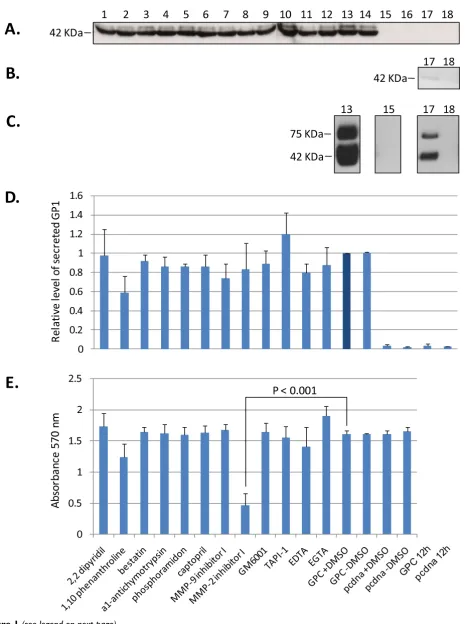
The effects of a diverse set of MMP inhibitors on the secre-tion of a soluble GP1 component from high level expres-sion of LASV GPC in human cells were investigated. None of the inhibitors employed in these studies resulted in sta-tistically significant reduction in the levels of secreted GP1 from HEK-293T/17 cells expressing LASV GPC (Figure 1A, D, lanes 1 - 12), when compared to untreated controls (Figure 1A, D, lanes 13, 14) [p > 0.05, N = 3]. Relative lev-els of secreted GP1 for each condition were normalized on GPC expression in the presence of 1% DMSO, the solvent
for the majority of inhibitors employed in these studies (Figure 1A, D, lane 13). Inhibitors were added to cells 12 hours after transfection, the earliest time that GP1 could be detected in cell culture supernatants, thereby marking the onset of glycoprotein secretion (Figure 1B, lane 17). The effects of inhibitors on cellular metabolism were measured by reduction of tetrazolium salt (MTT) and quantitated by A570 absorbance in 96 well plates mimick-ing the conditions used in the 6 well plate format. With the exception of MMP-2 inhibitor 1 (Figure 1E, lane 8) [p < 0.001, N = 3] cellular metabolism was not adversely affected by MMP inhibitors and conditions used in these assays. Despite significantly lowered MTT reduction in cells expressing GPC and treated with MMP-2 inhibitor I, the levels of secreted GP1 were equivalent to those in untreated and control treated cells (Figure 1D, lane 8). Expression of GPC in HEK-293T/17 cells did not adversely affect cellular metabolism, as MTT reduction levels were nearly identical to those obtained with pcDNA vector alone (Figure 1E, lanes 13 - 16).
Secretory pathway inhibitors abrogate secretion of GP1 from LASV GPC expressing cells
Figure 1 (see legend on next page)
!
"
#
$
%&
'
(
%)
*
+
,
-.
/
*
0
1 2 3 43 3 5
6 7
5 8 7 9 6 : ; 5 3 5 5 5 5 8 5 5 7 5 9 5 6 5 :
< = < >
Secretion of GP1 occurs in cells expressing high or low levels of LASV GPC
To assess if secretion of LASV glycoprotein is a phenome-non resulting from high level expression of GPC, intracel-lular and secreted GP1 levels driven by intron-A containing or intronless CMV promoter constructs were analyzed and quantitated. In HEK-293T/17 cells the aver-age level of intracellular GP1 expression derived from intronless CMV promoter constructs was 16% of that obtained with intron-A counterparts (Figure 3A, lane 3). Expression from the weaker CMV promoter resulted in undetectable levels of secreted GP1, as assessed by western blot analysis of cell culture supernatants (Figure 3B, lane 3). In an attempt to detect secreted GP1 from lower intra-cellular GPC expression, LASV GP1-specific mAb L52-74-7A was used to immunoprecipitate (IP) the glycoprotein from cell culture supernatants. One millilitre of each supernatant was subjected to IP with anti-GP1 mAb and Protein G Sepharose, and the resulting immunoprecipi-tates were detected by western blot. As shown in Figure 3C the entire IP reaction (1) was resolved for control vector (lane 1), intronless GPC (lane 3), and control GP1-TM (lane 4) constructs. Conversely, a fraction (0.025) of each of the intron-A driven GPC and sGP1 constructs were ana-lyzed in the same blots for comparison (Figure 3C, lanes 2 and 5). The intracellular ratios of GP1 between intron-A driven and intronless GPC constructs were calculated lin-early based upon densitometry. Whereas intracellular GP1 levels derived from expression of an intronless GPC construct were, on average, 16% of those obtained with the intron-A containing counterpart, the resulting secreted GP1 was only 0.11%, or ~1/100 of the cellular ratio (Fig-ure 3C, lane 3). A very minor GP1 band could be immu-noprecipitated from the supernatants of GP1-TM expressing cells (Figure 3C, lane 4). The GP1-TM construct contains the LASV GP2 TM domain directly fused to the C-terminus of the GP1 ORF, and the SKI-1/S1P protease
cleavage site, RRLL, remains intact. In this conformation the vast majority of GP1-TM is not cleaved, and GP1 is produced almost exclusively as a membrane-anchored form. Expression of LASV glycoprotein constructs in VERO cells generally produced similar results as those obtained with HEK-293T/17 cells (Figure 3D), with the notable exception of higher secreted levels of GP1 from intronless CMV promoter-driven GPC (Figure 3D, lane 3). Also, secreted levels of GP1 from a sGP1_RRAA-FLAG construct were approximately twice those observed with intron-A containing GPC (Figure 3D, lane 2 versus lane 5). In contrast, the same corresponding levels in HEK-293T/17 cells were nearly matched (Figure 3A, C, lane 5). To further assess the levels of secreted GP1 from VERO cells expressing GPC under the control of an intronless CMV promoter, supernatants were subjected with IP with mAb L52-74-7A. Western blot analysis revealed that sig-nificantly higher levels of sGP1 could be purified from the supernatants of VERO cell expressed intronless GPC than from HEK-293T/17 cells, as expected, based on analysis on non-immunoprecipitated samples (data not shown).
GP1 remains associated with the cell membrane in LASV GPC expressing cells
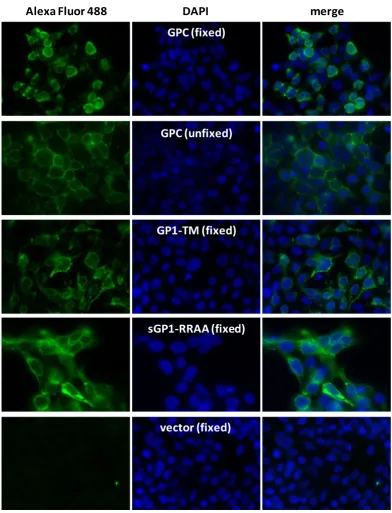
Expression and localization of LASV GP1 in HEK-293T/17 cells was analyzed by immunofluorescence assay (IFA) with mAb L52-74-7A on fixed and permeabilized, or live, unfixed cells (Figure 4). All constructs used in LASV glyc-oprotein expression for IFA were driven by intron-A con-taining CMV promoters. Expression of GPC on fixed cells was generally diffuse throughout the cytoplasm, with bright distribution of the antigen throughout the periph-eral outline of stained cells (Figure 4A, panels 1 and 3). Expression of GPC on live cells, which were not permea-ble to the antibody, and thus stained antigen present of the outer leaflet of the membrane, showed primarily bright punctate staining throughout the cellular periphery Effect of metalloprotease inhibitors on the expression and secretion of GP1, and cytotoxicity on LASV GPC-expressing HEK-293T/17 cells
Figure 1 (see previous page)
Figure 2 (see legend on next page)
!" #
$ %
&
&
'
(
( )*
+
, -. *
,
-( - / , * 0 . 1 2
3 4 5 )5 5 ( 3 4 5 )5 (
5
&
'
6
( )*
7 8 9 :
;< =>
?
@A
<
=
<
A
<
=B
C
@
?D
>
E<
=
=F =>
D
G
H
I
(Figure 4B, panels 1 and 3). Unfixed, GPC-expressing cells were extensively washed with staining buffer prior to incu-bating with GP1-specific mAb to remove soluble GP1 from the reactions. Thus, staining with mAb L52-74-7A on GPC-expressing unfixed cells detected GP1 associated with the outer leaflet of the cell membrane. GP1-TM expression on the cell surface was largely similar to that observed with GPC on unfixed cells, with additional dif-fuse stained throughout the cytoplasm (Figure 4C, panels 1 and 3). Soluble GP1 expression from sGP1-RRAA-FLAG displayed diffuse intracellular staining, in addition to bright antigen distribution throughout the periphery of transfected cells (Figure 4D, panels 1 and 3). The LASV GP1-specific mAb L52-74-7A did not stain empty vector transfected cells (Figure 4D, panels 1 and 3). Cells were counterstained with DAPI to enumerate nuclei (Figure 4A-D, panels 2 and 3).
Secreted GP1 derived from expression of LASV GPC and sGP1 have disparate glycosylation patterns
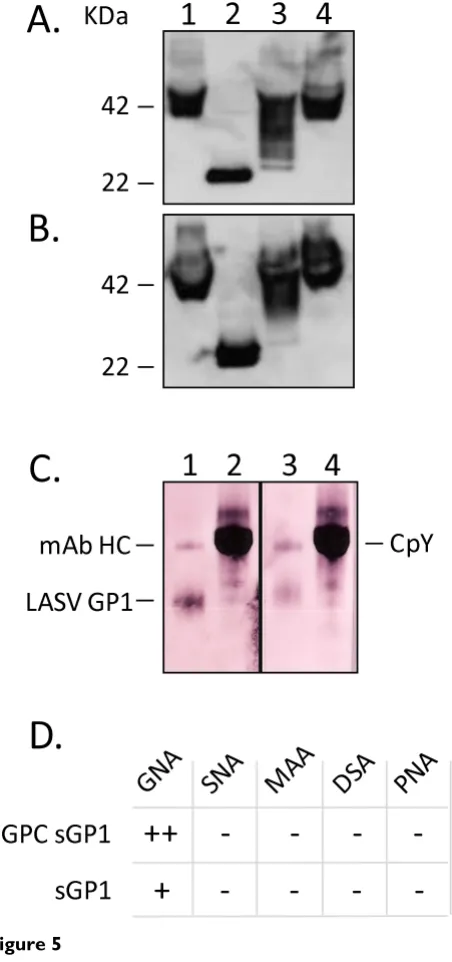
The glycosylation profile of secreted GP1 was derived by treatment of immunoprecipitated protein with PNGase-F, Endo-H, or Neuraminidase, followed by western blot analysis of protein migration on SDS-PAGE. The LASV GP1 glycoprotein contains 7 predicted N-linked glyco-sylation sites that could be accessible to removal by PNGase-F. Secreted GP1 from GPC expression was fully deglycosylated by PNGase-F, as determined by a loss of ca. 20 KDa from the mass of the protein detected on western blots (Figure 5A, lane 2). The expected mass of LASV GP1 without carbohydrate moieties is 22771.82 Daltons (ExPASy Compute pI/Mw tool [13-15]). Expression of sGP1-RRAA-FLAG produced a secreted form of GP1 that was largely deglycosylated by PNGase-F, with an addi-tional moiety at ca. 24 KDa that could not be further deglycosylated with higher levels of enzyme, additional digestion time, or further denaturation (N = 4) (Figure 5B, lane 2). Digestion of secreted GP1 from GPC expression
with Endo H produced a highly heterogeneous banding pattern on western blots, with moieties ranging from the fully glycosylated 42 KDa protein to approximately 25 KDa (N = 4) (Figure 5A, lane 3). Conversely, sGP1-RRAA-FLAG was less susceptible to Endo H digestion, producing mainly a heterogeneous banding pattern between 42 KDa and 35 KDa, with an additional faint band at ca. 25 KDa (N = 4) (Figure 5B, lane 3). Neither form of the secreted GP1 protein resulted in mobility shifts upon digestion with Neuraminidase (N = 3) (Figure 5A, B, lane 4). The carbohydrate composition of both GP1 forms was further dissected with a panel of lectin binding assays. Among the five lectins employed, each with well characterized carbo-hydrate binding specificities, only Galanthus nivalis agglu-tinin (GNA) bound to LASV GP1, albeit differentially. The lectin bound significantly stronger to GPC-derived sGP1 (Figure 5C, lane 1) than to sGP1-RRAA-FLAG (Figure 5C, lane 3) (N = 3). The amount of glycoprotein loaded per lane was assessed by densitometry analysis of GP1 detected on western blots with mAb L52-74-7A, and determined to be nearly equal in every experiment (data not shown). The internal kit control protein for GNA binding, carboxyl peptidase Y (CpY), was run alongside LASV GP1 and stained equivalently in both assays (Figure 5C, lanes 2 and 4).
Secreted GP1 from GPC and sGP1 expression have identical N-terminal sequences
Immunoprecipitated and PNGase-F deglycosylated GP1 protein from GPC and sGP1-RRAA-FLAG were subjected to SDS-PAGE and transferred to PVDF membranes for N-terminal sequence analysis by Edman degradation. The six N-terminal amino acids from each protein were T-S-L-Y-K-G, thus representing the SPase-cleaved form of the LASV GP1 protein, as previously characterized [8].
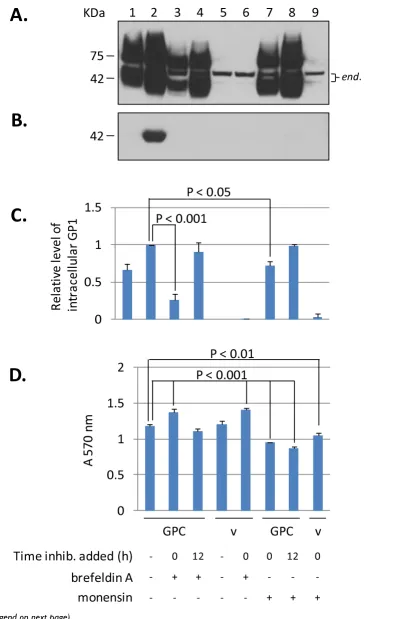
Inhibition of GP1 secretion from HEK-293T/17 cells expressing LASV GPC by brefeldin A and monensin Figure 2 (see previous page)
Discussion
A panel of soluble MMP inhibitors with a wide range of specificities was employed in the characterization of pro-tease-mediated GP1 shedding from mammalian cells expressing LASV GPC. A broad spectrum hydroxamic acid inhibitor of MMPs, GM 6001 (inhibits MMP1, 2, 3, 8, 9), metal ion chelators (EDTA, EGTA, 2,2 dipyridyl), a spe-cific inhibitor of chymotrypsin-like serine proteases (α1 -antichymotrypsin), a cell surface aminopeptidase inhibi-tor (Bestatin), an inhibiinhibi-tor of thermolysin-like protease and metalloendopeptidases (Phosphoramidon), a broad MMP inhibitor (phenanthroline), TNF-α convertase (TACE) protease inhibitor-1 (TAPI-1), and specific inhib-itors of MMPs (MMP2, 9), were added to growth medium of LASV GPC-expressing mammalian cells in an attempt to determine their role in the release of soluble GP1. None of the inhibitors showed statistically significant inhibition of GP1 shedding from HEK-293T/17 cells expressing LASV GPC, although most compounds were tested at con-centrations significantly greater than reported IC50 values (Table 1). These results strongly suggest that GP1 is released from cells as a soluble and uncoupled protein Figure 3
Intracellular expression and secretion of GP1 in cells trans-fected with intron-A containing and intronless LASV GPC constructs
Figure 3
Expression profile of LASV GPC, GP1-TM, and sGP1-RRAA-FLAG in HEK-293T/17 cells by immunofluorescent microscopy Figure 4
Expression profile of LASV GPC, GP1-TM, and sGP1-RRAA-FLAG in HEK-293T/17 cells by immunofluores-cent microscopy. HEK-293T/17 cells grown on cover slips and transfected with LASV glycoprotein constructs were stained with anti-GP1 mAb L52-74-7A and Alexa Fluor 488 secondary antibody, and counterstained with DAPI. Cells were fixed and permeabilized prior to staining (panels A, C, D, and E), or were stained live (panel B). Each panel shows captured fluorescent images of cells at 60× magnification, in oil immersion, with the same exposure settings used throughout for the given fluoro-chrome (300 ms for FITC channel; 175 ms for DAPI channel). Cell surface and intracellular GP1 (Alexa Fluor 488, panels A - E), stained nuclei (DAPI, panels A - E), and merged images (merge, panels A - E) were captured with Slidebook 5.0 software (Intel-ligent Imaging Innovations, Inc., Denver, CO). Images were not deconvolved or processed further. Each image is representative of at least 20 fields photographed and compared for each experimental condition.
! " # $ $ % & ' (
arising from the intracellular cleavage and processing of the GPC complex. Further, it can be proposed that the 1:1 stoichiometry of GP1 and GP2 in cells expressing GPC does not result in a 1:1 ratio of assembled tripartite plex on the cell surface. It is possible that tripartite com-plex assembly in the ER results in retention of a fraction of GP2 in favour of GP1 secretion. This model is partly sup-ported by our previous studies that established a critical role for GP1 as a chaperone for correct processing and secretion of GP2 [11]. These studies also suggested that cell surface expression of GP2 without associated GP1 was unlikely; GP2 expression resulted in very low levels of
intracellular protein, and it was undetectable on the cell surface (unpublished data). Cytotoxicity of MMP inhibi-tors was monitored by MTT uptake assays. MMP-2 inhib-itor I resulted in significantly cytotoxicity compared to untreated controls (p < 0.001, N = 3), but the resulting release of GP1 from cells was not significantly affected (Figure 1A, D, E, lane 8), indicating that de novo protein synthesis and cellular secretory pathways were not tar-geted by the inhibitor.
The mammalian expression system employed in these studies was originally developed for high level production of recombinant LASV proteins for diagnostic assay devel-opment [11]. High level expression of soluble LASV GPC resulted in both secretion of glycoprotein precursor uncleaved by SKI-1/S1P, and high levels of sGP1. Although CMV promoter strength has not been compared to that of the LASV promoter, it is reasonable to suggest that very high level expression of recombinant LASV genes in mammalian cells could result in artefactual processing, secretion, and stoichiometry of glycoprotein complex components. It is evident that high level expression of sol-uble GPC in HEK-293T/17 cells driven by CMV plus intron-A overwhelms cellular SKI-1/S1P protease, as approximately one half of the secreted glycoprotein is uncleaved [11]. In order to address the possibility that overexpression of GPC resulted in artefactual secretion of GP1 we expressed the glycoprotein from an intronless driven promoter. Expression of GPC from CMV-intron-A driven vectors resulted in 8 - 10 fold higher levels Figure 5
Glycosylation profile of GPC and sGP1-RRAA-FLAG-derived secreted GP1 assessed by digestion with endo- and exo-gly-cosidases, and by lectin binding profiles
Figure 5
of cleaved intracellular GP1 than from intronless counter-parts. Low levels of sGP1 in the supernatants of cells expressing intronless GPC were detected only when the glycoprotein was immunoprecipitated. An 8 - 10 fold dilution of culture supernatant from cells expressing sGP1 still resulted in detection of significant levels of secreted glycoprotein, whereas similar levels of immunoprecipi-tated GP1 from intronless GPC expression required 400 fold higher volume of supernatant. These results suggest that overexpression of GPC results in disproportionately enhanced secretion of sGP1 when compared to lower expression levels of the glycoprotein. Generally, expres-sion and secretion levels of GP1 in the HEK-293T/17 line paralleled those obtained with VERO cells, a common line used for the propagation of Lassa virions and analysis of LASV gene expression (Figure 3D).
Association of GP1 with the cell membrane as a compo-nent of the tripartite glycoprotein complex was verified by staining live cells overexpressing GPC. After extensive cell washing to remove sGP1, followed by staining with a LASV GP1-specific mAb, cell surface associated GP1 could be readily detected. The staining pattern was less diffuse than with fixed and permeabilized cells overexpressing
GPC, with bright fluorescence primarily associated with the cell membrane. Thus, a fraction of the GP1 protein associates with GP2 and SSP on the cell membrane of GPC-transfected cells, whereas a soluble, un-associated component is shed into the cellular milieu.
Sequencing of GP1 protein from expression of GPC or sGP1 revealed identical N-termini through six amino acids, suggesting that both forms of the glycoprotein result from cleavage of pre-GPC by SPase at amino acid 58, and that the SSP functions as the secretory signal.
Protein deglycosylation and lectin binding studies revealed significant heterogeneity in the carbohydrate composition of the LASV GP1 protein. Whereas secreted GP1 from expression of LASV GPC could be fully deglyc-osylated with PNGase F (Figure 5A, lane 2), two distinct forms could be observed in sGP1 from sGP1-RRAA-FLAG expression. The 22 KDa band corresponding to a fully deglycosylated sGP1 migrated just below a ca. 24 KDa form of the protein, and it was consistently detected on western blots (Figure 5B, lane 2). The average 14-residue precursor of N-linked oligosaccharides adds approxi-mately 2.6 KDa to the mass of a target protein ([GlnNAc
Table 1: Effects of matrix metalloprotease and secretory pathway inhibitors on GP1 shedding and cytotoxicty in HEK-293T/17 cells
inhibitor [] in assay Notes/references effect on GP1 shedding cytotox.(MTT) morphology (microscopy)
2,2 dipyridyl 1 μM Calbiochem - - enlarged cells
1,10 phenanthroline 10 μM ref. [12] - - detached cells
bestatin 10 μM 1 - 10 μM working [] - - enlarged cells
α1-antichymotrypsin 4 μM ref. [12] - - normal
phosphoramidon 10 μM IC50 = 4.6 μM - - enlarged cells
captopril 10 μM ref. [12] - - normal
MMP-9 inhibitor I 50 nM IC50 = 5 nM - - detached cells
MMP-2 inhibitor I 100 μM Ki = 1.7 μM - + enlarged cells
GM6001 5 μM Ki = 400 pM - 27 nM - - normal
TAPI-1 50 μM IC50 = 100 nM - - normal
EDTA 5 mM 1 - 10 mM working [] - - rounded cells
EGTA 5 mM 1 - 10 mM working [] - - rounded cells
brefeldin A 15 μg/mL BD Golgi Plug™ +++ + rounded cells
× 3] + [Man × 9] + [Glc × 3]). Thus, the 24 KDa form of sGP1-RRAA-FLAG that remains after digestion with PNGase F suggests the presence of an oligosaccharide branch other than N-linked in nature. Alternately, as PNGase F is not able to cleave N-linked glycans from glyc-oproteins when the innermost GlcNAc residue is linked to an α1-3 Fucose residue [16], the possibility of this form of linkage in sGP1-RRAA-FLAG exists. This type of modifica-tion is most commonly found in plant and some insect glycoproteins, however. Computational analysis of the LASV GP1 protein sequence using OGPET v1.0 (Univer-sity of Texas, El Paso [17] revealed the possibility of an O-GalNAc (mucin type) glycosylation in GP1 at Ser 80 (SnISTnHL), with a predictive score of 0.599833 (cutoff = 0.4247). Additionally, NetGlycate 1.0 Server [18], a pre-dictor of glycation of ε amino groups of lysines in mam-malian glycoproteins, attributed a score of 0.914 to Lys5 in LASV GP1, which is significantly above the threshold of 0.5. Lectin-binding assays did not aid in resolving the gly-cosylation pattern of the 24 KDa form of sGP1-RRAA-FLAG. The lectins PNA (Peanut agglutinin) and DSA ( Dat-ura stramonium agglutinin), which recognize the core dis-accharide galactose (1-3) N-acetylgalactosamine, and Gal-(1-4)GlcNAc in complex and hybrid glycans, in O-gly-cans, and GlnNAc in O-glyO-gly-cans, respectively, did not bind to the 24 KDa sGP1 form. A higher degree of N-linked gly-cosylation heterogeneity on LASV GP1 was obtained in Endo H digestion profiles. Endo H removes only high mannose and some hybrid types of N-linked carbohy-drates from glycoproteins, and will not cleave more com-plex glycan structures [19,20]. Soluble GP1 from GPC expression revealed a more heterogeneous distribution of high mannose and hybrid glycosylation than were present in sGP1-RRAA-FLAG, indicating a higher content of man-nose and/or hybrid structures. Conversely, it appears that sGP1-RRAA-FLAG has a significantly higher content of complex glycan structures, as determined by reduced EndoH activity on the glycoprotein. These results were confirmed by the differential staining of both GP1 forms by GNA; soluble GP1 from GPC expression was heavily stained with GNA, whereas sGP1-RRAA-FLAG showed sig-nificantly dimmer reactivity. Densitometry analysis showed a ratio of 2.27 ± 0.014 in GNA staining intensity of GPC-derived GP1 versus sGP1-RRAA-FLAG (N = 3). The marked differences in glycosylation of each form of LASV GP1 could be attributed to a potentially different translational and post-translational modification profile and timeline in expressing cells. The process of transla-tion, ER translocatransla-tion, SPase and SKI-1/S1P cleavage, ER retention of glycoproteins, and assembly of the LASV tri-partite complex (GP1+GP2+SSP) has been somewhat dis-sected, and constitutes a finely orchestrated process in the ER and Golgi of mammalian cells. The correct processing and assembly of the tripartite complex is essential for sub-sequent binding of LASV virions via GP1 to the α
-dystro-glycan cellular receptor, and initiation of viral entry via the fusion peptide on the N-terminus of GP2, a process largely mediated by the presence of the intact SSP peptide. Thus, it is conceivable that LASV GPC-derived glycopro-teins remain accessible to ER resident glucosyltrans-ferases, and the homologous lectins calnexin and calreticulin longer than sGP1-RRAA-FLAG, resulting in an overall different endpoint glycosylation pattern. Glucosyl-transferases act as one of the primary protein folding qual-ity control mechanisms in the ER, in concert with lectins, peptidyl-propyl-isomerases, and chaperones that are tightly regulated by nuclear transcription mediated by ER membrane resident proteins (e.g. ATF6) that sense high levels of protein misfolding in this organelle [21]. The for-mation of hybrid and complex glycans takes place in the
lectins MAA (Maackia amurensis agglutinin) and SNA (Sambucus nigra agglutinin), which are specific for α2-3 and α2-6 galactose, respectively. Thus, it appears that LASV GP1 is not synthesized with terminal sialic acid res-idues in its carbohydrate profile, irrespective of the glyco-protein precursor.
It is well known that hydrophobic interactions predomi-nate over the proper and improper folding of proteins. Further, the hydrophobic areas of high mannose N-gly-cans are closely associated with promotive effects on pro-tein folding, possibly depressing the hydrophobic interactions unfavorable to the proper folding of nascent polypeptides in the E.R. It has been established by Jitsu-hara et al. [29], Narhi et al. [30], and others that higher oligomannose chains of glycosylated proteins promote protein folding more strongly than lower ones [31]. Of noteworthy mention is the folding of influenza virus hemagglutinin with a truncated N-glycan Glc1Man5GlcNAc2 moiety that normally interacts with the
lectin calnexin in the E.R. is markedly depressed [32]. The E.R. resident lectins calnexin and calreticulin tether monoglucosylated high mannose N-glycans from nascent proteins, resulting in suppression of aggregation, thus promoting protein folding [33]. Many studies have estab-lished the correlation between proper protein glycosyla-tion with the acquisiglycosyla-tion and retenglycosyla-tion of glycoprotein biological activities. It is reasonable to expect that in the arenaviral tripartite complex the proper folding of the individual glycoprotein subunits, and the interaction with the SSP, have critical roles in establishing functional bind-ing of virions to host cell receptors and subsequent fusion and viral entry. Our own previous LASV GP1 protein expression studies in multiple biological systems have resulted in markedly different results. Although expres-sion of full length GP1 in E. coli was achievable, the lack of glycosylation in the prokaryotic system required the presence of sodium dodecyl sulfate (SDS), reducing agents (e.g. dithiothreitol [DTT]), and the zwitterion mor-pholino-ethanesulfonic acid (MES) in the purification scheme in order to yield non-aggregated protein [34]. Fur-ther processing of bacterial expressed GP1 protein for ana-lytical assays that required removal of SDS and DTT readily resulted in aggregation. In contrast, expression of multiple forms of LASV GP1 in mammalian cells always resulted in glycosylated, soluble protein, although aggre-gation of the standalone glycoprotein remained an issue [11]. Further characterization of post-translational processing of the arenaviral glycoprotein complex may be of crucial importance in the establishment of viral infec-tivity correlates, as well as pave the way for identification of disease susceptibility markers, and development of effective vaccines and therapeutics.
The present studies affirm the transition of GP1 from the ER to the Golgi in its path toward secretion, and that the secretory component of GPC follows the same route. Complete or nearly complete inhibition of GP1 secretion in supernatants of cells transfected with GPC and treated with BFA and monensin is indicative of a secretory path-way mediated phenomenon. This conclusion is further strengthened by the lack of inhibition of GP1 secretion from GPC-expressing cells treated with a wide range of MMP inhibitors. Despite secretion of GP1 from GPC-expressing cells, a surface membrane-associated GP1 com-ponent was specifically visualized on live cells. These observations are indicative of a secreted GP1 component, in addition to the presence of a cell surface expressed, functional tripartite glycoprotein complex. A proposed model outlining the secretory pathway of LASV GP1 is graphically displayed in Figure 6.
Together, these data strongly suggest dual modalities in LASV GPC expression; the formation of a fully functional tripartite complex for display on the surface of infectious virions, and the secretion of a soluble GP1 component with as of yet uncharacterized function. The fate of un-associated GP2 during expression of LASV GPC was not investigated in these studies, but it warrants analysis, as the stoichiometry of the glycoprotein complex depends on the ratio of the available individual components. Dol-nik et al. [12] have partly characterized the role of a solu-ble GP component in EBOV, and have proposed a role in the infectivity of the virus in vivo. According to Dolnik et al., the secreted EBOV GP component acts as an immune decoy, by targeting the humoral immune system and pos-sibly removing from circulation antibodies with innate neutralizing activity against the virus. This mechanism would provide circulating infectious virions a clearer path toward infection of new target cells, with enhanced viru-lence. Also, Wahl-Jensen et al. have further delineated the role of secreted EBOV GP in activation of primary target cells [35,36]. These studies revealed that rigid presenta-tion of the EBOV glycoprotein, as it's displayed on the sur-face of virions is critical for activation of pro-inflammatory cytokines and chemokines, whereas soluble glycoprotein failed to elicit any response. Additionally, EBOV GP(1,2) in viral particle-associated form mediated endothelial cell activation and decreased cell barrier func-tion, whereas sGP, the major soluble glycoprotein of EBOV, demonstrated an anti-inflammatory role by pro-tecting the endothelial cell barrier function.
test the feasibility of this hypothesis. If the phenomenon of GP1 shedding is present in vivo the glycoprotein should be preferentially detected in the early stages of arenaviral infection, when circulating antigens are present at the highest levels. Soluble GP1 in serum could be separated from virions by selective size filtration, thus providing a simple and easily deployable platform for identification of the soluble glycoprotein component. If confirmed, are-naviral glycoprotein shedding could result in the develop-ment of more sensitive and earlier detection diagnostics, as well as establish new correlates of pathogenesis and immune evasion by this class of hemorrhagic fever viruses.
Conclusion
The shedding of GP1 from cells expressing GPC results from secretion of a cleaved and un-associated fraction of the protein. This phenomenon is not the result of cleavage of GP1 from the tripartite complex expressed on the cell surface, and it is not mediated by cellular MMPs. Instead, secretion of GP1 occurs when GPC is processed into GP1 and GP2 in the ER, and a significant fraction of this pro-tein is shuttled through the secretory pathway and is released into the extracellular medium. Both forms of secreted GP1 share N-terminal sequences, but have dis-similar glycosylation profiles that suggest a differential Schematic representation of arenaviral glycoprotein expression pathway and secretory forms
Figure 6
retention and glycoprotein processing timeline in the ER and Golgi compartments.
Methods
Cells, plasmids, antibodies
HEK-293T/17 cells (ATCC CRL11268) were maintained in complete high glucose Dulbecco's Modified Eagle Medium (cDMEM) supplemented with non-essential amino acids (NEAA) and 10% heat-inactivated fetal bovine serum (ΔFBS).
Vero cells (ATCC CRL 1587) were maintained in cDMEM supplemented with NEAA and 5% ΔFBS. Plasmid con-structs expressing LASV GPC, GP1-TM, and sGP1, and the backbone vector pcDNA3.1+zeo:intA were described else-where [11]. For immunoassays, Dr. Randal Schoepp kindly provided the LASV-specific GP1 mAb L52-74-7A, which was generated against purified gamma-irradiated LASV, as previously described [37]. Horseradish peroxi-dase (HRP)-conjugated secondary antibodies specific for mouse IgG were purchased from Kirkegaard and Perry Laboratories (KPL, Gaithersburg, MD). Alexa Fluor 488-conjugated goat F(ab')2 mouse IgG secondary
anti-bodies for immunofluorescence assays were purchased from Molecular Probes. Anti-LASV GP1 mAb L52-74-7A was biotinylated with EZ-Link® NHS-Biotin (Pierce,
Rock-ford, IL), and desalted with Zeba™ Desalt Spin Columns (Thermo Scientific, Rockford, IL), according to manufac-turer's instructions.
Transient expression of LASV gene constructs
Recombinant LASV protein expression was analyzed in HEK-293T/17 or VERO cells transiently transfected with mammalian expression vector DNAs, which were pre-pared using the PureLink HiPure plasmid filter midiprep kit (Invitrogen, Carlsbad, CA). The negative control vector pcDNA3.1(+):intA was included in all transfections. Briefly, 1 × 10⁶ cells were seeded per well of a
Poly-D-Lysine-coated 6-well plate in 2 mL of cDMEM. After over-night incubation in growth conditions cells were trans-fected with unrestricted recombinant plasmid DNAs using Lipofectamine™ 2000 (Invitrogen), according to the man-ufacturer's instructions. Four μg of each plasmid DNA were used per transfection. Transfections were incubated for the times described in results, at 37°C, 5% CO2, 90% RH, after which cell culture supernatants were collected and clarified by centrifugation. To prepare cell extracts from transfected cultures, cell monolayers were carefully washed twice with Ca++- and Mg++-free PBS, pH7.4,
col-lected by gentle dislodging, transferred to 1.5 mL polypro-pylene tubes, and lysed for 10 minutes in a mammalian cell lysis buffer comprised of 50 mM Tris buffer, pH 7.5, 1 mM EDTA, 0.1% SDS, 0.5% deoxycholic acid, 1% Igepal CA-360, and a protease inhibitor cocktail (Sigma Aldrich, St. Louis, MO), according to the manufacturer's
instruc-tions. The insoluble fraction was pelleted by centrifuga-tion at 14,000 × g for 10 minutes, and the supernatants were transferred to fresh tubes. Protein concentration was determined for each sample by A280 with A260 subtrac-tion, and verified using a Micro BCA™ Protein Assay Kit, as outlined by the manufacturer (Thermo Scientific).
Metalloprotease and secretory pathway inhibition assays
Metalloprotease inhibitors were purchased from Sigma (1,10-Phenanthroline monohydrate, 2,2'-Dipyridyl Rea-gentPlus®, Bestatin hydrochloride, Phosphoramidon
diso-dium salt, α1-Antichymotrypsin, EDTA, EGTA) or
Calbiochem (MMP-2 Inhibitor I, MMP-9 Inhibitor I, InSolution™ GM 6001, InSolution™ TAPI-1, Captopril), and resuspended in 100% DMSO (Sigma), or with cell culture medium when appropriate, at 100× concentra-tion. Inhibitors were diluted in growth medium for anal-ysis, at a final DMSO concentration of 1%. For inhibition assays HEK-293T/17 cells were transiently transfected with plasmid DNAs in 6-well plates, as described above, for 12 hours prior to the addition of metalloprotease inhibitors. Transfection medium was then removed and cells were washed twice with 1× PBS, pH7.4, followed by addition of 2 mL of fresh growth medium containing inhibitors. Plates were returned to the growth chamber and reactions were harvested between 42 - 45 hours post transfection by collecting supernatants and generating whole cell protein extracts, as described above. The Golgi secretory pathway inhibitors brefeldin A and monensin were purchased from Sigma, and diluted in growth medium to 15 μg/mL and 10 μM, respectively. Inhibitors were added to cells at the time of transfection with pcDNA3.1(+):intA or pcDNA3.1(+):intA:LASV GPC, or at 12 hours. Supernatants and cell extracts were harvested at 36 hours post transfection for western blot analysis.
Western blot and densitometry analyses
Expression of LASV GP1 in cell extracts and culture super-natants was confirmed by Western blot analysis using anti-LASV GP1 mAb L52-74-7A and a horseradish peroxi-dase (HRP)-conjugated goat anti-mouse IgG (H+L) sec-ondary antibody. Briefly, 10 μg of total cell protein in 10 μL (~1 × 10⁵ cell equivalents), or 26 μL of cell culture
Health ImageJ 1.41o software http://rsb.info.nih.gov/ij, and following the procedure outlined in http://www.luke miller.org/journal/2007/08/quantifying-western-blots-without.html, using TIFF files.
Immunoprecipitation
Soluble GP1 was immunoprecipitated from 1 mL of trans-fected culture supernatants with 2 μg of anti-LASV GP1 mAb L52-74-7A and Protein G-Sepharose® 4B Fast Flow,
using a Protein G Immunoprecipitation Kit (Sigma), according to the manufacturer's instructions. Immuno-precipitated proteins were denatured and reduced, sepa-rated by SDS-PAGE, and blotted as outlined above. GP1 was detected with biotinylated anti-LASV GP1 mAb L52-74-7A and ImmunoPure® Streptavidin-HRP (Thermo
Sci-entific).
Cell proliferation assay
HEK-293T/17 cell cytotoxicity induced by metallopro-tease inhibitors was monitored with a TACS™ MTT Cell Proliferation Assay (R&D Systems, Minneapolis, MN), according to manufacturer's instructions. The transfection procedure outlined above for 6-well plates was scaled down to a 96-well format, with each condition analyzed in triplicate. Data was plotted as mean absorbance at 570 nm, with standard deviation, and background correction at 650 nm.
Immunofluorescence assay
HEK-293T/17 cells were seeded on Poly-D-Lysine-coated sterile glass cover slips (BD Biosciences, Walkersville, MD) in 24-well plates. Cells were transfected as outlined above. At 72 hours post-transfection cells were washed with cold HBSS and were either fixed in 2% methanol-free formal-dehyde, or incubated in 1× PBS, pH 7.4/1% heat inacti-vated FBS/0.1% NaN3 for live cell staining. Fixed cells were incubated for 20 minutes in 50 mM NH4Cl to reduce background fluorescence, followed by permeabilization with 0.1% Triton-X 100 for 5 minutes, and blocking with 8% heat inactivated goat serum for one hour. Cells were stained with anti-LASV GP1 mAb L52-74-7A diluted to 2 μg/mL in 0.8% goat serum/0.1% Triton-X 100, for one hour. After washing, cells were incubated with Alexa Fluor 488 Goat F(ab')2 anti-mouse IgG (Molecular
Probes/Inv-itrogen) diluted to 1 μg/mL in staining buffer containing 1 μM DAPI (Invitrogen), for 1 hour. Cover slips were mounted on ethanol washed glass slides with ProLong®
antifade reagent (Invitrogen). Reactions were cured for 48 hours prior to microscopy. Live cells were stained with the same primary, secondary antibodies and DAPI, for one hour each in 1× PBS, pH 7.4/1% heat inactivated FBS/ 0.1% NaN3, followed by mounting and curing, as described above. All reactions were performed at room temperature, and were washed three times with 1× DPBS between steps. Stained cells were imaged with a Zeiss
Axi-oplan 2 fluorescent microscope equipped with an Intelli-gent Imaging Innovations CCD (Denver, CO), using a Plan-APOCHROMAT 63X/1,4 oil DIC objective.
PNGase F, Endo H, and Neuraminidase assays
The glycosylation patterns in secreted GP1 generated from expression of LASV GPC and sGP1 were resolved by treat-ment with the glycosidases PNGase F, Endo H, and Neu-raminidase. Immunoprecipitated GP1 from transiently transfected HEK-293T/17 cell supernatants were subjected to treatment with 500 NEB U of PNGase F, Endo H, or Neuraminidase for 1 hour using the reaction conditions suggested by the manufacturer (New England Biolabs). Control reactions were similarly processed except that enzymes were not added. Following incubation proteins were resolved by reducing SDS-PAGE, blotted, probed with biotinylated anti-LASV GP1 mAb L52-74-7A and Streptavidin-HRP, and developed as described above.
Lectin-based Glycan differentiation assays
Glycosylation patterns on secreted GP1 were further char-acterized via binding of glycan-specific lectins using a DIG Glycan Differentiation Kit (Roche Applied Science, Man-nheim, Germany), according to the manufacturer's instructions. Immunoprecipitated GP1 from expression of LASV GPC and sGP1 was resolved on SDS-PAGE, blot-ted onto nitrocellulose, and subjecblot-ted to lectin binding assays.
N-terminal protein sequencing
Immunoprecipitated GP1 protein was resolved by SDS-PAGE, blotted onto PVDF membranes, stained with Pon-ceau Blue and destained in water. N-terminal sequence determination of the 42 KDa protein was performed by Edman degradation and carried out in an Applied Biosys-tems Model 4949 CLC protein suquenator. Phenylthiohy-dantoin derivatives of amino acids were analyzed on-line with an Applied Biosystems Model 785A/140C/610A ana-lyzer. All reagents and solvents were from Applied Biosys-tems.
Statistical analyses
Statistical analysis of data was performed with GraphPad InStat, V3.06 (GraphPad Software, Inc., San Diego, CA), using Analysis of Variance (ANOVA).
Competing interests
LMB and RFG are listed inventors, in addition to others, in a PCT application entitled "Soluble and Membrane-Anchored Forms of Lassa Virus Subunit Proteins", filed in April 2008.
Authors' contributions
drafted the manuscript. RFG contributed to the experi-mental design and provided critical review of the manu-script.
Acknowledgements
This work was supported by Department of Health and Human Services/ National Institutes of Health/National Institute of Allergy and Infectious Diseases Challenge and Partnership Grant Number 1 UC1 AI067188-01. The authors thank Dr. Kerstin Honer Zu Bentrup, Research Assistant Pro-fessor, Manager, Microbiology Imaging Facility, Tulane University Medical School Microbiology and Immunology Departments, for assistance with immunofluorescence microscopy and staining protocols. The authors also thank the Lassa Fever Diagnostic Development Consortium members Cor-genix, Inc., Broomfield, CO; Vybion, Inc., Ithaca, NY; Lassa Fever Labora-tory - Kenema Government Hospital, Kenema, Sierra Leone, for the supply of critical reagents and helpful discussions of results.
References
1. Fisher-Hoch SP, McCormick JB: Lassa fever vaccine: A review.
Expert Rev Vaccines 2004, 3:103-111.
2. McCormick JB: Clinical, epidemiologic, and therapeutic aspects of Lassa fever. Med Microbiol Immunol 1986, 175:153-155. 3. McCormick JB: Epidemiology and control of Lassa fever.
Cur-rent Topics in Microbiol and Immunol 1987, 134:69-78.
4. Fisher-Hoch SP, Tomori O, Nasidi A, Perez-Oronoz GI, Fakile Y, Hut-wagner L, McCormick JB: Review of cases of nosocomial Lassa fever in Nigeria: the high price of poor medical practice. Br Med J 1995, 311:857-859.
5. McCormick JB, Webb PA, Krebs JW, Johnson KM, Smith ES: A pro-spective study of the epidemiology and ecology of Lassa fever. J Infect Dis 1987, 155:437-444.
6. McCormick JB, King IJ, Webb PA, Scribner CL, Craven RB, Johnson KM, Elliot LH, Belmont-Williams R: Lassa fever. Effective therapy with ribavirin. N Engl J Med 1986, 314:20-26.
7. Buchmeier MJ, Bowen MD, Peters CJ: Arenaviridae: The viruses and their replication. In Fields Virology 4th edition. Edited by: Knipe DM, Howley PM. Philadelphia: Lippincott-Raven; 2001:1635-1668. 8. Lenz O, ter Meulen J, Klenk HD, Seidah NG, Garten W: The Lassa
virus glycoprotein precursor GP-C is proteolytically proc-essed by subtilase SKI-1/S1P. Proc Natl Acad Sci USA 2001,
A98:12701-12705.
9. Gallaher WR, DiSimone C, Buchmeier MJ: The viral transmem-brane superfamily: Possible divergence of arenavirus and filovirus glycoproteins from a common RNA virus ancestor.
BMC Microbiol 2001, 1:1.
10. Bausch DG, Rollin PE, Demby AH, Coulibaly M, Kanu J, Conteh AS, Wagoner KD, McMullan LK, Bowen MD, Peters CJ, Ksiazek T: Diag-nosis and clinical virology of Lassa fever as evaluated by enzyme-linked immunosorbent assay, indirect fluorescent-antibody test, and virus isolation. J Clin Microbiol 2000,
38:2670-2677.
11. Illick MM, Branco LM, Fair JN, Illick KA, Matschiner A, Schoepp R, Garry RF, Guttieri MC: Uncoupling GP1 and GP2 expression in the Lassa virus glycoprotein complex: implications for GP1 ectodomain shedding. Virology J 2008, 5:161.
12. Dolnik O, Volchkova V, Garten W, Carbonnelle C, Becker S, Kahnt J, Ströher U, Klenk H-D, Volchkov V: Ectodomain shedding of the glycoprotein GP of Ebola virus. The EMBO J 2004, 23:2175-2184. 13. Bjellqvist B, Hughes GJ, Pasquali Ch, Paquet N, Ravier F, Sanchez J-Ch, Frutiger S, Hochstrasser DF: The focusing positions of polypep-tides in immobilized pH gradients can be predicted from their amino acid sequences. Electrophoresis 1993, 14:1023-1031. 14. Bjellqvist B, Basse B, Olsen E, Celis JE: Reference points for com-parisons of two-dimensional maps of proteins from different human cell types defined in a pH scale where isoelectric points correlate with polypeptide compositions. Electrophore-sis 1994, 15:529-539.
15. Gasteiger E, Hoogland C, Gattiker A, Duvaud S, Wilkins MR, Appel RD, Bairoch A: Protein Identification and Analysis Tools on the ExPASy Server Edited by: John M Walker. The Proteomics Protocols Hand-book, Humana Press; 2005.
16. Tretter V, Altmann F, März L: Peptide_N4-(N-acetyl-beta-glu-cosaminyl)asparagines amidase F cannot release glycans with fucose attached alpha 1-3 to the asparagines-linked N-acetylglucosamine residue. Eur J Biochem 1991, 199(3):647-52. 17. OGPET was developed by Rafael Torres Jr. and Dr. Igor C.
Almeida, both from the Dept. of Biological Sciences, Border Biomedical Research Center (BBRC) at the University of Texas at El Paso (UTEP). The online version of this algo-rithm was developed by M.S. Yash Dayal from the BBRC, Bioinformatics Program, Mathematical Sciences Dept., and Dr. Ming-Ying Leung, Director of the Bioinformatics Pro-gram, Mathematical Sciences Dept., at UTEP. .
18. Johansen MB, Kiemer L, Brunak S: Analysis and prediction of mammalian protein glycation. Glycobiology 2006, 16:844-853. 19. Maley F, Trimble RB, Tarentino AL, Plummer TH Jr:
Characteriza-tion of glycoproteins and their associated oligosaccharides through the use of endoglycosidases. Anal Biochem 1989,
180(2):195-204.
20. Robbins PW, Trimble RB, Wirth DF, Hering C, Maley F, Maley GF, Das R, Gibson BW, Royal N, Biemann K: Primary structure of the
Streptomyces enzyme endo-beta-N-acetylglucosaminidase H. J Biol Chem 1984, 259(12):7577-7583.
21. Lodish H, Berk A, Kaiser CA, Krieger M, Scott MP, Bretscher A, Ploegh H, Matsudaira P: Protein Modifications, folding, and Quality Control in the ER. In Molecular Cell BiologyVolume Chapter 13.3. Sixth edition. Freeman and Company, New York; 2008:549-556. 22. Werner RG, Noë W, Kopp K, Schlüter M: Appropriate mamma-lian expression systems for biopharmaceuticals. Arzneimittel-forschung 1998, 48(8):870-880.
23. Griffin TJ, seth G, Xie H, Bandhakavi S, Hu WS: Advancing mam-malian cell culture engineering using genome-scale technol-ogies. Trends Biotechnol 2007, 25(9):401-408.
24. Jenkins N, Murphy L, Tyther R: Post-translational modifications of recombinant proteins: significance for biopharmaceuti-cals. Mol Biotechnol 2008, 39(2):113-118.
25. Jenkins N, Meleady P, Tyther R, Murphy L: Strategies for analyzing and improving the expression and quality of recombinant proteins made in mammalian cells. Biotechnol Appl Biochem 2009, 53(Pt 2):73-83.
26. Kawasaki N, Itoh S, Hashii N, Takakura D, Qin Y, Huang X, Yamaguchi T: The significance of glycosylation in development of biopharmaceuticals. Biol Pharm Bull 2009, 32(5):796-800. 27. Roggentin P, Rothe B, Lottspeich F, Schauer R: Cloning and
sequencing of a Clostridium perfringens sialidase gene. FEBS Lett 1988, 238(1):31-34.
28. Wong-Madden ST, Landry D: Purification and characterization of novel glycosidases from the bacterial genus Xanthomonas.
Glycobiology 1995, 5(1):19-28.
29. Jitsuhara Y, Toyoda T, Itai T, Yamaguchi H: Chaperone-like func-tions of high-mannose type and complex-type N-glycans and their molecular basis. J Biochem 2002, 132(5):803-811. 30. Narhi LO, Arakawa T, Aoki KH, Elmore R, Rohde MF, Boone T,
Strickland TW: The effect of carbohydrate on the structure and stability of erythropoietin. J Biol Chem 1991,
266(34):23022-23026.
31. Ermonval M, Duvet S, Zonneveld D, Cacan R, Buttin G, Braakman I:
Truncated N-glycans affect protein folding in the ER of CHO-derived mutant cell lines without preventing calnexin binding. Glycobiology 2000:77-87.
32. Hebert DN, Foellmer B, Helenius A: Calnexin and calreticulin promote protein folding, delay oligomerization and suppress degradation of influenza hemagglutinin in microsomes.
EMBO J 1996:2961-2968.
33. Wada I, Ou W-J, Liu M-C, Scheele G: Chaperone functions of cal-nexin for the folding intermediate of gp80, the major secre-tory protein in MDCK cells. Regulation by redox state and ATP. J Biol Chem 1994:7464-7472.
34. Branco LM, Matschiner A, Fair JN, Goba A, Sampey DB, Ferro PJ, Cashman KA, Schoepp RJ, Tesh RB, Bausch DG, Garry RF, Guttieri MC: Bacterial-based systems for expression and purification of recombinant Lassa virus proteins of immunological rele-vance. Virol J 2008, 5:74.
35. Wahl-Jensen V, Kurz SK, Hazelton PR, Schnittler HJ, Ströher U, Bur-ton DR, Feldmann H: Role of Ebola virus secreted glycoproteins and virus-like particles in activation of human macrophages.
Publish with BioMed Central and every scientist can read your work free of charge "BioMed Central will be the most significant development for disseminating the results of biomedical researc h in our lifetime."
Sir Paul Nurse, Cancer Research UK
Your research papers will be:
available free of charge to the entire biomedical community
peer reviewed and published immediately upon acceptance
cited in PubMed and archived on PubMed Central
yours — you keep the copyright
Submit your manuscript here:
http://www.biomedcentral.com/info/publishing_adv.asp
BioMedcentral 36. Wahl-Jensen VM, Afanasieva TA, Seebach J, Ströher U, Feldmann H,
Schnittler HJ: Effects of Ebola virus glycoproteins on endothe-lial cell activation and barrier function. J Virol 2005,
79(16):10442-10450.