The DialogBank
Harry Bunt*, Volha Petukhova**, Andrei Malchanau**, Alex Fang*** and Kars Wijnhoven*
*Tilburg Center for Cognition and Communication, Tilburg University, The Netherlands**Spoken Language Systems, Saarland University, Germany
***Dialogue Systems Group, City University of Hong Kong, Hong Kong SAR
harry.bunt,[email protected]; v.petukhova, [email protected], [email protected] Abstract
This paper presents the DialogBank, a new language resource consisting of dialogues with gold standard annotations according to the ISO 24617-2 standard. Some of these dialogues have been taken from existing corpora and have been re-annotated according to the ISO standard; others have been annotated directly according to the standard. The ISO 24617-2 annotations have been designed according to the ISO principles for semantic annotation, as formulated in ISO 24617-6. The DialogBank makes use of three alternative representation formats, which are shown to be interoperable.
Keywords:dialogue annotation, ISO standard,
interoper-ability
1.
Introduction
This DialogBank is a new language resource, developed at Tilburg University, which contains dialogues of various kind with gold standard dialogue act annotations accord-ing to the ISO 24617-2 standard. This standard builds on previously designed annotation schemes such as DAMSL, DIT++, MRDA, HCRC Map Task, Verbmobil, SWBD-DAMSL, and DIT.1Most of these schemes have been used
to construct annotated corpora, such as the Switchboard, HCRC Map Task, ICSI-MRDA, and DIAMOND corpora. For nearly all of these annotation schemes, dialogue act annotation consists of segmenting a dialogue into certain grammatical units and marking up each unit with one or more communicative function labels. ISO 24617-2 (like DIT++) supports semantically more complete annotation by additionally annotating the following aspects:
1. ’Dimension’, or category of semantic content: the annotation scheme supports multidimensional annota-tion, i.e. multiple communicative functions may be as-signed to dialogue segments; different from DAMSL and other multidimensional schemes, an explicitly de-fined notion of ‘dimension’ is used that corresponds to a certain category of semantic content. The ISO scheme distinguishes nine dimensions on empirical and theoretical grounds.
’Multidimensional segmentation’ is used: a dialogue is segmented in multiple ways, with functional ments in each relevant dimension. ‘Functional seg-ments’, defined as minimal stretches of behaviour that have a communicative function, are the units that di-alogue act annotations attach to. Functional segments are mostly shorter than turns, may be discontinuous, may overlap, and may contain parts contributed by dif-ferent speakers. A segment carrying a feedback func-tion may for instance overlap with a segment that car-ries a task-related function.
1See Allen & Core (1997); Bunt (2007); Shriberg et al. (2004); Anderson et al. (1991); Alexandersson et al. (1998); Jurafsky et al. (1997); and Bunt (1994; 2000), respectively.
2. ‘Qualifiers’ may be added for expressing that a dia-logue act is performed conditionally, with uncertainty, or with a particular sentiment.
3. Dependence relations are defined for expressing se-mantic relations between dialogue acts, e.g. for indi-cating which question is answered by a certain answer act, or which utterance a feedback act. responds to.
4. Rhetorical relations may be annotated to indicate e.g. that one dialogue act explains the performance of an-other dialogue act.
Most of the dialogues in the DialogBank have been taken from existing corpora and have been re-segmented and re-annotated; some of these also have their original anno-tations for comparison. Some of the dialogues are (also) annotated according to the DIT++ annotation scheme, which has been a major source of inspiration for the ISO 24617-2 scheme. The DialogBank presently contains (re-)annotated dialogues from four English-language corpora: HCRC Map Task, Switchboard, TRAINS (Allen et al., 1994) and DBOX (Petukhova et al., 2014); and from four Dutch-language corpora: DIAMOND (Geertzen et al., 2004), Schiphol (Pr¨ust et al., 1984), OVIS (www.let.rug.nl/vannoord/Ovis), and Dutch Map Task (http://doc.ukdataservice.ac.uk/ doc/4632/mrdoc/pdf/4632userguide.pdf). Dialogues from other corpora, such as the multi-party AMI corpus are planned to be added in the near future.
2.
Interoperable Annotation
2.1.
Annotations and Their Representation
therefore on the identification of empirically and theoreti-cally well-motivated concepts and precise definitions. ISO 24617-2 includes a comprehensive, application-independent annotation scheme with well-defined concepts and the markup language DiAML (Dialogue Act Markup Language), designed in accordance with the ISO Linguistic Annotation Framework (LAF)2 and the ISO Principles of
Semantic Annotation (‘SemAF Principles’).3 LAF makes
a fundamental distinction between annotation and repre-sentation: ‘annotation’ refers to the linguistic information that is added to segments of language data, independent of format; ‘representation’ refers to the format in which an annotation is rendered. Following SemAF Principles, this distinction is implemented in the DiAML definition in the form of anabstract syntaxthat specifies a class of abstract annotation structures, which are set-theoretical constructs like pairs and triples, and aconcrete syntaxthat specifies a rendering of these annotation structures in a ref-erence format using XML. This refref-erence format is called DiAML-XML. It uses abbreviated XML-expressions, is complete and unambiguous relative to the abstract syntax: (1) the concrete syntax defines a representation for every structure defined by the abstract syntax; and (2) every expression defined by the concrete syntax represents one and only one structure defined by the abstract syntax. A representation format with these properties is calledideal. Any ideal representation format can be converted through a meaning-preserving mapping to any other ideal represen-tation format (see Bunt, 2010 for formal definitions and proofs).
The dialogues in the DialogBank have all been (re-)annotated using the DIAML markup language; some of them are represented in the DiAML-XML format; others are cast in one of two alternative tabular representation for-mats, defined in such a way that they are demonstrably ideal (complete and unambiguous) and that they are more con-venient for human readers than DiAML-XML representa-tions.
2.2.
DiAML Representations in XML
The HRCR Map Task dialogues in the DialogBank are re-segmented and re-annnotated using the ANVIL tool (Kipp, 2001), starting from raw speech. These annotations are rep-resented in DiAML-XML, which makes use of two XML elements, one to represent dialogue acts and one to rep-resent a semantic or pragmatic (‘rhetorical’) relation be-tween dialogue acts. A <dialogueAct>element has
at-tributes whose values represent (1) the speaker; (2) the ad-dressee(s); (3) (optionally) possible other participants; (4) the communicative function; (5) the dimension; (6) quali-fiers (if any); and (7) dependence relations. Example (1b) shows the representation of the annotation of the dialogue fragment in (1a), which contains a rhetorical relation (Elab-oration) between the dialogue acts in 1 and 3, and a feed-back dependence between the dialogue acts in 3 and 4.
2ISO 24612:2012; see also Ide & Romary (2004). 3ISO 24617-6; see also Bunt (2015).
(1) a. 1. G: go south and you’ll pass some cliffs on your right
2. F: uhm...
3. G: and some adobe huts on your left 4. F: oh okay
b. <diaml xmlns=”http://www.iso.org/diaml”>
<dialogueAct xml:id=”da1” target=”#fs1” sender=”#g”
addressee=”#f” dimension=”task” communicativeFunction=”instruct” />
<dialogueAct xml:id=”da2” target=”#fs2” sender=”#f”
addressee=”#f” dimension=”turnManagement” />
communicativeFunction=”turnTake” />
<dialogueAct xml:id=”da3” target=”#fs2” sender=”#f”
addressee=”#g” dimension=”timeManagement” communicativeFunction=”stalling” />
<dialogueAct xml:id=”da4” target=”#fs3” sender=”#g”
addressee=”#f” dimension=”task” communicativeFunction=”inform” />
<rhetoricalLink dact=”#da4” rhetoAntecedent=”#da1”
rhetoRel=”elaborate” />
<dialogueAct xml:id=”da5” target=”#fs4” sender=”#f”
addressee=”#g” dimension=”autoFeedback” communicativeFunction=”autoPositive” feedbackDependence=”#da1” ”#da4” /> < /diaml>
2.3.
Representation in a Tabular Format
The re-annotation of the dialogues that were included in the DialogBank started in some cases from raw primary data or transcriptions, and in some cases from previous anno-tations in various formats, which mostly used the form of a table in which rows correspond to the segmentation; one column contains the transcribed speech; and the other col-umn(s) contain the annotation. This is illustrated in Figure 1 for a fragment of a Switchboard dialogue, originally an-notated according to the SWBD-DAMSL scheme and rep-resented in a 3-column format, and in Figure 2 for the mul-tidimensional annotation of a short dialogue fragment from the TRAINS corpus, using the DIT annotation scheme and the DitAT annotation tool (Geertzen, 20008).
The formats used in Figures 1 and 2 look rather different, and even more different from the XML format used in (1), yet they all contain essentially the same information. For example, the numbers in the first column in Fig. 1 as well as in Fig. 2 can be interpreted as identifiers of functional segments; the strings in the third column in both cases as containing the transcriptions of these segments; the sec-ond column in Fig. 2 as indicating the speaker of a seg-ment (and, by implication for a two-person dialogue, the addressee), which in Fig. 1 is part of the information in the third column; and the other columns as representing the di-alogue act annotations. The row numbered 1 in Fig. 2 thus corresponds to the following XML expression:
(2) <dialogueAct xml:id=”da1” target=”#fs1” sender=”#s”
addressee=”#u” dimension=”turnManagement” communicativeFunction=”turnTake” />
<dialogueAct xml:id=”da2” target=”#fs1” sender=”#s”
id function transcript
sw01-0105-0001-A001-01 qw A.1 utt1: Jimmy,{D so}how do you get most of your news? /
sw01-0105-0002-B002-01 sd B.1 utt1:{D Well, [ I kind of, +{F uh,}I ] watch the{F uh,}national news every day, for one /
sw01-0105-0003-B002-02 sd B.2 utt1 I also read one or two papers a day /
sw01-0105-0004-B002-03 sd B.3 utt1:{C and}[ I’m a, + I’m pretty much a ] news junkie / sw01-0105-0005-B002-04 sd B.4 utt1:{C and}I tune in to CNN a lot. /
sw01-0105-0006-A003-01 ba A.3 utt1:{F Oh,}wow. /
Figure 1: Annotation in tabular form of Switchboard (SWBD-DA) dialogue fragment
id sp transcript Task Auto- Allo- Turn Time Discourse Contact OC PC SOM Feedback Feedb. Man. Man. Structuring Man. M M
1 s hello Contact Initial
indication greeting
2 can I help you Offer
3 u uhm, Turn Stalling
Take
4 u yes hello, maybe Evaluation Accept
positive Offer
5 I’d like to take Inform Topic
a tanker .. introduct.
Figure 2: Representation in tabular form of DIT annotations produced with the DitAT tool
addressee=”#u” dimension=”socialObligationsManage ment” communicativeFunction=”initGreeting” />
The two tabular formats shown here are less expressive than the DiAML-XML format in that, firstly, the information as-signed to dialogue segments is limited to communicative functions only (Fig. 1) or to communicative functions and dimensions (Fig. 2); and secondly only contiguous, non-overlapping dialogue segments can be handled. The former limitation can be overcome by extending the information about a dialogue act in a cell of the table by adding qual-ifiers, dependences, and rhetorical relations. To overcome the latter limitation, and make the tabular representations compatible with the stand-off requirement of the ISO LAF, we will describe some further adjustments in Section 3. The resulting adaptations of the formats illustrated in Figures 1 and 2 are called DiAML-TabSW and DiAML-MultiTab, respectively, and will be shown to be ideal – complete and unambiguous.
3.
Interoperability of Representation
Formats
3.1.
Abstract Syntax and Alternative
Representations
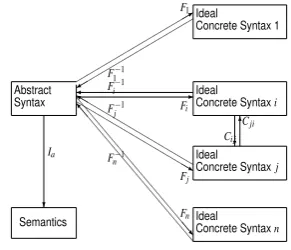
The introduction in the ISO standard of an abstract syn-tax, besides a concrete representation format, was to allow precise determination of the interoperability of alternative representations. Figure 3 displays the relations between an abstract syntax, one or more alternative ideal representation formats, and the semantics of a markup language according to SemAF-Principles.
Since the DiAML-XML format is defined in such a way that it is both complete and unambiguous, a functionFXML
can be defined that maps annotation structures as defined by the abstract syntax to an XML expression; due to the
Abstract
Figure 3: Abstract and concrete syntax, and semantics
unambiguity, this function has an inverseF−1
XMLwhich maps
any DiAML-XML expression to the annotation structure that it represents.
A tabular representation can be formally defined as a matrix of which each row is ann-tuple of elements corresponding to the contents of its cells. Using this formalization, the functionsFMultiTabandFTabSW are specified below, proving
that the modified tabular formats MultiTab and TabSW are complete. Similarly, defining their inverses F−1
MultiTab and
F−1
TabSW, shows their unambiguity. As a result, the
composi-tion of funccomposi-tions such as
(3) CMultiTab→XML=FXMLo FMultiTab−1
3.2.
Abstract Syntax
The abstract syntax of DiAML reflects the conceptual anal-ysis of dialogue acts according to Dynamic Interpretation Theory (DIT), which underlies the DIT++and ISO 24617-2 annotation schemes. On this analysis, a dialogue act is characterized by seven elements: (1) a sender; (2) one or more addressees; (3) zero or more other participants, such as an audience; (4) a communicative function; (5) a dimen-sion; (6) zero or more qualifiers; (7) zero or more depen-dence relations.
Two types of dependence relations are distinguished. A ‘functional’ dependence occurs when a dialogue act is se-mantically dependent on one or more previous dialogue acts due to having a communicative function of a respon-sive character. This is for example the case for answers, whose meaning is partly determined by the question which is being answered, but also for the acceptance or rejec-tion of offers, suggesrejec-tions, requests, and the acceptance of apologies and thankings. The subsetRSPof the set of com-municative functions, defined as part of the conceptual vo-cabulary, contains these communicative functions.
Feedback acts provide or elicit information about the pro-cessing of something that was said earlier in the dialogue, such as its perception or its interpretation, and their mean-ing often depends on that. Positive feedback utterances like“OK”and“Yes”, and negative ones like“What?”and “Excuse me?”illustrate this phenomenon. While positive feedback acts are typically about the processing of previ-ous dialogue acts, negative feedback acts are often about a problem in understanding something, and may thus refer to a segment of speech rather than to its interpretation as a di-alogue act. ISO 24617-2 therefore allows feedback depen-dence relations to have both dialogue acts and markables as antecedent arguments.
Note that a dialogue act can either have a functional de-pendence relation or a feedback dede-pendence relation to one or more other dialogue acts (or markables), but not both. Only dialogue acts in one of the two feedback dimensions can have a feedback dependence relation, and only dialogue acts with a responsive communicative function (f ∈RSP) have a functional dependence relation; such a function can be either a general-purpose one, like Answer, Agreement, or Correction, or a dimension-specific one, such as Return Greeting, Accept Apology, Self-Correction and Comple-tion. A dialogue act in one of the feedback dimensions that has a responsive general-purpose function has a functional dependence relation; all other acts in a feedback dimension have a feedback dependence relation. The following speci-fication lists the possible dependences of a dialogue act:
(4) Dependence relations:
1. Every dialogue act with a responsive commu-nicative function has a functional dependence re-lation.
2. Every dialogue act in the Auto-Feedback or the Allo-Feedback dimension that does not have a re-sponsive communicative function has a feedback dependence relation.
3. No other dialogue acts have functional or feed-back dependence relations.
Since a dialogue act can have a functional or a feedback dependence relation but not both, the component in a dialogue act annotation structure (the component∆in (7)) can be simply be the set of antecedents that the dialogue act depends on.4 Since responsive dialogue acts and feedback
acts are semantically incomplete without the specification of functional and feedback dependences, these are part of the structures that are used to annotate such acts.
A dialogue act may, finally, also be related to other dialogue acts through rhetorical relations, as in (5).
(5)
1. A: it ties you on in terms of the technology and the complexity that you want 2. A: like for example voice recognition 3. A: because you might need to power a
microphone and other things
In this example5 we see three functional segments, where
the second is related to the first through anExemplification relation, and the third to the first through an Explanation relation.
Different from functional and feedback dependence rela-tions, rhetorical relations are not part of the meaning of a dialogue act, but add information to the way a fully defined dialogue act is used to establish a semantic relation to other dialogue acts (or how their semantic contents are related – see Petukhova et al., 2011). They are therefore not part of an entity strucutre that describes a dialogue act, but they occur in link structures that relate dialogue acts.
An abstract syntax consists in general of: (a) a specification of the elements from which annotation structures are built up, called a ‘conceptual inventory’, and (b) a specification of the possible ways of constructing annotation structures using these elements. The DiAML abstract syntax is defined by the following specification:
Specification 1. DiAML abstract syntax.
a. Conceptual inventory
The DiAML conceptual inventory consists of six sets:
1. a set of dimensions (ten in the case of DIT++; nine in ISO 24617-2; these include the dimensions Task, Auto-FeedbackandAllo-Feedback);
2. a set of communicative functions, partitioned into ‘general-purpose’ functions, which can be used in any dimension, and sets of ‘dimension-specific’ functions for each dimension except Task. A subset RSP of the set of communicative functions is specified as the ‘responsive’ communicative functions (including both general-purpose and dimension-specific functions);
4This is a small technical improvement over the definition of the DiAML abstract syntax in ISO 24617-2: 2012.
5From the AMI corpus, see http://corpus.
3. a set of qualifiers that can be associated with dialogue acts, partitioned into subsets for certainty, condition-ality, and sentiment;
4. a set of rhetorical relations that can hold between dia-logue acts (or their semantic contents);
5. a set of dialogue participants, including possible side-participants or audiences, besides actively participat-ing speakers and addressees;
6. a set of functional segments of primary data.
The sets of functional segments and dialogue participants are specific for a particular annotation task; the other concepts are tasl-independent.
b. Annotation structures
An annotation structure is a set{ε1, . . . ,εk,L1, . . . ,Lm}
con-sisting of the entity structures{ε1, . . . ,εk,}, withk≥1, and
the link structures{L1, . . . ,Lm}(withm≥0). Entity
struc-tures contain semantic information about a functional seg-ment; link structures describe semantic relations between functional segments. An entity structure in DiAML is a pair
(6) ε=hm,αi
consisting of a functional segmentm(a ‘markable’) and the characterization of a dialogue act, which is either a 6-tuple (7a) or a 7-tuple (7b), whereSis the sender of the dialogue act; Ais a non-empty set of addressees; H is a (possibly empty) set of other dialogue participants;dis a dimension; f is a communicative function;Qis a (possibly empty) set of qualifiers, and∆is a set of other dialogue acts that the dialogue act in focus depends on.
(7) a.α =hS,A,H,d,f,Qi
b.α =hS,A,H,d,f,Q,∆i
Case (7a) occurs when the communicative function f is not a responsive one and the dialogue act does not belong to the auto- or the allo-feedback dimension.
A link structure is a triplehε,E,ρiconsisting of an entity
structure ε, a non-empty setE of entity structures, and a
rhetorical relationρ, which relates the dialogue actα inε
to the entity structures inE.
3.3.
DiAML Representations
3.3.1. Anchoring Annotations in Primary Data
Representation in DIAML relies on a three-level architec-ture: (1) a primary source, which may correspond to a speech recording, textual transcription or any further low-level annotation thereof; (2) the marking of functional seg-ments in the primary source; (3) the actual dialogue act information associated with a functional segment. Di-AML annotation is concerned with level (3) and follows the stand-off annotation approach: annotations refer to seg-ments of the primary data specified at level (2), and the pri-mary data are kept separate. This is quite clear in DiAML-XML representations, such as (1), where functional seg-ments appear as the values of the ‘target’ attribute, which
<?xml version=”1.0” encoding=”UTF-8”?> <TEI xmlns=”http://www.tei-c.org/ns/1.0”> <body/ >
<div><head>The dialogue turns, segmented into words
(TEI-compliant)</head> <u>
<w xml:id=”w1”>right</w> <w xml:id=”w2”>go</w> <w xml:id=”w3”>south</w> <w xml:id=”w4”>and</w> <w xml:id=”w5”>you’ll</w> <w xml:id=”w6”>pass</w> <w xml:id=”w7”>some</w> <w xml:id=”w8”>cliffs</w> <w xml:id=”w9”>on</w> <w xml:id=”w10”>your</w> <w xml:id=”w11”>right</w> </u>
</div>
<div><head>Identification of functional segments</head> <spanGrp xml:id=”ves1” type=”functionalVerbalSegment”>
<span xml:id=”ts1” type=”textStretch” from=”w1” to=”w1”/> </spanGrp>
<fs type=”functionalSegment” xml:id=”fs1”/> <f name=”verbalComponent” fVal=”#ves1”/ ><fs/ > <spanGrp xml:id=”ves2” type=”functionalVerbalSegment”>
<span xml:id=”ts2” type=”textStretch” from=”w2” to=”w11”/> </spanGrp>
<fs type=”functionalSegment” xml:id=”fs2”> <f name=”verbalComponent” fVal=”#ves2”/></fs> </div>
</body> </TEI>
Figure 4: TEI-compliant segmentation of primary data.
are assumed to be given as markables. Figure 4 shows how these markables can be defined at level 2 in a TEI-compliant way.
To make the tabular representation formats shown in Fig-ures 1 and 2 fit into this 3-level architecture, these formats were modified as described in the next subsections.
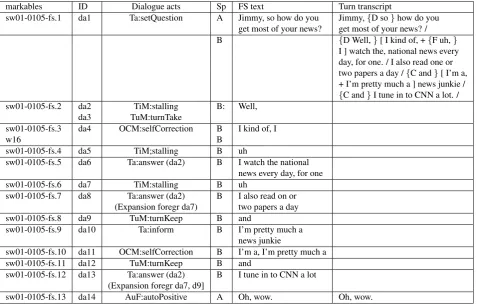
3.3.2. DiAML-TabSW
markables ID Dialogue acts Sp FS text Turn transcript
sw01-0105-fs.1 da1 Ta:setQuestion A Jimmy, so how do you Jimmy,{D so}how do you
get most of your news? get most of your news? / B {D Well,}[ I kind of, +{F uh,}
I ] watch the, national news every day, for one. / I also read one or two papers a day /{C and}[ I’m a,
+ I’m pretty much a ] news junkie /
{C and}I tune in to CNN a lot. / sw01-0105-fs.2 da2 TiM:stalling B: Well,
da3 TuM:turnTake
sw01-0105-fs.3 da4 OCM:selfCorrection B I kind of, I
w16 B
sw01-0105-fs.4 da5 TiM;stalling B uh
sw01-0105-fs.5 da6 Ta:answer (da2) B I watch the national news every day, for one sw01-0105-fs.6 da7 TiM:stalling B uh
sw01-0105-fs.7 da8 Ta:answer (da2) B I also read on or (Expansion foregr da7) two papers a day sw01-0105-fs.8 da9 TuM:turnKeep B and
sw01-0105-fs.9 da10 Ta:inform B I’m pretty much a news junkie
sw01-0105-fs.10 da11 OCM:selfCorrection B I’m a, I’m pretty much a sw01-0105-fs.11 da12 TuM:turnKeep B and
sw01-0105-fs.12 da13 Ta:answer (da2) B I tune in to CNN a lot (Expansion foregr da7, d9]
sw01-0105-fs.13 da14 AuF:autoPositive A Oh, wow. Oh, wow.
Figure 5: ISO 24617-2 annotation of dialogue fragment in Fig. 1, represented in DiAML-TabSW format.
text of a functional segment is represented in an extra col-umn (colcol-umn 5 in Fig. 5); the transcripts of speaker turns were retained as in Fig. 1, allowing one to see immediately where a functional segment occurs. The textual information in the columns 4 and 5 in Fig. 5 is strictly speaking redun-dant, and has no formal status in DiAML, but makes the annotations more readable.6Contentwise, the most
signifi-cant modification is the replacement in the second column of the SWBD-DAMSL tags by the DiAML representation of (1) communicative function; (2) dimension; (3) quali-fiers (if any); and (4) dependences (if any) - and this for all dialogue acts expressed by the functional segment of that row. Figure 5 shows the resulting DiAML-TabSW format applied to the same dialogue fragment as Fig. 1.
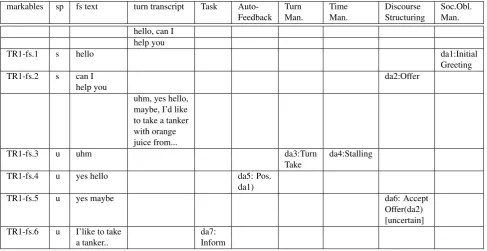
3.3.3. DiAML-MultiTab
The tabular representation format produced by the DitAT tool for DIT annotations, shown in Fig. 2, was likewise modified in order to be fully ISO-compliant. The identi-fiers of functional segments in the leftmost column in Fig. 2 were replaced by references to the functional segment spec-ifications. The ‘transcript’ column in Fig. 2 was split into a column containing functional segment texts and one con-taining turn transcripts.
The Contact Management column in Fig. 2 was deleted, since this dimension has not been adopted in ISO 24617-2. Like in DiAML-TabSW, the contents of the cells in the dimension columns were enriched to contain complete
di-6See ISO Principles or Bunt (2015) for the use of elements in a concrete representation that have no correspondence to elements in the underlying abstract syntax.
alogue act information according to ISO 24617-2. The re-sulting format is shown in Fig. 6.
3.4.
Encodings and Mappings
Functional and feedback dependence relations give rise to nested structures in the abstract syntax. For example, an answer by participant A to a question by participant B about the task domain takes the form of an entity structure with the following schematic form (for simplicity omitting empty sets of ‘other participants’ and qualifiers):
hm,hA,B,Task,answer,hm,hB,A,Task,questioniiii
‘Flat’ representation of annotation structures is made pos-sible by the introduction of identifiers for dialogue act rep-resentations and using these to refer from one dialogue act to another, as in Fig. 5 for dialogue act da6.
In a tabular format, rhetorical relations are are most con-veniently rendered as a property of the second argument of a relation, since this is typically where the existence of a rhetorical relation becomes apparent; see e.g. dialogue act da8 in Fig. 5.
DiAML annotation structures can be represented in Mul-tiTab through the following procedure, which defines the encoding functionFMultiTab.
Specification 2. Encoding DiAML annotation
struc-tures in DiAML-MultiTab representation format. For a given annotation structure{ε1, . . . ,εk,L1, . . . ,Lm}:
1. Step 1: introduction of identifiers for entity structures. Sort the entity structuresε1, . . . ,εk according to their
mark-markables sp fs text turn transcript Task Auto- Turn Time Discourse Soc.Obl. Feedback Man. Man. Structuring Man. hello, can I
help you
TR1-fs.1 s hello da1:Initial
Greeting
TR1-fs.2 s can I da2:Offer
help you
uhm, yes hello, maybe, I’d like to take a tanker with orange juice from...
TR1-fs.3 u uhm da3:Turn da4:Stalling
Take
TR1-fs.4 u yes hello da5: Pos.
da1)
TR1-fs.5 u yes maybe da6: Accept
Offer(da2) [uncertain] TR1-fs.6 u I’like to take da7:
a tanker.. Inform
Figure 6: ISO 24617-2 annotation of TRAINS dialogue fragment represented in DiAML-MultiTab format
able according to their dimension, with Task = 1, Auto-Feedback = 2, Allo-Feedback = 3, Turn Manage-ment = 4, Time ManageManage-ment = 5, Own Communica-tion Management = 6, Partner CommunicaCommunica-tion Man-agement = 7, Discourse Structuring = 8, Social Obli-gation Management = 9. Assign to each entity struc-ture an index corresponding to its position in the re-sulting ordering.
Output of this step is a setE={hεi,ii, . . . ,hεn,ni}of
entity structures with indices.
2. Step 2: extraction of elements for cells in DiAML-MultiTab cells from indexed entity structures: Te(hhm,hS,A,H,d,f,Q,∆ii,ii)=hhm,hS,A,H,hd,
hi,f,Q,∆iiiii 3. Step 3: restructuring the information in link structures
in entity-like form. IfL=hε1,{ε2, ...,εk},ρi, withε1
=hm1,hS1,A1,H1,d1,f1,Q1,∆1ii, then
TL(L)=hm1,hS1,A1,H1,hd1,hi1,f1,Q1,∆1
hρ,ρ1,{i2, ..,ik}iiiii
where ρ1 is the argument role of the related
dia-logue act(s)7; i
2, ..,ik are the indices of the structures
{hε2,i2i, ...,hεk,iki}, built in step 1.
The structures buit in this step are copies of structures built in step 2, extended with information from rhetorical links. The next step will eliminate dupli-cated information by merging the structures with and without rhetorical link information.
4. Step 4: merge of structures built in the previous two steps with and without rhetorical link information. This merge operation succeeds only if both arguments
7The abstract syntax of ISO standard 24617-8:2016 for anno-tating rhetorical relations assigns to each relation two argument roles, such as the rolesreasonandresultto the relationCause.
are identical except that one of them has additional rhetorical link information specified.
5. Step 5 finally forms combinations of all the struc-tures constructed so far that have the same mark-able. This operation is defined as: hm,hS,hd1,αiii ⊕
hm,hS,hd2,βiii=hm,hS,{hd1,αi,hd2,β}ii
These steps produce a set of structures of the form hm,S,A,H,{hd1,α1i, ...hdk,αki}iwhereαjis maximally a
quintuple hi,f,Q,∆,Rrhi (each of the last three elements
may be absent) and corresponds to the content of a cell in of one of the nine dimension-related columns in DiAML-MultiTab representations.
A convenient layout of such a table uses the first 4 columns for representing markable (m), speaker (S), addressee (A) and ‘other participants’ (H), and the remaining 9 columns as corresponding to the 9 dimensions of ISO 24617-2, rep-resenting the dialogue acts within a particular dimension in the corresponding column. For the sake of readability, the addressee column may be suppressed for two-party di-alogues, and the ‘other participants’ column may be sup-pressed if there are no such participants; instead, as we did in Fig. 6, columns representing the textual content of func-tional segments and turns greatly increases the readability.
The DiAML-TabSW encoding of annotation structures (the functionFTabSW) may be defined in a similar way, the only
difference being that all dialogue acts expressed by a func-tional segment are represented in a single column with an indication of their dimension, as illustrated in Fig. 5. The definition of the encoding functions FMultiTab) and
FTabSW demonstrates the completeness of the two tabular
Origin Lang Original representation Original annotation DiAML representation
HCRC Map Task EN NITE XML HCRC Map Task DiAML-XML
communicative functions
Switchboard EN 3-column tabular SWBD-DAMSL DiAML-TabSW communicative functions
TRAINS EN 13-column tabular DAMSL DiAML-MutiTab
communicative functions
DBOX EN DiAML-XML ISO 24617-2 annotations DiAML-XML
Dutch Map Task NL plain text transcript no dialogue act annotation DiAML-MultiTab DIAMOND NL 13-column tabular DIT++communicative DiAML-MultiTab
functions and dimensions
OVIS NL plain text transcript no dialogue act annotation DiAML-MultiTab Schiphol Airport NL plain text transcript no dialogue act annotation DiAML-XML
Table 1: Current contents of the DialogBank corpus.
with the corresponding functions for the DiAML-XML for-mat, this demonstrates the interoperability of the three rep-resentation formats.
4.
Conclusions and Future Work
The DialogBank is presently in beta version and had its first public release in December 2015. It contains at the time of writing annotated dialogues with the properties shown in Table 1. The dialogues from the HCRC Map Task and TRAINS corpora were re-segmented and re-annotated ac-cording to ISO 24617-2. The annotations of the Switch-board dialogues were converted semi-automatically by Fang et al. (2012) from SWBD-DAMSL tags to ISO 24617-2 function tags; this has been used as an interme-diate step to the construction of full-blown ISO 24617-2 annotations. The DBOX corpus was collected at the Uni-versity of Saarland and annotated using the ISO 24617-2 standard. The annotations of the dialogues from the DI-AMOND corpus were obtained by adapting DIT++. The dialogues from the Dutch Map Task, OVIS, and Schiphol corpora had not been annotated before.In the near future, more annotated dialogues from these cor-pora will be added. as well as multi-party dialogues from the AMI corpus.
Bibliography
Allen, J. and Core, M. (1997) DAMSL: Dialogue Act Markup in Several Layers. Technical Report, Multiparty Discourse Group.
Allen, J. et al. (1994) The TRAINS Project: a case study in building a conversational planning agent. Technical Note 94-3. University of Rochester.
Alexandersson, J., et al. (1998) Dialogue acts in Verbmobil-2. Second edition. Report 226. DFKI Saarbr¨ucken.
Andersson, A., et al. (1991) The HCRC Map Task Corpus. Language and Speech34, 351-366.
Bunt, H. (1994) Context and dialogue control. Think Quarterly 3(1), 19-31.
Bunt, H. and Black, W. (2000) Dialogue pragmatics and context specification. In Harry Bunt and William Black (eds.)Abduction, Belief and Context in Dialogue, Ben-jamin, Amsterdam, pp. 81-150.
Bunt, H. (2009) The DIT++taxonomy for functional di-alogue markup.AAMAS Workshop ’Towards a Standard Markup Language for Embodied Dialogue Acts, 13-23. Bunt, H. (2010) A methodology for designing semantic
annotation languages exploiting syntactic-semantic iso-morphisms. InProceedings of ICGL 2010, Second Inter-national Conference on Global Interoperability for Lan-guage Resources, Hong Kong, pp. 29-45.
Bunt, H. (2015) On the principles of semantic annotation. InProceedings of ISA-11, London, pp. 1-13.
Bunt, H., Alexandersson, J., Carletta, J., Choe, J.-W., Fang, A., Hasida, K., Lee, K., Petukhova, V., Popescu-Belis, A., Romary, L., Soria, C. and Traum, D. (2010) To-wards an ISO standard for dialogue act annotation. In Proceedings of LREC 2010.
Fang, A., Cao, J., Bunt, H., and Liu, X. (2012) The an-notation of the Switchboard corpus with the new ISO standard for Dialogue Act Analysis. In Proceedings of ISA-8, Pisa, pp. 13-18.
Geertzen, J., et al. (2004) The DIAMOND project. In Pro-ceedings of SIGSEM 2004 (CATALOG), Barcelona. Geertzen, J. (2007) DitAT: a flexible tool to support
web-based dialogue annotation. Proceedings of IWCS 2007, Tilburg, pp. 320-323
Ide, N. and Romary, L. (2004) International Standard for a Linguistic Annotation Framework. Natural Language Engineering10: 221-225.
Jurafsky, D., Schriberg, E., and Biasca, D. (1997) Switch-board SWBD-DAMSL Shallow-Discourse-Function An-notation: Coders Manual, University of Colorado. Kipp, M. (2001) Anvil - A Generic Annotation Tool for
Multimodal Dialogue.Eurospeech 2001, 1367-1370. Petukhova, V. and Pr´evot, L. and Bunt, H. 2011 Discourse
Relations in Dialogue. In:Proc. ISA-6, Oxford), 18-27. Petukhova, V. et al.(2014) The DBOX Corpus Collection of
Spoken Human-Human and Human-Machine Dialogues, InProceedings of LREC 2014, Reykjavik.
Pr¨ust, H., Minnen, G., and Beun, R.-J. (1984) Transcrip-tie dialooogesperiment juni/juli 1984, IPO Rapport 481. Eindhoven University of Technology.