R E S E A R C H A R T I C L E
Open Access
Stillbirth differences according to regions of
origin: an analysis of the German perinatal
database, 2004-2007
Anna Reeske
1,2*, Marcus Kutschmann
3, Oliver Razum
1and Jacob Spallek
1,2Abstract
Background:Stillbirth is a sensitive indicator for access to, and quality of health care and social services in a society. If a particular population group e.g. migrants experiences higher rates of stillbirth, this might be an indication of social deprivation or barriers to health care. This study examines differences in risk of stillbirth for women of different regions of origin compared to women from Germany in order to identify high risk groups/ target groups for prevention strategies.
Methods:We used the BQS dataset routinely compiled to examine perinatal outcomes in Germany nationwide. Participation of hospitals and completeness of data has been about 98% in recent years. Data on all live births and stillbirths were obtained for the period 2004 to 2007 (N = 2,670,048). We calculated crude and stratified mortality rates as well as corresponding relative mortality risks.
Results:A significantly elevated stillbirth rate was found for women from the Middle East and North Africa (incl. Turkey) (RR 1.34, CI 1.22-1.55). The risk was slightly attenuated for low SES. An elevated risk was also found for women from Asia (RR 1.18, CI 1.02-1.65) and from Mediterranean countries (RR 1.14, CI 0.93-1.28). No considerable differences either in use and timing of antenatal care or preterm birth and low birthweight were observed between migrant and non-migrant women. After stratification for light for gestational age, the relative risk of stillbirth for women from the Middle East/North Africa increased to 1.63 (95% CI 1.25-2.13). When adjusted for preterm births with low birthweight, women from Eastern Europe and the Middle East/North Africa experienced a 26% (43%) higher risk compared with women from Germany.
Conclusions:We found differences in risk of stillbirth among women from Middle East/North Africa, especially in association with low SES and low birthweight for gestational age. Our findings suggest a need for developing and evaluating socially and culturally sensitive health promotion and prevention programmes for this group. The findings should also stimulate discussion about the quality and appropriateness of antenatal and perinatal care of pregnant women and newborns with migrant backgrounds.
Keywords:stillbirth, region of origin, relative differences, risk factors
Background
Although stillbirth occurs rather rarely it is one of the more devastating events in obstetrics and a sensitive indicator for the quality of health care, living conditions and inequity in a society. If a particular population group, such as migrants experiences higher rates of
stillbirth than the non-migrant population, this might be an indication of social deprivation or access to health care barriers.
Migrants tend to be more vulnerable in terms of mor-bidity and mortality patterns compared to non-migrant populations, influenced e.g. by socioeconomic factors, barriers to prevention and health care offers, as well as migration and cultural related factors [1,2].
Recent published worldwide estimates of stillbirth rates showed a decline from 22.1 stillbirths per 1000 * Correspondence: [email protected]
1
Department of Epidemiology & International Public Health, School of Public Health, Bielefeld University, P.O. Box 10 01 31, D-33501 Bielefeld, Germany Full list of author information is available at the end of the article
births in 1995 to 18.9 in 2009, with the highest rates being observed in south Asia and sub-Saharan Africa [3]. It is, however, also a topic of high public health rele-vance in high-income countries because of the dispari-ties in stillbirth rates among different ethnic groups in these societies [4]. In Europe and the USA, several stu-dies have shown disparities in stillbirth, perinatal and infant mortality among ethnic groups compared with the host population of each country [5-11]. In European countries, risks of stillbirth are elevated especially for women from non-western countries, e.g. from Turkey, Morocco, Pakistan, Somalia and Ghana [5-7]. A recent systematic literature review on differences in stillbirths and infant deaths between migrant and non-migrant populations in industrialized countries however shows inconsistent results. Half of the studies reported worse mortality outcomes for migrants, one third did not find considerable differences and a few found better mortal-ity outcomes for migrants compared with the non-migrant population [12]. Furthermore, the distribution of risk factors for stillbirth, such as preterm birth [13-15], low birthweight [16-18], congenital anomalies [19,20], and inappropriate use of antenatal care [21-23], varies between ethnic groups in European countries.
In Germany, nationwide analyses on differences in stillbirth among migrants and non-migrants are lacking. Despite a positive trend in recent decades, there are indications that infant mortality among non-Germans is still higher than among Germans, [1]. Regional studies confirm this finding [24,25]. Women with Turkish ori-gin and immigrant women with a short duration of stay seem to be mainly affected [1,25,26]. Some studies also indicate differences between women with migrant grounds compared with women without migrant back-grounds in terms of certain risk factors for stillbirth [27-30]. Nevertheless, nationwide analyses on risk differ-ences of stillbirth for different ethnic groups in Ger-many are still missing.
We compared the risk of stillbirth among women of different regions of origin with that of women without migrant backgrounds. Our aim was to identify high risk groups/target groups for prevention strategies in order to reduce inequalities in stillbirth and associated factors. The present study is the first in Germany to use nation-wide perinatal data for the investigation of variations in the risk of stillbirth in relation to maternal migrant background.
Methods Database
We used anonymous data from the nationwide perinatal database maintained by the German National Agency for Performance Measurement in Health Care [Bundes-geschäftsstelle Qualitätssicherung gGmbH (BQS), since
2010: BQS Institute for Quality and Patient Safety]. From 2001-2009, the BQS was responsible for the devel-opment and implementation of comparative quality assurance in German hospitals. For this purpose, the BQS collected basic data and quality indicators from all hospitals in Germany. Participation in the quality assur-ance program is compulsory for all hospitals by law. Hence, the BQS database contains complete data con-cerning hospital-related processes of medical and nur-sing care. Participation of hospitals and completeness of data was about 98% in recent years [31]. All phases of the study were subject to the strict data protection regu-lations of the BQS and the German law. The study was performed in accordance with the guidelines for Good Scientific and Good Epidemiological Praxis of the Ger-man Society for Epidemiology (DGEPI 2008).
Ethical approval was not needed for our study as we fulfilled the criteria of the“Good Practice in Secondary Data Analysis” (GPS) of the German epidemiological societies. According to this guideline we observed all data protection provisions for secondary data analysis. Only anonymised data were used. Hence a re-identifica-tion of persons was not possible and no informed con-sent of participants was necessary.
Quality assessment in the field of obstetrics is based on a nationally standardized electronic data entry form which contains items concerning socio-demographic data of the mother, course of current pregnancy, deliv-ery and birth outcomes, and health of the newborn. The perinatal database includes only live births and stillbirths born in a hospital, but no spontaneous abortions and home deliveries.
The perinatal data entry form is filled in by the staff of the labour room. Pregnancy-related information is obtained from the maternity care records each mother is supposed to carry during pregnancy, and birth-related information is obtained from the hospital records. After-wards, data is submitted electronically to the Agency for Performance Measurement in Health Care (Landes-geschäftsstelle für Qualitätssicherung [LQS]) in the fed-eral state in which the hospital is located. The LQSs ensure anonymization and internal validation of the data and submits them to the BQS.
We obtained pregnancy and birth-related data for all live- and stillbirths during the time period 2004 to 2007 (N = 2,670,048).
Outcome
were excluded from the analyses. Stillbirth rate was defined as the number of stillbirths during the period from 2004 to 2007 per 1,000 live- and stillbirths during the same period. An external validation procedure with population data of the Federal Statistical Office revealed that completeness of reporting of stillbirths was about 90%. Differential recording of stillbirths is improbable because stillbirths are recorded directly after delivery.
Region of origin
In the German perinatal database, migrant background is assessed by the mother’s region of origin, grouped in six bands: (1) Germany, (2) Middle and Northern Eur-ope, North America, (3) Mediterranean countries, (4) Eastern Europe, (5) the Middle East and (6) Asia. An overview of countries in the different bands can be found in the Additional file 1 Table S1. Germany’s lar-gest migrant group by nationality, the Turkish migrants, is assigned to the“Middle East”, together with Afghani-stan, PakiAfghani-stan, and the Arab countries of North Africa. A separation of countries within a band is not possible. The group“other countries”was excluded from the ana-lyses as there is no information on which countries are included in this band. We did not obtain information on the manner and consistency concerning the assess-ment of “region of origin” in German hospitals. Thus we cannot exclude the possibility that hospital staff completing the perinatal sheet used concepts and defini-tions on migrant background other than region of origin (e.g. nationality). In the present paper, we referred to women originating from Germany as “women without migrant backgrounds” or “women from Germany”, although this might be imprecise.
Stratification factors
Socio-demographic and lifestyle-related factors
The socioeconomic status of mothers is insufficiently measured in the database. The variable“mother’s occu-pation” was the only one available as proxy for her socioeconomic status. We classified “housewife” and “un-/skilled worker” into low SES, “low-level office worker” and “currently being a trainee/student” into middle SES and “middle/high-level office worker” into high level SES. Nevertheless, it is a rather insufficient indicator for the SES, because subsidiary details con-cerning the occupation and income of the newborn’s father are not included in the database. We assessed “being single (yes/no)” as a further available proxy for an unfavourable socioeconomic situation. Maternal age was classified in five groups (< 18, 18-29, 30-34, 35-39, > 39) and parity in three groups (0, 1,≥2). The variable “smoking after awareness of pregnancy” was grouped in three categories (yes/no/missing information).
Obstetric factors
Concerning obstetric determinants, the following infor-mation was included: low birthweight (< 2500 g,≥2500 g), gestational age in weeks (< 28, 28-31, 32-36, ≥ 37) and congenital anomalies (yes/no). Preterm delivery is often associated with low birthweight. In order to explore interaction effects of gestational age & birth-weight on the stillbirth risk among women with and without migrant background, we defined an interaction variable grouped in four categories:
(1) preterm delivery (< 37 gestational weeks) com-bined with low birthweight (< 2500 g),
(2) preterm delivery (< 37 gestational weeks) com-bined with normal birthweight (≥ 2500 g), (3) term delivery (≥ 37 gestational weeks) combined with low birthweight (< 2500 g),
(4) term delivery (≥ 37 gestational weeks) combined with normal birthweight (≥2500 g).
Antenatal care
Use of antenatal care was assessed on the basis of num-ber of antenatal care visits and the timing of the first visit during pregnancy. According to the BQS definition, number of antenatal care visits was classified in (1) 0-4 visits (considered“insufficient care”), (2) 5-7 visits, (3) 8-11 visits, (4) > 11 visits (considered “above-average care”). The timing of first antenatal visit in gestational weeks was grouped in four categories: (1) < 9 gestational weeks, (2) 9-12 weeks, (3) 13-16 weeks, (4) > 16 weeks. Furthermore, the number of ultrasounds and the timing of first ultrasound during pregnancy was also assessed according to the BQS definition. The number of ultra-sounds was classified into (1) 0-2, (2) 3-4 (according to the German maternity guideline considered as standard for low risk pregnancies), (3) > 4. The timing of first ultrasound in gestational weeks was grouped into (1) 0-8, (2) 9-12, (3) 13-16 and (4) > 16 weeks.
Maternal co-morbidities
Maternal co-morbidities during pregnancy are assessed as pregnancy risk factors. We included pre-eclampsia, eclampsia, placenta praevia (antenatal) and placenta praevia (during birth) as important risk factors for still-birth, classified into binary variables (yes/no).
Statistical analysis
Firstly, we tested differences in socioeconomic, preg-nancy and delivery related characteristics between the migrant groups and the German reference group using chi-square tests.
influence on differences in stillbirth rates between women of different region of origin and women without migrant backgrounds.
Thirdly, we calculated crude and stratified relative mortality risks and 95% confidence intervals. These expressed the relative risk of stillbirth for women from each foreign region of origin compared with women without migrant backgrounds (reference group).
All statistical analyses were performed using the Sta-tistical Package of Social Science version 16.0 (SPSS Inc., Chicago, IL, USA).
Results
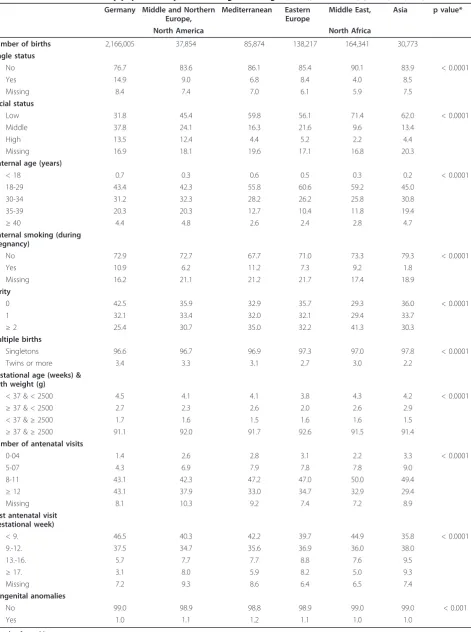
During the period 2004-2007 there were 2,623,064 live-births and stilllive-births in Germany of which 504.043 (18.9%) were to women from foreign regions of origin. Of the mothers, 37,854 originated from Middle and Northern Europe or North America, 85,874 from Medi-terranean countries, 138,217 from Eastern Europe, 164,341 from the Middle East or North Africa (incl. Turkey) and 30,773 from Asia. Migrants grouped in the category“other countries”were excluded from the ana-lysis (n = 46,984). Table 1 details the numbers of births and selected characteristics of mothers and their new-borns by region of origin. Further characteristics can be found in Additional file 2, Table S2.
Compared with women without migrant backgrounds, women with migrant backgrounds were of younger age at delivery, more often multiparous, and less often sin-gle. The proportion of single women was lowest among women from the Middle East and North Africa. They also showed the highest proportion of mothers with a low social status (71.4%).
In our sample, women with and without migrant backgrounds showed no substantial differences in the number and timing of antenatal care visits. In all groups about 40% of pregnant women made sufficient use of antenatal care (8-11 visits). The proportion of women with insufficient care (0-7 visits) was low (under 3%). About 80% of pregnant women attended their first visit prior to gestational week 13, and nearly half of them attended before gestational week 9. Only women from Eastern Europe and Asia showed a higher prevalence of having their first visit rather late in pregnancy (after gestational week 12) and receiving only 0-4 visits (3.1 and 3.3 respectively, p < 0.0001).
The same applied to the number and timing of ultra-sound examinations. About 50% of migrant mothers had an appropriate number of ultrasound scans (3-4 scans) and about 70% had their first ultrasound within the first trimester, compared to 49.9% and 84%, respectively, among German mothers.
We could not find relevant differences between women with and without migrant backgrounds for
preterm delivery, low birthweight, smallness for gesta-tional age (SGA), congenital anomalies and eclampsia during delivery. Pre-eclampsia was more prevalent among mothers from Germany (2.5%, p < 0.0001) com-pared to 1.3% among mothers from the Middle East and North Africa and 1.2% among Asian mothers. Although the proportion was rather low, compared to the other groups Asian women experienced a higher risk of pla-centa praevia during pregnancy or birth (Additional file 2 Table S2).
Additional file 2 Table S3 shows the number of still-births and crude stillbirth rates by mother’s region of origin as well as relative mortality risks for migrant women compared with women from Germany. During the time period 2004 to 2007, a significantly elevated stillbirth rate was found for women originating from the Middle East and North Africa (incl. Turkey) in compari-son to German women (RR 1.34, CI 1.22-1.55). A slightly higher risk was found for women from Asia (RR 1.18, CI 1.02-1.65). Women from Mediterranean coun-tries had a slightly increased risk for stillbirth, but this increase was not significant (RR 1.14, CI 0.93-1.28). Relative risks of stillbirth for women from Middle and Northern Europe, North America and Eastern Europe were not elevated.
Stratified analyses
In stratified analyses, we examined the effect of the previously described factors on the relative differences in the relative risk of stillbirth for women with migrant backgrounds compared with women without migrant backgrounds (Additional File 2 Table S3), in order to identify possible confounders or effect modifications.
The relative risk of stillbirth was modified after adjust-ment for social status in all migrant groups. A signifi-cantly increased relative risk was only obvious among women from Middle East and North Africa with a low social status (RR 1.29, 95% CI 1.17-1.42). Amongst those with high social status, the relative risk was also elevated, but did not reach statistical significance. The number of stillbirths in this group was small.
Table 1 Characteristics of study population by mother’s region of origin (in %), 2004-2007, (N = 2,623,064)
Germany Middle and Northern Europe,
Mediterranean Eastern Europe
Middle East, Asia p value*
North America North Africa
Number of births 2,166,005 37,854 85,874 138,217 164,341 30,773
Single status
No 76.7 83.6 86.1 85.4 90.1 83.9 < 0.0001
Yes 14.9 9.0 6.8 8.4 4.0 8.5
Missing 8.4 7.4 7.0 6.1 5.9 7.5
Social status
Low 31.8 45.4 59.8 56.1 71.4 62.0 < 0.0001
Middle 37.8 24.1 16.3 21.6 9.6 13.4
High 13.5 12.4 4.4 5.2 2.2 4.4
Missing 16.9 18.1 19.6 17.1 16.8 20.3
Maternal age (years)
< 18 0.7 0.3 0.6 0.5 0.3 0.2 < 0.0001
18-29 43.4 42.3 55.8 60.6 59.2 45.0
30-34 31.2 32.3 28.2 26.2 25.8 30.8
35-39 20.3 20.3 12.7 10.4 11.8 19.4
≥40 4.4 4.8 2.6 2.4 2.8 4.7
Maternal smoking (during pregnancy)
No 72.9 72.7 67.7 71.0 73.3 79.3 < 0.0001
Yes 10.9 6.2 11.2 7.3 9.2 1.8
Missing 16.2 21.1 21.2 21.7 17.4 18.9
Parity
0 42.5 35.9 32.9 35.7 29.3 36.0 < 0.0001
1 32.1 33.4 32.0 32.1 29.4 33.7
≥2 25.4 30.7 35.0 32.2 41.3 30.3
Multiple births
Singletons 96.6 96.7 96.9 97.3 97.0 97.8 < 0.0001
Twins or more 3.4 3.3 3.1 2.7 3.0 2.2
Gestational age (weeks) & birth weight (g)
< 37 & < 2500 4.5 4.1 4.1 3.8 4.3 4.2 < 0.0001
≥37 & < 2500 2.7 2.3 2.6 2.0 2.6 2.9
< 37 &≥2500 1.7 1.6 1.5 1.6 1.6 1.5
≥37 &≥2500 91.1 92.0 91.7 92.6 91.5 91.4
Number of antenatal visits
0-04 1.4 2.6 2.8 3.1 2.2 3.3 < 0.0001
5-07 4.3 6.9 7.9 7.8 7.8 9.0
8-11 43.1 42.3 47.2 47.0 50.0 49.4
≥12 43.1 37.9 33.0 34.7 32.9 29.4
Missing 8.1 10.3 9.2 7.4 7.2 8.9
First antenatal visit (gestational week)
< 9. 46.5 40.3 42.2 39.7 44.9 35.8 < 0.0001
9.-12. 37.5 34.7 35.6 36.9 36.0 38.0
13.-16. 5.7 7.7 7.7 8.8 7.6 9.5
≥17. 3.1 8.0 5.9 8.2 5.0 9.3
Missing 7.2 9.3 8.6 6.4 6.5 7.4
Congenital anomalies
No 99.0 98.9 98.8 98.9 99.0 99.0 < 0.001
Yes 1.0 1.1 1.2 1.1 1.0 1.0
Adjusting for birthweight increased the relative risk in the birthweight groups under 2,500 g (low birthweight) significantly among women from Eastern Europe and those from the Middle East and North Africa.
Concerning the interaction of preterm birth and low birthweight, the risk of stillbirth for women from the Middle East and North Africa compared with the major-ity population was highest after 37 gestational weeks combined with low birthweight (RR 1.63, 95% CI 1.25-2.13). Women from Eastern Europe and from the Mid-dle East and North Africa respectively experienced a 26% and 43% higher risk of stillbirth before 37 getional weeks combined with low birthweight (both sta-tistical significant at a 5% level).
Among women who attended antenatal care before week 9 of their pregnancy, the relative risk of stillbirth was significantly higher for migrants from the Middle East and North Africa, for Mediterranean countries and for Asia compared to women from Germany (RR 1.40, 1.37 and 1.48 respectively), but it was lower among those who attended late. The trend was similar when the number of antenatal visits was analyzed: amongst women with a substandard number of visits, women with migrant backgrounds showed a lower relative risk of stillbirth compared with women without migrant backgrounds. However, amongst women attending more than 11 visits, women from the Middle East and North Africa showed a 41% higher risk compared with women without migrant backgrounds. The relative risks of still-birth adjusted for congenital anomalies remained stable (Additional file 2 Table S3).
Discussion
Interpretation of differences in stillbirth risk
The present study is the first in Germany to use nation-wide perinatal data for the investigation of variations in the risk of stillbirth in relation to maternal migrant background.
Using the German perinatal database, we found rela-tive differences in the risk of stillbirth for women of dif-ferent regions of origin compared with women from Germany. Women from the Middle East and North Africa (including immigrant women from Turkey) showed the highest risk. After adjustment for maternal characteristics and obstetric factors, the higher risk of stillbirth among women from the Middle East and North Africa was partly attenuated for example when stratified for mother’s occupation. However the overall risk remained stable for other characteristics. In contrast to prior studies we did not find any considerable differ-ences between women originating from foreign regions of origin compared to women from Germany in terms of obstetric factors that might explain the higher still-birth rates in some migrants groups, e.g. in timing and
number of antenatal care visits as well as preterm birth and low birthweight. As the factors analysed did not confound or modify the association between migrant background and increased risk of stillbirth in the major-ity of stratified analyses, migrant status may have an independent effect on the risk of stillbirth. As migrant background might be a proxy for other underlying fac-tors such as cultural facfac-tors, social deprivation, access barriers etc., further studies should focus on these factors.
The increased relative risk of stillbirth among women with migrant background was slightly mitigated after stratification for socio-demographic factors, such as sin-gle status, low social status, young age of mother and high parity (Tables 2) but it was still elevated compared with women from Germany. These results are in line with a Danish study, where a higher risk of stillbirth for Turkish and Pakistani women was not associated with their higher parity, lower educational level and lower household income compared to the Danish women [6].
As the variables available for SES were insufficient in this study we have to interpret our results very carefully. In addition, the population groups in each band are very heterogeneous e.g. in terms of socioeconomic status, making it difficult to examine associations between migrant background, SES and risk of stillbirth. Com-pared to other regions the Middle East and North Africa had the highest proportion of women with low SES. These women also experienced a higher risk of stillbirth. This might point to the importance of socioeconomic factors e.g. education and income as well as socioeco-nomic-related factors e.g. integration level and working possibilities of migrants when looking at stillbirth risks. This is in line with a study from the Netherlands, where higher infant mortality rates among Turkish migrants compared to women from the Netherlands were partly explained by socioeconomic and demographic factors [32]. Consequently, women from the Middle East and North Africa in Germany comprise an important target group for future prevention strategies in the field of pregnancy care.
women in Germany, at least during pregnancy, and the majority seems to be informed about the appropriate timing and number of antenatal visits. What we found was an excess risk of stillbirth for women from the Mediterranean countries and Asia amongst those who attended antenatal care prior to gestational week 9 and for women from the Middle East and North Africa, who attended antenatal care very early and received a suffi-cient number of visits.
In contrast, previous studies based on regional data of the German perinatal database found a less frequent use of antenatal care, in particular for single women with migrant backgrounds [34], women from Eastern Europe and Mediterranean countries [27,30] and a later use of antenatal care among women from the Middle East [29], from Eastern Europe and from Mediterranean countries [30]. In addition, regional differences in the analysis of BQS data indicate that our findings may vary between federal states as well as urban and rural areas within sin-gle federal states in Germany. Comparisons of results between the previous German studies and our study are difficult because of the variations in defined number, timing of antenatal care and differences in the studied migrant groups. Nevertheless, we cannot rule out the possibility of variations in use and timing of antenatal care according to particular countries of origin and regional levels in Germany. Hence, further analyses of risk differences in stillbirth and its determinants on regional level and for precisely defined migrant groups are necessary.
In our study, women with migrant background with only a few or no antenatal visits, or who attended very late, showed a lower risk of stillbirth compared with women without migrant background with similar utiliza-tion patterns. Women with migrant background give birth in younger years and have a higher parity com-pared with women without migrant background (Table 1 and 2). It can be assumed that the women with migrant backgrounds are a selection of young women who already gave birth to several children without severe complications and altogether show a low risk profile.
Several studies from Europe and the USA showed a higher maternal risk of preterm birth and low birth-weight for migrant women [13-18]. In contrast, there are several studies showing a lower risk for migrants despite risk factors such as higher parity and lower socioeco-nomic status [11,27,28]. In line with these findings we did not find differences in preterm birth and low birth-weight prevalence between women of different regions of origin and women from Germany. When looking at the risk of stillbirth adjusted for birthweight, women from Eastern Europe and from the Middle East and North Africa experienced a significantly higher risk. Our
findings also suggest that birthweight relative to the gestational age seems to have an influence on the differ-ences in risk of stillbirth: a low birthweight combined with a regular gestational age ("small or light for dates”) contributed to a higher risk of stillbirth, especially for women from the Middle East and North Africa compared to women from Germany. This might be an indication for a higher stillbirth risk among these women associated with intrauterine growth retardation (IUGR) or fetal mal-nutrition. Detecting IUGR is one of the main aims of routine ultrasound screening in antenatal care. A study found that the sensitivity of routine ultrasound examina-tions in Germany was extremely low; merely 30% of cases with intrauterine growth retardation were diag-nosed antenatally [35]. Further research is needed to vali-date our indicative findings regarding a higher risk of stillbirth in association with fetal malnutrition or IUGR association among women from the Middle East and North Africa, and to examine whether differences in sen-sitivity of antenatal diagnostic investigation between women with and without migrant background exist.
Higher risks of stillbirth in some migrant groups might be associated with a more unfavourable use of antenatal care compared to women without migrant background, but it might also be assumed that there are differences in the quality of antenatal care. In this con-text, studies found that 25-30% of perinatal deaths are due to factors of suboptimal care [36,37]. Among the commonly found explanatory factors for this are the missed or delayed diagnosis of intrauterine growth retar-dation and an inadequate management of this condition, as well as the patient’s non-compliance or delayed atten-dance to antenatal care [36,38]. A Europe-wide study ("Perinatal Death Audit Study”) found that migrant women have a higher risk for perinatal mortality due to suboptimal factors during antenatal care [39]. Some of these factors seem to be associated with poor language skills leading to miscommunication between migrants and health providers, as well as a lack of knowledge and attention to cultural-related issues among maternity care professionals [40]. Researchers in Germany have found differences in the quality of antenatal care between women of German and non-German nationality [41]. The authors used the quality of documentation in the maternity record as a proxy indicator for the quality of care. Completeness of anamnestic data and documen-tation of consuldocumen-tation were lower among foreign women than among women without migrant background. The documentation of prenatal diagnoses (e.g. IUGR) is thus likely to be lower among women with migrant back-ground and may result in insufficient surveillance of intrauterine growth.
anomalies. We were not able to show considerable dif-ferences in the rate of congenital anomalies or modifica-tions of risk of stillbirth adjusted for anomalies. However, several studies showed a higher perinatal mor-tality among newborns of women from non-western countries in the Netherlands and among Pakistani women in Great Britain, associated with a higher rate of congenital anomalies in these migrant groups [19,20,42]. A Norwegian study found that nearly 30% of infant deaths among Pakistani migrants were due to the high percentage of consanguine marriages in this group [20], with consanguinity as a risk factor e.g. for congenital anomalies. The prevalence of consanguine marriages is high among Turkish migrants, the largest migrant group by nationality in Germany. An association with higher rates of stillbirth might be probable [43,44]. However, this remains an assumption because the German perina-tal database does not contain valid information on the parents’familial relationship.
Strengths and Limitations
The strengths of this study are the large number of cases, its representativeness, the topicality and the com-pleteness of data. We used population based and Ger-many-wide data. The data used were collected in a systematic way so we could confidently rule out selec-tion bias. Furthermore, the study is the first to analyse relative differences in stillbirth rate and risk of stillbirth between several migrant groups in Germany.
The study, however, has its limitations. Although completeness of data is very high, the quality of some data items is sub-optimal. Jahn and Berle [45] were able to show that (obstetric) risk factors in the perinatal database are not documented as well as in the maternity log. Thus, there seems to be a loss of information in the data transmission process. “Occupation of the mother” showed a high non-response, and information on the father’s occupation and income is lacking. Although smoking had a high non-response, it was included in the analyses because there was no evidence for a differ-ential proportion of missings among women with and without migrant background. We are also not sure about the completeness of data concerning pre-eclamp-sia. While the eclampsia rate of 0.1% is similar to prior reported incidences for Germany [46,47], the pre-eclampsia rate seems to be too low, especially among migrant women. Prior studies reported pre-eclampsia incidences of 5-10% for Germany [47]. Eclampsia and pre-eclampsia occur during pregnancy and are mostly diagnosed and treated outpatiently by a gynaecologist. A possible reason for the inadequate reporting of these in the BQS data might therefore be that information from the maternal card about outpatient diagnoses and treat-ments are insufficiently transferred to the hospital data
and subsequently to the BQS. Birth related factors showed a high completeness.
approaches should be promoted and expanded to other federal states in Germany.
Conclusion
This study is the first in Germany to use a large nation-wide perinatal dataset for the investigation of variations in the risk of stillbirth in relation to maternal migration background. It shows differences in relative risk of still-birth among women of different regions of origin com-pared with women originating from Germany, with a significantly higher risk among women from the Middle East and North Africa (which includes Turkey). This migrant group also showed by far the highest proportion of low social status mothers. Our findings lend support to planned efforts to develop and evaluate culturally sensitive health promotion and prevention programmes for pregnant women with low education and a Turkish migrant background in Germany. Considerable differ-ences concerning obstetric risk factors, e.g. preterm birth, low birthweight as well as number and timing of antenatal care visits, could not be observed.
Our findings suggest a higher risk of stillbirth among women with migrant background due to intrauterine growth retardation. Differences in the quality of provi-sion of antenatal care and/or the management of condi-tions identified cannot be ruled out. Migrant women with an early uptake and a sufficient number of antena-tal visits experienced a higher risk of stillbirth. This indicates a particular need to closely monitor risk preg-nancies among these women. Further studies should investigate whether the higher risk of stillbirths among migrant women is due to a lower sensitivity of antenatal screening for intrauterine growth retardation and insuf-ficient follow-up interventions.
Additional material
Additional file 1: Table S1 - Overview of countries in the different regions of origin, according to BQS Institute. This table gives an overview of countries that are included in the variable“regions of origin”, according to BQS Institute.
Additional file 2: Table S2 - Further characteristics of study population by mother’s region of origin (in %), 2004-2007, (N = 2,623,064). Further characteristics of study population by mother’s region of origin that are not shown in Table 1. Table S3 - Crude and stratified stillbirth rates and appropriate relative mortality risks according to mother’s region of origin. This table shows stillbirth rates and relative mortality risks stratified for mother’s region of origin as well as further socio-demographic, lifestyle-related and obstetric factors.
Acknowledgements and Funding
We thank the BQS (now: BQS-Institute) for providing the data and hosting AR and JS during the data analyses in Düsseldorf. Further, we thank Kai Kolpatzik from the Federal Association of Local Health Insurance Funds [AOK-Bundesverband] for his support.
The data analyses were part of a project concerning health of pregnant women with migration background, which was funded by the Federal Association of Local Health Insurance Funds [AOK-Bundesverband]. AR was financed from this grant during the study period. The AOK-Bundesverband had no influence on the data analysis and interpretation.
Author details
1Department of Epidemiology & International Public Health, School of Public
Health, Bielefeld University, P.O. Box 10 01 31, D-33501 Bielefeld, Germany. 2Bremen Institute for Prevention Research and Social Medicine (BIPS),
Department of Prevention and Evaluation, University of Bremen, Achterstraße 30, D-28359 Bremen, Germany.3BQS Institute for Quality and Patient Safety, Department of Medical Biometry, Kanzlerstraße 4, D-40472 Düsseldorf, Germany.
Authors’contributions
AR, OR and JS conceived the study. AR performed the data analysis and wrote the first draft. MK gave statistical advice and coordinated the data analysis at BQS. JS participated in the data analysis. JS and OR supported the interpretation of results. All authors helped to draft the manuscript and read and approved it in its final form.
Competing interests
Funding for these analyses was granted by the Federal Association of Local Health Insurance Funds [AOK-Bundesverband]. AR was financed from this grant during the study period. The AOK-Bundesverband had no influence on the data analysis and interpretation.
Received: 21 February 2011 Accepted: 21 September 2011 Published: 21 September 2011
References
1. Razum O, Zeeb H, Meesmann U:Schwerpunktbericht: Migration und GesundheitBerlin; 2008.
2. Spallek J, Zeeb H, Razum O:Prevention among immigrants: the example of Germany.BMC Public Health2010,10:92.
3. Cousens S, Blencowe H, Stanton C, Chou D, Ahmed S, Steinhardt L, Creanga A, Tunçalp Ö, Balsara ZP, Gupta S, Say L, Lawn J:National, regional, and worldwide estimates of stillbirth rates in 2009 with trends since 1995: a systematic analysis.Lancet2011,377:1319-30.
4. Spong CY, Reddy UM, Willinger M:Addressing the complexity of disparities in stillbirths.Lancet2011.
5. Malin M, Gissler M:Maternal care and birth outcomes among ethnic minority women in Finland.BMC Public Health2009,9:84.
6. Villadsen SF, Mortensen LH, Andersen AM:Ethnic disparity in stillbirth and infant mortality in Denmark 1981-2003.J Epidemiol Community Health 2009,63:106-112.
7. Alderliesten ME, Stronks K, van Lith JM, Smit BJ, van der Wal MF, Bonsel GJ, Bleker OP:Ethnic differences in perinatal mortality. A perinatal audit on the role of substandard care.Eur J Obstet Gynecol Reprod Biol2008,
138:164-170.
8. Troe EJ, Kunst AE, Bos V, Deerenberg IM, Joung IM, Mackenbach JP:The effect of age at immigration and generational status of the mother on infant mortality in ethnic minority populations in The Netherlands.Eur J Public Health2007,17:134-138.
9. Schulpen TW, van Steenbergen JE, van Driel HF:Influences of ethnicity on perinatal and child mortality in the Netherlands.Arch Dis Child2001,
84:222-226.
10. Singh GK, Yu SM:Adverse pregnancy outcomes: differences between US-and foreign-born women in major US racial US-and ethnic groups.Am J Public Health1996,86:837-843.
11. Guendelman S, Buekens P, Blondel B, Kaminski M, Notzon FC, Masuy-Stroobant G:Birth outcomes of immigrant women in the United States, France, and Belgium.Matern Child Health J1999,3:177-187.
12. Gissler M, Alexander S, Macfarlane A, Small R, Stray-Pedersen B, Zeitlin J, Zimbeck M, Gagnon A:Stillbirths and infant deaths among migrants in industrialized countries.Acta Obstet Gynecol Scand2009,88:134-148. 13. Goedhart G, van EM, van der Wal MF, Bonsel GJ:Ethnic differences in
preterm birth and its subtypes: the effect of a cumulative risk profile.
14. Aveyard P, Cheng KK, Manaseki S, Gardosi J:The risk of preterm delivery in women from different ethnic groups.BJOG2002,109:894-899. 15. Zeitlin J, Bucourt M, Rivera L, Topuz B, Papiernik E:Preterm birth and
maternal country of birth in a French district with a multiethnic population.BJOG2004,111:849-855.
16. Kelly Y, Panico L, Bartley M, Marmot M, Nazroo J, Sacker A:Why does birthweight vary among ethnic groups in the UK? Findings from the Millennium Cohort Study.J Public Health (Oxf)2009,31:131-137. 17. Troe EJ, Raat H, Jaddoe VW, Hofman A, Looman CW, Moll HA, Steegers EA,
Verhulst FC, Witteman JC, Mackenbach JP:Explaining differences in birthweight between ethnic populations. The Generation R Study.BJOG 2007,114:1557-1565.
18. Harding S, Rosato MG, Cruickshank JK:Lack of change in birthweights of infants by generational status among Indian, Pakistani, Bangladeshi, Black Caribbean, and Black African mothers in a British cohort study.Int J Epidemiol2004,33:1279-1285.
19. Vangen S, Stoltenberg C, Stray-Pedersen B:Complaints and complications in pregnancy: a study of ethnic Norwegian and ethnic Pakistani women in Oslo.Ethn Health1999,4:19-28.
20. Stoltenberg C, Magnus P, Lie RT, Daltveit AK, Irgens LM:Birth defects and parental consanguinity in Norway.Am J Epidemiol1997,145:439-448. 21. Alderliesten ME, Vrijkotte TG, van der Wal MF, Bonsel GJ:Late start of
antenatal care among ethnic minorities in a large cohort of pregnant women.BJOG2007,114:1232-1239.
22. Ny P, Dykes AK, Molin J, Dejin-Karlsson E:Utilisation of antenatal care by country of birth in a multi-ethnic population: a four-year community-based study in Malmo, Sweden.Acta Obstet Gynecol Scand2007,
86:805-813.
23. Rowe RE, Garcia J:Social class, ethnicity and attendance for antenatal care in the United Kingdom: a systematic review.J Public Health Med 2003,25:113-119.
24. Danke K, Blecher C, Bardehle D, Cremer D, Razum O:Small Area Analysis of Infant Mortality in Bielefeld with Special Consideration of the Migration Status of Parents, 2000-2006 [article in German].
Gesundheitswesen2008,70:624-630.
25. Sievers E, Hellmeier W:Ausländische Neugeborene in Deutschland: Analysen zur Säuglingssterblichkeit.Z Geburtshilfe Neonatol2007, 211. 26. Villadsen SF, Sievers E, Nybo Andersen AM, Arntzen A, Audard-Mariller M,
Martens G, Ascher H, Hjern A:Cross-country variation in stillbirth and neonatal mortality in offspring of Turkish migrants in northern Europe.
Eur J Public Health2010,20:530-535.
27. Koller D, Lack N, Mielck A:Soziale Unterschiede bei der Inanspruchnahme der Schwangerschafts-Vorsorgeuntersuchungen, beim Rauchen der Mutter während der Schwangerschaft und beim Geburtsgewicht des Neugeborenen. Empirische Analyse auf Basis der Bayerischen Perinatal-Studie.Gesundheitswesen2009,71:10-18.
28. Reime B, Ratner PA, Tomaselli-Reime SN, Kelly A, Schuecking BA, Wenzlaff P:
The role of mediating factors in the association between social deprivation and low birth weight in Germany.Soc Sci Med2006,
62:1731-1744.
29. David M, Pachaly J, Vetter K:Perinatal outcome in Berlin (Germany) among immigrants from Turkey.Arch Gynecol Obstet2006,274:271-278. 30. Weilandt C, Huismann A, Joksimovic L, Klaes L, van den Toorn S, Winkler J:
Gesundheit von Zuwanderern in Nordrhein-Westfalen., Sonderbericht im Rahmen der Gesundheitsberichterstattung Nordrhein-Westfalen 2009, Düsseldorf.
31. BQS:Datenübermittlung und -import.[http://www.bqs-qualitaetsreport.de/ 2008/grundlagen/datenbasis/index.html].
32. Troe EJ, Bos V, Deerenberg IM, Mackenbach JP, Joung IM:Ethnic differences in total and cause-specific infant mortality in The Netherlands.Paediatr Perinat Epidemiol2006,20:140-147.
33. Sarnoff R, Adams E:Racial and ethnic disparities in the discordance between women’s assessment of the timing of their prenatal care entry and the first trimester standard.Matern Child Health J2001,5:179-187. 34. Simoes E, Kunz S, Bosing-Schwenkglenks M, Schwoerer P, Schmahl FW:
Inanspruchnahme der Schwangerschaftsvorsorge - ein Spiegel gesellschaftlicher Entwicklungen und Aspekte der Effizienz. Untersuchung auf Basis der Perinatalerhebung Baden-Württemberg 1998-2001.Geburtsh Frauenheilk2003,61:538-545.
35. Jahn B, Razum O, Berle P:Questionable Effectiveness of Routine Ultrasound Screening in Antenatal Care in Germany: An Observational Study [article in German].Geburtsh Frauenheilk1999,59:97-102. 36. Essen B, Bödker B, Sjoberg NO, Langhoff-Roos J, Greisen G,
Gudmundsson S, Ostergren PO:Are some perinatal deaths in immigrant groups linked to suboptimal perinatal care services?BJOG2002,
109:677-682.
37. Langhoff-Roos J, Borch-Christensen H, Larsen S, Lindberg B, Wennergren M:
Potentially avoidable perinatal deaths in Denmark and Sweden 1991.
Acta Obstet Gynecol Scand1996,75:820-825.
38. Miranda JA, Herruzo AJ, Mozas J, Calderón MA, Agüera J, Biel E, Robles R:
Influence of obstetric and perinatal care on perinatal mortality.Eur J Obstet Gynecol Reprod Biol1996,67:103-107.
39. Richardus JH, Graafmans WC, Verloove-Vanhorick SP, Mackenbach JP:
Differences in perinatal mortality and suboptimal care between 10 European regions: results of an international audit.BJOG2003,
110:97-105.
40. Puthussery S, Twamley K, Harding S, Mirsky J, Baron M, Mcfarlane A:
’They’re more like ordinary stroppy British women’: attitudes and expectations of maternity care professionals to UK-born ethnic minority women.J Health Serv Res Policy2008,13:195-201.
41. Tadesse R, Jahn A, Razum O:How well do doctors document their findings in antenatal care - and are there differences between women of German and non-German nationality?1999, 5. Arbeitstagung der FIDE. 42. Collingwood BA:Investigating variations in infant mortality in England
and Wales by mother’s country of birth, 1983-2001.Paediatr Perinat Epidemiol2006,20:127-139.
43. Tadmouri GO, Nair P, Obeid T, Al Ali MT, Al Khaja N, Hamamy HA:
Consanguinity and reproductive health among Arabs.Reprod Health 2009,6:17.
44. Bittles AH, Mason WM, Greene J, Rao NA:Reproductive behavior and health in consanguineous marriages.Science1991,252:789-794. 45. Jahn A, Berle P:The Quality of Data in the Hessian Perinatal Registry
Comparison with Antenatal Records and Results of Interviews with Pregnant Women [article in German].Geburtsh Frauenheilk1996,
56:132-138.
46. Rath W:Hypertensive Erkrankungen in der Schwangerschaft.In Frauenheilkunde und Geburtshilfe.Edited by: Dudenhausen JW, Schneider HPG, Bastert G. de Gruyter: Berlin; 2003:189-200.
47. Knichwitz G, Klockenbusch W:Eklampsie und HELLP-Syndrom.Intensivmed up2date2008,4:113-132.
Pre-publication history
The pre-publication history for this paper can be accessed here: http://www.biomedcentral.com/1471-2393/11/63/prepub
doi:10.1186/1471-2393-11-63
Cite this article as:Reeskeet al.:Stillbirth differences according to regions of origin: an analysis of the German perinatal database, 2004-2007.BMC Pregnancy and Childbirth201111:63.
Submit your next manuscript to BioMed Central and take full advantage of:
• Convenient online submission
• Thorough peer review
• No space constraints or color figure charges
• Immediate publication on acceptance
• Inclusion in PubMed, CAS, Scopus and Google Scholar
• Research which is freely available for redistribution