R E S E A R C H
Open Access
Multicell multiuser massive MIMO
channel estimation and MPSK signal block
detection applying two-dimensional
compressed sensing
Xinrong Ye
1,2*, Aiqing Zhang
2, Gan Zheng
3, Li You
1and Xiqi Gao
1Abstract
For the uplink multicell massive multiple-input multiple-output (MIMO) block fading systems, a two-dimensional smoothedl0channel estimation method (2D-SL0-CE) with the aid of virtual channel representation is firstly exploited
in this paper, which can jointly estimate the desired multiuser channels of the target cell and the interference links from neighbor cells without inducing pilot contamination. Then, a 2D-SL0 signal detection method (2D-SL0-SD) with the aid of sparse decomposing and the modified 2Dsl0recovery algorithm is proposed, which can jointly decode
M-ary phase-shift keying (MPSK) signal block for whole desired users. Moreover, an improved 2D-SL0-SD is also proposed to remove multiuser interference of neighbor cells in high SNR scenario. Simulation results show that the 2D-SL0-CE method can remove performance floor induced by pilot contamination and need less pilot overhead than the conventional least square (LS) method. When detecting QPSK signal blocks at 12 dB SNR, the 2D-SL0-SD method with perfect channel state information (CSI) can obtain 10−2BER. Moreover, in the case of 8PSK signals, the 2D-SL0-SD joining with the 2D-SL0-CE can obtain 10−2BER at 20 dB SNR.
Keywords: Massive MIMO, Sparse channel estimation, Data block detection, Two-dimensional smoothedl0(2D-SL0)
1 Introduction
The high energy and spectrum efficiency of massive multiple-input multiple-output (MIMO) systems heavily build on the premise that the base stations (BS) obtain channel state information (CSI) with reasonable quality, which is generally estimated via pilot sequences [1]. How-ever, in the uplink massive MIMO systems, the pilot over-head demanded should be proportional to the number of users and would be prohibitively large as the number of users increase. In the uplink multicell massive MIMO, this results in pilot contamination as the same pilot sequences have to be reused by neighbor cells to serve a large num-ber of users [2]. Moreover, the pilot contamination is a major limiting factor to system performance [3]. Hence,
*Correspondence:[email protected]
1National Mobile Communications Research Laboratory, Southeast University, 210096 Nanjing, People’s Republic of China
2College of Physics and Electronic Information, Anhui Normal University, 241002 Wuhu, People’s Republic of China
Full list of author information is available at the end of the article
the massive MIMO urgently needs efficient channel esti-mation scheme without producing pilot contamination and requiring too much pilot overhead. Based on the estimated CSI, the signals received at base stations are typically detected through linear methods with low com-plexity, such as zero-forcing [4–6] and matched filter [7, 8]. However, the performances of linear detector are typically far inferior to the optimal maximum likelihood (ML) detector whose computational complexity exponen-tially scales up with the signal constellation size and the number of antennas [9]. Thus, the development of com-putationally efficient and reliable detector for massive MIMO also needs to be thoroughly addressed [10].
In the past few years, several types of schemes have been exploited to mitigate or reduce the impact of pilot contamination in multicell massive MIMO systems. (1) Semi-blind or blind approaches, such as [11–14]—the eigenvalue decomposition-based method with a short training sequence was proposed in [11]. Hu et al. [12]
proposed a semi-blind method without requiring the sta-tistical information of channels. Another low-complexity semi-blind approach was proposed in [13], which the received signal are firstly projected onto the subspace with minimal interference, then alternatively refined the chan-nel estimation and detected the data symbols. Applying the theory of large random matrices, [14] proposed a blind pilot decontamination with subspace projection. (2) Opti-mization design of non-orthogonal pilot signals, such as [15–18]—when training slots are not large enough to con-struct the orthogonal pilot signals, [15] exploits a pilot design criterion and shows that the line packing on a com-plex Grassmannian manifold is the optimization scheme, which is based on minimal mean square error (MMSE) estimator. A generalized Welch-bound equality-based pilot signal design method is proposed in [16], which has low correlation coefficients and ensures the network to satisfy the requirement of user capacity. For a given pilot length, [17] proposes an alternating minimization-based pilot design algorithm. (3) The precoding-minimization-based approaches, such as [19–21]—a MMSE-based precoding is exploited in [19] to alleviate the impact of pilot contam-ination. A pilot contamination mitigation method along with zero-forcing precoding is proposed in [20], which can generate orthogonal pilot signals across neighbor-ing cells through multiplyneighbor-ing the Zadoff-Chu sequences element-wise with a specific orthogonal variable spread-ing factor code.
Some significant efforts have been made to reduce the pilot overhead for massive MIMO systems, which can be divided into two broad categories. (1) Low-rank channel covariance matrices based methods, such as [22–24]—the finite scattering environment and small angular spread result in high correlation of different paths between the user and the BS [25–29] and low-rank channel covariance matrix. Through exploiting the correlation characteristic of channel vectors, the joint spatial division and multi-plexing (JSDM) was proposed in [23] which significantly reduced the overhead of downlink training and uplink feedback for frequency division duplexing (FDD) massive MIMO systems. When the number of pilot signals is no less than the rank of channel covariance matrix and the noise interference disappear, [24] proves that the MMSE estimator can recovery channel vectors exactly. (2) Com-pressed channel sensing method—exploiting the channel sparsity and applying the compressed sensing (CS) to reduce the overhead of CSI feedback has been investigated in [30–32]. A spare channel estimation method applying Gaussian-mixture Bayesian learning has been proposed in [33] to estimate the whole channel parameters includ-ing the desired and interference links, which can mitigate pilot contamination and reduce pilot overhead, but every time, the approach just can estimate the channel response at one beam.
An iterative MIMO detector with relaxed ML con-straints using sparse decomposition has been proposed to preserve a low computational cost even increase the sig-nal size, but the method just suit to detect a vector [34]. In block fading systems, the detection target at the BS usually is a multiuser data frame, i.e., a two-dimensional (2D) signal block. To detect the 2D signals, the method in [34] should run the decoding process many times or convert the 2D signal detection problem to a vector detection problem. However, the converting method will substantially increase the required memory and process-ing load which would make it become non-competitive when applied to massive MIMO block fading systems. For example, the converting approach can be represented as:
Y=AXBT ⇐⇒y=x (1) with A ∈ R60×200,B ∈ R30×100, x = vec(X), and y =
vec(Y), which results in = B⊗A with dimensions 1800×20, 000. The signs of vec()anddenote vector-ization of a matrix and Kronecker product, respectively.
In this paper, the multiuser channel estimation prob-lem and the multiuser signal decoding probprob-lem in uplink massive MIMO systems are modelled as two-dimensional sparse signal recovery problems in compressed sensing, respectively. Although [35, 36] researched the 2D com-pressed sensing channel estimation schemes for massive MIMO, it is the FDD model discussed in [35,36] which is different from the time division duplexing (TDD) mul-ticell multiuser system model considered in this paper. The main contributions of this paper are summarized as follows:
• We propose a channel estimation method named as 2D-SL0-CE applying the two-dimensional smoothed
l0-norm compressed sensing recovery algorithm [37,38], which are able to jointly estimate multiuser CSI. Using virtual channel representation, the 2D-SL0-CE formulates the joint channel estimation problem, comprising both the target and interference channels, as a 2D sparse signal reconstruction problem in CS, which not only can mitigate the pilot contamination but also can significantly reduce pilot overhead.
• We propose a signal detection method named as 2D-SL0-SD using our modified 2D-SL0 algorithm, which can decode multiuser M-ary phase-shift keying (MPSK) signal block. Applying sparse decomposition, the 2D-SL0-SD models the detection problem of multiuser signal block as a 2D sparse signal
decoding bottleneck induced by interference from neighboring cells.
The remaining paper is organized as follows. The sys-tem model and the least square (LS) channel estimation methods are described in Section2. Section3models the multicell multiuser channel estimation problem as a two-dimensional compressed sensing problem and describes the proposed channel estimation algorithm. Section 4
models the signal decoding problem of multiuser as a 2D sparse signal recovery problem and presents the steps of the proposed 2D-SL0-SD method. Section5gives and analyzes the numerical results. Section6draws a conclu-sion of the whole paper.
Notations: diag(x) represents a diagonal matrix with diagonal elements being the vectorx. SuperscriptsT and
†denote the transpose and pseudo-inverse, respectively. CN(0, 1) denotes complex Gaussian variables with zero mean and unit variance.denotes Kronecker product. Vectors and matrices are denoted by boldface lowercase and uppercase letters, respectively.
2 System model
Consider a multicell massive MIMO system in which each target cell shares the same frequency band with L −1 adjacent cells. Each cell has one BS with a uniform linear array (ULA) of M antennas that servesK(K <<M) sin-gle antenna users. The uplink channel vector from thekth terminal inith cell tojth BS is modelled as:
hjik=
βjikgjik, (2)
wheregjik is the fast fading vector, and large-scale fading factor βjik describes the quasi-static shadow fading and the path loss. Different channel vectors are assumed to be independent. Consequently, the channel matrix between theKusers inith cell and thejth BS can be represented as:
Hji=GjiDji (3) withHji =[hji1,· · ·,hjiK],Gji =[gji1,· · ·,gjiK] andDji= diagβji1,· · ·,βjiK.
In a block fading channel, the training signal received at thejth BS becomes:
Ytrj =Ptr L
i=1
HjiXtri +Ntrj , (4) wherePtrdenotes the training signal-to-noise ratio (SNR), the rows ofXtri ∈ CK×Ttr are the pilot sequences of ith
cell, andNtrj is the noise with i.i.d. elements distributed as CN(0, 1).
Thejth cell is assumed as the target cell. One natural choice to find a channel estimate based on the training signal without employing any prior information is the LS method which is given by:
ˆ
where the second term denotes pilot contamination resulting in the same orthogonal pilots reused by adjacent cells.
3 2D-SL0-CE channel estimation method
The key idea of our exploited channel estimation is to explore the sparsity in the virtual channel representa-tion, which applies spatial beams at fixed virtual direc-tions to characterize the physical channel matrix. The virtual channel matrix Gvji can be linked to the above described physical channel matrix Gji by the following transformation:
The direction θm is related to the physical angleφm ∈ [−π/2,π/2] asθm = dsin(φm)/λwith λbeing the car-rier wavelength anddbeing the antenna spacing [39]. We uniformly sample the principal θ period to set the vir-tual spatial angles, i.e., θm = m/M, and resulting in an
M×Munitary discrete Fourier transform matrixAR. The elementGvji,mk ofM×K matrixGvji represents the cou-pling gain from thekth terminal to themth virtual receive angleθm. Therefore, the element will be zero when there is no corresponding coupling, and theGvjiwill be a sparse matrix when the number of non-zero elements is much smaller than that of the total elements.
Substituting (6) into (4) yields the following received training signal at thejth BS:
Ytrj =Ptr L
i=1
Furthermore, taking the transpose operation to (8), we can channel estimation problem is modelled as a 2D sparse signal reconstruction problem in compressed sensing. Then, we estimate Hj =[Hj1,· · ·,HjL] based on Y, X, andAR, using the 2D-SL0 sparse reconstruction algorithm [38]. The proposed channel estimation method 2D-SL0-CE is summarized in Algorithm 1. Different from other types of compressed sensing recovery algorithms, theSL0
and 2D−SL0applied the following function to
approxi-mate thel0-norm ofb, i.e.,||b||0.
σ determines the quality of the approximation and how smooth the functionFσ(b). Consequently, the minimum
l0-norm solution can be found by maximizingFσ(b). In
Algorithm 1, steps 2–9 gradually decrease the value ofσ and maximize the objective function for each value ofσ.
4 2D-SL0-SD signal detection method
In a block fading scenario, the received data signal at the
jth BS can be written as:
the uplink SNR, Xi denotes the transmitted data matrix of the ith cell whose element is selected from a finite alphabet constellation defined as{s1,· · ·,sQ}withQbeing the finite alphabet cardinal,Njis the noise with elements distributed as CN(01), andWjrepresents the noise plus interference faced by the received data ofjth BS.
The transmitted symbol of theith cell can be sparse rep-resented as (12) through exploiting the prior knowledge that each transmitted elementXi,mnbelongs to a discrete
Algorithm 12D-SL0-CE channel estimation method [38]
Inputs: Y, X, DFT matrix AR, threshold value σmin, descent factorρ, step sizeμ, iteration numberP.
1: SetGˆ =X†Y(AR)†andσ =2∗maxu,v(| ˆGuv|), where algorithm with the beginning atGˆ as follows.
4: forp=1,· · ·,Pdo Applying this sparse representation into all symbols, the transmitted data matrix in theith cell can be expressed in function of a sparse matrix as:
Xi=BsEi, (13)
Substituting (13) into (11) generates
Yj=
PdataHjjBsEj+Wj=AjEjIN+Wj (14) with Aj = √PdataHjjBs. The detection problem of sig-nal block has been modelled as a 2D sparse binary{0, 1} reconstruction problem in CS, then based onYj,Aj, and
IN, the signal blockXj can be detected using the mod-ify 2D-SL0 algorithm which suits to reconstruct 2D sparse binary{0, 1}signal. The process of 2D-SL0-SD is summa-rized in Algorithm 2. Because the elements ofEj needed to be recovered are 0 or 1, but the elements recovered by the original 2D-SL0 algorithm are not exactly 0 or 1, step 10 of Algorithm 2 is added to find which element ofeˆj,mn maybe 1 with highest probability and reset such element to 1 and others to 0.
Algorithm 22D-SL0-SD signal detection method [38] est ascent algorithm with the beginning at Êj as follows.
10: Compare the real-part of each element ineˆj,mn and reset the element corresponding to the largest real-part to 1 and others to 0, here 1 m K and 1nN.
11: Compute and outputXˆj=BsEˆj.
the decoding performance is not the noise but the inter-ference from neighboring cells. Thus, the performance of 2D-SL0-SD will meet floor as the SNR increases. In order to resolve this problem, the CSI of interference links are exploited and an improved 2D-SL0-SD method is proposed, which does not treat the signals from neigh-bor cells as interference, moreover, decodes them jointly with the desired signals. Specifically, exploiting the CSI of whole links estimated by the above proposed 2D-SL0-CE method, the received data signal at thejth BS in (11) can
Moreover, substituting (13) into (15) can generate:
Yj=
Now, the decoding problem without multiuser interfer-ence has also been modelled as a 2D sparse{0, 1}signal reconstruction problem, which has the same form as that of (14), and can be solved through the processes of
Algorithm 2 whoseAjneeds to be replaced byA. Here-after, the improved 2D-SL0-SD with interference cancel is named as 2D-SL0-SD-IC. Comparing (16) with (14), it can be observed that the recovery object of the 2D-SL0-SD-IC isE, including not only theEjof the objective cell but also theEiof theL−1 neighbor cells(i= 1,· · ·L,i=j), and the noise is the only interference source.
It is worth noting that the proposed 2D-SL0-SD is only suitable to decode constant modulus signal, such as MPSK. Since there is only one element of ei,mn in (12) equaling to 1 and the others are zeros, Algorithm 2 needs a ruler to reset the values of the estimatedeˆi,mn. In step 10 of Algorithm 2, the ruler is that the element ofeˆj,mnwith the largest real part is viewed as such element whose value is 1 with the highest probability. Such ruler requires that the elements ofsin (12) have the same modulus.
5 Numerical results and discussion
The spectral efficiency and estimation accuracy of the proposed 2D-SL0-CE sparse channel estimation method and the decode performance of the proposed 2D-SL0-SD are investigated. A multicell scenario with L cells shar-ing the same frequency band is considered. The fadshar-ing coefficient is modelled asβjik = zjik/(rjik/rh)α, in which
zjik ∼lnN
0,σshadow2 is a lognormal random variable,rjik denotes the distance between the BS and the correspond-ing terminal, andrh is the cell-hole radius. The number of non-zero elements in each column ofGvji, which means the number of multipath, is assumed toS, whose positions are randomly selected and values are generated through CN(0, 1). The pilot sequence of each user is randomly gen-erated using the complex normal distribution and then is normalized to unity. The normalized mean square error
(NMSE) defined as N1 MC ate the estimation accuracy, whereNMCmeans the
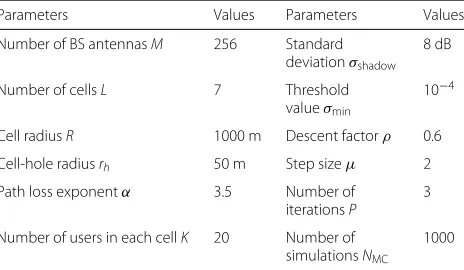
num-ber of Monte-Carlo simulations,HiandHˆi are the actual and estimated channel impulse response of ith Monte-Carlo trial, respectively. The parameters of the system and the 2D-SL0 algorithm are summarized in Table1.
Table 1System and algorithm parameter values
Parameters Values Parameters Values
Number of BS antennasM 256 Standard deviationσshadow
8 dB
Number of cellsL 7 Threshold
valueσmin
10−4
Cell radiusR 1000 m Descent factorρ 0.6
Cell-hole radiusrh 50 m Step sizeμ 2
Path loss exponentα 3.5 Number of
iterationsP
3
Number of users in each cellK 20 Number of simulationsNMC
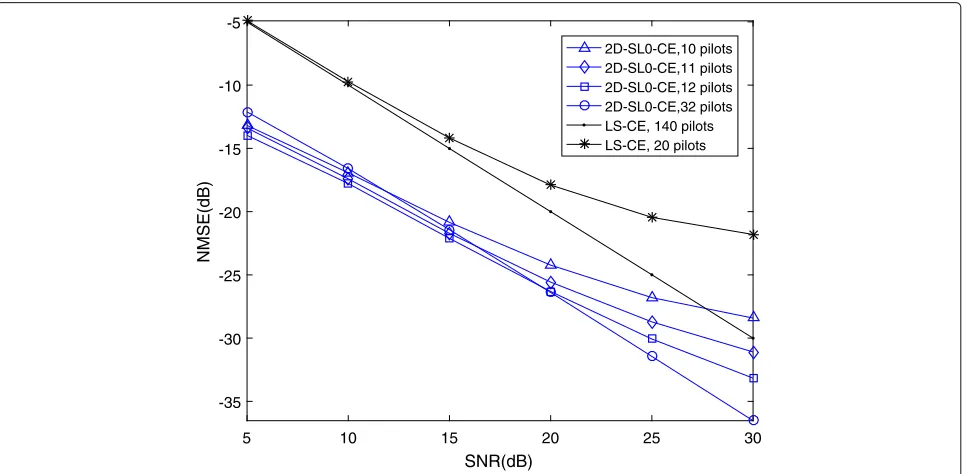
Firstly, at the scenario of S = 5, the NMSE of the CE and the bit error rate (BER) of the 2D-SL0-SD detection QPSK signals with various CSI, including perfect and estimated CSI, are investigated. The whole number of multicell users is 20×7 = 140; thus, the LS method should require orthogonal pilot sequences with length being not less than 140 to avoid pilot contamina-tion. Figure1shows that the 2D-SL0-CE method applying random pilot sequences with a length of 12 can outper-form LS with 140 pilots nearly 5 dB. Moreover, the NMSE of 2D-SL0-CE is approximate linear reducing with the SNR increasing when the pilot length is not less than 12. While in the case that 20 orthogonal pilot sequences are reused by the objective cell and neighbor cells, Fig.1also shows that the LS method will meet a performance floor caused by pilot contamination. In a block fading scenario with signal length N = 200, Fig. 2 plots the BER per-formance of the 2D-SL0-SD detection QPSK signal block using various CSIs. Applying perfect CSI at 10 dB SNR, the 2D-SL0-SD can approach near to 10−2 BER. More-over, its BER is approximate linear reducing with the SNR increasing, which shows its reliable detection ability. Using the CSI estimated through the 2D-SL0-CE, where each user applies random non-orthogonal pilot sequence with length being 32, the obtained BER of 2D-SL0-SD at 15 dB SNR is slightly better than 10−2, which shows joint the 2D-SL0-CE with 2D-SL0-SD for channel estimation and decoding QPSK signals is a feasible scheme.
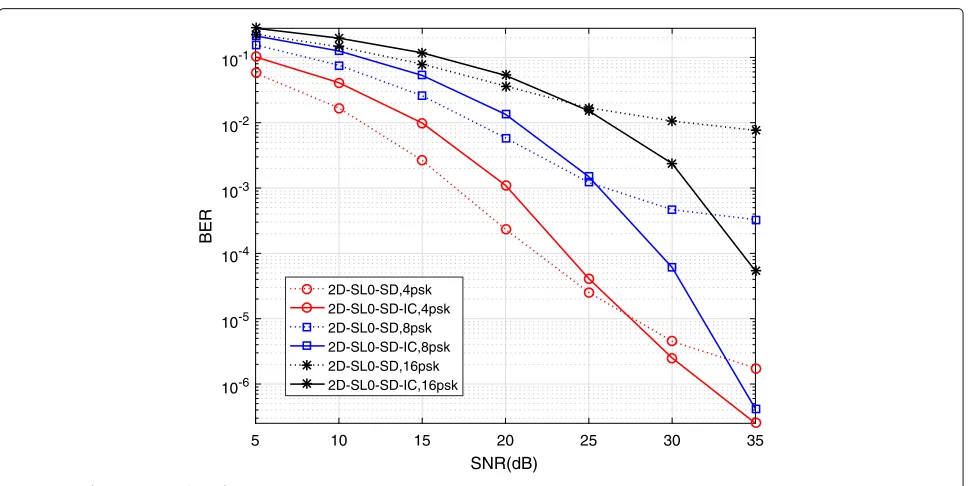
Then, applying perfect CSI and estimated CSI through 2D-SL0-CE, respectively, Figs. 3 and 4 show the BER of 2D-SL0-SD and its improved version 2D-SL0-SD-IC
detecting various PSK data block with lengthN =200. In both cases, the BER of SD is better than 2D-SL0-SD-IC within a SNR threshold value. This is because the received energy of interference data is usually smaller than that of target data, which induces more difficult to decode interference data. The decoding object in 2D-SL0-SD-IC includes the target and interference data, which means the decoding result of two parts will affect each other. Thus, in the low-SNR scenario, the low correct decoding probability of interference data leads to 2D-SL0-SD-IC has higher BER than 2D-SL0-SD. With the SNR increasing and exceeding a threshold value, the 2D-SL0-SD will gradu-ally meet a performance bound induced by interference. However, the BER of 2D-SL0-SD-IC will be still approx-imately linear reducing owing to gradually high correct decoding probability of interference data. In theory, with the distance of the two neighbor signal points in constel-lation diagram gradually reducing, it will be more difficult to decode the signals correctly. In Figs.3and4, it can be observed that the BERs of QPSK, 8PSK, and 16PSK are gradually increasing at the same SNR.
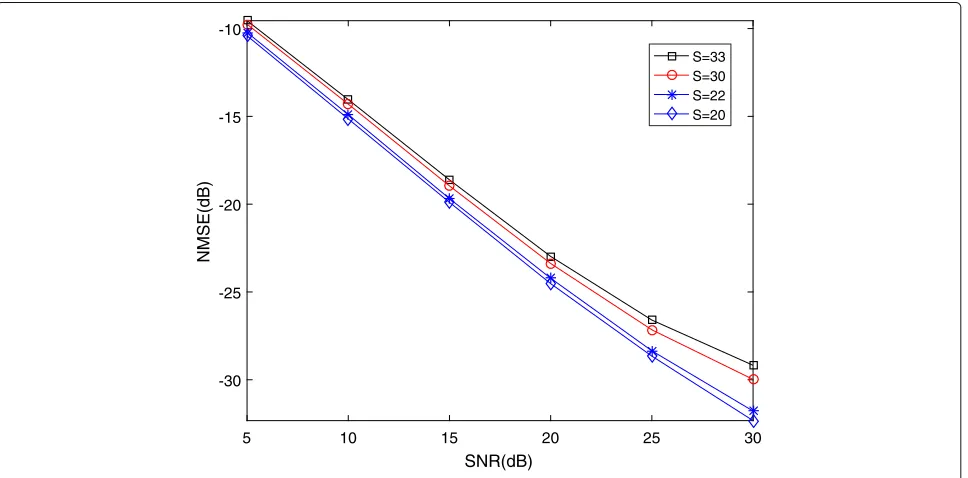
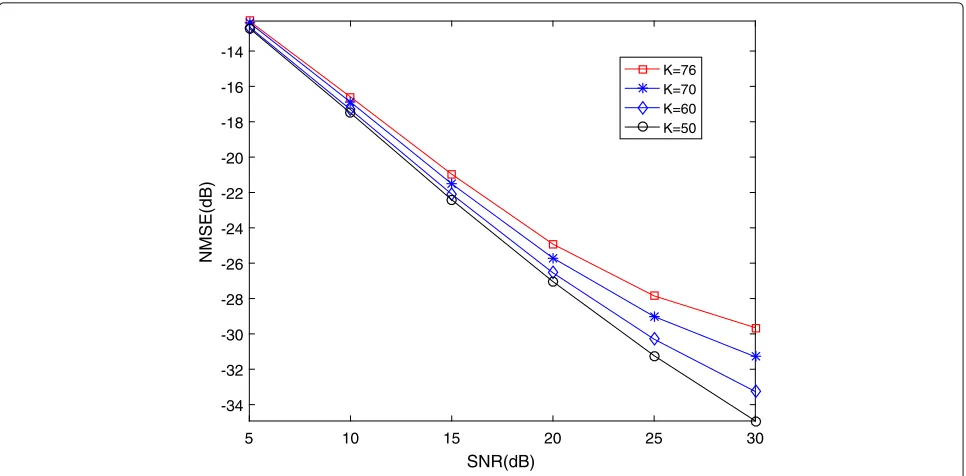
Finally, the NMSE of 2D-SL0-CE method with fixed pilot length at various scenarios, including various spar-sity and number of users in each cell, is studied in Figs.5
and6, respectively. In the case of each cell having 20 users, applying random pilot sequences with fixed length of 26, Fig.5shows that the NMSE is approximately linear reduc-ing with the SNR increasreduc-ing when theSis not larger than 20. In the case ofS = 5 and pilot length being 26, Fig.6
shows that the NMSE is approximately linear reducing with the SNR increasing when the number of users in each
5 10 15 20 25 30
SNR(dB)
-35 -30 -25 -20 -15 -10 -5
NMSE(dB)
2D-SL0-CE,10 pilots 2D-SL0-CE,11 pilots 2D-SL0-CE,12 pilots 2D-SL0-CE,32 pilots LS-CE, 140 pilots LS-CE, 20 pilots
5 10 15 20 25 30
SNR(dB)
10-5 10-4 10-3 10-2 10-1
BER
Perfect CSI
2D-SL0-CE,32 pilots, CSI LS-CE,140 pilots,CSI LS-CE,20 pilots,CSI
Fig. 2BER performance of 2D-SL0-SD with various CSIs
cell is not larger than 50. In order to recovery a 1D E-sparse F-length vector successfully with high probability, [40] presents that the number of measurements needed is of orderO(Elog(F/E)). In the 2D cases, from the best performance plots in Figs.5and6, it can be obtained that the number of measurements are 2.15 and 2.23 times of KLSlog(M/S), respectively, where the value of KLS is the
number of non-zero elements in 2D signals. Thus, ensur-ing the original 2D signal can be recovered with high probability, the number of measurements needed is also of orderO(Elog(F/E)), where theEandFdenote the num-bers of non-zero elements and whole elements in the 2D signal, respectively. In practical, the above ruler can be used to guide for setting pilot length.
5 10 15 20 25 30 35
SNR(dB)
10-6 10-5 10-4 10-3 10-2 10-1
BER
2D-SL0-SD,4psk 2D-SL0-SD-IC,4psk 2D-SL0-SD,8psk 2D-SL0-SD-IC,8psk 2D-SL0-SD,16psk 2D-SL0-SD-IC,16psk
5 10 15 20 25 30 35
SNR(dB)
10-6 10-5 10-4 10-3 10-2 10-1
BER
2D-SL0-SD,4psk 2D-SL0-SD-IC,4psk 2D-SL0-SD,8psk 2D-SL0-SD-IC,8psk 2D-SL0-SD,16psk 2D-SL0-SD-IC,16psk
Fig. 4BER of 2D-SL0-SD joint with 2D-SL0-CE
6 Conclusions
This paper has investigated the two challenging prob-lems for block fading massive MIMO systems. The one is to exploit efficient uplink channel estimation method that requires acceptable pilot overhead and can mitigate pilot contamination. The other one is to jointly decode multiuser data block. The joint multiuser channel esti-mation and data block detection problems have both
been modelled and solved as a 2D sparse signal recon-struction problem in the CS framework. More specifi-cally, through using a linear virtual channel representation for ULA, the 2D-SL0-CE compressed channel sensing method is proposed, which needs less pilot overhead than LS method, and can jointly estimate the desired and interference uplinks. Through sparse representation in a finite alphabet set for each transmitted data symbol,
5 10 15 20 25 30
SNR(dB)
-30 -25 -20 -15 -10
NMSE(dB)
S=33 S=30 S=22 S=20
5 10 15 20 25 30
SNR(dB)
-34 -32 -30 -28 -26 -24 -22 -20 -18 -16 -14
NMSE(dB)
K=76 K=70 K=60 K=50
Fig. 6NMSE of 2D-SL0-CE with various numbers of users
the 2D-SL0-SD data decoding method is proposed which can simultaneously decode a MPSK data block for mul-tiuser. Simulation results demonstrate that joint the 2D-SL0-CE with 2D-SL0-SD to estimate channel and decode MPSK data for multiuser massive MIMO is a feasible scheme.
Abbreviations
2D-SL0: Two-dimensional smoothedl0; 2D-SL0-CE: Two-dimensional smoothedl0-norm channel estimation; 2D-SL0-SD: Two-dimensional smoothedl0-norm signal detection; 2D-SL0-SD-IC: Two-dimensional smoothedl0-norm signal detection with interference cancel; BER: Bit error rate; BS: Base station; CS: Compressed sensing; CSI: Channel state information; FDD: Frequency division duplexing; JSDM: Joint spatial division and multiplexing; LS: Least square; MIMO: Multiple-input multiple-output; ML: Maximum likelihood; MMSE: Minimal mean square error; MPSK: M-ary phase-shift keying; NMSE: Normalized mean square error; QPSK: Quadrature phase-shift keying; SNR: Signal-to-noise ratio; TDD: Time division duplexing; ULA: Uniform linear array
Funding
This work was partly supported by the National Natural Science Foundation of China (Grant Nos. 61601005, 61801114), Natural Science Foundation of Anhui Province (Grant Nos. 1808085MF164, 1608085QF138), Key Projects of the Outstanding Young Talents Program in the Universities of Anhui Province (Grant No. gxyqZD2016027), the Natural Science Foundation of Jiangsu Province (Grant No. BK20170688) and Doctoral Scientific Research Foundation of Anhui Normal University (Grant Nos. 2014bsqdjj38, 2018XJJ40).
Availability of data and materials
Mostly, I got the writing material from different journals as presented in the references. A MATLAB tool has been used to simulate my concept.
Authors’ contributions
XY conceived and designed the methods. XY performed the experiments and wrote the paper. AZ analyzed the simulation data. GZ and XG gave valuable suggestions on the structure of the paper. LY revised the original manuscript. All authors read and agreed the manuscript.
Competing interests
The authors declare that they have no competing interests.
Publisher’s Note
Springer Nature remains neutral with regard to jurisdictional claims in published maps and institutional affiliations.
Author details
1National Mobile Communications Research Laboratory, Southeast University, 210096 Nanjing, People’s Republic of China.2College of Physics and Electronic Information, Anhui Normal University, 241002 Wuhu, People’s Republic of China.3Wolfson School of Mechanical, Electrical and Manufacturing Engineering, Loughborough University, LE11 3TU, Loughborough, UK.
Received: 11 June 2018 Accepted: 18 September 2018
References
1. N. Shariati, E. Bjornson, M. Bengtsson, M. Debbah, Low-complexity polynomial channel estimation in large-scale MIMO with arbitrary statistics. IEEE J. Sel. Top. Signal Proc.8(5), 815–830 (2014)
2. O. Elijah, C.Y. Leow, T.A. Rahman, S. Nunoo, S.Z. Iliya, A comprehensive survey of pilot contamination in massive MIMO 5G system. IEEE Commun. Surv. Tutor.18(2), 905–923 (2016)
3. H.Q. Ngo, E.G. Larsson, T.L. Marzetta, The multicell multiuser MIMO uplink with very large antenna arrays and a finite-dimensional channel. IEEE Trans. Commun.61(6), 2350–2361 (2013)
4. W. Tan, M. Matthaiou, S. Jin, X. Li, Spectral efficiency of DFT-based processing hybrid architectures in massive MIMO. IEEE Wirel. Commun. Lett.6(5), 586–589 (2017)
5. W. Tan, G. Xu, E.D. Carvalho, L. Fan, C. Li, Low cost and high efficiency hybrid architecture massive MIMO systems based on DFT processing. Wirel. Commun. Mob. Comput.2018, 1–11 (2018)
6. C. Li, K. Song, Y. Li, L. Yang, Energy efficient design for multiuser downlink energy and uplink information transfer in 5G. Sci. China Inf. Sci.59(2), 1–8 (2016)
8. W. Tan, S. Jin, C.K. Wen, J. Tao, Spectral efficiency of multi-user millimeter wave systems under single path with uniform rectangular arrays. EURASIP J. Wirel. Commun. Netw.181, 458–472 (2017)
9. A. Elghariani, M. Zoltowski, Low complexity detection algorithms in large-scale MIMO systems. IEEE Trans. Wirel. Commun.15(3), 1689–1702 (2016)
10. L. Bai, T. Li, J. Liu, Q. Yu, J. Choi, Large-scale MIMO detection using MCMC approach with blockwise sampling. IEEE Trans. Wirel. Commun.64(9), 3697–3707 (2016)
11. H.Q. Ngo, E.G. Larsson,EVD-based channel estimation in multicell multiuser MIMO systems with very large antenna arrays. (IEEE International Conference on Acoustics, Speech and Signal Processing (ICASSP), Kyoto, 2012), pp. 3249–3252
12. D. Hu, L. He, X. Wang, Semi-blind pilot decontamination for massive MIMO systems. IEEE Trans. Wirel. Commun.15(1), 525–536 (2016) 13. C.Y. Wu, W.J. Huang, W.H. Chung, Low-complexity semiblind channel
estimation in massive MU-MIMO systems. IEEE Trans. Wirel. Commun.
16(9), 6279–6290 (2017)
14. R.R. Muller, L. Cottatellucci, M. Vehkapera, Blind pilot decontamination. IEEE J. Sel. Top. Sign. Process.8(5), 773–786 (2014)
15. H. Wang, W. Zhang, Y. Liu, Q. Xu, P. Pan, On design of non-orthogonal pilot signals for a multi-cell massive MIMO system. IEEE Wirel. Commun. Lett.4(2), 129–132 (2015)
16. N. Akbar, N. Yang, P. Sadeghi, R.A. Kennedy, Multi-cell multiuser massive MIMO networks: user capacity analysis and pilot design. IEEE Trans. Commun.64(12), 5064–5077 (2016)
17. Y. Han, J. Lee, Uplink pilot design for multi-cell massive MIMO networks. IEEE Commun. Lett.20(8), 1619–1622 (2016)
18. C. Li, K. Song, D. Wang, F. Zheng, L. Yang, Optimal remote radio head selection for cloud radio access networks. Sci. China Inf. Sci.59(10), 1–12 (2016)
19. J. Jose, A. Ashikhmin, T.L. Marzetta, S. Vishwanath, Pilot contamination and precoding in multi-cell TDD systems. IEEE Trans. Wirel. Commun.
10(8), 2640–2651 (2011)
20. S. Ali, Z. Chen, F. Yin, Eradication of pilot contamination and zero forcing precoding in the multi-cell TDD massive MIMO systems. IET Commun.
11(13), 2027–2034 (2017)
21. C. Li, P. Liu, C. Zou, F. Sun, J.M. Cioffi, L. Yang, Spectral-efficient cellular communications with coexistent one- and two-hop transmissions. IEEE Trans. Veh. Technol.65(8), 6765–6772 (2016)
22. H. Xie, F. Gao, S. Jin, An overview of low-rank channel estimation for massive MIMO systems. IEEE Access.4, 7313–7321 (2016) 23. A. Adhikary, J. Nam, J.Y. Ahn, G. Caire, Joint spatial division and
multiplexing the large-scale array regime. IEEE Trans. Inf. Theory.59(10), 6441–6463 (2013)
24. J. Fang, X. Li, H. Li, F. Gao, Low-rank covariance-assisted downlink training and channel estimation for FDD massive MIMO systems. IEEE Trans. Wirel. Commun.16(3), 1935–1947 (2017)
25. L. Fan, R. Zhao, F. Gong, N. Yang, G.K. Karagiannidis, Secure multiple amplify-and-forward relaying over correlated fading channels. IEEE Trans. Commun.65(7), 2811–2820 (2017)
26. R. Zhao, Y. Yuan, L. Fan, Y. He, Secrecy performance analysis of cognitive decode-and-forward relay networks in Nakagami-m fading channels. IEEE Trans. Commun.65(2), 549–563 (2017)
27. L. Fan, X. Lei, N. Yang, T.Q. Duong, G.K. Karagiannidis, Secrecy cooperative networks with outdated relay selection over correlated fading channels. IEEE Trans. Veh. Technol.66(8), 7599–7603 (2017)
28. X. Wang, H. Zhang, L. Fan, Y. Li, Performance of distributed switch-and-stay combining for cognitive relay networks with primary transceiver. Wirel. Pers. Commun.97(2), 3031–3042 (2017) 29. J. Yuan, S. Jin, W. Xu, W. Tan, M. Matthaiou, K.K. Wong, User-centric
networking for dense C-RANS: high-SNR capacity analysis and antenna selection. IEEE Trans. Commun.65(11), 5067–5080 (2017)
30. Z. Gao, L. Dai, Z. Wang, S. Chen, Spatially common sparsity based adaptive channel estimation and feedback for FDD massive MIMO. IEEE Trans. Signal Process.63(23), 6169–6183 (2015)
31. V.K.N. Lau, S. Cai, A. Liu, Closed-loop compressive CSIT estimation in FDD massive MIMO systems with 1 bit feedback. IEEE Trans. Signal Process.
64(8), 2146–2155 (2016)
32. C. Li, K. Song, L. Yang, Low computational complexity design over sparse channel estimator in underwater acoustic OFDM communication system. IET Commun.11(7), 1143–1151 (2017)
33. C.K. Wen, S. Jin, K.K. Wong, J.C. Chen, P. Ting, Channel estimation for massive MIMO using Gaussian-mixture Bayesian learning. IEEE Trans. Wirel. Commun.14(3), 1356–1368 (2015)
34. Y. Fadlallah, A. Aissa-El-Bey, K. Amis, D. Pastor, R. Pyndiah, New iterative detector of MIMO transmission using sparse decomposition. IEEE Trans. Veh. Technol.64(8), 3458–3464 (2015)
35. W. Kai, L. Jingzhi, X. Lin, H. Le,Two-dimensional compressed sensing of channel state information in massive MIMO system. (IEEE International Conference on Electronics Information and Emergency Communication (ICEIEC), Macau, 2017), pp. 434–437
36. Y. Wang, H. Wang, Y. Fu,Modified two-dimensional compressed sensing scheme for massive MIMO channel estimation. (IEEE International Conference on Wireless Communications & Signal Processing (WCSP), Yangzhou, 2016), pp. 1–5
37. H. Mohimani, M. Babaie-Zadeh, C. Jutten, A fast approach for overcomplete sparse decomposition based on smoothedl0norm. IEEE Trans. Signal Process.57(1), 289–301 (2009)
38. A. Ghaffari, M. Babaie-Zadeh, C. Jutten,Sparse decomposition of two dimensional signals. (IEEE International Conference on Acoustics, Speech and Signal Processing (ICASSP), Taipei, 2009), pp. 3157–3160
39. N. Kolomvakis, M. Matthaiou, M. Coldrey,Massive MIMO in sparse channels. (IEEE International Workshop on Signal Processing Advances in Wireless Communications (SPAWC), Toronto, 2014), pp. 21–25