Volume 2007, Article ID 19249,16pages doi:10.1155/2007/19249
Research Article
An Analysis Framework for Mobility Metrics in
Mobile Ad Hoc Networks
Sanlin Xu, Kim L. Blackmore, and Haley M. Jones
Department of Engineering, Faculty of Engineering and Information Technology, Australian National University, ACT 0200, Australia
Received 31 January 2006; Revised 9 October 2006; Accepted 9 October 2006
Recommended by Hamid Sadjadpour
Mobile ad hoc networks (MANETs) have inherently dynamic topologies. Under these difficult circumstances, it is essential to have some dependable way of determining the reliability of communication paths.Mobility metricsare well suited to this purpose. Sev-eral mobility metrics have been proposed in the literature, including link persistence, link duration, link availability, link residual time, and their path equivalents. However, no method has been provided for their exact calculation. Instead, only statistical ap-proximations have been given. In this paper, exact expressions are derived for each of the aforementioned metrics, applicable to both links and paths. We further show relationships between the different metrics, where they exist. Such exact expressions con-stitute precise mathematical relationships between network connectivity and node mobility. These expressions can, therefore, be employed in a number of ways to improve performance of MANETs such as in the development of efficient algorithms for routing, in route caching, proactive routing, and clustering schemes.
Copyright © 2007 Sanlin Xu et al. This is an open access article distributed under the Creative Commons Attribution License, which permits unrestricted use, distribution, and reproduction in any medium, provided the original work is properly cited.
1. INTRODUCTION
Mobile ad hoc networks (MANETs) are comprised of mobile nodes communicating via (potentially multihop) wireless links. Mobility of the nodes causes communication links to be dynamic, affecting path reliability. Frequent path break-age, requiring discovery of new routes, leads to excessive end-to-end delay and affects the quality of service for delay-sensitive applications.
Understanding node mobility is one of the keys to deter-mine the potential capacity of an ad hoc network. Various mobility metrics have been proposed as measures of topo-logical change in networks. Metrics describing the link or path stability allow adaptive routing in MANETs based on predicted link behavior. A range of routing protocols based on predictive mobility metrics has been shown to increase the packet delivery ratio and to reduce routing overhead [1–6].
We consider a range of mobility metrics: link (path) availability, link (path) persistence, link (path) residual time, and link (path) duration. Many of these metrics have been considered previously, (see [1–3,7–13]), although the nam-ing has not been consistent. We seek to identify the relation-ships between the various metrics and provide a consistent
nomenclature. In particular, there is considerable confusion in the literature about the term “link availability.” The term is generally used to describe the probability that a currently active link will be active at a particular time in the future. However, some authors require that the link should exist for the whole of the intervening period, while others do not. The probability of existence will be considerably increased in the latter case.
To alleviate this confusion, we introduce the new terms link persistenceandpath persistenceto describe the contin-uous link and path availabilities, and reserve the term link (path) availability to describe the noncontinuous case [14]. That is, the link (path) persistence is the probability that a link (path) continuously lasts until a future timekgiven that it existed at time 0. In the perspective of link persistence, once the link is broken, it no longer exists.
Many random mobility models have been proposed [15], however, as yet, statistical analysis of the induced network connectivity is generally unavailable. One of the few which can be described by simple probability distribution functions is the random-walk mobility model (RWMM), which we use to illustrate the use of our framework. (Future work will in-volve the statistical description of more realistic models, sim-ilar to [16], and application of our framework to them.)
The calculated metrics can be useful as an aid to predict-ing link reliability for routpredict-ing purposes [5,17]. Moreover, random mobility models are regularly used for protocol eval-uation, so our work is important to facilitate comparison of the evaluation environment with practical implementation environments.
The main contributions of this paper are (1) introduc-tion of nointroduc-tion of link (path) persistence and its calculaintroduc-tion method, (2) expressions for the expected link (path) dura-tion and its PDF, (3) expressions for the expected link (path) residual time and its PDF which are derived using a random mobility model rather than a nonrandom travelling pattern (straight-line mobility model), (4) an exact expression for link (path) availability which matches the simulation data well for any given time interval.
We begin with definitions inSection 2for the mobility metrics we investigate, with a discussion of related work in the literature. In Section 3 we develop two Markov chain models of the evolution of the separation distance between two nodes. InSection 4the Markov chain models are used to develop exact expressions for the aforementioned mobil-ity metrics. InSection 5we apply the framework developed in the previous two sections to the random walk mobility model. InSection 6we compare our theoretical results for the RWMM with simulation results. Finally, we present con-clusions and further work inSection 7.
2. MOBILITY METRIC TAXONOMY
We define a series of mobility measures for links and for paths. As explained in the introduction, most of these have appeared in the literature, sometimes under different names, but they have not previously been gathered together as we have done here.
The following definitions do not make any assumptions about what it means for a link to exist, but do assume that it is possible to determine at any point in time whether or not a link does exist. Links are understood to be “on” or “off” at any point in time, as it is common in the existing literature on mobility in MANETs. In reality, fading links are the norm in wireless communication networks at the scales relevant for ad hoc networks [9]. In such cases, link availability is an appropriate metric to employ. However, schemes which use network topology information are sensitive to the length of time for which a link is consistently “on.” Therefore, our re-maining metrics—persistence, residual time, and duration— assume that the link is “on,” and consider how long it will continue to be “on.”
Anhhop path between two nodes consists of a chain of
h−1 intermediate nodes connecting them. Each node in the
chain has an active link with the nodes either side of it in the chain, effectively forming a transmission path between the two nodes of interest. Alinkcould be described as a 1-hop path. We define each of the metrics for paths, and define the corresponding link metrics as special cases for whichh=1.
The first two metrics, path (link) availability and persis-tence, are probabilities—they correspond to the probability that a path (link) exists at a certain time in the future given that it exists now. One can see intuitively that in most situ-ations, this probability decreases as the wait time increases. The difference between availability and persistence lies in the requirement that the path (link) may disappear and reappear during the wait time in the case of availability, but may not do so in the case of persistence.
The remaining metrics are measured in units of time— referring to the length of time that a path (link) exists. Resid-ual time can be measured from any point in the life of the path (link), whereas path (link) duration is measured from the time the path (link) is first “on” until the time the path (link) is next “off.” In the case where nodes move accord-ing to a synthetic mobility model, the residual time and du-ration are random variables. We calculate their probability mass functions (PMFs) and expected values inSection 4.
(i) Path availabilityA(t,h)
Given an active path withhhops between two nodes at time 0, the path availability [5] at timetis defined as the prob-ability that the path exists at timet, given that it existed at time,
A(t,h)Pravailable at timet|available at time 0.
(1)
The path may have been broken, possibly several times, be-tween time 0 and timet. Thelink availabilityis denoted by
A(t)A(t, 1).
Path and link availability were proposed by McDonald and Znati [5].
(ii) Path persistenceP(t,h)
Given an active path withhhops between two nodes at time 0, the path persistence, as a function of time, is defined as the probability that the path will continuously last until at least timet, given that it existed at time 0,
P(t,h)Prlast until at leas timet|available at time 0.
(2)
That is,P(t,h) is the probability that the path is continu-ously in existence from time 0 until at least timet. Thelink persistenceis denoted byP(t)P(t, 1).
Link persistence is called “link availability” in [18,19].
(iii) Path residual timeR(h)
of time for which the path will continue to exist until it is broken. Thelink residual timeis denoted byRR(1).
Link residual time has been referred to as the “link’s residual lifetime” [8], “link available time” [13], “link expi-ration time” [2], and “expected link lifetime” [3]. Path resid-ual time has been referred to as “path’s residresid-ual lifetime” [8], “available time in multihop” [13], and “route expiration time” [2].
(iv) Path durationD(h)
Given that a path becomes active at time 0, the path duration [12]D(h) is the length of time for which the path will con-tinue to exist until it is broken. That is, the path duration is the path residual time from the instant the path first becomes available, and it is a measure of stability of the path between a pair of nodes. It could be understood as a maximal value of the path residual time. Thelink duration[1] is denoted by
DD(1).
We can divide these metrics into two groups based on whether a persistent connection is required (persistence, residual time, and duration) or an intermittent connection is acceptable (availability).
2.1. Related work
Each of the metrics have been studied in various ways by var-ious authors. Here we give a brief overview.
In [5,11], path availability is used to divide mobile nodes into clusters. The link availability and path availability were theoretically analyzed, for nodes moving according to a vari-ant of the random-walk mobility model. However they em-ploy a Rayleigh approximation for relative movement be-tween a pair of mobile nodes (MNs), which does not work well when taken over short time intervals, particularly for the path availability calculation. By contrast, the calculation method presented in this paper is accurate for any time in-terval.
Link persistence is calculated approximately by Qin [19] for nodes moving according to the random-walk mobility model (though they call it link availability). In [13] an ex-pression for link persistence is derived for a simple straight-line mobility model. A mobility metric that is similar to link persistence is determined in [6,10] using a combina-tion of calculacombina-tion and experimental evaluacombina-tion, for modified random-walk and random waypoint mobility models.
Link (path) residual time is widely used in proactive rout-ing schemes. The mechanism is that when a communicatrout-ing path is active between two MNs, the destination node can es-timate the link (path) residual time by means of a prediction algorithm. New route discovery is initiated early by detect-ing that an active link is likely to be broken and an alterna-tive route is built before link failure. In many cases, this is achieved by assuming that the MNs do not change movement direction when communicating with each other [2,3,13] (a straight-line mobility model), which is clearly quite a re-strictive assumption. Link residual time is evaluated by sim-ulation in [8], for nodes moving according to a variety of synthetic mobility models.
The concept of link duration was introduced by Boleng et al. [1] as a mobility metric to enable adaptive routing. Link duration is a good indicator of protocol performance measures such as data packet delivery ratio and end-to-end delay. Furthermore, it is computable in real network imple-mentations without global network knowledge. Bai et al. [7] and Sadagopan et al. [12], investigate link duration and path duration experimentally, for four different mobility models corresponding to routing protocols such as AODV and DSR, based on simulations. Han et al. [20] give an approximate calculation for link duration and path duration for a ran-dom waypoint mobility model. In this paper, we determine an exact expression for the PMF of node separation distance when a link is set up and conclude that link (path) duration is a special case of link (path) residual time.
2.2. Metric calculation
In general, each of the above mobility metrics will differ be-tween particular links (paths). If the objective is to predict future connectivity of a particular link (path), specific infor-mation about the link (path) must be known—whether mea-sured [18] or assumed [5]. If, on the other hand, the objective is to characterize the degree of mobility of the network as a whole, it is necessary to average over all possible links (paths) [1].
Our framework allows calculation of the mobility met-rics under some random mobility model. In this case, link residual time and link duration are random variables. Con-sequently, the network average link residual time and link duration are also random variables. Thus, we consider the expected value of the network average for these entities.
Mobility models employed in simulation-based perfor-mance evaluation usually assume that all nodes move in an i.i.d. random manner. In this case, the expected value of the mobility metric associated with individual links (or paths) will be identical, and equal to the network average. Such assumptions may also provide useful predictions of future connectivity when noa prioriknowledge of individual node characteristics exists.
We will employ the notationA(k,h),P(k,h),R(h) to denote thenetwork averagevalues of availability, persistence, and residual time (omitting the argumenth=1 when links, rather than paths, are of interest). Under our assumptions, the link durationD and path durationD(h) do not need to be augmented in this manner as the expected value of the network average is identical to the expected value for an in-dividual link (or path).
In our calculations, the link-based mobility metrics, ex-cept link duration, depend (only) on the initial separation of nodes. The path-based mobility metrics, except path du-ration, depend (only) on the initial separation along all hops in the path. Therefore, we augment the notation for availability, persistence, and residual time to include L0,
the separation distance at time 0. The link-based mobility metrics becomeA(k;L0),P(k;L0), and R(L0). The
path-based mobility metrics become A(k,h;L0(1),. . .,L0(h)),
L0(i) is the initial separation of the nodes constituting the
ith hop in a particular path.
Having established definitions for each of the mobility metrics of interest, we next develop generic expressions for each of the mobility metrics, using a Markov chain model. (Using a Markov chain model allows for random mobility models for which no closed-form expression may be found for the PDF of the mobility, which is most often the case.) These expressions may then be applied to any particular ran-dom mobility model by substituting in the appropriate PDF. The random-walk mobility model is used as an example in Section 5.
3. MARKOV CHAIN DESCRIPTION OF NODE SEPARATION DISTANCE
A Markov chain model (MCM) gives a model for the evo-lution of the random process it is describing. We use an MCM to describe the evolution of the separation distance between nodes in an ad hoc network, moving according to a memoryless random mobility model. We will use the MCM to derive mathematical expressions for each of the mobility metrics introduced inSection 2.
In order to apply Markov chain methods, we examine node separation after periods of fixed time length, termed epochs. We assume that the duration of the epochs and the speed of the nodes are such that the path persistence after one epoch,P(1,h), is approximately one, and the path resid-ual time,R(h), is considerably more than one epoch. In this case, there is no significant error introduced by discretizing the time via epochs.
3.1. Notation for model development
The status of a wireless link depends on numerous system and environmental factors that affect transmitter and re-ceiver’s transmission range. A widely applied, albeit opti-mistic, model is used in this paper, whereby transmission range is approximated by a circle of radiusrcorresponding to a signal strength threshold. Thus, if the separation distance between a pair of nodes of interest is less thanr, it is assumed that the link between them is active.
All of the mobility metrics are based on the probability of a pair of nodes going out of range. That is, we are inter-ested in the behavior of the separation distance between a pair of nodes. An MCM can be employed to calculate the mo-bility metrics inSection 2if the separation distance between two nodes is a Markov process. Assume that the movement of nodes in the network can be described by i.i.d. random processes. Let the random variable representing the separa-tion distance between two nodes at epochmbeLm, and let lmdenote an instance ofLm.1We assume that the PDF of the Lm+1is dependent only onLm. Then separation distance is a
Markov process and the transition probabilities for the MCM
1Throughout this paper, we use the convention of capital letters for ran-dom variables and the corresponding lowercased letters for instances of random variables.
0 r Separation
distance
e1
ei
ε
enen+1
en+j
Figure1: Depiction of state space for distance between a pair of nodes in the intermittent metric group, where communication links for nodes which move outside the transmission range, and back in again, are considered to be the “same” link.
are derived from fLm+1|Lm(lm+1 |lm). This PDF is determined by the mobility model being used.
3.2. State-space derivation
We divide the node separation distance from 0 tor inton
bins of widthε. If a link exists, the node separation at epoch
m,Lm, falls into one of these bins. If we label statei,ei, then
thestate spaceof the distance between the two nodes isE =
{e1,. . .,ei,. . .}. The state space for distances greater thanr
differs for the two mobility metric groups. We examine each group separately below.
3.2.1. State space for intermittent metric group
In this case the state space for distances greater thanrconsists of an infinite number of states, each corresponding to a bin of widthε, as illustrated inFigure 1. The node separationLm
is ineiifLm=lm, where
(i−1)ε≤lm< iε, i∈Z+. (3)
3.2.2. State space for persistent metric group
The state space for metrics in the persistent group requires an absorbing statewhich, once reached, cannot be escaped. The absorbing state represents any distance greater than the com-munication ranger. If the distance between the two nodes reaches the absorbing state, the communication link is con-sidered to be broken. If the nodes move back within commu-nication range, a new link is considered to have been formed. In this model, the state of the node separation distance,
Lm=lm, is governed by
(i−1)ε≤lm< iε, i∈[1,. . .,n],
lm> r, i=n+ 1.
(4)
3.3. Initial probability vector
The Markov chain process is an evolving process. The proba-bility of being in any particular state changes with time. Thus, we begin with aninitial probabilityvector which denotes the probability of the initial node separation distance,L0 = l0,
being in each of the states at epoch 0. The initial probability vectorP(0) can be written as
P(0)=p1(0) p2(0) · · · pn(0) · · ·
where
Further, as the links are assumed to be active at epoch 0, that is, in a state with index at mostn,ni=1pi(0)=1.
The choice ofP(0) differs according to whether the ob-jective is to determine the mobility metric for a particular link, or the network average for the metric. In the first case, the initial separation distance,l0 < r, for the link is known,
and the initial state,ei, is determined according to (3) or (4),
wherem=0 andi∈[1,. . .,n]. Then, the initial probability vector, denoted byPL0(0), has only one nonzero element:
pi(0)=
For network average mobility metrics, it is necessary to de-termine how the mobile node positions distributed in a two-dimensional space. If the nodes are uniformly distributed over the network area (as it is the case for nodes moving ac-cording to a random walk in a bounded region), the distribu-tion of all separadistribu-tion distances is approximately Rayleigh (it is not exact if the network area is bounded). If, in addition, the transmission range is much smaller than the network area, then we can approximate the distribution of node sepa-ration distances in the range 0 toras being linear, as follows:
fL0
Thus, for network average metrics, when nodes are uni-formly distributed, the initial condition vector, denoted
Pnet(0), has elements
pi(0)=
To reiterate, this value of Pnet(0) is only appropriate for
networks with uniformly distributed nodes. For many inter-esting mobility models, nodes are not uniformly distributed [21].
A third initial condition vector,Pnew(0), will be
intro-duced inSection 4.1.4to describe the PDF of node separa-tion for links when they first become active.
3.4. Probability transition matrix
Having established the form of the initial condition vector for the different contexts, we now introduce the probability transmission matrices for the two metric groups.
3.4.1. Intermittent metric group transition matrix
Let the separation distancelmbetween two nodes be in state ei. After one epoch, the separation distancelm+1 must be in
the range
wherevmaxis the maximum speed that can be attained by the
nodes. This corresponds tolm+1being inejsuch that
j∈max(1,i−γ),i+γ, γ:=
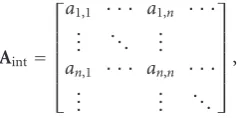
whereγis the maximum number of states that can be crossed in a single epoch. When there is no absorbing state, as de-picted inFigure 1, the transition matrix is denoted by the infinite-size matrixAint, where
Aint=
nodeimust move somewhere).
To calculate the transition probabilities between any two states in the nonabsorbing state model, as illustrated in Figure 2, consider the state space for the nonabsorbing state model at epochm. The transition probabilities are given by
ai,j=Pr assume that independently ofm,Lm is approximately
uni-formly distributed within theith bin. In this case,
fLm
Moreover, we can approximate the PDF of the conditioned separation distance from any point ineito any point inejby
the value of the PDF at the midpoint of the two states, such that
0 (i γ 1)ε lmiε (j 1)ε jε (i+γ)ε Separation distance
e1 e2
ε
ei γ
ei
ej
ei+γ en en+1
ai,i γ
ai,i ai,j ai,i+γ fLm+1Lm
lm+1l
m
Figure2: Depiction of state space for the nonabsorbing state model, showing the state transition probabilities,ai,j, the probability of
trans-ferring fromeitoejafter one epoch, for a given stateiand various statesj.
0 r Separation
distance
e1
ei
ε
en en+1
Absorbing state
Figure3: State space for distance between a pair of nodes in the persistent metric group, where separations greater than the trans-mission range (absorbing state) result in a link being discarded.
3.4.2. Persistent metric group transition matrix
Recalling that for the persistent metric group, there aren+ 1 possible states, as shown inFigure 3, we let the (n+1)×(n+1) state transition matrix, with absorbing state, be denoted by
Apst, where
Apst=
⎡ ⎢ ⎢ ⎢ ⎢ ⎣
a1,1 · · · a1,n a1,n+1
..
. . .. ... ...
an,1 · · · an,n an,n+1
0 · · · 0 1
⎤ ⎥ ⎥ ⎥ ⎥
⎦. (17)
The entries indicating the probabilities of entering the ab-sorbing state, that is, the rightmost column ofApst, are given
by
ai,n+1=1−
n
j=1
ai,j. (18)
The last row of Apst indicates the probability of transition
from the absorbing state.
The probabilities of moving between each pair of nonab-sorbing states are given by the upper left block ofApst:
Q=
⎡ ⎢ ⎢ ⎣
a1,1 · · · a1,n
..
. . .. ...
an,1 . . . an,n
⎤ ⎥ ⎥
⎦, (19)
where entryai,jis given by (16).
3.5. Separation probability vector afterkepochs
Using the transition matrices defined inSection 3.4, and the initial probability vectors defined inSection 3.3, we can cal-culate the probability vector of the separation distance afterk
epochsP(k). For the intermittent metrics, where there is no absorbing state,
P(k)=P(0)Akint, (20)
whereP(k) is an infinite-length vector with elements pi(k),
describing the probability that the separation distanceLkis
ineiat the end of epochkandAintis from (12).
Similarly, for the persistent metrics, where the separation distance state space does include an absorbing state,P(k) is an (n+ 1)-vector
P(k)=P(0)Ak
pst, (21)
whereApstis from (17).
In either case, necessarily,
i
pi(k)=1, (22)
whereiranges from 1 ton+ 1 if there is an absorbing state, and from 1 to∞if there is no absorbing state.
In summary,P(k) gives the discrete probability distribu-tion of the separadistribu-tion distance between a pair of nodes after
kepochs. It is discrete, but may be made as incremental as desired by appropriately choosingε, the width of each state.
4. MOBILITY METRIC CALCULATIONS
4.1. Expressions for link-based metrics
Calculation of the link-based metrics is achieved via di-rect application of Markov chain methods, using the ini-tial probability vectors and transition matrices introduced in Section 3.
4.1.1. Link availabilityA(k)
Link availability is an intermittent mobility metric—the link may be broken at some time before epochk, but must be reestablished by epochk. Thus we use the probability tran-sition matrix with no absorbing state Aint. The probability
of the link being in existence afterk epochs is the sum of the probabilities ofLk being in one ofe1 toen at epochk.
Thus, the link availability is the sum of the firstnelements ofP(k) in (20). The general equation for link availability is, therefore,
A(k)=
n
i=1
pi(k), (23)
wherepi(k) are the elements ofP(k)=P(0)Akint.
The link availability for a particular initial separation
A(k;L0) uses the initial condition vector PL0(0) with ele-ments defined in (7). The network average link availability
A(k) uses the initial probability vectorPnet(0) from (9).
4.1.2. Link persistenceP(k)
Link persistence is determined in the same way as link avail-ability, with the exception that the transition matrix with ab-sorbing stateApstis used. Thus, the general equation for link
persistence is
P(k)=
n
i=1
pi(k)=1−pn+1(k), (24)
where pn+1(k) is the final element of the vector P(k) =
P(0)Ak pst.
The link persistence for a particular initial separation,
P(k;L0) uses the initial condition vectorP(0)=PL0(0) with elements defined in (7). The network average link persistence
P(k) uses the initial condition vectorPnet(0) from (9).
4.1.3. Link residual timeR
The probability that the link residual time is, at most, k
is equal to the probability that after epoch k, the separa-tion distance is in the absorbing stateen+1. We can write the
(discrete) cumulative density function (CDF),FR(k), of the link residual time, as
FR(k)=Pr{R≤k} =pn+1(k), (25)
where pn+1(k) is defined in Section 4.1.2. Therefore, the
probability mass function (PMF), fR(k), of the link residual time is
fR(k)=Pr{R=k} =pn+1(k)−pn+1(k−1). (26)
InSection 6we illustrate that this PMF is approximately ex-ponential.
The expected value of the link residual time can then be written as
E{R} =
∞
k=1
k fR(k)=
∞
k=1
kpn+1(k)−pn+1(k−1)
.
(27)
This holds for both link-specific residual time R(L0) and
network average residual timeRby again using the appro-priate initial condition vector. Due to the exponential decay of the PMF, terms in this sum are negligible for largek, mean-ing that truncation at an appropriate point will result in neg-ligible error, allowing feasibility of calculation.
Alternatively, the link residual time can be determined directly from the fundamental matrix,F [22],
F =In−Q
−1
, (28)
whereInis then×nidentity matrix, andQis defined in (19).
The sum of the elements of theith row ofF is the expected link residual time for links starting inei,
ERL0
=
n
j=1
Fi,j, L0=l0∈ei. (29)
The expected value of the network average link residual time is
E{R} =
n
i=1
pi(0)
n
j=1
Fi,j, (30)
wherepi(0) are elements ofPnet(0) from (9).
4.1.4. Link durationD
Link duration is effectively a special case of the link residual time, with the requirement thatL0=r. That is, the link
du-ration is the link residual time at the time of formation of the link—how long the link lasts from beginning to end. In fact, as the mobility model is discrete in time,L0∈[r−2vmax,r),
since we only examine the connectivity at the end of each epoch. Therefore, the link duration can be determined iden-tically to the link residual time, above, with initial condition vectorPnew(0) determined below for the case where nodes
are uniformly distributed.
In order to obtain the PDF of the initial separation dis-tanceL0, we consider the conditional PDF ofL−1, the node
separation distance just prior to the link being established. A pair of nodes with separation distanceL−1∈[r,r+2vmax) has
0 r 2vmax r r+ 2vmax r+ 4vmax Separation
Figure4: Depiction of PDFs of node separation, with respect to separation distance state space, at epochs−1 and 0, taking into ac-count moves that do and do not result in a link being established. Nodes are assumed to be uniformly distributed.
r+ 2vmax. This is equivalent to saying that the node
separa-tion distances are uniformly distributed on a ring with inner radiusrand outer radiusr+ 2vmax. The PDF ofL−1is then
The marginal PDF of the initial separation distance for new links, fL0|new(l0 | new link) is equal to the portion of fL0|L−1(l0 |l−1) that intersects the region [r−2vmax,r), nor-malized accordingly.Figure 4illustrates the relationship be-tween fL−1(l−1), fL0|L−1(l0 | l−1) and fL0|new(l0 | new link) showing approximate shapes for the random-walk mobility model, described inSection 5. Obtaining the PDF fL0|L−1(l0| l−1) is the same as obtaining the PDF fLm+1|Lm(lm+1|lm) with
m = −1. Thus, we obtain a discretized version of fL0(l0) which is our initial condition vector for new links,Pnew(0),
valid when nodes are uniformly distributed.
The new initial condition vector Pnew(0) can be
em-ployed to determine the persistence of a newly established link, Pnew(k), in the same way as the link persistence for
a particular initial separation and the network average link persistence are determined.
Now, the PMF, fD(k), of the link duration is given by
fD(k)=pn+1(k)−pn+1(k−1), (32)
where pn+1(k) is the final element of the vector P(k) =
Pnew(0)Akpst. The expected value of the link duration can be
determined either from this PMF, or similar to link residual time, from the fundamental matrix
E{D} =
no concept of link duration for a given initial separation and that the link duration calculated here is effectively the net-work average.)
4.2. Path-based metrics
Path-based metrics are determined from link metrics using the assumption that links exist independently of each other.
This is true for a randomly chosen path when nodes move according to an i.i.d. random process, even though consecu-tive links in a path share a common node. (It may not be true when attention is restricted to a particular subset of all pos-sible paths, such as the shortest-distance path between two nodes.)
4.2.1. Path availabilityA(k,h)
For a path with hhops, path availability is the product of the individual link availabilities of thehhops. If the initial separation distances for each hop in a particular path are
L0(1),. . .,L0(h), respectively, the path availability can be
cal-availability forh-hop paths is given by
A(k,h)=A(k)h, (35) whereA(k) is the network average link availability, as defined inSection 4.1.1.
4.2.2. Path persistenceP(k,h)
By using the product of the link persistences for each of the constituent links, the path persistence is given by
Pk,h;L0(1),. . .,L0(h)
persistence for anh-hop path is given by
P(k,h)=P(k)h, (37) whereP(k) is the network average link persistence, as de-fined inSection 4.1.2.
4.2.3. Path residual timeR(h)
For a particular path, the path residual time is the length of time that the path continuously lasts without breaking. We can write the CMF,FR(k,h), of the path residual time, as
FR(k,h)=1−P(k,h)=1−P(path lasts≥k) =P(path lasts≤k). (38)
Therefore the PMF of the path residual time can be written as
fR(k,h)=P(k−1,h)−P(k,h). (39)
There is no equivalent of the fundamental matrix method that was available for link residual time.
4.2.4. Path durationD(h)
To determine the path duration, we need to be precise about the time that the path commences. We will assume that one link in the path has just become active, and all other links are active links with unspecified node separation. That is, the initial condition vector for one of the links isPnew(0), and
the initial condition for the remaining links isPnet(0). The
persistence and all links in the path are considered from the same point in time. Then, thenew pathpersistencePnew(k,h)
In this section, we have derived exact expressions for the mo-bility metrics using a probamo-bility transition matrix derived from the PDF of the node separation after one epoch. In Section 6, we use our calculations to illustrate the values of these mobility metrics for the random-walk mobility model.
5. APPLICATION USING RANDOM-WALK MOBILITY MODEL
The random-walk mobility model (RWMM) is probably the most mathematically tractable mobility model in use. It de-scribes the basic node mobility parameters, velocity, and di-rection of travel, in terms of known probability distribu-tions. We therefore use the RWMM to illustrate the use of the MCM-derived expressions for the mobility metrics, from Section 3.
We assume that each mobile node moves with a velocity uniformly distributed in both speedV ∼U[vmin,vmax] and
directionΦ∼U[0, 2π]. Both the speed and direction change in each epoch but are constant for the duration of an epoch, and are independent of each other. The speed has meanv= (1/2)(vmin+vmax), and variance,σv2 =(1/12)(vmax−vmin)2.
This random mobility model is widely used to analyze route stability in multihop mobile environments [3,23].
We saw inSection 3that the movement-related PDF re-quired for the MCM is fLm+1|Lm(lm+1 | lm), where lm is the separation distance between a pair of nodes at epochm. To obtain this PDF, we must formulate a description of the be-havior of the relative movement.
5.1. Relative movement between two nodes
To determine the PDF fLm+1|Lm(lm+1 |lm), we begin with the PDF of therelative movementbetween a given pair of nodes, labellediandj, whose movements are i.i.d. The relationship between the relative movement vectorXin any given epoch, and the node velocity vectorsViandVjisX=Vj−Vi, as
de-picted inFigure 5. LetXbe the random variable representing
Nodeiat epochm+ 1
Figure5: Relationship between the node movement vectorsViand
Vjof nodesiandj, respectively, relative movement vector,X,
sepa-ration vector at epochm,Lm, and separation vector after one epoch,
Lm+1. Solid lines indicate actual vector positions and dashed lines indicate vectors shifted for illustration purposes. The dotted circles indicate the loci of possible positions for nodesiand jat epoch
m+ 1.
Using the cosine rule, it can be seen that the relative move-mentXis related to the random variablesVi,Vj, andΨby
X=V2
i +V2j −2ViVjcosΨ. (44)
We use the Jacobian transform [24] to obtain the joint PDF:
fX,Vi,Vj
Then the marginal PDF of the magnitude of the relative movement can be found via
fX(x)=
however, there is apparently no closed-form solution to (46). So, (45) and (46) describe the behavior of the relative dis-tanceX between a given pair of nodes iand j in any one epoch, given uniform distributions forVi,Vj,Φi, andΦj, as
previously described.
5.2. Conditional PDF of separation distance
we use the Jacobian transform, this time to replace the ran-dom variables (X,Θ) with the new pair (Lm+1,Θ). The value
of new variableLm+1 depends on the given value ofLm, so
we include the condition in the notation for the new PDF, to obtain
since the magnitudeXand the angleΘare independent.Θ is uniformly distributed in the interval [0,π]. The PDF fX(x)
is given in (46) and can be reexpressed in terms of the new variables using
X=LmcosΘ±
L2
m+1−L2msin2Θ. (48)
So the new joint PDF is
fLm+1,Θ|Lm
We then take the marginal PDF with respect toΘto find the PDF ofLmconditioned onLm+1:
There are several different cases for the relative values ofLm
and Lm+1 which decide the expressions for a andb [25].
Again, there is apparently no closed-form solution to this ex-pression.
Thus, we have the conditional PDF of node separation distance after one epoch. Note that the assumption of iden-tical uniform distributions ofViandVj is not necessary to
this result, so a similar method could be used to determine the PDF for arbitrarily distributed, independentViandVj.
The PDF (50) can be evaluated at discrete points as indi-cated in (16), to generate expressions for the mobility metrics for the RWMM.
5.3. Approximation of link residual time and link duration
While, for the RWMM, it is difficult to determine an exact expression for the expected value of the node separation after a given time, it is actually simple to determine the expected value of its square. Let the initial separation distance between a pair of nodes bel0. Then, afterk epochs, from [26] and
[27, equation (4.2-11)], the mean square of the separation distancel2
v is the node speed
variance.
5.3.1. Link residual time approximation
The mean-square value of the separation distance monoton-ically increases with k. When k is sufficiently large, E{l2
k}
will be greater thanr2. Assuming that the nodes start within
range of each other, as required for link residual time calcu-lations to be meaningful, we can expect that the first epoch at which the mean-square value of the separation distance ex-ceedsr2will be approximately equal to the link residual time.
We denote the separation distance at the end of the epoch when the link is first broken asr+δ, where 0 < δ <2vmax,
To determine the expected value of the network average link residual time, we use
E{R} = network average link residual timeE{R}is given by
E{R} = r2+ 4rδ+ 2δ2
4v2+σ2 v
. (54)
5.3.2. Link duration approximation
To derive an approximate expression for the link duration, we combine the approximate expression for the link residual time in (52) with a linear approximation for the PDF of the initial link separation illustrated inFigure 4. The probability that the initial link separation falls in the region [r−2vmax,r−
2v] is nonzero but negligible. In fact it can be shown that
fL0|new(l0|new link) is well approximated by
The expected link duration is then
E{D} = model can be considered as a nonrandom travelling model [2,29].) InSection 6, we compare these approximations to the exact values obtained from (30) and (33).
5.4. Application to other mobility models
separation evolution relies only on the previous relative posi-tion. In particular it can be applied to the random waypoint mobility model, since it is shown in [30] that random way-point is asymptotic mean stationary.
Our framework does not directly apply to determinis-tic mobility models such as trace-based models. Indeed, the mobility metrics examined do not make sense with respect to such models. However, for deterministic models, equiva-lent average mobility metrics may be of interest. These can be calculated using our framework by replacing the PDF
fLm+1|Lm(lm+1 | lm) with the network average movement be-tween epochs.
6. VERIFICATION AND ANALYSIS OF CALCULATIONS FOR THE RWMM
Simulations were conducted to verify the theoretical calcula-tions in Seccalcula-tions4and5.3. Our calculations assume an un-bounded simulation area. However, it is typical for routing protocols to be tested using a simulation package such as NS-2, which confines mobile nodes to a bounded area. Therefore, we include metric performance results for both bounded and unbounded areas in our simulations.
6.1. Simulation environment
We ran simulations with each MN moving at a randomly chosen velocity during each epoch. The speed was uniformly distributed withv∈[0,vmax], such thatσv2=vmax2 /3, for
var-ious values ofvmax. The direction was uniformly distributed
in the range [0, 2π). Each MN was equipped with an om-nidirectional antenna with maximum transmission range of
r = 100 units.2 100 MNs start in a square plane of side
1000 distance units. For the bounded scenario, MNs which reached the boundary were reflected back into the allowed region for a bounded simulation area. The experiments were repeated for 2000 trials.
For the path residual time and path duration metrics, we compared randomly chosen paths with paths found using the breadth-first search (BFS) algorithm [31] to find the mini-mum hop path between any given pair of nodes. The diff er-ence between choosing a minimum hop path and a randomly chosen path is that links in a minimum hop path are likely to be longer than links in a randomly chosen path. Longer links are likely to break sooner, so minimum hop paths turn out to have a shorter residual time and duration than predicted by our calculations for randomly chosen paths.
6.2. Observations
6.2.1. Availability and persistence
Both thelinkavailability and thelinkpersistence, shown in Figures 6(a)and6(b), decrease with increasing simulation time, and at a greater rate with increasing ratio of mean
2We use the generic term “units” rather than, say, m or km because it is the relative and not the absolute distances that are important.
node speed to transmission rangev/r. Given the same simu-lation time andv/r, the link persistence is much smaller than the corresponding link availability, as would be expected be-cause the link availability allows breakage and reestablishing of links. Further, the path availability and the path persis-tence, shown in Figures6(c)and6(d), drop offat a greater rate than the link availability and the link persistence, respec-tively, for the same mean node speed, as would be expected. The path availability and the path persistence also drop off more quickly with an increased number of hops, as there is more chance of an individual link breaking.
6.2.2. Residual time and duration
In Figures7and8, the expected link (path) residual time and the expected link (path) duration have been plotted against (r/vmax)2andr/vmax, respectively, each showing a linear
rela-tionship. That is,
E{D}∝ r
vmax
, ED(h)∝ r
vmax
, (57)
E{R}∝ r
vmax
2
, ER(h)∝
r
vmax
2
. (58)
The relationship in (57) agrees with the experimentally derived relationship as stated in [7]. As expected, E{R(h)} andE{D(h)}are much lower thanE{R}andE{D}for the same communication range to speed ratio. The probability distributions show that R(h) andD(h) are more concen-trated near the origin than R and D. Moreover, the link (path) residual time and the link (path) duration are expo-nentially distributed, which can be seen in Figures7(c),7(d), 8(c), and8(d). This was experimentally determined in [12], and theoretically justified in [20].
It can be observed that the expected link (path) dura-tion is much less than the average expected link (path) resid-ual time as shown in Figures7(b),8(b),7(a), and8(a), re-spectively. This is initially a surprise as one would expect the link (path) duration to be effectively a maximal value of link (path) residual time. This is because the distribution of the initial separation of the links differs in the two cases. Mea-surement of link duration commences when links first form, that is when nodes first move within transmission range of each other. The initial separationL0is distributed on the
an-nulus, in the range [r−2vmax,r), with greater likelihood of
0 20 40 60 80 100 120 0
0.1 0.2 0.3 0.4 0.5 0.6 0.7 0.8 0.9 1
Time (epochs)
Link
av
ailabilit
y
Calculated
vmax=0.2r, bounded
vmax=0.2r, unbounded
vmax=0.4r, bounded
vmax=0.4r, unbounded (a)
0 20 40 60 80 100 120
0 0.1 0.2 0.3 0.4 0.5 0.6 0.7 0.8 0.9 1
Time (epochs)
Link
persist
enc
e
Calculated
vmax=0.2r, bounded
vmax=0.2r, unbounded
vmax=0.4r, bounded
vmax=0.4r, unbounded (b)
0 20 40 60 80 100 120
0 0.1 0.2 0.3 0.4 0.5 0.6 0.7 0.8 0.9 1
Time (epochs)
P
ath
av
ailabilit
y
Calculated 3 hops, bounded 3 hops, unbounded 3 hops, unbounded, BFS
6 hops, bounded 6 hops, unbounded 6 hops, unbounded, BFS
vmax=0.2r
(c)
0 20 40 60 80 100 120
0 0.1 0.2 0.3 0.4 0.5 0.6 0.7 0.8 0.9 1
Time (epochs)
P
ath
persist
enc
e
Calculated 3 hops, bounded 3 hops, unbounded 3 hops, unbounded, BFS
6 hops, bounded 6 hops, unbounded 6 hops, unbounded, BFS
vmax=0.2r
(d)
Figure6: Comparison of metric calculations and simulated results for link (path) availability and link (path) persistence. Each MN moves at a randomly chosen velocity during each epoch, which has uniformly distributed speed in the range [0,vmax], and uniformly distributed direction in the range [0, 2π). (a) Comparison of calculated and experimental link availability values for both bounded and unbounded simulation areas. Calculated values are from (23). (b) Comparison of calculated and experimental link persistence values for both bounded and unbounded simulation areas. Calculated values are from (24). (c) Comparison of calculated and experimental path availability values for bounded and unbounded simulation areas and the BFS algorithm. Calculated values are from (35). (d) Comparison of calculated and experimental path persistence values for bounded and unbounded simulation areas and the BFS algorithm. Calculated values are from (37).
would be to exclude separation distances below an appropri-ately chosen threshold.
6.2.3. Effect of bounded simulation area
In the bounded simulation environment, MNs were “re-flected” back into the simulation area, if their movement would otherwise take them outside. In this case, node pairs
0 10 20 30 40 50 60 70 80 90 100 0
10 20 30 40 50 60 70 80 90 100
(r/vmax)2
A
ver
age
link
re
sidual
time
(epoc
h
s)
Calculated Bounded Approximate Unbounded
(a)
0 1 2 3 4 5 6 7 8 9 10
0 10 20 30 40 50 60 70 80 90 100
r/vmax
Expect
ed
link
dur
ation
(epoc
h
s)
Calculated Bounded Approximate Unbounded
(b)
0 10 20 30 40 50 60
0 0.05 0.1 0.15 0.2 0.25
Time (epochs)
o
f
link
re
sidual
time
vmax=0.2r Calculated
(c)
0 10 20 30 40 50 60
0 0.05 0.1 0.15 0.2 0.25
Time (epochs)
D
ist
ri
but
ion
of
link
dur
at
ion
vmax=0.2r Calculated
(d)
Figure7: Comparison of metric calculations and simulated results for link residual time and link duration. Each MN moves at a randomly chosen velocity during each epoch, which has uniformly distributed speed in the range [0,vmax] and uniformly distributed direction in the range [0, 2π) (a) Comparison of calculated, approximate, and experimental average link residual time values for both bounded and un-bounded simulation areas. Calculated values are from (30). The approximation is from (54). (b) Comparison of calculated, approximate, and experimental average link duration values for both bounded and unbounded simulation areas. Calculated values are from (33). The approx-imation is from (56). (c) Comparison of calculated and experimental distributions of the link residual time for an unbounded simulation area. Calculated values are from (26). (d) Comparison of calculated and experimental distributions of the link duration for an unbounded simulation area. Calculated values are from (26).
6.2.4. Effect of selecting the shortest path
We used the BFS algorithm to select the shortest path in the path-based mobility metric simulations. Recall from Section 4 that independent link failures are assumed for path-based mobility metrics. For the shortest path, as cho-sen by the BFS algorithm, however, the hops are correlated.
0 10 20 30 40 50 60 70 80 90 100 0
5 10 15 20 25
(r/vmax)2
Expect
ed
path
re
sidual
time
(epoc
h
s)
Calculated 3 hops, bounded 3 hops, unbounded 3 hops, unbounded, BFS
(a)
0 1 2 3 4 5 6 7 8 9 10
0 5 10 15 20 25
r/vmax
Expect
ed
path
dur
ation
(epoc
h
s)
Calculated 3 hops, bounded 3 hops, unbounded 3 hops, unbounded, BFS
(b)
0 5 10 15 20 25 30
0 0.05 0.1 0.15 0.2 0.25 0.3 0.35 0.4 0.45 0.5
Time (epochs)
D
ist
ri
but
ion
of
path
re
sidual
ti
me
3 hops,vmax=0.2r Calculated
(c)
0 5 10 15 20 25 30
0 0.05 0.1 0.15 0.2 0.25 0.3 0.35 0.4 0.45 0.5
Time (epochs)
D
ist
ri
but
ion
of
path
dur
at
ion
3 hops,vmax=0.2r Calculated
(d)
Figure8: Comparison of metric calculations and simulated results for path residual time and path duration. Each MN moves at a randomly chosen velocity during each epoch, which has uniformly distributed speed in the range [0,vmax] and uniformly distributed direction in the range [0, 2π). (a) Comparison of calculated and experimental average path residual time values for bounded and unbounded simulation areas and BFS algorithm. Calculated values are from (40). (b) Comparison of calculated and experimental average path duration values for bounded and unbounded simulation areas and BFS algorithm. Calculated values are from (42). (c) Comparison of calculated and ex-perimental distributions of the path residual time for an unbounded simulation area. Calculated values are from (39). (d) Comparison of calculated and experimental distributions of the path duration for an unbounded simulation area. Calculated values are from (39).
path duration in a particular network routing environment where the method of choosing the paths may adversely affect the path duration. It also suggests that selecting the short-est path for routing is likely to have a detrimental effect on routing performance in MANETs, due to the route discovery necessitated by premature route breakage.
7. CONCLUSIONS
understanding of network behavior under mobility and some fundamental work on the issue of path stability. Apart from the link availability and path availability in previous lit-erature, we propose the link and path persistences for eval-uating link and path stabilities. The Markov chain model used in this paper has enabled us to accurately determine a series of mobility metrics. Further, we have presented intu-itive and simple expressions (52)–(56) for the link residual time and link duration, for the RWMM, which relate them directly to the ratio between transmission range and node speed. These calculations are useful for comparison of artifi-cial mobility behaviors with actual network implementation scenarios. The analytical results can be readily applied to var-ious adaptive routing protocols that use corresponding mo-bility metrics. Our next step is to develop statistical descrip-tions of other, more realistic, mobility models, and to apply this framework to them.
In related work [17,32], we have utilized our analytical framework to develop adaptive caching strategies that can be used to optimize existing on-demand routing protocols, such as DSR and AODV. We employ the path (link) resid-ual time and path (link) duration as adaptive parameters for route and link caching schemes in on-demand routing proto-cols, to reduce traffic control overhead and routing delay. We have also begun investigating clustering schemes in MANETs using the mobility metrics calculated in this paper.
ACKNOWLEDGMENTS
The authors wish to thank Dr. Leif Hanlen of the National ICT Australia for his helpful discussions during the develop-ment of this work, Dr. J. Boleng from Colorado School of Mines for providing NS-2 source code used for the link du-ration simulations, and the helpful comments of the various reviewers.
REFERENCES
[1] J. Boleng, W. Navidi, and T. Camp, “Metrics to enable adaptive protocols for mobile ad hoc networks,” inProceedings of the International Conference on Wireless Networks (ICWN ’02), pp. 293–298, Las Vegas, Nev, USA, June 2002.
[2] W. Su, S.-J. Lee, and M. Gerla, “Mobility prediction and rout-ing in ad hoc wireless networks,”International Journal of Net-work Management, vol. 11, no. 1, pp. 3–30, 2001.
[3] P. Samar and S. B. Wicker, “On the behavior of communica-tion links of a node in a multi-hop mobile environment,” in Proceedings of the 5th ACM International Symposium on Mobile Ad Hoc Networking and Computing (MobiHoc ’04), pp. 145– 156, Roppongi Hills, Tokyo, Japan, 2004.
[4] L. Qin and T. Kunz, “Increasing packet delivery ratio in DSR by link prediction,” inProceedings of the 36th Annual Hawaii International Conference on System Sciences (HICSS ’03), pp. 300–309, Big Island, Hawaii, USA, January 2003.
[5] A. B. McDonald and T. F. Znati, “A mobility-based framework for adaptive clustering in wireless ad-hoc networks,” IEEE Journal on Selected Areas in Communications, vol. 17, no. 8, pp. 1466–1487, 1999.
[6] S. Jiang, Y. Liu, Y. Jiang, and Q. Yin, “Provisioning of adapt-ability to variable topologies for routing schemes in MANETs,” IEEE Journal on Selected Areas in Communications, vol. 22, no. 7, pp. 1347–1356, 2004.
[7] F. Bai, N. Sadagopan, and A. Helmy, “Important: a frame-work to systematically analyze the impact of mobility on per-formance of routing protocols for adhoc networks,” in Pro-ceedings of the 22nd Annual Joint Conference of the IEEE Com-puter and Communications Societies (INFOCOM ’03), vol. 2, pp. 825–835, San Francisco, Calif, USA, March-April 2003. [8] M. Gerharz, C. de Waal, P. Martini, and P. James, “Strategies
for finding stable paths in mobile wireless ad hoc networks,” in Proceedings of the 28th Annual IEEE International Conference on Local Computer Networks (LCN ’03), pp. 130–139, Bonn, Germany, October 2003.
[9] H. M. Jones, S. Xu, and K. L. Blackmore, “Link ratio for ad hoc networks in a rayleigh fading channel,” inProceedings of the 3rd Workshop on the Internet, Telecommunications and Sig-nal Processing (WITSP ’04), pp. 252–255, Adelaide, Australia, December 2004.
[10] S. Jiang, “An enhanced prediction-based link availability esti-mation for MANETs,”IEEE Transactions on Communications, vol. 52, no. 2, pp. 183–186, 2004.
[11] A. B. McDonald and T. Znati, “A path availability model for wireless ad-hoc networks,” inProceedings of IEEE Wire-less Communications and Networking Conference (WCNC ’99), vol. 1, pp. 35–40, Orleans, La, USA, September 1999. [12] N. Sadagopan, F. Bai, B. Krishnamachari, and A. Helmy,
“PATHS: analysis of PATH duration statistics and their impact on reactive MANET routing protocols,” inProceedings of the 4th ACM Interational Symposium on Mobile Ad Hoc Network-ing and ComputNetwork-ing (MobiHoc ’03), pp. 245–256, Annapolis, Md, USA, June 2003.
[13] D. Yu, H. Li, and I. Gruber, “Path availability in ad hoc net-works,” in Proceedings of the 10th International Conference on Telecommunications (ICT ’03), vol. 1, pp. 383–387, Tahiti, Polynesia, February-March 2003.
[14] S. Xu, K. L. Blackmore, and H. M. Jones, “Mobility assessment for MANETs requiring persistent links,” inProceedings of Inter-national Workshop on Wireless Traffic Measurements and Mod-eling in Conjunction with MobiSys (WiTMeMo ’05), pp. 39–44, Seattle, Wash, USA, June 2005.
[15] T. Camp, J. Boleng, and V. Davies, “A survey of mobility mod-els for ad hoc network research,”Wireless Communications and Mobile Computing, vol. 2, no. 5, pp. 483–502, 2002, special is-sue on mobile ad hoc networking: research, trends and appli-cations.
[16] C. Bettstetter, H. Hartenstein, and X. P´erez-Costa, “Stochastic properties of the random waypoint mobility model,”Wireless Networks, vol. 10, no. 5, pp. 555–567, 2004.
[17] S. Xu, K. L. Blackmore, and H. M. Jones, “Cache timeout strategies for on-demand routing in MANETs,” inProceedings of Workshop on Information Theory and Signal Proocessing with DSPCS, pp. 153–158, Noosa, Australia, December 2005. [18] S. Jiang, D. He, and J. Rao, “A prediction-based link availability
estimation for mobile ad hoc networks,” inProceedings of the 12th Annual Joint Conference of the IEEE Computer and Com-munications Societies (INFOCOM ’01), vol. 3, pp. 1745–1752, Anchorage, Alaska, USA, April 2001.
prediction,” inProceedings of the 13th Annual ACM Interna-tional Conference on Multimedia (MM ’05), pp. 956–965, Sin-gapore, November 2005.
[20] Y. Han, R. J. La, and A. M. Makowski, “Distribution of path durations in mobile ad-hoc networks—Palm’s theorem at work,” inProceedings of the 16th ITC Specialist Seminar on Per-formance Evaluation of Wireless and Mobile Systems, Antwerp, Belgium, August-September 2004.
[21] J. Yoon, M. Liu, and B. Noble, “Random waypoint considered harmful,” inProceedings of the 22nd Annual Joint Conference of the IEEE Computer and Communications Societies (INFO-COM ’03), vol. 2, pp. 1312–1321, San Francisco, Calif, USA, March-April 2003.
[22] R. N. Greenwell, N. P. Ritchey, and M. L. Lial,Calculus for the Life Sciences, Addison-Wesley, Boston, Mass, USA, 2003. [23] B. An and S. Papavassiliou, “An entropy-based model for
sup-porting and evaluating route stability in mobile ad hoc wire-less networks,”IEEE Communications Letters, vol. 6, no. 8, pp. 328–330, 2002.
[24] A. Papoulis and S. U. Pillai,Probability, Random Variables and Stochastic Processes, McGraw-Hill, New York, NY, USA, 2002. [25] S. Xu, “Mobility metrics for routing in MANETs,” Ph.D.
dis-sertation, Australian National University, Canberra, Australia, 2006.
[26] R. P. Salda˜na and M. C. C. Changho, “On random walk mod-els and Markov chains,” inProceedings of the 1st Philippine Computing Science Congress (PCSC ’00), pp. 202–205, Manlila, Philippines, November 2000.
[27] P. Beckmann,Probability in Communication Engineering, Har-court, Brace & World, New York, NY, USA, 1967.
[28] S. Xu, K. L. Blackmore, and H. M. Jones, “Link duration calcu-lation of random walk mobility model in mobile ad hoc net-works,” Tech. Rep. ANU FEIT 11-02-04, Department of Sys-tems Engineering, The Australian National University, Can-berra, Australia, 2004.
[29] W. Su and M. Gerla, “IPv6 flow handoffin ad hoc wireless networks using mobility prediction,” inProceedings of Global Telecommunications Conference (GLOBECOM ’99), vol. 1, pp. 271–275, Rio de Janeireo, Brazil, December 1999.
[30] R. Timo, L. Hanlen, and K. L. Blackmore, “A lower bound on network layer control information,” inThe European Net-work of Excellence in Wireless Communications and the Aus-tralian ARC Communications Research Network (NEWCOM-ACoRN ’06), Vienna, Austria, September 2006.
[31] T. H. Cormen, C. E. Leiserson, R. L. Rivest, and C. Stein, In-troduction to Algorithms, McGraw-Hill, New York, NY, USA, 2nd edition, 1998.