Volume 2006, Article ID 61769, Pages1–12 DOI 10.1155/WCN/2006/61769
Key Management for Secure Multicast over IPv6
Wireless Networks
Win Aye1and Mohammad Umar Siddiqi2
1Faculty of Information Technology, Multimedia University, Jalan Multimedia, 63100 Cyberjaya, Selangor, Malaysia 2Faculty of Engineering, International Islamic University Malaysia, Jalan Gombak, 53100 Kuala Lumpur, Malaysia
Received 26 September 2005; Revised 21 April 2006; Accepted 17 May 2006
Multicasting is an efficient method for transmission and routing of packets to multiple destinations using fewer network resources. Along with widespread deployment of wireless networks, secure multicast over wireless networks is an important and challenging goal. In this paper, we extend the scope of a recent new key distribution scheme to a security framework that offers a novel solution for secure multicast over IPv6 wireless networks. Our key management framework includestwo scenariosfor securely distributing the group key and rekey messages for joining and leaving a mobile host in secure multicast group. In addition, we perform the security analysis and provide performance comparisons between our approach and two recently published scenarios. The benefits of our proposed techniques are that they minimize the number of transmissions required to rekey the multicast group and impose minimal storage requirements on the multicast group. In addition, our proposed schemes are also very desirable from the viewpoint of transmission bandwidth savings since an efficient rekeying mechanism is provided for membership changes and they significantly reduce the required bandwidth due to key updating in mobile networks. Moreover, they achieve the security and scalability requirements in wireless networks.
Copyright © 2006 W. Aye and M. U. Siddiqi. This is an open access article distributed under the Creative Commons Attribution License, which permits unrestricted use, distribution, and reproduction in any medium, provided the original work is properly cited.
1. INTRODUCTION
Multicast communication has been at the center of interest in the area of Internet activities for commercial, military, dis-tributed, and group-based applications. A multicast address is designed to enable the delivery of datagrams to a set of hosts configured as members of a multicast group in various scattered subnetworks [1]. A local multicast router period-ically sends the membership query messages using MLDv2 [2] for IPv6 in a multicast group. Any host that wishes to join the group replies with a membership report message. A multicast router periodically gathers and manages the mem-bership report messages and then sends a join message to the upstream-multicast routers. A multicast branch is con-structed between two adjacent multicast routers based on multicast membership information. The link of multicast branches forms the multicast delivery tree. This tree can be built using different techniques between source and re-ceivers. Most of current researches concentrate on provid-ing multicast for real-time applications in wired networks [3,4].
Along with widespread deployment of wireless networks, it is believed that a large number of services requested by
mobile users will be multicasted to them from various service providers. Content and service providers are increasingly in-terested in supporting multicast communications over wire-less networks. Businesses can use wirewire-less multicast to dis-tribute software, news updates, and stock quotes to branch offices. Wireless multicast becomes a challenging task and a topic of great interest to Internet service providers. How-ever, many important issues must be addressed before multi-cast can be widely deployed, including new business models for charging wireless customers and for revenue distribution among providers [5].
The new services on future wireless networks are the lack of thorough and well-defined security solutions that meet the challenges posed by wireless networks. We believe that an integrated approach to security development, which con-siders both network and application-specific issues, is critical to facilitating the ultimate deployment of a secure, pervasive computing infrastructure. In particular, security algorithms and protocols for wireless computing must be designed to consider the resource limitations of network nodes, the mo-bility of network nodes, and the underlying interworking of wireless networks.
Most researchers focus on two main kinds of wireless multicasts: multicast for infrastructure-based wireless net-work and multicast for ad hoc netnet-works. Infrastructure-based wireless networks involve base stations and switches in a fixed topology. On the other hand, ad hoc wireless net-works contain no fixed structure; all network components are subject to move without any constraints. In this pa-per, our proposed key management framework focused on infrastructure-based wireless network.
This paper contains three main contributions. First, we present our proposed schemes for securely distributing the group key and rekey messages for joining and leaving a mo-bile host in secure multicast group over IPv6 wireless net-work. Our proposed scheme includes (1) group creation, (2) initial key distribution, (3) new member join, (4) member leave, (5) handover process, and (6) multicast data distri-bution. Second, we perform the security analysis regarding group key security and group data secrecy. Third, we pro-vide performance comparisons between our approach and the corresponding scenario in [8].
The rest of the paper is organized as follows.Section 2 outlines the issues of security requirements included in our approach. The detail explanations of our proposed schemes and security analysis on them are described inSection 3. The performance comparisons between our approach and sce-narios in [8] are provided inSection 4. Concluding remarks are provided inSection 5.
2. SECURITY AND SCALABILITY REQUIREMENTS IN WIRELESS NETWORKS
Backward secrecy and forward secrecy are two important se-curity properties encountered in group key distribution. To achieve forward and backward secrecy, the group key is up-dated after each member join and departure event, and the new key information is distributed to the legitimate group members. It is important to update and distribute the keys in a secure, scalable, and reliable way. In this section, we outline the issues of security and scalability requirements in wireless multicast. The fundamental services of secure multicast for wireless networks [6,9] are as follows.
Authentication
This provides access control to the network by denying ac-cess to client stations that cannot authenticate properly. This
service addresses the question, “Are only authorized persons allowed to gain access to my network?”
Confidentiality
It was developed to provide “privacy achieved by a wired net-work.” The intent was to prevent information compromise from casual eavesdropping (passive attack). This service, in general, addresses the question, “Are only authorized persons allowed to view my data?”
Integrity
This service ensures that messages are not modified in tran-sit between the wireless clients and the access point in an ac-tive attack. This service addresses the question, “Is the data coming into or exiting the network trustworthy—has it been tampered with?”
Group key secrecy
This property guarantees that it is computationally infeasible for an adversary to discover any group key.
Backward secrecy
The join user cannot decrypt the content that was sent before his join.
Forward secrecy
The departure/revoked user cannot decrypt the content that is sent after his deletion from the group.
1 affectsn
This failure occurs when a group member affects all the other members.
1 does not equaln
This failure occurs when a protocol has to deal with each member separately.
3. OUR APPROACH
Our key management framework includes two scenarios for secure multicast over wireless network. One is key distri-bution on decentralized architecture for mobile multicast (DAMM) and another is key distribution on centralized ar-chitecture for mobile multicast (CAMM).
SRA Service region agent Mobile host (MH)
Multicast subnet station (MSS) MKD/sender
Home agent
Multicast delivery tree
SRA1 SRA2
Tunnel for multicast data
Handover
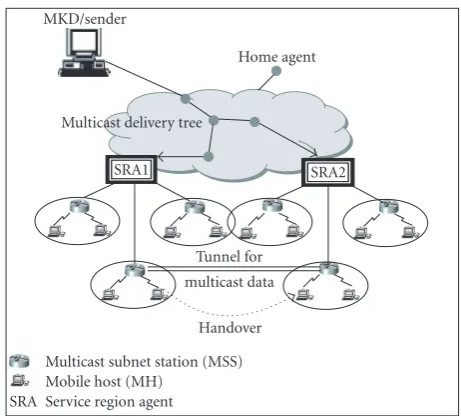
Figure1: Multicast enabled delivery path over IPv6 wireless network.
a local controller, has its own key. The subgroups are linked by intermediate agents for building a virtual group. The in-termediate agent role is to translate the multicast data dif-fused by a member within its subgroup to all members of the virtual group. Consequently, CAMM fits better dynamic groups. However, it is less efficient for diffusion of group data which undergoes encryption and decryption operations by the intermediate agents. On the other hand, DAMM is more efficient for data diffusion because it uses only one key shared among group members. DAMM is also a solution for scala-bility problems, in particularly for the revocation problem,1 does not equaln.
Both scenarios include (1) group creation, (2) initial key distribution, (3) new member join, (4) member leave, (5) handover process, and (6) multicast data distribution. We also perform the security analysis regarding group key se-curity and group data secrecy. In addition, we provide per-formance comparisons between our approach and the corre-sponding scenarios in [8].
The multicast enabled delivery path is shown inFigure 1. The components included in our approach referred to Figure 1are multicast key distributor (MKD), service region agent (SRA), multicast subnet station (MSS), and mobile hosts (MH).
Multicast key distributor
MKD manages all the access control, accounting, logging, and key distribution and data traffic distribution to a set of multicast support stations (MSSi). It also distributes the data encryption key to group members when they subscribe. The effects of group dynamics and host mobility are confined to each subnet, thus MKD is free from the rekeying operations upon join and leave operations.
Service region agent
There is only one SRA in which several subnets form a service region. SRA is a multicast router and will act as the core on the multicast delivery tree.
Multicast subnet station
MSS acts as a proxy for the mobile hosts by honestly relaying the data traffic to the mobile hosts and correctly managing the control traffic. There is only one MSS in each subnet that provides multicast service to all mobile hosts in that subnet. SRA and MSS are correctly managing the control traffic and they are the multicast listener delivery (MLD) capable IPv6 routers to discover the presence of interested receivers of a given multicast group. SRA and MSS use the multicast lis-tener discovery version 2 (MLDv2) (Vida and Costa, 2004) protocol that allows a host to inform its neighboring routers of its desire to receive IPv6 multicast transmissions.
Mobile host
MHi are mobile hosts in each subnet. The group dynam-ics and host mobility are confined to the subnet level. MHi are connected with MSSivia broadcast, transmission chan-nel such as air. MHilogically belong to one cell only at any given instance.
a tunnel is built between previous multicast subnet station (MSSp) and current multicast subnet station (MSS). This makes the multicast service interruption time very short be-cause the tunnel is much shorter than that between the mo-bile host and its home agent, especially when the momo-bile host is far away from its home network. The subnets are also clus-tered into different regions and the multicast delivery tree will be reconstructed at most one time when mobile host moves into a new service region, and when a mobile host moves around all subnets within the same MSS’s region, the multicast delivery tree will not be reconstructed.
One-to-many multicast applications such as stock quote exchange systems, scheduled audio/video (a/v) distribution, and push media have a single sender and multiple simulta-neous receivers, and transmission is unidirectional from one sender to many receivers. In this type of application, a sin-gle sender transmits secret information to a large number of patrons. Secret information would need to be encrypted and only paying users should have the decryption keys. One of the issues that must be addressed in secure sessions is key distribution, that is, how to securely distribute the keys to all members of a group. Multicast-based applications such as video conferencing, Internet broadcasting, and real-time fi-nance data distribution will play an important role in the fu-ture of the Internet as continued multicast encourages their use and deployment. In this paper, we consider a stock ex-change system as an example of one-to-many large group communication in which a single sender distributes its stock quotes to its customers.
3.1. Assumptions on proposed schemes
For both scenarios, we assume that multicast key distributor (MKD) is colocated with the sender only for the simplifica-tion purpose. MKD may be a group organizer and has the right to create the secure groups on Internet.
In our approach, we assume that all members must have a capability certificate (CC) from the designated certifica-tion authority (CA) to enforce the group access control and distribute their public keys securely and keep them initially through an off-line method. CA is a trusted third party that issues certificates for each entity. We assume that all pub-lic keys of responsible entities involved in our approach had been registered in the CA. We also assume that MKD and MSS keep CA’s public key to verify the authenticity of each mobile node’s certificate.
Our proposed schemes use RSA [11] encryption algo-rithm for securely distributing the signed TEK and other keys. RSA is a public key scheme based on security due to the difficulty of factoring large numbers. They also use ECDSA digital signature [12] scheme whose efficiency is superior to existing signature schemes for signing the broadcast access key (BAK). For symmetric key encryption, we use IDEA and MD5 [13] for message integrity. Prior to initial key distri-bution, each mobile host generates a public and private key pair using RSA encryption algorithm and publishes the pub-lic key (n, e) (i.e., it registers its public key in CA) shown in Algorithm 1. MKD and MSS also generate ECDSA key
(1) Each mobile node generates two large random primes, pandq[11], of approximately equal size such that their productn=pqis of the required bit length.
(2) Computen=pqand (ϕ) phi =(p−1)(q−1). (3) Choose an integere, 1< e < ϕ, such that gcd(e,ϕ)=1. (4) Compute the secret exponentd, 1 < d < ϕ, such that
ed≡1(modϕ).
(5) The public key is (n,e) and the private key is (n,d). The values ofp,q, andϕshould also be kept secret.
(i)nis known as the modulus.
(ii) eis known as the public exponent or encryption exponent.
(iii)dis known as the secret exponent or decryption exponent.
Algorithm1: RSA key generation procedures.
(1) Select an elliptic curve E defined overZ p. The number of points inE(Z p) should be divisible by a large prime n.
(2) Select a pointP∈E(Z p) of ordern.
(3) Select a statistically unique and unpredictable integerd in the interval [1,n−1].
(4) ComputeQ=dP.
(5) MSS’s public key is (E,P,n,Q) and private key isd.
Algorithm2: ECDSA key generation procedures.
pair and publish its public key. The key generation proce-dures of ECDSA key pair generated by BAKD are shown in Algorithm 2.
The capability certificate contains entity’s identity, en-tity’s ECDSA signature public key, or enen-tity’s RSA public key plus CA’s signature over these. For example, the capability certificate of mobile host is CCMH={MH’s Identity, KUMH, SCA[MH’s Identity, KUMH]}. To achieve the requirements of secure key distribution, the best solution is to combine the public and secret key systems in order to optimize the speed of symmetric key encryption while maintaining the security of public key encryption.
3.2. DAMM: key distribution algorithms
In this section, we propose the key distribution algorithms on decentralized architecture for mobile multicast (DAMM) on IPv6. The physical architecture and components are de-scribed inFigure 1.
subnets, MSS can play the role of MKD and can create a new group key (TEKnew). It also accepts or refuses a new mem-ber within the subnet and notifies the other multicast sub-net stations of any change in the subsub-net. We assume that SRA1 and SRA2 are adjacent, wired, and they are already pre-authenticated with each other via the secure channel. The no-tation used in this section is described inTable 1.
3.2.1. Group creation
Group creation is managed by the MKD. MKD is config-ured with group and access control information. MKD may be a group organizer and has the right to create the secure groups on Internet. Before holding a group session, multi-cast key distributor (MKD) has to prepare the members who are willing to join the group by other means (e-mail, fax, phone, post, etc.). MKD holds the group control list (GCL). MKD sends the updated GCL to all multicast subnet stations (MSSi).
Whenever a mobile host joins or leaves the multicast group, GCL is updated. After preparing the member list, MKD sends the invitation message to all the initial members and then waits for them to join. Upon receipt of the reply messages from members, MKD starts the initial key distribu-tion.
The group controller MKD starts the process of the group initialization by creating the group key TEK. For simpli-fication purposes, we assume that every MSS can securely generate the cryptographic keys. Whenever the membership changes within the subnets, MSS is delegated by MKD. MSS can play the role of MKD and can create a new group key (TEKnew). The MSS also accepts or refuses a new member within the subnet and notifies the other multicast subnet sta-tions of any change in the subnet. Then, the group controller MKD communicates the key TEK to group members via lo-cal controllers MSS.
(1) Initial key distribution
The multicast key distributor (MKD) starts the process of the group initialization by creating the traffic encryption key (TEK). For simplification purposes, we assume that every controller (MSS) can securely generate cryptographic keys. Then, the MKD communicates the key TEK to group mem-bers via local controllers (MSS). The decentralized nature of DAMM uses a single group key (TEK) at any time to encrypt or decrypt the group traffic.
InStep 1, MKD distributes the encrypted message that includes its signed group key (TEK), its public key, and prior-ity number of MSS to all multicast subnet stations. InStep 2, MSS sends the encrypted message that includes its signed se-cret key and its public key to mobile hosts. Eventually, the group key (TEK) is forwarded to the legitimate mobile hosts within the subnets.
Step 1.
MKD⇒MSSi: EPKUMSSi[SKRMKD[TEK], KUMKD, MSSpri].
(1)
Table1: Notation used inSection 3.
CCMH Capability certificate of mobile host
EPKRMKD Public key encryption with the private key of MKD EPKUMKD Public key encryption with the public key of MKD ESSKi Symmetric key encryption with the secret key SKi
f One-way hash function
Id Identifier (IP address) KC-Msg Key change message
SKR[M] Message M is signed by private key
SEKi Subnet encryption key for multicast subnet station i
SM Secret key from sender to multicast subnet station SKi Secret key of mobile host i
TEK Traffic encryption key
Step 2.
MSSi⇒MHi: EPKUMHi[SKRMSSi[SKi], KUMSSi],
MSSi⇒MHi: EPKRMSSi(ESSK1[TEK, MSSpri],. . .,
ESSKi[TEK, MSSpri]).
(2)
3.2.2. New member join
In join procedure, a local multicast router, MSS periodically sends membership query messages using multicast listener discovery (MLDv2) [2] for IPv6. Any host that wishes to join the group replies with a membership report message. A multicast router periodically gathers and manages the mem-bership report messages, and then sends a join message to the upstream-multicast routers. There are two steps: source level subscription and subnet-level subscription. There are two steps for join operation.
Step 1is concerned with a mobile host wishing to become a member of a multicast group. If the new mobile host wants to join the multicast group, it sends a join request that in-cludes its capability certificate with MLD membership report to a multicast subnet station (MSS). A mobile host capability certificate contains MH’s identity and public key.
InStep 2, MSS authenticates the new host’s join request. If authentication is successful, it generates the new TEK and shared secret key SK. Then MSS encrypts the TEKnew, the new shared secret key SKnew, and MSS’s priority with new mobile host public key, and sends it to a new mobile host. MSS also encrypts TEKnewwith old TEK and multicasts it to the other multicast subnet stations and to its existing mobile receivers.
Step 1.
Step 2.
MSS⇒MHnew: EPKUMHnew[TEKnew, SKnew, MSSpri],
MSS⇒MHi, MSSi: ESTEKold[TEKnew].
(4)
3.2.3. Member leave operation
It is possible that a mobile receiver (MHi) may want to leave from the multicast group either compulsorily or voluntarily. For both cases, the group key must be rekeyed. InStep 1, MSS encrypts the created TEKnewand its priority number with the old TEK. Next, MSS multicasts this encrypted message only to the multicast subnet stations and service region agents, upstream, which are capable to decrypt. To guarantee the for-ward secrecy, MSS must not forfor-ward this message to its mo-bile receivers (MHi) within its subnetwork. MSS unicasts the new key TEKnewto them under their respective unique secret keys (SKi), but not the evicted one shown inStep 2. The pri-ority number of the local controller (MSS) must be included in these messages.
An evicted member cannot any more obtain the new group key because its MSS, which proceed to change the key (TEK), multicasts the new TEK, downstream, to mem-bers under their respective unique secret keys, but not to the evicted one. We assume that the evicted member is only linked to one subnetwork. Thus, evicted members cannot re-trieve the new traffic encryption key-TEKnew.
Step 1.
MSS⇒MSSi: ESTEKold[TEKnew, MSSpri]. (5)
Step 2.
MSS⇒MHi: ESSK1[TEKnew, MSSpri],. . .,
ESSKi[TEKnew, MSSpri].
(6)
In order to maintain the synchronization of the use of data encryption key TEK, all group members use the same TEK at the same time, join and leave operations can be buffered at a break point. During the membership changes, all multicast group members may receive many traffic en-cryption keys (TEKs) sent by different multicast support sta-tions (MSSi) at a break point. In order to use the same group key (TEK) at the same time, group members may choose one of the group keys coming from the multicast subnet stations with the highest priority number (the smallest priority num-ber).
3.2.4. Handover process
Handover process is concerned with a mobile host moves from one IP network to another shown inFigure 2. In this case, we combine the protocol RHMoM [10] with our join procedure (Section 3.2.2) described as follows.
(1) If the mobile host is the first member of desired multi-cast group in the new subnet, the current MSSbuilds a tunnel between the mobile host and the previous mul-ticast subnet station (MSSp) on the previous network
MKD/sender
Home agent
Multicast delivery tree
SRA1 MSS¼
MH
SRA2 MSSp
MH 1
3 2
Current network Previous network
Figure2: Handover process.
and gets the packets from MSSp. At the same time, the current MSSsends an MLD report message to its ser-vice region agent SRA.
(2) If there are hosts in the subnet that have already been in the group, the mobile host can get multicast packets from the current MSSwithout any additional opera-tions and it is not needed to build a tunnel between the current MSSand previous subnet MSSp. The mobile host receives the multicast packets by the tunnel and it sends an MLD group report messages to the MSS on the current network to start to rejoin the proce-dure (using the same member join proceproce-dure referred toSection 3.2.2).
(3) After receiving the multicast packets directly from the MSS, the tunnel will be removed.
3.2.5. Multicast data distribution
Message plus concatenated hash code is encrypted using TEK-ESTEK[MH(M)] by the sender. The sender sends this encrypted message to multicast support stations and MSSi then forward it to their mobile hosts. All mobile receivers of the multicast group with TEK can decrypt the multicast data. In this case, the hash code provides the structure required to achieve authentication. Because encryption is applied to the entire message plus hash code and confidentiality is also pro-vided since the sender and mobile hosts share the secret key, the message must have come from sender.
DAMM’s keys assigned to MKD, MSS, and MH are shown inTable 2.
3.2.6. Security analysis on DAMM
Table2: DAMM assigned keys.
Keys Owner Shared user
TEK, KUMKD MKD MSS
TEK, KUMKD MKD MHi
KUMSS MSS MKD
SKi MSS MH
(1) Group key security
During the traffic data encryption key (TEK) distribu-tion phase in Section 3.2.1(1), an opponent may substitute the encrypted message—EPKUMSSi[SKRMKD [TEK], KUMKD,
MSSpri]. However, the opponent would be extremely difficult to alter the message without knowing the MSS’s private key and only MKD could create the signed TEK-SKRMKD[TEK]. In
addition, traffic data encryption key (TEK) is providing both the authentication function and confidentiality by a double use of the public key scheme. Thus, this attack fails.
A new join member cannot obtain the old TEK key be-cause itsMSSiupdates the traffic data encryption key (TEK).
MSSi then encrypts TEKnew, secret key (SKnew) and MSS’s priority number with the new mobile host’s public key— EPKUMHnew[TEKnew, SKnew, MSSpri] and sends it to the new
mobile host. ThenMSSimulticasts the encrypted key change message—ESTEKold[TEKnew] to its existing mobile receivers
under its old local traffic encryption key. Hence, the new member cannot retrieve the old traffic encryption key.
Similarly, an evicted mobile host cannot obtain any new group key because itsMSSiupdates the subnet encryption key-SEK. MSSi then multicasts the encrypted new traffic encryption key and MSS’s priority number—ESSK1[TEKnew,
MSSpri],. . ., ESSKi[TEKnew, MSSpri] to its only remaining
mobile receivers. Thus, the evicted member cannot retrieve the new traffic encryption key and he cannot know the new traffic encryption key.
(2) Group data secrecy
Only group membersowning the traffic encryption key (TEK)
can decrypt the group data.Multicast subnet stations cannot get the group dataand group data confidentiality is assured.
During the membership changes, all group members can choose the same TEK from different rekeying message and start to use it at the next break point. Hence, the new mem-bers and evicted memmem-bers cannot access old and new group data because they cannot retrieve the old and new group keys.
3.3. CAMM: key distribution algorithms
In this section, we propose the key distribution algorithms on centralized architecture for mobile multicast (CAMM) on IPv6. In this scenario, multicast subnet stations (MSSi) are not trusted and used to assist in enforcing the secure multicast group without having any access to the multicast
data. We propose key distribution algorithms regarding four operations: group creation, member join, member leave, and multicast data distribution. The physical architecture and components are similar to the one described inSection 3, for DAMM refer toFigure 1.
3.3.1. Group creation
Group creation is similar to the one described in Section 3.2.1.
(1) Initial key distribution
InStep 1, MKD generates a random number as a traffic en-cryption key (TEK). It then encrypts its signed TEK, pub-lic key, and secret key (SM) with MSSi’s pubpub-lic key. Then MKD sends this encrypted message to the multicast subnet stations.
In Step 2, the corresponding MSS decrypts it with its private key and stores the MKD’s public key and secret key (SM). Then MSS reencrypts the message that includes sender’s signed TEK, public key, local subnet encryption key, and unique secret key (SK) under the public keys of each mo-bile receiver and sends it to each momo-bile receiver within their subnets. Then MKD updates the group control list (GCL).
Step 1.
MKD⇒MSSi: EPKUMSSi[SKRMKD[TEK], KUMKD, SM].
(7)
Step 2.
MSSi⇒MHi: EPKUMHi[SKRMKD[TEK], KUMKD, SEKi, SKi].
(8)
Each mobile receiver decrypts the TEK, MKD’s public key, subnet encryption key-SEK, and unique secret key (SK) with their corresponding private keys and MKD’s public key.
3.3.2. New member join
This operation is concerned with a mobile host wishing to become a member of a multicast group. It includes two steps: source-level subscription and subnet-level subscription.
(1) Source-level subscription
InStep 1, when a new mobile host wants to join the mul-ticast group, it sends the join request message that includes its capability certificate to multicast subnet station (MSS). Next, MSS forwards MH’s capability certificate to multicast key distributor MKD.
Step 1.
MHnew⇒MSS : CCMHnew,
MSS⇒MKD : CCMHnew. (9)
Step 2.
MKD⇒MSS : EPKUMHnew[SKRMKD[TEK], KUMKD, f(SM)],
MSS⇒MHnew: EPKUMHnew[SKRMKD[TEK], KUMKD, f(SM)].
(10)
(2) Subnet-level subscription
InStep 1, the new mobile host requests the subnet encryp-tion key (SEK) from its corresponding MSS by sending its capability certificate and encrypted f(SM) after receiving the traffic encryption key (TEK). Encrypted hash code f(SM) lets MSSiknow that the new mobile host has received the traffic encryption key (TEK) from MKD. Then, MSSiauthenticates the new MH’s certificate and computes its own f(SM).
In Step 2, if authentication is successful and the com-puted f(SM) equals MH’s presented f(SM), MSS encrypts its signed new subnet key (SEKnew) and secret key (SKi) with new MH’s public key and sends it to new mobile host. Ver-ification of f(SM) shows that the new joining mobile node has received the traffic encryption key (TEK) from MKD. To guarantee the backward secrecy, MSS then multicasts the encrypted key change message—ESSEKold[KC-Msg] to its
ex-isting members. Each mobile receiver decrypts the KC-Msg and updates the subnet encryption key (SEK) by passing the key data through a randomly generated function in the key change message (Table 4).
Step 1.
MHnew⇒MSS : CCMH, EPKRMHnew[f(SM)]. (11)
Step 2.
MSS⇒MHnew: EPKUMHnew[SKRMSS[SEKnew, SKi]],
MSS⇒MHi: ESSEKold[KC-Msg].
(12)
The format of key change message used in mobile join and leave operations are shown inTable 4. The function type field in the key change message comprises four randomly generated functions based on SEK:00 for hash function,01 for4 bits left shift, 10for no operation, and 11 for4 bits right shift. The key version included in a key change message is in-creased whenever MSS wants to update its subnet encryption key (SEK) on join and leave operations.
3.3.3. Member leave operation
It is also possible that some mobile members may want to leave from the multicast group either voluntarily or compul-sorily. For the first case, a mobile host sends a member leave request to the corresponding MSS. To guarantee the forward secrecy for both cases, MSS updates its local subnet encryp-tion key (SEK) and sends the encrypted key change mes-sage to its remaining mobile receivers. Each of the mobile
Table3: CAMM assigned keys.
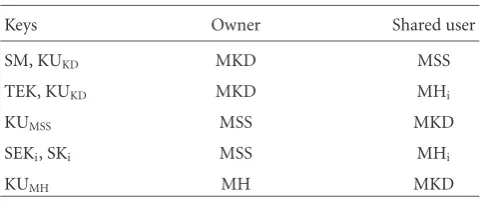
Keys Owner Shared user
SM, KUKD MKD MSS
TEK, KUKD MKD MHi
KUMSS MSS MKD
SEKi, SKi MSS MHi
KUMH MH MKD
Table4: Key change message.
2 bits 16 bits
Node identifier Function type Key version
receivers decrypts the key change message with its respec-tive shared secret keys (SKi) and updates the local subnet key (SEK) by passing the key data through the randomly gener-ated key change functions. Group control list (GCL) is up-dated on both MKD and MSS whenever a mobile host joins and/or leaves the multicast group.
Step 1.
MHleave⇒MSS : ESSKi[LEAVE]. (13)
Step 2.
MSS⇒MHi: ESSK1[KC-Msg],. . ., ESSKi[KC-Msg].
(14)
3.3.4. Handover process
Handover process in DAMM is similar to the one described inSection 3.2.4
3.3.5. Multicast data distribution
When a sender multicasts the group data (M) encrypted with a traffic encryption key-TEK first and then reencrypted with the corresponding subnet encryption key (SEK)-ESSEK[ESTEK[M]]. All mobile receivers of the multicast group with TEK and the corresponding local subnet key (SEK) can decrypt the multicast data.
CAMM’s keys assigned to MKD, MSS, and MH are shown inTable 3.
3.3.6. Security analysis on CAMM
In this section, we discuss group key security and group data secrecy on CAMM.
(1) Group key security
message—EPKUMHi[SKRMKD[TEK], KUMKD, SEKi, SKi].
How-ever, the opponent would be extremely difficult to alter the message without knowing the mobile host’s private key and only MKD could create the signed TEK-SKRMKD[TEK]. In
ad-dition, traffic data encryption key (TEK) is providing both the authentication function and confidentiality by a double use of the public key scheme. Thus, this attack fails.
A new join member cannot obtain the old subgroup key because its MSSi updates the local subnet encryption key (SEK). MSSithen encrypts its signed new subnet encryption key (SEKnew) and secret key (SKi) with the new mobile host’s public key—EPKUMHnew[SKRMSS[SEKnew, SKi]] and sends it to
the new mobile host. Then MSSi multicasts the encrypted key change message—ESSEKold[KC-Msg] to its existing
bers under its old local subgroup key. Hence, the new mem-ber cannot retrieve the old local subgroup key.
Similarly, an evicted mobile host cannot obtain any new group key because its MSSi updates the subnet encryption key-SEK. MSSi then multicasts the encrypted key change message—ESSK1[KC-Msg],. . ., ESSKi[KC-Msg] to its only
re-maining mobile receivers. Thus, the evicted member cannot retrieve the key change message and he cannot know the new local subgroup key.
(2) Group data secrecy
Only group members (receivers) owning the corresponding local subnet key (SEK) and the traffic encryption key (TEK)
can decrypt the group data. Multicast subnet stations can-not get the group data because they have no traffic encryp-tion key (TEK). When a new mobile host joins the group, the corresponding MSS updates its local subnet key. MSSi then sends (SEKi)newto the new mobile host and distributes the encrypted key change message to its existing mobile re-ceivers. Thus the new joining member cannot get the pre-vious (old) group data because the old group data is en-crypted as ESSEKold[ESTEK[M]]. He cannot know (SEK)old.
This achieves backward secrecy.
Similarly, when a mobile host leaves the group, the cor-responding MSSidistributes the encrypted key change mes-sage to its remaining members. The leaving member can-not retrieve the future group data because it is encrypted-[ES(SEK)new[ESTEK(M)]]. He knows only TEK and (SEK)old
keys. This achieves forward secrecy.
4. PERFORMANCE COMPARISON
4.1. Comparative analysis of DAMM with FT-MSS
In this section, we provide a comparative analysis of pro-posed scheme (DAMM) withfully trusted mobile support sta-tions(FT-MSS) in [8]. Both schemes use the public and se-cret key systems to achieve scalable and secure key distribu-tion. We compare the performance evaluation of these two scenarios based on storage requirements, new member join, member leave, and rekeying operations.
DAMM
(i) As we presented the initial key distribution in Section 3.2.1(1), the number of keys stored at an MSS depends on the number of mobile hosts within a subnet. However, the total keys stored at a mobile host are constant rather than increasing in logarithmic growth in the number of mobile hosts within the subnet.
(ii) In the case of a new member join inSection 3.2.2, MSS sends only one transmission to a new mobile host. The steps used in the member join operation are described as fol-lows:
(1) MHnew⇒MSS : CCMHnew,
(2) MSS⇒MHnew: EPKUMHnew[TEKnew, SKnew, MSSpri],
(3) MSS⇒MHi, MSSi: ESTEKold[TEKnew].
(iii) In DAMM, MSS incurs less key decryption costs than FT-MSS. Each mobile receiver also incurs less key decryp-tion costs than ST-MSS. MSS needs only one time to en-crypt and deen-crypt the traffic encryption key (TEK) and sub-net encryption key (SEK) during the group data transmis-sion. Each mobile host incurs only one key decryption cost which is significantly reduced to retrieve the traffic encryp-tion key (TEK) and unique secret key (SK). In this case, only three transmissions are required to receive all the node keys.
(iv) In the case of member leave (Section 3.2.3), the cor-responding MSS changes the traffic encryption key (TEK) and encrypts TEKnewwith the unique secret keys (SKi) of re-maining mobile receivers and multicasts that information to them. At the receiver side, each mobile host needs to decrypt only one time to get the new TEK. The number of transmis-sions required to rekey the mobile hosts within the subnet is significantly reduced from 2(log M) to 2.
FT-MSS
In initial key distribution on fully trusted multicast support stations (FT-MSS) in [8], the total keys stored at a mobile host are increasing in logarithmic growth in the number of mobile hosts within the subnet. The steps used in the mem-ber join operation on fully trusted multicast support stations are described as follows:
(1) MKD⇒MSS : ESSK[KEKi, TEKnew], SKRMKD[EPKUMSS[SK]],
(2) MSS⇒MHnew: SKRMSS[EPKUMHnew[CEK]].
(i) In the case of a new member join, MSS incurs only two key encryption costs compared to (N + 3) for DAMM. Each mobile receiver incurs the same decryption costs as with DAMM.
(ii) MSS needs more encryption and decryption costs for traffic encryption key (TEK) and cell encryption key (CEK) during the group data transmission.
on two times logarithmic growth in the number of multicast support stations.
(iv) In the case of member leave, MSS changes its cell en-cryption key (CEK) and key enen-cryption keys (KEKi) that is shared with other MSSiaccording to the centralized tree Ver-saKey [14] to prevent MH from accessing the data traffic and guarantee the traffic forward secrecy at cell level. The num-ber of transmissions required to rekey the mobile receivers depends on two times logarithmic growth in the number of multicast support stations.
4.2. Comparative analysis of CAMM with ST-MSS
In this section, we provide a comparative analysis of pro-posed scheme (CAMM) withsemi-trusted mobile support sta-tions(ST-MSS) in [8]. Both schemes use the public and se-cret key systems to achieve scalable and secure key distribu-tion. We compare the performance evaluation of these two scenarios regarding storage requirements, new member join, member leave, and rekeying operations.
CAMM
(i) As we presented initial key distribution in Section 3.3.1(1), the total keys stored at a mobile host are constant rather than increasing in logarithmic growth in the number of mobile hosts within the subnet. The number of keys stored at an MSS is also constant.
(ii) In the case of a new member join described in Section 3.3.2, MKD sends only one transmission to a mo-bile host. The steps used in the member join operation are described as follows:
(1) MHnew⇒MKD : CCMHnew,
(2) MKD ⇒ MHnew : EPKUMHnew[SKRMKD[TEK], KUMKD,
f(SM)],
(3) MHnew⇒MSS : CCMHnew, EPKRMHnew[f(SM)],
(4) MSS⇒MHnew: EPKUMHnew[SKRMSS[SEKnew, SKi]],
(5) MSS⇒MHi: ESSEKold[KC-Msg].
(iii) In CAMM, MSS incurs less key encryption costs than ST-MSS. Each mobile receiver incurs less key decryp-tion costs than ST-MSS. The new mobile receiver has to de-crypt four times to get the traffic encryption key (TEK) and subnet encryption key (SEK). From the security viewpoint, both TEK and SEK are providing both the authentication function and confidentiality by a double use of the public key scheme [15]. The number of transmissions is reduced from 2(log M) to 5.
(iv) In the case of member leave (Section 3.3.3), the cor-responding MSS changes its local subnet key and encrypts the key change message—ESSK1[KC-Msg],. . ., ESSKi
[KC-Msg] with the shared secret keys of all mobile receivers and multicasts that information to them. At the receiver side, each mobile host needs only one symmetric key decryption time. The number of transmissions required to rekey the mobile hosts within the subnet is significantly reduced from 2(log M) to 1.
ST-MSS
(i) In initial key distribution onsemi-trusted mobile support stations(ST-MSS) in [8], the total keys stored at a mobile host are increasing in logarithmic growth. The number of keys stored at an MSS depends on the number of mobile hosts under an MSS control.
(ii) The steps used in the member join operation on semi-trusted multicast support stations are described as fol-lows:
(1) MHnew⇒MSS : SKRMHnew[JOIN],
(2) MSS⇒MKD : SKRMHnew[JOIN],
(3) MKD⇒MSS : SKRMKD[EPKUMHnew[TEK]],
(4) MSS⇒MHnew: SKRMKD[EPKUMHnew[TEK]],
(5) MSS⇒MHnew: SKRMSS[EPKUMHnew[SM]], ESSM[CEK],
(6) MSS⇒MHi : SKRMSS [EPKUMHi[SM]], ESSM[new keys
from leaf to root].
(iii) In the case of a new member join, MSS incurs more key encryption costs than CAMM. Each mobile receiver in-curs more key decryption costs than CAMM. In member join, the number of transmissions depends on two times log-arithmic growth in the number of multicast support stations. (iv) In the case of member leave, MSS changes its cell encryption key (CEK) to prevent MH from accessing the data traffic and guarantee the traffic forward secrecy at cell level. In this case, multicast cell stations apply the centralized tree VersaKey [14]. The number of transmissions required to rekey the mobile receivers depends also on two times loga-rithmic growth in the number of multicast support stations.
4.3. Tabular comparison
In this section, we summarize the merits and shortcom-ings of a comparative analysis between DAMM and FT-MSS, as well as CAMM and ST-MSS shown in Table 5. A value written in boldis the best value for a certain row. All sce-narios use both public and secret key systems to achieve scalable and secure key distribution scheme. The scalabil-ity problem of group key management for a large group with frequent joins and leaves in wireless network was pre-viously addressed by [8] which applies centralized versa key (CVK) scheme [14]. In all these schemes, the session key is modified each time a mobile host joins and leaves. In comparing the two approaches, there are several issues to consider: performance, trust, and reliability. The main dif-ference between CVK and our approach is in how the 1-affects-n-type problem [16] is addressed. In CVK, every time a client joins/leaves the secure group, a rekeying op-eration is required, which affects the entire group and the server cost is O(log(N)). In CAMM, there is no globally shared group key with the apparent advantage that when-ever a client joins/leaves a subnet, only the subnet needs to be rekeyed.
Table5: Comparison of secure one-to-many multicast protocols (N: no. of participating mobile receivers, M: no. of multicast subnet stations, M: no. of mobile hosts under MSS control).
Criteria FT-MSS [8] DAMM ST-MSS [8] CAMM
No. of keys managed by the sender O(log M) M+1 M+1 M+2
No. of keys stored at the sender M+1 M+2 N+M+1 N+M+2
No. of keys stored at an MSS M M+1 M 4
No. of keys stored at a member O(log M) 3 O(log M) 5
Total key encryptions at the sender 3 2 2 2
Total key encryptions at the MSS 2 N+3 6 3
Total key decryptions at the MSS 3 2 0 1
Total key decryptions at a member 2 2 5 4
Total session key encryptions at sender 3 0 2 2
Total session key encryptions at an MSS 2 1 0 0
Total session key decryptions at an MSS 3 1 0 0
Total session key decryptions at a member 2 1 2 2
No. of messages at join O(log M+log M) O(1) O(1) O(1)
No. of messages at leave O(log M+log M) O(1) O(1) O(1)
Total messages on member join 2(log M) 3 2(log M) 5
Total messages on member leave 2(log M) 1 2(log M) 1
One affectsnscalability Yes Yes Yes Yes
Intermediate nodes (trusted?) Yes Yes No No
Forward secrecy Yes Yes Yes Yes
Backward secrecy Yes Yes Yes Yes
Public key/ secret key Both Both Both Both
receiver that must be performed in order to access the group key used to encrypt the data traffic.
Both DAMM and CAMM reduce the total number of messages transmitted during the membership changes from 2(log M) to two transmissions. Our approach is very de-sirable from the viewpoint of transmission savings since an efficient rekeying mechanism is provided for membership changes. In addition, proposed protocols ensure the forward secrecy and backward secrecy and provide for transmission efficiency. In particular, they achieve better performance than ST-MSS and FT-MSS.
5. CONCLUSION
The main focus of the key management approach and tech-niques proposed in this paper is to make better provision for securely distributing the group key and rekey messages for joining and leaving a mobile host in a secure multicast group. We provided the security analysis and performance comparisons between our approach and the scenarios in [8]. All scenarios apply both public and secret key cryptosys-tems in order to achieve the security advantages of public key cryptosystem and speed advantages of secret key cryptosys-tems. They all ensure the forward secrecy and backward se-crecy, confidentiality, authentication, and message integrity. The benefits of our proposed technique are that it minimizes the number of transmissions required to rekey the multicast group and it imposes minimal storage requirements on the multicast group. In our approach, dynamic architecture for
mobile multicast (DAMM) is very desirable from the view-point of transmission overhead since an efficient rekeying mechanism is provided for membership changes. In addi-tion, it ensures the forward secrecy, backward secrecy and provides transmission efficiency. Centralized architecture for mobile multicast (CAMM) also achieves robust against col-lusion of excluded users with generating fresh keys, and send-ing them to members securely. Our proposed protocols sig-nificantly reduce the communication burden associated with key updating.
REFERENCES
[1] M. Goncalves and K. Niles, “Multicasting overview,” inIP Multicasting: Concepts and Application, pp. 91–117, McGraw-Hill, New York, NY, USA, 1999.
[2] R. Vida and L. Costa, Eds., “Multicast Listener Discovery Ver-sion 2 (MLDv2) for IPv6,” 2004, (Requests For Comments— 3810), IETF Network Working Group.
[3] X. Jia, “A distributed algorithm of delay-bounded multicast routing for multimedia applications in wide area networks,”
IEEE/ACM Transactions on Networking, vol. 6, no. 6, pp. 828– 837, 1998.
[4] S. Banerjee, C. Kommareddy, K. Kar, B. Bhattacharjee, and S. Khuller, “Construction of an efficient overlay multicast infras-tructure for real-time applications,” inProceedings of 22nd An-nual Joint Conference on the IEEE Computer and Communi-cations Societies (INFOCOM ’03), vol. 2, pp. 1521–1531, San Francisco, Calif, USA, March-April 2003.
[6] M. Baugher, R. Canetti, L. Dondeti, and F. Lindholm, “Multi-cast Security (MSEC) Group Key Management Architecture,” Requests For Comments—4046, 2005.
[7] C. Perkins, “IP Mobility Support,” (Request for Comments— 2002), IETF Network working group, 1996.
[8] D. Bruschi and E. Rosti, “Secure multicast in wireless networks of mobile hosts: protocols and issues,”Mobile Networks and Applications, vol. 7, no. 6, pp. 503–511, 2002, special issue on multipoint communication in wireless mobile networks. [9] T. Karygiannis and L. Owens, “Wireless network security,
802.11, Bluetooth and Handheld Devices,” NIST Special Publication 800-48, 2002, http://csrc.nist.gov/publications/ nistpubs/800-48/NIST SP 800-48.pdf.
[10] L. Sun, Y. Liao, J. Zheng, W. Yichuan, and J. Ma, “An efficient multicast protocol in mobile IPv6 networks,” inProceedings of IEEE Wireless Communications and Networking Conference (WCNC ’04), vol. 1, pp. 155–159, Atlanta, Ga, USA, March 2004.
[11] R. L. Rivest, A. Shamir, and L. Adleman, “A method for ob-taining digital signatures and public-key cryptosystems,”ACM Communication, vol. 21, no. 2, pp. 120–126, 1978.
[12] D. Johnson and A. Menezes, “The elliptic curve digital signa-ture algorithm (ECDSA),” Tech. Rep. 99-34, University of Wa-terloo, Canada, 1999,http://www.cacr.math.uwaterloo.ca. [13] R. Rivest, “The MD5 Message-Digest Algorithm,” 1992,
(Re-quest For Comments—1321), IETF Network working group. [14] R. Vida and E. Costa, “Multicast Listener Discovery Version
2 (MLD) for IPv6,” 2004, (Requests For Comments—3810), IETF Network Working Group.
[15] M. Waldvogel, G. Caronni, D. Sun, N. Weiler, and B. Plattner, “The versakey framework: versatile group key management,”
IEEE Journal on Selected Areas in Communications, vol. 17, no. 9, pp. 1614–1631, 1999.
[16] W. Stallings,Cryptography and Network Security, Principles and Practice, Prentice Hall, Englewood Cliffs, NJ, USA, 2nd edi-tion, 1999.
Win Aye received the B.C. Tech. (Bach-elor of Computer Technology) and M.C. Tech. (Master’s of Computer Technology) degrees from the University of Computer Studies, Yangon (UCSY, Myanmar), in 1995 and 1999, respectively, and the Ph.D. degree from Multimedia University, Malaysia, in 2005. She has been teaching at UCSY since 1995. Currently, she is an Associate Profes-sor in the Department of Computer
Hard-ware Technology at UCSY. Her research interests include control engineering, multicast transmission, multicast security, and net-work security.
Mohammad Umar Siddiqireceived the B.S. Eng. and M.S. Eng. degrees from Aligarh Muslim University (AMU Aligarh) in 1966 and 1971, respectively, and the Ph.D. degree from Indian Institute of Technology Kanpur (IIT Kanpur) in 1976, all in electrical engi-neering. He has been in the teaching profes-sion throughout, first at AMU Aligarh, then at IIT Kanpur. In 1998, he joined Multime-dia University, Malaysia. Currently, he is a