Authentication Based on Multilayer Clustering
in Ad Hoc Networks
Keun-Ho Lee
Department of Computer Science & Engineering, Korea University, 1, 5-Ga, Anam-dong, Sungbuk-ku, Seoul 136-701, Korea Email:[email protected]
Sang-Bum Han
Department of Computer Science & Engineering, Korea University, 1, 5-Ga, Anam-dong, Sungbuk-ku, Seoul 136-701, Korea Email:[email protected]
Heyi-Sook Suh
Department of Computer Science & Engineering, Korea University, 77-6 Sejong-ro, Jongro-gu, Seoul 110-760, Korea Email:[email protected]
SangKeun Lee
Department of Computer Science & Engineering, Korea University, 1, 5-Ga, Anam-dong, Sungbuk-ku, Seoul 136-701, Korea Email:[email protected]
Chong-Sun Hwang
Department of Computer Science & Engineering, Korea University, 1, 5-Ga, Anam-dong, Sungbuk-ku, Seoul 136-701, Korea Email:[email protected]
Received 30 June 2004; Revised 2 August 2005
In this paper, we describe a secure cluster-routing protocol based on a multilayer scheme in ad hoc networks. This work provides scalable, threshold authentication scheme in ad hoc networks. We present detailed security threats against ad hoc routing proto-cols, specifically examining cluster-based routing. Our proposed protocol, called “authentication based on multilayer clustering for ad hoc networks” (AMCAN), designs an end-to-end authentication protocol that relies on mutual trust between nodes in other clusters. The AMCAN strategy takes advantage of a multilayer architecture that is designed for an authentication protocol in a cluster head (CH) using a new concept of control cluster head (CCH) scheme. We propose an authentication protocol that uses certificates containing an asymmetric key and a multilayer architecture so that the CCH is achieved using the threshold scheme, thereby reducing the computational overhead and successfully defeating all identified attacks. We also use a more extensive area, such as a CCH, using an identification protocol to build a highly secure, highly available authentication service, which forms the core of our security framework.
Keywords and phrases:authentication, clustering, cluster head, ad hoc network, multilayer.
1. INTRODUCTION
Mobile ad hoc networks consist of devices that are au-tonomously self-organized into networks. In ad hoc net-works, the devices themselves are the network, and this allows seamless communication, at low cost, with a self-organizing capability, which makes mobile ad hoc networks completely different from any other networking solution.
This is an open access article distributed under the Creative Commons Attribution License, which permits unrestricted use, distribution, and reproduction in any medium, provided the original work is properly cited.
the “distributed clustering algorithm” (DCA) [3], and “dis-tributed mobility-adaptive clustering” (DMAC) [3]. Mobile ad hoc networks’ security issues have became a central con-cern and are increasingly important. Ad hoc networks can-not be used in practice if they are can-not secure, because ad hoc networks are subject to various attacks. Wireless communi-cation links can be intercepted without noticeable effort, and communication protocols in all layers are vulnerable to spe-cific attacks [4]. Studies of secure cluster routing based on multiple layers in ad hoc networks have been carried out us-ing “authenticated routus-ing for ad hoc networks” (ARAN) [5] and in [4,6].
In this paper, we demonstrate possible ways to exploit ad hoc routing protocols, define various security environments, and offer a secure solution with “authentication based on multilayer clustering for ad hoc networks” (AMCAN). We detail the ways to exploit protocols that are under consid-eration by [1,2,3,4,5,6].
Our proposed protocol detects and protects against ma-licious actions by multilayer parties in one particular ad hoc environment. We propose an authentication protocol that uses certificates containing a Diffie-Hellman key agreement and a multilayer architecture so that CCH is achieved using the threshold scheme, so that the number of essential encryp-tions reduces the computational overhead and successfully defeats all identified attacks.
Our evaluations show that AMCAN has minimal perfor-mance costs in terms of processing and networking overhead for the increased security that it offers. While this basic idea has been proposed before in [2,3,5], we are the first to apply it to a clustered network. Our algorithm addresses issues of authentication and multilayer security architecture and helps to adapt the complexity to the scalability of mobile end sys-tems. Moreover, an extensive evaluation involves the reduc-tion of CH traffic using CCH.
In this paper, we first overview cluster routing pro-tocols in ad hoc networks, and briefly overview security goals, common techniques for authentication, and thresh-old cryptosystems, as well as related work for securing ad hoc networks in Section 2. Section 3 describes our secu-rity concept in detail as a CCH construction algorithm and presents authentication based on multilayer clustering for ad hoc networks (AMCAN). An important contribution of our work is the evaluation of the CCH construction and security architecture in Section 4. Those measurements are based on different authentication models, which are pre-sented in this section, and we also show the results of se-curity and network performance analyses of AMCAN. Fi-nally,Section 5concludes the paper and considers further re-search.
2. RELATED WORK
There are numerous proposals for clustering and multilayer routing schemes. This section presents two aspects of AM-CAN, including those that are most closely related to the cluster organization and security requirements in ad hoc net-works.
Cluster A Cluster B Cluster C
CHA 2 CHB 4 5 CHC
1 3 6
Cluster head Gateway node Member node
Figure1: Clustering-based architecture.
2.1. Clustering in ad hoc networks
A comprehensive overview of different clustering strategies is presented in [8]. In this section, we present several of the cluster-based control structures and associated control algo-rithms that have been proposed for use in large dynamic networks. A cluster-based control structure promotes more efficient use of resources in controlling large dynamic net-works. With cluster-based control, the physical network is transformed into a virtual network of interconnected node clusters. Each cluster has one or more controllers acting on its behalf to make control decisions for cluster members and, in some cases, to construct and distribute representations of cluster state for use outside the cluster [2,8].
CBRP [1] is a routing protocol designed for use in mo-bile ad hoc networks. The protocol divides the nodes of the ad hoc network into a number of overlapping or disjoint two-hop-diameter clusters using a distributed method. The cluster-based architecture was devised to minimize the flood-ing of route discovery packets. This kind of architecture is most suitable for large networks with several nodes. The entire network is divided into a number of overlapping or disjoint two-hop-diameter clusters, as shown inFigure 1. A cluster head (CH) is elected for each cluster to maintain clus-ter membership information. A clusclus-ter is identified by its CH ID. Intercluster routes are discovered dynamically using the cluster membership information kept by each CH. By clus-tering nodes into groups, the protocol efficiently minimizes the flooding traffic during route discovery and speeds up this process. A node regards itself as being in a cluster if it has a bidirectional link to the head of the cluster. In the current implementation of CBRP, the node with the lowest node ID is elected as the CH.
All of the nodes broadcast a HELLO message periodically. The HELLO message also contains tables carrying infor-mation about the neighboring nodes and adjacent clusters. These HELLO messages are useful for maintaining up-to-date two-hop topology. An in-depth study of cluster-based networks has been published [1].
able to adjust its depth dynamically in response to the chang-ing conditions of the network. ARCH conforms to the max-imum hierarchical depths proven to be the theoretical opti-mum. As such, the protocol lends itself well to hierarchical addressing structures. When used with hierarchical address-ing, it should be extremely beneficial for reducing routing table size.
2.2. Security protocol in ad hoc networks
The security requirement, which typically strives for ad hoc networks security goals like authentication, availability, con-fidentiality, integrity, and the nonrepudiation of communi-cating entities, is of particular importance as it forms the basis for achieving the other security goals. Encryption of ad hoc networks security is worthless if the communica-tion partners have not verified their identities beforehand. Authentication of entities and messages is realized in dif-ferent ways using either symmetric or asymmetric crypto-graphic algorithms. Authentication enables a node to ensure the identity of the peer node that it is in communication with. Without this, an attacker could impersonate a node, thereby gaining unauthorized access to a resource and sensi-tive information and interfering with the operation of other nodes.
While a symmetric algorithm depends on the existence of a preshared key, authentication using asymmetric cryp-tography requires a secure mapping of public key infrastruc-tures (PKI). PKIs use digitally signed certificates to verify a key owner’s identity. Each user has to prove their identity to a certification authority (CA) and in turn receives a digitally signed certificate proving the ownership of the public key. Distributing the signing key and the functionality of a CA over a number of different nodes by means of secret shar-ing and threshold cryptography is a possible solution to this problem, as we will study here [4].
Threshold cryptosystem
A threshold cryptosystem is a distributed implementation of a cryptosystem, in which the secret key is a secret that is shared among a group of nodes. These nodes can then de-crypt or sign messages by following a distributed protocol. The goal of a threshold scheme is to protect the secret key in a fault-tolerant way. Namely, the key remains secret, and cor-rect decryptions or signatures are always computed, even if the adversary corrupts less than a fixed threshold of the node. Desmedt and Frankel introduced threshold cryptosystems [13]. In particular, they presented a threshold cryptosystem based on the Diffie-Hellman problem. The secret sharing scheme [14] is important for threshold cryptosystems. The idea of secret sharing is to start with a secret, and divide it into pieces called shares, which are distributed amongst users such that the pooled shares of specific subsets of users al-low reconstruction of the original secret. We now describe the Shamir (t·n)-threshold secret sharing scheme. Suppose
pandq are large primes such thatq divides p−1, andg
is an element of order 1 in Z. It is assumed that p,q, and
g are known publicly. Unless otherwise stated, all arithmetic
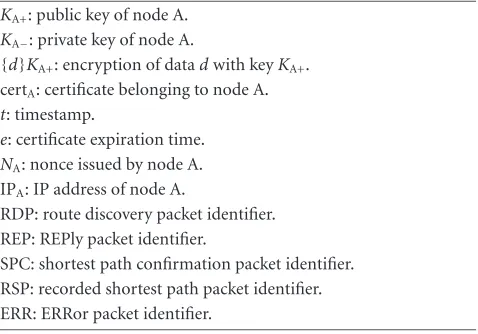
Table1: Variables and notation used in ARAN.
KA+: public key of node A. KA−: private key of node A.
{d}KA+: encryption of datadwith keyKA+. certA: certificate belonging to node A. t: timestamp.
e: certificate expiration time. NA: nonce issued by node A. IPA: IP address of node A.
RDP: route discovery packet identifier. REP: REPly packet identifier.
SPC: shortest path confirmation packet identifier. RSP: recorded shortest path packet identifier. ERR: ERRor packet identifier.
will be computed modulop. The scheme is described in the following protocol. Distribution of trust in our key manage-ment service is accomplished using threshold cryptography [16,17]. An (n,t+ 1)-threshold cryptography scheme allows
nparties to share the ability to perform a cryptographic op-eration so that anyt+ 1 parties can perform this operation jointly, whereas it is infeasible for at mosttparties to do so, even by collusion.
ARAN protocol
The ARAN protocol can detect and protect against mali-cious actions by third parties and in the ad hoc environment. ARAN is composed of two distinct stages. The first stage is simple and requires little extra work from peers beyond tra-ditional ad hoc protocols. Nodes that perform the optional second stage increase the security of their route, but incur an additional cost for their ad hoc peers who may not com-ply. ARAN makes use of cryptographic certificates for the purposes of authentication and nonrepudiation. It consists of a preliminary certification process, a mandatory end-to-end authentication stage, and an optional second stage that provides secure shortest paths. The optional stage is consid-erably more expensive than providing end-to-end authenti-cation. There are twelve steps necessary to implement ARAN [5].
In [5], vulnerabilities and attacks specific to AODV and DSR protocols are discussed and the two protocols are com-pared with the ARAN protocol. The ARAN protocol uses a preliminary cryptographic certification process, followed by an end-to-end route authentication process, which ensures secure route establishment. The protocol does not specify any specific key distribution algorithm. On joining the network, each node receives a certificate from the trusted server.
In this partition, we briefly review ARAN protocol. We first describe the notations used throughout this paper in Table 1.
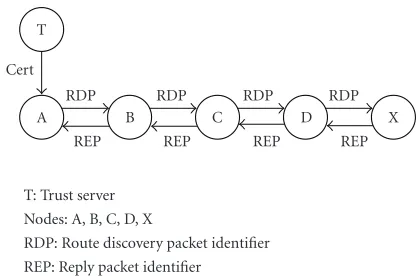
There are totally twelve steps to implement ARAN:
(1) T→A: certA=[IPA,KA+,t,e]KT−,
T
A B C D X
Cert
RDP RDP RDP RDP
REP REP REP REP
T: Trust server Nodes: A, B, C, D, X
RDP: Route discovery packet identifier REP: Reply packet identifier
Figure2: ARAN simple ad hoc network model.
(3) B→broadcast:
[[RDP, IPX, certA,NA,t]KA−]KB−, certB,
(4) C→broadcast: [[RDP, IPX, certA,NA,t]KA−]KC−, certC,
(5) X→D: [REP, IPA, certX,NA,t]KX−,
(6) D→C: [[REP, IPA, certX,NA,t]KX−]KD−, certC,
(7) C→B: [[REP, IPA, certX,NA,t]KX−]KC−, certC,
(8) A→broadcast: SPC, IPX, certX,
{[IPX, certA,NA,t]KA−}KX+,
(9) B→broadcast: IPX, certX, SPC, IPX, certX,
{[{[IPX, certA,NA,t]KA−}KX+]KB−, certB}KX+,
(10) X→D: [RSP, IPA, certX,NA, route]KX−, (11) B→C: [ERR, IPA, IPX, certC,NB,t]KB−, (12) T→broadcast: [revoke, certr]KT−.
Figure 2shows totally how to process ARAN situation. The idea to use a distributed certification authority based on a shared certification key and threshold cryptography for se-curing ad hoc networks was presented by [15]. Our approach is based on modification idea of ARAN protocol used by [5,15], but introduces several new concepts, like a cluster-based network architecture, a process for admitting new par-ticipants, and end-to-end access control within the multi-layer in the ad hoc networks. The ARAN protocol cannot be a configuration for a large area. If ARAN is large area, ARAN has a lot of overhead.
In this paper, we show how our proposed AMCAN re-duces the computational overhead and successfully defeats all identified attacks in a large area.
3. AUTHENTICATION BASED ON MULTILAYER
CLUSTERING FOR AD HOC NETWORKS 3.1. Scenario for an experiment in AMCAN
Our proposed scheme is based on the following assump-tions. First, mobile nodes in an ad hoc network usually com-municate with one another via an error-prone, bandwidth-constrained, insecure wireless channel. The physical layer of the network is vulnerable to denial-of-service (DoS) at-tacks. As there is no way to protect from DoS attacks, we do not consider physical attacks. Second, the CH knows which nodes are in its own cluster. Therefore, the CH manages the
IDs of cluster members (i.e., when the CH receives a commu-nication request, it can identify members of its own cluster). Third, we consider CH a trusted member. The CH is similar to the server in [15]. Actually, one can trust the section area CH, even if a member node is abnormal. Therefore, we used the CCH (control cluster head) key in a network. Finally, the CCH selected always trusts CH.
The AMCAN protocol requires the use of a trusted cer-tificate server T (CCH) in a cluster. A CH is a cercer-tificate server T for authenticated nodes in a cluster. A CCH authen-ticates the CH for the CCH private key. A CCH is a root-layer certificate trust server. CH certification uses communication between the nodes in a cluster. All the nodes of a network know the public key for the system. Suppose that we have a pair of public and private keys. The CCH and CH use the certificates to keep the Diffie-Hellman key [17] agreement. Our proposed scheme should minimize the communication load in order to extend the overall lifetime of the system. The CH knows who is in its own cluster. We use the key when ex-changing certificates to enable secure communication. Fig-ures3and4illustrate how the service is configured. More-over, we propose applying the use of ID-based [18,19] cryp-tography to abate the overhead effect on exchanging the pub-lic key. ID-based pubpub-lic key exchange is weighted more than the RSA algorithm. An ID-based public key is suitable in a mobile ad hoc network.
3.2. Configuration of a multilayer cluster
In this section, we describe an efficient authentication algo-rithm for the set up and maintenance of cluster organiza-tion in the presence of node mobility that modify, thus sat-isfying the DMAC and the ARCH for the ad hoc clustering routing protocol. We make two main modifications to the original DMAC and ARCH algorithms as shown in Figures3 and4. We use the concept of low-maintenance clustering and mobility-aware clustering schemes. Low-maintenance clus-tering schemes aim at providing stable cluster architecture for upper-layer protocols with little cluster maintenance cost. By limiting reclustering situations or minimizing explicit control messages for clustering, the cluster structure can be maintained well without excessive consumption of network resources for cluster maintenance. Mobility-aware clustering takes the mobility behavior of mobile nodes into considera-tion. This is because the mobile node’s movement is the main cause of changes to the network topology. By grouping mo-bile nodes with similar speed into the same cluster, the intra-cluster links can be greatly tightened and the intra-cluster structure can be correspondingly stabilized in the face of moving mo-bile nodes. The cluster topology is initialized and maintained through the periodic transmission of HELLO messages by each node. This makes this algorithm suitable for both clus-tering set up and maintenance authentication from the CH, which was not available in authentication solutions.
3.2.1. CH selection algorithm
3
2
1 CHA
Cluster head Member node
(a)
3
2
1 CHA
CHB
3
2
1
Cluster A Cluster B
Cluster A Cluster B
CHB
CHA CHB
B
5 5
4
Cluster head Gateway node Member node
(b)
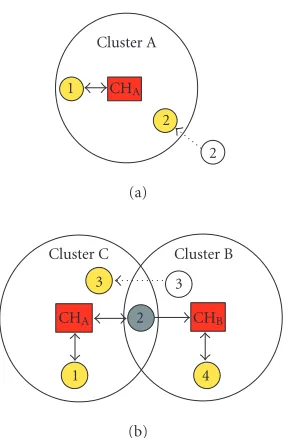
Figure3: The CH selected when joining a CH between cluster A and cluster B (parameter priority lowest ID: A>B in cluster, 1>2>3> 4>5 in nodes) (a) Normal cluster. (b) Cluster A moves CHBinto cluster B.
conditions to change the CH.Figure 3shows the DMAC state in the two conditions. One is when two CHs come within the range of each other, another is when a node becomes discon-nected from any other cluster. This is an improvement over existing algorithms, which select the CH every time the clus-ter membership changes. The DMAC algorithm assumes that a message sent by a node is received correctly within a finite time by all its neighbors. The DMAC also assumes that each node knows its own ID, weight, and role of all its neighbors. In addition, each node knows its power of nodes.
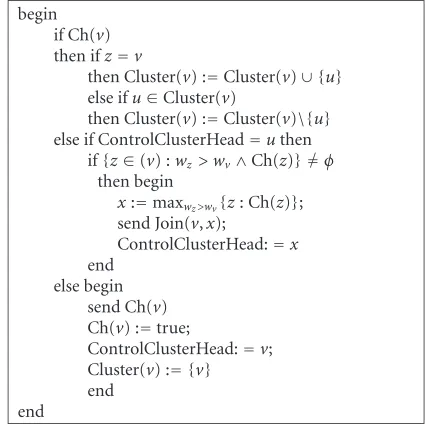
Here, we use the same two types of messages used in the DCA (namely, Ch(v) and Join(v,u)) [3]. In the following we use Cluster(v) and ClusterHead to indicate the set of nodes in the cluster whose ClusterHead isvand the ClusterHead of a node’s cluster, respectively.v’s Boolean variable Ch(v) is set to true ifvhas sent a Ch message. Its variables Cluster-Head, Ch(·), and Cluster(·) are initialized to nil, false, andφ, respectively. The following is the description of the twoM -procedures as executed at each nodev. In DCA algorithm, on receiving a Ch message from a neighboru, nodevchecks if it has received from all its neighborsz, such thatwz > wu, a Join(z,x) message. In this case,vwill not receive a Ch mes-sage from thesez, anduis the node with the biggest weight inv’s neighborhood that has sent a Ch message.
At the clustering set up, or when a node vis added to the network, it executes the CH selection procedure (see Algorithm 1) in order to determine its own role. If its neigh-bors include at least one CH with a greater weight, thenvwill join it. Otherwise it will be a CH [3].
Initialize begin
if{z∈(v) :wz>wv∧Ch(z)} =φ
then begin
x:=maxwz>wv{z: Ch(z)};
send Join(v,x); ClusterHead:=x end
else begin send Ch(v) Ch(v) :=true; ClusterHead:=v; Cluster(v) := {v}
end end;
Repeat—On receivingClusterHead(u) begin
if (wu> wClusterHead) then begin send Join(v,u);
ClusterHead:=u;
if Ch(v) then Ch(v) :=false end
end;
Algorithm 1: CH selection procedure.
CHB
CHA CHB CHC
1 CHA 2 CHB 3 4 CHC 5
CCH node CH node
Gateway node Member node
Cluster A Cluster B Cluster C Layer1
Layer2 Layer3
Figure4: CCH selection process with multiple layers (parameter priority lowest ID : B>A>C in cluster, 1>2>3>4>5 in nodes).
that a neighbor with a bigger weight that has not decided its role yet will eventually send a message. If this message is a Ch message, thenvwill affiliate with the new cluster head. When a neighborubecomes a cluster head, on receiving the corresponding Ch message, nodevchecks if it has to affiliate withu, and it checks whether wnis bigger than the weight ofv’s cluster head or not. In this case, independently of its current role,vjoinsu’s cluster [3].
3.2.2. CCH selection algorithm
In this section, our proposed scheme describes the CCH for managing a CH. The CCH selection scheme uses the ARCH algorithm. The CCH has information on all the CHs and takes charge of certificates between CHs. AMCAN uses the ARAN protocol based on the CCH selection algorithm. Figure 4 shows the authenticated architecture for multiple layers using the ARCH algorithm. Source node 1 in cluster A communicates with destination node 5 in cluster C. Before designing the details of our algorithm, we noted that the CH selected the self-stabilizing leader.
On receiving the message Join(u,z), the behavior of node
vdepends on whether it is a cluster head or not. In the affi r-mative,vhas to check if eitheruis joining its cluster (z=v: in this case,uis added to Cluster(v)) or ifubelonged to its cluster and is now joining another cluster (z=v: in this case,
uis removed from Cluster(v)). Ifvis not a cluster head, it has to check ifuwas its cluster head. Only if this is the case,vhas to decide its role: it will join the biggest cluster headxin its neighborhood such thatwx> wvif such a node exists. Other-wise, it will be a CCH (ControlClusterHead). The CCH isv. The CCH roles need slow mobility, lowest of ID, and enough of energy in CHs. uparameter contents included mobility, ID, and energy (seeAlgorithm 2).
3.3. Design of AMCAN 3.3.1. Protocol scheme
In this section, we describe the detailed operation of AM-CAN. AMCAN consists of a preliminary certification process
begin if Ch(v) then ifz=v
then Cluster(v) :=Cluster(v)∪ {u}
else ifu∈Cluster(v)
then Cluster(v) :=Cluster(v)\{u}
else if ControlClusterHead=uthen if{z∈(v) :wz> wv∧Ch(z)} =φ
then begin
x:=maxwz>wv{z: Ch(z)};
send Join(v,x);
ControlClusterHead:=x end
else begin send Ch(v) Ch(v) :=true;
ControlClusterHead:=v; Cluster(v) := {v}
end end
Algorithm 2: CCH selection procedure.
and three mandatory stages: CCH authentication for CHs, a node joins a cluster for the first time, and authentication for end-to-end of session key exchange. So far, we have sur-veyed several existing solutions for CCH key establishment based on the Diffie-Hellman key exchange. These involve sharing the CCH key communication securely with all mem-bers. However, as all members share the same secret key, they cannot communicate with another member using the end-to-end method. Moreover, if anyone has their key stolen, all the members must reestablish the CCH key. The core of the matter is sharing the same secret key with all members. It is impossible for all members to share one secret key because all nodes cannot trust each other in an ad hoc network.
For this reason, we classify all members into two types of trust level: trusted members and untrusted members. Only the CH for trusted members in a cluster can establish a CCH key. Untrusted members authenticate and communicate with other untrusted members using a session key, which is gen-erated by certificate exchange through an authenticated path. AMCAN achieves end-to-end security services and executes partial authentication in all clusters.
3.3.2. System model
Table2: Variables and notation used in AMACN.
CCH: trust server of control CH CHA: cluster head in cluster A IDX: identity of X
KS,CH: secret key shared with S and CH Time1: current time
S: member node in CHA X: member node in CHB
As large area networks are adaptive to a hierarchical ar-chitecture, cluster-based networks are used. A large commu-nication area is divided into several section areas (clusters). Each section CH can participate in only one section and manages the communication units (cluster member nodes) within its section area. Each unit shares a secret key with the section CH when entering a section area. If any unit (S) wants to communicate with another unit (X) in another section area, S needs to know whether X wants to communicate with unit S. If so, they will also want to communicate mutually us-ing a secure end-to-end method. Therefore, they exchange a certificate with each other through an authenticated path, so that they can authenticate each other and establish a session key for secure end-to-end communication. Figures4,6, and 7illustrate how the service is configured.
3.3.3. Notation
We use the notation listed inTable 2to describe the proposed scheme.
3.3.4. CCH authenticated for CH using threshold cryptosystem
In our case, thenCHs of the key management service share the ability to sign certificates. For the service to tolerate t
compromised CHs, we use an (n,t+ 1)-threshold cryptogra-phy scheme and divide the private key,k, of the service into
nshares (CHA, CHB, CHC), assigning one share to each CH.
We call (CHA, CHB, CHC) sharing ofK.Figure 5illustrates
how the service is configured.
Given a service consisting of three CHs, letK/k be the public/private key pair of the service. Using a (3,2)-threshold cryptography scheme, each CHigets a sharesiof the private
keyk.
For a message m, CHi can generate partial signatures
PS(m,si) using its sharesi. The correct CHAand CHC both
generate partial signatures and forward the signatures to a combiner, c. Although CHB fails to submit a partial
signa-ture,ccan generate the signature (m)k ofmsigned by CH
using the privatek.
AMCAN consists of a preliminary certification process, a mandatory end-to-end authentication step, and an optional second step that provides threshold cryptosystem. Option step of the AMACN reduced more overhead than end-to-end authentication of ARAN.
CCH requires the use of a trusted certificate server T [5]. All CHs receive a certificate from CCH in Figure 6. A CH
CHA
Figure6: Authentication process for multiple layers within a large cluster network.
certificate has the following form:
CCH−→CHA: certCHA=
IDCHAKCCH +eTime1
. (1)
The certificate contains the ID address of the CH, the public key of the CCH, timestamp Time1for when the
certifi-cate was created, and timeeat which the certificate expires. These variables are concatenated and signed by the CCH. Every CH must maintain fresh certificates with the trusted server and must know the CCH public key. CHA sends a
request message with a timestamp to CCH for a public key request to communicate with CHB. If sending an encrypted
message, CCH uses a private key that CHAdecrypts using the
CCH public key.
3.3.5. A node joins a cluster for the first time
The ID address of the IDCH, node S’s certificate (certS), a
nonceNCH, and the current timetare all signed with A’s
CHA CCH CHC RequestIDCHAIDCHCTime1NCHA
EKCCH−
KCHC+Requeste
IDCHAIDCHCNCHAIDSIDScertSNCHA
hIDCHAIDCHCNCHA|NSIDS
KCHC+
RequestIDCHCIDCHATime2NCHC
EKCCH−
KCHA+Requeste
Figure7: CHs authenticated from CCH.
1 CHA 2
2 Cluster A
(a)
3 3
2
CHA CHB
1 4
Cluster C Cluster B
(b)
Figure8: A node joins a cluster for the first time. (a) New node 2 joins cluster A for the first time. (b) Node 3 joins cluster A from cluster B.
The CH generates a random numberNCH and sends it
to entry node A with its own cluster key. Source node A es-tablishes a path message as a multicast to its own CH. En-try node A stores a cluster key for communication within the cluster. The public key for the encryption of random number
NCHis sent to CH.
3.3.6. Authentication for end-to-end of key exchange
So far, we have considered security services for communi-cation from one cluster member to a cluster head. In an ad hoc network environment, securing the end-to-end path from one mobile user to another is the primary concern. The end-to-end security service minimizes the interference from intermediate nodes, especially malicious nodes. In this subsection, we present secure end-to-end authentication and
a key exchange protocol between one cluster member and another. The end-to-end key exchange progress is described in Figure 9. The end-to-end key exchange uses the Diffi e-Hellman key as the public key.
Figure 6shows the authentication process for multiple layers in large ad hoc networks. The CCH authenticates CHs. There are 7 steps required to implement AMCAN.Figure 9 shows the end-to-end authentication between CHs commu-nicating after authentication using the CCH.
First, using a previously shared secret keyKS,CHA, S sends a message to CHArequesting communication with X. Since
IDSis encrypted usingKS,CHA, other nodes except S and CHA do not know the node with which S wishes to communicate. As certSandNSare also encrypted, they can be transferred
securely.
Upon receiving the request, CHAchecks that S is a
mem-ber. If so, this equals the progress leaving out steps (2) and (6) (i.e., CHA=CHC). Otherwise, CHAasks the other
clus-ter heads where X is using the CHC public key, which was
previously established in step (3) between cluster heads. Let X be a member of CHB.
In step (3), X is informed of the request from S to com-municate with him. CHC sends S’s certificate along with NCHC. Upon deriving the public key for S from the certificate, X calculates the session keyKX,S=(PKS)kXmodp, which will
be shared between S and X. X usesKS,Xin step (4) to let CHC
know that it accepts S’s request for communication. CHCand
CHApass to S the part of the message in step (4) that contains
X’s confirmation usingKS,X. CHCand CHAalso forward X’s
certificate to S. Upon receiving a message including X’s cer-tificate, S can calculate the session keyKS,X=(PKX)kSmodp
using PKXderived from certX.
Finally, S and X share the same secret key, and S com-municates with X by sending back X’s nonce encrypted us-ing the shared keyKS,X. We propose a reliable algorithm that
Cluster A Cluster C
(2) Search X (include certS)
(1) Request communication with X (include certS)
(6) Forward response (include certX) (7) Forward response
(include certX)
(5) Response (include certX)
(3) Inform the request fromS(include certS)
CHA CHC
S X
(9) Confirmation & communication (8) Calculate
session keyKS,X
(4) Calculate session keyKS,X
Figure9: End-to-end authentication between clusters after the CHs are authenticated from the CCH.
reference by appending them to routing packets when a route is discovered.
4. EVALUATION AND PERFORMANCE ANALYSIS
4.1. Experiment of energy and mobility becoming a CCH
We used tools within Matlab to simulate the algorithm de-scribed inSection 3.2for networks with varying node den-sity (λ) and different values of the parameterspandk. Each node in the network chooses to become a CH with probabil-itypand advertises itself as a CH to the nodes within its radio range. This advertisement is forwarded to all the nodes that are no more thankhops away from the CH. Any node that receives such advertisements and is not itself a CH joins the cluster of the closest CH. Any node that is neither a CH nor has joined any cluster itself becomes a CH. Because we have limited the advertisement forwarding to k hops, if a node does not receive a CH advertisement within time duration
t(wheretunits is the time required for data from the CH to reach any nodekhops away) it can infer that it is not within
khops of any volunteer CH and hence become a forced CH. Moreover, this limit on the number of hops allows the CH to schedule periodic transmissions to the processing center. To generate the network for each simulation experiment, the location of each node is found by generation of two ran-dom numbers uniformly distributed in [0, 2a], where 2a is the length of a side of the square area in which the nodes are distributed. In all of these experiments, the communication range of each node was assumed to be 1 unit. To verify that the optimal values of the parameters p andkof our algo-rithm computed according to [20] formulae (11) and (13) do minimize the energy spent in the system, we simulated our clustering algorithm on node networks with 50, 100, and 200 nodes distributed uniformly in a square area of 10 square units. We have, without loss of generality, assumed that the
cost of transmitting 1 unit of data is 1 unit of energy. The processing center is assumed to be located at the center of the square area. For the first set of simulation experiments, we considered a range of values for the probability pof be-coming a CH in the algorithm proposed inSection 3.2. For each of these probability values, we computed the maximum number of hopsk allowed in a cluster using (13) and used these values for the maximum number of hops allowed in a cluster in the simulations. We simulated in a cluster in the simulations. We simulated the clustering algorithm 100 times for each density and each of the probability values and used the average energy consumption over the 100 experiments to plot the graph in Figures10and11.
4.2. Compare ARAN and AMCAN
In this section, we compare the efficiency properties of the existing CCH key establishment protocol and our proposed scheme. We also compare end-to-end security and move dis-tance within a cluster.Table 3presents the total message and the total number of move distance operations necessary for each protocol. The efficiency numbers for existing solutions are given in tables for each protocol. None of the existing so-lutions achieve end-to-end security. In AMCAN, variable c
is the number of CHs. We assume that CCH establishment among CHs uses ARCH, CBRP, and DMAC. As AMCAN also establishes authentication based on a trust layer, it also achieves end-to-end security.
100
80
60
40
20
0 0.05 0.1 0.15 0.2 0.25 0.3 0.35 0.4
N=200
N=100
N=50
Probability of becoming a CCH
Energ
y
(%)
Figure10: Total energy in a network ofnnodes distributed in an area of 10 square units for different values of probability of becom-ing a CCH in the algorithm inSection 3.2.
100
80
60
40
20
0 0.05 0.1 0.15 0.2 0.25 0.3 0.35 0.4
N=200
N=100
N=50
Probability of becoming a CCH
Mo
b
il
it
y
(%
)
Figure11: Mobility in a network ofnnodes distributed in an area of 10 square units for different values of probability of becoming a CCH in the algorithm inSection 3.2.
CH using CCH and has fewer processing operations. The ARAN protocol distinguishes the nodes of a local distance area as a cluster.Table 4presents AMCAN superior for large networks as it was designed for use in such networks. The AMCAN protocol has strong security as it uses the CCH to obtain a higher level of security than that of ARAN.
The advantages and limitations of the proposed approach have been identified. The certificate mechanism uses the certification method of the ARAN identification protocol within a cluster. AMCAN minimizes the process of
chang-ing certificates by uschang-ing clusterchang-ing-routchang-ing protocols. An analysis of its stability verified its authentication, efficiency, safety, and scalability. Authentication and nonrepudiation use a cryptographic certificate. Each node receives a certifi-cate from the CH.
We evaluated three performance metrics.
(i) Unauthorized participation: AMCAN participation accepts only packets that have been signed with a cer-tified key issued by a trusted authority. There are many mechanisms for authenticating users to a trusted cer-tificate authority. The trusted authority is also a single point of failure attack.
(ii) Spoofed route signaling: since only the source node can sign using its own private key, nodes cannot spoof other nodes in route instantiation. Similarly, reply packets include the destination node’s certificate and signature, ensuring that only the destination can re-spond to route discovery.
(iii) Reply attacks: reply attacks are prevented by including a nonce and a timestamp with the routing message.
AMCAN minimizes changes in the certificate process of clus-ter networks. The analysis of scalability verified the authenti-cation, efficiency, safety, and scalability of the method.
Protocol analysis
We need to show that the above protocol is an AMCAN.
Lemma 1. The protocol described inSection 3is designed for AMCAN.
Proof. The protocol can be performed as follows: receiver CHC authenticates IDSIDCHAcertSNS for interclus-ter. Sender CHA sends CCH including IDCHAIDCHC
Time1NCHA. AMCAN further improves the stability by the
use of a nonce. AMCAN can reduce system energy use by di-viding the parts to be handled in each CH. The CCH offers safe authentication of each node through management of the CHs.
Computation costs
The computation costs are calculated as
KS,X=(PKX)kSmodp, (3)
and our protocol uses an encryption/decryption protocol that requires a total of 1 operation ofKS,X=(PKX)kSmodp,
which can be computed efficiently using the standard AM-CAN. The CCH is achieved using the threshold scheme, thereby reducing the computation overhead because the ARAN protocol step has 12 steps but the AMCAN protocol step has 7 steps.
5. CONCLUSION
Table3: Performance evaluation on each protocol.
Item Protocol
ARAN AMCAN
Encryption algorithm RSA digital signature Diffie-Hellman
Total number of session keys n 2
Total number of message n(n: node number) n/c(c: cluster number) End-to-end security of area X(small area) O(small and large area)
Move distance More 2 hops 2 hops
X: no (impossible),O: yes (possible).
Table4: Characteristics on each protocol.
Item Protocol
ARAN AMCAN
Authentication O O
Efficiency O O
Safety O O
Scalability X O
X: no (impossible),O: yes (possible).
environments, and offered a secure solution with authentica-tion based on multilayer clustering for ad hoc networks (AM-CAN). We showed ways to exploit two protocols that are un-der consiun-deration for clustering-based routing protocols and the ARAN identification protocol. Clustering-based proto-cols are efficient in terms of network performance. Our pro-posed protocol, called AMCAN, detects and protects against malicious actions across multiple layers and by peers in one particular ad hoc environment. AMCAN introduces authen-tication, efficiency, safety, and scalability to an ad hoc envi-ronment as part of a minimal security policy. Our evalua-tion showed that AMCAN has minimal performance costs in terms of processing and networking overhead for the in-creased security that it offers. In this paper, we examined the certification process for clustering routing protocols in ad hoc networks, and designed a certification protocol for AM-CAN. The basic idea of AMCAN is to propose a CCH that has top-layer authority. We propose an authentication pro-tocol that uses certificates containing an asymmetric key and a multilayer architecture so that the CCH is achieved using the threshold scheme, thereby reducing the computational overhead and successfully defeating all identified attacks. We also use a more extensive area, such as a CCH, using an iden-tification protocol to build a highly secure, highly available authentication service, which forms the core of our security framework.
ACKNOWLEDGMENT
This work was done under a University Fundamental Re-search Program supported by Ministry of Information & Communication in Republic of Korea.
REFERENCES
[1] M. Jiang, J. Li, and Y. C. Tay, “Cluster based routing pro-tocol (CBRP) functional specification,” IETF internet draft, MANET working group, August 1999, http://www.comp. nus.edu.sg/∼tayyc/cbrp/draft-ietf-manet-cbrp-spec-01.txt. [2] E. M. Belding-Royer, “Multi-level hierarchies for scalable Ad
Hoc routing,”Wireless Networks, vol. 9, no. 5, pp. 461–478, 2003.
[3] S. Basagni, “Distributed clustering for Ad Hoc networks,” in Proc. International Symposium on Parallel Architectures, Algo-rithms, and Networks (ISPAN ’99), pp. 310–315, Fremantle, Australia, June 1999.
[4] M. Bechler, H.-J. Hof, D. Kraft, F. Rahlke, and L. Wolf, “A cluster-based security architecture for Ad Hoc networks,” in Proc. 23rd Annual Joint Conference of the IEEE Computer and Communications Societies (INFOCOM ’04), vol. 4, pp. 2393– 2403, Hong Kong, March 2004.
[5] K. Sanzgiri, B. Dahill, B. N. Levine, C. Shields, and E. M. Belding-Royer, “A secure routing protocol for Ad Hoc net-works,” inProc. 10th IEEE International Conference on Net-work Protocols (ICNP ’02), pp. 78–87, Paris, France, Novem-ber 2002.
[6] A. C.-F. Chan, “Distributed symmetric key management for mobile Ad Hoc networks,” inProc. 23rd Annual Joint Confer-ence of the IEEE Computer and Communications Societies (IN-FOCOM ’04), vol. 4, pp. 2414–2424, Hong Kong, March 2004. [7] L. Zhou and Z. J. Haas, “Securing Ad Hoc networks,”IEEE
Network, vol. 13, no. 6, pp. 24–30, 1999.
[8] M. Steenstrup, “Cluster-based networks,” inAd Hoc Network-ing, C. E. Perkins, Ed., chapter 4, pp. 75–138, Addison-Wesley, Reading, Mass, USA, 2000.
[9] L. Venkatraman and D. P. Agrawal, “A novel authentication scheme for Ad Hoc networks,” inProc. IEEE Wireless Commu-nications and Networking Conference (WCNC ’00), vol. 3, pp. 1268–1273, Chicago, Ill, USA, September 2000.
[10] L. Kleinrock and F. Kamoun, “Hierarchical routing for large networks: performance evaluation and optimization,” Com-puter Networks, vol. 1, no. 3, pp. 155–174, 1977.
[11] J. Sucec and I. Marsic, “Clustering overhead for hierarchical routing in mobile Ad Hoc networks,” inProc. 21st Annual Joint Conference of the IEEE Computer and Communications Societies (INFOCOM ’02), vol. 3, pp. 1698–1706, New York, NY, USA, June 2002.
[12] L. Butty´an and J.-P. Hubaux, “Report on a working session on security in wireless Ad Hoc networks,”ACM SIGMOBILE Mobile Computing and Communications Review, vol. 7, no. 1, pp. 74–94, 2003.
[14] A. Shamir, “How to share a secret,”Communications of the ACM, vol. 22, no. 11, pp. 612–613, 1979.
[15] L. Zhou and Z. J. Hass, “Securing Ad Hoc network,”IEEE Net-work, vol. 13, no. 6, pp. 24–30, 1999.
[16] Y. G. Desmedt and Y. Frankel, “Threshold cryptosystems,” in Proc. 9th Annual International Cryptology Conference on Ad-vances in Cryptology (CRYPTO ’89), G. Brassard, Ed., vol. 435 ofLecture Notes in Computer Science, pp. 307–315, Springer, Santa Barbara, Calif, USA, August 1990.
[17] M. Steiner, G. Tsudik, and M. Waidner, “Diffie-Hellman key distribution extended to group communication,” inProc. 3rd ACM Conference on Computer and Communications Security (CCS ’96), pp. 31–37, New Delhi, India, March 1996. [18] A. Shamir, “Identity-based cryptosystems and signature
schemes,” inProc. International Cryptology Conference on Ad-vances in Cryptology (CRYPTO ’84), vol. 196 ofLecture Notes in Computer Science, pp. 47–53, Springer, Santa Barbara, Calif, USA, August 1985.
[19] D. Boneh and M. K. Franklin, “Identity-based encryption from the Weil pairing,” in Proc. 21st Annual International Cryptology Conference on Advances in Cryptology (CRYPTO ’01), vol. 2139 ofLecture Notes in Computer Science, pp. 213– 229, Springer, Santa Barbara, Calif, USA, August 2001. [20] S. Bandyopadhyay and E. J. Coyle, “Minimizing
communica-tion costs in hierarchically-clustered networks of wireless sen-sors,”Computer Networks, vol. 44, no. 1, pp. 1–16, 2004.
Keun-Ho Lee received the B.S. degree in computer science from SoonChun-Hyang University, Korea, in 1998, and the M.S. degree in electronic commerce from SoonChunHyang University, Korea, in 2001. He is currently a Ph.D. candidate in computer science and engineering at Korea University, Korea. He is also a researcher in the Research Institute of Computer Infor-mation and Communication at Korea
Uni-versity. His research interests include ad hoc, sensor, ubiquitous, and mobile communication security.
Sang-Bum Hanreceived the B.S. degree in computer science from Seoul National Uni-versity of Technology, Korea, in 1997, and the M.S. degree in computer engineering from Korea University, Korea, in 2001. He is currently a Ph.D. candidate in computer science and engineering at Korea Univer-sity, Korea. He is also a Manager of the Net-work Operation Center in Korea Telecom. His main fields are in wireless network, ad hoc mobility management, and network security.
Heyi-Sook Suh received the B.S. degree in computer science from SookMyung Women’s University, Korea, in 1988, the M.S. degree in computer education from Korea University, and the Ph.D. degree in computer science from Korea University. She is currently an Assistant Junior Offi -cial in the Ministry of Education & Hu-man Resources, Seoul, Korea. She is also a researcher at the Center for Modeling &
Simulation in Korea Institute for Defense Analyses (KIDA). Her
main fields are in wireless network, mobility management, network security, HLA/RTI, and so forth.
SangKeun Leereceived his B.S., M.S., and Ph.D. degrees in computer science and engi-neering, Korea University, Seoul, South Ko-rea, in 1994, 1996, and 1999, respectively. Since 2003, he has been an Assistant Pro-fessor in computer science and engineer-ing, Korea University, Seoul, South Korea. His research interests include data manage-ment in mobile/pervasive computing sys-tems, location-based information syssys-tems, XML databases, and mobile ad hoc networks.
Chong-Sun Hwang received the M.S. de-gree in mathematics from Korea University, Korea, in 1970, and the Ph.D. degree in stat-ics and computer science from the Univer-sity of Georgia in 1978. From 1978 to 1980, he was an Associate Professor at South Car-olina Lander State University. He is cur-rently a Full Professor in the Department of Computer Science and Engineering at Ko-rea University, Seoul, KoKo-rea. Since 1995, he