Volume 2007, Article ID 74890,10pages doi:10.1155/2007/74890
Research Article
Characterization and Optimization of LDPC Codes for
the 2-User Gaussian Multiple Access Channel
Aline Roumy1and David Declercq2
1Unit´e de recherche INRIA Rennes, Irisa, Campus universitaire de Beaulieu, 35042 Rennes Cedex, France 2ETIS/ENSEA, University of Cergy-Pontoise/CNRS, 6 Avenue du Ponceau, 95014 Cergy-Pontoise, France
Received 25 October 2006; Revised 6 March 2007; Accepted 10 May 2007
Recommended by Tongtong Li
We address the problem of designing good LDPC codes for the Gaussian multiple access channel (MAC). The framework we choose is to design multiuser LDPC codes with joint belief propagation decoding on the joint graph of the 2-user case. Our main result compared to existing work is to express analytically EXIT functions of the multiuser decoder with two different approximations of the density evolution. This allows us to propose a very simple linear programming optimization for the complicated problem of LDPC code design with joint multiuser decoding. The stability condition for our case is derived and used in the optimization constraints. The codes that we obtain for the 2-user case are quite good for various rates, especially if we consider the very simple optimization procedure.
Copyright © 2007 A. Roumy and D. Declercq. This is an open access article distributed under the Creative Commons Attribution License, which permits unrestricted use, distribution, and reproduction in any medium, provided the original work is properly cited.
1. INTRODUCTION
In this paper we address the problem of designing good LDPC codes for the Gaussian multiple access channel (MAC). The corner points of the capacity region have long been known to be achievable by single-user decoding. This idea was also used to achieve any point of the capacity region by means of rate splitting [1]. Here we focus on the design of multiuser codes since the key idea for achieving any point in the capacity region of the Gaussian MAC is random coding and optimal joint decoding [2,3]. A suboptimal but practical approach consists in using irregular low-density parity-check codes (LDPC) decoded with belief propagation (BP) [4–6]. In this paper we aim at proposing low-complexity LDPC code design methods for the 2-user MAC where joint decod-ing is performed with belief propagation decoder (BP).
Here as in [5], we tackle the difficult and important prob-lem where all users have the same power constraint and the same rate in order to show that the designed multiuser codes can get close to any point of the boundary in the capac-ity region of the Gaussian MAC. We propose two optimiza-tion approaches based on two different approximations of density evolution (DE) in the 2-user MAC factor graph: the first is the Gaussian approximation (GA) of the messages,
and the second is an erasure channel (EC) approximation of the messages. These two approximations, together with constraints specific to the multiuser case, lead to very sim-ple LDPC optimization problems, solved by linear program-ming. The paper is organized as follows: in Section 2, we present the MAC factor graph and the notations used for the LDPC optimization. InSection 3, we describe our approx-imations of the mutual information evolution through the central function node, that we callstate check node. A prac-tical optimization algorithm is presented inSection 4and fi-nally, we report inSection 5the thresholds of the optimized codes computed with density evolution and we plot some fi-nite length performance curves.
2. 2-USER MAC FACTOR GRAPH AND
DECODING ALGORITHM
In a 2-user Gaussian MAC, we consider 2 independent users
x[1]andx[2], being sent to a single receiver. Each user is LDPC encoded by different irregular LDPC codes (the LDPC codes could however belong to the same code ensemble) with code-word length N, and their respective received power will be denoted by σ2
x(1) m x(2) (1)
vs m(2)sv
m(1)sv m(2)vs
z
y
m(2)vc
m(2)cv
m(1)vc
m(1)cv P
LDPC2 LDPC1
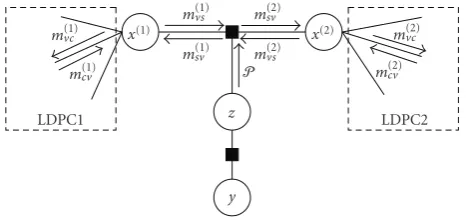
Figure1: Factor graph of the 2-user synchronous MAC channel: zoom around the state-check node neighborhood.
synchronous discrete model of the transmission at timenis given by, for all 0≤n≤N−1,
yn=σ1x[1]n +σ2x[2]n +wn=
σ1 σ2
·Zn+wn. (1)
Throughout the paper, neither the flat fading nor the multi-path fading effect are taken into account. More precisely, we will consider theequal rate/equal power2-user MAC chan-nel, that isR1 =R2=Randσ12=σ22 =1. The equal receive power channel can be encountered in practice, for example, if power allocation is performed at the transmitter side. In (1),
Zn=[xn[1],x[2]n ]Tis thestate vectorof the multiuser channel, andwn is a zero mean additive white Gaussian noise with varianceσ2: its probability density function (pdf) is denoted byN(0,σ2).
In order to jointly decode the two users, we will con-sider the factor graph [7] of the whole multiuser system, and run several iterations of BP [8]. The factor graph of the 2-user LDPC-MAC is composed of the 2 LDPC graphs,1which are connected through function nodes representing the link between the state vectorZnand the coded symbols of each userx[1]n andx[2]n . We will call this node thestate-check node. Figure 1shows the state check node neighborhood and the messages on the edges that are updated during a decoding iteration.
In the following, the nodes of each individual LDPC graph are referred to asvariable nodesandcheck nodes. Let
m[k]ab denote the message from nodeato nodebfor userk, where (a,b) can either be vfor variable node, cfor check node, orsfor state check node.
From now on and as indicated onFigure 1, we will drop the time indexnin the equations. All messages in the graph are given in log-density ratio form logp· |x[i]=+1/ p· |
x[i] = −1, except for the probability messageP coming from the channel observationy.P is a vector composed of
1An LDPC graph denotes the Tanner graph [9] that represents an LDPC code.
four probability messages given by
P = ⎡ ⎢ ⎢ ⎢ ⎣
P00 P01 P10 P11
⎤ ⎥ ⎥ ⎥
⎦=
⎡ ⎢ ⎢ ⎢ ⎣
py|Z=[+1 + 1]T
py|Z=[+1−1]T
py|Z=[−1 + 1]T
py|Z=[−1−1]T
⎤ ⎥ ⎥ ⎥
⎦. (2)
Since for the equal power casep(y|Z=[−1 + 1]T)= P10=P01=p(y|Z=[+1 −1]T), the likelihood message P is completely defined by only three values.
At initialization, the log likelihoods are computed from the channel observations y. The message update rules for all messages in the graphm[i]cv,m[i]vc,m[i]vs
follow from usual LDPC BP decoding [7,10]. We still need to give the update rule through the state-check node to complete the decod-ing algorithm description. The message m[i]sv at the output of the state-check node is computed from m[j]sv for (i,j) ∈
{(1, 2), (2, 1)}andP:
m[1]sv =logP00e
m[2]vs +P01 P10em[2]vs +P11,
m[2] sv =log
P00em[1]vs +P10 P01em[1]
vs +P11.
(3)
The channel noise is Gaussian N(0,σ2), and (3) can be rewritten for the equal power case as
m[i] sv =loge
(2y−2)/σ2
em[vsj]+ 1
em[vsj]+e(−2y−2)/σ2
, (4)
where the distribution ofyis a mixture of Gaussian distribu-tionsy ∼(1/4)N(2,σ2) + (1/2)N(0,σ2) + (1/4)N(−2,σ2) since the channel conditionnal distributions are
y|(+1,+1)∼N
2,σ2,
y|(+1,−1)∼N0,σ2,
y|(−1,+1)∼N0,σ2,
y|(−1,−1)∼N−2,σ2.
(5)
Now that we have stated all the message update rules within the whole graph, we need to indicate in which order the message computation are performed. We will consider in this work the following two differents schedulings.
(i) Serial scheduling. Adecoding iterationfor a given user (or “round” [10]) consists in activating all the vari-able nodes, and thus sending information to the check nodes, activating all the check nodes and all the vari-able nodes again that now send information to the state check nodes, and finally activating all the state check nodes that send information to the next user. Once this iteration for one user is completed, a new iteration can be performed for the second user. In a serial scheduling, a decoding round for user two is not performed until a decoding round for user one is completed.
3. MUTUAL INFORMATION EVOLUTION THROUGH THE STATE-CHECK NODE
The DE is a general tool that aims to predict the asymptotical and average behavior of LDPC codes or more general graphs decoded with BP. However, DE is computationally intensive and in order to reduce the computational burden of LDPC codes optimization, faster techniques have been proposed, based on the approximations of DE by a one-dimensional dynamical system (see [11,12] and references therein). This is equivalent to considering that the true density of the mes-sages is mapped onto a single parameter, and tracking the evolution of this parameter along the decoding iterations.
It is also known that an accurate single parameter is the mutual information between the variables associated with the variable nodes and their messages [11, 12]. The mu-tual information evolution describes each computation node in BP-decoding by a mutual information transfer function, which is usually referred to as the EXtrinsic mutual informa-tion transfer (EXIT) funcinforma-tion. For parity-check codes with binary variables only (as for LDPCs or irregular repeat ac-cumulate codes), the EXIT charts can be expressed analyti-cally [12], leading to very fast and powerful optimization al-gorithms.
In this section, we will express analytically the EXIT chart of the state-check node update, based on two different ap-proximations. First, we will express a symmetry property for the state-check node, then we will present a Gaussian approx-imation (GA) of the messages densities, and finally we will consider that the messages are the output of an erasure chan-nel (EC).
Similarly to the definition of the messages (seeSection 2), we will denote byxabthe mutual information from nodeato nodeb, where (a,b) can either bevfor variable node,cfor check node, orsfor state-check node.
3.1. Symmetry property
First of all, let us present one of the main differences between the single-user case and the 2-user case. For the single user, memoryless, binary-input, and symmetric-output channel, the transmission of the all-one BPSK sequence is assumed in the DE. The generalization of this property for nonsym-metric channels is not trivial and some authors have recently addressed this question [13,14].
In the 2-user case, the channel seen by each user is not symmetric since it depends on the other users, decoding. However, the asymmetry of the 2-user MAC channel is very specific and much simpler to deal with than the general case. We proceed as explained below.
Let us denote byΨS(y,m) the state-check node map of the BP decoder, that is the equation that takes an input messagemfrom one user and the observation yand com-putes the output message that is sent to the second user. The symmetry condition of a state-check node map is de-fined as follows.
Definition 1 (State-check node symmetry condition). The state check node update rule is said to be symmetric if sign inversion invariance holds, that is,
ΨS(−y,−m)= −ΨS(y,m). (6) Note that the update rule defined in (4) is symmetric.
In order to state a symmetry property for the state-check node, we further need to define some symmetry conditions for the channel and the messages passed by in the BP decoder. Definition 2(Symmetry conditions for the channel observa-tion). A 2-user MAC is output symmetric if its observation
yverifies
pyt|xt[k],xt[j]
=p−yt| −x[k]t ,−xt[j]
, (7)
where yt is the observation at time index tandxt[k] is the
tth element of the codeword sent by userk. Note that this condition holds for the 2-user Gaussian MAC.
Definition 3(Symmetry conditions for messages). A message is symmetric if
pmt|xt
=p−mt| −xt
, (8)
wheremt is a message at time indextandxt is the variable that is estimated by messagemt.
Proposition 1. Consider a state-check node. Assume a sym-metric channel observation, the entire average behavior of the state-check node can be predicted from its behavior assuming transmission of the all-one BPSK sequence for the output user and a sequence with half symbols fixed at “1” and half symbols at “−1” for the input user.
Proof. SeeAppendix B.
3.2. Gaussian approximation of the state-check messages (GA)
The first approximation of the DE through the state-check node considered in this work assumes that the input message
mvsis Gaussian with densityN(μvs, 2μvs), and that the out-put messagemsvis a mixture of two Gaussian densities with meansμsv|(+1,+1)andμsv|(+1,−1), and variances equal to twice the means. The state-check node update rule is symmetric and thus we omit the user index in the notations.
Hence by noticing thatmsvin (4) can be rewritten as the sum of three functions of Gaussian distributed random vari-ables
msv= −mvs+ log
1 +emvs+(2y−2)/σ2
−log1 +e−mvs−(2y+2)/σ2,
(9)
we get the output means
μsv|(+1,+1)=F+1,+1
μvs,σ2
,
μsv|(+1,−1)=F+1,−1μvs,σ2
where The detailed computation of these functions is reported inAppendix A. Note that these expressions need to be accu-rately implemented with functional approximations in order to be used efficiently in an optimization procedure.
As mentioned earlier, it is desirable to follow the evolu-tion of the mutual informaevolu-tion as single paramater, so we make use of the usual function that relates the mean and the mutual information: for a messagemwith conditional pdf
m| x =1∼N(μ, 2μ), andm |x = −1∼N(−μ, 2μ) the
Note that J(μ) is the capacity of a binary-antipodal input additive white Gaussian channel (BIAWGNC) with variance 2/μ.
Now that we have expressed the evolution of the mean of the messages when they are assumed Gaussian, we make use of the functionJ(μ) (12) in order to give the evolution of the mutual information through the state check node un-der Gaussian approximation. This corresponds exactly to the EXIT chart [11] of the state-check node update:
xsv|(+1,+1)=J
3.3. Erasure channel approximation of the state-check messages (EC)
This approximation assumes that the distribution of the mes-sages at the state-check node input (mvs seeFigure 1) is the output of a binary erasure channel (BEC). Thus when the symbol +1 is sent, the LLR distribution consists of two mass points, one at zero and the other at +∞. Let us denote byδx, a mass point atx. It follows that the LLR distribution when the symbol +1 is sent is
E+()=Δδ0+ (1−)δ∞. (15)
Similarly, when −1 is sent, the LLR distribution is E−() =Δ δ0+ (1−)δ−∞. The mutual information asso-ciated with these distributions is the capacity of a BEC:
x=1−. (16) The distribution of channel observationyis not consis-tent with the approximation presented here since y is the output of a ternary input additive white Gaussian channel (TIAWGNC) with input distribution (1/4)δ−2 + (1/2)δ0+ (1/4)δ2(because of the symmetry property, seeSection 3.1) and varianceσ2. The capacity of such a channel is
CTIAWGNC(μ)
In order to use coherent hypothesis in the erasure ap-proximation of the state-check node, the real channel is mapped onto an erasure channel with same capacity. The ternary erasure channel (TEC) used for the approximation has input distribution (1/4)δ−2+ (1/2)δ0+ (1/4)δ2and era-sure probabilityp. The capacity of such a TEC is
CTEC=3
2(1−p). (18) Therefore the true channel with capacityCTIAWGNC will be approximated by a TEC with erasure probability p = 1−
(2/3)CTIAWGNC.
Because of the symmetry property (seeSection 3.1), we consider only two cases.
(i) Under the (+1, +1)-hypothesis and by definition of the erasure channel, the observationyis either an erasure with probability (w.p.)por y =2 w.p. (1−p). The input message corresponds to the symbol +1 and its distribution isE+(). The output message corresponds to the symbol +1 and by applying (3), we obtain the output distributionmsv|(+1,+1)∼E+(p).
(ii) Under the (+1,−1)-hypothesis, the observation of the erasure channelyis either an erasure w.p. por y=0 w.p. (1−p). The input message corresponds to the symbol−1 and its distribution isE−(). The output message corresponds to the symbol +1 and by apply-ing (3), we obtain the output distributionmsv|(+1,−1)∼ E+(1−(1−p)(1−)).
By applying (16), (18), and the assumption CTIAWGNC =
CTEC, the mutual information transfer function through the state-check node is thus
xsv|(+1,+1)=2
3CTIAWGNC,
xsv|(+1,−1)=2
3xvsCTIAWGNC.
0 0.1 0.2 0.3 0.4 0.5 0.6 0.7 0.8 0.9 1
Figure2: Mutual information evolution at the state-check node. Comparison of the approximation methods with the exact mutual information at the state-check node. The solid lines represent the GA approximation, the broken lines the EC approximation, and
plussigns show Monte Carlo simulations.
It follows that
InFigure 2, we compare the two approximations for the state node EXIT function with (14) and (20), for three dif-ferent signal-to-noise ratios. The solid lines show the GA ap-proximation whereas the broken lines show the EC approx-imation. We have also indicated withplussigns the mutual information obtained with Monte Carlo simulations. Our numerical results show that the Gaussian a priori GA ap-proximation is more attractive since the mutual information computed under this assumption have the smallest gap to the exact mutual information (Monte Carlo simulation without any approximation).
4. LDPC CODE OPTIMIZATION
Using the EXIT charts for the LDPC codes [12,15] and for the state-check node under the two considered approxima-tions (14), (20), we are now able to give the evolution of the mutual information x along a whole 2-user decoding iteration. The irregularity of the LDPC code is defined as usual by the degree sequences{λi}i=2dv ,{ρj}dj=2c
that repre-sent the fraction of edges connected to variable nodes (resp., check nodes) of degreei(resp.,j). As in the single-user case, we wish to have an optimization algorithm that could be solved quickly and efficiently using linear programming. In
order to do so, we must make different assumptions that are mandatory to ensure that the evolution of the mutual infor-mation islinearin the parameters{λi}:
{H0} hypothesisequal LDPC codes. Under this hypothesis, we assume that the 2 LDPC codes belong to the same ensemble ({λi}di=2v ,{ρj}dj=2c );
{H1} hypothesiswithout interleaver. Under this hypothesis, each and every state-check node is connected to two variable nodes (one in each LDPC code) havingexactly the same degree.
Proposition 2. Under hypothesesH0andH1, the evolution of the mutual informationxvcat thelth iteration under the paral-lel scheduling described inSection 2is linear in the parameters
{λi}.
Proof. SeeAppendix C.
FromProposition 2, we can now write the evolution of the mutual information for the entire graph. More precisely, by using (12), (14), and (20), we finally obtain (21) for the Gaussian approximation and (22) for the erasure channel ap-proximation:
It is interesting to note that, in (21) and (22), the evolution of the mutual information is indeed linear in the parameters
{λi}, when{ρj}are fixed.
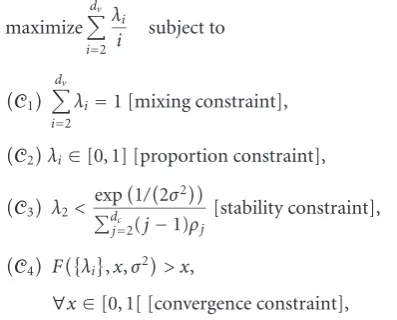
maximize dv
i=2
λi
i subject to
C1 dv i=2
λi=1 [mixing constraint],
C2λi∈[0, 1] [proportion constraint],
C3 λ2<
exp1/2σ2
dc
j=2(j−1)ρj
[stability constraint],
C4 Fλi
,x,σ2> x,
∀x∈[0, 1[ [convergence constraint],
(24)
where (C3) is the condition for the fixed point to be stable (seeProposition 3) and where (C4) corresponds to the con-vergence to the stable fixed pointx=1, which corresponds to zero error rate constraint.
Solution to the optimization problem
For a givenσ2 and a givenρ(x), the cost function and the constraints (C1), (C2), and (C3) are linear in the parameters
{λi}. The function used in constraint (C4) is either (21) or (22) which are both linear in the parameters{λi}. The op-timization problem can then be solved for a givenρ(x) by linear programming. We would like to emphasize the fact that the hypothesesH0 andH1are necessary to have a lin-ear problem, which is the key feature of quick and efficient LDPC optimization.
These remarks allow us to propose an algorithm that solves the optimization problem (24) in the class of functions
ρ(x) of the typeρ(x)=xn, for alln >0.
(i) First, we fix a target SNR (or equivalentlyσ2). (ii) Then, for eachn >0,ρ(x)=xnand we perform a
lin-ear programming in order to find a set of parameters
{λi}that maximizes the rate under the constraints (C1) to (C4) (24). In order to integrate the (C4) constraint in the algorithm, we quantize x. For each quantized value ofx, the equation in (C4) leads to an additional
constraint. Hence, for eachn, we get a rate.
(iii) Finally, we choosenthat maximizes the rate (over all
n).
In practice, the search over all possible nis performed up to a maximal value. This is to insure that the graph remains sparse.
Stability of the solution
Finally, the stability condition of the fixed point for the 2-user MAC channel is given in the following proposition.
Proposition 3. The local stability condition of the DE for the 2-user Gaussian MAC is the same as that of the single user case:
λ2<
exp1/2σ2
dc
j=2(j−1)ρj
. (25)
The proof is given inAppendix D.
5. RESULTS
In this section we present results for codes designed accord-ing to the two methods presented inSection 3, for rates from 0.3 to 0.6, and we compare the methods on the basis of the true thresholds obtained by DE and finite length simulations. Table 1shows the performance of LDPC codes optimized with the Gaussian approximation.Table 2shows the perfor-mance of LDPC codes designed according to the Erasure channel approximation. In both tables the code rate, the check nodes degrees ρ(x) = dc
j=2ρj−1j , the optimized pa-rameters{λi}di=2v , and the gap to the 2-user Gaussian MAC Shannon limit are indicated.
We can see that the LDPC codes optimized for the 2-user MAC channel are indeed very good and have decoding thresholds very close to the capacity. Our numerical results show that, the Gaussian a priori approximation is more at-tractive since the codes designed under this assumption have the smallest gap to Shannon limit.
An interesting result is that the codes obtained forR =
0.3 andR=0.6 are worse than the ones obtained forR=0.5. Our opinion is that it does not come from the same reason. For small rates (R = 0.3), the multiuser problem iseasyto solve because the system load (sum rate) is lower than 1, but the approximations of DE become less and less accurate as the rate decreases.R =0.3 gives worse codes thanR =0.5 because of the LDPC part of the multiuser graph. For larger rates (R =0.6), the DE approximations are fairly accurate, but the multiuser problem we address is more difficult, as the system load is larger than 1 (equal to 1.2).R=0.6 gives worse codes thanR=0.5 because of the multiuser part of the graph (state-check node).
In order to verify the asymptotical results obtained with DE, we have made extensive simulations for a finite length equal toN=50 000. The codes have been build with an ef-ficient parity check matrix construction. Since the progres-sive edge growth algorithm [16] tends to be inefficient at very large code lengths, we used the ACE algorithm proposed in [17] which helps to prevent the apparition of small cycles with degree two bitnodes. The ACE algorithm generally low-ers greatly the error floor of very irregular LDPC codes (like the ones in Tables1and2).
Table1: Optimized LDPC codes for the 2-user Gaussian channel obtained with the Gaussian Approximation of the state-check node. The distance between the (Eb/N0) thresholdδ(evaluated with true DE) and the Shannon limitSlis given in dBs.
GA
Rate 0.3 0.4 0.5 0.6
ρ(x) x7 x8 x9 x10
λ(x) λi i λi i λi i λi i
2.749809e−01 2 2.786702e−01 2 3.170178e−01 2 4.393437e−01 2
2.040936e−01 3 2.306721e−01 3 2.312804e−01 3 1.305465e−01 3
5.708851e−03 4 5.059420e−02 9 4.241393e−02 17 2.508237e−02 20 1.817382e−02 5 4.229097e−04 10 1.714436e−01 18 2.462773e−01 21 1.891399e−02 6 1.608676e−01 12 2.378443e−01 100 1.587501e−01 100 2.682255e−02 7 2.787730e−01 100
7.317063e−02 8 1.130643e−01 13 2.650713e−01 100
δ−Sl 0.22 0.15 0.19 0.52
Table2: Optimized LDPC codes for the 2-user Gaussian channel obtained with the erasure channel approximation of the state-check node. The distance between the (Eb/N0) thresholdδ(evaluated with true DE) and the Shannon limitSlis given in dBs.
EC
Rate 0.3 0.4 0.5 0.6
ρ(x) x7 x8 x9 x10
λ(x) λi i λi i λi i λi i
2.762791e−01 2 2.792405e−01 2 3.165084e−01 2 4.388191e−01 2
2.321906e−01 3 2.456371e−01 3 2.339989e−01 3 1.303074e−01 3
7.870900e−02 9 1.020663e−01 13 4.285469e−02 18 1.649224e−01 20 1.077795e−01 10 8.130383e−02 14 1.713483e−01 19 1.093493e−01 21 3.050418e−01 100 2.917522e−01 100 2.352897e−01 100 1.566018e−01 100
δ−Sl 0.38 0.26 0.21 0.59
6. CONCLUSION
This paper has tackled the optimization of LDPC codes for the 2-user Gaussian MAC and has shown that it is possi-ble to design good irregular LDPC codes with very simple techniques, the optimization problem being solved by linear programming. We have proposed 2 different analytical ap-proximations of the state-check node update, one based on a Gaussian approximation and one very simple based on an erasure channel approach. The codes obtained have decoding thresholds as close as 0.15 dB away from the Shannon limit, and can be used as initial codes for more complex optimiza-tion techniques based on true density evoluoptimiza-tion. Future work will deal with the generalization of our approach to more than two users and/or users with different powers.
APPENDICES
A. COMPUTATION OF FUNCTIONSF+1,+1ANDF+1,−1
We proceed to compute the state-check node update rule for the mean of the messages.
Let us first consider hypothesisZ=[+1, +1]T. Under the Gaussian assumption, the conditional input distributions are
y|(+1,+1)∼N
2,σ2,
mvs|(+1,+1)∼N
μvs, 2μvs
. (A.1)
Therefore
mvs+ 2y−2
σ2
(+1,+1)∼N
μvs+ 2
σ2, 2μvs+ 4
σ2
,
mvs+ 2y+ 2
σ2
(+1,+1)∼N
μvs+ 6
σ2, 2μvs+ 4
σ2
.
(A.2)
Since for a Gaussian random variablex∼N(μ+a, 2μ+b), whereaandbare real valued constants,
Elog1 +e±x=√1
π
+∞
−∞e −z2
0 0.5 1 1.5 2 2.5 3 3.5 4 4.5 5 Eb/N0
10−6 10−5 10−4 10−3 10−2 10−1 100
Bi
t
er
ror
ra
te
EC approximation GA approximation
R=0.3 R=0.5 R=0.6
Sl(0.3) Sl(0.5)
Sl(0.6)
Figure3: Simulation results for the optimized LDPC codes given in Tables1and2. The codeword length isN =50 000. The maxi-mum number of iterations is set to 200. For comparison, we have indicated the Shannon limit for the three considered rates.
and by using (9), we get
Emsv|Z=[+1, +1]T
= −μvs+√1
π
+∞
−∞e −z2
log
1 +e+2√μvs+(2/σ2)z+μvs+2/σ2 1 +e−2√μvs+(2/σ2)z−μvs−6/σ2
dz
=F+1,+1
μvs,σ2
.
(A.4) Similarly we getF+1,−1(μvs,σ2).
B. PROOF OFPROPOSITION 1
To proveProposition 1, we first need to show the following lemmas.
Lemma 1. Consider a state-check node. Assume a symmetric input message and a symmetric channel observation. The out-put message is symmetric.
Proof ofLemma 1.We consider a state- check node that veri-fies the symmetry condition (seeDefinition 1). Without loss of generality we can assumekto be the output user andjthe input user.
Lety(z, resp.) denote the observation vector when the codewordsx[k],x[j] (−x[k],−x[j], resp.) are sent. Now note that a symmetric-output 2-user MAC can be modeled as fol-lows (see [10, Lemma 1]):
y= −z (B.1)
sincepyt|xt[k],xt[j]
=p−yt | −x[k]t ,−x[j]t
and since we are interested in the performance of the BP algorithm, that is, the densities of the messages.
Similarly we denote bym[j]t ,m[k]t (rt[j],rt[k], resp.) the in-put and outin-put messages of the state-check node at position
twhen the codewordsx[k],x[j](−x[k],−x[j], resp.) are sent. Let us assume a symmetric input message, that is,
pm[j]t |x[j]t
=p−m[j]t | −x[j]t
. Here again we can model this input message as
m[j]t (y)= −rt[j]. (B.2)
The state-check node update rule is denoted by ΨSyt,m[j]t
.
The output message verifies
m[k]t =ΨS
yt,m[j]t
=ΨS−zt,−rt[j]
= −ΨSzt,rt[j]
= −rt[k](z),
(B.3)
where the second equation is due to the symmetry conditions of the channel and the input message and the third equation follows from the symmetry condition of the state-check node map.
This can be rewritten as
pm[k]t |x[k]t ,x[j]t
=p−m[k]t | −x[k]t ,−xt[j]
(B.4)
and therefore
pm[k]t |xt[k]
=p−m[k]t | −x[j]t
(B.5)
by marginalizing the probability with respect toxt[j]and by using (B.4).
Equation (B.5) implies that with symmetric observation and symmetric input message, the message at the state-check node output is also symmetric. The symmetry is conserved through the state-check node which completes the proof of Lemma 1.
Lemma 2. Consider a state-check node. Assume a symmetric channel observation. At any iteration, the input and output messages of the state check node are symmetrics.
Proof ofLemma 2.Lemma 1shows that the state check node conserves the symmetry condition, [10, Lemma 1] shows the conservation of the symmetry condition of the messages through the variable and check node. At initialization, the channel observation is symmetric therefore a proof by induc-tion shows the conservainduc-tion of the symmetry property at any iteration with a BP decoder.
C. PROOF OFPROPOSITION 2
Lemma 3. Under the parallel scheduling assumption described inSection 2and by using hypothesisH0(seeSection 4), the en-tire behavior of the BP decoder can be predicted with one de-coding iteration (i.e., half of a round).
Proof ofLemma 3.Under the parallel scheduling assumption described inSection 2, two decoding iterations (one for each user) are completed simultaneously. Hence by using hypoth-esis H0 (same code family for both users), the two de-coding iterations are equivalent in the sense that they pro-vide messages with the same distribution. This can be eas-ily shown by induction. It follows that a whole round is en-tirely determined by only one decoding iteration (i.e., half of a round).
Therefore in the following we omit the user index. Proof ofProposition 2.We now proceed to compute the evo-lution of the mutual information through all nodes of the graph. By assuming that the distributions at any iteration are Gaussian, we obtain similarly to method 1 in [12] the mutual information evolutions as
whereλidenotes the fraction of variable nodes of degreei (λi=(λi/i)/( withxsvdefined either in (14) or (20), depending on the ap-proach used.
First notice that this system is not linear in the parameters
{λi}. But by using hypothesisH1, the input messagemsvof a variable node of degreeiresults from a variable node with the same degree. It follows that the third equation in (C.1) reduces to
Finally the global recursion in the form (21)-(22) is ob-tained by combining all four equations and the global recur-sion is linear in the paremeters{λi}.
D. PROOF OFPROPOSITION 3
Similarly to the definition of the message (seeSection 2) and of the mutual information (seeSection 3), we will denote by
Pab(l)the distribution of the messages from nodeato nodeb in iterationl, where (a,b) can either bevfor variable node,c
for check node, orsfor state-check node.
We follow in the footsteps of [18] and analyze the local stability of the zero error rate fixed point by using a small perturbation approach. Let us denote byΔ0 the dirac at 0, that is, the distribution with 0.5-BER andΔ+∞the distribu-tion with zero-BER when the symbol “+1” is sent.
FromLemma 3(seeAppendix C) we know that only half of a complete round needs to be performed in order to get the entire behavior of the BP decoder. All distributions of the DE are conditional densities of the messages given that the symbol sent is +1. From the symmetry property of the vari-able and check nodes, the transformation of the distributions can be performed under the assumption that the all-one se-quence is sent. However, for the state-check node, different cases will be considered as detailed below.
We consider the DE recursion with state variable of the dynamical systemPvc. In order to study the local stability of the fixed pointΔ∞, we initialize the DE recursion at the point
P(0)
vc =(1−2)Δ∞+ 2Δ0 (D.1) for some small >0, and we apply one iteration of the DE recursion. Following [18] (and also in [12]), the distribution
Pcv(0)can be computed which leads toP(0)vs as
P(0)
vs =Δ∞+O
2. (D.2)
For the sake of brevity, we omit the now-well-known step-by-step derivation and focus on the transformation at the state-check node. Note that (D.2) holds with and without the hypothesisH1(without interleaver) since it follows from the fact that ani-fold convolution of the distributionPcv(0)is per-formed withi≥2 in both cases.
From the symmetry property (seeProposition 1) of the state check node, the entire behavior at a state-check node can be predicted under the two hypotheses called (+1, +1) and (+1,−1), that is, when the output symbol is +1 and when the input symbol is either +1 or−1 with probability 1/2 each. In the following, we seek for the output distribution P(0)sv , for a given input distributionPvs(0)(conditional distribution given that the input symbol is +1) and a given channel dis-tribution. Hence, by applying (4) we have
m(0) symmetry property of the input message at the state-check node, we have
m(0)
vs ∼P(0)vs (−z)=Δ−∞+O
and from (5) we get
m(0)
vs ∼Δ−∞+O
2,
y∼N0,σ2. (D.6) Hence, by applying (4) we have
m(0) sv =
−2y−2
σ2 ∼N
2
σ2, 4
σ2
. (D.7)
Combining (D.4) and (D.7), we obtain
P(0) sv =N
2
σ2, 4
σ2
. (D.8)
It follows that at convergence, the channel seen by one user isP(0)sv which is exactly the LLR distribution of a BIAWGNC with noise varianceσ2. It follows that at convergence the DE recursion is equivalent to the single-user case and the stabil-ity condition is therefore [18]
λ2<
exp1/2σ2
dc
j=2(j−1)ρj
. (D.9)
REFERENCES
[1] B. Rimoldi and R. Urbanke, “A rate-splitting approach to the Gaussian multiple-access channel,”IEEE Transactions on Infor-mation Theory, vol. 42, no. 2, pp. 364–375, 1996.
[2] R. Ahlswede, “Multi-way communication channels,” in Pro-ceedings of the 2nd IEEE International Symposium on Informa-tion Theory (ISIT ’71), pp. 23–52, Aremenian Prague, Czech Republic, 1971.
[3] H. Liao,Multiple access channels, Ph.D. thesis, University of Hawaii, Honolulu, Hawaii, USA, 1972.
[4] R. Palanki, A. Khandekar, and R. McEliece, “Graph based codes for synchronous multiple access channels,” in Proceed-ings of the 39th Annual Allerton Conference on Communication, Control, and Computing, Monticello, Ill, USA, October 2001. [5] A. Amraoui, S. Dusad, and R. Urbanke, “Achieving general
points in the 2-user Gaussian MAC without time-sharing or rate-splitting by means of iterative coding,” in Proceed-ings of IEEE International Symposium on Information Theory (ISIT ’02), p. 334, Lausanne, Switzerland, June-July 2002. [6] A. De Baynast and D. Declercq, “Gallager codes for multiple
user applications,” inProceedings of IEEE International Sym-posium on Information Theory (ISIT ’02), p. 335, Lausanne, Switzerland, June-July 2002.
[7] F. R. Kschischang, B. J. Frey, and H.-A. Loeliger, “Factor graphs and the sum-product algorithm,”IEEE Transactions on Infor-mation Theory, vol. 47, no. 2, pp. 498–519, 2001.
[8] J. Pearl,Probabilistic Reasoning in Intelligent Systems: Networks of Plausible Inference, Morgan Kaufmann, San Mateo, Calif, USA, 1988.
[9] R. M. Tanner, “A recursive approach to low complexity codes,”
IEEE Transactions on Information Theory, vol. 27, no. 5, pp. 533–547, 1981.
[10] T. J. Richardson and R. Urbanke, “The capacity of low-density parity-check codes under message-passing decoding,” IEEE Transactions on Information Theory, vol. 47, no. 2, pp. 599– 618, 2001.
[11] S. Ten Brink, “Designing iterative decoding schemes with the extrinsic information transfer chart,”International Journal of Electronics and Communications, vol. 54, no. 6, pp. 389–398, 2000.
[12] A. Roumy, S. Guemghar, G. Caire, and S. Verd ´u, “Design methods for irregular repeat-accumulate codes,”IEEE Trans-actions on Information Theory, vol. 50, no. 8, pp. 1711–1727, 2004.
[13] A. Bennatan and D. Burshtein, “On the application of LDPC codes to arbitrary discrete-memoryless channels,”IEEE Trans-actions on Information Theory, vol. 50, no. 3, pp. 417–438, 2004.
[14] C.-C. Wang, S. R. Kulkarni, and H. V. Poor, “Density evolution for asymmetric memoryless channels,”IEEE Transactions on Information Theory, vol. 51, no. 12, pp. 4216–4236, 2005. [15] S.-Y. Chung, T. J. Richardson, and R. Urbanke, “Analysis of
sum-product decoding of low-density parity-check codes us-ing a Gaussian approximation,”IEEE Transactions on Informa-tion Theory, vol. 47, no. 2, pp. 657–670, 2001.
[16] X.-Y. Hu, E. Eleftheriou, and D.-M. Arnold, “Progressive edge-growth tanner graphs,” inProceedings of IEEE Global Telecom-munications Conference (GLOBECOM ’01), vol. 2, pp. 995– 1001, San Antonio, Tex, USA, November 2001.
[17] T. Tian, C. Jones, J. D. Villasenor, and R. D. Wesel, “Construc-tion of irregular LDPC codes with low error floors,” in Pro-ceedings of IEEE International Conference on Communications (ICC ’03), vol. 5, pp. 3125–3129, Anchorage, Alaska, USA, May 2003.