R E S E A R C H
Open Access
Phishing page detection via learning
classifiers from page layout feature
Jian Mao
1*, Jingdong Bian
1,2†, Wenqian Tian
1,2†, Shishi Zhu
1,2, Tao Wei
3, Aili Li
4and Zhenkai Liang
5Abstract
The web technology has become the cornerstone of a wide range of platforms, such as mobile services and smart Internet-of-things (IoT) systems. In such platforms, users’ data are aggregated to a cloud-based platform, where web applications are used as a key interface to access and configure user data. Securing the web interface requires solutions to deal with threats from both technical vulnerabilities and social factors. Phishing attacks are one of the most commonly exploited vectors in social engineering attacks. The attackers use web pages visually mimicking legitimate web sites, such as banking and government services, to collect users’ sensitive information. Existing phishing defense mechanisms based on URLs or page contents are often evaded by attackers. Recent research has demonstrated that visual layout similarity can be used as a robust basis to detect phishing attacks. In particular, features extracted from CSS layout files can be used to measure page similarity. However, it needs human expertise in specifying how to measure page similarity based on such features. In this paper, we aim to enable automated page-layout-based phishing detection techniques using machine learning techniques. We propose a learning-based aggregation analysis mechanism to decide page layout similarity, which is used to detect phishing pages. We prototype our solution and evaluate four popular machine learning classifiers on their accuracy and the factors affecting their results.
Keywords: Anti-phishing, Machine learning, Aggregation analysis
1 Introduction
The web technology has become the cornerstone of a wide range of platforms, such as mobile services and smart Internet-of-things (IoT) systems. In such platforms, users’ data are aggregated to a cloud-based platform, where web applications are used as a key interface to access and configure user data. Securing the web interface requires solutions to deal with threats from both technical vulner-abilities and social factors.
Phishing attacks are one of the most common form of social engineering attacks. In a web-based phishing attack, attackers use web pages visually mimicking legitimate web sites, such as banking and government services, to deceive the victims to input their sensitive information (e.g., bank accounts and social security number). Though phishing attacks do not require advanced technical knowledge and these attack techniques are becoming familiar to users,
*Correspondence:[email protected]
†Jingdong Bian and Wenqian Tian contributed equally to this work. 1School of Cyber Science and Technology, Beihang University, Xueyuan Road, Beijing 100083, China
Full list of author information is available at the end of the article
they are still causing major financial damages. Accord-ing to the report from the Anti-PhishAccord-ing WorkAccord-ing Group (APWG), there are 1,220,523 phishing attacks reported in 2016, which is a 65% increase over 2015 [1].
Several types of anti-phishing solutions have been developed for web-based phishing solutions. The tradi-tional URL-based anti-phishing solutions [2–5] try to decide whether a page is a phishing page based on its URL. They are limited by the timeliness of malicious URL database update. The solutions based on page contents [6,7] rely on the context or image processing techniques to detect phishing attacks, which can cause high perfor-mance overhead. As the phishing pages usually maintain similar page layouts to their target websites, the similar-ity of page layouts has been demonstrated as an impor-tant metric to detect phishing pages [8,9]. In particular, features extracted from CSS layout files are used to mea-sure page similarity. However, these meamea-surements heav-ily rely on human experiences and thus may not be comprehensive to detect new attacks. How to compre-hensively evaluate the pages’ similarity remains a great challenge.
Machine learning has been widely used in many areas to create automated solutions. Researchers also use machine learning to detect phishing attacks based on var-ious features [10–14]. The solutions show the potential of machine learning techniques to detect phishing attacks. In this paper, we aim to explore learning techniques to develop efficient phishing page detec-tion techniques that are difficult to bypass. Our solu-tion is based on the aggregasolu-tion analysis mechanism to automatically generate rules to determine layout similarity of web pages and then detect phishing pages. Our approach consists of two phases. It first trains a similarity classifier using page layout fea-tures, then uses the classifier to detect phishing pages.
1.1 Experimental method
We prototyped our approach and evaluated it based on four learning classifiers, namely, Support Vector Machine (SVM), Decision Tree, AdaBoost, and Random Forest. Our evaluation used more than 490 phishing web pages from phishtank.com that mimic 46 target pages, from which we extracted over 20,000 testing sam-ples. Using experiment results, we show the strength and weakness of the classifiers in detecting similar pages and analyzed the effective influences caused by the size of dataset and the sample distributions. It also shows that our approach is effective in creating clas-sifiers and detecting phishing pages via page layout similarity.
In summary, we made the following contributions in this paper:
• We propose a learning-based mechanism to evaluate the similarity of web page layouts and identify phishing pages.
• We define the rules to extract and create effective page layout features and develop a phishing page classifier based on four typical learning algorithms, Supporting Vector Machine, Decision Tree, AdaBoost, and Random Forest.
• We prototyped our approach and evaluated it with real-world web page samples fromphishtank.com. The experiment results illustrate the efficiency of our approach.
1.2 Paper organization
The rest of this paper is organized as follows. We discuss closely related work in Section 2. Section 3 introduces the background of our work and gives an overview of our approach. Section 4 presents our main algorithm. Section5presents the evaluation results. We conclude the paper in Section6.
2 Related work
In this section, we discuss past research work that is closely related to our approach. We focus on phishing detection techniques that are based on page features intrinsic to page visual appearance, instead of external page features, such as URLs.
2.1 Page-feature-based phishing detection
Eric et al. [15] proposed a scheme that selects text pieces, images, and overall visual appearance as the basic prop-erties to compare the similarity of two pages. Chen et al. [16] presented another algorithm to detect visually similar pages according to Getstalt theory, in which they process the webpage as an indivisible entity. CANTINA [6] detects phishing pages based on “term frequency-inverse docu-ment frequency (TF-IDF).” SpoofGuard [17] usesdomain name,URL,link, andimageas the critical features to check suspicious pages. GoldPhish [18] uses optical character recognition from a rendered page to extract page infor-mation. It then uses search engines to decide whether the page content is consistent with its domain and thus identifies phishing sites. Zhang et al. [19] used spatial lay-out characteristics from web pages and used as a basis to decide page similarity. Moghimi et al. [20] discovered a rule-based scheme that used two novel feature sets to detect phishing in internet banking. One feature set is used to evaluate the identity of page resources, and the other is utilized to identify the access protocol. Wardman et al. [21] used file-level similarity between two web pages and to detect phishing web sites. Phishing-Alarm uses CSS layout features that are efficient and robust in detecting phishing web sites [8]. In contrast, to identify new fea-tures as a basis for phishing detection, this paper focuses on how to automatically learn classifiers of similar pages from CSS features.
2.2 Learning-based phishing detection
on multi-label classifiers. Bottazzi et al. [23] proposed a framework in Android mobile devices for phishing detec-tion, which includes a machine learning detection engine for protecting from new phishing activities. Abdelhamid et al. [14] investigated several machine-learning-based phishing detection techniques on their pros and cons, including evaluation with real-world dataset on their per-formance. In our preliminary work [24], we used two classifiers to detect phishing attacks from page layout features.
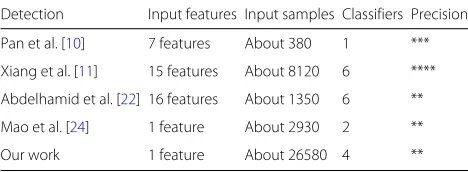
We summarize the properties of typical learning-based phishing detection approaches and make a comparison with our scheme in Table1.
3 Background and overview
In this section, we introduce the background for our solu-tion, define the problem, and describe the overall solution.
3.1 Page layout features
Cascading Style Sheets (CSS) is the commonly used visual layout definition of web pages. Widely supported by browsers, CSS rules specify how different classes of web page components should appear, for example, the font type and the color of the body of a page.
In our previous work [8,9], we have demonstrated that CSS-based page layout features can be used as the basis to detect phishing pages, where we convert CSS into a nor-malized representation calledinfluence vector. It consists of two parts: a property, and one or more declarations. Each declaration consists of avalueand one or more selec-tors. In addition, the selectors can be classified into four categoriestag,ID,class, andothers.
For example, given the CSS rule set of a web page,
{. . ., [Selectori{. . .; [Propertyj:Valuek;. . .] ,. . .}] ,. . .},
its influence vector will be defined as
. . .,Propertyj:. . .;Valuejk:. . .,Selectorij,k;. . .,. . .,. . .,.
wherejmeans thejth property of one page,kmeans the kth property value in thejth property of the page, andi means theith selector that hasPropertyjandValuejk. Table 1Comparison of learning-based phishing detection
Detection Input features Input samples Classifiers Precision
Pan et al. [10] 7 features About 380 1 *** Xiang et al. [11] 15 features About 8120 6 **** Abdelhamid et al. [22] 16 features About 1350 6 ** Mao et al. [24] 1 feature About 2930 2 ** Our work 1 feature About 26580 4 **
The precision in the table means the degree of correct detection *The precision is below 90%
**The precision is in 90–95% ***The precision is in 95–97% ****The precision is in 97–100%
More concretely, from the following CSS rules,
div {padding: 2px;},
the corresponding influence vector will be
padding: Note that this is a basic form to represent the page features from CSS layouts. Considering the influence impacts, our approach includes additional influence fac-tors of a page layout. For example, if the element size does matter to the detection effect, we will include it into the feature representation.
3.2 Learning-based layout similarity detection
The metric we used in our previous work is mainly based on human experiences and may not comprehensively rep-resent all the statistical similarity properties between page layouts of phishing pages and legitimate pages. Especially, the threshold, a critical parameter of that approach, is selected based on the similarity score distribution of the collected samples. As a result, its accuracy heavily relies on the completeness of the sample collection and attackers may craft new phishing pages to bypass the detection.
Our goal is to develop methods that can detect the similarity among two page layouts by comprehensively “considering” layout features. Machine learning mecha-nisms are typically used in such situations, where they are used to infer similarity models according to the statistical properties retrieved from the training samples.
The problem addressed by our paper can be formulated as follows: Taking a set of labeled benign and malicious pages as inputs, we extract CSS features and identify learning algorithms to detect visually similar pages based on these CSS features. The page similarity will help to detect phishing pages.
3.3 Approach overview
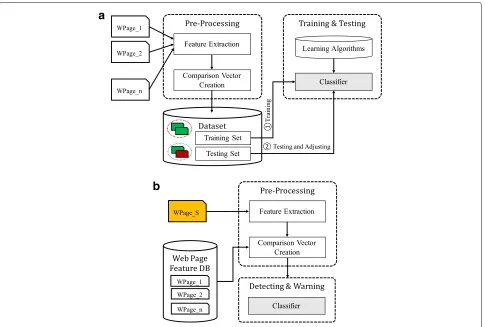
As shown in Fig.1, our approach includes two phases: sim-ilarity classifier trainingandphishing web page detection based on layout similarity.
3.3.1 Similarity classifier training
a
b
Fig. 1Overview of our approach.aTrain layout similarity classifier.bDetect suspicious web page
pairs, visually similar web page pairs and visually different web page pairs. Our approach obtains features from web page layouts and creates the comparison vectors, which summarize the key similarity features, of every web page pairs accordingly. We label the comparison vector as “c1”
to represent a pair of similar web pages. Correspondingly, the visually different web page pair is labelled as “c0.” The
classifier training stage takes as inputs the labelled com-parison vectors from the training set. The similar page classifier obtained in this stage can be used to determine whether two web pages are similar according to their comparison vectors.
3.3.2 Phishing web page detection based on layout similarity
The trained classifier can then be used to detect phishing pages. When a user opens a new web page, “WPage_S” (illustrated in a yellow block in Fig.1b), our detector pre-processes the web page by extracting the layout features of the new page and creating comparison vectors between the “WPage_S” and the pages, “WPage_1, ..., WPage_n” in web page databaseWeb Page Feature DB, respectively.
The classifier obtained in phase I takes the comparison vectors as inputs and determines the labels of each vec-tor. If the comparison vector of web page pair “(WPage_S, WPage_i)” is classified as “c0,” it means “WPage_S” is
visually different from “WPage_i” and the system will go to test the next vector. Otherwise, it means “WPage_S” is visually similar as “WPage_i.” Once the classifier out-puts a “c1” labelled vector, the system will send a warning
message to alert users.
4 Learning-based similar page layout classification
module is a similar page classifier that takes web pages’ features as inputs and outputs 1 or 0 to represent similar pages or different pages respectively.
4.1 Property vector extraction
One of the challenges faced by our approach is to extract features from page layouts and represent them into formats that are easily processed by learning tech-niques. In this step, we present the rules that quantify the CSS elements’ impact of a web page and combine CSS features of two pages into one comparison property vector.
4.1.1 Property vector generation
As in our previous work [8,9], we use the area of elements in a page to demonstrate their impacts on page layout. The larger the area is, the more impact it has on the page lay-out. As our main goal is to learn classifierswithouthuman expertises, instead of manually decide how to use the area information, we extract area properties as a part of the influence vectors extracted from CSS layouts, which we callproperty vectorin this paper.
To avoid the inaccuracy of detection in different page window sizes, in this paper, we use the relative area, i.e., the proportion of an element’s area to the whole page window size. Because page visual appearance is affected by CSS selectors’ properties and values, which are not CSS names of selectors, we associate the area information with properties in the representation. We extract and express CSS features to the pattern shown as follows:
. . .,Propertyj. . .;Valuekj :AreaInf okj,. . .,. . .,.
wherejdenotes thejth property in a page andkdenotes thekth value inPropertyj.
Different from the representation used in our past work, we incorporate the relative area size of page elements into the features. We rank the CSS objects in the decreasing order by area proportion in aPropertyj, i.e.,AreaInf o1j > AreaInf o2j >...>AreaInf onj.
For example, assuming pages have common three properties: Property1=“height,”Property2=“width,”Property3=“color.” There are target Page1 and suspicious Page2. Here is an illustrative example of the vector representation.
Page1 :[ “height"{16px: 0.26, 20px: 0.2}, “width"{344px: 0.2}, “color"{#fffff0 : 0.1}] Page2 :[ “height"{14px: 0.28},
“width"{320px: 0.2}, “color"{#ffffff : 0.15}]
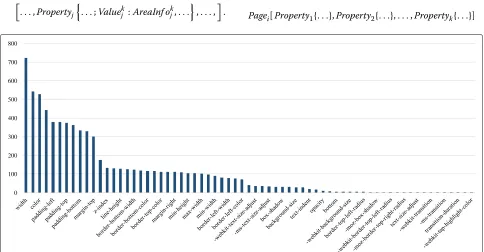
One practical challenge is that different pages have dif-ferent numbers of CSS selectors and declarations. If we want to merge two pages, we should unify the dimen-sion of properties of different pages and then they can be combined. To understand the effective CSS prop-erties used in web page CSS files, we collect all the properties from all the web pages for training and test-ing and made a statistics, shown in Fig. 2. We make a union set of the properties, denoted by, where = {Property1,Property2, ...,Propertyk}. We make the length
of the union set|| =kas the dimension of the property vector. So, we can unify effective CSS features of one page into the following pattern:
Pagei[Property1{. . .},Property2{. . .},. . .,Propertyk{. . .}]
0 100 200 300 400 500 600 700 800
Different pages have the samekproperty expressed as above. For simplicity, we can represent the pattern as follows:
where P denotes the property, V denotes the value, A denotes thearea proportion. Differentpropertiesmay have different numbers ofvalues.
In order to quantify CSS features, we should transfer their property values into computable type. So we do some simplified encoding in property values. For examples, we transfercolor:#ffffff tocolor:(255,255,255)and take away units ofwidth:16pxto getwidth:16.
4.1.2 Comparison vector generation
Given the two pages, we quantify their common CSS features into a comparison vector. The procedure is as follows:
• We first unify the property values of the same property into the same dimension. For the same propertyPk, if Page1 hasm1values
Page2 hasm2values
and extend the page property of the smaller one to the length ofm by adding zeros. The outputs in this step are Page1Vk1:A1k,. . .,Vkm:Amkand Page2
Vk1:A1k, ...,Vkm:Amkwith the same dimension.
• We compute the difference betweenPage1 :Vki and
Page2 :Vkiwherei∈mand use the maximum value of
Page1 :AikandPage2 :Aikto multiply the difference value. The result is denoted byεki.εki = |Page1 : Vk1−Page2 :Vk1| ×maxPage1 :Aik,Page2 :Aik. Then, we get a value ini th {Vk:Ak} as thei th
dimension of their comparison property vector.
• We calculate all theεki ofPkand obtain
• After repeating the previous stepsk times, we finally get the comparison property vector of Page1 and Page2 denoted as [ε1,ε2,... ,εk].
For the above example, after apply simplified encoding, the features become:
So, the common property vector is: [4.56, 4.8, 2.25]. After representing all page features into comparison vectors, they are ready to be processed by the learning algorithms.
Table 2Comparison of the four classification algorithms
Classifier Robustness Efficiency Dataset scale
SVM ◦ ◦ ◦ ◦◦ *
DT ◦ ◦ ◦ ◦ *
AB ◦◦ ◦ **
RF ◦ ◦ ◦ ◦◦ **
“◦” represents the performance level “*” represents the scale of affordable dataset
4.2 Classifier building
We consider our approach as a two-category classification problem. We set the output of the classifier as a binary output, 1 or 0, and make the comparison property vec-tors in the dataset as inputs. We divide the dataset into two parts. One is used to train the classifier, and the other is the testing set used to evaluate the performance. Let 1 = {xi}mi=1be a set ofMtraining vectors, wherexiis a
k-dimension vector labelled byyi∈ {±1}, withyi =1 and
yi=-1 indicatingxito the class 1 and class 2 respectively.
And2= {xi}ni=1be a set ofNtesting vectors.
We use the following four classifiers in our approach, including Support Vector Machine (SVM) [25,26], Deci-sion Tree (DT) [27,28], AdaBoost (AB) [29,30], and Ran-dom Forest (RF) [31,32]. The property comparison of the four classification algorithms is summarized in Table2, with detailed explanation as follows.
• Support Vector Machine (SVM). SVM aims to maximize the margin between classes closest points to find an optimal separating hyperplane between them. The minority of support vectors (SV) produced after training determines the result of classifiers, which avoids dimension disaster and offers a good performance in robustness.
• Decision tree (DT). DT classifies items by making decisions at each branch to obtain as much as entropy gain as possible. A decision tree consists of a root node, several internal nodes, and leaf nodes. Leaf nodes denote the result of the classifier, and other nodes denote each attribute. Every route from the root node to a leaf node corresponds a determining test sequence. It follows the rule of
divide-and-conquer.
• AdaBoost (AB). Boosting is a kind of ensemble learning algorithms that promote weak learner to
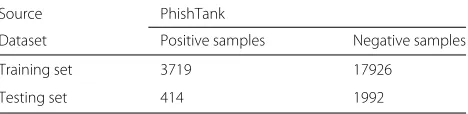
Table 3Dataset for classifier
Source PhishTank
Dataset Positive samples Negative samples
Training set 3719 17926
Fig. 3Result of SVM with regard to gamma. According to the experiment results shown in this figure, the accuracy is around 96%, while the rest of the three metrics are mostly above 80%. With the rising of gamma, the value of accuracy and F1 almost remain constant, while recall falls down a little and precision goes up a little. When gamma is about 0.0002, the four metrics get close to the best performances
strong learner. AB is a representative of this kind of boosting. Its training starts with a base learner and adjusts the distribution of samples based on the performance of the base learner. Then, it trains the next base learner based on the adjusted distribution of samples iteratively. Their outputs are given different weights that contribute to the final output of the boosted classifier. It is a kind of serial ensemble algorithm.
• Random Forest (RF). Different from boosting, Bagging is a parallel ensemble learning algorithm. It
samples different sets form the training set, trains base learners based on these different sample sets, and combines the base learners to produce a good result. RF is an expansion of Bagging technique that builds lots of decision trees for training and outputs the most-voting class. It introduces the random attribute selective to make stronger generalization.
In our approach, we use1to train a classifier model
and use 2 to test its performance. When the input of
a comparison property vector gets output 1, it means
Fig. 4Result of Decision Tree with regard to depth of tree. According to the experiment results, the four metrics remain constant whenmax_depth
is above 20, and their values may fluctuate a little. The accuracy is about 93%, while the precision is the lowest, which is around 80%. When
Fig. 5Result of AdaBoost with regard ton_estimators. The four metrics displayed in this figure are above 82.5%, and their values increase slightly when the value ofn_estimatorsincreases. The accuracy is close to 94%. Whenn_estimatorsis about 250, the system obtains a relatively optimal performance
the two pages are similar. The suspicious page will be determined to be malicious. When the input of a comparison property vector gets output 0, it means the two pages are not similar. The suspicious page will be determined to be benign. We evaluate four classifiers in the next section.
5 Evaluation
In this section, we evaluate our approach. In order to eval-uate the effectiveness of our solution, we deploy several machine learning classifiers to evaluate the performance.
We use four metrics accuracy, precision, recall, and F1 score, to analyze the results of our approach. Accuracy equals to the proportion of the number of web pages that are correctly detected as phishing pages or normal pages to the number of total sample web pages. Precision equals to the proportion of the number of web pages that are correctly detected as phishing pages to the number of total detected web pages. Recall equals to the pro-portion of the number of web pages that are correctly detected as phishing pages to the number of total phishing samples.
Fig. 7Result of SVM with different ratios of positive/negative samples. We tested the Support-vector-machine classifiers using the following positive/negative ratios: 7.089, 3.499, 2.081, 1.375, 0.988, 0.727, 0.462, 0.346, 0.278, 0.139, 0.099, 0.075, and 0.058
The accuracy, precision, and recall (as shown in Eqs. (1), (2), and (3)) are calculated the same as in [9].
Precision= TP+TN
TP+FP+TN+FN (1)
Precision= TP
TP+FP (2)
Recall= TP
TP+FN (3)
True positive (TP) is the number of correctly classi-fied phishing pages. True negative (TN) is the number
of correctly classified legitimate pages. False negative (FN) is the number of phishing pages misclassified as legitimate pages. False positive (FP) is the number of legitimate pages misclassified as phishing pages. Besides, we use F1 score (Eq. (4)) as a metric to evaluate our approach.
F1=2×Precision×Recall
Precision+Recall (4)
Dataset preparation. We collect phishing websites from phishtank.com. We first check and filter those invalid
Fig. 9Result of AB with different ratios of positive/negative samples. We tested the AdaBoost classifiers using the following positive/negative ratios: 7.089, 3.499, 2.081, 1.375, 0.988, 0.727, 0.462, 0.346, 0.278, 0.139, 0.099, 0.075, and 0.058
pages manually. We then exclude the pages whose lay-out elements are too small and whose laylay-out appear-ance is totally different from their target. We select 46 target pages, 448 suspicious pages, and 40 normal pages different from target pages to test our approach. In property vector extraction, we obtain 4133 compar-ison vectors as positive samples whose label is set to 1 and 19918 comparison vectors as negative samples whose label is set to 0. Positive samples consist of pairs of target pages and corresponding similar suspicious pages. Negative samples consist of pairs of target pages and corresponding dissimilar suspicious pages, pairs of
normal pages and suspicious pages, and pairs of nor-mal pages and target pages. There are 24051 sam-ples in total to evaluate our four classifiers, shown in Table3.
5.1 Classifier effectiveness
We first evaluate the classifiers’ effectiveness under dif-ferent parameters. In these experiments, we use all of our effective 24051 samples mentioned above to evaluate and ignore the unbalance of positive and negative samples, which we will analyze the impact in the next experiment. The results are as follows:
Fig. 11Result of SVM with different training set size. We test the SVM classifier using subsets with the following sizes: 803, 1622, 2357, 3201, 4043, 4909, 5628, 6425, 7230, and 8155, where the ratio of positive/negative is close to 1. The accuracy is high, which is above 95%. With the increase of data size, the results get better
• Support Vector Machine (SVM). We employ SVM as the classifier and test four metrics regarding the parametergamma in the SVM algorithm. According to the experiment results shown in Fig.3, the accuracy is around 96%, while the rest three metrics are mostly above 80%. With the rising ofgamma, the value of accuracy andF1almost remain constant, while recall falls down a little and precision goes up a little. Whengamma is about 0.0002, the four metrics get close to their best performance.
• Decision Tree (DT). We employ DT as the classifier and test four metrics regarding the parameter
max_depthin the DT algorithm. The results are shown in Fig.4, where the four metrics remain constant whenmax_depthis above 20, and their values may fluctuate a little. The accuracy is about 93%, while the precision is the lowest, which is around 80%. Whenmax_depthis about 25, the four metrics achieve the best.
• AdaBoost (AB). We employ AB as the classifier and test four metrics regarding the parameter
n_estimatorsin the AB algorithm. The four metrics displayed in Fig.5are above 82.5%, and their values increase slightly when the value ofn_estimators
Fig. 13Result of AB with different training set size. We test the AdaBoost Decision Tree classifier using subsets with the following sizes: 803, 1622, 2357, 3201, 4043, 4909, 5628, 6425, 7230, and 8155, where the ratio of positive/negative is close to 1. The accuracy is high, which is above 95%. With the increase of the data size, the results get better
increases. The accuracy is close to 94%. When
n_estimatorsis about 250, the system obtains a relatively optimal performance.
• Random Forest (RF). We employ RF as the classifier and test four metrics regarding the parameter
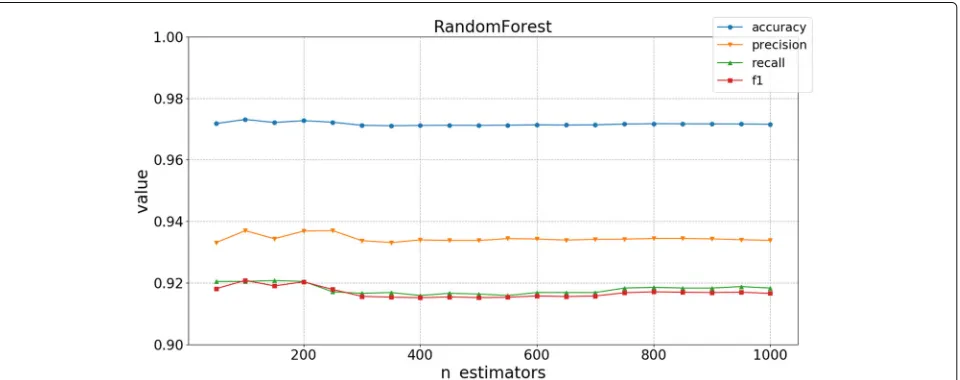
n_estimatorsin the RF algorithm. Figure6gives the experiment results, and we can see that the accuracy is above 96%, and the rest of the three metrics are above 90% and their values keep nearly stable over different values ofn_estimators. The system gets a better performance, whenn_estimatorsis about 100.
5.2 Effectiveness of positive-negative sample distributions
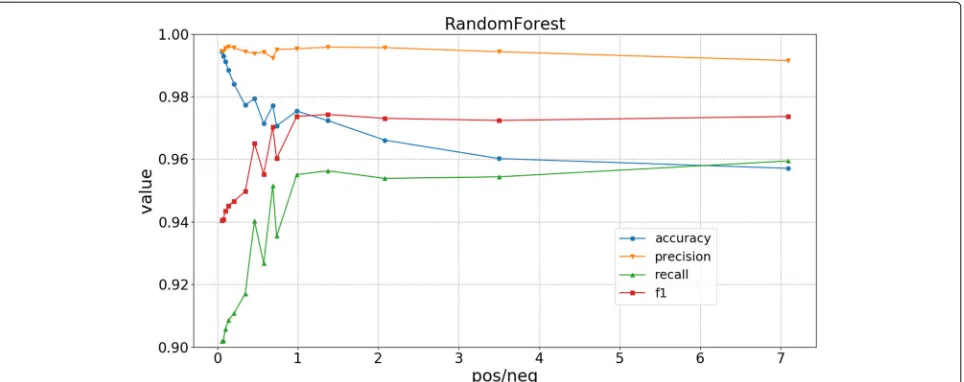
Here, we evaluate the effect of the ratio of posi-tive/negative samples. We change the number of negative samples to control the ratio. We tested the classifiers using the following positive/negative ratios: 7.089, 3.499, 2.081, 1.375, 0.988, 0.727, 0.462, 0.346, 0.278, 0.139, 0.099, 0.075, and 0.058. The results are shown in Figs.7,8,9, and10. The accuracy decreases with the increase of the ratio, while all three other metrics increase. A ratio of 1 to 2 is recommended.
Table 4Test results of the four classifiers
Classifier Accuracy Precision Recall F1
SVM 0.96948 0.96235 0.86115 0.90134 DT 0.93676 0.80674 0.90015 0.84467 AB 0.94500 0.85218 0.93378 0.87145 RF 0.97310 0.93695 0.92046 0.92078
5.3 Sensitivity to size of training set
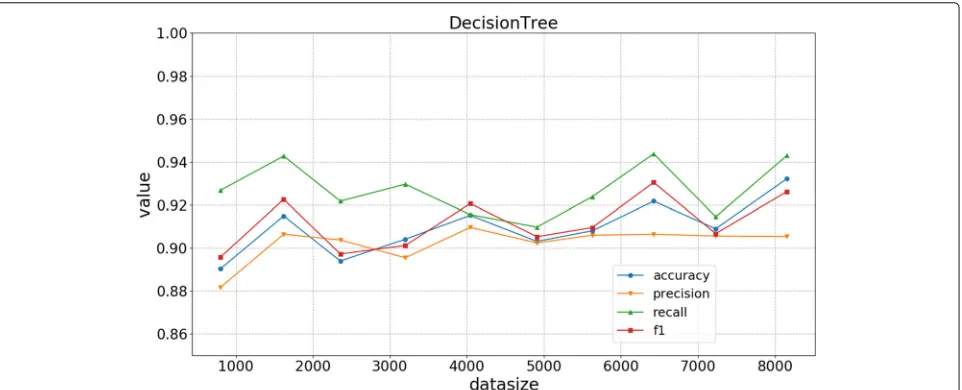
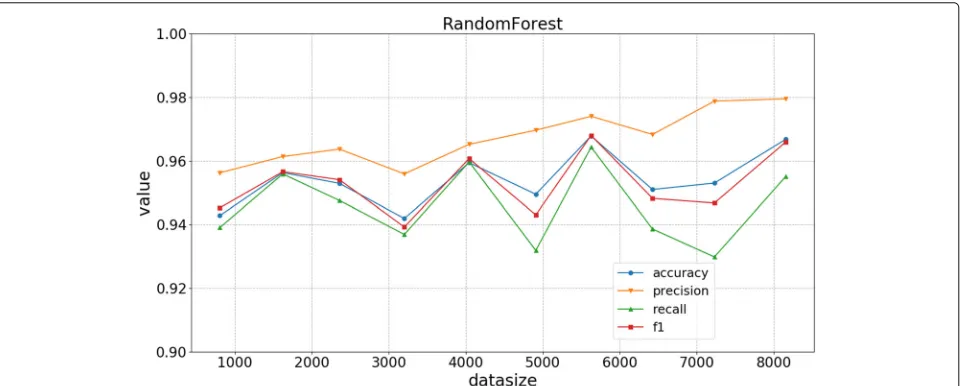
Finally, we evaluate how the size of the training set affects the detection results. Here, we test classifiers using subsets with the following sizes: 803, 1622, 2357, 3201, 4043, 4909, 5628, 6425, 7230, and 8155, where the ratio of positive/negative is close to 1. The results are shown in Figs.11,12,13, and14. The accuracy is above 95%. With the increase of data size, SVM and Random Forest explic-itly improve their performance, while Decision Tree and AdaBoost have implicit tendency under the distribution of the testing samples.
5.4 Results and discussion
According to the experiment results, we present the best performance values of each classifier in Table4. Among these four classifiers, Random Forest performs the best by considering all the four metrics. All the classifiers show more than 93% accuracy and more than 84%F1, which demonstrates that our approach can make an effective detection in phishing websites.
Table 5 illustrates three metrics of our work and four other approaches (CANTINA [6], CANTINA+ [11], Corbetta et al. [33], and Zhang et.al [19].
Although the metrics of our approach is not the best, it still performs better than Corbetta et.al [33] and Zhang et.al [19]. However, with respect to other approaches, our method is light-weight as it only takes one class of fea-tures, CSS structure, as the input to identify the similarity of web pages and detect phishing attacks. Moreover, our method is independent of the language of web pages. In addition, according to the evaluation conducted in Sections5.2and5.3, the accuracy and robustness of such learning-based solutions are greatly influenced/limited by the size of the dataset and the distribution of the testing
Table 5The precision, recall, and F1 score of our work and other approaches
Approaches Precision (%) Recall (%) F1
CANTINA [6] 94.2 97.0 0.956
CANTINA+ [11] 97.5 93.47 0.963
Corbetta et.al [33] 95.3 73.08 0.827 Zhang et.al [19] 91.0 91.90 0.915
Our work 93.7 92.05 0.921
samples. More testing samples and the adjustment of classifier parameters will promote our results.
6 Conclusion
In phishing web site detection, comprehensively evaluat-ing page similarity remains a great challenge. In this paper, we propose a learning-based aggregation analysis mech-anism to determine similarity of page layouts and detect phishing pages. Our approach automatically trains clas-sifiers to determine web page similarity from CSS layout features, which does not require human expertise. We prototyped our approach and evaluated it using a large amount of phishing web pages. The experiment results demonstrate that our approach is accurate and effective in determining similarity from page layouts. Our approach can effectively enhance the performance of existing anti-phishing mechanisms.
Abbreviations
AB: AdaBoost; CSS: Cascading style sheets; DT: Decision tree; IoT: Internet of things; RF: Random forest; SVM: Support vector machine
Acknowledgements
Not applicable.
Funding
This work was supported in part by the National Key R&D Program of China (No. 2017YFB0802400), the National Natural Science Foundation of China (No. 61402029, No. 61471028, No. U11733115), the Funding Project of Shanghai Key Laboratory of Integrated Administration Technologies for Information Security (No. AGK201708), the Singapore Ministry of Education under National University of Singapore (NUS) Grant R-252-000-666-114.
Availability of data and materials
Data sharing not applicable to this article as no datasets were generated or analysed during the current study.
Authors’ contributions
The authors have contributed jointly to the manuscript. All authors have read and approved the final manuscript.
Competing interests
The authors declare that they have no competing interests.
Publisher’s Note
Springer Nature remains neutral with regard to jurisdictional claims in published maps and institutional affiliations.
Author details
1School of Cyber Science and Technology, Beihang University, Xueyuan Road, Beijing 100083, China.2School of Electronic and Information Engineering, Beihang University, Xueyuan Road, Beijing 100083, China.3Baidu USA LLC, Bordeaux Drive, SunnyVale 94089, USA.4Information Technology Service Center, China National Petroleum Corporation, Beijing, China.5School of Computing, National University of Singapore, Lower Kent Ridge Road, Singapore 117417, Singapore.
Received: 13 September 2018 Accepted: 29 January 2019
References
1. APWG, Statistical highlights for 4th quarter 2016.http://docs.apwg.org/ reports/apwg_trends_report_q4_2016.pdf. Accessed 26 July 2018 2. P. Likarish, E. Jung, D. Dunbar, T. E. Hansen, J. P. Hourcade, inProceedings
3. Cloudmark Inc., Couldmark toolbar (2018).https://www.cloudmark.com/ en/s/products/cloudmark-safe-messaging-cloud. Accessed 26 July 2018 4. T. Ronda, S. Saroiu, A. Wolman, itrustpage: a user-assisted anti-phishing
tool. ACM SIGOPS Oper. Syst. Rev.42(4), 261–272 (2008)
5. I. Fette, N. Sadeh, A. Tomasic, inProceedings of the 16th International Conference on World Wide Web. Learning to detect phishing emails (ACM, Banff, Alberta, Canada, 2007), pp. 649–656
6. Y. Zhang, J. I. Hong, L. F. Cranor, inProceedings of the 16th International Conference on World Wide Web. Cantina: a content-based approach to detecting phishing web sites (ACM, Banff, Alberta, Canada, 2007), pp. 639–648
7. A. Nourian, S. Ishtiaq, M. Maheswaran, inProceedings of 5th International Conference on Collaborative Computing: Networking, Applications and Worksharing, Washington, DC, USA,. Castle: A scocial framework for collaborative anti-phishing databases (IEEE, 2009), pp. 1–10
8. J. Mao, W. Tian, P. Li, T. Wei, Z. Liang, inProceedings of the 12th International Conference on Wireless Algorithms, Systems, and Applications. Phishing website detection based on effective css features of web pages (Spinger, Guilin, 2017), pp. 804–815
9. J. Mao, W. Tian, P. Li, T. Wei, Z. Liang, Phishing-alarm: robust and efficient phishing detection via page component similarity. IEEE Access.5, 17020–17030 (2017)
10. Y. Pan, X. Ding, inProceedings of the 22nd Computer Security Applications Conference(ACSAC). Anomaly based web phishing page detection (IEEE, Miami Beach, Florida, 2006), pp. 381–392
11. G. Xiang, J. Hong, C. P. Rose, L. Cranor, Cantina+: a feature-rich machine learning framework for detecting phishing web sites. ACM Trans. Inf. Syst. (TISSEC).14(2), 1–28 (2011)
12. L. Lee, K. Lee, Y. Juan, H. Chen, Y. Tseng, inProceedings of the 23rd International Conference on World Wide Web. Users’ behavioral prediction for phishing detection (ACM, Seoul, 2014), pp. 337–338
13. N. Abdelhamid, A. Ayesh, F. Thabtah, Phishing detection based associative classification data mining. Expert Syst. Appl.41(13), 5948–5959 (2014) 14. N. Abdelhamid, F. Thabtah, H. Abdel-Jaber, inProceedings of IEEE
International Conference on Intelligence and Security Informatics. Phishing detection: a recent intelligent machine learning comparison based on models content and features (IEEE, Beijing, China, 2017), pp. 72–77 15. E. Medvet, E. Kirda, C. Kruegel, inProceedings of the 4th International
Conference on Security and Privacy in Communication Netowrks. Visual-similarity-based phishing detection (ACM, Istanbul, 2008), pp. 1–6 16. T.-C. Chen, S. Dick, J. Miller, Detecting visually similar web pages:
application to phishing detection. ACM Trans. Internet Technol.10(2), 1–38 (2010)
17. N. Chou, R. Ledesma, Y. Teraguchi, D. Boneh, J. C. Mitchell, inProceedings of the 11th Annual Network and Distributed System Security Symposium (NDSS). Client-side defense against web-based identity theft (Internet Society, San Diego, 2004), pp. 1–16
18. M. Dunlop, S. Groat, D. Shelly, inProceedings of the 5th International Conference on Internet Monitoring and Protection (ICIMP). Goldphish: using images for content-based phishing analysis (IEEE, Barcelona, 2010), pp. 123–128
19. W. Zhang, H. Lu, B. Xu, H. Yang, Web phishing detection based on page spatial layout similarity. Informatica.37(3), 231–244 (2013)
20. M. Moghimi, A. Y. Varjani, New rule-based phishing detection method. Expert Syst. Appl.53, 231–242 (2016)
21. B. Wardman, T. Stallings, G. Warner, A. Skjellum, ineCrime Researchers Summit. High-performance content-based phishing attack detection (IEEE, San Diego, California, 2011), pp. 1–9
22. S. Abu-Nimeh, D. Nappa, X. Wang, S. Nair, inProceedings of the Anti-phishing Working Groups 2nd Annual eCrime Researchers Summit. A comparison of machine learning techniques for phishing detection (ACM, Pittsburgh, Pennsylvania, 2007), pp. 60–69
23. G. Bottazzi, E. Casalicchio, D. Cingolani, F. Marturana, M. Piu, inProceedings of the 2015 IEEE International Conference on Computer and Information Technology; Ubiquitous Computing and Communications; Dependable, Autonomic and Secure Computing; Pervasive Intelligence and Computing (CIT/IUCC/DASC/PICOM). MP-Shield: a framework for phishing detection in mobile devices (IEEE, Liverpool, 2015), pp. 1977–1983
24. J. Mao, J. Bian, W. Tian, S. Zhu, T. Wei, A. Li, Z. Liang, inProceedings of International Conference On Identification, Information and Knowledge in
the Internet of Things (IIKI). Detecting phishing websites via aggregation analysis of page layouts (Elsevier, Qufu, China, 2017), pp. 224–230 25. C. Cortes, V. Vapnik, Support-vector networks. Mach. Learn.20(3),
273–297 (1995)
26. Wikipedia, Support vector machine (2018).https://en.wikipedia.org/wiki/ Support_vector_machine/, [Online]. Accessed 26 July 2018
27. L. Breiman, J. H. Friedman, R. A. Olshen, C. J. Stone,Classification and Regression Trees. (Wadsworth and Brooks/Cole Advanced Books and Software, Monterey, CA, 1984)
28. Wikipedia, Decision tree learning (2018).https://en.wikipedia.org/wiki/ Decision_tree_learning/, [Online]. Accessed 26 July 2018
29. Y. Freund, R. E. Schapire, A decision-theoretic generalization of on-line learning and an application to boosting. Comput, J., Syst. Sci.55(1), 119–139 (1997)
30. Wikipedia, AdaBoost (2018).https://en.wikipedia.org/wiki/AdaBoost/, [Online]. Accessed 26 July 2018
31. L. Breiman, Random forests. Mach. Learn.45(1), 5–32 (2001) 32. Wikipedia, Random forest (2018).https://en.wikipedia.org/wiki/
Random_forest/, [Online]. Accessed 26 July 2018