R E S E A R C H
Open Access
Compressive sensing-based channel
estimation for SC-FDE system
Lu Si
*, Xinle Yu, Hang Yin and Weizhang Xu
Abstract
The channel of wireless broadband communication system usually features time domain sparsity. The channel estimation of single carrier frequency domain equalization (SC-FDE) system was modeled as compressive sensing (CS)-based reconstruction of sparse signal. Matching pursuit algorithms based on greedy search were adopted to reconstruct channel information. Under the premise of reduced reference signal overhead, the system reliability can be effectively enhanced. This paper proposes a priori information aided scheme. By inserting the cyclic prefix of the first training sequence to a SC-FDE transmission frame, which is used as guard interval, the priori information including more accurate channel length and sparsity can be obtained with inter-block-interference (IBI)-free training sequence. The proposed scheme shows obvious superiority in slow fading channels. It effectively improves the reconstruction of probability, thereby improving the accuracy of channel estimation, meanwhile sacrificing less spectral efficiency.
Keywords:Compressive sensing, SC-FDE, OMP, SP, Priori information
1 Introduction
Channel state detection represents one key technology in modern wireless communication system. The refer-ence signal-based channel estimation method has signifi-cant advantages in small error and low complexity, thus widely applied in modern wireless transmission systems. Different from the traditional channel estimation method which only considers the maximum delay in channel transmission, the compressive sensing (CS) theory-based method takes advantage of time domain sparsity of wireless broadband communication channel, and adopts parameterized estimation method to accom-plish channel state detection through the estimation of position and gain of each transmission path, which can decrease the length of reference signal and improve the performance of channel estimation.
Traditional channel estimation algorithms such as least square (LS) estimation and minimum mean square error (MMSE) algorithm have better performance under multipath enrichment of wireless channels, but the per-formance will be greatly weakened in case of sparse wireless channels (with few multipaths). The sparsity will
be more obvious when the transmission bandwidth is wide, multipath delay is big, and number of paths is lim-ited. At this time, using conventional pilot frequency-based channel estimation will lead to high channel overhead, with estimation accuracy greatly re-duced. Therefore, channel estimation of sparse channels using CS algorithm has become a new focus. The CS theory shows that if the signal is sparse, then
high-dimensional signal can be converted to
low-dimensional signal through sensing matrix, and then the original signal can be reconstructed with high prob-ability from a small number of low-dimensional signals by solving the optimization problem [1–3]. Compared with the conventional pilot-based channel estimation method, CS-based method can greatly reduce pilot over-head and improve the performance while improving spectral efficiency. Bajwa et al. applied compressive sens-ing to channel estimation and proposed compressive channel sensing (CCS) [4]. The literature [5, 6] studied CS-based underwater acoustic channel estimation; litera-ture [7, 8] applied CS to channel estimation of ultra wideband (UWB) communication systems; literature [9] studied TDS-OFDM transmission method based on the CS theory. The signal structure of TDS-OFDM and sin-gle carrier frequency domain equalization (SC-FDE) * Correspondence:[email protected]
Engineering Center of Digital Audio and Video, Communication University of China, Beijing, China
system is quite similar, which utilizes known training se-quence in the time domain as data block guard interval.
Accurate channel state is obtained to eliminate the ef-fects of channel multipath and Doppler on the transmit-ted signal by using channel equalization. The SC-FDE applies frequency domain equalization to single carrier systems, and adopts block transmission scheme. Similar to OFDM, SC-FDE has advantages of low complexity and strong anti-interference characteristics. Meanwhile, it has low peak-to-average power ratio (PAPR) and in-sensitivity to frequency deviation [10], which is particu-larly suitable for broadband communication uplink systems and spaceborne launch systems that are sensi-tive to the power, weight, and volume of transmitting equipment.
The SC-FDE system adopts unique words (UW) as guard interval and reference signal, and proposes a series of corresponding channel estimation algorithms. In order to avoid the interference of UW sequences from data blocks due to the multipath delay spread, literature [11] used dual UW (DUW) as guard inter-val to effectively improve the performance, but the channel overhead is high as each UW length is equivalent to the maximum multipath delay. In order to reduce the channel overhead, an iterative process-ing method was proposed. The total UW length is equivalent to the maximum multipath delay, but the slow convergence rate makes it impossible to acquire channel state quickly, so the method is not suitable for fast time varying channels. Targeting at the above problem, this paper proposed a CS-based channel es-timation method for SC-FDE system, in which single UW is used as guard interval and reference signal. The conventional reconstruction algorithm is opti-mized, and an improved scheme based on priori in-formation is proposed. The proposed scheme can improve the reconstruction of probability compared to the conventional one, thereby improving the accur-acy of channel estimation and enhancing the reliabil-ity of the system effectively.
2 Methodology
2.1 Compressive sensing-based SC-FDE
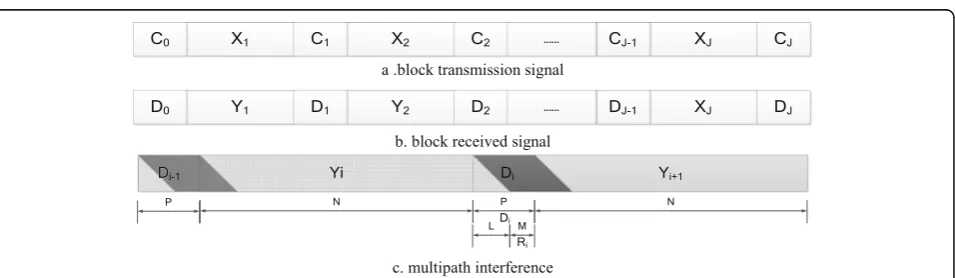
The signal structure of the SC-FDE transmission system based on training sequence is shown in Fig. 1a. Where
Ci= [ci, 0,ci, 1,⋯,ci, P−1]T is a UW with a length P.
Therefore, for anyiandj,ci=cjis established,Xi= [xi, 0,
xi, 1,⋯,xi, N−1]T is payload data block with a length N.
Let discrete time channel impulse response with the maximum multipath spread length L be Hi= [hi, 0,hi, 1,⋯,hi, L]T, which satisfies P≥L. Record M=P-L. The received signal obtained after channel transmission, time-frequency synchronization, and the multipath interference is shown in Fig.1b, c.
The received signal Di= [di, 0,di, 1,⋯,di, P−1]T
corre-sponding to the known training sequence can be expressed as:
Di¼ΨiHiþNi ð1Þ
Niis additive white Gaussian noise andΨiis:
Ψi¼ ples of the received signal are not interfered by the
un-known data, which constitute the
inter-block-interference (IBI)-free region of the training sequence, to be recorded as Ri= [di, L,di, L+ 1,⋯,di, P−
1]T.Viis lastMsamples ofNi, then:
Ri¼ΦiHiþVi ð3Þ
whereΦiis a Toeplitz array:
Φi¼ umn full rank, then Eq. (3) can be used to estimate the channel state using conventional algorithms such as LS and MMSE. For broadband wireless channels, the chan-nel stateHi energy is mainly concentrated in a few ele-ments and can be approximated as:
Hið Þ ¼n As can be seen from the Formula (5), the element value ofHi isαi, k atτi, k, the other element values are 0, and there are K non-zero elements. Record the path delay set as Ωi= [τi, 0,τi, 1,⋯,τi, K−1], the path gain set as Ai = [αi, 0,αi, 1,⋯,αi, K−1]. Without loss of generality,
sup-pose 0≤τi,0≤τi,1≤…≤τi,K-1≤L-1. In general, K< <L,
that is, the channel has a high sparsity, so the channel estimation can be performed using CS algorithm. In CS algorithms,Riis referred to as measurement vector,Φiis a measurement matrix, M is number of measurements, and Kis sparsity ofHi. The idea of compressive sensing is to turn the problem of finding Lunknowns Hiinto a problem of estimating 2K unknowns Ωi, Ai, the key of which lies in correct estimation of Ωi. The reduced number of key unknowns enables effective improvement of performance in channel estimation. When M<L+ 1, the problem of solving Hi in Formula (3) becomes a problem of solving underdetermined equation. Hi is a sparse variable, then according to compressive sensing theory, the underdetermined equation can be solved by solving the following optimization problem to obtain the estimated channel parameterHi:
^
Hi¼ arg min Hi
Hi
k k0 s:t:kRi−ΦiHik2≤ε ð6Þ
Whereεis a non-negative constant related to noise. In recent years, compressive sensing theory has been devel-oped to provide corresponding algorithms for solution of the above problems, including basis pursuit (BP) rithm, greedy search-based matching pursuit (MP) algo-rithm, and relaxation convex optimization algorithm. Among them, MP is the most widely used reconstruc-tion algorithm with the lowest complexity and the lar-gest number of measurements.
Take the normalized random measurement matrix proposed in literature [12] as an example. Record it as
Gi¼ΦTiΦi,Giis a Hermitian matrix. When all elements
in Φi are identically distributed random numbers and the columns are normalized (the sum of the squares of the column elements is 1), the diagonal elements of Gi are always 1, and the remaining elements are normally distributed random numbers with a mean of 0 and a variance of 1/M. Columns with index equal to Ωi are taken from the matrix Gi to constitute matrix B, rows with index equal toΩi are taken from matrixBto con-stitute the sub-matrix IþGiΩi (I is a unit matrix). The remaining rows of matrix Bmake up a sub-matrix GiΩ0
i. Taking the orthogonal matching pursuit (OMP) algo-rithm as an example, the condition [13] for correct choice of τi,k in each iteration by OMP is that the
ine-quation (7) is established.
All the elemental and non-diagonal elements of GiΩ0 i are normally distributed random numbers with a mean value of 0 and a variance of 1/M. Therefore, for a larger
M, the establishment probability of inequation (7) is higher. That is, the accurate rate in estimatingΩican be increased by increasing the measurements numberM.
2.2 Parameterized channel estimation based on priori information
lead to a higher reconstruction of probability. The frame structure for the proposed scheme is shown in Fig.2.
As shown in Fig.2,Cn, 0consists of UW with a length
of P and its cyclic prefix, let Cn;0¼
½cP−Lmax;cTP−Lmaxþ1;⋯;cP−1;c0;c1;⋯;cP−1, andLmaxis equal to the
length of maximum delay spread that may exist in the actual channel. Set Lmax=τmax×fs, in which τmaxis the
maximum multipath delay and fs is the sampling rate. TakeJ consecutive blocks of data as a frame, so for any
i, j∈[1,J], there is cn, i=cn, j= [c0,c1,⋯,cP−1]T. The
co-herence time of the channel is assumed to beTc, i.e.,Tc = 1/fd, and fd is the Doppler frequency shift, which can be easily estimated at the receiving end [14]. When J=
Tc/(Ts(P+N))−1, it is considered that the path delay of the channel remains unchanged and the path gain varies slightly within J consecutive data blocks.
The key to the PIA scheme lies in the estimation of channel length and sparsity. According to LS criterion, the last P samples of the known sequenceCn, 0 without
interference from unknown data can be used to obtain the channel frequency domain response H^n of the nth frame, and H^n¼ ½H^n;0;H^n;1;⋯;H^n;P−1T. Let hn= [hn, 0,
hn, 1,⋯,hn, P−1]T be the channel time domain impulse
response of the nth frame, then H^n and hn will satisfy the relationship in (8):
^
Hn¼WPhnþnp ð8Þ
Where WP is the Fourier transform matrix in the size of P×P, np is the white Gaussian noise vector of P× 1, the variance isσ2
n. Owing to the unique inverse existence
ofWP,hncan be reduced to inverse Fourier transform of ^
Hn at the point P, i.e., ^hn¼WP−1H^n . Let ^hn¼
½^hn;0;^hn;1;⋯;^hn;P−1T, then the estimate^Snof impulse re-sponse power in the nth frame can be calculated as^Sn
¼ ½S^n;0;^Sn;1;⋯;^Sn;P−1T¼ ½j^hn;0j2;j^hn;1j2;⋯;j^hn;P−1j2. By
averaging the power of ^Sn within two consecutive frames, the estimated power of each path ^S can be ob-tained, soS^¼1
2ð^Snþ^Snþ1Þ.S^can be seen as a
represen-tation of the delay power spectrum which reflects statistical properties of the channel [15, 16]. In this
algorithm, ^S is defined as a time observation and corre-sponding time parameters can be extracted from it. Let ^
The elements in the vector ^Sare arranged in
descend-ing order to obtain vector ^S0¼ ½^S00;^S01;⋯;^S The laterGelements of ^S0 are selected to represent the noise power. In simulation experiments,Gis selected ac-cording to different channel conditions. The latterG ele-ments are averaged to obtain average noiseNav, which is subtracted from time observation ^S to obtain the vector, i.e., ^S″¼^S−Nav.S^
″
is searched according to (10) criter-ion to obtain the index:
^
The elements in the index set Ω^n obtained according to this criterion can be regarded as an estimate of the multipath delay position for the nth frame. The thresh-old will be determined by Formula (11) [17]:
γ¼ max ^S}max
min respectively represent the
max-imum and minmax-imum values in^S″, γ1;γ2 are a
represen-tation of the energy ^S″ , which are determined by simulation experiments according to different systems in specific calculations. Suppose L^¼ maxfΩ^ng as the value of estimated channel length, and K^ ¼ kΩ^nk0 as
the channel sparsity. According to the estimated value^L, the position of the IBI-free region in the received train-ing sequence is determined. The input parameters of the reconstruction algorithms are initialized. The measure-ment matrix Φi at each moment is obtained from the channel length^L, as shown in Eq. (12).
Φi¼
The measurement vector is Ri¼
½di;^L;di;L^þ1;⋯;di;P−1T, and the number of
measure-ments is M¼P−^L. The subsequent steps are consistent with those of classic MP algorithms and will not be elab-orated here. The OMP and SP algorithms based on prior information are referred to as PIA-OMP and PIA-SP re-spectively in what follows.
Regarding to the proposed PIA scheme,H^n can be effi-ciently calculated byP-point FFT to realize the LS estima-tion, and h^n can be calculated byP-point IFFT. Same as the conventional methods, the main computational bur-den of the PIA scheme comes from the MP algorithm.
3 Simulation results and discussion
This paper sets up a SC-FDE system simulation platform and sets the symbol rate atfs= 8KSps. The main parame-ters of the sending end are shown in Table1. The wide sense stationary uncorrelated scattering (WSSUS) chan-nel model is adopted in this simulation. The maximum multipath delay is set as τmax= 5ms based on the
iono-spheric channel characteristics. The channel sparsity K
= 2, the Doppler spread fd= 1Hz, and the gain is inde-pendent for different propagation paths. Assume that the system is perfectly synchronized.
Let the length of UW P= 64 and the length of data block N= 512, and every J(J= 12) data blocks are se-lected as a frame. Where UW is in Chu sequence with constant envelope characteristics [18]. For different esti-mation methods, the reference signal length and spectral efficiency are shown in Table 2. For LS, MMSE, OMP, and SP schemes, spectral efficiency is η¼ N
NþP. In par-ticular, spectral efficiency for PIA-OMP and PIA-SP is η
¼ JN
JðNþPÞþðLmaxþPÞ. From the table, it can be observed that
PIA schemes sacrifice less spectral efficiency. But whenJ
gets smaller, the decrease in spectral efficiency cannot be ignored. Therefore, the proposed scheme is not suitable for fast fading channels. However, its application in slow fading channels shows obvious superiority.
What needs illustration is that conventional OMP and SP assumed that the channel sparsity is known, and the channel length takes the value Lmax=τmax×
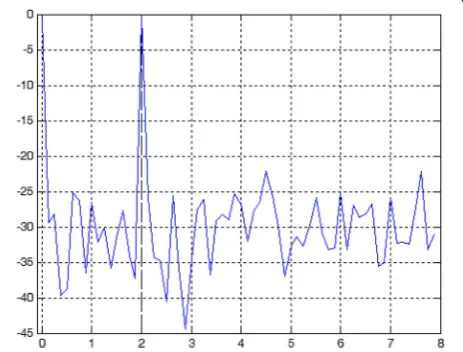
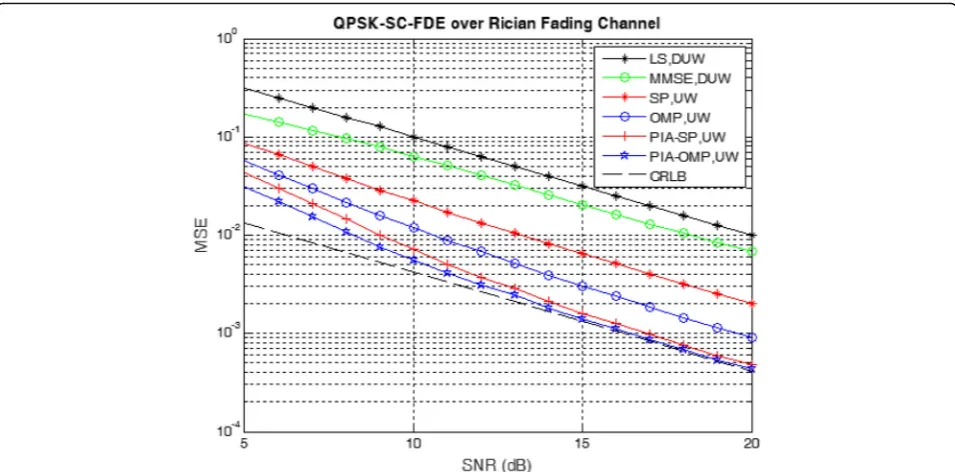
fs. Figure3 shows the power of time domain impulse response of the channel obtained with the proposed scheme with SNR = 10 dB. Accurate two-path delay information can be obtained from the figure. The MSE performance comparison between the proposed schemes and its conventional counterparts is given in Fig. 4. For LS and MMSE algorithms, dual UW is used as guard interval and reference signal. It can be seen from the figure that, under the premise of re-ducing the reference signal length by half, OMP and SP result in a SNR gain of more than 5 dB when MSE = 10−2 compared with conventional MMSE based on DUW; the proposed PIA-SP result in a SNR gain of about 4 dB when MSE = 10−2 com-pared with SP, the proposed PIA-OMP result in a SNR gain of about 2.5 dB when MSE = 10−3 com-pared with OMP. This is because a longer measure-ment vector is utilized, and the reconstruction of probability is improved. As SNR goes up, the per-formance of PIA schemes approaches the theoretical
CRLB lower bound [19]. Figure 5 shows the
bit-error-rate (BER) curves for different methods. It can be observed that OMP and SP perform closely to MMSE, but PIA-OMP and PIA-SP outperforms
Table 1Modulation and coding parameters
Parameter Value
Modulation QPSK
Coding Convolution code
Code rate 0.5
Table 2The reference signal and spectral efficiency comparison
Channel estimation scheme LS/MMSE OMP/SP PIA-OMP/PIA-SP
Reference signal DUW UW UW
Data block length (N) 512 512 512
Reference signal length (P) 128 64 64
Spectral efficiency (η) 80% 88.9% 87.6%
Fig. 3The power of time domain pulse response with SNR = 10 dB.
In Fig. 3,X-axis is the power of time domain pulse response (dB) and
the conventional MMSE by more than 1 dB at the target BER of 10−4.
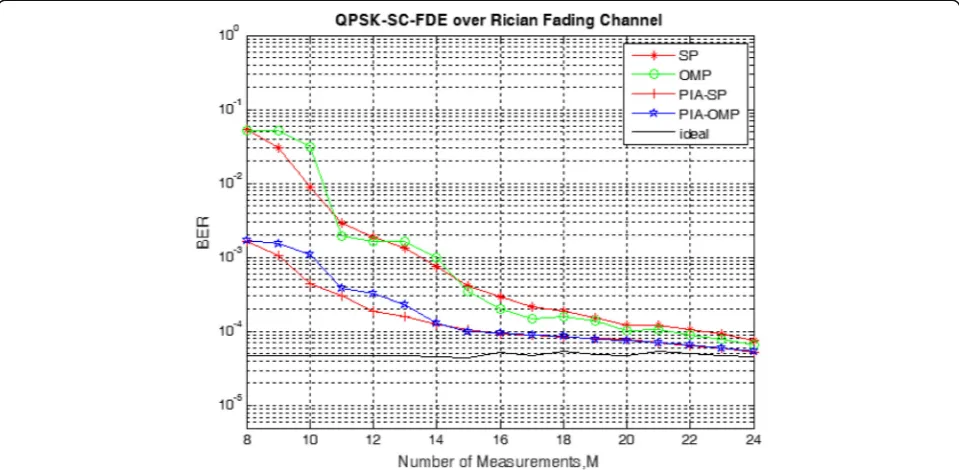
In addition, the simulation tests the performance of CS-based schemes when adopting different number of measurements M. Figures 6 and 7 show the signal re-construction performance and BER performance when varying number of measurements is utilized with SNR =
15 dB. As described in the previous section, for OMP and SP, M is equal to the value of the horizontal axis, and the length of reference signal is P=M+Lmax; for
PIA-OMP and PIA-SP, the actual number of measure-ments M′ is always bigger than the horizontal value, and M0¼P−^L¼MþLmax−L^. It is clear that the pro-posed scheme performs better than others when the
Fig. 4The MSE performance comparison between the proposed channel estimation scheme and its conventional counterparts withP= 64
number of measurements is small, e.g., M< 7K. When M goes up, the BER performance of proposed schemes approach the ideal estimation.
4 Conclusion
Taking advantage of the sparsity of wireless broadband channels, this paper models the channel estimation of SC-FDE system as a CS-based sparse signal recon
struction problem, and uses greedy search-based match-ing pursuit algorithm to reconstruct channel
informa-tion. The CS-based methods can improve the
performance of channel estimation effectively, mean-while reducing the reference signal overhead. This paper proposes a priori information aided scheme. By inserting a cyclic prefix of the first training sequence to a SC-FDE transmission frame, which is used as guard interval, the
Fig. 6Signal reconstruction performance when varying number of measurements is utilized with SNR = 15 dB
priori information including more accurate channel length and sparsity can be obtained with IBI-free train-ing sequence. The proposed scheme shows obvious su-periority in slow fading channels. Compared with the conventional methods, the PIA scheme effectively im-proves the reconstruction of probability, while sacrificing less spectral efficiency. What is more, the proposed scheme is more universal due to the acquisition of priori information.
Abbreviations
BER:Bit-error-rate; CS: Compressive sensing; IBI: Inter-block-interference; OMP: Orthogonal matching pursuit; PIA: Priori information aided; SC-FDE: Single carrier frequency domain equalization; SP: Subspace pursuit
Acknowledgements
The research presented in this paper was supported by Communication University of China, Beijing, China.
Funding
This work is supported by the Sponsor of 2015BAK05B01, National Key Technology Support Program.
Availability of data and materials Not applicable.
Authors’contributions
LS is the main writer of this paper. She proposed the main idea, completed the simulation, and analyzed the result. XY and WX provides mathematical and statistical guidance for this paper. HY gave some important suggestions for the simulation. All authors read and approved the final manuscript.
Competing interests
The authors declare that they have no competing interests.
Publisher’s Note
Springer Nature remains neutral with regard to jurisdictional claims in published maps and institutional affiliations.
Received: 3 July 2018 Accepted: 21 December 2018
References
1. D.L. Donoho, Compressed sensing. IEEE Trans. Inf. Theory52(4), 1289–1306 (2006)
2. R.G. Baraniuk, Compressive sensing. IEEE Signal Process. Mag.24(4), 118–121 (2007)
3. E.J. Candès, M.B. Wakin, An introduction to compressive sampling. IEEE Signal Process. Mag.25(2), 21–30 (2008)
4. W.U. Bajwa, J. Haupt, A.M. Sayeed, et al., Compressed channel sensing: a new approach to estimating sparse multipath channels. Proc. IEEE98(6), 1058–1076 (2010)
5. C.R. Berger, S. Zhou, J.C. Preisig, et al., Sparse channel estimation for multicarrier underwater acoustic communication: from subspace methods to compressed sensing. IEEE Trans. Signal Process.58(3), 1708–1721 (2010) 6. C. Qi, X. Wang, L. Wu, Underwater acoustic channel estimation based on
sparse recovery algorithms. IET Signal Process5(8), 739–747 (2011) 7. J.L. Paredes, G.R. Arce, Z. Wang, Ultra-wideband compressed sensing:
channel estimation. IEEE J. Sel. Top. Sign. Proces.1(3), 383–395 (2007) 8. A.H. Muqaibel, M.T. Alkhodary, Practical application of compressive sensing
to ultra-wideband channels. IET Commun.6(16), 2534–2542 (2012) 9. L. Dai, Z. Wang, Z. Yang, Compressive sensing based time domain
synchronous OFDM transmission for vehicular communications. IEEE J. Sel. Areas Commun.31(9), 460–469 (2013)
10. N. Benvenuto, R. Dinis, D. Falconer, S. Tomasin, Single carrier modulation with nonlinear frequency domain equalization: An idea whose time has ComeAgain. Proc. IEEE98(1), 69–96 (2010)
11. Y. Zeng, T.S. Ng, Pilot cyclic prefixed single carrier communication: channel estimation and equalization. IEEE Signal Process Lett.12(1), 56–59 (2005) 12. J.A. Tropp, A.C. Gilbert, Signal recovery from random measurements via
orthogonal matching pursuit. IEEE Trans. Inf. Theory53(12), 4655–4666 (2007)
13. J.A. Tropp, Greed is good: algorithmic results for sparse approximation. IEEE Trans. Inf. Theory50(10), 2231–2242 (2004)
14. J. Cai, W. Song, Z. Li, Doppler spread estimation for mobile OFDM systems in Rayleigh fading channels. IEEE Trans. Consum. Electron.49(4), 973–977 (2003)
15. J.J. Van de Beek, M. Sandell, P.O. Borjesson, ML estimation of time and frequency offset in OFDM systems. IEEE Trans. Signal Process.45(7), 1800– 1805 (1997)
16. Y. Li, L.J. Cimini, N.R. Sollenberger, Robust channel estimation for OFDM systems with rapid dispersive fading channels. IEEE Trans. Commun.46(7), 902–915 (1998)
17. B. Yang, K.B. Letaief, R.S. Cheng, Z. Cao, Timing recovery for OFDM transmission. IEEE J. Sel. Areas Commun.18(11), 2278–2291 (2000) 18. D.C. Chu, Polyphase codes with good periodic correlation properties. IEEE
Trans. Inf. Theory18(4), 531–532 (1972)