R E S E A R C H
Open Access
Human-derived IgG level as an indicator for
EBV-associated lymphoma model in Hu-PBL/SCID
chimeras
Yunlian Tang
1†, Rongfang He
2†, Yang Zhang
1, Fang Liu
1, Ailan Cheng
1, Yimou Wu
1and Runliang Gan
1*Abstract
Background:Epstein-Barr virus (EBV) has a close association with various types of human lymphomas. Animal models are essential to elucidate the pathogenesis of human EBV-associated lymphomas. The aim of the present study is to evaluate the association between human IgG concentration and EBV-associated lymphoma
development in huPBL/SCID mice.
Methods:Human peripheral blood lymphocytes (hu-PBL) from EBV-seropositive donors were inoculated
intraperitoneally into SCID mouse. Immunohistochemical staining was used to examine differentiated antigens of tumor cells. EBV infection of the induced tumors was detected byin situhybridization. IgG concentrations in the serums of 12 SCID mice were measured by unidirectional immunodiffusion assay.
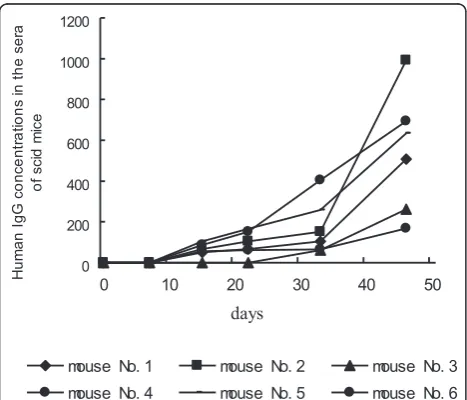
Results:21 out of 29 mice developed tumors in their body. Immunohistochemical staining showed that all induced tumors were LCA (leukocyte common antigen) positive, B-cell markers (CD20, CD79a) positive, and T-cell markers (both CD3 and CD45RO) negative. The tumors can be diagnosed as human B-cell lymphomas by these morphological and immunohistochemical features. In situ hybridization exhibited resultant tumor cells had EBV encoded small RNA-1 (EBER-1). Human-derived IgG could be found in the serum from SCID mice on the 15thday following hu-PBL transplantation, and IgG levels increased with the tumor development in 6 hu-PBL/SCID chimeras. Conclusions:Intraperitoneal transfer of hu-PBLs from EBV+ donors to SCID mice leads to high human IgG levels in mouse serum and B cell lymphomas. Our findings suggest that increasing levels of human-derived IgG in
peripheral blood from hu-PBL/SCID mice could be used to monitor EBV-related human B-cell lymphoma development in experimental animals.
Background
Epstein-Barr virus (EBV) is a ubiquitous human herpes virus that persists in most human bodies as a lifelong latent infection in host lymphocytes after a primary viral encounter, and it has been confirmed to be the etiologi-cal factor of infectious mononucleosis [1,2]. More important, EBV, which may be one of human tumor viruses [3], has a close association with human lym-phoma and nasopharyngeal carcinoma [4-6]. Although EBV can transform human lymphocytes and squamous epithelia in vitro, it is impossible to conduct controllable
investigation on human body. It is also a difficult pro-blem to induce neoplasm with EBV in animal body. Up to date, no study about infection and oncogenicity of EBV has been done with an ideal animal model.
Animal models of lymphoma are essential to elucidate the pathogenesis of human EBV-associated lymphomas. Severe combined immunodeficient (SCID) mouse (homozygous C.B.-17 scid/scid) expresses a truncated form of the catalytic subunit of the DNA-dependent protein kinase and is unable to properly rearrange the Ig and TCR genes. The ensuing severe combined immu-nodeficiency endows these mice with the capacity to accept xenografts. Because SCID mice lack functional T or B lymphocytes, they can be engrafted with function-ing human hematolymphoid cells to create human/SCID chimeras [7,8]. In immunosuppressed individuals, such
* Correspondence: [email protected]
†Contributed equally
1
Cancer Research Institute, University of South China, Hengyang City, Hunan 421001, P. R. China
Full list of author information is available at the end of the article
as post-transplant patients, the presence of EBV-infected B cells may lead to lymphoproliferative disease [9]. Injection of human peripheral blood lymphocytes (hu-PBLs) or hematopoietic stem cells from EBV-positive donors into SCID mice induces human lymphoprolifera-tive disease in the humanized SCID recipients [10,11]. This xenochimeric human-mouse model can be used to elucidate the mechanisms of EBV-specific lymphoma-genesis and to assess novel therapeutic approaches. The aim of the present study is to detect molecular biomar-kers of the EBV-induced lymphomas in hu-PBL/SCID mice and to measure serum IgG levels in hu-PBL/SCID chimeras.
Materials and methods
Construction of hu-PBL/SCID chimeras
SCID(C.B.-17scid/scid) mice were bought from Labora-tory Animal Center of Science Academy in China, 6 to 8 weeks old, 18 ± 2.43 g in weight, male or female. All mice were bred in micro-isolator cages in a specific pathogen-free (SPF) environment. Animal studies were approved by Institutional Animal Care and Use Com-mittee (IACUC) of Chinese Academy of Sciences.
Fresh peripheral venous blood was collected from 12 healthy adult donors by 300 ml per one, and PBLs were separated from heparinized peripheral blood by isopyc-nic centrifugation on Ficoll-Hypaque. The EBV immune status of donors was assessed by using a standard ELISA for the presence of a serum IgA anti-EBV-viral-capsid-antigen(IgA/VCA). Hu-PBLs from EBV-seroposi-tive donors were inoculated intraperitoneally into 29 SCID mice by 1 × 10⁸PBLs resuspended in 1 ml RPMI-1640 medium per mouse, such mice are hereafter referred to as hu/SCID chimeras.
Assay for human IgG of mouse serum
12 mice were bled from a tail vein on days 3, 7, 15, 22, 33, and 46 post hu-PBLs transplantation, 10-20μl blood for each mouse every time; serum samples were stored at -80°C until use. The concentrations of human IgG in mouse serums were assessed by unidirectional immuno-diffusion assay. Briefly, serum samples were diluted (1:5), and loaded 10μl/well on the mouse anti-human IgG immunodiffusion plate. The plate was incubated in a wet box at 37°C for 24 h. Then the plate was taken out to have the diameter of the precipitation loop measured. The values of IgG were calculated with the diameter-con-tent contrast table prepared by the manufacturer.
Animal observation, anatomical and histopathological examination
SCID mice were bred in cages separately, with the abnormities of weight, behavior, fur, abdomen and respiration monitored. If animals were sick, they would
be killed and exposed to excess-ethyl-ether, then autop-sied. In other SCID mice, follow-up was extended to 135 days. The position of tumor formation and thorax-celiac viscera were under particular observation.
Examining the thorax -celiac cavity, mediastinum and other main organs of mice, such as heart, lung, brain, liver, spleen, kidney, lymphnodes, and etc. Observing the size, shape, color, section and invasion of tumor with naked eye. Each tumor mass was divided into 2 samples: one was immediately frozen at -80°C for DNA analysis; the other part was fixed in 10% neutralized for-malin, embedded in paraffin and sectioned at 4μm for histopathology observation and immunohistochemical examination.
Immunohistochemical staining of the induced tumor Tumors were fixed in 10% neutral formalin, embedded in paraffin and cut into 4μm sections for further study. Immunohistochemical stains were performed to assess differentiated antigens of tumor cells, a panel of mono-clonal antibodies against lymphocytes (LCA, CD45), B cells (L26/CD20, CD79a) and T cells (CD45RO, CD3) (purchased from Maxin Co., San Francisco, LA) respec-tively according to the manufacturer’s protocol. Briefly, endogenous peroxidase was quenched with 0.3% hydro-gen peroxide. Before the application of the primary anti-body, nonspecific binding was blocked with normal non-immune serum, and tissue slides were incubated with each diluted antibody at 4°C overnight. Bound anti-body was detected with biotin-conjugated secondary antibody followed by streptavidin-peroxidase and diami-nobenzidine (DAB) color reagent. The slides were coun-ter-stained with hematoxylin. A case was regarded as positive if more than 5% of the malignant cells were stained with the antibody, although in practice most positive cases had 20% or more of their cells marked.
Human-specific Alu detection by PCR
DNA was extracted from tumor tissues as described in protocol. AluPCR was conducted under the following conditions: 95°C predenaturation for 5 min, and then 30 cycles of denaturation at 94°C for 1 min, annealing at 57°C for 1 min and extension at 72°C for 1 min. Primers
(sense: 5’-CAC CTG TAA TCC CAG CAG TTT-3’,
anti-sense: 5’-CGC GAT CTC GGC TCA CTG CA-3’) were used to amplify a 221 bp sequence for human-spe-cificAlu.
In situ hybridization of EBV infection
The synthetic oligonucleotide EBER1 probe (sequence:
5’-CTC CTC CCT AGC AAA ACC CTC AGG ACG
(Boehringer Mannheim Co., Ingelheim, Germany). In situ hybridization using EBER1 probe was carried out as follows. Briefly, the glass slides were pretreated with 2% APES. 4-μm tissue slices of the induced tumors were heated at 70°C for 1 h, and deparaffinaged in xylene, then digested with 0.5%μg/ml proteinase K at 37°C for 10 min, and washed in water. The labeled probes were diluted to a concentration of 100 ng/ml in hybridization medium [25% deionized formamide, 4 × SSC (sodium citrate, sodium chloride), 50 mmol/L NaH2PO4/
Na2HPO4, 1 mmol/L EDTA, 5 × Denhart’s, 1 mg/ml
ssDNA], and then spotted on to the tissue slices, which were covered with a coverslip. Both DNA probe and tar-get RNA in tissue slices were simultaneously denatured at 70°C for 8 min. Then the sections were hybridized at
37°C for 4 h or overnight. The non-specific or unbound probes were removed by two post-hybridization washes as follows: 2 × SSC, 0.1 × SSC, each for 10 min at room temperature. The slices were blocked with 2% normal goat serum at room temperature for 20 min, incubated with anti-Digoxigenin antibody at 37°C for 30 min, and then washed 3 times. NBT/NCIP was used as the chro-mogen. Counter-staining was done to enhance visualiza-tion with nuclear fast red.
Results
The EBV-related neoplasms in the SCID mice were solid masses. 21 out of 29 mice (72%) developed tumors in their body. By autopsy, some were round-shaped nodes (Figure 1A), with distinct boundary and no envelope;
A
B
D
C
F
E
A
B
D
C
F
E
others were irregular nodes, adherent to contiguous organs. The diameters of tumors were about 0.5-3.6 cm, and the cuts displayed pale and gray-red. Moreover, loci of necrosis could be observed in the center of larger tumors. Under microscope, tumor cells diffusely arranged with rare sparse interstitial fibers and tiny ves-sels. The tumors were dominated by large cleaved and non-cleaved cells (Figure 1B), with a few large and diverse immunoblasts and plasmacytoid lymphocytes and a few megalocytes as well. Karyokinesis could be easily observed and nucleoli were distinct in the tumor cells. The tumors in the abdominal cavity of mice often invaded into kidney, liver, pancreas, mesentery; and those in the midiastinum invaded into striated-muscles of posterior thoracic wall. All of the pathological charac-ters revealed that the induced-tumor was highly malig-nant non-Hodgkin’s lymphoma (NHL).
Immunohistochemical staining showed that all induced tumors were LCA (leukocyte common antigen) positive (Figure 1C), B-cell marker (CD20, CD79a) posi-tive (Figure 1D), and T-cell markers (both CD3 and CD45RO) negative (Figure 1E, F). By these morphologi-cal and immunohistochemimorphologi-cal features, those tumors can be diagnosed as human B-cell lymphomas. Further-more,Alu-PCR showed that all of tumor tissues con-tained 221 bp Alu sequence (Figure 2). It confirmed that the induced tumors in hu-PBL/SCID mice were derived from human, but not from mouse.
In biopsy tissue, localization of EBER transcripts byin
situhybridization remains the gold standard for identify-ing latent infection of EBV. The in situhybridization signal of EBER1 probe was very intense with a diffuse pattern of staining confined to the nucleus (sparing the nucleus) in all cases (Figure 3). Notably, almost all
morphologically malignant cells exhibited a positive sig-nal with the EBER1 probe, while the normal host tissue adjacent to tumor cells showed negative.
In the 12 mice whose IgG was examined, human serum IgG could be found in 6 SCID mice on day 15 after the engraftment of hu-PBLs and the IgG concen-trations increased with the prolongation of the experi-ment (Figure 4), and then visible tumors developed. Marked elevations of human serum IgG levels in hu-PBL/SCID mice are associated with EBV-related lym-phoma development. Human serum IgG levels from hu-PBL/SCID mice can be considered as a useful index of prediction for oncogenesis and tumor development. In contrast, IgG could not be detected both in the 3 mice with micro-lymphoproliferative lesions only and in the other 3 mice with no tumors during the experimental course. Additionally, our data showed human IgG con-centrations in the serum of each of hu-PBL/SCID chi-meras were also positively related to the serum IgG levels from different donors.
Discussion
With the development of human organ transplantation and the increase of AIDS cases in recent years, both lymphoproliferative disease (LPD) in the immunocom-promised patients and its relationship with EBV have become increasingly followed with interest [1]. Clini-cally, almost all post-transplantation lymphomas are associated with EBV infection [12,13]. Post-transplant lymphoprolifertive disorder (PT-LPD) is a syndrome of uncontrolled lymphoid growth in the immunosup-pressed transplant patient. In the patients with PT-LPD, the incidence varies from 0.5% after bone marrow trans-plantation to 12% after heart-lung transtrans-plantation. PT-LPD remains so far a complication with a high morbid-ity and mortalmorbid-ity. EBV is associated with posttransplant lymphoproliferative disease (PTLD), which is a leading cause of cancer death in recipients of transplants. On the other hand, investigations for AIDS-related lympho-mas show that about 50-80% of those tumors are con-cerned with EBV [14]. The vast majority of AIDS-NHL belongs to three kinds of high-grade B-cell lymphomas: Burkitt’s lymphoma, immunoblastic lymphoma, and large-cell lymphoma [15]. Although there are some dif-ferences between this immunodeficiency-associated lym-phoproliferative disorders, they share several common features: a tendency to present in extranodal sites, rapid clinical progression when untreated, diffuse large cell histology, B-cell origin and association with the EBV [16]. The occurrence of lymphoma needs the activation, proliferation and transform of B-cell, as well as the development of malignant phenotype. The present experiment showed that B-cell lymphoma in the hu-PBL/SCID chimeras was similar to EBV-related
221bp
221bp
neoplasms in the immunocompromised patients, so it could further indicate that immunodeficiency of animal or human body is an essential condition for the tumorigenesis.
EBV is a herpesvirus associated with approximately 1% of tumours worldwide. EBV is the epitome of B lympho-tropic viruses, but the spectrum of tumours associated with EBV extends to various types of human malignan-cies and carcinomas [1]. Ubiquitous EBV infection in humans implies that most individuals carry EBV-infected cells. Therefore, mere detection of the virus in individuals with a tumour is not sufficient for establish-ing a causal relationship between both events. Currently there is no in vivo model that can adequately recapitu-late EBV infection and its association with B-cell
lymphomas. In this experiment, we can observe the development of EBV-related lymphoma in the SCID mice engrafted with hu-PBLs from EBV-seropositive donors. 72% of mice (21/29) developed tumors in EBV-positive hu-PBL/SCID chimeras. The tumors possess solid, aggressive and fatal features, and belong to high malignant NHL in histopathology. Both Alu-gene detec-tion and immune marker examinadetec-tion showed that the induced-tumors were derived from human B-cell, and the tumor cells contained EBV-encoded small RNA (EBER). We have successfully induced human B-cell lymphomas in the body of hu-PBL/SCID chimeras. An in vivo model of human CD20+ B-lymphoma was estab-lished in SCID mice with huPBLs transplantation from EBV-seropositive donors.
Our present experiment showed that intraperitoneal transfer of hu-PBLs from EBV+ donors to SCID mice could generate human-derived B cell lymphomas. But it is necessary for us to monitor EBV-associated human B-cell lymphoma development in the body of SCID mice. IgG is an immunoglobulin secreted by plasmocyte when mature B cells are differentiated into plasmocytes by anti-gen stimulation. It is reported that human-derived IgG can be used to assess whether immune function of SCID mouse with hu-PBL engraftment is reconstructed [17,18] and that antigen stimulation promotes human secondary IgG responses in hu-PBL/SCID mouse [19,20]. Interest-ingly, a significantly positive relationship exists between the appearance of human IgG and tumorigenesis of B-cell lymphoma in the findings of our present study. Those SCID mice in which human serum IgG continu-ously increased would finally developed visible tumors in their bodies. In the mice without human serum IgG dur-ing all the experimental phases, no tumor or only lymphaproliferative lesions was identified with micro-scope. From our data, human serum IgG concentrations in hu-PBL/SCID chimeras were also related to the serum IgG levels from original donors. However, the IgG level
A
B
A
B
Figure 3Detection of EBER in the induced lymphoma of SCID mice. (A) Diffuse large cell lymphomas invaded into pancreatic tissue (arrow) of SCID mouse by microscopic observation (HE stain × 400). (B) Positive signals of EBER-1 were located in the nuclei of all tumor cells by in situ hybridization, whereas pancreatic epithelial cells (arrow) of SCID mouse were negative (×400).
from a donor was not related to the development of tumors. It meant that all B-lymphocytes that produce dif-ferent IgG levels from various donors had the same potential to develop lymphomas if activated by EBV. Moreover, it is of importance and practice for us to repli-cate the tumor model in the future. So we can predict the tumorigenesis by detecting human serum IgG levels from hu-PBL/SCID mice during the experimental phases. More importantly, it can give us a dependable serum marker if we want to test therapeutic intervention on the EBV-induced lymphomas.
Abbreviations
EBV: Epstein-Barr virus; hu-PBL: human peripheral blood lymphocyte; SCID: severe combined immunodeficiency;
Acknowledgements
This research was supported by the National Natural Science Foundation of China (grant 30801335, grant 81071620, grant 81072198), Hunan Provincial Foundation of China (grant 09C833), the Foundation of the Construct Program of the Key Discipline in Hunan Province (2006-180), and Scientific Research Initial Foundation of University of South China for Post-doctor (2007XQD25).
Author details
1Cancer Research Institute, University of South China, Hengyang City, Hunan
421001, P. R. China.2Department of Pathology, The First Affiliated Hospital, University of South China, Hengyang 421001, Hunan Province, China.
Authors’contributions
YT and RH carried out construction of hu-PBL/SCID chimeras, participated in the animal observation, anatomical and histopathological examination, drafted and revised the manuscript. YZ, FL and AC participated in the immunoassays and in situ hybridization. YW and RG participated in the design of the study and revised the manuscript. All authors read and approved the final manuscript.
Competing interests
The authors declare that they have no competing interests.
Received: 15 February 2011 Accepted: 9 May 2011 Published: 9 May 2011
References
1. Carbone A, Gloghini A, Dotti G:EBV-associated lymphoproliferative disorders: classification and treatment.Oncologist2008,13(5):577-85. 2. Odumade OA, Hogquist KA, Balfour HH Jr:Progress and problems in
understanding and managing primary Epstein-Barr virus infections.Clin Microbiol Rev2011,24(1):193-209.
3. Boccardo E, Villa LL:Viral origins of human cancer.Curr Med Chem2007,
14(24):2526-39.
4. Zhang Y, Peng J, Tang Y, He J, Peng J, Zhao Q, He R, Xie X, Peng X, Gan R:
The prevalence of Epstein-Barr virus infection in different types and sites of lymphomas.Jpn J Infect Dis2010,6(2):132-35.
5. Gao J, Luo X, Tang K, Li X, Li G:Epstein-Barr virus integrates frequently into chromosome 4q, 2q, 1q and 7q of Burkitt’s lymphoma cell line (Raji).J Virol Methods2006,136(1-2):193-9.
6. Cao SM, Simons MJ, Qian CN:The prevalence and prevention of nasopharyngeal carcinoma in China.Chin J Cancer2011,30(2):114-119. 7. Pearson T, Greiner DL, Shultz LD:Humanized SCID mouse models for
biomedical research.Curr Top Microbiol Immunol2008,324:25-51. 8. Strowig T, Chijioke O, Carrega P, Arrey F, Meixlsperger S, Rämer PC,
Ferlazzo G, Münz C:Human NK cells of mice with reconstituted human immune system components require preactivation to acquire functional competence.Blood2010,116(20):4158-67.
9. Frey NV, Tsai DE:The management of posttransplant lymphoproliferative disorder.Med Oncol2007,24(2):125-36.
10. Gan R, Yin Z, Liu T, Wang L, Tang Y, Song Y:Cyclosporine A effectively inhibits graft-versus-host disease during development of Epstein-Barr virus-infected human B cell lymphoma in SCID mouse.Cancer Sci2003,
94(9):796-801.
11. Shultz LD, Saito Y, Najima Y, Tanaka S, Ochi T, Tomizawa M, Doi T, Sone A, Suzuki N, Fujiwara H, Yasukawa M, Ishikawa F:Generation of functional human T-cell subsets with HLA-restricted immune responses in HLA class I expressing NOD/SCID/IL2r gamma(null) humanized mice.Proc Natl Acad Sci USA2010,107(29):13022-7.
12. Sebelin-Wulf K, Nguyen TD, Oertel S, Papp-Vary M, Trappe RU, Schulzki A, Pezzutto A, Riess H, Subklewe M:Quantitative analysis of EBV-specific CD4/CD8 T cell numbers, absolute CD4/CD8 T cell numbers and EBV load in solid organ transplant recipients with PLTD.Transpl Immunol
2007,17(3):203-10.
13. Khedmat H, Alavian S, Taheri S:Significance of Epstein-Barr virus infection in the outcome of renal transplant patients with lymphoproliferative disorders.Ann Transplant2010,15(2):40-4.
14. Carbone A, Gloghini A:AIDS-related lymphomas: from pathogenesis to pathology.Br J Haematol2005,130(5):662-70.
15. Capello D, Martini M, Gloghini A, Cerri M, Rasi S, Deambrogi C, Spina M, Tirelli U, Larocca LM, Carbone A, Gaidano G:Molecular analysis of immunoglobulin variable genes in human immunodeficiency virus-related non-Hodgkin’s lymphoma reveals implications for disease pathogenesis and histogenesis.Haematologica2008,93(8):1178-85. 16. Oertel SH, Riess H:Immunosurveillance, immunodeficiency and
lymphoproliferations.Recent Results Cancer Res2002,159:1-8.
17. Ye F, Chen H, Liang Z, Lu W, Cheng Q, Xie X:Establishment of a cervical cancer model via inoculating SiHa Cells into humanized severe combined immunodeficient mice.Eur J Gynaecol Oncol2006,27(6):566-72. 18. Ito R, Shiina M, Saito Y, Tokuda Y, Kametani Y, Habu S:Antigen-specific
antibody production of human B cells in NOG mice reconstituted with the human immune system.Curr Top Microbiol Immunol2008,324:95-107. 19. Salam MA, Nakao R, Yonezawa H, Watanabe H, Senpuku H:Human T-cell
responses to oral streptococci in human PBMC-NOD/SCID mice.Oral Microbiol Immunol2006,21(3):169-76.
20. Zhang J, Sun R, Tian Z:Human prolactin promotes human secondary immunoglobulin response in human/SCID mouse chimeras.Clin Vaccine Immunol2007,14(1):60-4.
doi:10.1186/1743-422X-8-213
Cite this article as:Tanget al.:Human-derived IgG level as an indicator
for EBV-associated lymphoma model in Hu-PBL/SCID chimeras.Virology Journal20118:213.
Submit your next manuscript to BioMed Central and take full advantage of:
• Convenient online submission
• Thorough peer review
• No space constraints or color figure charges
• Immediate publication on acceptance
• Inclusion in PubMed, CAS, Scopus and Google Scholar
• Research which is freely available for redistribution