R E S E A R C H
Open Access
Efficient adaptive framework for
securing the Internet of Things devices
Umer Farooq
*, Najam Ul Hasan, Imran Baig and Naeem Shehzad
Abstract
The research on the Internet of Things (IoT) has made huge strides forward in the past couple of years. IoT has its applications in almost every walk of life, and it is being regarded as the next big thing that can change the way humans perceive about their daily life. Smart IoT devices of heterogeneous nature make an essential part of modern day IoT-based systems. The security of these devices is of paramount importance as they handle an enormous amount of critical data and its breach can lead to potentially life-threatening situations. To secure the IoT devices of heterogeneous nature, we formulated a weighted optimization problem in this work. The objective function of this problem is to secure the IoT devices while finding the best trade-off between their resource usage and throughput. To achieve the objective, we consider a pool of five different implementations of Advanced Encryption Standard (AES) cryptographic schemes that offer varied resources and throughput numbers. These implementation schemes are mapped to IoT devices of heterogeneous nature. The mapping is performed through a novel adaptive framework that can consider different weights for resources and throughput to eventually find the best trade-off between the resources and throughput of an IoT-based system. This framework considers the resource and throughput requirements of different IoT devices and uses the Hungarian algorithm to adaptively map different AES
implementations on them. Extensive experimentation is performed where the best trade-off is found through varying resource and throughput weight combinations. The comparison of the proposed framework with random and greedy approaches is also performed. Comparison results show that the proposed framework adaptively secures the IoT-based system while providing better resource usage and throughput results. The proposed framework provides, on average, 11% and 17% better throughput and 3% and 13% better resource usage results as compared to random and greedy approach, respectively.
Keywords: IoT, Security, Adaptive Framework, AES algorithm, Cryptography
1 Introduction
The Internet of Things (IoT) is a paradigm that has seen enormous popularity in last few years. A formal definition of IoT does not exist yet. However, a loose interpretation of IoT is that it provides internet-based services that involve human-to-thing, thing-to-thing, and thing-to-things communications [1]. Entities of varied nature can interact with each other through IoT. These entities include humans, sensors, computing devices, or potentially anything that can give/receive services [2]. The striking emergence of IoT is a result of the rapid advancement in various communication protocols which
*Correspondence:[email protected]
Department of Electrical and Computer Engineering, Dhofar University, Salalah, Oman
is further aided by ever improving design process and miniaturizing processing technologies [3]. The improved communication protocols and better design process have resulted in devices with increased computing capabilities, higher data rate, and more energy storage capacities. At the same time, the IoT devices are becoming smaller in size and more efficient in terms of performance. The tech-nological advances in software as well as hardware have tremendously increased the number of smart devices con-nected to the internet, and this number is expected to grow exponentially in future with the advent of new com-munication technologies. The importance of these devices and the level of services that could be provided by them in the future is limited by human imagination only. Some of the possible applications of IoT are smart vehicles,
smart buildings, health monitoring systems, environmen-tal monitoring, and food supply chain [3].
The aforementioned applications of IoTs indicate that IoT-based systems have to handle an enormous amount of data which includes information about smart cars, industrial plants, health monitoring systems, and smart buildings [4]. The amount and type of data handled by IoTs require efficient algorithms for data processing and analysis [5, 6]. Authors in [7] have proposed smart solu-tions for big data collection, processing, and analysis of IoT-based systems. Moreover, the simple data collection and analysis for IoT-based systems is not enough. This is because of the fact that the type of data usually han-dled by IoTs is of very critical nature and this makes IoT-based systems an interesting target for different kinds of adversaries. For example, potential attackers might be interested in stealing location information, financial infor-mation, or health-related records from IoT-based systems. Furthermore, they can compromise the IoT components to subsequently launch security attacks against third-party entities. The theft/compromise of any information may result in poor confidentiality, lower integrity, and smaller availability of IoT devices. This could eventually lead to even life-threatening situations [8–11]. There-fore, for safe and reliable operation of IoT-based systems, security becomes the fundamental enabler where the con-fidentiality, authenticity, and integrity of the IoT data is ensured [12].
There is no doubt that the security is of paramount importance in the IoT devices. However, the way to best implement the security in IoT-based systems is debatable [13]. IoT-based systems have normally multiple layers. The number of layers may vary depending upon the refer-ence model under consideration. But, all of them usually have at least three common layers called the application layer, the network layer, and the edge side layer [14]. The application and network layers can be protected through firewalls and other well-established security protocols. But, the security of the deeply embedded edge side nodes is a challenging task. This situation is further aggravated because of the heterogeneous nature, varied resources, and different performance requirements of these nodes [15]. Edge side nodes are normally susceptible to differ-ent kinds of security attacks. Some examples of these attacks are hardware trojans [16], side-channel attacks [17], denial-of-service (DoS) attacks [18], and node repli-cation attacks [19]. There are several countermeasures like side-channel analysis, isolation, blocking, and implemen-tation of cryptographic schemes [14,20,21]. To secure the edge nodes, these countermeasures can be used against the security attacks. Among these countermeasures, tographic schemes are particularly popular. The cryp-tographic schemes are generic, hardware independent, and offer high-level robustness to the IoT-based systems.
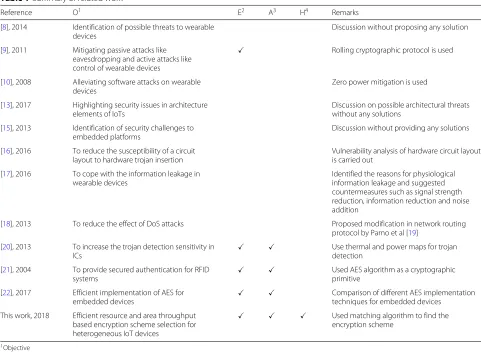
Table 1Summary of related work
Reference O1 E2 A3 H4 Remarks
[8], 2014 Identification of possible threats to wearable devices
Discussion without proposing any solution
[9], 2011 Mitigating passive attacks like eavesdropping and active attacks like control of wearable devices
Rolling cryptographic protocol is used
[10], 2008 Alleviating software attacks on wearable devices
Zero power mitigation is used
[13], 2017 Highlighting security issues in architecture elements of IoTs
Discussion on possible architectural threats without any solutions
[15], 2013 Identification of security challenges to embedded platforms
Discussion without providing any solutions
[16], 2016 To reduce the susceptibility of a circuit layout to hardware trojan insertion
Vulnerability analysis of hardware circuit layout is carried out
[17], 2016 To cope with the information leakage in wearable devices
Identified the reasons for physiological information leakage and suggested countermeasures such as signal strength reduction, information reduction and noise addition
[18], 2013 To reduce the effect of DoS attacks Proposed modification in network routing protocol by Parno et al [19]
[20], 2013 To increase the trojan detection sensitivity in
ICs
Use thermal and power maps for trojan detection
[21], 2004 To provide secured authentication for RFID systems
Used AES algorithm as a cryptographic
primitive
[22], 2017 Efficient implementation of AES for
embedded devices
Comparison of different AES implementation techniques for embedded devices
This work, 2018 Efficient resource and area throughput based encryption scheme selection for heterogeneous IoT devices
Used matching algorithm to find the
encryption scheme
1Objective 2Encryption 3AES 4Hybrid
adaptively uses the AES cryptographic encryption scheme for the security of IoT devices of heterogeneous nature. The main contributions of this work are also summarized as follows:
• An adaptive framework is proposed that considers different AES implementation schemes for the security of heterogeneous IoT devices.
• The proposed framework finds the best trade-off between the resources and throughput of an IoT-based system through a mathematical optimization model and a modified bipartite matching algorithm.
• Extensive experimentation is done and comparison is performed with random and greedy approaches.
The rest of the paper is organized as follows. Section2
details the different reference models in the state-of-the-art. This section also discusses the reference system model that we consider in this work. Section 3 discusses the mathematical equations that consider the weighted values
of resource and throughput constraints of IoT devices in an IoT-based system. Section 4 discusses the proposed adaptive framework that uses the weighted equations and maps their values to a modified bipartite graph. In this section, details about the optimization equation, weighted distribution, and optimization algorithm are given. Section 5 presents the experimental setup and gives details about the five AES schemes that we consider for experimentation. This section also presents the com-parison of proposed approach with random and greedy approaches. The paper is finally concluded in Section6
with some discussion on the future work.
2 Reference IoT model
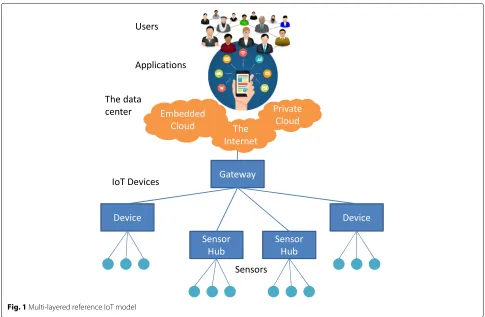
model was presented in [2] which was comprehensively extended by CISCO in 2014 [27] and has the potential to be standardized for IoT-based systems. A three-layered fog-based detection system was presented by [28] that used a trust evaluation mechanism to detect internal attacks at data level. In this work, however, we consider a reference model similar to CISCO reference model and its pictorial presentation is given in Fig.1. It can be seen from this figure that it is a multi-layered model. In this model, at the bottom level, we have sensors that are attached to different IoT devices. These devices are assumed to be heterogeneous in nature with different resource and performance requirements. In a secure IoT-based system, these devices are of critical importance as the integrity and authenticity of data starts from this level upwards. It can be seen from the figure that next we have a gateway that sends/receives data from a public or private cloud. At the gateway level, essential processing/computation of data is also performed so that load on the lower level is reduced and a high response rate is ensured. Next in the level, we have data accumulation and data abstraction points. At this level, data is stored and analyzed for upper level com-puting servers. At this level, the data is stored, analyzed, and formatted in such a way that the additional process-ing on the data becomes easier; hence, eventually makprocess-ing it more meaningful for the higher level applications and
end users. Finally, we have applications that collect the analyzed data from a data center and provide the inter-pretation of that data which is then used by end users for specific purposes.
To have a secure IoT-based system, considering a ref-erence IoT model is of pivotal importance. Without a reference IoT model it becomes quite difficult to have a global picture of an IoT-based system. Moreover, it becomes even more challenging to identify the levels where cryptographic schemes are required to be imple-mented. In the reference model of Fig.1, security at the higher levels can be ensured through network firewalls and well-developed protocols. Moreover, the devices at higher levels normally operate in protected environments and they are well beyond the reach of malicious attack-ers. However, as we move towards the lower levels, the issue of security exacerbates and it becomes more chal-lenging to secure IoT devices. Specially from the gateway level onwards, we have to take into account the heteroge-neous nature of IoT devices which usually have different resource capacities and diverse throughput constraints. Furthermore, the lower level devices are usually in direct access of attackers which makes them an attractive target for all kinds of security attacks [16–19]. A few crypto-graphic countermeasures against these attacks have been proposed by [14, 24]. But these propositions are static
in nature as they do not adapt as per the target IoT device requirements. Furthermore, they do not consider any IoT reference model. The static nature of these propo-sitions can not justify different resource and throughput requirements of various IoT nodes. In this work, we con-sider the reference model shown in Fig.1and propose to use five different implementations [22] of AES algorithm. These techniques use different hardware implementation optimizations. For example, we use optimizations like pipe-lining, loop unrolling, and serial implementation in different implementations. These techniques are applied from gateway level downwards. As a results of the imple-mentation mechanism, these techniques give a variety of area and throughput results. We use a pool of five techniques as it gives us the choice to best satisfy the different resource and performance constraints of target IoT device. Because, a single technique would have either resulted in compromise of logical resources or throughput or even both.
In order to best utilize these techniques for refer-ence IoT-based system, in this work, we first present a mathematical system model. Next, we propose an adap-tive selection mechanism. This selection mechanism uses optimization equations of mathematical system model that consider weighted values of resource and through-put constraints of target IoT devices. Based on those constraints and available values of different AES imple-mentation techniques, a selection of the technique for a particular device/gateway is made through the Hungar-ian algorithm. This process is applied on hundreds of IoT devices to improve the overall throughput of the IoT-based system while adaptively minimizing the resource usage of IoT devices. Further details about the mathe-matical system model, adaptive selection mechanism, and matching algorithm are given in the succeeding sections of the paper.
3 Mathematical system model
As stated in Section 1, the objective of this work is to adaptively secure an IoT-based system while finding the best trade-off between the resource and throughput con-straints. For this purpose, it is important to first model the system mathematically and later do the optimization using matching algorithm. To mathematically model an IoT-based system, in this paper, we considered an IoT net-work with three main entities namely sensors, IoT devices, and IoT servers (i.e. gateway). Sensors interact with the physical environment and collect the environmental infor-mation. IoT devices acquire the data from these sensors and make it available to different applications via IoT servers. The IoT network is usually characterized as a dense network with a large number of IoT devices. These devices are generating massive amounts of data. To han-dle such a big amount of data, a significantly large number
of IoT servers are needed to be deployed. Therefore, it can be assumed that each IoT device is associated with one of these servers. The communication between the IoT devices and servers takes place over the wireless link. To ensure a secure channel between the IoT device and the IoT server, the data must be encrypted. But the heteroge-neous nature of IoT devices renders a uniform encryption for all these devices infeasible. Therefore, IoT servers are assigned with an additional task of selecting the appropri-ate encryption scheme. This selection is based on mini-mizing the resource and maximini-mizing the throughput for an IoT-based system. There are a large number of IoT servers, and a large number of IoT devices are associated with each of them. However, for the sake of simplicity, we considered the case of just one IoT server without the loss of generality.
For mathematical model, let there be N IoT devices that are associated with an IoT server. After associating with an IoT server, eachithIoT device sends its relevant information including its available resourcesRi and the required demand in terms of its throughputTibased on the running application. With the given information about available resources and required throughput for each IoT device associated with it, an IoT server assigns an encryp-tion scheme to each IoT device. There are totalMnumber of different encryption schemes. Each encryption scheme is also attributed with two parameters: first is the number of resources required to implement this scheme, and sec-ond is the maximum throughput it can provide to the IoT devices. From a pool ofMdifferent encryption schemes, the IoT server has to assign a certain scheme to each device that is associated with it. The assignment should be such that the overall throughput of the network is maxi-mized and the resources being used are minimaxi-mized while respecting the constraint of each individual IoT device. Since there are two objective functions of this problem, we designed a weighted multi-objective optimization prob-lem, which can be mathematically written as follows:
maxNi=1Mk=1 (w1f1+(1−w1)f2)xik
The sum of the weights assigned to bothf1andf2is equal to 1, wherew1 is the weight assigned to f1 and 1− w1 (also termed as w2 in Section5) is the weight assigned to f2andxik is the binary variable. The value ofxik is 1 if thekthscheme is assigned to theith IoT device and 0 otherwise. It can be seen from Eq. 1 that the optimiza-tion problem has also three constraints. The explanaoptimiza-tion of these constraints is as follows:
• Constraint 1 (C1). Constraint 1 states that each IoT device must be assigned only one encryption scheme.
• Constraint 2 (C2). This constraint states that the resource required for the selected scheme should be less than the resources available at the IoT device.
• Constraint 3 (C3). Constraint 3 states that the throughput for the selected scheme should be greater than the required throughput of the IoT device.
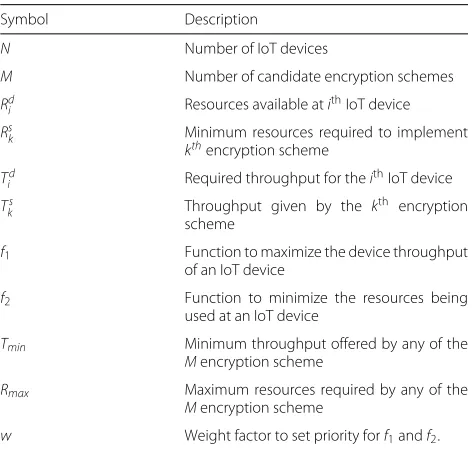
A description of symbols used in Eqs.1,2, and3 is also given in Table2.
4 Proposed adaptive framework
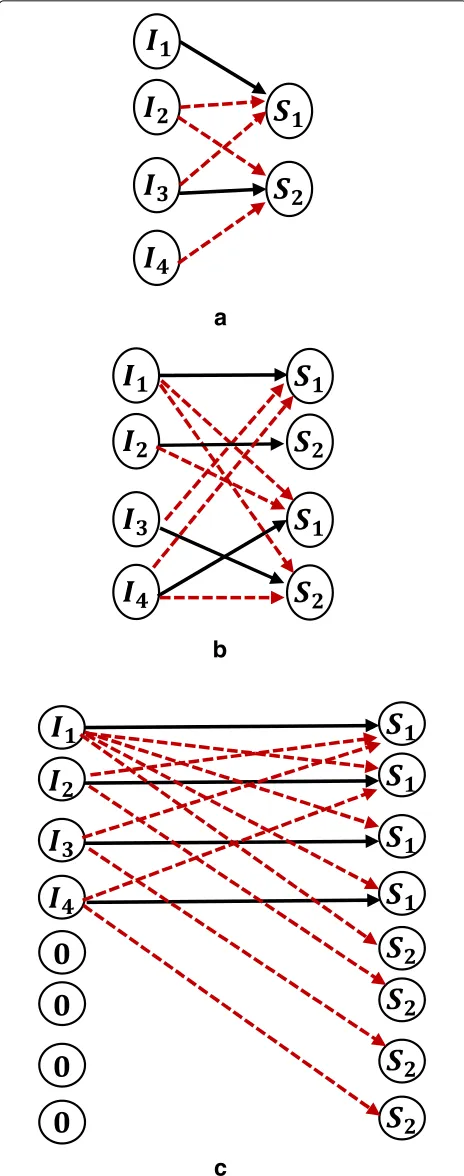
To solve the problem described in previous section, we opted a graph theory approach. We mapped this problem into a matching problem in the form of a weighted bipar-tite graph. A biparbipar-tite graph is a graph of two disjoint sets, i.e.,XandY such thatX∩Y = ∞. The bipartite graph is unidirectional graph, in which the edges always point in one direction that isX →Y. Moreover, in a weighted bipartite graph, each edge is also assigned a weight based on a specific criteria. Usually in such a kind of problem where a weighted bipartite graph is involved, once a graph is formed, a matching algorithm is employed to find the
Table 2Symbol Description
Symbol Description
N Number of IoT devices
M Number of candidate encryption schemes
Rd
i Resources available atithIoT device Rs
k Minimum resources required to implement
kthencryption scheme
Tid Required throughput for theithIoT device
Tks Throughput given by the kth encryption scheme
f1 Function to maximize the device throughput of an IoT device
f2 Function to minimize the resources being
used at an IoT device
Tmin Minimum throughput offered by any of the Mencryption scheme
Rmax Maximum resources required by any of the Mencryption scheme
w Weight factor to set priority forf1andf2.
matching solution consisting of edges in order to optimize certain objective function.
a
b
c
Fig. 2Graphical representation of mapping between IoT devices and cryptographic schemes.aInitial bipartite graph,bModified bipartite graphG, andcFinal bipartite graphGto solve the assignment problem
known one to one matching algorithm named Hungarian is employed to solve the graphG. The steps involved in the Hungarian algorithm are as follows:
1. Generate a square martrixZ of orderK×Kwhere K=N×M. Each entry of Z is computed using Zij=Ni=1
M
k=1(w1f1+(1−w1)f2).
2. The minimum value of each row ofZ is subtracted from that row which results in another matrixZ. 3. The minimum value of each column ofZis
subtracted from each entry in that column. This results in a new matrixZ.
4. Cross out the rows and columnsZwith all zeros entries. Terminate, if the number of crossed out rows and columns are equal to the number of sensors used in Step 2 and exit.
5. Find the minimal uncrossed entry of matrixZand add to all the elements that crossed out both horizontally and vertically and subtract it from all uncrossed entries inZand return to step 3 with this new updated coefficient matrix.
It is clear from the discussion presented in this section that an IoT-based system is first mathematically modeled. Next, the model is mapped to a modified bipartite graph. Finally, the objective function of the model is adaptively optimized using the Hungarian algorithm.
5 Experimentation and analysis
In this section, we present the experimental results that we have obtained through our proposed adaptive frame-work. For experimentation, we have considered the sys-tem model discussed in Section3. For this model, we con-sider five different AES implementation schemes. These implementation schemes are considered for a number of IoT devices that are heterogeneous in nature and they have varying resource and throughput requirements. We use the adaptive framework discussed in Section 4 to optimize the overall resource and throughput of an IoT-based system. The current section is mainly divided into two parts. In the first part, a comprehensive overview of the five implementation schemes is given. In the second part, the results obtained through experimentation are presented and discussed.
5.1 Different AES schemes
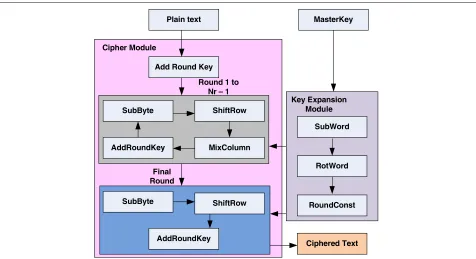
Fig. 3An overview of standard AES implementation with different modules and sub-modules
using techniques like loop unrolling and pipe-lining. An unrolled cipher module can be coupled with a smaller key expansion module to increase the overall through-put of AES implementation. Similarly, the implementation of AES can also be improved by efficiently exploiting the resources of target architecture. By combining the aforementioned optimization techniques and hardware resource exploitation, we explore five different AES imple-mentation schemes in this work. These schemes are used by the adaptive framework discussed in Section4to find the best trade-off between resource and throughput of a reference IoT system model. Further details on the five schemes are given next.
As discussed before, in this work, we use five differ-ent AES implemdiffer-entation techniques, and a summary of the resource and throughput metrics of the techniques under consideration is given in Table3. These metrics are obtained through the implementation of these schemes on a Stratix V FPGA. The variation in the throughput and resource requirement of these techniques is because of
Table 3AES Schemes Overview
Name Logic Resources Throughput (Gbps)
Technique 1 3571 17.5
Technique 2 4789 28.5
Technique 3 4563 26.6
Technique 4 6066 27.5
Technique 5 9631 113.4
different hardware implementations. A brief discussion on the optimizations applied on each technique is as follows:
• Technique 1. It can be seen from Fig.3that both cipher module and key expansion module of the AES implementation have several sub-modules. In this technique, the sub-modules of cipher and key expansion module are implemented in the hardware in a serialized way. In serialized implementation, first, the key expansion module is implemented, and next, the cipher module is executed. The serialized implementation of this technique requires minimal logic resources while also giving the lowest throughput among the five techniques under consideration.
• Technique 2. In this technique loop unrolling is performed for the cipher module and key expansion is performed online. Online key expansion improves the execution speed. Because of the parallel
implementation, this technique gives better throughput results as compared to technique 1. But at the same time, it requires more resources as well.
• Technique 3. In this technique, pipe-lining is introduced for the key expansion and cipher module is executed in a serialized manner. This results in comparatively less resources and smaller throughput as compared to technique 2.
is executed in a pipe-lined manner. This results in a significant increase in terms of resource requirement. But, the throughput gain is not that much significant.
• Technique 5. Finally in technique 5, all the implementation of the AES is performed in such a way that the execution is totally parallel which eventually results in the highest logic resource requirement while giving the best throughput among the five implementation techniques under
consideration.
5.2 Results and analysis
In this work, we consider a system model where our objective is to map the AES cryptographic scheme to heterogeneous IoT devices in such a way that the aver-age throughput of the system is maximized while mini-mizing the number of resources used. For this purpose, we use a weighted function described in Eq. 1. In this equation, combinations of different weights are assigned to the throughput and resource metrics in order to deter-mine the techniques that give the best results through our proposed adaptive framework described in Section4.
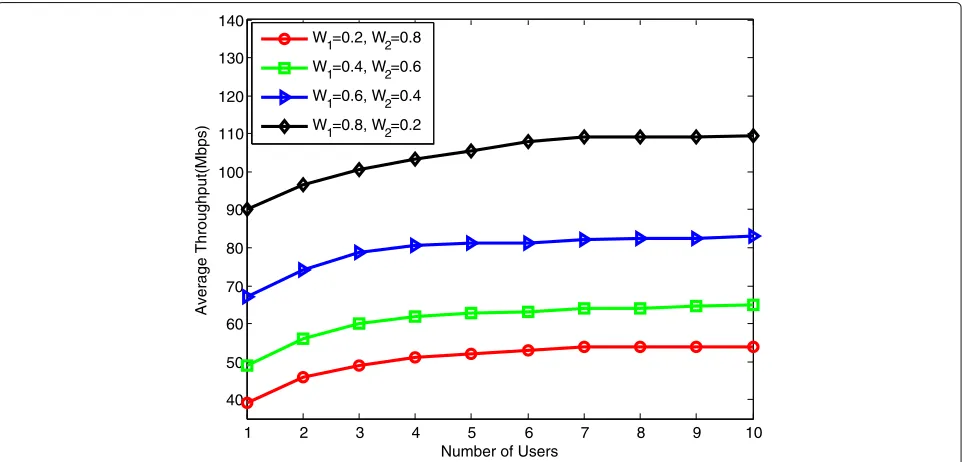
A number of experiments are performed where the number of end users (i.e., IoT devices) are varied and along with that the weights of the throughput and resources of the devices are also varied. The main objective of this variation is to find the trade-off between throughput and resources that gives the best overall results. In this regard, the average throughput results with different weight com-binations and varying number of users are shown in Fig.4. In this figure the value ofw1corresponds to the weight
assigned to throughput parameter whereas the value ofw2 corresponds to the weight for resources. The value ofw2 is equal to 1−w1. The values ofw1andw2are varied from 0.2 to 0.8. As discussed in Section3, the sum ofw1and w2should always be equal to 1. It can be seen from Fig.4 that when the value ofw1is 0.2 and the value ofw2is 0.8 then the average throughput is at the lowest point. It can also be seen from this figure that the average throughput increases as the number of users (i.e., IoT devices) increase and it stabilizes after the number of devices surpass a cer-tain number. Furthermore, Fig.4shows that the average throughput of the system steadily increases as the value of w1is increased from 0.2 to 0.8. This is because of the fact that an increase inw1weight causes a decrease inw2value which eventually gives higher preference to throughput increase rather than resource curb.
As mentioned earlier, the objective of the proposed framework is to maximize the throughput while minimiz-ing the resource usage of the system under consideration. In this regard, the average resource requirement results with different weight combinations and a varying number of users are shown in Fig.5. It can be seen from Fig.5
that when values of w1 andw2 are 0.2 and 0.8, respec-tively, then the average resources is at the lowest point and it steadily increases with the increase in the value of w1. This is because of the fact that a bigger value of w2 means more focus on resource optimization; hence, smaller resource requirement and vice versa. The results in Figs.4and5demonstrate that with the maximum value of eitherw1orw2, we can achieve either best throughput or minimum resource usage. It is clear from these figures
Fig. 5Average resource requirement results with different weight combinations and number of devices
that both constraints cannot be satisfied simultaneously, and we have to find a trade-off between them. For this purpose, the average throughput and resource results for a fixed number of users are plotted in Fig.6. In this figure, horizontal axis shows the values ofw1andw2, while pri-mary and secondaryY-axis give the average throughput and resource results for varying values ofw1andw2. As stated earlier, the sum of values of w1 andw2 is always equal to 1. It can be seen from Fig.6that when the value
of w1 is 0.1 and the value ofw2is 0.9 then the average throughput is at the lowest point and the average num-ber of resources is also the smallest. This is because of the fact that when the value ofw1is 0.1 and the value ofw2 is 0.9, the lowest priority is given to throughput and the highest priority is given to resource saving. On the other hand, when the value ofw1is 0.9 and the value ofw2is 0.1, then both the average throughput and average num-ber of resources used by the system are at their peak. The
aforementioned two cases are the extreme cases where in the first case the resources are given the highest pri-ority while in the second case the average throughput is given the top priority. As stated earlier, the objective of the proposed framework is to find the best trade-off between average throughput and resource values. To achieve this objective when the value of w1 is increased and value of w2 is decreased, both average throughput and aver-age resources start increasing and eventually the values of w1 andw2 between 0.5 and 0.6 give the best overall throughput and resource values for the reference system model under consideration. It is important to note that the results in this figure are generic in nature and they hold for any number of users/IoT devices.
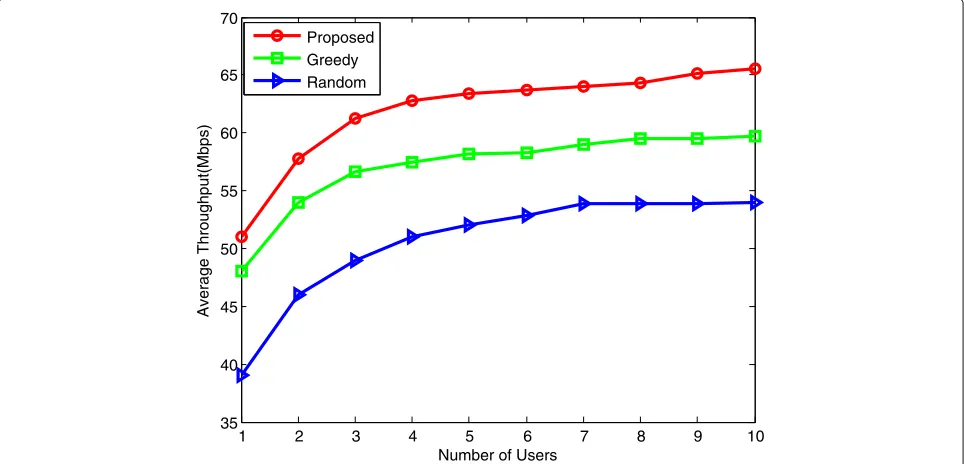
In this work, we also perform average throughput and resource comparison between the proposed framework and random, greedy approaches. For this purpose, we fix the weights of throughput and resources at 0.5 each as this weight combination gives the best average throughput and resource results (see Fig.6). Next, we vary the number of users (i.e., IoT devices) and observe the impact on overall throughput and resource of the system. We perform the experimentation for the proposed framework and com-pare the results against random and greedy approaches as well. The throughput and resource results are shown in Figs.7and8, respectively.
The average throughput results in Fig. 7 show that initially the average throughput of the system under con-sideration increases with an increase in number of users. However, it stabilizes when the number of users are more than five. Furthermore, it can also be observed
from this figure that the proposed framework gives bet-ter throughput results as compared to random and greedy approaches. This is because of the fact that the pro-posed framework considers all the possible combinations of schemes and devices and then selects the best pos-sible combination using the Hungarian algorithm. On the other hand, the greedy approach either goes for the best throughput or resource value and does not look for the best trade-off. As a result the proposed frame-work gives, on average, 11% and 17% better throughput results as compared to the greedy and random approach respectively.
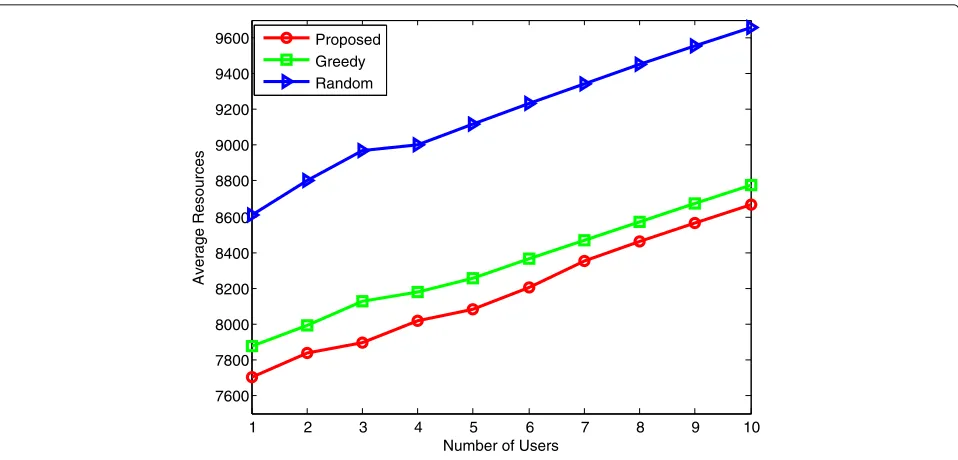
Average resource usage results for proposed framework versus random and greedy approach are shown in Fig.8. It can be seen from this figure that the average number of resources increase with increase in number of users. Moreover, it can also be observed from this figure that the random approach requires, on average, the largest resources while the proposed framework requires the least number of resources while giving the overall throughput results. Results in Fig.8 show that the proposed frame-work, on average, requires 3% and 13% fewer resources as compared to the greedy and random approach, respec-tively.
6 Conclusion
IoT is the next big thing in the domain of science and technology. Its role is increasing exponentially in human lives with each passing year, and this trend is not going to slow down any time soon. Because of the critical nature of the data handled by IoTs, an IoT-based system is an
Fig. 8Average resource results for proposed framework versus greedy and random approach
attractive target for malicious attackers. However, because of the limited resources of IoT devices, researchers face a difficult task of making an IoT-based system secure. In this work, we formulated a weighted optimization func-tion to secure the IoT devices. Among a pool of available cryptographic implementation schemes of AES, this opti-mization function assigns values to them based on their weights. We next propose an adaptive framework that considers the heterogeneous nature of IoT devices and metrics of different implementation schemes. The adap-tive function maps the AES implementation schemes to the IoT devices using a modified bipartite matching graph. During mapping, the core objective is to optimize the throughput of the IoT-based system while using the mini-mum resources. This mapping process is optimized using Hungarian algorithm. We perform extensive experimen-tation using the proposed framework. Comparison is also performed between the results of the proposed frame-work and those of the random and greedy approach. Analysis of the results shows that the proposed frame-work provides, on average, 11% and 17% better aver-age throughput and 3% and 13% better resource usaver-age results as compared to the random and greedy approach, respectively.
In this work, we consider two optimization parameters only. In the future, we would like to extend this work to multiple objectives like fairness and energy and power consumption parameters. Moreover, we would extend the current work from single network scenario to multi-network scenario as well.
Abbreviations
AES: Advanced Encryption Standard; DoS: Denial of service; IoT: Internet of Things; WSN: Wireless sensor networks
Acknowledgements
Not applicable.
Authors’ contributions
UF worked on the overall writing of the paper. He also worked on the design and simulation part. NUH worked on the manuscript review, data gathering, and simulation analysis of the results. IB worked on the design part of the problem, the optimization of the techniques, and manuscript writing of the paper. NS worked on the analysis of the results, design and optimization of the problem, and overall manuscript improvement of the work. All authors read and approved the final manuscript.
Funding
No funding was received for this research work.
Availability of data and materials
It is not applicable to this article as it mandatory for biology and medical journals only.
Competing interests
The authors declare that they have no competing interests.
Received: 18 January 2019 Accepted: 7 August 2019
References
1. D. Singh, G. Tripathi, A. J. Jara, in2014 IEEE World Forum on Internet of Things (WF-IoT). A survey of internet-of-things: Future vision, architecture, challenges and services, (2014), pp. 287–292
2. L. Atzori, A. Iera, G. Morabito, The internet of things: A survey. Comput. Netw.15, 2787–2805 (2010).http://doi.org/10.1016/j.comnet.2010.05.010
3. A. Mosenia, N. K. Jha, A comprehensive study of security of
internet-of-things. IEEE Trans. Emerg. Top. Comput.5(4), 586–602 (2017) 4. A. P. Plageras, K. E. Psannis, C. Stergiou, H. Wang, B. B. Gupta, Efficient
iot-based sensor big data collection–processing and analysis in smart buildings. Futur. Gener. Comput. Syst.82, 349–357 (2018)
5. C. Stergiou, K. E. Psannis, A. P. Plageras, Y. Ishibashi, B.-G. Kim, et al., Algorithms for efficient digital media transmission over iot and cloud networking. J. Multimed. Inf. Syst.5(1), 27–34 (2018)
7. K. E. Psannis, C. Stergiou, B. B. Gupta, Advanced media-based smart big data on intelligent cloud systems. IEEE Trans. Sustain. Comput.4(1), 77–87 (2018)
8. M. Zhang, A. Raghunathan, N. K. Jha, Trustworthiness of medical devices and body area networks. Proc. IEEE.102(8), 1174–1188 (2014) 9. C. Li, A. Raghunathan, N. K. Jha, in2011 IEEE 13th International Conference
on e-Health Networking, Applications and Services. Hijacking an insulin pump: Security attacks and defenses for a diabetes therapy system, (2011), pp. 150–156
10. D. Halperin, T. S. Heydt-Benjamin, B. Ransford, S. S. Clark, B. Defend, W. Morgan, K. Fu, T. Kohno, W. H. Maisel, in2008 IEEE Symposium on Security and Privacy (sp 2008). Pacemakers and implantable cardiac defibrillators: Software radio attacks and zero-power defenses, (2008), pp. 129–142 11. C. Stergiou, K. E. Psannis, B. B. Gupta, Y. Ishibashi, Security, privacy &
efficiency of sustainable cloud computing for big data & iot. Sustain. Comput. Inform. Syst.19, 174–184 (2018)
12. Y. Cherdantseva, J. Hilton, in2013 International Conference on Availability, Reliability and Security. A reference model of information assurance & security, (2013), pp. 546–555
13. S. Vashi, J. Ram, J. Modi, S. Verma, C. Prakash, in2017 International Conference on I-SMAC (IoT in Social, Mobile, Analytics and Cloud) (I-SMAC). Internet of Things (iot): A vision, architectural elements, and security issues, (2017), pp. 492–496
14. H. Suo, J. Wan, C. Zou, J. Liu, in2012 International Conference on Computer Science and Electronics Engineering, vol. 3. Security in the internet of things: A review, (2012), pp. 648–651
15. M. M. Kermani, M. Zhang, A. Raghunathan, N. K. Jha, in2013 26th International Conference on VLSI Design and 2013 12th International Conference on Embedded Systems. Emerging frontiers in embedded security, (2013), pp. 203–208
16. H. Salmani, M. M. Tehranipoor, Vulnerability analysis of a circuit layout to hardware trojan insertion. IEEE Trans. Inf. Forensic Secur.11(6), 1214–1225 (2016)
17. A. M. Nia, S. Sur-Kolay, A. Raghunathan, N. K. Jha, Physiological information leakage: A new frontier in health information security. IEEE Trans. Emerg. Top. Comput.4(3), 321–334 (2016)
18. E. Y. Vasserman, N. Hopper, Vampire attacks: Draining life from wireless ad hoc sensor networks. IEEE Trans. Mob. Comput.12(2), 318–332 (2013) 19. B. Parno, A. Perrig, V. Gligor, in2005 IEEE Symposium on Security and Privacy
(S P’05). Distributed detection of node replication attacks in sensor networks, (2005), pp. 49–63
20. K. Hu, A. N. Nowroz, S. Reda, F. Koushanfar, in2013 Design, Automation Test in Europe Conference Exhibition (DATE). High-sensitivity hardware trojan detection using multimodal characterization, (2013), pp. 1271–1276 21. M. Feldhofer, S. Dominikus, J. Wolkerstorfer,Strong Authentication for RFID
Systems Using the AES Algorithm. (Springer Berlin Heidelberg, Berlin, Heidelberg, 2004), pp. 357–370
22. U. Farooq, M. F. Aslam, Comparative analysis of different aes implementation techniques for efficient resource usage and better performance of an fpga. J. King Saud Univ. Comput. Inf. Sci.29(3), 295–302 (2017)
23. M. Jung, H. Fiedler, R. Lerch, inEcrypt Workshop on RFID and Lightweight Crypto. 8-bit microcontroller system with area efficient aes coprocessor for transponder applications, (2005), pp. 32–43
24. S. Kulkarni, S. Durg, N. Iyer, inComputing for Sustainable Global Development (INDIACom), 2016 3rd International Conference on. Internet of things (iot) security (IEEE, 2016), pp. 821–824
25. G. A. Mills-Tettey, A. Stentz, M. B. Dias, The dynamic hungarian algorithm for the assignment problem with changing costs. Tech Report (2007) 26. J. Gubbi, R. Buyya, S. Marusic, M. Palaniswami, Internet of things (iot): A
vision, architectural elements, and future directions. Future Generation Computer Systems.29(7), 1645–1660 (2013). Special sections: cyber-enabled distributed computing for ubiquitous cloud and network services & cloud computing and scientific applications, big data, scalable analytics, and beyond.http://www.sciencedirect.com/science/article/pii/ S0167739X13000241
27. CISCO, The internet of things reference model. CISCO, Tech. Rep. (2014). Available:http://cdn.iotwf.com/resources/71/
IoT_Reference_Model_White_Paper_June_4_2014.pdf
28. G. Zhang, T. Wang, G. Wang, A. Liu, W. Jia, Detection of hidden data attacks combined fog computing and trust evaluation method in sensor-cloud system. Concurr. Comput. Pract. Experience, e5109 (2018).
https://onlinelibrary.wiley.com/doi/pdf/10.1002/cpe.5109
Publisher’s Note