Volume 6, No. 5, May - June 2015
International Journal of Advanced Research in Computer Science
RESEARCH
PAPER
Available Online at www.ijarcs.info
Live Cloud based dynamic Fuzzy Semantic Relevance Matrix based CBIR
Pawandeep
Saini
1, Hardeep Singh
2,
1,2Computer Science & Engg Deppt
CGC,College of Engineering,Landran,India
Abstract- In this paper, a relevance feedback algorithm based fuzzy semantic relevance matrix (FSRM), is constructed to describe the semantically relevance between the images in the database. The weights in the FSRM are adjusted according to user’s feedback in each feedback and the FSRM are modified by learning more time. The algorithm does not need a priori knowledge of specific problem because it based on FSRM. A fuzzy set is a class of objects with a continuum of grades of membership. Fuzzy sets characteristic a set 0, 1 expand to the interval [0, 1]. Therefore, we use the value of interval [0, 1] represents the ”grade of membership” of an object of the concept. The more the value close to 1, the more the object belongs to the concept. The semantic gap between low level visual features and high level semantic concepts is an obstacle to the development of image retrieval. Relevance feedback techniques narrow the semantic gap to some extent. In this paper a relevance feedback algorithm is presented based on fuzzy semantic relevance matrix (FSRM). During the retrieval process, the weights in the FSRM are adjusted according to user’s feedback and the FSRM are modified by learning more time. Experimental results show the effectiveness of the algorithm in the paper.
Keywords: FSRM, CBIR, Color matching, texture matching, relevance feedback.
I. INTRODUCTION
Large collection of images and videos are available for the public and as a result there is high demand of multimedia information and rapid development of multimedia and communication technology. To handle the huge database efficient tools are required for image and video retrieval. Earlier text keyword approach was used where each image was manually annotated by a set of keywords and then using these keywords for image retrieval. But this approach has two demerits. First is that manual annotation is very tedious and time consuming. Second is that human perception subjectivity varies from person to person and this may lead to annotation inaccuracy. Thus to overcome the limitations of text keyword approach, in 1980s content based image retrieval was introduced. In this approach image is indexed by its visual content like color, shape and texture in the form of feature vectors in spite of a set of keywords. The use of only low level features for image retrieval makes the CBIR system computer centric system. Such systems don’t perform satisfactory because of semantic gap and human perception subjectivity.
Semantic gap occurs due to the difference between the information that one extracts from the visual data and its interpretation in real world.[5] Features that are extracted from the image by using the image processing technique are low level features like shape, color and texture whereas humans use the concept of keywords that is high level features to measure their similarity and to understand the contents of images. There is much research efforts for the development of CBIR systems because there is no direct mapping between the high level and low level features of an image. Still the performance of CBIR systems is not satisfactory due to difference between the system generated low level features and semantic concepts. Second reason is the human perception subjectivity because human perception varies differently for different persons under different circumstances. Humans may perceive the same
image differently. So to overcome these problems research focus should be on high level querying and browsing.
a. Relevance feedback techniques:it is a method of step by step automatic refinement of the query given by user. It was first implemented in text based information retrieval. It is applied to reduce the gap between the high level image concepts and low level features. To implement the relevance feedback in CBIR system, minimum requirements which need to be fulfilled are that based upon the predefined similarity metrics the initial results should be shown to the user by the system. Secondly user must indicate the relevancy of an image that is which one is relevant and which is irrelevant. Lastly, depending upon the negative and positive feedback the system must change its mechanism. The main purpose of relevance feedback technique is to understand the user needs and return the results in a refined manner.[10]. Query shifting concept is also used which means moving the query more towards the relevant image than the region of irrelevant image
b. Fuzzy semantic relevance matrix: Because it is always inaccurate, incomplete and laborious to describe the semantic information of the image by annotating keywords or semantic labels we present a Fuzzy Semantic Relevance Matrix (FSRM) to connect the low-level features with the semantic concepts. The dimension of the FSRM is N x N , where N is the number of the images in the database. Each element of the FSRM, R(i, j) ,called “direct similarity” between Images i and j, is related to the semantic similarity between Image i and Image j. Here R(i, j)�(0,1] and
Figure: CBIR Architecture Overview
II. LITERATURE REVIEW
Gudivada et al.[4] proposed an algorithm which is strong as it can manage interpretation, scale, and rotation fluctuations in pictures. The calculation has quadratic time unpredictability regarding the aggregate number of articles in both the database and inquiry pictures. Authors present the thought of measuring a framework's recovery quality by having a specialist indicate the normal rank requesting concerning every question for an arrangement of test inquiries. This empowers us to exhaustively asses the nature of calculations for recovery in picture databases. Smeulders et al.[9] Presents a survey of 200 references in substance based picture recovery.
The paper begins with examining the working states of substance based recovery: examples of utilization, sorts of pictures, the part of semantics, and the tangible crevice. Ensuing segments examine computational ventures for picture recovery frameworks. Step one of the audit is picture handling for recovery sorted by shading, composition, and nearby geometry. Highlights for recovery are talked about next, sorted by: aggregate and worldwide highlights, notable focuses, question and shape highlights, signs, and auxiliary blends thereof. Comparability of pictures and protests in pictures is evaluated for each of the highlight sorts, in close association with the sorts and method for criticism the client of the frameworks is equipped for giving by cooperation. Lu et al. [7] suggested that relevance feedback is an intense method for image recovery and has been a dynamic exploration bearing for as far back as couple of years.
Different impromptu parameter estimation procedures have been proposed for importance input. Furthermore, strategies that perform improvement on multilevel picture substance model have been figured. Nonetheless, these systems just perform significance criticism on low-level picture highlights and neglect to address the pictures' semantic substance. In this paper, we propose a significance input structure to exploit the semantic substance of pictures notwithstanding low-level highlights. Xin et al. [10]made use of Gaussian mixture model for the representation of user’s distribution of target which is responsible for the narrowing down the gap between high level and low level features. Since current image recovery frameworks are unequipped for catching client's conflicting aims, system is proposed to determine client's contention input. Trial results demonstrate that framework which can continuously enhance its recovery execution through gathered client communications. Krishnapuram et al. [5] have proposed FIRST i.e. Fuzzy image retrieval system which uses the fuzzy set theory to represent an image, similarity measure and relevance feedback. FIRST incorporates these ideas.
FIRST make use of attributes, spatial relations and linguistic queries to handle the exemplary based graphical sketches. Fuzzy attributes relational graphs are used to
represent the images. Liu et al.[6] keeping in mind the end goal to enhance the recovery exactness of substance based picture recovery frameworks, examination center has been moved from planning modern low-level highlight extraction calculations to diminishing the 'semantic hole' between the visual highlights and the abundance of human semantics. This paper endeavors to give a thorough overview of the late specialized accomplishments in abnormal state semantic-based picture recovery.Yang et al. [11] NIR is an open source distributed computing empowered substance based picture recovery framework. With the improvement and promotion of distributed computing, more specialists from diverse exploration ranges do research with the assistance of distributed computing. This paper exhibits our thoughts, discoveries, outline and the framework from our work of NIR. Chang et al. [2] analyzed the contents of image and suggested that retrieval of semantics is important during semantic based image retrieval. PCA (principal component analysis) is applied to extract the image features and then concatenate them with Fuzzy-ARTNN. Dillon et al. [3] discussed that Cloud will reshape the entire industry as a revolution. In this paper, aim is to discuss the challenges and issues of Cloud computing. First two related computing paradigms - Service-Oriented Computing and Grid computing are discussed and also their relationships with Cloud computing. Cao et al [1] suggested that for the purpose of protecting data privacy, data has to be in the encrypted form before outsourcing it to the cloud. It replaces the traditional technique of data utilization based on plaintext keyword search. Work done in this paper focuses on the multi- keyword search over encrypted cloud data.
For the future work authors have suggested schemes to reduce overhead over computation and communication. Mohana et al.[8] Content Based Image Retrieval (CBIR) is a proficient recovery of important pictures from substantial databases taking into account highlights separated from the picture. This paper proposes a framework that can be utilized for recovering pictures identified with a question picture from a huge arrangement of particular pictures.
III. EXPERIMENTAL DESIGN
knowledge of specific problem because it based on FSRM. It can achieve very good results under the limited feedback.
Algorithm 2: FSRM based CBIR using Color and Texture
1. Load database in the Mat lab workspace
2. Resize the image according to the smaller sized image
3. Convert image from RGB to Gray 4. Normalize the gray image for fixed mean 5. Generate the histogram of RGB
6. Find entropy, standard deviation and local range of Gray
7. Combine the image feature 8. Load the test image
9. Apply the procedure 2-7 to find combine feature of test image
10. Determine the normalized Euclidean distance of test image with stored image of database
11. Sort the normalized Euclidean distance values to perform indexing.
12. Build the Fuzzy Semantic Relevance Matrix (FSRM) from the training set images matching index 13. Display the desired number of results on Results Window using FSRM
14. User prompted to enter the irrelevant image ID 15. Set the irrelevant image semantic bit to 0
16. Again display the desired number of results on Results Window using FSRM (does not show the irrelevant images due to semantic bit value 0)
17. Go to step 14
IV. PERFORMANCE EVALUATION AND
DISCUSSION
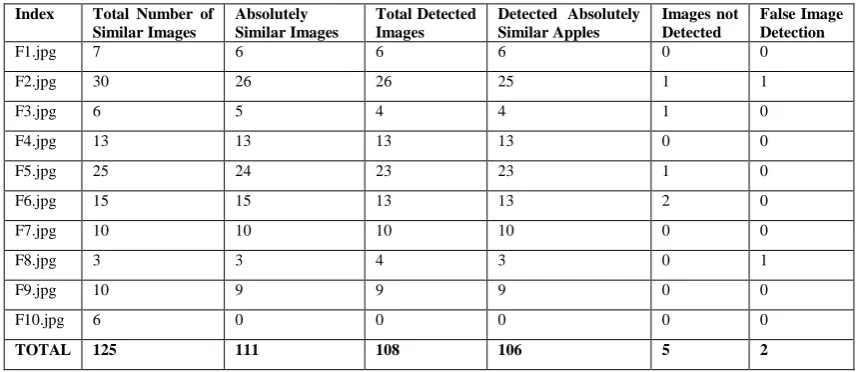
The proposed CBIR model has been tested with the 10 query objects/images in order to understand the performance of the proposed model. The proposed model has been tested with the 500 images in the training dataset. The training dataset is a validated dataset by the several institutes and contains the images from various categories, like tribal, monuments, urban, beach, digital, etc. The proposed CBIR model is based upon the fuzzy semantic relevance matrix, which enables it to keep the long term memory. The long term memory has been stored in a permanent content filter array with respect to the query image the user filtered the results for. The permanent content filter remains enabled until the user empty it manually, and keep filtering the content each time the user perform the search with the selected query image. The result has been obtained in various forms such as absolutely similar images, total detected images, detected absolutely similar images and image not detected and false image detection. There parameters are used to judge the accuracy of the proposed model.
Table 1: The statistics of the total results on 10 images
Index Total Number of statistical type 1 and type 2 errors include the true positive, true negative, false positive and false negative values. The true positives are the correctly searched results, where as the false positive shows the possibility of false results. The true negative value indicates the correct rejection of the objects, whereas the false negative indicates the false rejection of the image content.
Table 2: Type 1 and Type 2 statistical errors
Parameter Value
True Positive 106
False Positive 2
True Negative 14
False Negative 5
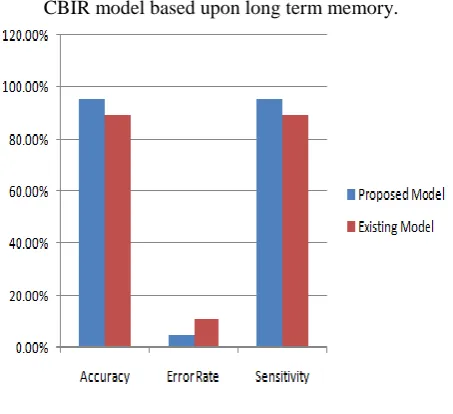
The performance of the proposed model has been further analyzed using the various performance parameters such as accuracy, error rate, sensitivity, specificity, positive
likelihood ratio and negative likelihood ratio. Also the relevance feedback and fuzzy semantic relevance matrix performances has been evaluated on the basis of elapsed time. The accuracy indicates the possibility of the correct
CBIR model based upon long term memory.
Figure 1: The performance comparison of proposed model and existing model
Table 3: The performance measurement parameters and statistical errors
Parameter Proposed
Scheme
Existing Scheme
Accuracy 95.50% 89%
Error Rate 4.50% 11%
Sensitivity 95.50% 89%
Specificity 87.50% -
Positive likelihood ratio 7.64 -
Negative likelihood ratio 0.05 -
The sensitivity is the parameter to indicate the case of reject of the truly false results or image objects in the training image data in accordance with the query image provided by the user, whereas the specificity is the parameters to indicate the appearance of the correct results against the input query image. The positive and negative likelihood ratio indicates the rule-in and rule-out of the correct results produced by the CBIR systems.
Table 4: The performance measure in the terms of elapsed time
Image Elapsed Time of proposed scheme
F1.jpg 7.34
F2.jpg 14.11
F3.jpg 10.60
F4.jpg 7.36
F5.jpg 7.88
F6.jpg 6.88
F7.jpg 10.52
F8.jpg 13.95
F9.jpg 5.07
F10.jpg 1.83
Figure 2: Relevance feedback vs Semantic Matrix
Table 5: Time based difference of Normal relevance feedback with fuzzy semantic feedback
Sr. No. Mean
Time
Maximum Time
Minimum Time
Median Time Relevance
Feedback
0.250035 0.42664 0.071121 0.231611
Fuzzy Semantic Relevance Matrix
0.165132 2.04227 0.071450 0.106773
The proposed model has been tested on the basis of the elapsed time between the fuzzy semantic relevance matrix and relevance feedback. The elapsed time tells us about the response delay when the input query image is processed. The elapsed time clearly indicates the effectiveness of the proposed model. The average time of the fuzzy semantic relevance matrix has been marginally lower than the relevance feedback technique, when it comes to build the semantic relationship library (SRL). The relevance feedback technique build the SRL for the runtime period and flush it afterwards, whereas the FRSM technique will keep the SRL in the shape of permanent semantic array, which increases the efficiency of the proposed model and filter the results with higher level of accuracy.
V. CONCLUSION
In this paper on querying an image, a reduced set of candidate images. The color histogram for an image is constructed by quantizing the colors within the image and counting the number of pixels of each color. The feature vector of an image can be derived from the histograms of its color components and finally can set the number of bins in the color histogram to obtain the feature vector of desired size. Fuzzy relevance semantic matrix is applied to the relevance feedback of image retrieval, According to the user’s feedback, to adjust the weight of FSRM, to catch the user’s intension. After the limited training, the weight of each of the image class FSRM modified according to the algorithm in this paper, thus, there is a good result in the more feedback times. The algorithm is similar to the experience of mechanism of human brain and has an initial learning mechanism. Experiment results clearly show the effectiveness of the algorithm.
FSRM will be tested up to the new limits of futuristic CBIR applications with the very large scale databases (Big Data Image Shift).
VI. REFERENCES
[1]. Cao, N., Wang, C., Li, M., Ren, K., & Lou, W. (2014). Privacy-preserving multi-keyword ranked search over encrypted cloud data. Parallel and Distributed Systems, IEEE Transactions on, 25(1), 222-233.
[2]. Chang, C. Y., Wang, H. J., & Jian, R. H. (2010, July). Semantic image retrieval with Fuzzy-ART. In System Science and Engineering (ICSSE), 2010 International Conference on (pp. 69-74). IEEE.
[3]. Dillon, T., Wu, C., & Chang, E. (2010, April). Cloud computing: issues and challenges. In Advanced Information Networking and Applications (AINA), 2010 24th IEEE International Conference on (pp. 27-33). Ieee.
[4]. Gudivada, V. N., & Raghavan, V. V. (1995). Design and evaluation of algorithms for image retrieval by spatial similarity. ACM Transactions on Information Systems (TOIS), 13(2), 115-144.
[5]. Krishnapuram, R., Medasani, S., Jung, S. H., Choi, Y. S., & Balasubramaniam, R. (2004). Content-based image retrieval based on a fuzzy approach. Knowledge and Data Engineering, IEEE Transactions on, 16(10), 1185-1199.
[6]. Liu, Y., Zhang, D., Lu, G., & Ma, W. Y. (2007). A survey of
content-based image retrieval with high-level
semantics. Pattern Recognition, 40(1), 262-282.
[7]. Lu, Y., Zhang, H., Wenyin, L., & Hu, C. (2003). Joint semantics and feature based image retrieval using relevance feedback. Multimedia, IEEE Transactions on, 5(3), 339-347.
[8]. MOHANA, R. M., & REDDY, A. R. M. CCBIR: A Cloud Based Implementation of Content Based Image Retrieval.
[9]. Smeulders, A. W., Worring, M., Santini, S., Gupta, A., & Jain, R. (2000). Content-based image retrieval at the end of the early years. Pattern Analysis and Machine Intelligence, IEEE Transactions on, 22(12), 1349-1380.
[10]. Xin, J., & Jin, J. S. (2003, December). Learning from user
feedback for image retrieval. In Information,
Communications and Signal Processing, 2003 and Fourth Pacific Rim Conference on Multimedia. Proceedings of the 2003 Joint Conference of the Fourth International Conference on (Vol. 3, pp. 1792-1795). IEEE.