Studying Discourse and Dialogue with SIDGrid
∗Gina-Anne Levow
Department of Computer Science University of Chicago Chicago, IL 60611, USA
Abstract
Teaching Computational Linguistics is in-herently multi-disciplinary and frequently poses challenges and provides opportunities in teaching to a student body with diverse ed-ucational backgrounds and goals. This pa-per describes the use of a computational en-vironment (SIDGrid) that facilitates interdis-ciplinary instruction by providing support for students with little computational background as well as extending the scale of projects ac-cessible to students with more advanced com-putational skills. The environment facilitates the use of hands-on exercises and is being ap-plied to interdisciplinary instruction in Dis-course and Dialogue.
1 Introduction
Teaching Computational Linguistics poses many challenges but also provides many opportunities. Students in Computational Linguistics courses come from diverse academic backgrounds, including com-puter science, linguistics, and psychology. The students enter with differing experience and expo-sure to programming, computational and mathemat-ical models, and linguistic, psycholinguistic and so-ciolinguistic theories that inform the practice and study of computational linguistics. However, study-ing in a common class provides students with the op-portunity to gain exposure to diverse perspectives on their research problems and to apply computational
∗
The work is supported by a University of Chicago Aca-demic Technology Innovation Grant.
tools and techniques to expand the range and scope of problems they can investigate.
While there are many facets of these instructional challenges that must be addressed to support a suc-cessful course with a multi-disciplinary class and perspective, this paper focuses on the use and de-velopment of a computational environment to sup-port laboratory exercises for students from diverse backgrounds. The framework aims to facilitate col-laborative projects, reduce barriers of entry for stu-dents with little prior computational experience, and to provide access to large-scale distributed process-ing resources for students with greater computa-tional expertise to expand the scope and scale of their projects and exercises.
Specifically, we exploit the Social Informatics Data Grid (SIDGrid) framework developed as part of the NSF-funded Cyberinfrastructure project, ”Cy-berinfrastructure for Collaborative Research in the Social and Behavioral Sciences (PI: Stevens)”, to support hands-on annotation and analysis exercises in a computational linguistics course focused on dis-course and dialogue. We begin by describing the SIDGrid framework for annotation, archiving, and analysis of multi-modal, multi-measure data. We then describe the course setting and the applica-tion of SIDGrid funcapplica-tionality to expand exercise and project possibilities. Finally, we discuss the impact of this framework for multi-disciplinary instruction in computational linguistics as well as the limita-tions of the current implementation of the frame-work.
2 SIDGrid Framework
2.1 Motivation
Recent research programs in multi-modal environ-ments, including understanding and analysis of multi-party meeting data and oral history recording projects, have created an explosion of multi-modal data sets, including video and audio recordings, transcripts and other annotations, and increased in-terest in annotation and analysis of such data. A number of systems have been developed to man-age and support annotation of multi-modal data, in-cluding Annotation Graphs (Bird and Liberman, 2001), Exmeralda (Schmidt, 2004), NITE XML Toolkit (Carletta et al., 2003), Multitool (Allwood et al., 2001), Anvil (Kipp, 2001), and Elan (Wit-tenburg et al., 2006). The Social Informatics Data Grid (SIDGrid), developed under the NSF Cyberin-frastructure Program, aims to extend the capabilities of such systems by focusing on support for large-scale, extensible distributed data annotation, shar-ing, and analysis. The system is open-source and multi-platform and based on existing open-source software and standards. The system greatly eases the integration of annotation with analysis though user-defined functions both on the client-side for data ex-ploration and on the TeraGrid for large-scale dis-tributed data processing. A web-accessible repos-itory supports data search, sharing, and distributed annotation. While the framework is general, anal-ysis of spoken and multi-modal discourse and dia-logue data is a primary application.
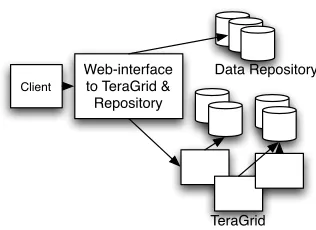
The details of the system are presented below. Sections 2.2, 2.3, and 2.4 describe the annota-tion client, the web-accessible data repository, and the portal to the TeraGrid, respectively, as shown in Figure 1 below.
2.2 The SIDGrid Client
The SIDGrid client provides an interactive multi-modal annotation interface, building on the open-source ELAN annotation tool from the Max Planck Institute1. A screenshot appears in Figure 2. ELAN supports display and synchronized playback of mul-tiple video files, audio files, and arbitrarily many annotation ”tiers” in its ”music-score”-style graph-ical interface. The annotations are assumed to be
1http://www.mpi.nl/tools/elan.html
Web-interface to TeraGrid & Repository
Client
Data Repository
[image:2.612.346.504.59.174.2]TeraGrid
Figure 1: System Architecture
Figure 2: Screenshot of the annotation client interface, with video, time-aligned textual annotations, and time se-ries displays.
time-aligned intervals with, typically, text content; the system leverages Unicode to provide multilin-gual support. Time series such as pitch tracks or motion capture data can be displayed synchronously. The user may interactively add, edit, and do sim-ple search in annotations. For examsim-ple, in multi-modal multi-party spoken data, annotation tiers cor-responding to aligned text transcriptions, head nods, pause, gesture, and reference can be created.
[image:2.612.315.525.222.394.2]analysis of multi-party meeting data, the user can se-lect a Praat (Boersma, 2001) script to perform pitch or intensity tracking. Also, the client provides inte-grated import and export capabilities for the central repository. New and updated experiments and an-notations may be uploaded directly to the archive from within the client interface. Existing experi-ments may be loaded from local disk or downloaded from the repository for additional annotation.
2.3 The SIDGrid Repository
The SIDGrid repository provides a web-accessible, central archive of multi-modal data, annotations, and analyses. This archive facilitates distributed anno-tation efforts by multiple researchers working on a common data set by allowing shared storage and ac-cess to annotations, while keeping a history of up-dates to the shared data, annotations, and analysis.
The browser-based interface to the archive allows the user to browse or search the on-line data col-lection by media type, tags, project identifier, and group or owner. Once selected, all or part of any ex-periment may be downloaded. In addition to lists of experiment names or thumbnail images, the web in-terface also provides a streaming preview of the se-lected media and annotations, allowing verification prior to download. (Figure 3)
All data is stored in a MySQL database. Anno-tation tiers are converted to an internal time-span based representation, while media and time series files are linked in unanalyzed. This format allows generation of ELAN format files for download to the client tool without regard to the original source form of the annotation file. The database structure further enables the potential for flexible search of the stored annotations both within and across multiple annota-tion types.
2.4 The TeraGrid Portal
The large-scale multimedia data collected for multi-modal research poses significant computational challenges. Signal processing of gigabytes of me-dia files requires processing horsepower that may strain many local sites, as do approaches such as multi-dimensional scaling for semantic analysis and topic segmentation. To enable users to more effec-tively exploit this data, the SIDGrid provides a por-tal to the TeraGrid (Pennington, 2002), the largest
distributed cyberinfrastructure for open scientific research, which uses high-speed network connec-tions to link high performance computers and large scale data stores distributed across the United States. While the TeraGrid has been exploited within the as-tronomy and physics communities, it has been little used by the computational linguistics community.
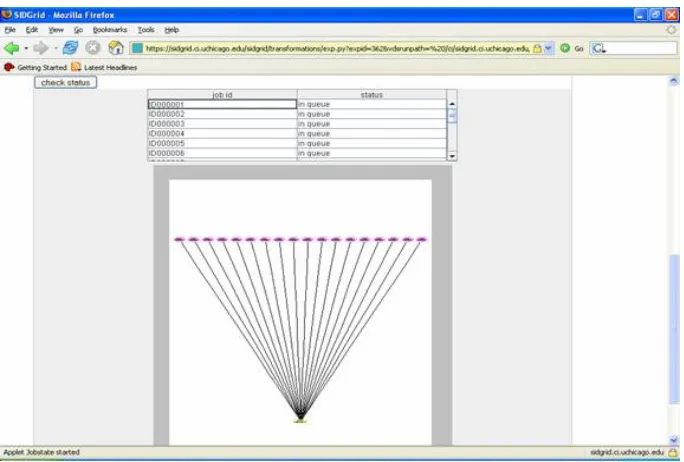
The SIDGrid portal to the TeraGrid allows scale experimentation by providing access to large-scale distributed processing clusters to enable par-allel processing on very high capacity servers. The SIDGrid portal to the TeraGrid allows the user to specify a set of files in the repository and a program or programs to run on them on the Grid-based re-sources. Once a program is installed on the Grid, the processing can be distributed automatically to different TeraGrid nodes. Software supports arbi-trarily complex workflow specifications, but the cur-rent SIDGrid interface provides simple support for high degrees of data-parallel processing, as well as a graphical display indicating the progress of the dis-tributed program execution, as shown in Figure 4. The results are then reintegrated with the original experiments in the on-line repository. Currently in-stalled programs support distributed acoustic analy-sis using Praat, statistical analyanaly-sis using R, and ma-trix computations using Matlab and Octave.
2.5 Software Availability
The client software is freely available. Ac-cess to the public portion of the repository is possible through the project website at
https://sidgrid.ci.uchicago.edu; full access to the repository to create new experi-ments may also be requested there.
3 Course Setting and Activities
Figure 3: Screenshot of the archive download interface, with thumbnails of available video and download and analysis controls.
[image:4.612.136.478.414.645.2]computational tools to support annotation, archiv-ing, and analysis. However, prior offerings of this course through the Computer Science Department had attracted primarily Computer Science gradu-ate students, even though readings for the course spanned the range of related fields. In collabora-tion with researchers in co-verbal gesture in the Psy-chology department, we hoped to increase the attrac-tion and accessibility of the course material and ex-ercises to a more diverse student population. Af-ter advertising the course to a broader population through the Linguistics Department mailing list, em-phasizing the use of computational tools but lack of requirements for previous programming experience, the resulting class included members of the Linguis-tics, Slavic Studies, Psychology, and Computer Sci-ence Departments, about half of whom had some prior programming experience, but few were expert.
3.1 Hands-on Exercises
Currently, we have only included a small number of software tools as proof-of-concept and to enable par-ticular course exercises in discourse and dialogue. This first set of exercises explores three main prob-lems in this area: topic segmentation, dialogue act tagging, and turn-taking.
The topic segmentation exercise investigates the impact of segment granularity and automatic speech recognition errors on topic segmentation of conver-sational speech. The data is drawn from the Language Speech Retrieval Track of the Cross-language Evaluation Forum (CLEF CL-SR) (Pecina et al., 2007) collection. This collection includes au-tomatic transcriptions of interviews from an oral his-tory project, accompanied by manual segmentation created as part of the MALACH project (Franz et al., 2003). The exercise employs the web-based portal to the TeraGrid to perform segmentation of multiple interviews in parallel on the Grid, followed by eval-uation in parallel. We perform segmentation using LCSeg (Galley et al., 2003) and evaluate using the
pk and WindowDiff metrics. Students identify the
best segmentation parameters for these interviews and perform error analysis to assess the effect of ASR errors.
The dialogue act tagging exercise involves both annotation and analysis components. The students are asked to download and annotate a small portion
of a conversation from the AMI corpus (Carletta et al., 2005) with dialogue act tags. The AMI cor-pus of multiparty meetings includes recorded video, recorded audio, aligned manual transcriptions, and manually annotated head and hand gesture. Stu-dents annotate from text alone, with audio, with video, and with all modalities. Local ”transforma-tions”, programs or scripts associated with the an-notation client, can also provide prosodic analysis of features such as pitch and intensity. Students are asked to assess the influence of different fea-tures on their annotation process and to compare to a gold standard annotation which is later provided. The automatic analysis phase is performed on the web-based portal to assess the impact of different feature sets on automatic tagging. The tagging is done in the Feature Latent Semantic Analysis frame-work (Serafin and Di Eugenio, 2004), augmented with additional prosodic and multi-modal features drawn from the annotation. Since this analysis re-quires Singular Value Decomposition of the poten-tially large Feature-by-Dialogue-Act matrices, it is often impractical to execute on single personal or even departmental servers. Furthermore, feature ex-traction, such as pitch tracking, of the full conver-sation can itself strain the computational resources available to students. Grid-based processing over-comes both of these problems.
Exercises on turn-taking follow similar patterns. An initial phase requires annotation and assessment exercises by the students in the ELAN-based client tool and downloaded from the web-based repository. Subsequent phases of the exercises include applica-tion and investigaapplica-tion of automatic techniques us-ing the web-based environment and computational resources of the TeraGrid. Clearly, many other exer-cises could be framed within this general paradigm, and we plan to extend the options available to stu-dents as our interests and available software and data sets permit.
4 Impact on Interdisciplinary Instruction
the cyberinfrastructure framework to achieve three main goals: lower barriers of entry to use of com-putational tools by students with little prior pro-gramming experience, enable students with greater computational skills to expand the scale and scope of their experiments, and to support collaborative projects and a broader, interdisciplinary perspective on research in discourse and dialogue.
4.1 Enabling All Users
A key goal in employing this architecture was to en-able students with little or no programming expe-rience to exploit advanced computational tools and techniques. The integration of so-called ”transfor-mations”, actually arbitrary program applications, in both the annotation client and the web-based portal to the TeraGrid, supports this goal. In both cases, drop-down menus to select programs and text- and check-boxes to specify parameters provide graphi-cal user interfaces to what can otherwise be complex command-line specifications. In particular, the web-based portal removes requirements for local instal-lation of software, shielding the user from problems due to complex installations, variations in platforms and operating systems, and abstruse command-line syntax. In addition, the web-based archive provides simple mechanisms to browse and download a range of data sources. The students all found the archive, download, and transformation mechanisms easy to use, regardless of prior programming experience. It is important to remember that the goal of this envi-ronment is not to replace existing software systems for Natural Language Processing, such the Natural Language Toolkit (NLTK) (Bird and Loper, 2004), but rather to provide a simpler interface to such soft-ware tools and to support their application to poten-tially large data sets, irrespective of the processing power of the individual user’ system.
4.2 Enabling Large-Scale Experimentation
A second goal is to enable larger-scale experimenta-tion by both expert and non-expert users. The use of the web-based portal to the TeraGrid provides such opportunities. The portal provides access to highly distributed parallel processing capabilities. For ex-ample, in the case of the segmentation of the oral history interviews above, the user can select several interviews, say 60, to segment by checking the
as-sociated check-boxes in the interface. The portal software will automatically identify available pro-cessing nodes and distribute the segmentation jobs for the corresponding interviews to each of the avail-able nodes to be executed in parallel. Not only are there many processing nodes, but these nodes are of very high capacity in terms of CPU speed, number of CPUs, and available memory.
The multigigabyte data files associated with the growing number of multi-modal discourse and dia-logue corpora, such as the AMI and ICSI Meeting Recorder collections, make such processing power highly desirable. For example, pitch tracking for such corpora is beyond the memory limitations of any single machine in the department, while such tasks are quickly processed on the powerful Tera-Grid machines.
Expert users are also granted privileges to upload their own user-defined programs to be executed on the Grid. Finally, web services also enable execu-tion of arbitrary read-only queries on the underly-ing database of annotations, media files, and time-series data through standard Structure Query Lan-guage (SQL) calls. All these capabilities enhance the scope of problems that more skilled program-mers can employ in the study of discourse and dia-logue phenomena.
4.3 Interdisciplinary Collaboration and Perspectives
The web-based archive in the SIDGrid framework also provides support for group distributed collab-orative projects. The archive provides a Unix-style permission structure that allows data sharing within groups. The process of project creation, annota-tion, and experimentation maintains a version his-tory. Uploads of new annotations create new ver-sions; older versions are not deleted or overwritten. Experimental runs are also archived, providing an experiment history and shared access to intermedi-ate and final results. Script and software versions are also maintained. While the version control is not nearly as sophisticated as that provided by GForge or Subversion, this simple model requires no spe-cial training and facilitates flexible, web-based dis-tributed access and collaboration.
ar-chitecture provides the students with additional in-sight into different aspects of research on discourse and dialogue. Students from linguistics and psy-chology gain greater experience in automatic analy-sis and recognition of discourse phenomena, while more computationally oriented students develop a greater appreciation of the challenges of annotation and theoretical issues in analysis of dialogue data.
5 Challenges and Costs
The capabilities and opportunities for study of com-putational approaches to discourse and dialogue af-forded within the SIDGrid framework do require some significant investment of time and effort. In-corporating new data sets and software packages requires programming expertise. The framework can, in principle, incorporate arbitrary data types: media, physiological measures, manual and auto-matic annotations, and even motion tracking. The data must be converted into the ELAN .eaf for-mat to be deployed effectively by the annotation client and interpreted correctly by the archive’s un-derlying database. Converters have been created for several established formats2, such as Annota-tion Graphs (Bird and Liberman, 2001), ANVIL (Kipp, 2001), and EXMARaLDA(Schmidt, 2004), and projects are underway to improve interoperabil-ity between formats. However, new formats such as the CLEF Cross-language Speech Retrieval SGML format and NITE XML(Carletta et al., 2003) format for the AMI data used here, required the implemen-tation of software to convert the source format to one suitable for use by SIDGrid.
Incorporating new Grid-based ”transformation” programs can also range in required effort. For self-contained programs in supported frameworks - cur-rently, Perl, Python, Praat, and Octave - adding a new program requires only a simple browser-based upload. Compiled programs, such as LCSeg here, must be compatible with the operating systems and 64-bit architecture on the Grid servers, often requir-ing recompilation and occasionally addition of li-braries to existing Grid installations. Finally, soft-ware with licensing restrictions can only run on a local cluster rather than on the full TeraGrid. Thus, public domain programs and systems that rely on
2www.multimodal-annotation.org
such are preferred; for example, Octave-based pro-grams are preferred to Matlab-based ones.
Finally, one must remember that the SIDGrid framework is itself an ongoing research project. It provides many opportunities to enhance interdisci-plinary instruction in Computational Linguistics, es-pecially in areas involving multi-modal data. How-ever, the functionality is still under active develop-ment, and current system users are beta-testers. The use of the system, both in coursework and in re-search, has driven improvements and expansions in service.
6 Conclusions and Future Directions
We have explored the use of the SIDGrid framework for annotation, archiving, and analysis of multi-modal data to enhance hands-on activities in the study of discourse and dialogue in a highly inter-disciplinary course setting. Our preliminary efforts have demonstrated the potential for the framework to lower barriers of entry for students with less pro-gramming experience to apply computational tech-niques while enabling large-scale investigation of discourse and dialogue phenomena by more expert users. Annotation, analysis, and automatic recog-nition exercises relating to topic segmentation, di-alogue act tagging, and turn-taking give students a broader perspective on research and issues in dis-course and dialogue. These exercises also allow students to contribute to class discussion and col-laborative projects drawing on their diverse disci-plinary backgrounds. We plan to extend our current suite of hands-on exercises to cover other aspects of discourse and dialogue, both in terms of data sets and software, including well-known toolkits such as NLTK. We hope that this expanded framework will encourage additional interdisciplinary collaborative projects among students.
Acknowledgments
infrastruc-ture. We are particularly appreciative of the response to our bug reports and functionality requests by Tom Uram and Sarah Kenny.
References
Jens Allwood, Leif Groenqvist, Elisabeth Ahlsen, and Magnus Gunnarsson. 2001. Annotations and tools for an activity based spoken language corpus. In Proceed-ings of the Second SIGdial Workshop on Discourse and Dialogue, pages 1–10.
S. Bird and M. Liberman. 2001. A formal
frame-work for linguistic annotation. Speech Communica-tion, 33(1,2):23–60.
Steven Bird and Edward Loper. 2004. Nltk: The natural language toolkit. In Proceedings of the ACL demon-stration session, pages 214–217.
P. Boersma. 2001. Praat, a system for doing phonetics by computer. Glot International, 5(9–10):341–345. J. Carletta, S. Evert, U. Heid, J. Kilgour, J. Robertson,
and H. Voormann. 2003. The NITE XML Toolkit: flexible annotation for multi-modal language data. Be-havior Research Methods, Instruments, and Comput-ers, special issue on Measuring Behavior, 35(3):353– 363.
Jean Carletta, Simone Ashby, Sebastien Bourban, Mike Flynn, Mael Guillemot, Thomas Hain, Jaroslav Kadlec, Vasilis Karaiskos, Wessel Kraaij, Melissa Kronenthal, Guillaume Lathoud, Mike Lincoln, Agnes Lisowska, Iain A. McCowan, Wilfried Post, Dennis Reidsma, and Pierre Wellner. 2005. The AMI meet-ings corpus. In Proceedings of the Measuring Be-havior 2005 symposium on Annotating and measuring Meeting Behavior.
M. Franz, B. Ramabhadran, T. Ward, and M. Picheny. 2003. Automated transcription and topic segmenta-tion of large spoken archives. InProceedings of EU-ROSPEECH.
Michel Galley, Kathleen McKeown, Eric Fosler-Lussier, and Hongyan Jing. 2003. Discourse segmentation of multi-party conversation. InProceedings of ACL’03. M. Kipp. 2001. Anvil- a generic annotation tool for
mul-timodal dialogue. InProceedings of the 7th European Conference on Speech Communication and Technol-ogy (Eurospeech), pages 1367–1370.
Pavel Pecina, Petra Hoffmannova, Gareth J. F. Jones, Ying Zhang, and Douglas W. Oard. 2007. Overview of the clef-2007 cross language speech retrieval track. InWorking Notes for CLEF 2007.
Rob Pennington. 2002. Terascale clusters and the Tera-Grid. InProceedings for HPC Asia, pages 407–413. Invited talk.
T. Schmidt. 2004. Transcribing and annotating spoken language with EXMARaLDA. InProceedings of the LREC-Workshop on XML-based richly annotated cor-pora.
Riccardo Serafin and Barbara Di Eugenio. 2004. Flsa: Extending latent semantic analysis with features for dialogue act classification. In Proceedings of the 42nd Meeting of the Association for Computational Linguistics (ACL’04), Main Volume, pages 692–699, Barcelona, Spain, July.