Determining the Syntactic Structure of Medical Terms in Clinical Notes
Bridget T. McInnes
Dept. of Computer Science and Engineering University of Minnesota Minneapolis, MN, 55455 [email protected]
Ted Pedersen
Dept. of Computer Science University of Minnesota Duluth
Duluth, MN, 55812 [email protected]
Serguei V. Pakhomov
Dept. of Pharmaceutical Care and Health Systems Center
for Health Informatics University of Minnesota Minneapolis, MN, 55455
Abstract
This paper demonstrates a method for de-termining the syntactic structure of medi-cal terms. We use a model-fitting method based on the Log Likelihood Ratio to clas-sify three-word medical terms as right or left-branching. We validate this method by computing the agreement between the clas-sification produced by the method and man-ually annotated classifications. The results show an agreement of 75% - 83%. This method may be used effectively to enable a wide range of applications that depend on the semantic interpretation of medical terms including automatic mapping of terms to standardized vocabularies and induction of terminologies from unstructured medical text.
1 Introduction
Most medical concepts are expressed via a domain specific terminology that can either be explicitly agreed upon or extracted empirically from domain specific text. Regardless of how it is constructed, a terminology serves as a foundation for informa-tion encoding, processing and exchange in a special-ized sub-language such as medicine. Concepts in the medical domain are encoded through a variety of lin-guistic forms, the most typical and widely accepted is the noun phrase (NP). In some even further spe-cialized subdomains within medicine, such as nurs-ing and surgery, an argument can be made that some concepts are represented by an entire predication
rather than encapsulated within a single nominal-ized expression. For example, in order to describe someone’s ability to lift objects 5 pounds or heav-ier above their head, it may be necessary to use a term consisting of a predicate such as [LIFT] and a set of arguments corresponding to various thematic roles such as<PATIENT>and<PATH>(Ruggieri et al., 2004). In this paper, we address typical med-ical terms encoded as noun phrases (NPs) that are often structurally ambiguous, as in Example 1, and discuss a case for extending the proposed method to non-nominalized terms as well.
small1bowel2obstruction3 (1)
The NP in Example 1 can have at least two interpre-tations depending on the syntactic analysis:
[[small1bowel2] obstruction3] (2)
[small1[bowel2obstruction3]] (3)
The term in Example 2 denotes an obstruction in the small bowel, which is a diagnosable disorder; whereas, the term in Example 3 refers to a small un-specified obstruction in the bowel.
Unlike the truly ambiguous general English cases such as the classical “American History Professor” where the appropriate interpretation depends on the context, medical terms, such as in Example 1, tend to have only one appropriate interpretation. The context, in this case, is the discourse domain of medicine. From the standpoint of the English lan-guage, the interpretation that follows from Example 3 is certainly plausible, but unlikely in the context of a medical term. The syntax of a term only shows
what interpretations are possible without restricting them to any particular one. From the syntactic anal-ysis, we know that the term in Example 1 has the po-tential for being ambiguous; however, we also know that it does have an intended interpretation by virtue of being an entry term in a standardized terminology with a unique identifier anchoring its meaning. What we do not know is which syntactic structure gen-erated that interpretation. Being able to determine the structure consistent with the intended interpreta-tion of a clinical term can improve the analysis of unrestricted medical text and subsequently improve the accuracy of Natural Language Processing (NLP) tasks that depend on semantic interpretation.
To address this problem, we propose to use a model-fitting method which utilizes an existing sta-tistical measure, the Log Likelihood Ratio. We val-idate the application of this method on a corpus of manually annotated noun-phrase-based medical terms. First, we present previous work on structural ambiguity resolution. Second, we describe the Log Likelihood Ratio and then its application to deter-mining the structure of medical terms. Third, we describe the training corpus and discuss the compi-lation of a test set of medical terms and human ex-pert annotation of those terms. Last, we present the results of a preliminary validation of the method and discuss several possible future directions.
2 Previous Work
The problem of resolving structural ambiguity has been previously addressed in the computational lin-guistics literature. There are multiple approaches ranging from purely statistical (Ratnaparkhi, 1998), to hybrid approaches that take into account the lexi-cal semantics of the verb (Hindle and Rooth, 1993), to corpus-based, which is the approach discussed in this paper. (Marcus, 1980) presents an early ex-ample of a corpus-based approach to syntactic am-biguity resolution. One type of structural ambigu-ity that has received much attention has to do with nominal compounds as seen in the work of (Resnik, 1993), (Resnik and Hearst, 1993), (Pustejovsky et al., 1993), and (Lauer, 1995).
(Lauer, 1995) points out that the existing ap-proaches to resolving the ambiguity of noun phrases fall roughly into two camps: adjacency and
de-pendency. The proponents of the adjacency model ((Liberman and Sproat, 1992), (Resnik, 1993) and (Pustejovsky et al., 1993)) argue that, given a three word noun phrase XYZ, there are two possible an-alyzes [[XY]Z] and [X[YZ]]. The correct analysis is chosen based on the “acceptability” of the adja-cent bigrams A[XY] and A[YZ]. If A[XY] is more acceptable than A[YZ], then the left-branching anal-ysis [[XY]Z] is preferred.
(Lauer and Dras, 1994) and (Lauer, 1995) address the issue of structural ambiguity by developing a de-pendency model where instead of computing the ac-ceptability of A[YZ] one would compute the accept-ability of A[XZ]. (Lauer, 1995) argues that the de-pendency model is not only more intuitive than the adjacency model, but also yields better results. (La-pata and Keller, 2004) results also support this as-sertion.
The difference between the approaches within the two models is the computation of acceptability. Pro-posals for computing acceptability (or preference) include raw frequency counts ((Evans and Zhai, 1996) and (Lapata and Keller, 2004)), Latent Se-mantic Indexing ((Buckeridge and Sutcliffe, 2002)) and statistical measures of association ((Lapata et al., 1999) and (Nakov and Hearst, 2005)).
One of the main problems with using frequency counts or statistical methods for structural ambigu-ity resolution is the sparseness of data; however, (Resnik and Hearst, 1993) used conceptual associa-tions (associaassocia-tions between groups of terms deemed to form conceptual units) in order to alleviate this problem. (Lapata and Keller, 2004) use the doc-ument counts returned by WWW search engines. (Nakov and Hearst, 2005) use theχ2
measure based on statistics obtained from WWW search engines to compute values to determine acceptability of a syn-tactic analysis for nominal compounds. This method is tested using a set of general English nominal com-pounds developed by (Lauer, 1995) as well as a set of nominal compounds extracted from MEDLINE abstracts.
3 Log Likelihood Ratio
The Log Likelihood Ratio (G2
) is a “goodness of fit” statistic first proposed by (Wilks, 1938) to test if a given piece of data is a sample from a set of data with a specific distribution described by a hypothe-sized model. It was later applied by (Dunning, 1993) as a way to determine if a sequence of N words (N-gram) came from an independently distributed sam-ple.
(Pedersen et al., 1996) pointed out that there ex-ists theoretical assumptions underlying theG2
mea-sure that were being violated therefore making them unreliable for significance testing. (Moore, 2004) provided additional evidence that althoughG2
may not be useful for determining the significance of an event, its near equivalence to mutual information makes it an appropriate measure of word associa-tion. (McInnes, 2004) appliedG2
to the task of ex-tracting three and four word collocations from raw text.
G2
, formally defined for trigrams in Equation 4, compares the observed frequency counts with the counts that would be expected if the words in the trigram (3-gram; a sequence of three words) corre-sponded to the hypothesized model.
G2 = 2∗
X
x,y,z
nxyz∗log(
nxyz
mxyz
) (4)
The parameter nxyz is the observed frequency of the trigram wherex,y, andzrespectively represent the occurrence of the first, second and third words in the trigram. The variable mxyz is the expected frequency of the trigram which is calculated based on the hypothesized model. This calculation varies depending on the model used. Often the hypothe-sized model used is the independence model which assumes that the words in the trigram occur together by chance. The calculation of the expected values based on this model is as follows:
mxyz =nx++∗n+y+∗n++z/n+++ (5)
The parameter, n+++, is the total number of
tri-grams that exist in the training data, and nx++, n+y+, andn++z are the individual marginal counts of seeing wordsx,y, andzin their respective posi-tions in a trigram. AG2
score reflects the degree to which the observed and expected values diverge. A
G2
score of zero implies that the observed values are equal to the expected and the trigram is represented perfectly by the hypothesized model. Hence, we would say that the data ’fits’ the model. Therefore, the higher the G2
score, the less likely the words in the trigram are represented by the hypothesized model.
4 Methods
4.1 Applying Log Likelihood to Structural Disambiguation
The independence model is the only hypothesized model used for bigrams (2-gram; a sequence of two words). As the number of words in an N-gram grows, the number of hypothesized models also grows. The expected values for a trigram can be based on four models. The first model is the independence model discussed above. The second is the model based on the probability that the first word and the second word in the trigram are depen-dent and independepen-dent of the third word. The third model is based on the probability that the second and third words are dependent and independent of the first word. The last model is based on the prob-ability that the first and third words are dependent and independent of the second word. Table 1 shows the different models for the trigram XYZ.
Table 1: Models for the trigram XYZ Model 1 P(XYZ) / P(X) P(Y) P(Z) Model 2 P(XYZ) / P(XY) P(Z) Model 3 P(XYZ) / P(X) / P(YZ) Model 4 P(XYZ) / P(XZ) P(Y)
Slightly different formulas are used to calculate the expected values for the different hypothesized models. The expected values for Model 1 (the in-dependence model) are given above in Equation 5. The calculation of expected values for Model 2, 3, 4 are seen in Equations 6, 7, 8 respectively.
mxyz=nxy+∗n++z/n+++ (6)
mxyz=nx++∗n+yz/n+++ (7)
mxyz=nx+z∗n+y+/n+++ (8)
the number of times words y and z occur in their respective positions andnx+zis the number of times that wordsxandzoccur in their respective positions in the trigram.
The hypothesized models result in different ex-pected values which results in a different G2
score. AG2score of zero implies that the data are perfectly
represented by the hypothesized model and the ob-served values are equal to the expected. Therefore, the model that returns the lowest score for a given trigram is the model that best represents the struc-ture of that trigram, and hence, best ’fits’ the trigram. For example, Table 2 shows the scores returned for each of the four hypothesized models for the trigram “small bowel obstruction”.
Table 2: Example for the term “small bowel obstruc-tion”
Model G2score Model G2 score
Model 1 11,635.45 Model 2 5,169.81 Model 3 8,532.90 Model 4 7,249.90
The smallest G2
score is returned by Model 2 which is based on the first and second words be-ing dependent and independent of the third. Based on the data, Model 2 best represents or ’fits’ the tri-gram, “small bowel obstruction”. In this particular case that happens to be the correct analysis.
The frequency counts and G2 scores for each
model were obtained using the N-gram Statistics Package1(Banerjee and Pedersen, 2003).
4.2 Data
The data for this study was collected from two sources: the Mayo Clinic clinical notes and SNOMED-CT terminology (Stearns et al., 2001).
4.2.1 Clinical Notes
The corpus used in this study consists of over 100,000 clinical notes covering a variety of ma-jor medical specialties at the Mayo Clinic. These notes document each patient-physician contact and are typically dictated over the telephone. They range in length from a few lines to several pages of text and represent a quasi-spontaneous discourse where the dictations are made partly from notes and partly
1http://www.d.umn.edu/ tpederse/nsp.html
from memory. At the Mayo Clinic, the dictations are transcribed by trained personnel and are stored in the patient’s chart electronically.
4.2.2 SNOMED-CT
SNOMED-CT (Systematized Nomenclature of Medicine, Clinical Terminology) is an ontologi-cal resource produced by the College of American Pathologists and distributed as part of the Unified Medical Language System2(UMLS) Metathesaurus maintained by the National Library of Medicine. SNOMED-CT is the single largest source of clini-cal terms in the UMLS and as such lends itself well to the analysis of terms found in clinical reports.
SNOMED-CT is used for many applications in-cluding indexing electronic medical records, ICU monitoring, clinical decision support, clinical trials, computerized physician order entry, disease surveil-lance, image indexing and consumer health informa-tion services. The version of SNOMED-CT used in this study consists of more than 361,800 unique con-cepts with over 975,000 descriptions (entry terms) (SNOMED-CT Fact Sheet, 2004).
4.3 Testset of Three Word Terms
We used SNOMED-CT to compile a list of terms in order to develop a test set to validate the G2
method. The test set was created by extracting all trigrams from the corpus of clinical notes and all three word terms found in SNOMED-CT. The inter-section of the SNOMED-CT terms and the trigrams found in the clinical notes was further restricted to include only simple noun phrases that consist of a head noun modified with a set of other nominal or adjectival elements including adjectives and present and past participles. Adverbial modification of ad-jectives was also permitted (e.g. “partially edentu-lous maxilla”). Noun phrases with nested prepo-sitional phrases such as “fear of flying” as well as three word terms that are not noun phrases such as “does not eat” or “unable to walk” were excluded from the test set. The resulting test set contains 710 items.
The intended interpretation of each three word term (trigram) was determined by arriving at a
2Unified Medical Language System is a compendium of
consensus between two medical index experts (kappa=0.704). These experts have over ten years of experience with classifying medical diagnoses and are highly qualified to carry out the task of deter-mining the intended syntactic structure of a clinical term.
Table 3: Four Types of Syntactic Structures of Tri-gram Terms
left-branching ((XY)Z): [[urinary tract] infection] [[right sided] weakness] right-branching (X(YZ)):
[chronic [back pain]] [low [blood pressure]] non-branching ((X)(Y)(Z)):
[[follicular][thyroid][carcinoma]] [[serum][dioxin][level]]
monolithic (XYZ):
[difficulty finding words] [serous otitis media]
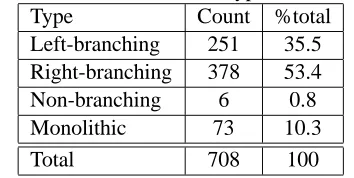
In the process of annotating the test set of tri-grams, four types of terms emerged (Table 3). The first two types are left and right-branching where the left-branching phrases contain a left-adjoining group that modifies the head of the noun phrase. The right-branching phrases contain a right-adjoining group that forms the kernel or the head of the noun phrase and is modified by the remaining word on the left. The non-branching type is where the phrase contains a head noun that is independently modified by the other two words. For example, in “follicular thyroid carcinoma”, the experts felt that “carcinoma” was modified by both “follicular” and “thyroid” indepen-dently, where the former denotes the type of cancer and the latter denotes its location. This intuition is reflected in some formal medical classification sys-tems such as the Hospital International Classifica-tion of Disease AdaptaClassifica-tion (HICDA) where cancers are typically classified with at least two categories -one for location and -one for the type of malignancy. This type of pattern is rare. We were able to iden-tify only six examples out of the 710 terms. The monolithic type captures the intuition that the terms function as a collocation and are not decomposable into subunits. For example, “leg length discrepancy”
denotes a specific disorder where one leg is of a dif-ferent length from the other. Various combinations of subunits within this term result in nonsensical ex-pressions.
Table 4: Distribution of term types in the test set Type Count %total Left-branching 251 35.5 Right-branching 378 53.4 Non-branching 6 0.8 Monolithic 73 10.3
Total 708 100
Finally, there were two terms for which no con-sensus could be reached: “heart irregularly irregu-lar” and “subacute combined degeneration”. These cases were excluded from the final set. Table 4 shows the distribution of the four types of terms in the test set.
5 Evaluation
We hypothesize that general English typically has a specific syntactic structure in the medical domain, which provides a single semantic interpretation. The patterns observed in the set of 710 medical terms described in the previous section suggest that the
G2 method offers an intuitive way to determine the
structure of a term that underlies its syntactic struc-ture.
Table 5:G2
Model Descriptions left-branching Model 2 [ [XY] Z ] right-branching Model 3 [ X [YZ] ]
Figure 1: Comparison of the results with two base-lines: L-branching and R-branching assumptions
middle word, which is not motivated from the stand-point of a traditional context free grammar which prohibits branch crossing. However, this model may be welcome in a dependency grammar paradigm.
One of the goals of this study is to test an ap-plication of the G2
method trained on a corpus of medical data to distinguish between left and right-branching patterns. The method ought to suggest the most likely analysis for an NP-based medical term based on the empirical distribution of the term and its components. As part of the evaluation, we compute theG2
scores for each of the terms in the test set, and picked the model with the lowest score to represent the structural pattern of the term. We compared these results with manually identified pat-terns. At this preliminary stage, we cast the problem of identifying the structure of a three word medical term as a binary classification task where a term is considered to be either left or right-branching, ef-fectively forcing all terms to either be represented by either Model 2 or Model 3.
6 Results and Discussion
In order to validate the G2
method for determin-ing the structure of medical terms, we calculated the agreement between human experts’ interpreta-tion of the syntactic structure of the terms and the interpretation suggested by the G2
method. The agreement was computed as the ratio of match-ing interpretations to the total number of terms be-ing interpreted. We used two baselines, one estab-lished by assuming that each term is left-branching
and the other by assuming that each term is right-branching. As is clear from Table 4, the left-branching baseline is 35.5% and the right-left-branching baseline is 53.4% meaning that if we simply as-sign left-branching pattern to each three word term, we would agree with human experts 35.5% of the time. The G2
method correctly identifies 185 grams as being left-branching (Model 2) and 345 tri-grams as being right-branching (Model 3). There are 116 right-branching trigrams incorrectly identified as left-branching, and 62 left-branching trigrams in-correctly identified as right- branching. Thus the method and the human experts agreed on 530 (75%) terms out of 708 (kappa=0.473), which is better than both baselines (Figure 1). We did not find any over-lap between the terms that human experts annotated as non-branching and the terms whose corpus dis-tribution can be represented by Model 4 ([[XZ]Y]). This is not surprising as this pattern is very rare. Most of the terms are represented by either Model 2 (left-branching) or Model 3 (right-branching). The monolithic terms that the human experts felt were not decomposable constitute 10% of all terms and may be handled through some other mechanism such as collocation extraction or dictionary lookup. Excluding monolithic terms from testing results in 83.5% overall agreement (kappa=0.664).
We observed that 53% of the terms in our test set are right-branching while only 35% are left-branching. (Resnik, 1993) found between 64% and 67% of nominal compounds to be left-branching and used that finding to establish a baseline for his exper-iments with structural ambiguity resolution. (Nakov and Hearst, 2005) also report a similar percentage (66.8%) of left-branching noun compounds. Our test set is not limited to nominal compounds, which may account for the fact that a slight majority of the terms are found to be right-branching as adjectival modification in English is typically located to the left of the head noun. This may also help explain the fact that the method tends to have higher agree-ment within the set of right-branching terms (85%) vs. left-branching (62%).
status of a patient such as the term in Example 10.
erythema1ab2 igne3 (9)
difficulty1 swallowing2 solids3 (10)
Example 10 merits further discussion as it illus-trates another potential application of the method in the domain of functional status terminology. As was mentioned in the introduction, functional status terms may be be represented as a predication with a set of arguments. Such view of functional status terminology lends itself well to a frame-based repre-sentation of functional status terms in the context of a database such as FrameNet3or PropBank4. One of the challenging issues in representing functional sta-tus terminology in terms of frames is the distinction between the core predicate and the frame elements (Ruggieri et al., 2004). It is not always clear what lexical material should be part of the core predicate and what lexical material should be part of one or more arguments. Consider the term in Example 10 which represents a nominalized form of a predica-tion. Conceivably, we could analyze this term as a frame shown in Example 11 where the predication consists of a predicate [DIFFICULTY] and two ar-guments. Alternatively, Example 12 presents a dif-ferent analysis where the predicate is a specific kind of difficulty with a single argument.
[P:DIFFICULTY]
[ARG1:SWALLOWING<ACTIVITY>] [ARG2:SOLIDS<PATIENT>]
(11)
[P:SWALLOWING DIFFICULTY] [ARG1: SOLIDS<PATIENT>]
(12)
The analysis dictates the shape of the frames and how the frames would fit into a network of frames. The G2
method identifies Example 10 as left-branching (Model 2), which suggests that it would be possible to have a parent DIFFICULTY frame and a child CLIMBING DIFFICULTY that would inherit form its parent. An example where this is not possible is the term “difficulty staying asleep” where it would probably be nonsensical or at least impractical to have a predicate such as [STAY-ING DIFFICULTY]. It would be more intuitive to
3
http://www.icsi.berkeley.edu/framenet/
4http://www.cis.upenn.edu/ ace/
assign this term to the DIFFICULTY frame with a frame element whose lexical content is “staying asleep”. The method appropriately identifies the term “difficulty staying asleep” as right-branching (Model 3) where the words “staying asleep” are grouped together. This is an example based on in-formal observations; however, it does suggest a util-ity in constructing frame-based representation of at least some clinical terms.
7 Limitations
The main limitation of the G2 method is the
expo-nential growth in the number of models to be evalu-ated with the growth in the length of the term. This limitation can be partly alleviated by either only con-sidering adjacent models and limiting the length to 5-6 words, or using a forward or backward sequen-tial search proposed by (Pedersen et al., 1997) for the problem of selecting models for the Word Sense Disambiguation task.
8 Conclusions and Future Work
This paper presented a simple but effective method based on G2
to determine the internal structure of three-word noun phrase medical terms. The abil-ity to determine the syntactic structure that gives rise to a particular semantic interpretation of a med-ical term may enable accurate mapping of unstruc-tured medical text to standardized terminologies and nomenclatures. Future directions to improve the ac-curacy of our method include determining how other measures of association, such as dice coefficient and
χ2, perform on this task. We feel that there is a
pos-sibility that no single measure performs best over all types of terms. In that case, we plan to investigate in-corporating the different measures into an ensemble-based algorithm.
Acknowledgments
We thank Barbara Abbott, Debra Albrecht and Pauline Funk for their contribution to annotating the test set and discussing aspects of medical terms.
This research was supported in part by the NLM Training Grant in Medical Informatics (T15 LM07041-19). Ted Pedersen’s participation in this project was supported by the NSF Faculty Early Ca-reer Development Award (#0092784).
References
S. Banerjee and T. Pedersen. 2003. The design, imple-mentation, and use of the Ngram Statistic Package. In Proc. of the Fourth International Conference on Intel-ligent Text Processing and Computational Linguistics, Mexico City, February.
A.M. Buckeridge and R.F.E. Sutcliffe. 2002. Disam-biguating noun compounds with latent semantic index-ing. International Conference On Computational Lin-guistics, pages 1–7.
T. Dunning. 1993. Accurate methods for the statistics of surprise and coincidence. Computational Linguistics, 19(1):61–74.
D.A. Evans and C. Zhai. 1996. Noun-phrase analysis in unrestricted text for information retrieval. Proc. of the 34th conference of ACL, pages 17–24.
D. Hindle and M. Rooth. 1993. Structural Ambigu-ity and Lexical Relations. Computational Linguistics, 19(1):103–120.
M. Lapata and F. Keller. 2004. The Web as a Base-line: Evaluaing the Performance of Unsupervised Web-based Models for a Range of NLP Tasks. Proc. of HLT-NAACL, pages 121–128.
M. Lapata, S. McDonald, and F. Keller. 1999. Determi-nants of Adjective-Noun Plausibility. Proc. of the 9th Conference of the European Chapter of ACL, 30:36.
M. Lauer and M. Dras. 1994. A Probabilistic Model of Compound Nouns. Proc. of the 7th Australian Joint Conference on AI.
M. Lauer. 1995. Corpus Statistics Meet the Noun Com-pound: Some Empirical Results. Proc. of the 33rd An-nual Meeting of ACL, pages 47–55.
M. Liberman and R. Sproat. 1992. The stress and struc-ture of modified noun phrases in English. Lexical Mat-ters, CSLI Lecture Notes, 24:131–181.
M.P. Marcus. 1980. Theory of Syntactic Recognition for Natural Languages. MIT Press Cambridge, MA, USA.
B.T. McInnes. 2004. Extending the log-likelihood ratio to improve collocation identification. Master’s thesis, University of Minnesota.
R. Moore. 2004. On log-likelihood-ratios and the sig-nificance of rare events. In Dekang Lin and Dekai Wu, editors, Proc. of EMNLP 2004, pages 333–340, Barcelona, Spain, July. Association for Computational Linguistics.
P. Nakov and M. Hearst. 2005. Search engine statistics beyond the n-gram: Application to noun compound bracketing. In Proceedings of the Ninth Conference on Computational Natural Language Learning (CoNLL-2005), pages 17–24, Ann Arbor, Michigan, June. As-sociation for Computational Linguistics.
T. Pedersen, M. Kayaalp, and R. Bruce. 1996. Signifi-cant lexical relationships. In Howard Shrobe and Ted Senator, editors, Proc. of the Thirteenth National Con-ference on Artificial Intelligence and the Eighth Inno-vative Applications of Artificial Intelligence Confer-ence, Vol. 2, pages 455–460, Menlo Park, California. AAAI Press.
T. Pedersen, R. Bruce, and J. Wiebe. 1997. Sequen-tial model selection for word sense disambiguation. In Proc. of the Fifth Conference on Applied Natural Lan-guage Processing, pages 388–395, Washington, DC, April.
J. Pustejovsky, P. Anick, and S. Bergler. 1993. Lexi-cal semantic techniques for corpus analysis. Compu-tational Linguistics, 19(2):331–358.
A. Ratnaparkhi. 1998. Maximum Entropy Models for Natural Lnaguage Ambiguity Resolution. Ph.D. thesis, University of Pennsylvania.
P. Resnik and M. Hearst. 1993. Structural Ambiguity and Conceptual Relations. Proc. of the Workshop on Very Large Corpora: Academic and Industrial Per-spectives, June, 22(1993):58–64.
P.S. Resnik. 1993. Selection and Information: A Class-Based Approach to Lexical Relationships. Ph.D. the-sis, University of Pennsylvania.
A.P. Ruggieri, S. Pakhomov, and C.G. Chute. 2004. A Corpus Driven Approach Applying the ”Frame Se-mantic” Method for Modeling Functional Status Ter-minology. Proc. of MedInfo, 11(Pt 1):434–438.
M.Q. Stearns, C. Price, KA Spackman, and AY Wang. 2001. SNOMED clinical terms: overview of the de-velopment process and project status. Proc AMIA Symp, pages 662–6.