Proceedings of the NAACL HLT Workshop on Semantic Evaluations: Recent Achievements and Future Directions, pages 138–145,
Error Analysis of the TempEval Temporal Relation Identification Task
Chong Min Lee
Linguistics Department Georgetown University Washington, DC 20057, USA [email protected]
Graham Katz
Linguistics Department Georgetown University Washington, DC 20057, USA
Abstract
The task to classify a temporal relation be-tween temporal entities has proven to be dif-ficult with unsatisfactory results of previous research. In TempEval07 that was a first at-tempt to standardize the task, six teams com-peted with each other for three simple relation-identification tasks and their results were com-parably poor. In this paper we provide an anal-ysis of the TempEval07 competition results, identifying aspects of the tasks which pre-sented the systems with particular challenges and those that were accomplished with relative ease.
1 Introduction
The automatic temporal interpretation of a text has long been an important area computational linguis-tics research (Bennett and Partee, 1972; Kamp and Reyle, 1993). In recent years, with the advent of the TimeML markup language (Pustejovsky et al., 2003) and the creation of the TimeBank resource (Pustejovsky et al., 2003) interest has focussed on the application of a variety of automatic techniques to this task (Boguraev and Ando, 2005; Mani et al., 2006; Bramsen et al., 2006; Chambers et al., 2007; Lee and Katz, 2008). The task of identifying the events and times described in a text and classifying the relations that hold among them has proven to be difficult, however, with reported results for relation classification tasks ranging in F-score from 0.52 to 0.60.
Variation in the specifics has made comparison among research methods difficult, however. A first
attempt to standardize this task was the 2007 Tem-pEval competition(Verhagen et al., 2007). This competition provided a standardized training and evaluation scheme for automatic temporal interpre-tation systems. Systems were pitted against one an-other on three simple relation-identification tasks. The competing systems made use of a variety of techniques but their results were comparable, but poor, with average system performance on the tasks ranging in F-score from 0.74 on the easiest task to 0.51 on the most difficult. In this paper we provide an analysis of the TempEval 07 competition, identi-fying aspects of the tasks which presented the sys-tems with particular challenges and those that were accomplished with relative ease.
2 TempEval
The TempEval competition consisted of three tasks, each attempting to model an important subpart of the task of general temporal interpretation of texts. Each of these tasks involved identifying in running text the temporal relationships that hold among events and times referred to in the text.
• Task A was to identify the temporal relation holding between an event expressions and a temporal expression occurring in the same sen-tence.
• Task B was to identify the temporal relations holding between an event expressions and the Document Creation Time (DCT) for the text.
• Task Cwas to identify which temporal relation held between main events of described by
tences adjacent in text.
For the competition, training and development data—newswire files from the TimeBank corpus (Pustejovsky et al., 2003) —was made available in which the events and temporal expressions of in-terest were identified, and the gold-standard tempo-ral relation was specified (a simplified set of tem-poral relations was used: BEFORE, AFTER, OVER-LAP, OVERLAP-OR-BEFORE,AFTER-OR-OVERLAP and VAGUE.1). For evaluation, a set of newswire
texts was provided in which the event and temporal expressions to be related were identified (with full and annotated in TimeML markup) but the temporal relations holding among them withheld. The task in was to identify these relations.
The text below allows illustrates the features of the TimeML markup that were made available as part of the training texts and which will serve as the basis for our analysis below:
<TIMEX3 tid="t13" type="DATE" value="1989-11-02"
temporalFunction="false"
functionInDocument="CREATION TIME">11/02/89 </TIMEX3> <s> Italian chemical giant Montedison S.p.A. <TIMEX3 tid="t19" type="DATE" value="1989-11-01"
$37-a-share for all the common shares outstanding of Erbamont N.V.</s> <s>Montedison <TIMEX3 tid="t17" 72%of Erbamont’s common shares outstanding.</s>
TimeML annotation associates with temporal ex-pression and event exex-pression identifiers (tid and eid, respectively). Task A was to identify the tem-poral relationships holding between time t19 and evente2and betweent17ande20(OVERLAPwas
1This contrasts with the 13 temporal relations supported by
TimeML. The full TimeML markup of event and temporal ex-pressions was maintained.
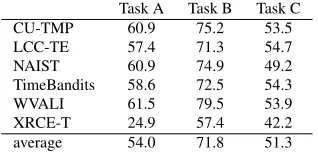
Task A Task B Task C CU-TMP 60.9 75.2 53.5 LCC-TE 57.4 71.3 54.7 NAIST 60.9 74.9 49.2 TimeBandits 58.6 72.5 54.3 WVALI 61.5 79.5 53.9 XRCE-T 24.9 57.4 42.2 average 54.0 71.8 51.3
Table 2: TempEval Accuracy (%)
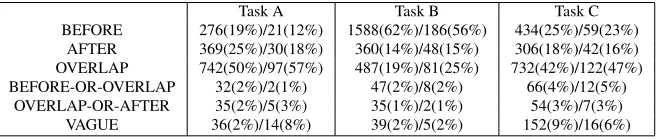
the gold-standard answer for both). Task B was to identify the relationship between the events and the document creation time t13 (BEFORE for e2and OVERLAP for e20). Task C was to identify the relationship between e2 and e20 (OVERLAP-OR-BEFORE). The TempEval07 training data consisted of a total of 162 document. This amounted to a total of 1490 total relations for Task A, 2556 for task B, and 1744 for Task C. The 20 documents of testing data had 169 Task A relations, 337 Task B relations, and 258 Task C relations. The distribution of items by relation type in the training and test data is given in Table 1.
Six teams participated in the TempEval compe-tition. They made use of a variety of techniques, from the application of off-the shelf machine learn-ing tools to “deep” NLP. As indicated in Table 22,
while the tasks varied in difficulty, within each task the results of the teams were, for the most part, com-parable.3
The systems (other than XRCE-T) did somewhat to quite a bit better than baseline on the tasks.
Our focus here is on identifying features of the task that gave rise to difficult, using overall per-formance of the different systems as a metric. Of the 764 test items, a large portion were either ’easy’—meaning that all the systems provided cor-rect output—or ’hard’—meaning none did.
Task A Task B Task C All systems correct 24 (14%) 160 (45%) 35 (14%) No systems correct 33 (20%) 36 (11%) 40 (16%)
In task A, the cases (24/14%) that all participants make correct prediction are when the target relation isoverlap. And, the part-of-speeches of most events
2TempEval was scored in a number of ways; we report
accu-racy of relation identification here as we will use this measure, and ones related to it below
3The XRCE-T team, which made use of the deep analysis
Task A Task B Task C BEFORE 276(19%)/21(12%) 1588(62%)/186(56%) 434(25%)/59(23%)
AFTER 369(25%)/30(18%) 360(14%)/48(15%) 306(18%)/42(16%) OVERLAP 742(50%)/97(57%) 487(19%)/81(25%) 732(42%)/122(47%) BEFORE-OR-OVERLAP 32(2%)/2(1%) 47(2%)/8(2%) 66(4%)/12(5%)
OVERLAP-OR-AFTER 35(2%)/5(3%) 35(1%)/2(1%) 54(3%)/7(3%) VAGUE 36(2%)/14(8%) 39(2%)/5(2%) 152(9%)/16(6%)
Table 1: Relation distribution of training/test sets
in the cases are verbs (19 cases), and their tenses are past(13 cases). In task B, among 160 cases for that every participant predicts correct temporal relation, 159 cases areverbs, 122 cases havebeforeas target relation, and 112 cases are simple past tenses. In task C, we find that 22 cases among 35 cases are reporting:reportingwith overlap as target relation. In what follows we will identify aspects of the tasks that make some items difficult and some not so much so.
3 Analysis
In order to make fine-grained distinctions and to compare arbitrary classes of items, our analysis will be stated in terms of a summary statistic: thesuccess measure(SM).
(1) Success measure
P
k=06kCk
6(Pk=06Ck)
where Ck is the number of items k systems got
correct. This simply the proportion of total correct responses to items in a class (for all systems) divided by the total number of items in that class (a success measure of 1.0 is easy and of 0.0 is hard). For exam-ple, let’s supposebeforerelation have 10 instances. Among the instances, three cases are correct by all teams, four by three teams, two by two teams, and one by no teams. Then, SM of before relation is 0.567 ((3×6)+(4×3)+(2×2)+(1×0)
6×(1+2+4+3) ).
In addition, we would like to keep track of how important each class of errors is to the total evalu-ation. To indicate this, we compute theerror pro-portion(ER) for each class: the proportion of total errors attributable to that class.
(2) Error proportion
P
k=06(6−k)Ck
AllErrorsInT ask×N umberOf T eams
TaskA TaskB TaskC BEFORE 0.26/21% 0.89/23% 0.47/25%
AFTER 0.42/24% 0.56/23% 0.48/17% OVERLAP 0.75/33% 0.56/39% 0.68/31% BEFORE-OR-OVERLAP 0.08/9% 0/3% 0.06/9%
OVERLAP-OR-AFTER 0.03/2% 0/1% 0.10/5% VAGUE 0/19% 0/5% 0.02/12%
Table 3: Overall performance by relation type (SM/ER)
When a case shows high SM and high ER, we can guess that the case has lots of instances. With low SM and low ER, it says there is little instances. With high SM and low ER, we don’t need to focus on the case because the case show very good performance. Of particular interest are classes in which the SM is low and the ER is high because it has a room for the improvement.
3.1 Overall analysis
Table 3 provides the overall analysis by relation type. This shows that (as might be expected) the systems did best on the relations that were the ma-jority class for each task:overlapin Task A,before in Task B, andoverlapin Task C.
Furthermore systems do poorly on all of the dis-junctive classes, with this accounting for between 1% and 9% of the task error. In what follows we will ignore the disjunctive relations. Performance on the beforerelation is low for Task A but very good for Task B and moderate for Task C. For more detailed analysis we treat each task separately.
3.2 Task A
For Task A we analyze the results with respect to the attribute information of the EVENT and TIMEX3 TimeML tags. These are the event class (aspectual, i action, i state, occurrence, perception, reporting, andstate)4part-of-speech (basicallynounandverb), 4The detailed explanations on the event classes
NOUN VERB
and tense&aspect marking for event expressions. In-formation about the temporal expression turned out not to be a relevant dimension of analysis.
As we seen in Table 4, verbal event expressions make for easier classification for before and after (there is a 75%/25% verb/noun split in the data). When the target relation isoverlap, nouns and verbs have similar SMs.
One reason for this difference, of course, is that verbal event expressions have tense and aspect marking (the tense and aspect marking for nouns is simply none).
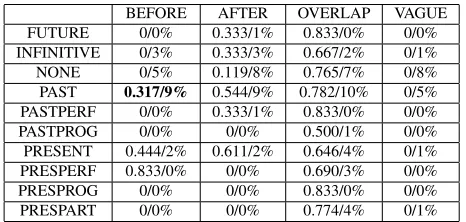
In Table 5 we show the detailed error analy-sis with respect to tense and aspect values of the event expression. The combination of tense and aspect values of verbs generates 10 possible val-ues: future, infinitive, past, perfective, past-progressive (pastprog), past-participle (pastpart), present, perfective (presperf), present-progressive (presprog),andpresent-participle (pres-part). Among them, only five cases (infinitive, past, present, presperf, and prespart) have more than 2 examples in test data. Past takes the biggest por-tions (40%) in test data and in errors (33%). Over-lap seems less influenced with the values of tense and aspect thanbeforeandafterwhen the five cases are considered. Before and after show 0.444 and 0.278 differences betweeninfinitiveandpresentand betweeninfinitiveandpresent. But, overlapscores 0.136 differences betweenpresentandpast. And a problem case is before with past tense that shows 0.317 SM and 9% EP.
When we consider simultaneously SM and EP of the semantic class of events in Table 6, we can find three noticeable cases: occurrenceandreportingof before, and occurrence ofafter. All of them have over 5% EP and under 0.4 SM. In case ofreporting ofafter, its SM is over 0.5 but its EP shows some room for the improvement.
http://www.timeml.org/.
BEFORE AFTER OVERLAP VAGUE FUTURE 0/0% 0.333/1% 0.833/0% 0/0% INFINITIVE 0/3% 0.333/3% 0.667/2% 0/1% NONE 0/5% 0.119/8% 0.765/7% 0/8% PAST 0.317/9% 0.544/9% 0.782/10% 0/5% PASTPERF 0/0% 0.333/1% 0.833/0% 0/0% PASTPROG 0/0% 0/0% 0.500/1% 0/0% PRESENT 0.444/2% 0.611/2% 0.646/4% 0/1% PRESPERF 0.833/0% 0/0% 0.690/3% 0/0% PRESPROG 0/0% 0/0% 0.833/0% 0/0% PRESPART 0/0% 0/0% 0.774/4% 0/1%
Table 5: Tense & Aspect of EVENT in Task A
≤4 ≤16 >16 BEFORE 0/1% 0.322/13% 0.133/6%
AFTER 0.306/5% 0.422/13% 0.500/5% OVERLAP 0.846/10% 0.654/17% 0.619/3% VAGUE 0/0% 0/5% 0/13%
Table 7: Distance in Task A
Boguraev and Ando (2005) report a slight in-crease in performance in relation identification based on proximity of the event expression to the temporal expression. We investigated this in Table 7, looking at the distance in word tokens.
We can see noticeable cases inbeforeandafterof ≤16row. Both cases show over 13% EP and under 0.5 SM. The participants show good SM inoverlap of≤4. Overlapof≤16has the biggest EP (17%). When its less satisfactory SM (0.654) is considered, it seems to have a room for the improvement. One of the cases that have 13% EP isvagueof≥16. It says that it is difficult even for humans to make a decision on a temporal relation when the distance between an event and a temporal expression is greater than and equal to 16 words.
3.3 Task B
Task B is to identify a temporal relation between an EVENT and DCT. We analyze the participants per-formance with part-of-speech. This analysis shows how poor the participants are onafterandoverlapof nouns (0.167 and 0.115 SM). And the EM of over-lapof verbs (26%) shows that the improvement is needed on it.
ASPECTUAL I ACTION I STATE OCCURRENCE PERCEPTION REPORTING STATE BEFORE 0.167/1% 0/0% 0.333/3% 0.067/6% 0/0% 0.364/9% 0/1%
AFTER 0.111/3% 0/0% 0/0% 0.317/9% 0/0% 0.578/8% 0.167/2% OVERLAP 0.917/0% 0.778/1% 0.583/3% 0.787/15% 0.750/1% 0.667/9% 0.815/2%
VAGUE 0/1% 0/1% 0/0% 0/9% 0/0% 0/6% 0/0%
Table 6: EVENT Class in Task A
ASPECTUAL I ACTION I STATE OCCURRENCE PERCEPTION REPORTING STATE BEFORE 1/0% 0.905/1% 0.875/1% 0.818/13% 0.556/1% 0.949/5% 0.750/1%
AFTER 0.500/3% 0.500/1% 0/0% 0.578/15% 0.778/1% 0.333/1% 0.444/2% OVERLAP 0.625/2% 0.405/5% 0.927/1% 0.367/17% 0.500/1% 0.542/6% 0.567/7%
VAGUE 0/1% 0/0% 0/0% 0/4% 0/0% 0/0% 0/0%
Table 9: EVENT Class in Task B
NOUN VERB BEFORE 0.735/6% 0.908/16%
AFTER 0.167/8% 0.667/14% OVERLAP 0.115/13% 0.645/26%
VAGUE 0/4% 0/1%
Table 8: POS of EVENT in Task B
Table 9 shows most errors in after occur with oc-currenceclass 65% (15%/23%) when we consider 23% EP in Table 3.Occurrenceandreportingof be-foreshow noticeably good performance (0.818 and 0.949). Andoccurrenceofoverlaphas the biggest error rate (17%) with 0.367 of SM.
In case ofstate, it has 22 examples (7%) but takes 10% of errors. And it is interesting that the most errors are concentrated instate. In our intuition, it is not a difficult task to identifyoverlaprelation of stateclass.
Table 9 does not clearly show what causes the poor performance of nouns in after and overlap. In the additional analysis of nouns with class in-formation, occurrence shows poor performance in after and overlap: 0.111/6% and 0.083/8%. And other noticeable case in nouns is state of overlap: 0.125/4%. We can see the low performance of nouns inoverlap is due to the poor performance of state andoccurrence, but only occurrence is a cause of the poor performance inafter.
DCT can be considered as speech time. Then, tense and aspect of verb events can be a cue in pre-dicting temporal relations between verb events and DCT. The better performance of the participants in verbs can be an indirect evidence. The analysis with tense & aspect can tell us which tense & aspect formation is more useful. A problem with the
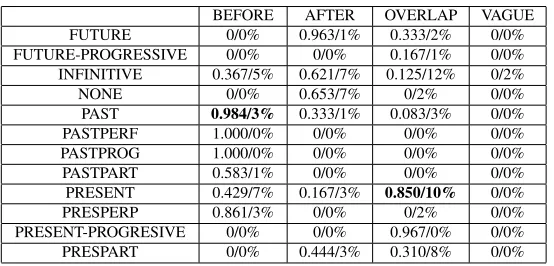
in-formation is sparsity. Most cases appear less than 3 times. The cases that have more than or equal to three instances are 13 cases among the possible combinations of 7 tenses and 4 aspects in TimeML. Moreover, only two cases are over 5% of the whole data:pastwithbefore(45%) andpresentwith over-lap(15%). In Table 10, tense and aspect information seems valuable in judging a relation between a verb event and DCT. The participants show good perfor-mances in the cases that seem easy intuitively: past withbefore,futurewithafter, andpresentwith over-lap. Among intuitively obvious cases that arepast, present, or future tense, present tense makes large errors (20% of verb errors). Andpresentshows 7% EP inbefore.
When events has no cue to infer a relation like infinitive, none, pastpart, and prespart, their SMs are lower than 0.500 except infinitive and none of after. infinitiveofoverlapshows poor performance with the biggest error rate (0.125/12%).
3.4 Task C
The task is to identify the relation between consec-utive main events. There are four part-of-speeches in Task C:adjective,noun,other, andverb. Among eight possible pairs of part-of-speeches, only three pairs have over 1% in 258 TLINKs: nounandverb (4%),verbandnoun(4%), andverbandverb(85%). When we see the distribution of verb andverb by three relations (before, after,andoverlap), the rela-tions show 19%, 14%, and 41% distribution each. In Table 11, the best SM is verb:verb of overlap (0.690). Andverb:verbshows around 0.5 SM in be-foreandafter.
BEFORE AFTER OVERLAP VAGUE FUTURE 0/0% 0.963/1% 0.333/2% 0/0% FUTURE-PROGRESSIVE 0/0% 0/0% 0.167/1% 0/0% INFINITIVE 0.367/5% 0.621/7% 0.125/12% 0/2% NONE 0/0% 0.653/7% 0/2% 0/0% PAST 0.984/3% 0.333/1% 0.083/3% 0/0% PASTPERF 1.000/0% 0/0% 0/0% 0/0% PASTPROG 1.000/0% 0/0% 0/0% 0/0% PASTPART 0.583/1% 0/0% 0/0% 0/0% PRESENT 0.429/7% 0.167/3% 0.850/10% 0/0% PRESPERP 0.861/3% 0/0% 0/2% 0/0% PRESENT-PROGRESIVE 0/0% 0/0% 0.967/0% 0/0% PRESPART 0/0% 0.444/3% 0.310/8% 0/0%
Table 10: Tense & Aspect of EVENT in Task B
BEFORE AFTER OVERLAP VAGUE NOUN:VERB 0.250/2% 0/0% 0.625/1% 0/0% VERB:NOUN 0.583/1% 0.500/2% 0.333/1% 0/1% VERB:VERB 0.500/20% 0.491/15% 0.690/26% 0.220/12%
Table 11: POS pairs in Task C
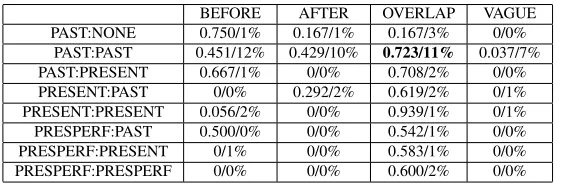
skewed distribution, too. The cases that have over 1% data are eight: past:none, past:past, past:present, present:past, present:present, present:past, presperf:present, and pres-perf:presperf. Among them, past tense pairs show the biggest portion (40%). The performance of the eight cases is reported in Table 12. As we can guess with the distribution of tense&aspect, most errors are frompast:past (40%). When the target re-lation ofpast:pastisoverlap, the participants show reasonable SM (0.723). But, their performances are unsatisfactory inbeforeandafter.
When we consider cases over 1% of test data in main event class pairs, we can see eleven cases as Table 13. Among the eleven cases, four pairs have over 5% data:occurrence:occurrence(13%), occur-rence:reporting (14%),reporting:occurrence(9%), andreporting:reporting(17%).Reporting:reporting shows the best performance (0.934/2%) in over-lap. Two class pairs have over 10% EP: occur-rence:occurrence (15%), andoccurrence:reporting (14%). In addition,occurrencepairs seem difficult tasks when target relations arebefore andafter be-cause they show low SMs (0.317 and 0.200) with 5% and 3% error rates.
4 Discussion and Conclusion
Our analysis shows that the participants have the dif-ficulty in predicting a relation of a noun event when
its target relation isbeforeandafterin Task A, and afterandoverlapin Task B. When the distance is in the range from 5 to 16 in Task A, more effort seems to be needed.
In Task B, tense and aspect information seems valuable. Six teams show good performance when simple tenses such aspast, present, and future ap-pear with intuitively relevant target relations such as before,overlap, andafter. Their poor performance withnoneandinfinitivetenses, and nouns can be an-other indirect evidence.
A difficulty in analyzing Task C is sparsity. So, this analysis is focused onverb:verbpair. When we can see in (12),past pairs still show the margin for the improvement. But, a lot ofreportingevents are used as main events. When we consider that im-portant events in news paper are cited, the current TempEval task can miss useful information.
BEFORE AFTER OVERLAP VAGUE PAST:NONE 0.750/1% 0.167/1% 0.167/3% 0/0%
PAST:PAST 0.451/12% 0.429/10% 0.723/11% 0.037/7% PAST:PRESENT 0.667/1% 0/0% 0.708/2% 0/0% PRESENT:PAST 0/0% 0.292/2% 0.619/2% 0/1% PRESENT:PRESENT 0.056/2% 0/0% 0.939/1% 0/1% PRESPERF:PAST 0.500/0% 0/0% 0.542/1% 0/0% PRESPERF:PRESENT 0/1% 0/0% 0.583/1% 0/0% PRESPERF:PRESPERF 0/0% 0/0% 0.600/2% 0/0%
Table 12: Tense&Aspect Performance in Task C
BEFORE AFTER OVERLAP VAGUE I ACTION:OCCURRENCE 0.524/1% 0.400/2% 0.500/1% 0/0%
I STATE:OCCURRENCE 0.250/1% 0.500/1% 0.833/0% 0/0% I STATE:ASPECTUAL 0/0% 0.333/1% 0.500/0% 0/0% OCCURRENCE:I ACTION 0.583/1% 0.417/1% 0.300/3% 0/0% OCCURRENCE:OCCURRENCE 0.317/5% 0.200/3% 0.600/5% 0/2% OCCURRENCE:REPORTING 0.569/4% 0.367/3% 0.594/5% 0.111/2%
OCCURRENCE:STATE 0.333/1% 0/0% 0.583/1% 0/0% REPORTING:I STATE 0.167/1% 0.583/1% 0.867/1% 0/0% REPORTING:OCCURRENCE 0.625/1% 0.611/3% 0.542/3 0/2% REPORTING:REPORTING 0.167/1% 0.167/2% 0.934/2% 0/4%
Table 13: Event class in Task C
Our analysis can be used as a cue in adding an additional module for weak points. When a pair of a noun event and a temporal expression appears in a sentence, a module can be added based on our study.
References
Branimir Boguraev and Rie Kubota Ando. 2005. TimeML-Compliant Text Analysis for Temporal Rea-soning.Preceedings of IJCAI-05, 997–1003.
James Pustejovsky, Patrick Hanks, Roser Sauri, Andrew See, David Day, Lisa Ferro, Robert Gaizauska, Marcia Lazo, Andrea Setzer, and Beth Sundheim. 2003. The TIMEBANK corpus. Proceedings of Corpus Linguis-tics 2003, 647–656.
Michael Bennett and Barbara Partee. 1972. Toward the logic of tense and aspect in English. Technical report, System Development Corporation. Santa Monica, CA Philip Bramsen, Pawan Deshpande, Yoong Keok Lee, and Regina Barzilay. 2006. Inducing Temporal Graphs Proceedings of EMNLP 2006, 189–198. Nathanael Chambers, Shan Wang, and Dan Jurafsky.
2007. Classifying Temporal Relations Between Events Proceedings of ACL 2007, 173–176.
Inderjeet Mani, Marc Verhagen, Ben Wellner, Chong Min Lee, and James Pustejovsky. 2006. Machine Learn-ing of Temporal Relations.Proceedings of ACL-2006, 753–760.
Chong Min Lee and Graham Katz. 2008. Toward an
Automated Time-Event Anchoring System. The Fifth Midwest Computational Linguistics Colloquium. Hans Kamp and Uwe Reyle. 1993. From Discourse
to Logic: Introduction to modeltheoretic semantics of natural language. Kluwer Academic, Boston. James Pustejovsky, Jos´e Casta˜no, Robert Ingria, Roser
Saur´ı, Robert Gaizauskas, Andrea Setzer, and Graham Katz. 2003. TimeML: Robust Specification of Event and Temporal Expressions in Text. IWCS-5, Fifth In-ternational Workshop on Computational Semantics. Marc Verhagen, Robert Gaizauskas, Frank Schilder,
Mark Hepple, Graham Katz, James Pustejovsky. 2007. SemEval-2007 Task 15: TempEval Tempo-ral Relation Identification. Proceedings of SemEval-2007, 75–80.
Caroline Hag`ege and Xavier Tannier. 2007 XRCE-T: XIP Temporal Module for TempEval campaign. Pro-ceedings of the Fourth International Workshop on Se-mantic Evaluations (SemEval-2007), 492–495. Steven Bethard and James H. Martin. 2007. CU-TMP:
Temporal Relation Classification Using Syntactic and Semantic Features. Proceedings of the Fourth Interna-tional Workshop on Semantic Evaluations (SemEval-2007), 129–132.
Congmin Min, Munirathnam Srikanth, and Abraham Fowler. 2007. LCC-TE: A Hybrid Approach to Tem-poral Relation Identification in News Text. Proceed-ings of the Fourth International Workshop on Semantic Evaluations (SemEval-2007), 219–222.
Identification Using Dependency Parsed Tree. Pro-ceedings of the Fourth International Workshop on Se-mantic Evaluations (SemEval-2007), 245–248. Georgiana Pus¸cas¸u. 2007. WVALI: Temporal Relation
Identification by Syntactico-Semantic Analysis Pro-ceedings of the Fourth International Workshop on Se-mantic Evaluations (SemEval-2007), 484–487. Mark Hepple, Andrea Setzer, and Robert Gaizauskas.