Volume 3, No. 4, July- August 2012
International Journal of Advanced Research in Computer Science
RESEARCH PAPER
Available Online at www.ijarcs.info
ISSN No. 0976-5697
Enchanced Automatic Offline Character Image Pre-processing and Recogintion Using
Single Layer Network
R.Radha*
Department of Computer science SDNB vaishnav college
Chennai,India
R.R.Aparna
Department of Computer science BCC college
Bangalore , India [email protected]
Abstract: In this paper the pre-processing, feature extraction phases, classification and recognition of an offline handwritten numeric character are discussed.. This paper discusses in detail some of the algorithms used in the pre-processing stages of an offline handwritten numeric character in the form of an image file and digit recognition using artificial neural network. This paper serves as the beginning part of a future research work that aims at recognizing handwritten isolated and cursive alphabets.. The pre-processing phase starts from reading in the input file, the process of binarization, filtering, edge enhancement, segmentation and feature extraction of the character image for further use in the next stage of labeling and recognition process by neural network. The handwritten digits considered here are non-slant characters with less noise but feature varies from writer to writer
Keywords: Pre-processing; feature extraction; chain-code;binarization; handwritten character;unsharp masking, single- layer neural network.
I. INTRODUCTION
The objective of computer vision or the machine is to imitate the human ability to read and recognize handwritten script (offline). This is the objective of optical character recognition (OCR), or sometimes specifically referred as handwritten character recognition (HCR) research. Handwriting recognition is the task of converting the manuscript or handwritten data into image format (digital format) either by scanning the writing on paper or by writing with a special pen on an electronic surface such as a digitizer combined with a liquid crystal display. The two approaches are respectively distinguished as off-line and online handwriting. This proposed research concentrates only on Off-line handwriting processing. Many commercial systems for OCR exist for a variety of applications. Text detection and character recognition, which is known as Optical Character Recognition (OCR) has become one of the most successful applications of technology in the field of pattern recognition and artificial intelligence. In section 2 the background work in this field is explained. In section 3 the proposed system structure is given. In section 4 the pre-processing stages and the feature extraction with chain-coding technique is explained. In section 6 Recognition of the digit using single layer neural network and recognition accuracy of the digit is discussed .In section 7 the future work is discussed and section 8 gives the conclusion.
II. LITERATUREREVIEW
There has been a growing interest in the development of methods for detecting, localizing and segmenting text from images. Mohanad Alata and Mohammad Al-Shabi[1] in their research presents an algorithm and software to detect and recognize character in an image. Three types of fonts, namely Verdana, Arial and Lucida Console were taken for study. The font size will be within the range of 17–29 font size. They used in their algorithm 8-connected component to
binarize the image and to find the characters in the image and recognize them. As the previous works adopts the histogram methods for finding binarization which may create negative text when the text and background colors are very similar, they said their approach better as it will take each color alone. They also compared their proposed algorithm with others. Nor Amizam Jusoh and Jasni Mohamad Zain [2] in their research work focused on conducting an experiment using chain codes technique to perform recognition for different types of fonts used in Malaysian car plates. They say even if their algorithm which uses connected component achieves an accuracy of 95.45% than pixel count technique (85.45% accuracy) which the other research work used, 100% accuracy is not able to achieve through their method because of different font sizes, thickness etc used in Malaysian car number plates. Yan Cheng Cheok [3] has proposed a new matching algorithm for chain codes using java. M. Pietik¨ainen and O. Okun [4] proposed a simple method based on edge detectors, such as the Sobel operator, for document image filtering and text extraction. Richard G. Casey and Eric Lecolinet[5] proposes a survey on character segmentation methods. In [6], Wu evaluated a local threshold between background colors and text colors and then generated binary images simultaneously. Filters can be designed for smoothing [7], sharpening [8], thresholding [9]. Various morphological operations can be designed to connect broken strokes [10] and extract boundaries [11]. Jukka livarinen and Ari Visa [12] proposed a new approach to object recognition.
Chain Code(FCC) and it can discard most of the possible corners by computing the sum of the difference, so by calculating less points of curvature, the corners are easily get. Meanwhile this algorithm has strong robustnessfor the noise in the line, the algorithm can effectively filter the noise points without denoising. Herbert Freeman [16] in his paper describes various forms of line drawing representation, compares different schemes of quantization and reviews the manner in which a line drawing can be extracted from a tracing or a photographic image.
He compared various encoding schemes and suggested that the chain code is the most convenient for irregular line drawings. S. Hoque et al. in their paper [17] proposed a novel approach to classify handwritten characters based on a directional decomposition of the corresponding chain-code representation. This is alternative to previous transformations of the chain-codes proposed by the authors, namely the ordered and random decomposition of the bit-planes resulting from the binary representation of the chain-codes. Subsequently they utilize the sntuple classifiers to integrate the complimentary information encapsulated in all three transformations into a more powerful and robust character recognition system. Dayashankar Singh et al. [18] In their paper have applied a new feature extraction technique to calculate only twelve directional feature inputs depending upon the gradients. Features extracted from handwritten characters are directions of pixels with respect to their neighboring pixels. These inputs are given to a back propagation neural network with one hidden layer and one output layer. They show that their approach provides better results as compared to other techniques in terms of recognition accuracy, training time and classification time.
The work carried out in this paper is able to recognize all type of handwritten characters even special characters in any language.S.Knerr, L.Personnaz,et al [21].In their work they have used single-layer network training and they have introduced the STEPNET procedure for recognition of handwritten digits. Faisal Tehseen Shah, Kamran Yousaf [22] in their work they took sample image of size 16*16 pixel for each digit and they used MLP for image recognition. In our work the main advantage is there is no size limitation for the image, the image can be of any size is pre processed and its normalized chain code is obtained. The obtained normalized chain code is converted to bipolar values and sent as input to SLP for image recognition.The result obtained was 90-100% accuracy of digit recognition was performed.
III. THEPROPOSEDSYSTEMSTRUCTURE
The CR research was focused basically on the shape recognition techniques. The image file of an offline handwritten character will have to undergo the process of pre-processing, feature extraction and recognition. Each of the phases plays an equally important role in a HCR system. The continuing sections in this paper concentrate on the discussion of the pre-processing and recognition techniques of this research work.”Fig 1”
Figure 1. System Structure
IV. PRE-PROCESSINGPHASES
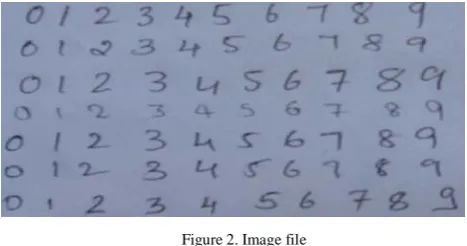
The raw data of handwritten characters, will be subjected to a number of pre-processing steps to make it useable. The obtained image is of very less or no noise. Filters are used for sharpening. Various morphological operations can be done .In this research work a minimal number of pre-processing processes are used. The pre-pre-processing steps are shown below. An image file containing 450 samples of handwritten digit (0 to 9) was collected from various people of different hand writing. Every digit(image) is read and binarized. For this purpose we have taken the image (handwritten samples) from manuscript using Canon digital camera. Then the image is scanned for further use. Now the input image undergoes the following pre-processing phases. “Fig 2”.The image file containing the samples
Figure 2. Image file
From this image file the individual digit sample is taken and 50 sets of samples for every digit were created. Each digit sample is undergoes pre-processing techniques as follows.
A. Methodology for image pre-processing:
Step 1: RGB image is converted to grayscale. “Fig 3” Step 2: Segmenting the image in which binarization is done through thresholding. (Appropriate thresholding value is supplied). “Fig 4”
Figure 3. Grayscale Figure 4. Binarized image
Step 4: Edges are detected and clear visibility of edges is obtained by applying Prewitt filters. “Fig 6” [12][19]
Figure 5. Unsharp Masking Figure 6. Prewitt Filter
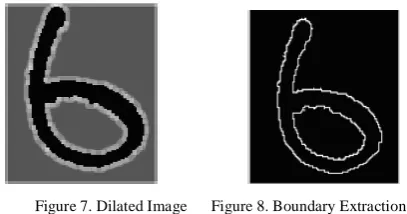
Step 5: Dilation is performed and the boundary of the image is detected by applying Boundary Extraction Method. “Fig 7 & 8” [19]
Figure 7. Dilated Image Figure 8. Boundary Extraction
There is a notable difference in the image obtained by the Prewitt Filter “Fig 6” and in the image obtained after applying boundary extraction algorithm “Fig 8”.A definite boundary is achieved using Boundary Extraction algorithm.
II. TECHNIQUES USED
A. Chain code extraction and Normalization:
The chain code provides a storage-efficient representation for the boundary of an object in a binary image. The chain code representation incorporates such pertinent information as the length of the boundary of the encoded object, its area and moments. Chain code lend to efficient calculation of certain curve parameters. Additionally, chain codes are invertible in that an object can be reconstructed from its chain code representation.
Basically when extracting chain code two types of boundaries has to be considered: 4-connectd and 8-connected. If the boundary is 4-connected, there are four possible directions in which to walk. If the boundary is 8-connected, there are eight possible directions. Chain codes based from this scheme are known as Freeman chain codes.
The “Figure 9 &10” gives directions of 4-connectedness and 8 connectedness
Figure 9. 4-connected Figure 10. 8-connected
Figure 11
“Fig.11 a & b” A 4-connected object and its boundary;( c & d) Obtaining the chain code from the object in (a & b) with (c) for 4-connected and (d) for 8-connected According to [23], chain codes are a linear structure that results from quantization of the trajectory traced by the centers of adjacent boundary elements in an image array. A chain code can be generated by following a boundary of an object in a clockwise direction and assigning a direction to the segments connecting every pair of pixels. First, we pick a starting pixel location anywhere on the object boundary. Our aim is to find the next pixel in the boundary. There must be an adjoining boundary pixel at one of the eight locations, surrounding the current boundary pixel. By looking at each of the eight adjoining pixels, we will find at least one that is also a boundary pixel. Depending on which one it is, we assign a numeric code of between 0 and 7 as already shown in Figure 9. For example, if the pixel found is located at the right of the current location or pixel, a code “0” is assigned. If the pixel found is directly to the upper right, a code “1” is assigned.
The process of locating the next boundary pixel and assigning a code is repeated until we came back to our first location or boundary pixel. The result is a list of chain codes showing the direction taken in moving from each boundary pixel to the next. The same way we can do for a 4-connected boundary.The process of finding the boundary pixel and assigning a code for 4-connected boundary and 8-connected boundary are shown in Figure 8 and Figure 9 respectively. Chain codes have been claimed as one of the techniques that are able to recognize characters and digits successfully [24]. This is because of several advantages possessed by this technique as listed by [25]. The first advantage over the representation of a binary object is that the chain codes are a compact representation of a binary object. Second, the chain codes are a translation invariant representation of a binary object. Due to that, it is easier to compare objects using this technique. The third advantage is that the chain code is a complete representation of an object or curve. This means that we can compute any shape feature from the chain codes. According to [26], chain codes provide a lossless compressing and preserving all topological and morphological information which bring out another benefit in terms of speed and effectiveness for the analysis of line patterns.
a. Start by finding the pixel in the object that has the left-most value in the topmost row; call this pixel P0
b. Define a variable dir (for direction) and set it equal to 7 (since P0 is the top-left pixel in the object, the direction to the next pixel must be 7).
c. Traverse the 3x3 neighbourhood of the current pixel in a counter-clockwise direction, beginning the search at the pixel in direction
dir + 7 (mod 8) if dir is even or dir + 6 (mod 8) if dir is odd.
This will sets the current direction to the first direction counter-clockwise from dir:
dir 0 1 2 3 4 5 6 7 dir + 7
(mod 8)
7 0 1 2 3 4 5 6
dir + 6 (mod 8)
6 7 0 1 2 3 4 5
d. The first foreground pixel will be the new
boundary element. Update dir.
e. Stop when the current boundary element Pn is equal to the second element P1 and the previous boundary pixel Pn-1 is equal to the first boundary element P0.
B. Normalization of chain code:
Feature extraction is performed by implementing chain code using connectivity. “Fig.10” [15] [17][12].The obtained chain code is normalized since the original chain code (8-connetecdenss) for digit 6 “Fig. 10” results in 245 digits. The chain code varies for different images based on the size. This has to be normalized by using the following steps:
a.The frequency of occurrence (CF) of the same digit is calculated and the sum value of CF is calculated and it is equal to the length of the chain code obtained.
∑
CF
=CF
1+
CF
2+
...
+
CF
n (1)b. Further normalize the chain code by dividing the individual frequency of occurrence of digit by total chain code frequency and to reduce the (length) number of digits to 10.
Normalized Frequency= (2) Finally we obtain a chain code of 10 digits. The same method can be applied to all other digits and the normalized chain codes are obtained.
C. Bipolar coding:
The normalized chain codes are converted to bipolar coding where -1 is assigned to the attribute value of less than .5 and 1 to attributes greater than or equal to .5 .These bipolar converted input values are supplied as training data in to the neural network.
D. Single Layer Feed Forward Neural Network(SLP):
Neural networks, with their remarkable ability to derive meaning from complicated or imprecise data, can be used to extract patterns and detect trends that are too complex to be noticed by either humans or other computer techniques. An artificial neuron is a device with many inputs and one
output. The neuron has two modes of operation; the training mode and the using mode. In the training mode, the neuron can be trained to fire (or not), for particular input patterns. In the using mode, when a taught input pattern is detected at the input, its associated output becomes the current output. If the input pattern does not belong in the taught list of input patterns, the firing rule is used to determine whether to fire or not. A trained neural network can easily associate and recognize the given test data.
E. Architecture of SLP:
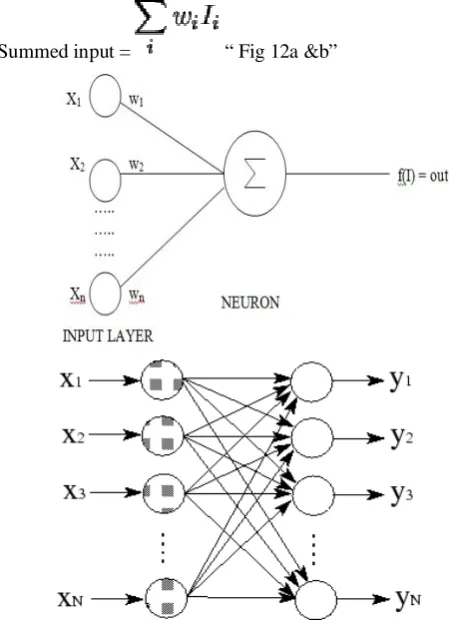
A single layer perceptron is the simplest form of neural network used for classification of patterns that are linearly separable. It consists of single neuron with adjustable weights and bias. The input layer consists of input neurons from X1….XN. There always exists a common bias of ‘1’.The
input neurons are connected to the output neurons(Y1..YN)
through weighted interconnections. It is a single layer network because it has only one layer of interconnections between the input and the output neurons. This network perceives the input signal received and performs the classification. It uses the perceptron algorithm for several output classes. Input nodes (or units) are connected (typically fully) to a node (or multiple nodes) in the next layer. A node in the next layer takes a weighted sum of all its inputs:
Summed input = “ Fig 12a &b”
Figure 12. Single layer feed forward network
The model then used a threshold function to determine whether the neuron should fire. If the weighted sum of the inputs was greater than this threshold value the neuron would fire positively (1), otherwise negatively (0).
F. Supervised Lerning:
Supervised learning is the training of networks by inputting known sets of input and output data. We adjust the weights (using algorithms) until the model gives satisfactory output when provided with the known input.
V. RESULTSANDDISCUSSIONS
For our work a single layer perceptron network is constructed using MATLAB. This research work was carried on 500 samples and the normalized chain code(bipolar input) is extracted. The network is constructed with 8 input neurons and 8 output neurons inclusive of bias and weights. It uses perceptron algorithm for several output classes. [27]The following steps are performed.
Step 1: Initialize the weight(w) and bias(b). Set learning rate.
Step 2: When stopping condition is false perform steps 3-7. Step 3: For each input training pair, do steps 4-6.
Step 4: set activation for the input units. Xi=Si for i= 1 to n
Step 5: compute the activation output of each output unit Y-
inj=bj+ i i
i
x w
∑
for j= j=1 to m. (4)
y f y
j=(
−inj)
=
1,
0
0,
1,
inj
inj
inj
y
if
y
y
θ
θ
θ
−
−
−
>
− ≤
≤
−
< −
(5)
Step 6: The weights and bias are updated for j=1 to m and i=1 to n.
If yj≠tj and xi≠0 then,
wij(new)=wij(old)+αtjxi. (7)
bj(new)=bj(old)+αtj
Else if
wij(new)=wij(old) (8) bj(new)=bj(old)… iIe.bias and weights remain unchanged.
Step 7: Test for stopping condition
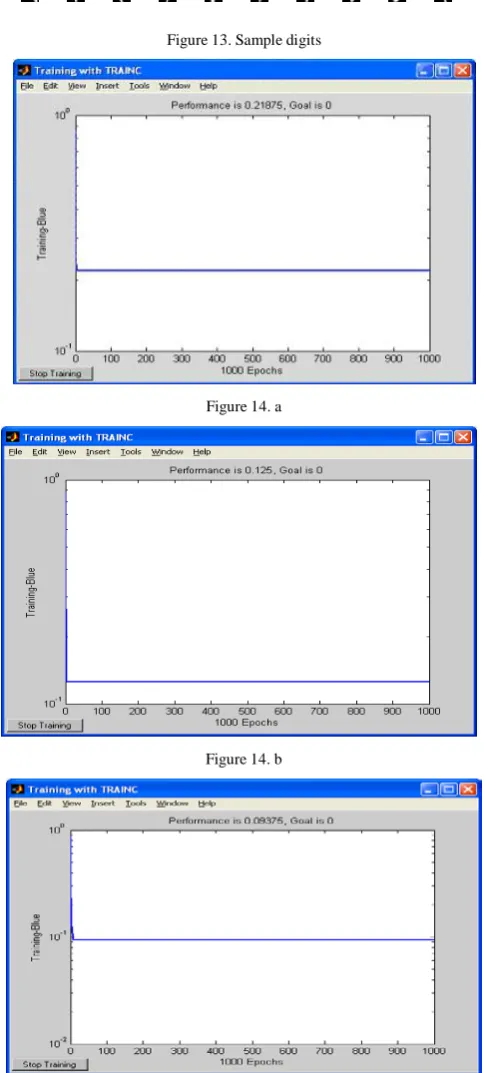
The single layer perceptron (newp) network was trained with different samples of same digit and tested with different samples of it. “Fig.13”. Hardlim transfer function(Transfer functions calculate a layer's output from its net input) and TRAINC training function were used.
TRAINC trains a network with weight and bias learning rules with incremental updates after each presentation of an input. Inputs are presented in cyclic order. For each epoch, each vector (or sequence) is presented in order to the network with the weight and bias values updated accordingly after each individual presentation. Training stops when any of these conditions are met:1)The maximum number of epochs (repetitions) is reached.2)Performance has been minimized to the goal. 3)The maximum amount of time has been exceeded.
The network is trained with 50 samples of each digit and tested with 30 instances of same digit and trained with 20 instances of it. 90 to 100% accuracy was achieved. Epochs was set to 1000. “Fig.14 a,b&c” shows training for digits 0,1and 2. It was noted that even with lesser training data and the recognition accuracy was very high.
Figure 13. Sample digits
Figure 14. a
Figure 14. b
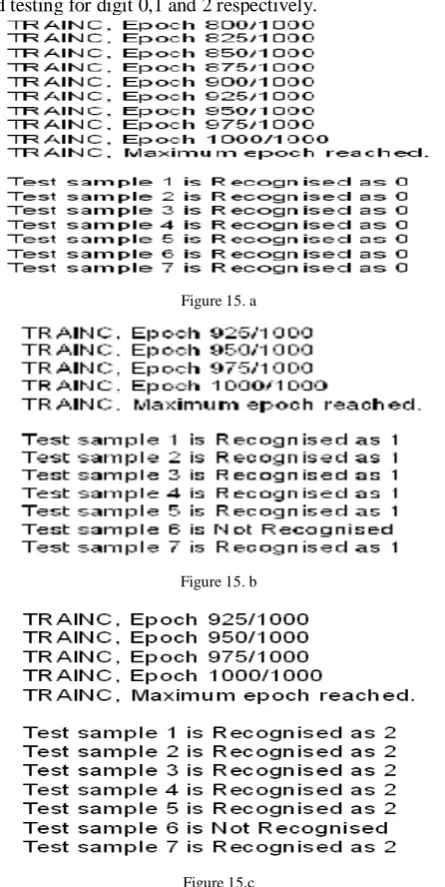
The accuracy obtained was 90-100%.The following “Fig. 14 a,b &c” displays the various accuracy rates of digit 0,1 and 2.The accuracy of the remaining digits were also observed to be consistent. Hence it is achieved that using single layer network a linearly separable classification like digit recognition was performed on sample digits belongs to same category. Since single layer of adaptive weights were used between the input units and output uints, it was easy for recognizing sample digits belongs to same category. When attempted to train and test samples of different digits (combination of 0 to 9) the accuracy obtained was between 40 -60%.The following “Fig.15a,b &c” displays the training and testing for digit 0,1 and 2 respectively.
Figure 15. a
Figure 15. b
Figure 15.c
VI. CONCLUSION
Thus this paper mainly deals with the steps we have carried over in extracting the feature of the given character using various image processing techniques. Chain code algorithm is used to extract the features of the given character. By using the above mentioned methods we can easily obtain and normalize the chain codes of any handwritten numeric character and these can be sent as inputs(bipolar) to neural network and the digits are well recognized. It was found that to construct more general
functions many layers are required. Thus the future work concentrates on the further processing of digit recognition of sample set (0-9)using the MLP and fuzzy systems for more generalized function analysis.[20].
VII.REFERENCES
[1]. Mohanad Alata and Mohammad Al-Shabi. “Text detection and character recognition using fuzzy image processing”.Journal of electrical engineering, 57, 5,2006.
[2]. Nor Amizam Jusoh and Jasni Mohamad Zain. “ Application of Freeman Chain Codes: An Alternative Recognition Technique for Malaysian Car Plates”. IJCSNS International Journal of Computer Science and Network S 222 ecurity, 9,11, 2009.
[3]. Yan Cheng Cheok. “Handwritten Digit Recognition By using libnumrecognition.
”http://sourceforge.net/projects/numrecognition/.Version 1.1,2005
[4]. Pietik¨Ainen, M.Okun. “Text Extraction from Grey Scale Page Images by Simple Edge Detectors”, Proceedings of the 12th Scandinavian Conference on Image Analysis,Bergen, Norway,2001.
[5]. Richard G. Casey and Eric Lecolinet. “A survey of methods and strategies in charater segmentation”. ENST Paris.
[6]. V. Wu, R. Manmatha, and E.M. Riseman.“Textfinder:An automatic system to detect and recognize text in images”.IEEE Trans. on PAMI, Vol.20,1999.
[7]. Legault R. and Suen C.Y.“Optimal local weighted averaging methods in contour smoothing”, IEEE Trans. PAMI, vol.18.1997
[8]. Leu, J.G.“Edge Sharpening through ramp width reduction”. ImageVis. Comput., vol. 18, no. 6-7, pp. 501-514,2000.
[9]. Solihin, Y. and Leedham C.G.“Integral ratio: A new class of global thresholding techniques for handwriting images”, IEEE Trans. PAMI, vol.21, pp. 761-768,1999.
[10]. Atici, A. and Yarman-Vural, F. A. “Heuristic Method for Arabic Character Recognition”, Signal Process, vol. 62, pp. 87-99,2001.
[11]. Yang, J. and Li, X.B.“ Boundary Detection using mathematical morphology”, Pattern Recognition Letters, vol. 16, no.12, pp. 1287-1296,1995.
[12]. Jukka livarinen and Ari Visa. “Shape recognition of irregular objects”,Helsinki University of Technology,Laboratory of computer and information science,Finland.
[13]. Bo Yu; Lei Guo, Xiaoliang Qian and Tianyun Zhao, A Corner Detection Algorithm Based on the Difference of FCC, International Conference On Computer Design And Applications (ICCDA 2010), vol 4, Page(s): 226 - V4-229, (2010).
[15]. H. Hasan, H. Haron & S. Z. Mohd Hashim, “The Framework of Image Recognition Based on Modified Freeman Chain Code”, Faculty of Computer Science and Information System (FSKSM) Universiti Teknologi Malaysia, Skudai, 81310, Malaysia.
[16]. H. Freeman.“ Computer processing of line-drawing images”. ACM Computing Surveys, 6(1):57–98.1974.
[17]. S. Hoque, K. Sirlantzis, M. C. Fairhurst, “A New Chain-code Quantization Approach Enabling High Performance Handwriting Recognition based on Multi-Classifier Schemes”, Department of Electronics, University of Kent, Canterbury, Kent, United Kingdom.
[18]. Dayashankar singh,Snajay Kr. Singh, Maitreyee Dutta, “ Hand Written Character Recognition Using Twelve directional feature input and neural network”. International Journal of Computer Applications, 1, 3.
[19]. Alasdair McAndew. “Introduction to digital image processing with matlab”, Cengage Learning, United states, 2004.
[20]. S.Sridhar.”Digital image Processing”,Oxford university press, New Delhi,2011.
[21]. S. Knerr,L.Personnaz,G.Dreyfus.“ Handwritten Digit Recognition by Neural Networks with Single-Layer
Training Processing”,IEEE Transactions on neural networks, vol. 3, 962 ,1991.
[22]. Faisal Tehseen Shah, Kamran Yousaf. “Handwritten Digit Recognition Using Image Processing and Neural Networks”, Proceedings of the World Congress on Engineering Vol I WCE , July 2 - 4, London, U.K.2007.
[23]. S. Madhvanath, G. Kim and V. Govindaraju, “Chaincode Contour Processing for Handwritten Word Recognition”, IEEE Transactions on Pattern Analysis and Machine Intelligence, Vol. 21, No. 9,1999.
[24]. Jahne, B.“Digital Image Processing”. Springer, New York:,6th ed.2005.
[25]. Seul et al.“Practical Algorithms for Image Analysis: Description, Examples and Code”. edisi kebrp. USA: Cambridge University Press.1999.
[26]. McAndrew, A.“Introduction to Digital Image Processing With Matlab”. USA: Thomson Course Technology. :pg353,2004