BER COMPARISON BETWEEN CDMA & COFDM
MODEL
Sandeep Kumar Nigam, Prof. Kavita Kamerikar
Research Scholar, Professor, Department of ECE,
TIT College, Bhopal (India)
ABSTRACT
The work emphasizes the suitability of Coded orthogonal Frequency Division Multiplexing (COFDM) which is
a technique of modulation for 3G transceiver system. The performance of a COFDM system may be affected
due to the main factors which were measured comprising of channel noise, multipath delay spread, distortion of
the signal (clipping) & requirement of timing. Using MATLAB to access the performance of COFDM the
computer simulations is performed [18].
In the 3rd generation mobile phone system CDMA modulation techniques is mainly proposed for Code Division Multiple Accesses (CDMA). For the comparison between the two techniques to be established Code Division
Multiple Access was used. It was observed and found on examination that a very high tolerance to channel
noise, peak power clipping, and multipath delay spread as was provided by COFDM [12].
On observation total immunity to multipath delay spread was found in COFDM and provided less reflection
time as compared to the guard interval used in COFDM signal.
We are aware that multipath signal would provide strengthening to the received signal. Corresponding to
multipath reflection of 30 km, delay spread up to 100μsec could be borne.
Frequency selective fading strikes a problem due to the multipath and due to this the thing which comes into the
picture is that the received signal is heavily attenuated as well as interference comes into existence.
Key words: COFDM (Coded Orthogonal Frequency Division Multiplexing), CDMA (Code Division
Multiplexing), SNR (Signal to Noise Ratio), BER (Bit Error Rate), IFFT (Inverse Fast Fourier
Transform)
I INTRODUCTION
Since the customer based is very small in rural areas due to which the telecom industry faces the problem in
providing telephone services and the installation cost is exorbitant. By fixing wireless radio network a method
for the high infrastructure cost reduction of a wired system is possible. Another problem arises which is to get
sufficient coverage in rural and urban areas which can be overcome by using large cell sizes (requirement)
Due to delay time in multipath signal propagation many other problems arise. GSM technology in the current
scenario is being applied in the rural areas of Australia since fixed wireless phone system use time division
multiple access (TDMA) which has a symbol rate. Inter-Symbol Interference (ISI) leads to problems with
For the digital phone systems many next generation techniques is currently under consideration having an aim
of improving multipath immunity, cell capacity and flexibility which includes CDMA & COFDM. The
application of both these techniques can be applicable for providing a fixed wireless system for rural areas. The
accountability for making it more suitable is that each technique has different properties for specific
applications.
In several new radio broadcasting system is currently is being used including the proposal for digital audio
broadcasting (DAB) & high definition digital television (HDTV). Very few researches have been made for the
use COFDM as a transmission method in mobile telecommunications systems.
Using broad band frequency basis for all users of CDMA transmit specialized codes which is known by the
mobile station as well as base station demodulating the sent data.
CDMA has a comparison with wireless telecommunications based on COFDM as a modulation technique
allowing many users to transmit in an allocated band further sub dividing the available bandwidth to several
narrow carriers. Data is transmitted by the allocation of several carriers by each user. Transmission is generated
such that the carriers use must be orthogonal to each other allowing carriers too much closer compare to
standard frequency division multiplexing (FDM) hence OFDM/COFDM provides high spectral efficiency.
II LITERATURE REVIEW
On the basis of survey and study various literature and their relationship correlates with COFDM and CDMA
technologies.
During 1994 spread spectrum signaling was economically viable and was at its peak and thus being attracted
and attached to this technology were many people (individuals) and companies in numerous numbers
Ways & means to benefit were created through spread spectrum techniques in products & commercial systems.
In this write up we shall discuss and consider applications to satellite mobile communications and indoor mobile
communications in a brief overview. [1] For the future 3rd generation mobile radio system, currently the trend
would be beneficial & viable interface would have code division multiple access. The problems in numbers that
would crop up would have to be solved by architects / network planners [2]. In order to cater to the category of
successful operation of direct sequence (DS) CDMA Handoff will play a pivotal role. To address DS-CDMA air
interface would take care of 3rd generation. [16]
Because the broadcasters are testing on small groups the interactive televisions, by using personal computers
(PC) millions of working on interactive media linked to the interface by the phone lines. How interactive media
will work commercially in future and the activities of this online population is the blueprint for this. The
development of the technology and its future use is the discussion of the author in this. [3].
III PURPOSE OF STUDY
By using BPSK techniques and its comparison with CDMA is the object of the study related to investigate the
error and signal power suitability for COFDM and CDMA 3rd generation wireless communication which
includes two major steps namely the design of COFDM transmitter-receiver scheme then to apply BPSK
In the field of communication engineering in order to visualize the suitability of a wireless standard for a
communication system is the most critical selection.
Main sources of the errors are phase noise of the transmitter, problems related to frequency stability along with
other problems of frequency offset errors between the transmitter and receiver and the main weak point was
found that the COFDM was very sensitive to phase errors between the transmitter and receiver and frequency
which was the review of literature.
IV CDMA SIMULATION MODEL
4.1 Forward Link
To separate the user’s orthogonal Walsh codes was used as a forward link of CDMA system model. In order to
spread the data which is to be transmitted every individual user is allocated of Walsh code randomly.
Through a radio channel model from all the users are combined together which allows for clipping of the signal
& adding Gaussian noise to the signal & multipath interference.
By using the Walsh code after the received signal is de spread which was used by the transmitter to demodulate
the signal and same was used by the receiver. This is sub sampled to the original date rate by using an integrator
& dump filter along with a comparator to ascertain whether the data was 1 or a 0. To calculate the bit error rate
(BER) the original data transmitted is compared to the received data.
After the signal level has been demodulated as well as filtered, working out of RMS amplitude is also done
which is then compared with the amplitude expected of the signal on the transmitted data base which directly
relates to the bit error rate and is the RMS amplitude error, a measurement of use.
The model for the simulation of CDMA forward link [13] is shown in figure below.
Fig-1, Model used for CDMA forward link
4.2 Reverse Path
The CDMA link was similar to that of forwards link and the reverse was the simulation, except by using the
orthogonal Walsh codes. The use of orthogonal codes is extremely difficult since accurate synchronizing have
enough difficulties in a reverse link from mobile to the base station. Due to this simply long pseudo random
4.3 Parameter Value
Process gain (Antenna) 64db
Total words 64*10
No of users 10 & 30
SNR 300db (constant)
Fig-2, Simulation result of CDMA model for 10 user & 30 user respectively
4.3 BER verses the number of users in a cell
Pseudo random noise codes (PN codes) has reverse link of the CDMA system from the base station to the
mobile & they used non orthogonal codes leading to each user interfering with each other. Each user has its
own unique pseudo random sequence code which result in the signal appearing as a noise to other users as signal
transmitted by each user is uncorrelated with each other.
As the number of uses increases in same cell of the CDMA system, BER will increases. The result is for an
isolated cell with no channel noise, with no multipath effect & with no interference effect from neighboring
cells. From the above figure BER becomes extremely significant & large if the no of users is greater than 8
which represent only 12.5 % of 64 users of the total user capacity. By using advance forward error correction,
voice activity detection & cell sectorization the maximum no of user can be increased.
From the above figure it is clear that the weak point in the CDMA system is in the reverse link limiting the cell
capacity to 8-12 users approx.
V COFDM SIMULATION MODEL
Using MATLAB modeled with a COFDM system for verification and testing various parameters of the system
and the objective for doing the simulation was to evaluate under different channel conditions the performance of
COFDM system as well as to allow testing of different COFDM configurations. In order to measure
performance of COFDM system four main criteria were used, which provides tolerance to peak power clipping,
5.1 COFDM Model Used
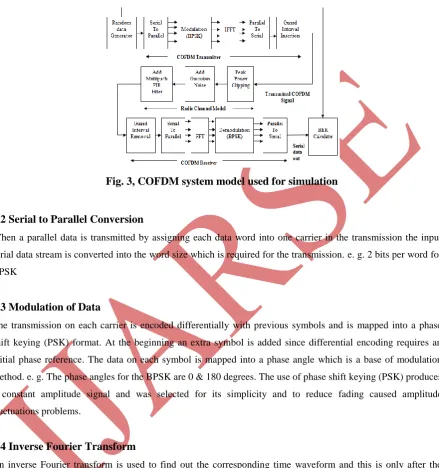
A brief description of the OFDM system model [12] using MATLAB can be understood by the below
mentioned figure
Fig. 3, COFDM system model used for simulation
5.2 Serial to Parallel Conversion
When a parallel data is transmitted by assigning each data word into one carrier in the transmission the input
serial data stream is converted into the word size which is required for the transmission. e. g. 2 bits per word for
BPSK
5.3 Modulation of Data
The transmission on each carrier is encoded differentially with previous symbols and is mapped into a phase
shift keying (PSK) format. At the beginning an extra symbol is added since differential encoding requires an
initial phase reference. The data on each symbol is mapped into a phase angle which is a base of modulation
method. e. g. The phase angles for the BPSK are 0 & 180 degrees. The use of phase shift keying (PSK) produces
a constant amplitude signal and was selected for its simplicity and to reduce fading caused amplitude
fluctuations problems.
5.4 Inverse Fourier Transform
An inverse Fourier transform is used to find out the corresponding time waveform and this is only after the
spectrum requirement is worked out. To the guard period, start of each symbol is done.
5.5 Guard Period
Amplitude transmission time for half the guard period was zero & the other is a cyclic extension of the symbol
to be transmitted and for this two section were made up for the guard period used. The symbol timing was
allowed for easy envelope detection. Since accurate determination of the position of the sample, it was not
required in any of the simulation. Baseband signal for COFDM transmission in which symbols were converted
5.6 Channel
A channel model is applied to the transmitted signal aligning the signal to noise ratio, multipath and the clipping
to be controlled for its peak as well as adding of known amount of white noise to be transmitted signal to noise
ratio is set. Delay spread is then added by using an FIR filter multipath delay spread by simulating. Maximum
delay spread represents the length of FIR while the reflected signal magnitude correlates to the coefficient
amplitude.
5.7 Receiver
The operation of receiver is the reverse operation of transmitter and the guard period is removed. The FFT of
each symbol is taken for finding out the original transmitted spectrum. The phase angle of each transmission
carrier is evaluated & converted back to the data word by the demodulation of received phase. The word size of
the original data is then combined by using the data word of the same word size.
5.8 Test Setup used
The below mentioned data shows the setup which is used for most of the simulations performed for the OFDM
signals. We are using here simulation model for a single user with a main objective that each user has 2 carriers
since frequency selective fading otherwise would exist and several carriers would be lost and remaining carriers
will allow the lost data to be recovered by using the forward error correction.
Greater the number of a carrier system used greater the frequency stability. For most of the generated
simulations, signals generated were not measured and hence it was considered to be a normal frequency. A
tradeoff between system robustness and system capacity was shown in this manner. The most durable method
was that BPSK gave 1 bit /Hz spectral efficiency. By using DQPSK (2 bit/Hz) & D16PSK (4bits/Hz) the system
capacity can be increased but at the cost of higher BER. On the entire simulationplot, modulation method used
is shown as BPSK, sincethe differential coding of any OFDM transmission is an integral part.
OFDM system parameters used for the simulations
Carrier Modulation
used
BPSK
FFT size 128
Number of carrier
used
2
Guard time 32 Samples
Guard Period Type All zero signal as a
cyclic extension of the
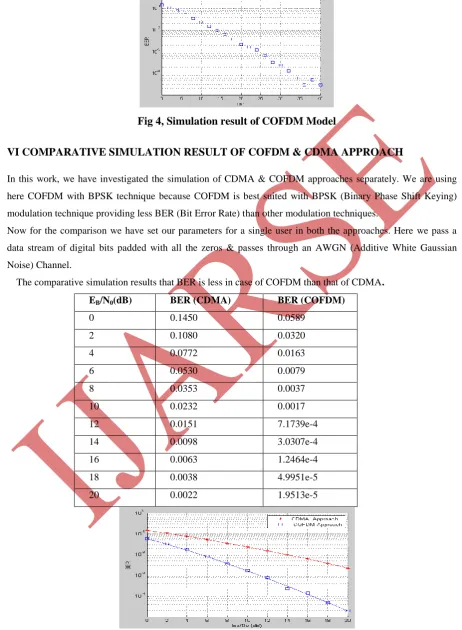
Fig 4, Simulation result of COFDM Model
VI COMPARATIVE SIMULATION RESULT OF COFDM & CDMA APPROACH
In this work, we have investigated the simulation of CDMA & COFDM approaches separately. We are using
here COFDM with BPSK technique because COFDM is best suited with BPSK (Binary Phase Shift Keying)
modulation technique providing less BER (Bit Error Rate) than other modulation techniques.
Now for the comparison we have set our parameters for a single user in both the approaches. Here we pass a
data stream of digital bits padded with all the zeros & passes through an AWGN (Additive White Gaussian
Noise) Channel.
The comparative simulation results that BER is less in case of COFDM than that of CDMA.
EB/N0(dB) BER (CDMA) BER (COFDM)
0 0.1450 0.0589
2 0.1080 0.0320
4 0.0772 0.0163
6 0.0530 0.0079
8 0.0353 0.0037
10 0.0232 0.0017
12 0.0151 7.1739e-4
14 0.0098 3.0307e-4
16 0.0063 1.2464e-4
18 0.0038 4.9951e-5
20 0.0022 1.9513e-5
VII CONCLUSION
In the present scenario, there is a demand of a suitable technique for high performance of wireless
telecommunication and COFDM is emerging as the best modulation technique. COFDM tolerance to the
multipath delay spread on which only four main performances have been tested which are the criteria for
channel noise, peak power clipping as well as start time error. Some partly measured factors affecting the
performance of COFDM have been done which includes the effect of the frequency stability errors & impulse
noise effects.
As compared to CDMA, the performance of COFDM was better. For a single & multi cell environment with
it-out performing CDMA in many areas was better. In a single cell environment CDMA was found to allow 2 -10
times more user and 0.7-4 times more users in a multi cellular environment. The dependence on whether cell
sectorization & voice activity detection being used was basically the difference in the user capacity between
CDMA & COFDM.
Where a single frequency is used in all cells the CDMA performance was well up to the mark thus increasing
the comparative performance against other system which would require a cellular pattern of frequencies in order
to reduce the inter cellular interference.
While COFDM is used in a multi user environment an important major area which has not been investigated is a
problem which may be counted and another problem which may be encountered is a requirement of the receiver
in a large dynamic range which would enable tohandle a large signal strength variation between users.
REFERENCES
1.
D. Magill, "Spread-Spectrum Technology for Commercial Applications," Proceedings of the IEEE, 1994.2.
M. Beach, S. Swales, Third Generation Wireless Networks Future Communication Systems course., 1994.3.
R. Comerford, "Interactive Media: An Internet reality," IEEE Spectrum, 1996.4.
L. Geppert, "Semiconductor lithography for the next millennium," IEEE Spectrum, 1996.5.
J. Adam, S. Lowe T. Bell, "Wireless Communications," IEEE press, 1996.6.
T. S. Rappaport, "Wireless Communications Principles & Practice," IEEE Press, 1996.7.
J. Scourias, "Overview of the GSM Cellular System,"http://ccnga.uwaterloo.ca/~jsouria/GSM/trio.html,1997.
8.
Stanford University, "SPIFFEE, a low power FFT processing chip,"http://nova.stanford.edu/~bbass/spiffe.html, 1997.
9.
M. Back, W. K. Edwards, R. E. Grinter V. Bellotti, "Making Sense of Sensing Systems Five Questions forDesigners and Researchers," minneapolis, minnesota, 2002.
10.
N. BikasSinha and SouravChakraborty, "Performance Evaluation of Hybrid - Multicarrier AccessSchemes for Broadband Wireless Communication," Research Journal of Applied Science, Engineering and
11.
V.Sridhar M.V Bramhananda Reddy M.NagalaxmiG.NagendraM.Renuka, "Ber and Simulation of OFDMModulator and Demodulator for Wireless Broadband Applications," International Journal of Advanced
Research in Computer Engineering & Technology, June 2012.
12.
www.skydsp.com/publications/4thyrthesis13.
Lalit Singh Garia, Amit Shah, Deepesh Rawat, “Comparative Study of OFDM and CDMA Technique”IOSR Journal of Electronics and Communication Engineering (IOSR-JECE) e-ISSN: 2278-2834,p- ISSN:
2278-8735. Volume 5, Issue 3 (Mar. - Apr. 2013)
14.
Tutorial coding & decoding with convolution codes by Charan Langton www.complextoreal.com15.
Dolly Rajdev, A thesis on “ORTHOGONAL FREQUENCY DIVISION MULTIPLEXING” (5 Jun. 2013).16.
Magill, D.T. Natali, F.D.Edwards, G.P. “Spread-spectrum technology for commercial application”Proceedings of the IEEE (Volume:82 , Issue: 4 ) Apr 1994.
17.
http://ieeexplore.ieee.org/xpls/abs_all.jsp?arnumber=486631&isnumber=10407.18.
Ajay Dmello, “Thesis Eric Lawrey OFDM Vs CDMA Old” Oct 01, 2010.19.
Srikanth Krishnamurthy Anthony - Anthony S. Acampora - Michele Zorzi - “On the capacity of TDMA& CDMA for Broadband Wireless Packet Access” [IsBasedOn]
http://www-cwc.ucsd.edu/~zorzi/papers/PIMRC98_packet.ps.
20.
http://www.coinchon.com/Papers/OFDM_report.doc.21.
F. Adachi, M. Sawahashi and H. Suda,” Wideband DS-CDMA for next generation mobile communication systems”, IEEE Commun. Mag., vol.36, pp. 56-59, September 1998.22.
P. Kumar, M. Ramesh, and S. Chakrabarti, “Overloading Cellular DS-CDMA: A Bandwidth EfficientScheme for Capacity Enhancement” Springer-Verlag LNCS, vol. 4904, pp.515-527, 2008.