Distributing Test Cases More Evenly in
Adaptive Random Testing
∗
Tsong Yueh Chen, Fei-Ching Kuo, Huai Liu
†Faculty of Information and Communication Technologies
Swinburne University of Technology
John Street, Hawthorn, Victoria 3122, Australia.
Abstract
Adaptive Random Testing (ART) has recently been proposed to
enhance the failure-detection capability of Random Testing. In ART,
test cases are not only randomly generated, but also evenly spread over
the input domain. Various ART algorithms have been developed to
evenly spread test cases in different ways. Previous studies have shown
that some ART algorithms prefer to select test cases from the edge part
of the input domain rather than from the centre part, that is, inputs
do not have equal chance to be selected as test cases. Since we do not
know where the failure-causing inputs are prior to testing, it is not
desirable for inputs to have different chances of being selected as test
cases. Therefore, in this paper, we investigate how to enhance some
∗A preliminary version of this paper was presented at the 18th Australian Software
Engineering Conference (ASWEC 2007) (Chen et al., 2007b).
†Corresponding author. Tel.: +61 3 9214 5276; fax: +61 3 9819 0823.
ART algorithms by offsetting the edge preference, and propose a new
family of ART algorithms. A series of simulations have been conducted
and it is shown that these new algorithms not only select test cases
more evenly, but also have better failure detection capabilities.
Keywords: Software Quality, Software Testing, Random Testing,
Adaptive Random Testing, Test Case Distribution.
1
Introduction
Software testing is a major approach to software quality assurance. There
exist many testing methods which actively select inputs for testing (namely
test cases) in order to effectively detect software failures. Random
Test-ing (RT) is a basic software testing method, which simply selects test cases
in a random manner from the set of all possible inputs (namely the input
domain) (Hamlet, 2002; Myers, 2004). RT has many advantages as a
soft-ware testing method. For example, it can automatically generate a large
number of test cases at low cost, and the test case generation is not
influ-enced by any human bias. What is more, its “randomness” may help reveal
failures which cannot be detected by deterministic approaches (such as
do-main testing (White and Cohen, 1980), data flow testing (Laski and Korel,
1983), and branch testing (Myers, 2004)). Because of these advantages, RT
has been successfully applied to detect software failures in industry, such as
the testing of UNIX utilities (Miller et al., 1990, 1995), SQL database
sys-tems (Slutz, 1998), Windows NT applications (Forrester and Miller, 2000),
Java Just-In-Time compilers (Yoshikawa et al., 2003), and embedded
soft-ware systems (Regehr, 2005). However, some researchers (Myers, 2004)
ar-gued that RT may be the “least effective” testing method because it uses
A number of studies (Ammann and Knight, 1988; Finelli, 1991; Bishop,
1993) have independently shown a common characteristic about most faulty
programs, that is, program inputs that can reveal failures (namely
failure-causing inputs) tend to cluster together. Ammann and Knight (1988), for
ex-ample, examinedfailure regions (that is, regions where failure-causing inputs
reside) in some missile launch decision programs and observed that “at the
resolution used in scanning, these particular failure regions are locally
con-tinuous”. Bishop (1993) studied some faulty programs which implemented a
nuclear reactor trip function, and found that all detected failures occupied
contiguous regions (referred to as “blob defects” by Bishop (1993)). He also
provided a theoretical justification for the existence of these “blob defects”.
Chen et al. (2004c) employed the above-mentioned common
character-istic of failure-causing inputs to improve the failure-detection capability
of RT. They found that the effectiveness of RT can be significantly
en-hanced by evenly spreading random test cases over the whole input domain.
This approach was named as Adaptive Random Testing (ART). Based on
their work, many ART algorithms have been proposed, such as
Fixed-Sized-Candidate-Set ART (FSCS-ART) (Chen et al., 2004c), Lattice-based ART
(LART) (Mayer, 2005), andRestricted Random Testing (RRT) (Chan et al.,
2006). These algorithms have been experimentally evaluated and it was
con-firmed that ART can use fewer test cases to detect the first failure than RT
when failure-causing inputs are clustered into contiguous failure regions. As
a consequence of using fewer test cases for detecting failures, ART can save
testing resources, and the saving will become more significant when test case
execution or test output verification is expensive. Briefly speaking, ART
improves the performance of RT while keeping the randomness in the test
alternative to RT, especially when it takes considerable resources to execute
test cases or to verify test results.
Some researchers (Mayer and Schneckenburger, 2006; Chen et al., 2007c)
have pointed out that although all ART algorithms are based on the same
intuition of evenly spreading test cases, they distribute test cases in different
ways, and hence have different failure detection capabilities. For example,
FSCS-ART and RRT prefer to select test cases from the edge part of the
input domain rather than from the centre part. Due to such an edge
prefer-ence, FSCS-ART and RRT may exhibit a certain degree of uneven test case
distribution, and thus have a poor failure-detection capability under some
situations (Chen et al., 2007c). Since we do not know where the
failure-causing inputs are prior to testing, in order not to miss any failure-failure-causing
input, RT has normally been conducted based on the uniform distribution,
that is, all inputs have equal chance to be selected as test cases. As an
en-hancement of RT, it is not desirable for ART to have any kind of preference
of selecting test cases.
In this paper, we investigate how to offset the edge preference of two
particular ART algorithms, namely FSCS-ART and RRT. We propose a new
approach, which helps FSCS-ART and RRT distribute test cases more evenly,
and hence improves their failure detection capabilities. The paper is
orga-nized as follows. Section 2 provides the preliminaries of FSCS-ART and
RRT. Section 3 presents how we measure the edge preference of an ART
algorithm. Section 4 explains how our approach offsets the edge preference.
Some experiments have been conducted to evaluate the new approach. The
experimental results are also reported in this section. Section 5 concludes
2
Preliminaries
2.1
Notation and Concepts
For ease of discussion, we introduce the following notation and concepts used
in the rest of the paper.
• E denotes the set of all already executed test cases.
• D denotes the input domain. For the convenience of illustration, D is
set to be a rectangle in the experiments of this paper. In this paper,
D is assumed to be of numeric type (that is, input parameters accept
either integers or real numbers). For applications of RT and ART on
non-numeric programs, readers may consult the studies of Miller et al.
(1990, 1995); Slutz (1998); Forrester and Miller (2000); Yoshikawa et al.
(2003); Regehr (2005) and Merkel (2005); Kuo (2006); Ciupa et al.
(2006, 2008), respectively.
• dD denotes d-dimension, where d = 1,2,3,4,· · ·. The dimension of D refers to the number of input parameters of the program under test.
• |E| and |D| denote the size of E and D, respectively.
• Two basic features of all faulty programs.
* Failure rate, denoted by θ, is defined as the ratio of the number of failure-causing inputs to the number of all possible inputs.
* Failure pattern refers to the shapes of failure regions together with
their distributions over D.
• F-measure refers to the expected number of test cases required to detect
the first software failure. F-measure is more appropriate than other
testing effectiveness metrics to measure ART/RT, as justified by Chen
and Merkel (2008), so we will follow previous studies (Chen et al.,
2004b,c, 2007c,d; Mayer, 2005; Chan et al., 2006) to use F-measure for
evaluating the failure-detection capability of ART.
* FRT denotes the F-measure of RT. Theoretically,FRT = 1/θwhen
test cases are selected with replacement, and according to uniform
distribution.
* FART denotes the F-measure of ART. As it has been reported
by Chen et al. (2007d) thatFART depends on many factors (such as θ, the dimension ofD, the compactness and the number of failure regions, the existence and the size of a predominant failure region),
theoretical study of FART is extremely difficult. Hence, previous
studies (Chen et al., 2004b,c, 2007c,d; Mayer, 2005; Chan et al.,
2006) investigated FART through either simulations or empirical
studies. For simulations,θand the failure pattern were predefined. Test cases were selected using an ART algorithm. When a point
is generated inside a failure region, a failure is said to be detected.
The simulation was repeated for a sufficient number (S) of times to ensure that FART is accurate within a certain confidence level
and a certain accuracy range (the details of calculating S can be found in the study of Chen et al. (2004b)). In this paper, the
default values of confidence level and accuracy range are set as
95% and ±5%, respectively.
* ART F-ratio denotes FART
FRT
. ART F-ratio measures the
2.2
FSCS-ART
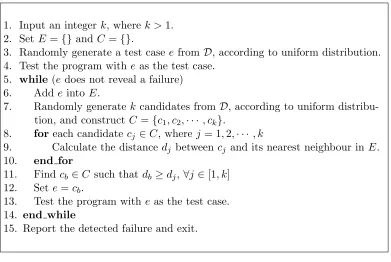
TheFixed-Sized-Candidate-Set ART (FSCS-ART) (Chen et al., 2004c)
main-tains two sets of test cases. One set is theexecuted set E ={e1, e2,· · · , en}, as
defined in the previous section; the other set is the candidate set, which
con-tains k randomly generated inputs, denoted byC={c1, c2,· · · , ck}, wherek
is fixed throughout the testing process. A candidate will be selected as the
next test case if it has the longest distance to its nearest neighbour in E. Figure 1 shows the FSCS-ART algorithm. In this paper, the default value of
k is set as 10, as recommended by Chen et al. (2004c).
1. Input an integerk, wherek >1. 2. SetE ={} and C={}.
3. Randomly generate a test caseefrom D, according to uniform distribution. 4. Test the program witheas the test case.
5. while (edoes not reveal a failure)
6. Add eintoE.
7. Randomly generatek candidates from D, according to uniform distribu-tion, and constructC={c1, c2,· · ·, ck}.
8. foreach candidate cj ∈C, where j= 1,2,· · · , k
9. Calculate the distance dj between cj and its nearest neighbour inE.
10. end for
11. Find cb ∈C such thatdb ≥dj,∀j∈[1, k]
12. Sete=cb.
13. Test the program witheas the test case.
14. end while
15. Report the detected failure and exit.
Figure 1: The algorithm of FSCS-ART
2.3
RRT
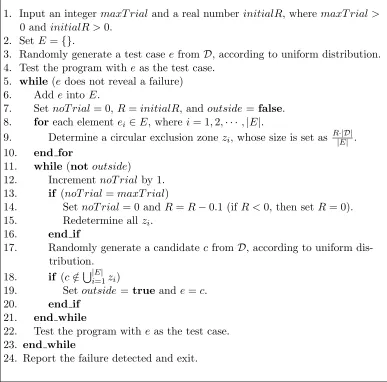
In Restricted Random Testing (RRT) (Chan et al., 2006), anexclusion zone
E is of the same size R· |D|
|E| , where R is referred to as the target exclusion
ratio. The RRT algorithm continuously generates inputs randomly from D
until an input is generated outside all exclusion zones, which is then used as
the next test case. Figure 2 shows details of the RRT algorithm.
1. Input an integermaxT rial and a real number initialR, wheremaxT rial >
0 and initialR >0. 2. SetE ={}.
3. Randomly generate a test caseefrom D, according to uniform distribution. 4. Test the program witheas the test case.
5. while (edoes not reveal a failure)
6. Add eintoE.
7. SetnoT rial= 0,R=initialR, andoutside= false. 8. foreach element ei ∈E, where i= 1,2,· · · ,|E|.
9. Determine a circular exclusion zonezi, whose size is set as R|·|D|E| .
10. end for
11. while (not outside)
12. IncrementnoT rial by 1.
13. if (noT rial=maxT rial)
14. SetnoT rial= 0 and R=R−0.1 (ifR <0, then setR= 0).
15. Redetermine allzi.
16. end if
17. Randomly generate a candidatec from D, according to uniform dis-tribution.
18. if (c /∈S|iE=1| zi)
19. Setoutside=true and e=c.
20. end if
21. end while
22. Test the program witheas the test case.
23. end while
24. Report the failure detected and exit.
Figure 2: The algorithm of RRT
Some simulations (Chan et al., 2006) have shown that the
Con-sequently, a larger R may result in a longer computation time to find an appropriate test case. Previous studies have assumed a constant R. In this paper, two parameters (initialR and maxT rial) were introduced to provide a facility that can dynamically reduce the value of R as a trade-off between the computation time and the even spreading of test cases. At first, R is set to be equal to initialR. If the RRT algorithm cannot find any appropriate input as the next test case after maxT rial attempts, R will be reduced by a certain value (the reduction step value is set as 0.1 in this study). In this
pa-per, we will use 1.0, 1.7, 3.3 and 6.4 as the default values of initialR for 1D, 2D, 3D and 4D RRT, respectively, as recommended by Chan et al. (2006).
The algorithms in both Figures 1 and 2 are specifically used to evaluate
the F-measure of ART. Therefore, the termination condition (“e does not reveal a failure” on Line 5 in Figures 1 and 2), is effectively set as “when the
first failure is detected”. It should be noted that when these ART algorithms
are applied in real life, there are other possible termination conditions, such
as “when a certain number of test cases have been selected”, “when testing
resources are exhausted”, etc.
2.4
Edge preferences of FSCS-ART and RRT
Chen et al. (2007c) have pointed out that both FSCS-ART and RRT prefer
to select test cases from the edge part of Drather than from the central part.
Chen et al. (2007c) measured the edge preference of an ART algorithm by
a metric, namely MEdge:Centre, which is defined as the ratio of the number
of test cases inside the subdomain DEdge to the number of test cases inside
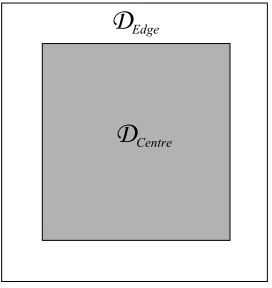
the subdomain DCentre, where DCentre is located in the centre of D, DEdge is
right outsideDCentre, and the sizes ofDCentreandDEdgeare equal. These two
values of MEdge:Centre for FSCS-ART and RRT are always greater than 1,
and the edge preference of RRT is more significant than that of FSCS-ART.
D
CentreD
EdgeFigure 3: DEdge and DCentre in a 2D space
Some testing methods, such as the domain testing strategy (White and
Cohen, 1980) and boundary-value analysis (Myers, 2004), select test cases
close to or exactly on some “borders”. However, the concept of “border” in
these testing methods is different from the concept of “edge” in this study.
For example, in the domain testing strategy, testers first divideDinto regions
based on the execution paths of the program under test. Test cases are then
selected from near or on the borders of these regions. Obviously, these borders
are not necessarily the boundary of D. However, in FSCS-ART and RRT,
the edge means the boundary of D.
3
Measuring the Edge preference of an ART
Algorithm
MEdge:Centreonly coarsely measures the edge preference of an ART algorithm
the edge preference of an ART algorithm by a graph, namely the frequency
distribution graph of test cases with respect to the edge and the centre of D
(abbreviated as ECgraph). The method of getting the ECgraphof an ART algorithm is as follows.
(1) Partition D into m equal-sized and disjoint subdomains (denoted by Di, where i = 1,2,· · · , m) from the edge (where i = 1) to the centre
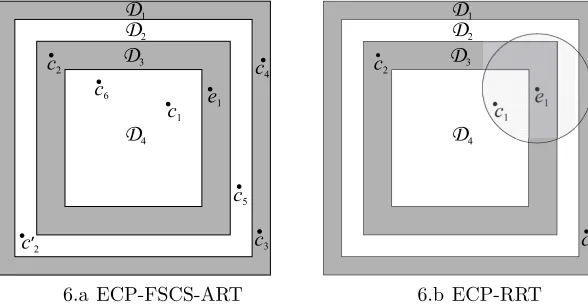
(wherei=m) ofD. Figure 6 illustrates the partitioning in a 2D space. In Figure 6,D is partitioned intoD1,D2,D3 and D4, which are located
from the edge to the centre of D, respectively, and have the same size.
(2) Generate a set of test cases.
(3) Record the number of points in each subdomain.
(4) Calculate the normalized frequency of test cases in each subdomain.
(5) Repeat Steps (2)-(4) for a sufficient number of times to obtain reliable
average values of frequencies with a confidence level of 95% and ±5%
accuracy range.
(6) Plot a curve in a 2D coordinate system, where the x-axis lists all
subdo-mains from the edge (D1) to the centre (Dm) of D, and y-axis denotes
the normalized frequency of test cases inside each subdomain.
Based on the average values of normalized frequencies in the ECgraph, two more statistical data can be collected, (i) the standard deviation of av-erage normalized frequencies, denoted by MEC−SD, and (ii) the difference
between the maximal and minimal values of average normalized
MEC−M M are, the more uniformly an ART algorithm distributes its test
cases.
We conducted a series of simulations to obtain ECgraphs of pure RT, FSCS-ART and RRT in 1D, 2D, 3D and 4D spaces. In these simulations,
we setm = 128, because such a value ensures a sufficiently preciseECgraph
at an acceptable computation overhead. Furthermore, many previous
stud-ies (Merkel, 2005; Mayer and Schneckenburger, 2006; Chen et al., 2007a)
have also used such a value for plotting the spatial distribution of test cases;
and our setting will make it easier to compare different works in the
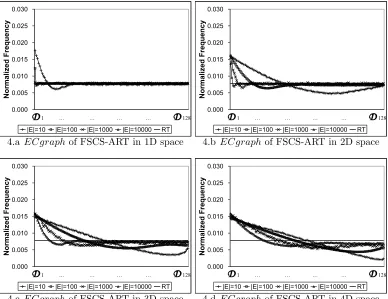
fu-ture. |E| was set as 10, 100, 1000, and 10000. The simulation results are shown in Figures 4 and 5. It has been observed that no matter what |E| is, the normalized frequency for RT is always around 1/128 (that is, 1/m), as theoretically expected, that is, the test cases of RT are always uniformly
distributed. Therefore, in these figures, we only plot the ECgraph of RT with |E|= 10000.
The values ofMEC−SD and MEC−M M for RT, FSCS-ART, and RRT are
summarized in Table 1.
Table 1: Values of MEC−SD and MEC−M M for RT, FSCS-ART, and RRT
dimension testing strategy |E| = 10 |E| = 100 |E| = 1000 |E| = 10000 MEC-SD MEC-MM MEC-SD MEC-MM MEC-SD MEC-MM MEC-SD MEC-MM
1D RT 8.56E-05 4.01E-04 2.95E-05 1.56E-04 1.78E-04 9.30E-04 6.09E-05 2.98E-04 FSCS-ART 1.67E-03 1.16E-02 4.08E-04 5.10E-03 9.59E-05 6.55E-04 2.02E-05 9.75E-05 RRT 1.44E-03 9.51E-03 3.85E-04 4.84E-03 8.63E-05 6.40E-04 2.28E-05 1.23E-04 2D RT 9.00E-05 5.54E-04 2.67E-05 1.23E-04 2.10E-04 9.15E-04 6.11E-05 3.36E-04 FSCS-ART 3.13E-03 1.13E-02 1.79E-03 9.70E-03 1.05E-03 9.05E-03 5.62E-04 6.77E-03 RRT 3.47E-03 1.25E-02 2.62E-03 1.54E-02 1.62E-03 1.53E-02 8.94E-04 1.14E-02 3D RT 9.33E-05 4.30E-04 2.99E-05 1.47E-04 2.08E-04 9.80E-04 5.87E-05 3.06E-04 FSCS-ART 3.57E-03 1.12E-02 2.72E-03 1.00E-02 2.01E-03 9.44E-03 1.41E-03 9.23E-03 RRT 4.52E-03 1.49E-02 4.95E-03 2.05E-02 3.88E-03 2.24E-02 2.74E-03 2.09E-02 4D RT 9.36E-05 4.33E-04 2.80E-05 1.34E-04 2.08E-04 1.29E-03 5.51E-05 2.78E-04 FSCS-ART 3.74E-03 1.23E-02 3.21E-03 1.05E-02 2.70E-03 1.01E-02 2.16E-03 9.69E-03 RRT 5.02E-03 1.63E-02 6.28E-03 2.28E-02 5.53E-03 2.38E-02 4.37E-03 2.29E-02
0.000 0.005 0.010 0.015 0.020 0.025 0.030 128 121 114 107 100 93 86 79 72 65 58 51 44 37 30 23 16 9 2 N o rm a li ze d F re q u e n c y
|E|=10 |E|=100 |E|=1000 |E|=10000 RT D1 … … … … D128
4.a ECgraphof FSCS-ART in 1D space
0.000 0.005 0.010 0.015 0.020 0.025 0.030 128 121 114 107 100 93 86 79 72 65 58 51 44 37 30 23 16 9 2 N o rm a li ze d F re q u e n c y
|E|=10 |E|=100 |E|=1000 |E|=10000 RT D1 … … … … D128
4.b ECgraphof FSCS-ART in 2D space
0.000 0.005 0.010 0.015 0.020 0.025 0.030 128 121 114 107 100 93 86 79 72 65 58 51 44 37 30 23 16 9 2 N o rm a li ze d F re q u e n c y
|E|=10 |E|=100 |E|=1000 |E|=10000 RT D1 … … … … D128
4.c ECgraph of FSCS-ART in 3D space
0.000 0.005 0.010 0.015 0.020 0.025 0.030 128 121 114 107 100 93 86 79 72 65 58 51 44 37 30 23 16 9 2 N o rm a li ze d F re q u e n c y
|E|=10 |E|=100 |E|=1000 |E|=10000 RT D1 … … … … D128
4.d ECgraphof FSCS-ART in 4D space
Figure 4: Frequency distribution of test cases selected by FSCS-ART with respect to the edge and the centre of input domain
(1) Both FSCS-ART and RRT have an edge preference.
(2) The edge preference becomes more significant with the increase of the
dimension of D.
(3) The edge preference becomes less significant with the increase of |E|.
(4) The edge preference of RRT is more significant than that of FSCS-ART
for high dimension cases.
FSCS-ART and RRT algorithms evenly spread test cases by enforcing
them far apart from one another; as a consequence, some of their test cases
0.000 0.005 0.010 0.015 0.020 0.025 0.030 128 121 114 107 100 93 86 79 72 65 58 51 44 37 30 23 16 9 2 N o rm a li ze d F re q u e n c y
|E|=10 |E|=100 |E|=1000 |E|=10000 RT D1 … … … … D128
5.a ECgraphof RRT in 1D space
0.000 0.005 0.010 0.015 0.020 0.025 0.030 128 121 114 107 100 93 86 79 72 65 58 51 44 37 30 23 16 9 2 N o rm a li ze d F re q u e n c y
|E|=10 |E|=100 |E|=1000 |E|=10000 RT D1 … … … … D128
5.b ECgraphof RRT in 2D space
0.000 0.005 0.010 0.015 0.020 0.025 0.030 128 121 114 107 100 93 86 79 72 65 58 51 44 37 30 23 16 9 2 N o rm a li ze d F re q u e n c y
|E|=10 |E|=100 |E|=1000 |E|=10000 RT D1 … … … … D128
5.c ECgraph of RRT in 3D space
0.000 0.005 0.010 0.015 0.020 0.025 0.030 128 121 114 107 100 93 86 79 72 65 58 51 44 37 30 23 16 9 2 N o rm a li ze d F re q u e n c y
|E|=10 |E|=100 |E|=1000 |E|=10000 RT D1 … … … … D128
5.d ECgraphof RRT in 4D space
Figure 5: Frequency distribution of test cases selected by RRT with respect to the edge and the centre of input domain
a by-product of the test case selection procedures of FSCS-ART and RRT.
However, it was observed that a poor failure-detection capability is always
associated with a significant edge preference. As shown in the above
ex-perimental data, the edge preferences of FSCS-ART and RRT become more
significant as |E| decreases or the dimension of D increases. It was also re-ported that FSCS-ART and RRT have poorer failure detection capabilities
for the cases of higher θ or higher dimension (Chen et al., 2007c). Such a correlation between the edge preference and the effectiveness of these ART
algorithms has motivated us to improve these algorithms by offsetting their
4
Enhancing ART by offsetting the Edge
preference
In this section, we will introduce a new approach to offsetting the edge
pref-erence of FSCS-ART and RRT algorithms. In this approach,Dis partitioned
into some equal-sized partitions from the edge to the centre of D, and test
cases will be evenly selected from these partitions. We integrate such a
Partitioning by Edge and Centre (ECP) approach with the existing ART
al-gorithms, and develop a new family of ART alal-gorithms, namely ECP-ART
algorithms. The new algorithms and their performances are elaborated in
the following sections.
4.1
ART with partitioning by edge and centre
There are two instances of ART algorithms, FSCS-ART and
ECP-RRT, which will be illustrated in a 2D space, as shown in Figures 6.a and 6.b,
respectively. In these figures,D is partitioned into four equal-sized partitions
D1, D2, D3 and D4, from the edge to the centre, respectively.
D4
D3
D2
D1
c2
c5 c4
c’2
c6
c3 e1 c1
6.a ECP-FSCS-ART
c2
c3
e1
c1
D4
D3
D2
D1
6.b ECP-RRT
ECP-FSCS-ART is an integration of the ECP approach and FSCS-ART
algorithm. Figure 6.a illustrates how it works. Suppose that the first test
case e1 is randomly generated from D and happens to be located inside D3.
With regard to the selection of the next test case, six candidates,c1,c2,c3,c4,
c5 and c6, are generated, as shown in Figure 6.a. However, since c2 is inside
the same partition as e1, ECP-FSCS-ART requires a random replacement
for c2, sayc′2 which is not located inside the same partition ase1. Then, the
second test case e2 is selected from c1, c′2 (instead of c2), c3, c4, c5 and c6.
Since c′
2 is the farthest candidate from e1, it will be selected as e2.
For ECP-RRT (the integration of the ECP approach and RRT algorithm),
refer to Figure 6.b. Suppose that the first random test case e1 resides inside
D3. A random inputc1 is generated and found to be inside the exclusion zone
of e1 (the shadowed circular zone around e1). c1 will be discarded, and then
another input c2 will be randomly generated, which happens to be outside
the exclusion zone ofe1. Unfortunately,c2is in the same partition ase1 (that
is, D3). ECP-RRT will discard c2, and then c3 will be generated. c3 will be
selected as the next teste2, because it is both outside the exclusion zone and
the partition of e1.
4.1.1 Details of new algorithms
There are two methods to implement the ECP approach. One method is to
dynamically partition D, that is, the number of partitions is varying with
the number of executed test cases. The other method is static partitioning,
that is, the number of partitions is fixed throughout the testing process. As
reported by Chen et al. (2007b), the dynamic partitioning method performs
better than the static method. Therefore, in this paper, we will focus on
of ECP-FSCS-ART and ECP-RRT algorithms are given in Figures 7 and 8,
respectively.
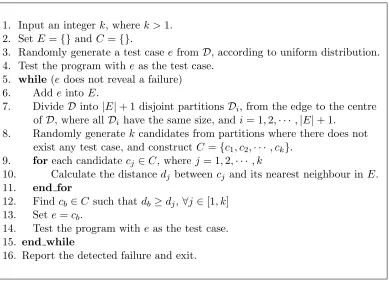
1. Input an integerk, wherek >1. 2. SetE ={} and C={}.
3. Randomly generate a test caseefrom D, according to uniform distribution. 4. Test the program witheas the test case.
5. while (edoes not reveal a failure)
6. Add eintoE.
7. DivideD into|E|+ 1 disjoint partitionsDi, from the edge to the centre
of D, where allDi have the same size, andi= 1,2,· · ·,|E|+ 1.
8. Randomly generatek candidates from partitions where there does not exist any test case, and constructC ={c1, c2,· · · , ck}.
9. foreach candidate cj ∈C, where j= 1,2,· · · , k
10. Calculate the distance dj betweencj and its nearest neighbour inE.
11. end for
12. Find cb ∈C such thatdb ≥dj,∀j∈[1, k]
13. Sete=cb.
14. Test the program witheas the test case.
15. end while
16. Report the detected failure and exit.
Figure 7: The algorithm of ECP-FSCS-ART
As shown in Figures 7 and 8, ECP-ART always has |E|+ 1 partitions. Therefore, at least one partition will not contain any executed test case. Our
approach is to select the next test case from a “blank” partition. This will
prevent test cases from being selected more frequently in certain subdomains,
and hence offset the edge preference.
4.1.2 Runtime of new algorithms
Since the new algorithms are the integration of the ECP approach and the
original ART algorithms, we will only analyze the computational overhead
1. Input an integermaxT rial and a real number initialR, wheremaxT rial >
0 and initialR >0. 2. SetE ={}.
3. Randomly generate a test caseefrom D, according to uniform distribution. 4. Test the program witheas the test case.
5. while (edoes not reveal a failure)
6. Add eintoE.
7. DivideD into|E|+ 1 disjoint partitionsDi, from the edge to the centre
of D, where allDi have the same size, andi= 1,· · · ,|E|+ 1.
8. SetnoT rial= 0,R=initialR, andoutside= false. 9. foreach element ei ∈E, where i= 1,2,· · · ,|E|.
10. Determine a circular exclusion zone zi, whose size is set as R|·|D|E| .
11. end for
12. while (not outside)
13. Increment noT rialby 1.
14. if (noT rial=maxT rial)
15. SetnoT rial= 0 and R=R−0.1 (ifR <0, then setR= 0).
16. Redetermine allzi.
17. end if
18. Randomly generate a candidate cfrom partitions where there does
not exist any executed test case. 19. if (c /∈S|iE=1| zi)
20. Setoutside=true and e=c.
21. end if
22. end while
23. Test the program witheas the test case.
24. end while
25. Report the failure detected and exit.
the ECP approach will first partitionD into|E|+ 1 partitions; then identify the blank partitions, that is, the partitions which do not contain any executed
test case; and finally, generate candidates from the blank partitions. Since
D is of numeric type, it is very easy to calculate the value ranges for all
partitions. For each executed test case, its corresponding partition can be
identified simply through checking which value range each of its coordinates
belongs to. Therefore, the identification of blank partitions requires O(|E|) time. With regard to the candidate generation, it is basically the same
as the random generation of any possible program input, except that the
candidate must be selected within the value range of a blank partition Di
instead of from D. Briefly speaking, it takes O(|E|) time to implement the ECP approach in the process of selecting the (|E|+ 1)th test case, and thus the total computation overhead of the ECP approach for selecting |E| test cases is in O(|E|2
). Since FSCS-ART and RRT algorithms require O(|E|2
)
and O(|E|2
log|E|) time to select |E| test cases, respectively (Mayer and Schneckenburger, 2006), the orders of computation of ECP-ART and the
original ART algorithms are the same.
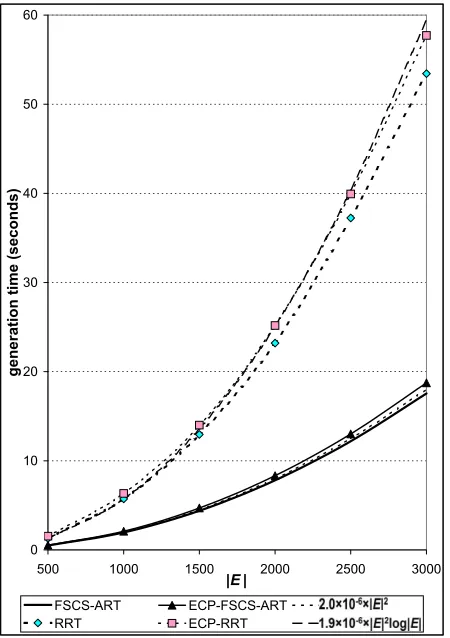
We also experimentally evaluated the runtime of ECP-ART via some
simulations. All simulations were conducted on a machine with an Intel
Pentium processor running at 3195 MHz and 1024 megabytes of RAM. The
ART algorithms were implemented in C language and compiled with GNU
Compiler Collection (version 3.3.4) (GCC, 2004). FSCS-ART,
ECP-FSCS-ART, RRT, and ECP-RRT were implemented in a 2D space. For each
al-gorithm, we recorded the time taken to select a number of test cases, with
|E|= 500,1000,1500,2000,2500, and 3000. The simulation results are given in Figure 9, in which, x- and y-axes denote|E|and time required to generate
both requireO(|E|2
) time to select|E|test cases, while the runtimes of RRT and ECP-RRT are both in O(|E|2
log|E|). In other words, the experimental data are consistent with the theoretical analysis.
0 10 20 30 40 50 60
500 1000 1500 2000 2500 3000
|E|
g
e
n
e
ra
ti
o
n
t
im
e
(
s
e
c
o
n
d
s
)
FSCS-ART ECP-FSCS-ART
RRT ECP-RRT
Figure 9: Comparison of runtime between the original ART algorithms and the new ECP-ART algorithms
4.2
Experiment 1
The intuition of ART is to enforce random test cases as evenly spread as
possible. Thus, it is important to know how evenly ECP-ART algorithms
spread their test cases. Chen et al. (2007c) have used three metrics to
these metrics, MEdge:Centre has been discussed in Section 2.4. The other two
metrics are discrepancy and dispersion, which are commonly used in
measur-ing the equidistribution of sample points (Branicky et al., 2001). Intuitively
speaking, discrepancy indicates whether regions have an equal density of the
points; while dispersion indicates whether any point in E is surrounded by a very large empty spherical region (containing no points other than itself).
E is considered reasonably equidistributed if discrepancy is close to 0, dis-persion is small, andMEdge:Centre is close to 1 (that is, the edge preference is
insignificant).
We first examine to what extent ECP-ART algorithms offset the edge
preference. We repeated the simulations in Section 3 using ECP-FSCS-ART
and ECP-RRT. The simulations results are shown in Figures 10 and 11,
respectively. The values ofMEC−SD and MEC−M M for ECP-FSCS-ART and
ECP-RRT are summarized in Table 2.
Table 2: Values of MEC−SD and MEC−M M for FSCS-ART and
ECP-RRT
dimension testing strategy |E| = 10 |E| = 100 |E| = 1000 |E| = 10000 MEC-SD MEC-MM MEC-SD MEC-MM MEC-SD MEC-MM MEC-SD MEC-MM
1D ECP-FSCS-ART 1.35E-03 9.65E-03 1.06E-04 7.77E-04 6.86E-05 3.15E-04 2.07E-05 1.22E-04 ECP-RRT 1.02E-03 1.07E-02 1.76E-04 8.03E-03 7.85E-05 8.01E-03 2.11E-05 7.85E-03 2D ECP-FSCS-ART 8.54E-04 3.13E-03 3.83E-04 2.22E-03 2.83E-04 2.22E-03 8.74E-05 7.64E-04 ECP-RRT 9.97E-04 9.94E-03 8.14E-04 1.06E-02 4.98E-04 1.07E-02 2.88E-04 1.06E-02 3D ECP-FSCS-ART 1.37E-03 4.07E-03 6.68E-04 2.58E-03 4.26E-04 2.38E-03 2.65E-04 2.08E-03 ECP-RRT 1.28E-03 1.01E-02 1.66E-03 1.12E-02 1.23E-03 1.16E-02 8.49E-04 1.17E-02 4D ECP-FSCS-ART 1.68E-03 4.80E-03 9.42E-04 2.98E-03 6.16E-04 2.84E-03 4.18E-04 2.30E-03 ECP-RRT 1.86E-03 1.01E-02 2.23E-03 1.14E-02 1.82E-03 1.17E-02 1.38E-03 1.17E-02
Based on these data, we make the following three observations.
(1) ECP-ART algorithms distribute test cases more evenly than the
origi-nal ART algorithms. Moreover, by comparing Figures 4 and 10 as well
as Figures 5 and 11, it can be further observed that ECP-ART
0.000 0.005 0.010 0.015 0.020 0.025 0.030 128 121 114 107 100 93 86 79 72 65 58 51 44 37 30 23 16 9 2 N o rm a li ze d F re q u e n c y
|E|=10 |E|=100 |E|=1000 |E|=10000 RT D1 … … … … D128
10.a ECgraph of ECP-FSCS-ART in 1D space 0.000 0.005 0.010 0.015 0.020 0.025 0.030 128 121 114 107 100 93 86 79 72 65 58 51 44 37 30 23 16 9 2 N o rm a li ze d F re q u e n c y
|E|=10 |E|=100 |E|=1000 |E|=10000 RT D1 … … … … D128
10.b ECgraph of ECP-FSCS-ART in 2D space 0.000 0.005 0.010 0.015 0.020 0.025 0.030 128 121 114 107 100 93 86 79 72 65 58 51 44 37 30 23 16 9 2 N o rm a li ze d F re q u e n c y
|E|=10 |E|=100 |E|=1000 |E|=10000 RT D1 … … … … D128
10.c ECgraph of ECP-FSCS-ART in 3D space 0.000 0.005 0.010 0.015 0.020 0.025 0.030 128 121 114 107 100 93 86 79 72 65 58 51 44 37 30 23 16 9 2 N o rm a li ze d F re q u e n c y
|E|=10 |E|=100 |E|=1000 |E|=10000 RT D1 … … … … D128
10.d ECgraph of ECP-FSCS-ART in 4D space
Figure 10: Frequency distribution of test cases selected by ECP-FSCS-ART with respect to the edge and the centre of input domain
RRT have a higher edge preference.
(2) There is still a small edge preference for ECP-ART algorithms.
(3) Based on Table 2, it can be observed that when the dimension of D is
higher than 1, ECP-FSCS-ART algorithm has a smaller edge preference
than ECP-RRT algorithm.
The first observation is consistent with the intuition of our study, that
is, the edge preference can be offset by ECP-ART algorithms. It has been
0.000 0.005 0.010 0.015 0.020 0.025 0.030 128 121 114 107 100 93 86 79 72 65 58 51 44 37 30 23 16 9 2 N o rm a li ze d F re q u e n c y
|E|=10 |E|=100 |E|=1000 |E|=10000 RT D1 … … … … D128
11.aECgraph of ECP-RRT in 1D space
0.000 0.005 0.010 0.015 0.020 0.025 0.030 128 121 114 107 100 93 86 79 72 65 58 51 44 37 30 23 16 9 2 N o rm a li ze d F re q u e n c y
|E|=10 |E|=100 |E|=1000 |E|=10000 RT D1 … … … … D128
11.b ECgraph of ECP-RRT in 2D space
0.000 0.005 0.010 0.015 0.020 0.025 0.030 128 121 114 107 100 93 86 79 72 65 58 51 44 37 30 23 16 9 2 N o rm a li ze d F re q u e n c y
|E|=10 |E|=100 |E|=1000 |E|=10000 RT D1 … … … … D128
11.cECgraph of ECP-RRT in 3D space
0.000 0.005 0.010 0.015 0.020 0.025 0.030 128 121 114 107 100 93 86 79 72 65 58 51 44 37 30 23 16 9 2 N o rm a li ze d F re q u e n c y
|E|=10 |E|=100 |E|=1000 |E|=10000 RT D1 … … … … D128
11.d ECgraph of ECP-RRT in 4D space
Figure 11: Frequency distribution of test cases selected by ECP-RRT with respect to the edge and the centre of input domain
more significant edge preference of FSCS-ART and RRT. Therefore, it is
expected that ECP-ART algorithms have a more noticeable offset of the
edge preference when the dimension is higher or θ is higher. The second observation can be explained as follows. Although the next test case is from
a “blank” partition, there can be more than one blank partition. Due to
the nature of FSCS-ART and RRT, inputs from the blank partition near
D’s edge have a higher probability to be selected as the next test case than
inputs from the blank partition near D’s centre. The last observation is also
understandable. Since the edge preference of the original RRT algorithm
dimension ofDis high, it is intuitive for ECP-RRT to have a more significant
edge preference than ECP-FSCS-ART for higher dimensions.
In order to further investigate the test case distributions of ECP-ART
algorithms, we repeated the simulations in the study of Chen et al. (2007c) on
ECP-FSCS-ART and ECP-RRT, and got their discrepancies and dispersions.
Since we found that ECP-RRT distributes test cases similarly as
ART, we only report the values of discrepancy and dispersion for
ECP-FSCS-ART, as shown in Figures 12 and 13, respectively. For ease of comparison, the
previous simulation results of FSCS-ART are also included in these figures.
These figures clearly show that ECP-FSCS-ART has a smaller MDiscrepancy
than FSCS-ART, and its MDispersion is similar to that of FSCS-ART.
0.00 0.01 0.02 0.03 0.04 0.05 0.06 0.07 0.08 0.09
0 2000 4000 6000 8000 10000
|E| D is c re p a n c y FSCS-ART ECP-FSCS-ART 12.a discrepancy in 1D space
0.00 0.01 0.02 0.03 0.04 0.05 0.06 0.07 0.08 0.09
0 2000 4000 6000 8000 10000
|E| D is c re p a n c y FSCS-ART ECP-FSCS-ART 12.b discrepancy in 2D space
0.00 0.01 0.02 0.03 0.04 0.05 0.06 0.07 0.08 0.09
0 2000 4000 6000 8000 10000
|E| D is c re p a n c y FSCS-ART ECP-FSCS-ART 12.c discrepancy in 3D space
0.00 0.01 0.02 0.03 0.04 0.05 0.06 0.07 0.08 0.09
0 2000 4000 6000 8000 10000
|E| D is c re p a n c y FSCS-ART ECP-FSCS-ART 12.d discrepancy in 4D space
0.00 0.07 0.14 0.21 0.28 0.35 0.42
0 2000 4000 6000 8000 10000
|E|
D
is
pe
rs
ion
FSCS-ART ECP-FSCS-ART 13.a dispersion in 1D space
0.00 0.07 0.14 0.21 0.28 0.35 0.42
0 2000 4000 6000 8000 10000
|E|
D
is
pe
rs
ion
FSCS-ART ECP-FSCS-ART 13.b dispersion in 2D space
0.00 0.07 0.14 0.21 0.28 0.35 0.42
0 2000 4000 6000 8000 10000
|E|
D
is
pe
rs
ion
FSCS-ART ECP-FSCS-ART 13.c dispersion in 3D space
0.00 0.07 0.14 0.21 0.28 0.35 0.42
0 2000 4000 6000 8000 10000
|E|
D
is
p
e
rs
io
n
FSCS-ART ECP-FSCS-ART 13.d dispersion in 4D space
Figure 13: Comparison of dispersion between ECP-ART and FSCS-ART
In summary, ECP-ART algorithms can offset the edge preference very
well, and spread test cases more evenly than the original ART algorithms.
4.3
Experiment 2
The previous section concludes that the new ECP-ART algorithms distribute
test cases more evenly than original ART algorithms. We are now going to
examine whether the failure detection capabilities can be improved, through a
series of simulations. The parameters for these simulations are set as follows.
• θ: 0.75, 0.5, 0.25, 0.1, 0.075, 0.05, 0.025, 0.01, 0.0075, 0.005, 0.0025, 0.001, 0.00075, 0.0005, 0.00025, 0.0001, 0.000075, and 0.00005.
• Failure pattern: a single square failure region is randomly placed inside
D.
It should be noted that the setting of this experiment is exactly the
same as Experiment 1 in the study of Chen et al. (2007d). The results of
these simulations are reported in Figure 14, which also includes the previous
simulation results of FSCS-ART and RRT for ease of comparison. Note that
the scales in Figure 14 do not start at 0.
0.5 0.6 0.7 0.8 0.9 1.0 1.1 1.00E-05 1.00E-04 1.00E-03 1.00E-02 1.00E-01 1.00E+00 T ART F -rat io = F A R T / F R T
FSCS-ART ECP-FSCS-ART RRT ECP-RRT 14.a Comparison in 1D space
0.5 0.6 0.7 0.8 0.9 1.0 1.1 1.2 1.00E-05 1.00E-04 1.00E-03 1.00E-02 1.00E-01 1.00E+00 T ART F -rat io = F A R T / F R T
FSCS-ART ECP-FSCS-ART RRT ECP-RRT 14.b Comparison in 2D space
0.6 0.7 0.8 0.9 1.0 1.1 1.2 1.3 1.4 1.5 1.00E-05 1.00E-04 1.00E-03 1.00E-02 1.00E-01 1.00E+00 T ART F -rat io = F A R T / F R T
FSCS-ART ECP-FSCS-ART RRT ECP-RRT 14.c Comparison in 3D space
0.7 0.8 0.9 1.0 1.1 1.2 1.3 1.4 1.5 1.6 1.7 1.8 1.9 2.0 2.1 1.00E-05 1.00E-04 1.00E-03 1.00E-02 1.00E-01 1.00E+00 T ART F -rat io = F A R T / F R T
FSCS-ART ECP-FSCS-ART RRT ECP-RRT 14.d Comparison in 4D space
Figure 14: Comparison of failure detection capabilities between the original ART algorithms and the new ECP-ART algorithms
(1) When the dimension ofD orθ is high, the failure detection capabilities of ECP-ART algorithms are better than those of the original ART
algorithms; otherwise, the performances of ECP-ART and the original
ART algorithms are more or less similar.
(2) ECP-FSCS-ART is more effective than ECP-RRT for the cases of high
dimension and high θ.
The first conclusion is expected. As explained in Section 4.2, the higher
the dimension of D orθ is, the more edge preference will be offset by ECP-ART algorithms. Since ECP-ECP-ART algorithms are introduced to enhance the
failure detection capabilities of the original ART algorithms by offsetting
their edge preferences, it is expected that the higher the dimension ofDorθ, the better improvement of the failure-detection capability of ECP-ART over
the original ART algorithms. It is also understandable to have the second
conclusion that ECP-FSCS-ART has better failure-detection capability than
ECP-RRT for higher θ cases, because the former can distribute test cases more evenly than the latter (the last observation in Section 4.2).
As a summary of experiments reported in Sections 4.2 and 4.3, the new
partitioning approach enhances the original ART algorithms not only in
terms of the even distribution of test cases, but also with respect to the
failure-detection capability. As shown in these experiments,
ECP-FSCS-ART and ECP-RRT algorithms have similar performance trends, so we will
only investigate ECP-FSCS-ART in the rest of the experimental study.
4.4
Experiment 3
compact the failure region is, (b) how many failure regions there are, (c) whether there exists a predominant failure region by size, and (d) how large the predominant failure region is. In this section, we conducted a similar
investigation for ECP-FSCS-ART.
We first conducted a simulation to see how the compactness of a failure
region influences the failure-detection capability of ECP-FSCS-ART. The
simulation used the rectangle (instead of the square in Section 4.3) as the
shape of the failure region in order to investigate the impact of compactness.
The experimental setting is as follows.
• Dimension of D: 2, 3 and 4.
• θ: 0.005.
• Failure pattern: a single rectangular region is randomly placed inside
the input domain. The ratios among edge lengths of the rectangular
region are 1 : α, 1 : α : α and 1 : α : α : α in 2D, 3D and 4D spaces, respectively, where α≥1.
• α: 1, 4, 7, 10, 20, 30, 40, 50, 60, 70, 80, 90 and 100. As justified by Chen et al. (2007d), the larger α is, the less compact the failure region is.
The above experimental setting is similar to the setting of Experiment 2
in the study of Chen et al. (2007d). The simulation results are reported in
Figure 15, which also includes the previous simulation results on FSCS-ART
for ease of comparison. As shown in Figure 15, although the effectiveness of
FSCS-ART also depends on the compactness of a failure region,
ECP-FSCS-ART outperforms ECP-FSCS-ART in most scenarios, and the performance
0.6 0.7 0.8 0.9 1.0 1.1 1.2 1.3
0 10 20 30 40 50 60 70 80 90 100
D A RT F -rati o = F A R T / F R T FSCS-ART ECP-FSCS-ART 15.a 2D,θ= 0.005
0.6 0.7 0.8 0.9 1.0 1.1 1.2 1.3
0 10 20 30 40 50 60 70 80 90 100
D A RT F -rati o = F A R T / F R T FSCS-ART ECP-FSCS-ART 15.b 3D,θ= 0.005
0.6 0.7 0.8 0.9 1.0 1.1 1.2 1.3
0 10 20 30 40 50 60 70 80 90 100
D A RT F -rati o = F A R T / F R T FSCS-ART ECP-FSCS-ART 15.c 4D,θ= 0.005
Figure 15: Failure detection capabilities of ECP-FSCS-ART on a rectangular failure region
We conducted another simulation to evaluate the failure-detection
capa-bility of ECP-FSCS-ART where there are more than one failure region. The
experimental setting of this simulation is as follows.
• Dimension of D: 2, 3 and 4.
• θ: 0.005.
• Failure pattern: a number of equal-sized square regions are randomly
placed inside the input domain.
• The number of failure regions: 1, 4, 7, 10, 20, 30, 40, 50, 60, 70, 80, 90
It should be noted that the above setting is similar to the experimental
setting of Experiment 3 in the study of Chen et al. (2007d). Figure 16 shows
the simulation results. It can be observed that ECP-FSCS-ART behaves
similarly as FSCS-ART, that is, its effectiveness depends on the number of
failure regions. But ECP-FSCS-ART has a better failure-detection
capabil-ity, especially when the dimension of D is higher.
0.6 0.7 0.8 0.9 1.0 1.1 1.2 1.3
0 10 20 30 40 50 60 70 80 90 100
Number of failure regions
A RT F -rati o = F A R T / F R T FSCS-ART ECP-FSCS-ART 16.a 2D,θ= 0.005
0.6 0.7 0.8 0.9 1.0 1.1 1.2 1.3
0 10 20 30 40 50 60 70 80 90 100
Number of failure regions
A RT F -rati o = F A R T / F R T FSCS-ART ECP-FSCS-ART 16.b 3D,θ= 0.005
0.6 0.7 0.8 0.9 1.0 1.1 1.2 1.3
0 10 20 30 40 50 60 70 80 90 100
Number of failure regions
A RT F -rat io = F A R T / F R T FSCS-ART ECP-FSCS-ART 16.c 4D,θ= 0.005
Figure 16: Failure detection capabilities of ECP-FSCS-ART on multiple equal-sized failure regions
In the above simulation, all the failure regions have the same size.
How-ever, it is unlikely that all failure regions are equal-sized in reality. Therefore,
we further conducted a simulation where failure regions are of different sizes.
• Dimension of D: 2, 3 and 4.
• θ: 0.005.
• Failure pattern: a number of square regions are randomly placed
in-side the input domain. Suppose that there are n failure regions, denoted by R1, R2,· · · , Rn, respectively. The sizes of these regions
(|R1|,|R2|,· · · ,|Rn|) are assigned by either of the following two ways.
* Existence of a predominant failure region. For one region Rn, set
|Rn| = r ·θ · |D|, where r = 0.3,0.5 and 0.8. For all the other
regions, |Ri| = vi
Pn−1
i=1 vi
·(1−r)·θ · |D|, where vi is a random
number uniformly distributed in [0,1), andi= 1,2,· · · , n−1.
* No predominant failure region. For all regions, |Ri|= vi
Pn i=1vi
·θ· |D|, where vi is a random number uniformly distributed in [0,1),
and i= 1,2,· · · , n.
• The number of failure regions: 1, 4, 7, 10, 20, 30, 40, 50, 60, 70, 80, 90
and 100.
The above setting is similar to the setting of Experiment 4 in the study
of Chen et al. (2007d). The simulation results of ECP-FSCS-ART as well as
the previous results of FSCS-ART are given in Figure 17. We can observe
that the performance of ECP-FSCS-ART also depends on the existence and
the size of a predominant failure region, and ECP-FSCS-ART generally has
a better failure-detection capability than the original FSCS-ART.
Based on experiments reported in Sections 4.3 and 4.4, we conclude that
like FSCS-ART, the failure-detection capability of ECP-FSCS-ART also
0.6 0.7 0.8 0.9 1.0 1.1 1.2 1.3
0 10 20 30 40 50 60 70 80 90 100
Number of failure regions
A RT F -rati o = F A R T / F R T FSCS-ART ECP-FSCS-ART 17.a No predominant failure region, 2D
0.6 0.7 0.8 0.9 1.0 1.1 1.2 1.3
0 10 20 30 40 50 60 70 80 90 100
Number of failure regions
A RT F -rati o = F A R T / F R T FSCS-ART ECP-FSCS-ART
17.d Predominant failure region exists, 2D,
r= 0.3
0.6 0.7 0.8 0.9 1.0 1.1 1.2 1.3
0 10 20 30 40 50 60 70 80 90 100
Number of failure regions
A RT F -rati o = F A R T / F R T FSCS-ART ECP-FSCS-ART 17.b No predominant failure region, 3D
0.6 0.7 0.8 0.9 1.0 1.1 1.2 1.3
0 10 20 30 40 50 60 70 80 90 100
Number of failure regions
A RT F -rati o = F A R T / F R T FSCS-ART ECP-FSCS-ART
17.e Predominant failure region exists, 3D,
r= 0.3
0.6 0.7 0.8 0.9 1.0 1.1 1.2 1.3
0 10 20 30 40 50 60 70 80 90 100
Number of failure regions
A RT F -rat io = F A R T / F R T FSCS-ART ECP-FSCS-ART 17.c No predominant failure region, 4D
0.6 0.7 0.8 0.9 1.0 1.1 1.2 1.3
0 10 20 30 40 50 60 70 80 90 100
Number of failure regions
A RT F -rat io = F A R T / F R T FSCS-ART ECP-FSCS-ART
17.f Predominant failure region exists, 4D,
0.6 0.7 0.8 0.9 1.0 1.1 1.2 1.3
0 10 20 30 40 50 60 70 80 90 100
Number of failure regions
A RT F -rati o = F A R T / F R T FSCS-ART ECP-FSCS-ART
17.g Predominant failure region exists, 2D,
r= 0.5
0.6 0.7 0.8 0.9 1.0 1.1 1.2 1.3
0 10 20 30 40 50 60 70 80 90 100
Number of failure regions
A RT F -rati o = F A R T / F R T FSCS-ART ECP-FSCS-ART
17.j Predominant failure region exists, 2D,
r= 0.8
0.6 0.7 0.8 0.9 1.0 1.1 1.2 1.3
0 10 20 30 40 50 60 70 80 90 100
Number of failure regions
A RT F -rati o = F A R T / F R T FSCS-ART ECP-FSCS-ART
17.h Predominant failure region exists, 3D,
r= 0.5
0.6 0.7 0.8 0.9 1.0 1.1 1.2 1.3
0 10 20 30 40 50 60 70 80 90 100
Number of failure regions
A RT F -rati o = F A R T / F R T FSCS-ART ECP-FSCS-ART
17.k Predominant failure region exists, 3D,
r= 0.8
0.6 0.7 0.8 0.9 1.0 1.1 1.2 1.3
0 10 20 30 40 50 60 70 80 90 100
Number of failure regions
A RT F -rat io = F A R T / F R T FSCS-ART ECP-FSCS-ART
17.i Predominant failure region exists, 4D,
r= 0.5
0.6 0.7 0.8 0.9 1.0 1.1 1.2 1.3
0 10 20 30 40 50 60 70 80 90 100
Number of failure regions
A RT F -rat io = F A R T / F R T FSCS-ART ECP-FSCS-ART
17.l Predominant failure region exists, 4D,
r= 0.8
regions, the existence and the size of a predominant failure region. But
ECP-FSCS-ART generally outperforms the original ECP-FSCS-ART, and the
perfor-mance improvement becomes more significant when the dimension of Dorθ
is higher.
4.5
Experiment 4
Chen et al. (2004c) have also applied the original FSCS-ART to test some
real-life programs, which are all published programs (ACM, 1980; Press et al.,
1986), and were error-seeded using the technique of mutation (Budd, 1981).
As shown in Section 4.3, the failure-detection capability of ECP-FSCS-ART
is dependent on the dimension of D. Therefore, in this experimental study,
we selected four particular programs as the subject programs with varying
dimensions, namely airy,bessj,plgndr, andel2, whose input domains are 1D,
2D, 3D, and 4D, respectively. The details of these 4 programs are given in
Table 3.
Table 3: Program name, dimension, and seeded errors for each subject pro-gram
Program Dimension Number of seeded errors
AOR ROR SVR CR
airy 1 1
bessj 2 2 1 1
plgndr 3 1 2 2
el2 4 1 3 2 3
AOR arithmatic operator replacement
ROR relational operator replacement
SVR scalar variable replacement
CR constant replacement
For each subject program, Chen et al. (2004c) defined its input domain
the input domains, they estimated the failure rates (θ) of these programs by finding the F-measures of RT and then applying the formula θ = 1/FRT.
In this study, we aim to investigate the impact of the relative locations of
failure regions on the ART performance. Hence, we kept the same seeded
errors for these subject programs, but modified the relative locations of
fail-ure regions by changing the range values for the input domains. Refer to
Table 4, where airy, bessj, plgndr, and el2 denote the programs on original
input domains (which were defined by Chen et al. (2004c)), while airy new,
bessj new, plgndr new and el2 new denote the programs on newly-defined
input domains. The modification of the input domains only have strong
im-pacts on the locations of failure regions and θ of subject programs; while the basic shapes of the failure regions remain unchanged because the seeded
errors are not changed.
Table 4: The failure rates and failure patterns of subject programs on differ-ent input domains
Program Input domain Failure rate Failure pattern
From To (T)
airy (-5000) (5000) 0.000716 A block in the centre of input domain airy_new (0) (10000) 0.000694 A block on the edge of input domain bessj (2, -1000) (300, 15000) 0.001298 Strips near the edge of input domain bessj_new (-100, -8000) (200, 8000) 0.001279 Strips in the centre of input domain plgndr (10, 0, 0) (500, 11, 1) 0.000368 Strips near the edge of input domain plgndr_new (-300, -6, -1) (300, 6, 1) 0.000965 Strips spanning from the centre
to the edge of input domain el2 (0, 0, 0, 0) (250, 250, 250, 250) 0.000690 Strips near the edge of input domain el2_new (-200,-200,-200,-200) (200, 200, 200, 200) 0.000703 Strips crossing the centre of input domain
We applied the original FSCS-ART algorithm to testairy new,bessj new,
plgndr new and el2 new. The experimental results are shown in Table 5,
which also includes the previous results on airy, bessj, plgndr, and el2. It is
clearly shown that as expected, for the same program, FSCS-ART has fairly
Table 5: Failure detection capabilities of FSCS-ART on 4 programs with different input domains
Program FSCS-ART F-ratio
original input domains new input domains
airy 0.5786 0.3564
bessj 0.5817 0.8102
plgndr 0.6591 0.8462
el2 0.4798 1.0845
We repeated the experiment by applying ECP-FSCS-ART to test all four
subject programs on both the original and the new input domains. The
experimental results are shown in Table 6. As intuitively expected,
ECP-FSCS-ART performs similarly on the same program under various scenarios.
Table 6: Failure detection capabilities of ECP-FSCS-ART on 4 programs with different input domains
Program ECP-FSCS-ART F-ratio
original input domains new input domains
airy 0.5338 0.5534
bessj 0.6347 0.6717
plgndr 0.7011 0.7456
el2 0.7744 0.8289
In summary, the failure-detection capability of ECP-FSCS-ART is less
dependent on the locations of failure regions than that of FSCS-ART.
5
Discussion and Conclusion
ART was originally proposed as an approach to enhancing the
failure-detection capability of RT. Recent studies have pointed out that some ART
algorithms prefer to select test cases from the edge part of the input domain.
is not desirable for inputs to have different chances of being selected as test
cases. In this paper, we investigated the edge preferences of FSCS-ART and
RRT, and proposed a new family of algorithms, namely ART with
Partition-ing by Edge and Centre (ECP-ART).
ECP-ART uses an additional partitioning scheme to offset the edge
pref-erence. The new ECP-ART algorithms have the same orders of computation
as the original ART algorithms. Compared with the original ART
algo-rithms, ECP-ART algorithms have similar values of dispersion, but smaller
values of discrepancy. In other words, ECP-ART can spread test cases more
evenly than the original ART algorithms. It has also been observed that
the effectiveness of ECP-ART depends on the same factors as the original
ART algorithms. However, ECP-ART algorithms normally have better
fail-ure detection capabilities under the same conditions, and the performance
enhancement of ECP-ART over the original ART algorithms becomes more
significant with the increase of dimension or failure rate. It has also been
shown by simulations and experimental studies that the failure detection
capabilities of the new ECP-ART algorithms are less dependent on the
loca-tions of failure regions than those of the corresponding ART algorithms. In
summary, the basic idea of our new approach is that for an ART algorithm
which prefers to select test cases from certain locations of the input domain,
we offset the preference by using a specifically designed partitioning scheme.
As a pilot study, this paper only investigated how to apply such an idea
into FSCS-ART and RRT algorithms. Mayer and Schneckenburger (2006)
have pointed out that most ART algorithms have a preference toward test
cases from certain locations of the input domain. For example, ART through
Iterative Partitioning (ART-IP) (Chen et al., 2006) has a similar test case
exhibits a preference on some small square regions inside the input domain.
Chen et al. (2007c) also observed that ART by Random Partitioning
(ART-RP) (Chen et al., 2004a) has a small centre preference (that is, inputs from
the centre part of the input domain has a high probability of being selected
as test cases). Intuitively speaking, the basic idea of this paper can also
be applied to these ART algorithms, as long as we can find appropriate
partitioning schemes that can offset the preferences of these algorithms. The
ECP approach proposed in this paper is applicable for IP and
ART-RP. For LART and many other ART algorithms (such asMirror ART (Chen
et al., 2004b) and ART by Localization (Chen and Huang, 2004)), since they
have more complicated test case distributions than FSCS-ART and RRT,
further investigations are required to find appropriate partitioning schemes
for them.
There exists one particular ART algorithm, namely ART by Bisection
(ART-B) (Chen et al., 2004a), which does not exhibit any preference in
the test case selection. Chen et al. (2007c) have observed that FSCS-ART
and RRT only outperform ART-B when the failure rate is small. We have
compared the failure detection capabilities of ART-B and ECP-ART, and
found that ECP-ART normally has a better failure-detection capability than
ART-B, no matter whether the failure rate is high or not.
In conclusion, this paper has proposed a new approach that can help some
ART algorithms spread test cases more evenly and detect software failures
more effectively. The basic idea of the new approach is not only applicable
Acknowledgment
This research project is supported by an Australian Research Council
Dis-covery Grant (DP0880295).
References
ACM, 1980. Collected Algorithms from ACM. Association for Computing
Machinery.
Ammann, P. E., Knight, J. C., 1988. Data diversity: an approach to software
fault tolerance. IEEE Transactions on Computers 37 (4), 418–425.
Bishop, P. G., 1993. The variation of software survival times for different
operational input profiles. In: Proceedings of the 23rd International
Sym-posium on Fault-Tolerant Computing (FTCS-23). IEEE Computer Society
Press, pp. 98–107.
Branicky, M. S., LaValle, S. M., Olson, K., Yang, L., 2001. Quasi-randomized
path planning. In: Proceedings of the 2001 IEEE International Conference
on Robotics and Automation. IEEE Computer Society, pp. 1481–1487.
Budd, T. A., 1981. Mutation analysis: Ideas, examples, problems and
prospects. In: Chandrasekaran, B., Radicci, S. (Eds.), Computer Program
Testing. North-Holland, Amsterdam, pp. 129–148.
Chan, K. P., Chen, T. Y., Towey, D., 2006. Restricted random testing:
Adap-tive random testing by exclusion. International Journal of Software
Chen, T. Y., Eddy, G., Merkel, R., Wong, P. K., 2004a. Adaptive random
testing through dynamic partitioning. In: Proceedings of the 4th
Interna-tional Conference on Quality Software (QSIC 04). IEEE Computer Society
Press, Braunschweig, Germany, pp. 79–86.
Chen, T. Y., Huang, D. H., 2004. Adaptive random testing by localization.
In: Proceedings of the 11th Asia-Pacific Software Engineering Conference
(APSEC’04). IEEE Computer Society, pp. 292–298.
Chen, T. Y., Huang, D. H., Zhou, Z. Q., 2006. Adaptive random testing
through iterative partitioning. In: Proceedings of the 11th Ada-Europe
International Conference on Reliable Software Technologies (Ada-Europe
2006). Vol. 4006 of Lecture Notes in Computer Science. Springer-Verlag,
pp. 155–166.
Chen, T. Y., Kuo, F.-C., Liu, H., 2007a. Enhancing adaptive random testing
in high dimensional input domains. In: Proceedings of 22nd Annual ACM
Symposium on Applied Computing (SAC 2007). ACM Press, pp. 1467–
1472.
Chen, T. Y., Kuo, F.-C., Liu, H., 2007b. Enhancing adaptive random testing
through partitioning by edge and centre. In: Proceedings of the 18th
Aus-tralian Software Engineering Conference (ASWEC 2007). IEEE Computer
Society Press, pp. 265–273.
Chen, T. Y., Kuo, F.-C., Liu, H., 2007c. On test case distributions of adaptive
random testing. In: Proceedings of the 19th International Conference on
Software Engineering and Knowledge Engineering (SEKE 2007). pp. 141–
Chen, T. Y., Kuo, F.-C., Merkel, R., Ng, S. P., 2004b. Mirror adaptive
random testing. Information and Software Technology 46 (15), 1001–1010.
Chen, T. Y., Kuo, F.-C., Zhou, Z. Q., 2007d. On favorable conditions for
adaptive random testing. International Journal of Software Engineering
and Knowledge Engineering 17 (6), 805–825.
Chen, T. Y., Leung, H., Mak, I. K., 2004c. Adaptive random testing. In:
Proceedings of the 9th Asian Computing Science Conference. Vol. 3321 of
Lecture Notes in Computer Science. pp. 320–329.
Chen, T. Y., Merkel, R., 2008. An upper bound on software testing
effective-ness. Accepted to appear in ACM Transactions on Software Engineering
and Methodology.
Ciupa, I., Leitner, A., Oriol, M., Meyer, B., 2006. Object distance and its
ap-plication to adaptive random testing of object-oriented programs. In:
Pro-ceedings of the First International Workshop on Random Testing (RT06).
Portland, ME, USA, pp. 55–63.
Ciupa, I., Leitner, A., Oriol, M., Meyer, B., 2008. ARTOO: adaptive
ran-dom testing for object-oriented software. Accepted to appear in the 30th
International Conference on Software Engineering (ICSE2008).
Finelli, G. B., 1991. NASA software failure characterization experiments.
Reliability Engineering and System Safety 32 (1–2), 155–169.
Forrester, J. E., Miller, B. P., 2000. An empirical study of the robustness of
Windows NT applications using random testing. In: Proceedings of the
4th USENIX Windows Systems Symposium. Seattle, pp. 59–68.
Hamlet, R., 2002. Random testing. In: Marciniak, J. (Ed.), Encyclopedia of
Software Engineering, 2nd Edition. John Wiley & Sons.
Kuo, F.-C., 2006. On adaptive random testing. Ph.D. thesis, Faculty of
Infor-mation and Communications Technologies, Swinburne University of
Tech-nology.
Laski, J. W., Korel, B., 1983. A data flow oriented program testing strategy.
IEEE Transactions on Software Engineering 9 (3), 347–254.
Mayer, J., 2005. Lattice-based adaptive random testing. In: Proceedings of
the 20th IEEE/ACM International Conference on Automated Software
Engineering (ASE 2005). ACM, New York, USA, pp. 333–336.
Mayer, J., Schneckenburger, C., 2006. An empirical analysis and comparison
of random testing techniques. In: Proceedings of the 2006 ACM/IEEE
In-ternational Symposium on Empirical Software Engineering (ISESE 2006).
ACM Press, pp. 105–114.
Merkel, R., 2005. Analysis and enhancements of adaptive random testing.
Ph.D. thesis, School of Information Technology, Swinburne University of
Technology.
Miller, B. P., Fredriksen, L., So, B., 1990. An empirical study of the reliability
of UNIX utilities. Communications of the ACM 33 (12), 32–44.
Miller, B. P., Koski, D., Lee, C. P., Maganty, V., Murthy, R., Natarajan,
A., Steidl, J., 1995. Fuzz revisited: A re-examination of the reliability of
UNIX utilities and services. Tech. Rep. CS-TR-1995-1268, University of