
C
∅
C
∅
: A Framework for Building Composable Zero-Knowledge
Proofs
Ahmed Kosba† Zhichao Zhao∗ Andrew Miller† Yi Qian‡
T-H. Hubert Chan∗ Charalampos Papamanthou† Rafael Pass‡ abhi shelat• Elaine Shi‡
†: UMD ∗: HKU ‡: Cornell •: UVA
Abstract
Non-interactive zero-knowledge proofs are a powerful cryptographic primitive used in privacy-preserving protocols. We design and buildC∅C∅, the first system enabling developers to build efficient,composable, non-interactive zero-knowledge proofs for generic, user-defined statements.
C∅C∅ extends state-of-the-art SNARK constructions by applying known strengthening trans-formations to yield UC-composable zero-knowledge proofs suitable for modular use in larger cryptographic protocols.
To attain fast practical performance, C∅C∅ includes a library of several “SNARK-friendly” cryptographic primitives.
These primitives are used in the strengthening transformations in order to reduce the over-head of achieving composable security. Our open-source library of optimized arithmetic circuits for these functions are up to40×more efficient than standard implementations and are thus of independent interest for use in other NIZK projects.
Finally, we evaluate C∅C∅ on applications such as anonymous credentials, private smart contracts, and nonoutsourceable proof-of-work puzzles and demonstrate 5× to8×speedup in these application settings compared to naive implementations.
1
Introduction
Non-Interactive Zero-Knowledge proofs (NIZKs) are a powerful building block in the design of expressive cryptographic protocols such as anonymous credentials, anonymous survey systems [43], privacy-preserving digital currencies [11,47], and multi-party computation [39] in general. Typically, NIZKs are used to defend against malicious parties and enforce honest behavior. Specifically, any deviation from the protocol will result in failure of NIZK verification, and thus translate to an aborting (i.e., Denial-of-Service) attack.
Despite their well-known drawback of relying on assumptions that are non-falsifiable, SNARKs are attractive to practitioners not only due to their (relative) practical efficiency, but more im-portantly for their general-purpose nature. In contrast, until recently, most systems [22, 23, 43] adopted customized NIZK protocols for application-specific statements of interest. Although this customized approach can result in protocols highly optimized for the specific task at hand, the enormous cryptography expertise and time required to develop new protocols for each application severely limit the adoption of modern cryptography building blocks such as NIZKs.
The general-purpose feature of SNARKs is quite compelling, and promises to simplify the usage of NIZKs in secure systems. With latest open-source SNARK implementations [2,13,32,55,63], even system builders who are not cryptography experts can easily express a statement to be proven in a familiar programming language, and automated toolchains will generate a corresponding SNARK implementation. Further, this approach in turn enables rapid protocol prototyping, and avoids the need for full-scale protocol redesign when the functionality requirements change (as is often needed for customized protocols), since it is easy to modify a zk-SNARK to prove a different statement.
SNARKs have made an impact since their invention: they have been adopted to instantiate NIZKs in various systems [11, 33, 47, 53], including ones built for production usage (e.g., Zero-Cash [11]); further, new cryptocurrency systems such as Ethereum [65] have pronounced interest in supporting SNARKs as an opcode [3].
Composability is the recommended best practice in pragmatic cryptography engineer-ing. Composability of cryptographic building blocks is often imperative in protocol design. When cryptographic building blocks are composable, they do not interfere with other building blocks in the same protocol or with other possibly concurrent protocol instances. For this reason, a univer-sally composable(UC-secure) [24,25,27] NIZK is frequently recommended or necessary in designing larger cryptographic systems [43, 47].
While some may be tempted to dismiss UC as being a theoretical notion, we stress that UC is of vital importance and the recommended best practice in pragmatic cryptography engineering. We give a 10-min crash course on UC for the practitioner in Appendix B, and clearly state why one should care about UC, and why UC provides “worry-free” adoption of cryptographic building blocks as if were “ideal boxes”, and help avoid numerous perils and subtle attacks that might arise from lack of composability.
1.1 Our Results and Contributions
In this paper, we design and build C∅C∅ (pronounced “coco”, short for Composable 0-knowledge,
Compact0-knowledge). C∅C∅is thefirstsystem that provides practical, UC-secure, non-interactive zero-knowledge proofs for general, user-defined statements. C∅C∅ makes UC-secure NIZKs an ac-cessible building block for system builders who are not necessarily cryptography experts.
C∅C∅ provides UC-secure NIZKs that are circuit succinct, but not witness succinct. In other words, the size of the proofs and verification time are (quasi-)linear in the witness size, but inde-pendent of the size of the circuit that encodes the language. Note that in comparison, standard, non-UC-secure SNARKs achieve a stronger notion of succinctness, i.e., they are both circuit- and witness succinct. We note that currently there is also no known UC-secure zero-knowledge proof construction that is circuit- and witness succinct, even under non-standard assumptions—whether or how we can achieve this is left as future work. Below we describe our technical contributions in more detail.
SNARK-lifting transformations optimized for concrete efficiency. At the core, C∅C∅ builds on top of existing SNARKs and hence inherit their generality. To achieve simulation sound extractability, we adopt efficient SNARK-lifting transformations that allow us to transform zk-SNARKs to zero-knowledge proofs with simulation sound extractability, such that they could be adopted in UC-secure protocols. Our transformations are inspired by the work by De Santis et al. transforms an ordinary NIZK to a simulation sound NIZK [60]. Although De Santis’s work only achieves a weaker notion called simulation soundness (without the online extraction property), it is not theoretically difficult to modify their constructions to additionally allow online extraction of the witness. In particular, under the common reference string model, one could encrypt the witness with a public-key encryption scheme, such that the simulator with knowledge of the secret key can extract the witness.
Our main contribution is not to show the theoretical feasibility of a SNARK lifting transforma-tion, but to carefully select and optimize these constructions for concrete efficiency, and offer com-posable NIZKs as a building block to non-expert programmers. To optimize for concrete efficiency, we made various explorations: 1) we explored and compared different variants of SNARK-lifting transformations (see Sections 3, 4 and 5); 2) we consider “SNARK-friendly cryptography”, where we carefully select known cryptographic primitives (e.g., encryption, key exchange, pseudo-random functions, signatures) and express them as efficient algebraic circuits which is the representation recognized by SNARKs. Earlier and concurrent works have considered the optimization of such primitives for specific purposes, such as [11, 14, 33, 34]. In this paper, we study more possible opti-mizations/alternatives with a focus on composable SNARKs. For example, we study the trade-offs of existing constructions such as RSA and field extension for key exchange, and propose to use a customized elliptic curve-based construction that is more efficient. Additionally, we select and optimize different block ciphers for symmetric encryption, and compare their performance. Overall, our implementation for encryption for example achieves more than 8x-9x compared to optimized RSA-based constructions.
Programming model. C∅C∅is a Java-based library that allows developers to encode statements to be proven as a circuit, where each gate expresses an algebraic constraint. C∅C∅ provides a development interface similar to that of libsnark [15], where the developer can encode a circuit modularly by defining and composing “gadgets”.
In comparison with directly using earlier SNARK programming frameworks [13,15,32,55,63,64],
C∅C∅ provides the following advantages: with previous frameworks, the developer not only needs to implement the user-defined statement to be proven as an algebraic circuit, but would also be faced with the daunting task of implementing the entire SNARK-lifting transformation, including primitives such as encryption and signatures, as algebraic circuits.
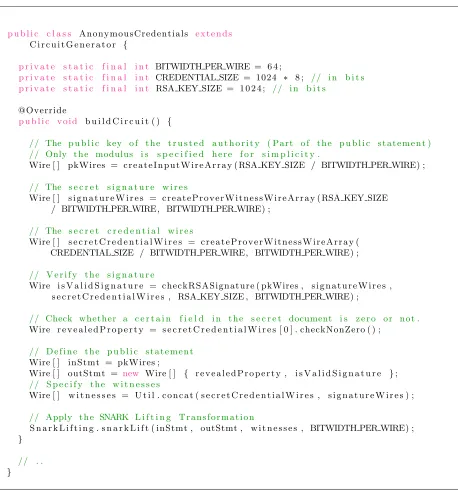
WithC∅C∅, the developer only needs to implement the high-level application (i.e., user-defined statement), and the C∅C∅ framework handles the remaining automatically and results in highly optimized implementations. To how easy/hard it is to program with C∅C∅, we provide a code sample in Figure 2 of the Appendix.
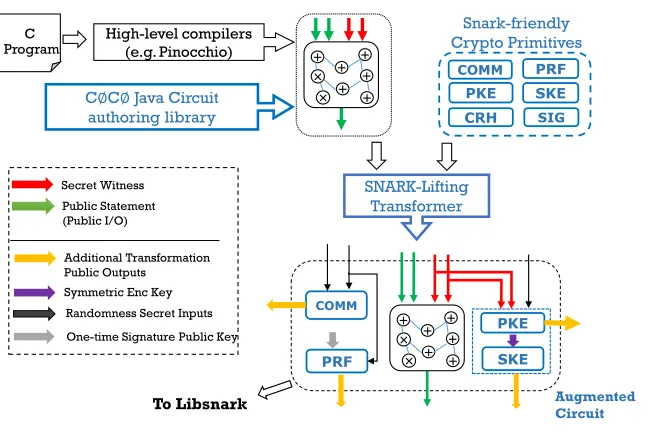
Open source and evaluation. Figure 1 presents the high-level architecture of C∅C∅ and high-lights our contributions. A code example can be found in Appendix A. We report the performance of C∅C∅ through both micro-benchmarks as well as three end-to-end applications. First, we show that for individual primitives such as encryption, we achieve 10x to 40x speedup in comparison with a straightforward, unoptimized baseline. Next, we evaluatedC∅C∅ with three end-to-end ap-plications, and demonstrate 5×to 8×performance improvement over an unoptimized baseline. To make our work reusable by the community, we are in the process of open sourcing our code and implementations.
Adoption. C∅C∅ has been adopted in subsequent works [46, 47] to build privacy-preserving pro-tocols. These works adopted an earlier, naive version of C∅C∅ that implemented unoptimized constructions described in Section 3 of this paper, and without SNARK-friendly cryptography optimizations. Since then, we have adopted more efficient constructions and SNARK-friendly op-timizations, allowing us to demonstrate 5×performance improvements in end-to-end applications such as Hawk [47] (see Section 7 for detailed evaluations).
1.2 Related Work
Non-interactive zero-knowledge proofs were first proposed by Blum, Feldman, and Micali [20], and later extended to multi-theorem by Blum et al. [21].
Sahai [59] was the first to construct a one-time, simulation-sound NIZK scheme. De Santis et al. [60] subsequently provide unbounded simulation-sound NIZKs, allowing the adversary to access many simulated proofs of possibly false statements. Neither technique is practical. Simulation soundness is a slightly weaker condition than simulation sound extractability—the latter requires that even after seeing a polynomial number of simulated proofs of possibly false statements, when-ever a polynomial-time adversary produces a valid proof, an extractor can extract a valid witness except with negligible failures. It has been observed [41, 42] that simulation sound extractable NIZKs are UC-secure NIZKs by Canetti’s definition [24] in the presence of a static adversary. Groth et al. [42] construct perfect NIZK arguments for circuit satisfiability using bilinear groups. They also extend their scheme to construct UC-secure NIZKs. Groth [41] also gave more practical, simulation-sound extractable NIZK constructions for an NP language for bilinear groups.
..
C
Program High-level compilers(e.g. Pinocchio)
C∅C∅Java Circuit authoring library
COMM PKE
PRF SKE CRH SIG Snark-friendly Crypto Primitives
× +
+ +
× +
+ +
× +
+ +
× + + +
PKE
SKE SNARK-Lifting
Transformer
PRF COMM
Augmented Circuit
To Libsnark
Secret Witness
Additional Transformation Public Outputs Symmetric Enc Key Public Statement (Public I/O)
Randomness Secret Inputs One-time Signature Public Key
Figure 1: C∅C∅’s architecture. The components that represent our contributions are highlighted in blue.
fact, Gentry and Wichs [38] has shown succinct non-interactive arguments to be impossible from any falsifiable assumption. Existing SNARKs adopt non-falsifiable assumptions to attain succinctness as well as practical efficiency [13, 31, 32, 37, 55, 63].
In general, non-malleability is closely related to and often necessary in composable proto-cols. Zerocash [11] features a technique bearing resemblance ours to ensure a limited form of non-malleability, called “transaction non-malleability”. However, Zerocash is not known to satisfy composable security.
Garmanet al.[36] construct a simulation sound SNARK in the CRS model by using well-known techniques to augment the statement with a trapdoor for the simulator. Their goal was to define an ideal model for decentralized anonymous payments, and design a scheme that satisfies the model
in the stand-alone setting withstatic corruptions; their goal was not to achieve composability, and therefore a weaker notion suffices, and they can also achieve witness succinctness. They do not provide implementations details for the costs of their choices.
Finally, Appendix B provides an overview of UC, and explains why UC is the best practice for cryptography engineering.
2
Preliminaries
Notation. In the remainder of the paper,f(λ)≈g(λ) means that there exists a negligible function
2.1 Non-Interactive Zero-Knowledge Proofs
A non-interactive zero-knowledge proof system (NIZK) for an NP language L consists of the fol-lowing algorithms:
• crs← K(1λ,L), also written as crs← KeyGennizk(1λ,L): Takes in a security parameter λ, a description of the language L, and generates a common reference stringcrs.
• π← P(crs,stmt, w): Takes incrs, a statementstmt, a witnesswsuch that (stmt, w)∈ L, and produces a proofπ.
• b ← V(crs,stmt, π): Takes in a crs, a statement stmt, and a proof π, and outputs 0 or 1, denoting accept or reject.
• (crs, τ,c ek) ←Kb(1λ,L): Generates a simulated common reference string crsc, trapdoor τ, and
extract keyek
• π←Pb(crs, τ,c stmt): Uses trapdoor τ to produce a proof π without needing a witness
Perfect completeness. A NIZK system is said to be perfectly complete, if an honest prover with a valid witness can always convince an honest verifier. More formally, for any (stmt, w) ∈ R, we have that
Pr
crs← K(1λ,L), π← P(crs,stmt, w) : V(crs,stmt, π) = 1
= 1
Computational zero-knowlege. Informally, an NIZK system is computationally zero-knowledge if the proof does not reveal any information about the witness to any polynomial-time adver-sary. More formally, a NIZK system is said to computationally zero-knowledge, if there exists a polynomial-time simulatorS= (Kb,Pb), such that for all non-uniform polynomial-time adversaryA,
Prcrs← K(1λ,L) :AP(crs,·,·)(crs) = 1 ≈ Pr
h
(crs, τ,c ek)←Kb(1
λ,L) :APb1(crsc,τ,·,·)(
c crs) = 1
i
In the above, Pb1(crs, τ,c stmt, w) verifies that (stmt, w)∈ L, and if so, outputs Pb(crs, τ,c stmt) which
simulates a proof without knowing a witness. Otherwise, if (stmt, w)∈ L/ , the experiment aborts. This notion is adaptive zero knowledge in the sense that the simulator must specify the reference string before seeing the theorem statements.
Computational soundness. A NIZK scheme for the language L is said to be computationally sound, if for all polynomial-time adversariesA,
Pr
crs← K(1λ,L),(stmt, π)← A(crs) : (V(crs,stmt, π) = 1)∧(stmt∈ L/ )
≈0
Simulation extractability. Simulation extractability is a strong notion which requires that even
a NIZK system is said to be simulation extractable if it satisfies computational zero-knowledge and additionally, there exists a polynomial-time algorithm E, such that for any polynomial-time adversaryA, it holds that
Pr
(crs, τ,c ek)←Kb(1λ,L);
(stmt, π)← APb(crsc,τ,·)(
c crs,ek);
w← E(crs,c ek,stmt, π) :stmt∈/ Qand
(stmt, w)∈ L/ andV(crs,c stmt, π) = 1
≈0
where in the above,Q is the list of oracle queries made byAtoPb(crs, τ,c ·). Here theKb is identical
to the zero-knowledge simulation setup algorithm.
A few remarks about the definition follow. First, note that the extractor algorithm E works for all adversaries, and does not therefore depend or have access to the adversary’s code. Rather, the extractor’s advantage arises entirely from its special access to a trapdoorek for the crsc. Next,
note that the adversary may be able to fake a (different) proof for a statement that has been queried, however, it is not able to forge a proof for any other invalid statement. There is a natural strengthening of the above notion where the adversary cannot even fake a different proof for a statement queried (in fact, it is this stronger notion that is given as the default in [41]). We define and give constructions for this later in Section 5. In Hawk [47], however, it is shown that the weaker notion defined above suffices for a typical UC application; therefore we focus on this notion first.
Relation between UC secure NIZKs and simulation sound extractability. It is well understood that the notion of simulation-sound extractability and UC-secure NIZKs are roughly speaking interchangeable [26, 41]. Therefore, for the remainder of the paper, we will use the notion simulation-sound extractability, and later in Appendix C, we elaborate on the relationship between simulation sound extractability and UC security for NIZKs.
2.2 SNARKs
A SNARK is a NIZK that is succint, perfectly complete, computationally zero-knowledge, and has a knowledge extractor (a stronger property than soundness):
Succinctness. A SNARK is said to be succinct if an honestly generated proof has poly(λ) bits and that the verification algorithm V(crs,stmt, π) runs inO(|stmt| ·poly(λ)).
Adaptive knowledge extraction. Knowledge extraction requires that if a proof generated by an adversary is accepted by the verifier, then the adversary “knows” a witness for the given instance; i.e., there exists an algorithm E which recovers a witness. Furthermore, the extraction property holds adaptively even if the prover picks the statement after seeing the reference string. Formally, a SNARK for language Lsatisfies the knowledge extraction property iff:
For all polynomial-sized adversary A, there exists a polynomial-size extractorEA, such that for
all advice stringsz∈ {0,1}poly(λ),
Pr
crs← K(1λ,L) (stmt, π)← A(crs, z)
a← EA(crs, z)
: V(crs,stmt, π) = 1 (stmt, a)∈ R/ L
≈0
3
Basic Lifting Transformation
We begin by presenting the theoretical constructions thatC∅C∅implements. In this section, we will start from a simpler basic construction that is relatively inefficient and provides a slightly weaker notion of composability (and nonetheless strong enough for many applications); we then describe improvements and strengthenings in Sections 4 and 5 respectively.
We show a construction that transforms any NIZK to one that satisfies simulation sound ex-tractability.
Typically, a NIZK only guarantees soundness, which simply means that if the verifier accepts a proof, then the statement must be in the language. However, in many cases, what we actually desire is to guarantee that the prover actually “knows” a valid witness. For example, given a collision-resistant hash function, it is necessarily true that a collision exists, though to actually
compute such a collision is intractable. The definition of simulation extractability captures the desired knowledge property–given a valid proof (and the extraction key produced during setup), the extractor algorithm can efficiently compute a witness.
Intuition. Our first construction makes use of an asymmetric signature scheme and encryption scheme, the public keys for which are embedded in the setup parameters, and the private keys for which are embedded in the trapdoor and extraction key, respectively. The idea is to force every prover to encrypt a witness and a signature, at least one of which must be legitimate. While an honest prover will simply provide a valid witness, the simulated prover will use the signing key to provide a signature. The extractor can simply use the decryption key to recover a valid witness (or at least a signature) from the proof. This guarantees that an adversary who breaks the system can be leveraged to either break the soundness of the underlying NIZK or the unforgeability of the signature scheme.
Construction. In the following, assume Σ is an unforgeable signature scheme, and (KeyGenEnc,Enc,Dec) is a perfectly correct public key encryption scheme.
• K(1λ,L): Run (pk,sk)←Σ.Gen(1λ). Run (pke,ske)←KeyGenEnc(1λ).
LetL0 be the following language: ((stmt, c),(r, w, σ))∈ L0 iff
(c=Enc(pke,(w, σ), r))∧
((stmt, w)∈ L ∨(Σ.V(pk,stmt, σ) = 1))
Runnizk.crs←nizk.K(1λ,L0).
Publishcrs:= (nizk.crs,pk,pke) as the common reference string.
• P(crs,stmt, w): Parsecrs:= (nizk.crs,pk). Choose randomr, and computec:=Enc(pke,(w,⊥), r). Callπ :=nizk.P(nizk.crs, (stmt, c), (r, w,⊥)), and outputπ0:= (c, π).
• V(crs,stmt, π0): Parse π0 := (c, π), and output nizk.V(nizk.crs, (stmt,c), π).
• Kb(1λ,L): Run the honest K algorithm, but retain the signing key sk as the simulation trapdoor τ :=sk. The extraction key ek:=ske, the simulatedcrsc :=crs= (nizk.crs,pk,pke).
• Pb(crs, τ,c stmt): the simulator calls
π :=nizk.P(nizk.crs,(stmt, c),(⊥,⊥, σ))
Theorem 1. Assume that the underlying NIZK scheme satisfies perfect completeness, computa-tional soundness, and computacomputa-tional zero-knowlege, that the signature scheme satisfies existential unforgeability under chosen message attack, and that the encryption scheme is semantically secure and perfectly correct, then the above construction is a zero-knowledge proof system satisfying perfect completeness, computational zero-knowledge, and simulation extractability.
The proof for the above theorem appears in the appendix.
This basic SNARK-lifting construction can be further optimized for concrete performance. We defer the details of these optimizations to Appendix D, and instead focus on describing a more efficient construction that avoids evaluating signatures inside a SNARK circuit, but instead relies on pseudorandom functions and commitments.
4
Improved SNARK Lifting
The previous section demonstrates the possibility of upgrading any NIZK to an SSE-NIZK. How-ever, the construction relies on the use of signature scheme within an arithmetic circuit, which limits its performance. In this section, we first show a more efficient construction that avoids the use of signature schemes.
Our construction makes use of a pseudo-random function and a perfectly-binding commitment scheme, which together replace the original signature scheme.
Intuition. Recall the intuition for a pseudorandom functionf: without the knowledge of the key
a,fa(·) behaves like a true random function. However, given a, one can compute fa(·) easily. In
order to use this in lieu of a signature, we include a commitment to a in the public parameters, and keepa(and the commitment opening) as the trapdoor.
We then design a transformed language such that a prover with a correct witness can pass; otherwise, the (simulated) prover must give fa(stmt) and an opening of the commitment to the
samea.
Construction. Let{fs:{0,1}∗ → {0,1}λ}s∈{0,1}λ be a pseudo-random function family, letcomm be a perfectly binding commitment scheme, and let (KeyGenEnc,Enc,Dec) be a semantically secure encryption scheme.
To simplify our description, we assume Enc and comm both take exactly λ random bits as randomness and that the witness for L is exactly λ bits; it is straightforward to adapt the proof when they are of different lengths.
Note that in the languageL0,cmust be a correct encryption of somewand µ, which allows the extractor to decrypt. For a statement-witness pair to be valid, either a witness inRL is provided
or an opening to ρ together with the value offa(stmt) is provided, where ais the opened value of
ρ (fromcrs).
For languageLwithNPrelationRL, letL0be the language defined as (stmt, c,pke, ρ),(µ, r, r0, w, a)
∈ RL0 iff:
c=Enc(pke,(w, µ);r)∧
(stmt, w)∈ RL∨ ρ=comm(a;r0)∧µ=fa(stmt)
Our SSE-NIZK construction is defined as follows:
• K(1λ,L):
(pke,ske)←KeyGenEnc(1λ);
s0, r0 $
← {0,1}λ;ρ:=comm(s
0;r0);
return crs:= (nizk.crs,pke, ρ).
• P(crs,stmt, w):
Parsecrs:= (nizk.crs,pke, ρ); Output⊥if (stmt, w)∈ R/ L; z0, z1, z2, r1
$
← {0,1}λ;
c←Enc(pke,(w, z0);r1);
nizk.π←nizk.P(nizk.crs,(stmt, c,pke, ρ),
(z0, r1, z1, w, z2));
return π:= (c,nizk.π).
• V(crs,stmt, π):
Parsecrs:= (nizk.crs,pke, ρ) and π := (c,nizk.π); Callnizk.V(nizk.crs,(stmt, c,pke, ρ),nizk.π).
• Kb(1λ,L): Run K to getcrsc :=crs, but keep trapdoorτ := (s0, r0), extraction keyek:=ske. • Pb(crs, τ,c stmt):
Parsecrsc := (nizk.crs,pke, ρ) and τ := (s0, r0);
z3, r1 $
← {0,1}λ;µ=f
s0(stmt);
c=Enc(pke,(z3, µ);r1);
nizk.π←nizk.P(nizk.crs,(stmt, c,pke, ρ),
(µ, r1, r0, z3, s0));
return π:= (c,nizk.π).
• We also define the extractor here: E(crs,c ek,stmt, π): Parseπ := (c,nizk.π);
(w, µ)←Dec(ek, c);return w.
Theorem 2. Assume that the underlying NIZK scheme satisfies perfect completeness, computa-tional soundness, computacomputa-tional zero-knowledge, and that the encryption scheme is semantically secure and perfectly correct, and that the pseudo-random function family is secure, and that the commitment scheme is perfectly binding and computational hiding, then the above construction is a zero-knowledge proof system satisfying perfect completeness, computational zero-knowledge, and simulation sound extractability.
We defer the proof to Appendix E.2.
Optimization using hash functions. We demonstrate a way to improve the performance by the use of hash functions. Intuitively, we can apply a collision resistant hash function to the statement before applying the PRF.
We need a collision resistant hash function h:{0,1}∗ → {0,1}λ. Formally, for any polynomial
time adversary Awe have,
Pr[x0, x1 ← A(1λ) :x06=x1∧h(x0) =h(x1)] =negl(1k)
For languageLwithNPrelationRL, letL0be the language defined as (stmt, c,pke, ρ),(µ, r, r0, w, a)
∈ RL0 iff:
c=Enc(pke,(w, µ);r)∧
(stmt, w)∈ RL∨ ρ=comm(a;r0)∧µ=fa(h(stmt))
Note that instead µ = fa(stmt), we have µ = fa(h(stmt)). That is to say, we apply a hash
function before applying the PRF. We then modify the algorithms accordingly. The algorithmsK, P,Kb and E are the same as before. The only part that needs changing is Pb,
• Pb(crs, τ,c stmt):
Parsecrsc := (nizk.crs,pke, ρ) and τ := (s0, r0);
z3, r1 $
← {0,1}λ;µ=f
s0(h(stmt));
c=Enc(pke,(z3, µ);r1);
nizk.π←nizk.P(nizk.crs,(stmt, c,pke, ρ),
(µ, r1, r0, z3, s0));
return π:= (c,nizk.π).
The change is we applyh tostmt as defined inL0.
Next we argue the proofs can still go through. For the simulation sound extractability part, the experiments can be defined similarly. The changes are that in step 2, µ = fs0(stmtx) or
µ=F(stmtx) and that in step 5, return condition (3) is changed to fs0(stmt) =µorF(stmt) =µ. It can be seen that except Claim 5, all claims can go through. Luckily we can still prove Claim 5 similarly. Observe that sincestmthas not appeared before, we can argue thath(stmt) has not been queried on F except for negligible probability, hence F(h(stmt)) =µhappens with only negligible probability.
For the zero-knowledge part, we also modify the experiments accordingly. Then it can be seen that the proofs can go through naturally.
5
A Stronger Version
In this section, we define a strengthened version of simulation sound extractability and provide a construction.
The original definition of simulation sound extractability says that if the adversary does not know a witness for a statement, he can only prove that statement if the he has previously submitted this statement as an oracle query (i.e., to the simulated prover). In our strengthened definition, which we call “strongly simulation sound extractable”, we further constrain the adversary to only producestatement-proof pairs that have been previously queried. In other words, under the weaker definition, it is possible for an adversary to generatenovel proofs for previously-queried statements; this is precluded by the stronger definition.
Strongly simulation sound extractable. We say a NIZK for a languageLis strongly simulation extractableiffthere exists an extractorEsuch that for all polynomial-size adversaryA, the following holds:
Pr
(crsc, τ,ek)←K(1b λ)
(stmt, π)← APb(ccrs,τ,·)( c crs,ek) w← E(crsc,ek,stmt, π)
:
(stmt, π)∈/ Qand (stmt, w)∈ R/ L and
V(crsc,stmt, π) = 1
whereQ is the set of statement-proof pairs generated by the oracle calls toPb.
Intuition. Like before, a prover must always provide an encryption of a (possibly bogus) witness. Our construction makes use of a one-time signature scheme. A pair of one-time signing/verification keys are generated for each proof. Compared with Section 4, the difference is that instead of
fa(stmt), a simulated prover is required to provide µ = fa(pk). Then we require the prover to
sign the statement together with the proof, the cipher-text, and µ. Briefly, due to the security of signature scheme, the adversary must use a different pk from the ones returned from oracle queries. Thus, in order for a statement to pass the verifier without a proper witness, the prover must generatefa(pk) without the knowledge of a(thus breaking the pseudo-random function).
Construction. Given a languageL withNPrelationRL, letL0 be the language that
(stmt, c, µ,pks,pke, ρ),(r, r0, w, a)
∈ RL0 iff:
c=Enc(pke, w;r)∧
(stmt, w)∈ RL∨ µ=fa(pks)∧ρ=comm(a;r0)
Next we show the construction from NIZK to strong SE-NIZK.
• K(1λ,L):
nizk.crs←nizk.K(1λ,L0);
(pke,ske)←KeyGenEnc(1λ);s0, r0 $
← {0,1}λ;
ρ:=comm(s0;r0). return crs:= (nizk.crs,pke, ρ).
• P(crs,stmt, w):
Parsecrs:= (nizk.crs,pke, ρ); Abort if (stmt, w)∈ R/ L;
(pks,sks)←KeyGenSig(1λ);z0, z1, z2, r1 $
← {0,1}λ;
c=Enc(pke, w;r1);
nizk.π←nizk.P(nizk.crs,(stmt, c, z0,pks,pke, ρ),
(r1, z1, w, z2));
σ←Sign(sks,(stmt, c, z0,nizk.π));
return π:= (c, z0,nizk.π,pks, σ).
• V(crs,stmt, π):
Parsecrs:= (nizk.crs,pke, ρ) and π := (c, µ,nizk.π,pks, σ); Abort ifVerify(pks,(stmt, c, µ,nizk.π), σ) = 0;
Callnizk.V(nizk.crs,(stmt, c, µ,pks,pke, ρ),nizk.π).
• Kb(1λ,L): Run K to getcrsc :=crs, but keep trapdoorτ := (s0, r0), extraction keyek:=ske. • Pb(crs, τ,c stmt):
Parsecrsc := (nizk.crs,pke, ρ) and τ := (s0, r0);
(pks,sks)←KeyGenSig(1λ);µ=fs0(pks);
z3, r1 $
← {0,1}λ;c=Enc(pk
e, z3;r1);
nizk.π←nizk.P(nizk.crs,(stmt, c, µ,pks,pke, ρ),
(r1, r0, z3, s0));
σ←Sign(sks,(stmt, c, µ,nizk.π));
• We also define the extractor here:
E(crs,c ek,stmt, π): Parseπ := (c, µ,nizk.π,pks, σ);w←Dec(ek, c); returnw.
Theorem 3. Assume that the underlying NIZK scheme satisfies perfect completeness, computa-tional soundness, computacomputa-tional zero-knowledge, that the encryption scheme is semantically secure and perfectly correct, that the pseudo-random function family is secure, that the commitment scheme is perfectly binding and computational hiding, and that the one-time signature scheme is strongly unforgeable. Then the above construction is a zero-knowledge proof system satisfying perfect com-pleteness, computational zero-knowledge, and strongly simulation sound extractability.
The proof uses a similar idea of that in Section 4, which we defer to Appendix E.3.
6
SNARK-Friendly Cryptography
We now discuss how to efficiently implement the theoretical constructions described in Sections 3, 4, and 5. In particular, our theoretical constructions require implementing several cryptographic primitives such as encryption, commitment, and pseudorandom functions as statements (i.e., cir-cuits) to be proven. This raises interesting challenges in terms of practical performance because traditionally, these cryptographic primitives are optimized for raw execution on modern processor architectures, not as SNARK statements.
In the remainder of the section, we will describe several important optimizations, and report the performance improvement attained through micro-benchmarking numbers.
What is efficient and not efficient for SNARKs. Known SNARK constructions model com-putation as algebraic circuits modulo a large prime p. Standard implementations and parameter choices for cryptographic primitives are targeted at modern hardware platforms with different constraints than SNARKs. For example, some algebraic operations, like addition and constant-scalar multiplication of field elements Fp, which are expensive in hardware, are essentially free in
a SNARK; however, while XORing two 32-bit numbers takes a single cycle on an ordinary CPU, this is far more costly in an arithmetic circuit.
The following observations guide our choices. These points were noted by other earlier works [6, 11, 14, 33, 34, 55, 62] as well.
• Addition and multiplications by constants in the fieldFp, wherepis the SNARK field order, are
almost for free, and in particular are much cheaper than multiplication. Reducing the number of multiplication gates is the main optimization criteria.
• Bit-level operations are expensive because splitting a field element into n bits requires n+ 1 multiplication gates.
• However, once we have a binary representation of a value, operations like Rotation and Shift are free.
• Verification can be simpler than forward computation. The SNARK circuits do not always have to compute the result, but can instead represent a verification algorithm. For example, a multiplicative inverse circuit does not have to encode the computation of the inverse, but can instead consist of a single multiplication constraint on the value provided by the prover.
Designing SNARK-friendly cryptographic primitives. We explore the following strategies for designing SNARK-friendly cryptographic primitives.
1. Protocol- and algebraic-level choices. First, for the same cryptographic building block (e.g., encryption, signature), we explore building it from different algebraic building blocks such as RSA and Diffie-Hellman. Certain algebraic structures and operations are by nature more efficient when encoded as SNARK circuits. We also explore various choices such as using public-key encryption vs hybrid encryption.
2. Circuit-level optimizations. Once a scheme is fixed, we perform numerous optimizations at the circuit level to reduce the concrete circuit size.
We now describe our protocol choices and optimizations for the cryptographic tasks needed in our SNARK-lifting constructions from Sections 3, 4 and 5.
6.1 Encryption
As the costs of all our SNARK-lifting constructions are dominated by the public-key encryption of the witness, we focus most of our efforts on this task.
Public-Key encryption. Hawk [47] and Gyges [46] use an earlier version ofC∅C∅that has na¨ıve implementation of RSA with OAEP, which is poorly suited to arithmetic circuits.
We start by implementing an optimized circuit for RSA-OAEP encryption with SHA-256 as the hash and mask generation function [44]. The essential challenge with RSA is that the arithmetic operations are over integers modn, wherenis larger (e.g., 1024 bits) than the SNARK field order
p(typically a 254-bit prime). We represent integers modnasdlog2n
m e m-bit elements. To multiply
a pair of such integersz:=x∗y modn, we construct a circuit that verifiesx∗y=q∗n+z, whereq
andzaredlog2n
m em-bit elements provided as witnesses by the prover. Our current implementation
for big integers uses m = 64 for easy interfacing. It is possible to use larger m, but this results in less than 1% savings in our implementation, as this is not the bottleneck of the circuit. To improve over a naive implementation, we use an efficient approach for long integer equality checks when the chunks are not aligned to reduce the number of comparisons. Furthermore, we use a manually-optimized circuit for SHA-256 to implement the OAEP encoding within the circuit.
Hybrid encryption. We consider the use of hybrid encryption, where we use a public-key scheme to exchange/encrypt a symmetric key, and then use the symmetric key to encrypt the plaintext. To explore this alternative, we explored various options for key exchange and symmetric-key encryption as we describe below.
Key exchange. Although it is possible to use the optimized RSA circuit above to encrypt and exchange a symmetric key, we explored the following schemes for a SNARK-friendly key exchange in order to find a more efficient alternative than RSA.
in Extension Fields, and use it for symmetric key exchange. Since pis only 254-bit prime, the DL problem inFp will not be hard, therefore an extensionFpµ will be used instead. This idea is mainly inspired by the construction in PinocchioCoin [33]. The key exchange circuit has two generators in that case g, h ∈Fpµ, wherehgi =hhi is a large multiplicative subgroup of order q|pµ−1. We follow Lentra’s guidelines for selecting q to be a factor of the µ-th cyclotomic polynomial Φµ(x)
when evaluated at x=p [49].
The hardness of discrete-log in extension fields has been studied for quite some time; recently quasi-polynomial time algorithms [40,57] have been designed for the special case of fixed-sized, i.e., small, characteristic fields. The key ideas behind these recent algorithms, however, do not extend to larger characteristic fields. To estimate the security level in our case, we observe that the finite field in our context is related to pairing-based curves due to the underlying implementation of SNARKs using BN curves [7]. In fact, the prime p has a special form in our case (p can be computed based on a polynomial 36x4+ 36x3 + 18x2+ 6x+ 1). This property can be utilized to solve the Discrete-Logarithm problem faster using the the Special Number Field Sieve algorithm proposed by Joux et al [45]. This is the best attack (see [56]) we are aware of; using µ= 4 in our scenario yields about 86-bit security.
The extension field construction requires us to search for large primes that divide Φµ(p). In our
implementation using libsnark [15], in order to get about 80-bit level of security, we set µ to be 4 as mentioned above, and choose q to be the 398-bit prime factor of the Φ4(p), where p is the
SNARK field order of libsnark. For higher security when µ= 6, we found a 313-bit prime order subgroup for the extension field. However, to get higher security levels (i.e., µ > 6), this may require expensive factorization.
• Diffie-Hellman key exchange via a SNARK-friendly Elliptic Curve. The field extension approach above has two drawbacks: 1) The size of public keys and keying material is large. For 80-bit security, the size of the exchanged key is nearly 128 bytes. A hash-based key derivation function (KDF) will have a high cost for SNARKs, especially if we raise the security level of the field ex-tension to above 100. 2) It requires expensive factorization to find suitable parameters to achieve higher bit security. Therefore, we investigated whether we can construct a SNARK-friendly el-liptic curve mainly for key exchange. Note that in earlier works that proposed elel-liptic curves for SNARKs [14, 32], one goal was to implement the pairing operation efficiently within the circuits. On the other hand, our goal here to implement the operation required in key exchange, i.e. gx, in a more efficient way.
Following the guidelines described in constructing Curve25519 [16], we propose a SNARK-friendly Montgomery elliptic curve over the SNARK field Fp, that is specified by the equation: y2 =
x3+Ax2+x, whereA= 126932.
Choosing A = 126932 implies that the order of the curve is 8× 251-bit prime, and the order of its twist is 4× 252-bit prime. Note that the size of the prime order subgroup is above 2250, achieving about 125-bit security. The secret key in our construction has the same properties as in Curve25519, i.e. chosen to be a multiple of 8, in order to avoid small subgroup attacks. Note that we don’t follow the other efficiency guidelines described for Curve25519, due to the different setting and cost model. Finally, the safety of the parameters of the new curve was verified according to the script available online on the Safe Curves website [18].
number of constraints in our case. In fact, each step only requires 4 multiplication gates. This is because verifying multiplicative inverses in SNARKs is very cheap, costing one multiplication gate per operation. Furthermore, to implement the operation gx efficiently, one possible optimization is to pre-compute all powers for a base g, and hardcode them in the circuit, i.e. {g2, g3, .., g251}, then use them to compute gx. In our implementation, the operationgx costs 6 multiplications per each bit in x(compared to 60 multiplications in Geppetto’s curve [32]).
Symmetric-key encryption. After exchanging a secret key using a public key scheme, symmetric encryption is performed in CBC mode using a block cipher. Note that in the case of using the extension field-based scheme or the elliptic curve scheme, we use a hash-based key derivation function to derive a secret key and a secret initialization vector for the symmetric encryption. This process is not required in the RSA case, as the sender can encrypt the random key and initialization vector directly.
Choosing a standard block cipher like AES can be a poor choice for SNARKs due to its com-plexity. For example, using an available na¨ıve implementation of AES using snarklib [28], one AES-128 block requires more than 1 million gates, which would result in very expensive circuits especially when the plaintext is long. A conservative lower bound for naive AES implementation using [55] or [62] will be about 65k gates. This high cost is mainly because na¨ıve implementa-tions use inefficient look up tables for S-boxes, as well as similarly unoptimized procedures. In our optimized implementation, we substantially reduce the overhead for memory accesses by using a customized efficient manual implementation for the S-Box, and remove other look up tables when more efficient alternatives can be used. Our more efficient implementation costs about 23k gates per block, and about 4.6k gates in the initial key expansion phase (we are also investigating more optimizations in an ongoing work).
To achieve more practical performance, we looked for lightweight ciphers according to the criteria we described in the beginning of the section, and found two promising ciphers, Speck and Chaskey block ciphers. Speck was proposed in 2013 [8] by NSA, and in 2015, no attacks have been found so far [9]. The Chaskey block cipher is an Even-Mansour block cipher that was used in the Chaskey MAC algorithm [54]. In terms of security, this block cipher relies on a weaker security model, in which the time complexity of an attack is about 2k/D if the attacker obtainsD
chosen plaintext-ciphertext pairs, and the key size is kbits. For increased security, we use a more secure version of the Chaskey block cipher called Chaskey-LTS, which applies 16 rounds instead of 8 to achieve long-term security. Both Speck and Chaskey-LTS ciphers have more SNARK-friendly implementations compared to AES, but the disadvantage of using these ciphers is that they are new compared to AES. We plan to investigate more lightweight ciphers in the future as well.
Table 1: Number of constraints of PKE and symmetric-key encryption. Numbers between (.) represent naive implementation cost, when significant. The field extension uses (µ= 4). The block cipher schemes all use a 128-bit key. The block cipher cost does not include any one-time key expansion cost.
PKE Scheme Key Exchange + Derivation Block Cipher Cost / Block
RSA-OAEP (1024) 205k (330k) + 0 AES 23k (1m, 65k)
Field Extension 3.5k + 52k Speck 6.5k
RSA-OAEP (2048) 435k (654k) + 0 Chaskey 5k
Elliptic Curve 3k + 26k
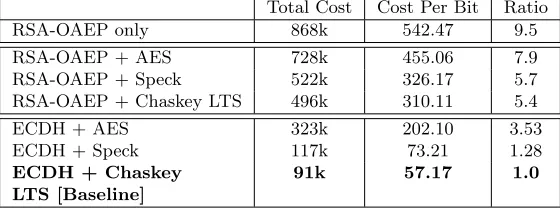
Table 2: # gates for encrypting 200 bytes for all schemes. RSA uses 2048-bit keys. ECDH refers to key exchange using the SNARK-friendly elliptic curve.
Total Cost Cost Per Bit Ratio
RSA-OAEP only 868k 542.47 9.5
RSA-OAEP + AES 728k 455.06 7.9
RSA-OAEP + Speck 522k 326.17 5.7
RSA-OAEP + Chaskey LTS 496k 310.11 5.4
ECDH + AES 323k 202.10 3.53
ECDH + Speck 117k 73.21 1.28
ECDH + Chaskey LTS [Baseline]
91k 57.17 1.0
For the block ciphers, the table shows about 4x better cost for Speck and Chaskey compared to an optimized version of AES. We also compared with our optimized version of AES (23k multipli-cation gates) to an auto-generated SNARK circuit using snarklib [28] (>1 million multiplication gates). In this case, our optimized version of AES implementation is at least 40xbetter than the auto-generated version, and it is also at least 2-3x better than a lower bound estimate for AES implementation using current compilers.
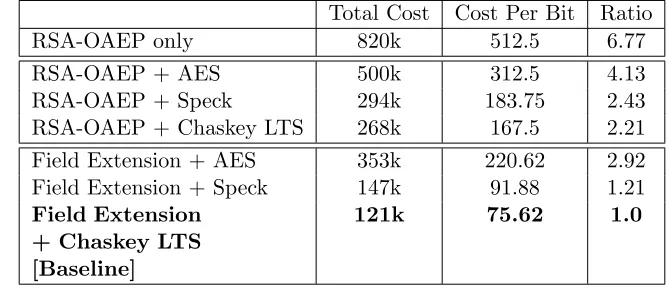
Starting from this point, we will only present results for the high security setting using RSA-2048 and the SNARK-friendly elliptic curve. The results of lower-level security involving Field Extension can be found in Appendix G. Table 2 provides the cost of encrypting 200 bytes using the above schemes (after optimizations). It can be noted that using the snark-friendly elliptic curve with the two lightweight ciphers provides better performance than the other techniques achieving about 3-9xspeedup.
6.2 Other Cryptographic Primitives
PRFs and commitments. In our implementation, we instantiate PRFs and Commitments using an efficient SHA-256 circuit. An efficient SHA-256 circuit costs about 26k gates for one block (512-bit input), while its na¨ıve implementation using SNARK compilers costs more than 40k gates. The optimizations are mainly achieved by representing Boolean operations efficiently, and careful circuit design. A previous similar implementation and a detailed discussion of SHA-256 optimizations can be found in [11]. Our implementation has additional 1000 gates savings via further low-level optimizations across rounds.
con-Table 3: Application – Privacy-preserving smart contracts: Benchmarks for pour and freeze circuits in Hawk [47].
Transformation in Section 3
Hyb. Enc. w/ ECDH Hyb. Enc. w/ RSA
RSA Naive RSA
Chaskey LTS Speck AES Chaskey LTS Speck AES Baseline
[Pour] KeyGen(s) 171.72 190.28 230.14 212.97 213.77 233.48 301.72 451.42
[Pour] Proof(s) 55.26 65.67 86.74 83.81 81.94 85.29 109.36 167.49
[Pour] Verify(s) 0.01 0.01 0.01 0.01 0.01 0.01 0.01 0.01
[Pour] Eval. Key(MB) 295.55 314.25 421.44 383.62 388.84 427.91 559.22 838.33
[Pour] Ver. Key(KB) 9.65 9.65 9.65 9.58 9.58 9.58 12.39 12.39
[Freeze] KeyGen(s) 124.53 130.87 185.56 166.38 170.56 188.68 389.47 389.47
[Freeze] Proof(s) 41.59 44.68 68.7 57.13 54.68 67.01 132.34 132.34
[Freeze] Verify(s) 0.01 0.01 0.01 0.01 0.01 0.01 0.01 0.01
[Freeze] Eval. Key(MB) 213.36 224.09 331.28 285.49 290.71 337.75 732.24 732.24
[Freeze] Ver. Key(KB) 6.22 6.22 6.22 6.15 6.15 6.15 8.95 8.95
Transformation in Section 4
Hyb. Enc. w/ ECDH Hyb. Enc. w/ RSA
RSA Chaskey LTS Speck AES Chaskey LTS Speck AES
[Pour] KeyGen(s) 100.39 104.03 133.15 150.98 158.21 183.97 192.48
[Pour] Proof(s) 32.83 32.95 44.38 47.93 52.04 66.7 65.41
[Pour] Verify(s) 0.01 0.01 0.01 0.01 0.01 0.01 0.01
[Pour] Eval. Key(MB) 169.31 175.22 228.78 257.65 264.86 315.89 345.26
[Pour] Ver. Key(KB) 7.97 7.97 7.97 9.86 9.86 9.86 10.42
[Freeze] KeyGen(s) 70.68 73.99 103.18 122.9 125.37 150.99 170.38
[Freeze] Proof(s) 21.7 23.78 34.85 41.96 41.07 51.55 54.86
[Freeze] Verify(s) 0.01 0.01 0.01 0.01 0.01 0.01 0.01
[Freeze] Eval. Key(MB) 115.64 122.05 175.11 209.96 215.17 258.23 291.59
[Freeze] Ver. Key(KB) 4.54 4.54 4.54 6.43 6.43 6.43 6.99
Transformation in Section 5
Hyb. Enc. w/ ECDH Hyb. Enc. w/ RSA
RSA Chaskey LTS Speck AES Chaskey LTS Speck AES
[Pour] KeyGen(s) 94.06 97.92 124.1 146.52 149.68 174.43 137.16
[Pour] Proof(s) 29.98 32.71 43.96 46.87 47.38 57.22 42.09
[Pour] Verify(s) 0.01 0.01 0.01 0.01 0.01 0.01 0.01
[Pour] Eval. Key(MB) 155.25 164.45 211.49 247.86 253.82 299.87 236.11
[Pour] Ver. Key(KB) 8.25 8.25 8.25 10.42 10.42 10.42 8.74
[Freeze] KeyGen(s) 62.48 65.61 93.17 117.35 120.22 144.89 111.02
[Freeze] Proof(s) 20.74 20.95 34.52 41 41.03 48.94 40.52
[Freeze] Verify(s) 0.01 0.01 0.01 0.01 0.01 0.01 0.01
[Freeze] Eval. Key(MB) 103.87 109.09 156.13 200.22 205.43 245.01 188.71
[Freeze] Ver. Key(KB) 4.82 4.82 4.82 6.99 6.99 6.99 5.31
structed over a SNARK’s (much larger) native field. In Appendix F, we establish that these estimates do indeed apply and show how to parameterize lattice-based schemes.
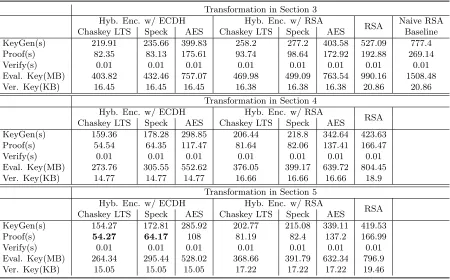
Table 4: Application – anonymous credential
Transformation in Section 3
Hyb. Enc. w/ ECDH Hyb. Enc. w/ RSA
RSA Naive RSA
Chaskey LTS Speck AES Chaskey LTS Speck AES Baseline
KeyGen(s) 219.91 235.66 399.83 258.2 277.2 403.58 527.09 777.4
Proof(s) 82.35 83.13 175.61 93.74 98.64 172.92 192.88 269.14
Verify(s) 0.01 0.01 0.01 0.01 0.01 0.01 0.01 0.01
Eval. Key(MB) 403.82 432.46 757.07 469.98 499.09 763.54 990.16 1508.48
Ver. Key(KB) 16.45 16.45 16.45 16.38 16.38 16.38 20.86 20.86
Transformation in Section 4
Hyb. Enc. w/ ECDH Hyb. Enc. w/ RSA
RSA Chaskey LTS Speck AES Chaskey LTS Speck AES
KeyGen(s) 159.36 178.28 298.85 206.44 218.8 342.64 423.63
Proof(s) 54.54 64.35 117.47 81.64 82.06 137.41 166.47
Verify(s) 0.01 0.01 0.01 0.01 0.01 0.01 0.01
Eval. Key(MB) 273.76 305.55 552.62 376.05 399.17 639.72 804.45
Ver. Key(KB) 14.77 14.77 14.77 16.66 16.66 16.66 18.9
Transformation in Section 5
Hyb. Enc. w/ ECDH Hyb. Enc. w/ RSA
RSA Chaskey LTS Speck AES Chaskey LTS Speck AES
KeyGen(s) 154.27 172.81 285.92 202.77 215.08 339.11 419.53
Proof(s) 54.27 64.17 108 81.19 82.4 137.2 166.99
Verify(s) 0.01 0.01 0.01 0.01 0.01 0.01 0.01
Eval. Key(MB) 264.34 295.44 528.02 368.66 391.79 632.34 796.9
Ver. Key(KB) 15.05 15.05 15.05 17.22 17.22 17.22 19.46
Another optimization that can be done is to use the same approach we used for optimized DH key exchange, by relying on a SNARK-friendly elliptic curve-based scheme for signatures. Such scheme can actually be derived based on the curve used earlier in key exchange, like the relation between the curve used in Ed25519 [17] and Curve25519 [16]. Since our final transformation does not rely mainly on signatures within the circuits, we leave investigating this direction to future work.
7
End-to-end Applications
To show the enhancement introduced by our techniques, we evaluate the performance of our trans-formations and the SNARK-friendly cryptography in the context of three different real applications that use zk-SNARKs. The evaluation will include the three transformations presented in Section 3 , the transformation in Section 4 , and the stronger version in Section 5. The evaluation will also compare all the encryption schemes presented earlier in Table 8. The baseline will be a naive im-plementation that adopts the first transformation while using unoptimized standard RSA for both encryption and signature. As before, we assume a minimum of 112-bit security in our implemen-tation. Results for 80-bit security are provided in Appendix G.
Table 5: Application – nonoutsourceable puzzles for thwarting mining pools (Type II) [53].
Transformation in Section 3
Hyb. Enc. w/ ECDH Hyb. Enc. w/ RSA
RSA Naive RSA
Chaskey LTS Speck AES Chaskey LTS Speck AES Baseline
KeyGen(s) 109.23 119.73 173.99 152.07 155.84 179.08 244.36 383.46
Proof(s) 35.48 43.78 61.09 50.17 52.06 61.57 86.41 134.31
Verify(s) 0.01 0.01 0.01 0.01 0.01 0.01 0.01 0.01
Eval. Key(MB) 182.27 200.62 296.58 256.39 263.26 303.05 446.85 710.03
Ver. Key(KB) 6.43 6.43 6.43 6.36 6.36 6.36 9.3 9.3
Transformation in Section 4
Hyb. Enc. w/ ECDH Hyb. Enc. w/ RSA
RSA Chaskey LTS Speck AES Chaskey LTS Speck AES
KeyGen(s) 59.39 62.58 89.41 113.38 116.1 135.37 163.2
Proof(s) 23.2 23.31 32.44 43.28 43.38 46.51 57.89
Verify(s) 0.01 0.01 0.01 0.01 0.01 0.01 0.01
Eval. Key(MB) 95.53 101.09 147.41 189.85 194.72 230.53 272.43
Ver. Key(KB) 4.75 4.75 4.75 6.64 6.64 6.64 7.34
Transformation in Section 5
Hyb. Enc. w/ ECDH Hyb. Enc. w/ RSA
RSA Chaskey LTS Speck AES Chaskey LTS Speck AES
KeyGen(s) 47.34 52.18 73.48 101.3 103.95 133.17 95.53
Proof(s) 16.56 19.26 26 34.69 34.72 48.45 34.71
Verify(s) 0.01 0.01 0.01 0.01 0.01 0.01 0.01
Eval. Key(MB) 73.81 80.67 120.47 168.16 173.03 216.82 157.61
Ver. Key(KB) 5.03 5.03 5.03 7.2 7.2 7.2 5.66
Privacy-preserving smart contracts. Hawk [47] is a recently proposed cryptocurrency system that enables users to run privacy-preserving decentralized applications on top of the blockchain, such as private auctions, crowdfunding, etc. In order to achieve privacy, Hawk relies mainly on zk-SNARKs to main its guarantees. The original Hawk paper [47] used the transformation in Section 3 , using only unoptimized RSA for encryption and signature. We investigate how the proposed transformation can provide better performance.
We applied our transformations to two Hawk circuits: pour and freeze, which mainly enable users to spend or commit to secret coin values that they own. Table 3 presents the results at the 112-bit security level. It can be noted that the transformation presented in Section 5 achieves better performance compared to other transformations. Furthermore, for both pour and freeze circuits, usage of SNARK-friendly cryptographic schemes using ECDH and the lightweight ciphers achieved more than 5× speedupcompared to the na¨ıve implementation used for the first transformation. As stated in the Hawk paper, Hawk has now switched their implementation to using the C∅C∅ framework.
Table 4 provides the benchmarks for this application at the 112-bit security level, showing more than 5× speedup compared to the na¨ıve implementation used for the first transformation. The main reason for why the speedup in this application is higher than the previous one is due to the size of the secret witness here, which makes the encryption modules dominant in the circuit.
Nonoutsourceable puzzles. Motivated by the prevalence of Bitcoin mining coalitions, which is harmful to the decentralization goal of cryptocurrency, Miller et al. proposed a technique for deterring coalitions using what is called: Nonoutsourceable Puzzles [53]. These puzzles aims to discourage pool operators from outsourcing mining work to other workers, as they can enable a worker to steal the reward without being implicated. The implementation of these nonoutsourceable puzzles relied on zk-SNARKs as well, and hence we investigate how our techniques will perform in the context of this application.
Table 5 provides the benchmarks at the 112-bit security level, showing that using SNARK-friendly schemes along with the third transformation (the transformation in Section 5) can achieve
8× speedup compared to the na¨ıve implementation used for the first transformation.
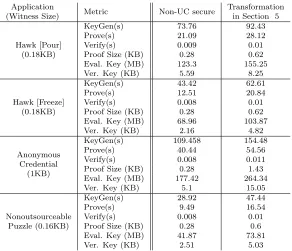
Discussion: transformation cost. Although we have noted the perils of non-composability in protocol design, we nonetheless evaluate the cost of our SNARK lifting transformations in Table 6. This table reflects the most efficient transformation (Section 5). Note that the proof size in the table includes any additional outputs that are not part of the original statement. As the table shows, the additional proof size correlates with the size of the secret witness. This is why the anonymous credential application has the largest proof size. In terms of the proof computation time, the transformation we employed resulted in nearly 2× higher proof time in the worst case, which is still practical within the context of the applications we considered.
Table 6: Cost comparison with non-UC secure scheme. Proof size includes any additional outputs that are not part of the original statement, e.g. encrypted witness.
Application
(Witness Size) Metric Non-UC secure
Transformation in Section 5
Hawk [Pour] (0.18KB)
KeyGen(s) 73.76 92.43 Prove(s) 21.09 28.12 Verify(s) 0.009 0.01 Proof Size (KB) 0.28 0.62 Eval. Key (MB) 123.3 155.25 Ver. Key (KB) 5.59 8.25
Hawk [Freeze] (0.18KB)
KeyGen(s) 43.42 62.61 Prove(s) 12.51 20.84 Verify(s) 0.008 0.01 Proof Size (KB) 0.28 0.62 Eval. Key (MB) 68.96 103.87 Ver. Key (KB) 2.16 4.82
Anonymous Credential
(1KB)
KeyGen(s) 109.458 154.48 Prove(s) 40.44 54.56 Verify(s) 0.008 0.011 Proof Size (KB) 0.28 1.43 Eval. Key (MB) 177.42 264.34 Ver. Key (KB) 5.1 15.05
Nonoutsourceable Puzzle (0.16KB)
8
Conclusion
We design and implement a framework called C∅C∅, making composable zero-knowledge proofs a practically efficient and accessible building block for non-specialist programmers for the first time. In comparison with earlier works, C∅C∅ makes it much easier for programmers to code up composable NIZKs for general statements — in particular, the programmer now only needs to code up the high-level application and need not express the SNARK lifting transformation itself as algebraic circuits. We formally prove the security of our constructions, and demonstrate the practical performance ofC∅C∅in several applications that require zero-knowledge proofs. We show that through careful optimizations and design of SNARK-friendly cryptographic primitives, C∅C∅ provides 5×to8×performance improvement in comparison with naive implementations.
Acknowledgments
We gratefully acknowledge Jonathan Katz for helpful technical discussions about the zero-knowledge proof constructions. We also thank Dario Fiore for pointing out an error in the previous version in one of the optimizations in the baseline schemes we compare with 1. This work is funded in part by NSF grants CNS-1314857, CNS-1453634, CNS-1518765, CNS-1514261, a Packard Fellowship, a Sloan Fellowship, two Google Faculty Research Awards, a VMWare Research Award, as well as grants from the DARPA Safeware and DARPA Brandeis programs. This work was done in part while a subset of the authors were visiting the Simons Institute for the Theory of Computing, supported by the Simons Foundation and by the DIMACS/Simons Collaboration in Cryptography through NSF grant CNS-1523467.
References
[1] Intel SGX for dummies (intel SGX design objectives). https://software.intel.com/en-us/blogs/ 2013/09/26/protecting-application-secrets-with-intel-sgx.
[2] jsnark: A java library for building snarks. oblivm.com/jsnark. [3] Personal communication with vitalik buterin.
[4] Trusted computing group. http://www.trustedcomputinggroup.org/.
[5] M. R. Albrecht, R. Player, and S. Scott. On the concrete hardness of learning with errors. 2015. [6] M. Backes, M. Barbosa, D. Fiore, and R. M. Reischuk. Adsnark: nearly practical and privacy-preserving
proofs on authenticated data. In Security and Privacy (SP), 2015 IEEE Symposium on. IEEE, 2015. [7] P. S. L. M. Barreto and M. Naehrig. Pairing-friendly elliptic curves of prime order. Cryptology ePrint
Archive, Report 2005/133, 2005.
[8] R. Beaulieu, D. Shors, J. Smith, S. Treatman-Clark, B. Weeks, and L. Wingers. The simon and speck families of lightweight block ciphers. Cryptology ePrint Archive, Report 2013/404, 2013.
1In our earlier version, to give the baseline schemes the benefit of the doubt, we made an optimization whose
[9] R. Beaulieu, D. Shors, J. Smith, S. Treatman-Clark, B. Weeks, and L. Wingers. Simon and speck: Block ciphers for the internet of things. Cryptology ePrint Archive, Report 2015/585, 2015.
[10] M. Ben-Or, S. Goldwasser, and A. Wigderson. Completeness theorems for non-cryptographic fault-tolerant distributed computation. In STOC, 1988.
[11] E. Ben-Sasson, A. Chiesa, C. Garman, M. Green, I. Miers, E. Tromer, and M. Virza. Zerocash: Decentralized anonymous payments from bitcoin. InS & P, 2014.
[12] E. Ben-Sasson, A. Chiesa, D. Genkin, and E. Tromer. Fast reductions from rams to delegatable succinct constraint satisfaction problems: extended abstract. InITCS, 2013.
[13] E. Ben-Sasson, A. Chiesa, D. Genkin, E. Tromer, and M. Virza. Snarks for C: verifying program executions succinctly and in zero knowledge. InCRYPTO, 2013.
[14] E. Ben-Sasson, A. Chiesa, E. Tromer, and M. Virza. Scalable zero knowledge via cycles of elliptic curves. In Advances in Cryptology–CRYPTO 2014, pages 276–294. Springer, 2014.
[15] E. Ben-Sasson, A. Chiesa, E. Tromer, and M. Virza. Succinct non-interactive zero knowledge for a von neumann architecture. InUSENIX Security, 2014.
[16] D. J. Bernstein. Curve25519: new diffie-hellman speed records. InPublic Key Cryptography-PKC 2006, pages 207–228. Springer, 2006.
[17] D. J. Bernstein, N. Duif, T. Lange, P. Schwabe, and B.-Y. Yang. High-speed high-security signatures.
Journal of Cryptographic Engineering, 2(2):77–89, 2012.
[18] D. J. Bernstein and T. Lange. Safecurves: choosing safe curves for elliptic-curve cryptography. http: //safecurves.cr.yp.to. Accessed: 2016-05-20.
[19] N. Bitansky, R. Canetti, A. Chiesa, and E. Tromer. From extractable collision resistance to succinct non-interactive arguments of knowledge, and back again. InITCS, pages 326–349, 2012.
[20] M. Blum, P. Feldman, and S. Micali. Non-interactive zero-knowledge and its applications. In STOC, 1988.
[21] M. Blum, A. D. Santis, S. Micali, and G. Persiano. Non-interactive zero knowledge. SIAM Jornal of Computation, 1991.
[22] J. Camenisch, S. Hohenberger, and A. Lysyanskaya. Compact e-cash. InEUROCRYPT, 2005.
[23] J. Camenisch and A. Lysyanskaya. An efficient system for non-transferable anonymous credentials with optional anonymity revocation. In EUROCRYPT, 2001.
[24] R. Canetti. Universally composable security: A new paradigm for cryptographic protocols. InFOCS, 2001.
[25] R. Canetti, Y. Dodis, R. Pass, and S. Walfish. Universally composable security with global setup. In
TCC. 2007.
[26] R. Canetti, Y. Lindell, R. Ostrovsky, and A. Sahai. Universally composable two-party and multi-party secure computation. InSTOC, 2002.
[27] R. Canetti and T. Rabin. Universal composition with joint state. InCRYPTO, 2003.
[28] J. Carlsson. snarklib: a c++ template library for zero knowledge proofs. https://github.com/jancarlsson/snarklib.
[29] Y. Chen and P. Q. Nguyen. Bkz 2.0: Better lattice security estimates. InASIACRYPT, 2011. [30] Y. Chen and P. Q. Nguyen. Bkz 2.0: Better lattice security estimates (full version), 2012.
[32] C. Costello, C. Fournet, J. Howell, M. Kohlweiss, B. Kreuter, M. Naehrig, B. Parno, and S. Zahur. Geppetto: Versatile verifiable computation. In S&P, 2014.
[33] G. Danezis, C. Fournet, M. Kohlweiss, and B. Parno. Pinocchio Coin: building Zerocoin from a succinct pairing-based proof system. In PETShop, 2013.
[34] A. Delignat-Lavaud, C. Fournet, M. Kohlweiss, and B. Parno. Turning shabby x.509 certificates into elegant anonymous credentials with the magic of verifiable computation. In S& P, 2016.
[35] D. Fiore and A. Nitulescu. On the (in) security of snarks in the presence of oracles. In Theory of Cryptography Conference, pages 108–138. Springer, 2016.
[36] C. Garman, M. Green, and I. Miers. Accountable privacy for decentralized anonymous payments. In
Financial Crypto’16, 2016.
[37] R. Gennaro, C. Gentry, B. Parno, and M. Raykova. Quadratic span programs and succinct NIZKs without PCPs. In Eurocrypt, 2013.
[38] C. Gentry and D. Wichs. Separating succinct non-interactive arguments from all falsifiable assumptions. InSTOC, 2011.
[39] O. Goldreich, S. Micali, and A. Wigderson. How to play any mental game. In ACM symposium on Theory of computing (STOC), 1987.
[40] R. Granger, T. Kleinjung, and J. Zumbragel. On the discrete logarithm problem in finite fields of fixed characteristic. IACR ePrint Archive 2015/685, 2015.
[41] J. Groth. Simulation-sound nizk proofs for a practical language and constant size group signatures. In
ASIACRYPT, 2006.
[42] J. Groth, R. Ostrovsky, and A. Sahai. Perfect non-interactive zero knowledge for NP. InEUROCRYPT, 2006.
[43] S. Hohenberger, S. Myers, R. Pass, and a. shelat. Anonize: A large-scale anonymous survey system. In
S & P, 2014.
[44] J. Jonsson and B. Kaliski. Public-Key Cryptography Standards (PKCS) #1: RSA Cryptography Specifications Version 2.1, 2003. RFC 3447.
[45] A. Joux and C. Pierrot. The special number field sieve inFpn, application to pairing-friendly construc-tions. Cryptology ePrint Archive, Report 2013/582, 2013.
[46] A. Juels, A. Kosba, and E. Shi. The ring of gyges: Using smart contracts for crime. Manuscript, 2015. [47] A. Kosba, A. Miller, E. Shi, Z. Wen, and C. Papamanthou. Hawk: The blockchain model of cryptography
and privacy-preserving smart contracts. InIEEE Symposium on Security and Privacy, 2016.
[48] A. E. Kosba, D. Papadopoulos, C. Papamanthou, M. F. Sayed, E. Shi, and N. Triandopoulos. Trueset: Nearly practical verifiable set computations. InUsenix Security Symposium, 2014.
[49] A. K. Lenstra. Using cyclotomic polynomials to construct efficient discrete logarithm cryptosystems over finite fields. InInformation Security and Privacy, pages 126–138. Springer, 1997.
[50] R. Lindner and C. Peikert. Better key sizes (and attacks) for lwe-based encryption. InCT-RSA, Berlin, 2011.
[51] C. C. Martin R. Albrecht, J.-C. Faug`ere, R. Fitzpatrick, and L. Per-ret. On the complexity of the bkw algorithm on lwe. InDesigns, Codes and Cryptography, volume 74, pages 325–354, 2015.
[52] D. Micciancio and O. Regev. Lattice-based cryptography. InBernstein et al, pages 147–191, 2009. [53] A. Miller, E. Shi, A. Kosba, and J. Katz. Nonoutsourceable Scratch-Off Puzzles to Discourage Bitcoin
[54] N. Mouha, B. Mennink, A. Van Herrewege, D. Watanabe, B. Preneel, and I. Verbauwhede. Chaskey: An efficient mac algorithm for 32-bit microcontrollers. InSelected Areas in Cryptography. 2014. [55] B. Parno, J. Howell, C. Gentry, and M. Raykova. Pinocchio: Nearly practical verifiable computation.
InS & P, 2013.
[56] L. G. Pierrick Gaudry and M. Videau. Collecting relations for the number field sieve ingf(p6). IACR ePrint Archive 2016/124, 2016.
[57] A. J. Razvan Barbulescu, Pierrick Gaudry and E. Thome. A heuristic quasi-polynomial algorithm for discrete logarithm in finite fields of small characteristic. In EUROCRYPT’14, 2014.
[58] M. R¨uckert and M. Schneider. Estimating the security of lattice-based cryptosystems. 2010.
[59] A. Sahai. Non-malleable non-interactive zero knowledge and adaptive chosen-ciphertext security. In
FOCS ’99, 1999.
[60] A. D. Santis, G. D. Crescenzo, R. Ostrovsky, G. Persiano, and A. Sahai. Robust non-interactive zero knowledge. InCRYPTO, 2001.
[61] S. Setty, V. Vu, N. Panpalia, B. Braun, A. Blumberg, and M. Walfish. Taking proof-based verified computation a few steps closer to actual practicality. InUSENIX security, 2012.
[62] R. S. Wahby, S. Setty, Z. Ren, A. J. Blumberg, and M. Walfish. Efficient ram and control flow in verifiable outsourced computation. In NDSS, 2015.
[63] R. S. Wahby, S. T. V. Setty, Z. Ren, A. J. Blumberg, and M. Walfish. Efficient RAM and control flow in verifiable outsourced computation. InNDSS, 2015.
[64] M. Walfish and A. J. Blumberg. Verifying computations without reexecuting them. Communications of the ACM, 58(2):74–84, 2015.
[65] G. Wood. Ethereum: A secure decentralized transaction ledger. http://gavwood.com/paper.pdf. [66] Y. Zhang, J. Katz, and C. Papamanthou. Integridb: Verifiable SQL for outsourced databases. InACM
CCS, 2015.
[67] Y. Zhang, C. Papamanthou, and J. Katz. ALITHEIA: towards practical verifiable graph processing. In
ACM CCS, 2014.
Appendix
A
Sample Code
Figure 2 illustrates a code example written usingC∅C∅for a circuit that computes a certain property over a secret document or credential that is signed by some authority.
B
UC 10-Minute Crash Course and Why the Practitioner Should
Care
p u b l i c c l a s s A n o n y m o u s C r e d e n t i a l s e x t e n d s
C i r c u i t G e n e r a t o r {
p r i v a t e s t a t i c f i n a l i n t BITWIDTH PER WIRE = 6 4 ;
p r i v a t e s t a t i c f i n a l i n t CREDENTIAL SIZE = 1024 ∗ 8 ; // i n b i t s
p r i v a t e s t a t i c f i n a l i n t RSA KEY SIZE = 1 0 2 4 ; // i n b i t s
@Override
p u b l i c v o i d b u i l d C i r c u i t ( ) {
// The p u b l i c key o f t h e t r u s t e d a u t h o r i t y ( P a r t o f t h e p u b l i c s t a t e m e n t ) // Only t h e modulus i s s p e c i f i e d h e r e f o r s i m p l i c i t y .
Wire [ ] pkWires = c r e a t e I n p u t W i r e A r r a y ( RSA KEY SIZE / BITWIDTH PER WIRE) ;
// The s e c r e t s i g n a t u r e w i r e s
Wire [ ] s i g n a t u r e W i r e s = c r e a t e P r o v e r W i t n e s s W i r e A r r a y ( RSA KEY SIZE / BITWIDTH PER WIRE, BITWIDTH PER WIRE) ;
// The s e c r e t c r e d e n t i a l w i r e s
Wire [ ] s e c r e t C r e d e n t i a l W i r e s = c r e a t e P r o v e r W i t n e s s W i r e A r r a y ( CREDENTIAL SIZE / BITWIDTH PER WIRE, BITWIDTH PER WIRE) ;
// V e r i f y t h e s i g n a t u r e
Wire i s V a l i d S i g n a t u r e = c h e c k R S A S i g n a t u r e ( pkWires , s i g n a t u r e W i r e s , s e c r e t C r e d e n t i a l W i r e s , RSA KEY SIZE , BITWIDTH PER WIRE) ;
// Check w h e t h e r a c e r t a i n f i e l d i n t h e s e c r e t document i s z e r o o r n o t . Wire r e v e a l e d P r o p e r t y = s e c r e t C r e d e n t i a l W i r e s [ 0 ] . checkNonZero ( ) ;
// D e f i n e t h e p u b l i c s t a t e m e n t Wire [ ] inStmt = pkWires ;
Wire [ ] outStmt = new Wire [ ] { r e v e a l e d P r o p e r t y , i s V a l i d S i g n a t u r e }; // S p e c i f y t h e w i t n e s s e s
Wire [ ] w i t n e s s e s = U t i l . c o n c a t ( s e c r e t C r e d e n t i a l W i r e s , s i g n a t u r e W i r e s ) ;
// Apply t h e SNARK L i f t i n g T r a n s f o r m a t i o n
S n a r k L i f t i n g . s n a r k L i f t ( inStmt , outStmt , w i t n e s s e s , BITWIDTH PER WIRE) ; }
// . . }
Figure 2: A code example for an anonymous credential circuit usingC∅C∅.
UC allows abstraction of cryptography. Cryptographic building blocks and protocols are com-plex. When programmers in the real world program cryptography, they should not have to think about cryptography at the abstraction of modular exponentiations or RSA hardness. Rather, they should be able to think about cryptography as a blackbox while abstracting away the implementa-tion details.
![Table 3: Application – Privacy-preserving smart contracts: Benchmarks for pour and freezecircuits in Hawk [47].](https://thumb-us.123doks.com/thumbv2/123dok_us/7920759.1315222/18.612.77.560.106.551/table-application-privacy-preserving-smart-contracts-benchmarks-freezecircuits.webp)
![Table 5:Application – nonoutsourceable puzzles for thwarting mining pools (TypeII) [53].](https://thumb-us.123doks.com/thumbv2/123dok_us/7920759.1315222/20.612.84.531.107.386/table-application-nonoutsourceable-puzzles-thwarting-mining-pools-typeii.webp)

![Table 9: Application – Privacy-preserving smart contracts: Benchmarks for pour and freezecircuits in Hawk [47].](https://thumb-us.123doks.com/thumbv2/123dok_us/7920759.1315222/51.612.70.564.177.622/table-application-privacy-preserving-smart-contracts-benchmarks-freezecircuits.webp)
