More than free paint
Exploring young people’s experiences of the B-Creative
street art program
THE VICTORIA INSTITUTE
Dr Alison Baker
vu.edu.au
CRICOS Provider No. 00124k CRICOS Provider No. 02475D
MORE THAN FREE PAINT
EXPLORING YOUNG PEOPLE’S EXPERIENCES
OF THE B-CREATIVE STREET ART PROGRAM
Final Report
DECEMBER 2013
Acknowledgements
I would like to acknowledge the young people and the artist mentors who
participated in this research and shared their experiences with me. I would also like to thank Ms Charlotte Hilder for her support during the research project and for the work she does with young people across the City of Brimbank.
Thank you Nicola Dracoulis for taking photographs throughout the project and allowing us to use those in the report.
The Researcher
Dr Alison Baker is a Research Fellow at the Victoria Institute. Alison’s current research projects are focused on the use of community-based arts as a catalyst for community and civic engagement among young people from under-represented groups. Alison is interested in blending creative research methodologies and documentary techniques to develop young people’s sense of social justice and capacity for action.
Address
Victoria University
City Queen Campus
300 Queen Street
VIC, 3000
Australia
Phone:
+61 3 9919 5934
The Victoria Institute
About
The Victoria Institute is a research institute with a focus on
inclusive education. We work with researchers, teachers,
communities and policy makers to improve educational
experiences and outcomes for all.
Our research aims to build better learning for students from diverse and
disadvantaged backgrounds.
The Institute was founded in 2011 in response to fading sophisticated research
into education policy and programming.
Led by Professor Roger Slee (Director), we aim to analyse, evaluate and
challenge education practices, curriculum and assessment.
Contents
Contents ...6
Tables ...7
Glossary ...9
Executive Summary ...11
1. Overview ...15
1.1 Project context ... 15
1.2 Project background ... 15
1.3 Project description ... 16
2. Literature Snapshot ...17
2.1 Civic engagement ... 17
2.2 Arts, community and young people ... 17
2.3
Youth and graffiti
... 18
3. Research Methods and Participants ...21
3.1 Summary ... 21
3.2 Participants ... 21
3.3 Data collection ... 22
4. Research Findings ...25
4.1 Personal development ... 27
4.2 Social connection & community engagement ... 32
5. Summary of Recommendations ...41
6. Participant Photo Gallery ...43
References ...47
Tables
TABLE 1: Young people participating in research activities...21
TABLE 2: Research activities for B-Creative! Program:
Data collection, types and timeframes ...22
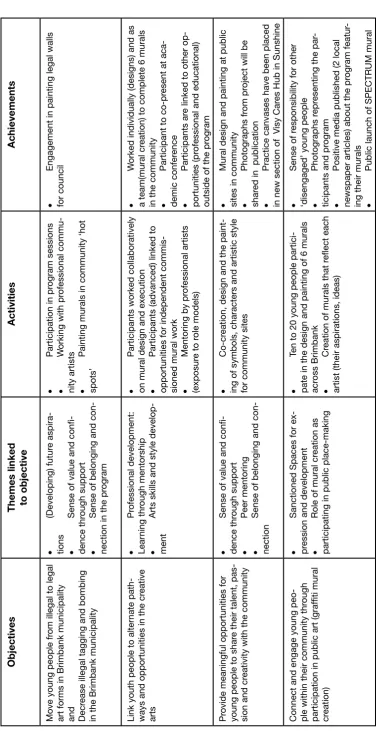
TABLE 3: Summary of objectives, themes, activities and achievements
Glossary
AB
Alison Baker, researcher.
Bombing
Painting a large scale illegal piece or ‘throw-up’ of graffiti.
BYS
Brimbank Youth Services.
CIV
Community Indicators Victoria
M1
Artist mentor 1.
M2
Artist mentor 2.
Tagging
13
13
EXECUTIVE SUMMARYExecutive Summary
In recent years there has been growing concern about the amount of graffiti in public spaces. The
VictorianGraffiti Prevention Act 2007 recognises graffiti as a crime and has implemented penalties, including fines and jail time for those violating this law. Brimbank City Council has also identified graffiti
as an issue of concern, especially tagging and large scale ‘bombing’ on local public buildings. The primary strategies being used by most Local Government Authorities (LGAs) to deter young people from
doing graffiti have been directing a substantial amount of public funds for the removal of graffiti from
public spaces. However, Brimbank Youth Services are implementing a number of strategies to reduce
graffiti in the community while also providing a space for young artists to develop their skills through
a street art program called B-Creative. In late 2012, Brimbank Youth Services won a grant from the Department of Justice, which provided funding to complete six murals across Brimbank. This funding allowed the program to expand by (1) hiring professional community artists to mentor young people and (2) providing the necessary materials (e.g. paint) to complete the murals.
Research purpose and method
The purpose of this research was to evaluate young people’s experiences of the B-Creative program, focusing on the timeframe in which the six murals were undertaken. This research was aimed at understanding young people’s community engagement through this public arts program and the extent to which it facilitated the development of (civic) identity, connection to community and future aspirations. The evaluation used a number of data gathering techniques including participant observations, photo-elicitation and focus groups/interviews with participants, and interviews with program staff (e.g. mentors). Prior to receiving the funding from the Department of Justice, the researcher had been working with the program to explore civic engagement through community arts
programs for young people, with a specific focus on the Brimbank region. Data gathering activities
conducted prior to the Department of Justice funding provide a contrast to the research that took place one year later, after the participants had worked collaboratively in the community on six public murals.
Key findings & recommendations
The findings of this evaluation highlight a number of personal development and psychosocial benefits for young people participating in the program. Participants reflected upon professional development
through mentoring, including enhancements of their artistic skills, business knowledge and sense of value in their art. In addition, peer mentorship proved to be an important part of the program, with young people of different skill and knowledge levels working with each other to develop their arts
practice. Young people participating in the program also reflected upon their future aspirations in and
out of the arts world, highlighting again the importance of professional artist mentors as role models.
The B-Creative program also illuminated the benefits provided through participation in the areas of
social connection and community engagement. The program quite clearly provides ‘sanctioned spaces’ for young people to work together and to show and express their creativity, providing an alternative to
illegal graffiti painting. These spaces also provided a sense of safety, acting as a protective factor from the potential negative influences affiliated with graffiti. Flowing from benefits provided by the spaces
More than free paint December 2013
14
to paint in public spaces have been instrumental in developing young people’s capacities and ties to
community life, while also giving them the chance to influence future directions for the program. During
the six months of mural creation across Brimbank, participants moved from being passive participants to having a more active role in the program (e.g. making decisions) increasing their sense of ownership
of the B-Creative program. These recommendations are a reflection of participants’ ideas about how the
program could be enhanced:
• Raise the standard and expectations in the program (e.g. strive to enhance quality of their murals through organization and participation in all activities).
• Ensure participation in design and brainstorming sessions. • Use a rewards or competition system to motivate participants. • Make Brimbank an area known for public art in Melbourne’s west. • Continue funding and community partners/clients.
• Include separate groups or sessions that cater to different skill levels and interests (e.g. beginner versus advanced).
• Maintaining role of peer mentorship.
• Increase professional training (e.g. developing a portfolio, learning to create a website) for participants, including guest speaker sessions.
• Continue to link program participants to other services because B-Creative is a point of contact in the community for many young people (e.g. justice services, health etc.).
More than free paint December 2013
1
More than free paint December 2013
17
1 OVERVIEW
17
OVERVIEW
1.1 Project context
In the 2007 Wellbeing Reports published by Community Indicators Victoria (CIV), the Brimbank region scored below the state average in several key areas. Of special importance is that 18% of adolescents
15 to 19 years of age who are not attending school, have been classified as ‘disengaged’ because they
aren’t studying, working, or attending vocational training. Local council and community members have
also identified that in various suburbs in the Brimbank LGA there are increasing numbers of disengaged
young people, especially those from low SES and CALD backgrounds. While these statistics are not evidence of a causal relationship, it can be inferred that there are links between community context and
disengaged youth, and investigating these connections using a research-based approach would benefit
young people and the broader community. The goal of this initial research was to understand more about the lives of ‘disengaged’ young people in that they are (or at risk of) not attending school, working and/
or have been referred to a community outreach service. More specifically, this research sought to shed
light on the ways in which community arts programs can serve as a catalyst for engagement for young people who are considered ‘at risk’. For young people participation through arts, cultural and sports activities are considered important ways of engaging in community life. Providing more opportunities for arts participation is an important strategic priority for Brimbank City Council, however, in 2011 only 55 % of those living in the area had participated in arts/cultural activities in the previous month, compared to the state average of 64% (CIV, 2011). Given the relatively high percentage of young people not engaged in formal education or work in Brimbank, council-led arts programs offer another point of contact and engagement, offering potential pathways that can lead to employment or further education.
1.2 Project background
Brimbank Youth Services (BYS) works with young people, mentor artists and the community to offer creative arts programs. The B-Creative Urban Aerosol art program (B-Creative) has been offered to young
people living, working or studying in Brimbank to help them develop their graffiti art skills and to provide
them with opportunities to legally paint public murals. The primary aims for the B-Creative program are:
• Move young people from illegal to legal art forms in Brimbank municipality.
• Connect and engage young people in their community through participation in public art (graffiti mural
creation).
• Provide meaningful opportunities for young people to share their talent, passion and creativity with the community.
More than free paint December 2013
18
1.3 Project description
This street art program has been offered weekly for the past 18 months with participants ranging in
age from 14 to 21, many of whom have been involved in illegal graffiti writing and vandalism. Most of
the participants in the B-Creative program were engaged in education through public or alternative,
‘flexible’, schools. Others were involved in training or were employed (usually part-time) during the project.
Approximately 20 young people have participated in the recent program activities; however, a core group of 10 participants consistently attended and took part the majority of the activities the program offers.
The young people in this program work with professional graffiti artists (mentors) to design and deliver
collaborative pieces in local community spaces. The program aims to build a sense of ownership and community connection among the young people through collaborative engagement, and deter engagement
in illegal graffiti writing on private property.
In 2012, BYS received funding from the Department of Justice to engage young people participating in this
program to complete six murals across the Brimbank region, focussing on graffiti ‘hotspot’ areas. One of
the main goals of this project, which was delivered from December 2012 to May 2013, was to provide the necessary supplies (paint) and staff (professional artists) to allow young people to design and complete murals in partnership with the community. In doing this, young people were to work collaboratively and develop their artistic skills.
More than free paint December 2013
19
2 LITERATURE SnApShOT
19
2
LITERATURE SnApShOT
2.1 Civic engagement
Flanagan and Levine (2010) have recently identified the importance of civic engagement during late
adolescence and young adulthood as a time in which, “people chart a course for their future and ‘take stock’ of the values they live by and the kind of world they want to be a part of” (p.160). Civic engagement, that is, participation in social and political activities such as voting, working in community-based organizations or programs, volunteering, and religious activities, provides young people with the opportunity to build social capital and contribute to social change.
As noted by Pancer, Pratt, Hunsberger & Alisat (2007) youth who participate in activities such as community service, arts and music programs, athletics, political or social action, and youth organizational work have fewer negative outcomes such as school failure and dropout (Janosz, Le Blana, Boulerice & Tremblay 1997; Mahoney & Cairns, 1997) criminal activity (Mahoney, 2000) and teen
pregnancy (Allen & Philliber, 1997). Other research has noted the benefits of participation in civic and
community activities including increased psychosocial well-being (Checkoway, 2011) sense of agency and teamwork (Hansen, Larson & Dworkin, 2003), academic success (Barber, Eccles & Stone, 2001) political knowledge and participation (Niemi, Hepburn & Chapman, 2000) and foster young people’s commitment to civic participation (Kahne & Sporte, 2008). Community–based youth organizations and activities are places in which young people develop a collective voice, sense of identity through group membership, and which promotes action for social justice (Flanagan, Cumsille, Gill, & Gallay, 2007; Ginwright & James, 2002; Watts, 2007).
2.2 Arts, community and young people
Creative arts education in school settings is beneficial for low income students, who were more likely
to have attended college, obtained employment, volunteered in their communities and participated in voting than those students who did not participate in the arts (Catterall, 2009). Arts practice in after-school programs is linked to more complex language acquisition (Heath & Roach, 1999) identity exploration (Larson, Hansen, & Moneta, 2006) and increased levels of intrinsic motivation and engagement (Shernoff & Vandell, 2007). Collaborative research projects using arts methodologies are to construct citizenship and develop capacities such as a sense of social justice, a sense of agency, and fostering intercultural dialogue (Bell & Desai, 2011; El-Haj & Renda, 2009; Madyaningrum & Sonn, 2011; Sonn, 2011).
More than free paint December 2013
20
2.3 Youth and graffiti
Docuyanan (2000) and Schacter (2008) have identified that graffiti has been considered an act of
vandalism, a mode of resistance, and a form of public art, being both celebrated and contested
in Melbourne. In Melbourne, research has shown that graffiti is part of the ‘character’ of the city,
something that adds to the urban landscape (Dovey, Wollan & Woodcock, 2012), yet the state
government has implemented a zero tolerance policy in Victoria. Youth research has identified that graffiti, like many arts, also provides young people with a sense of connection, pride, and enjoyment
(Halsey & Young, 2006). While a substantial body of research has pointed out the negative aspects
of illegal graffiti writing such as it being a gang ‘subculture’ (for example see White, 1993), other work has identified it as becoming or leading to a career in the art world for many artists (Lachmann, 1988; Kramer, 2010). While current research focuses on illegal graffiti writing, less is known about the ways in which ‘legal’ programs influence young people who participate in them. Despite the growing number of alternative or ‘flexi’ schools using graffiti as an educational engagement tool and the few council led
programs in Australia offering opportunities to paint, this area of research has been neglected. This report will examine, through an evaluation of the B-Creative program the ways in which a legal,
council-led, community-based arts program influences young people over period of intense artistic activity.
23
More than free paint December 2013
23
3 RESEARCh METhODS AnD pARTICIpAnTS
3
RESEARCh METhODS AnD
pARTICIpAnTS
3.1 Summary
This research used a number of data gathering techniques to document participants’ and mentors’
reflections of the program. Focus groups were the main source of data, however, interviews were used with
younger participants (14 to 16 years) and the professional artist mentors leading the project. In addition,
participants’ photographs and comments were part of the evaluation data, including field notes that documented casual conversations about the images and their significance.
3.2 Participants
Young people participating in the research ranged in age (14-21) and were from different cultural
backgrounds (e.g. Second generation Turkish, Chilean, Vietnamese, and Greek). As noted previously, the majority of the program participants were engaged in education (ranging from public schools to alternative
‘flexi schools’), training or employment during their time in the B-Creative program. One-on-one interviews
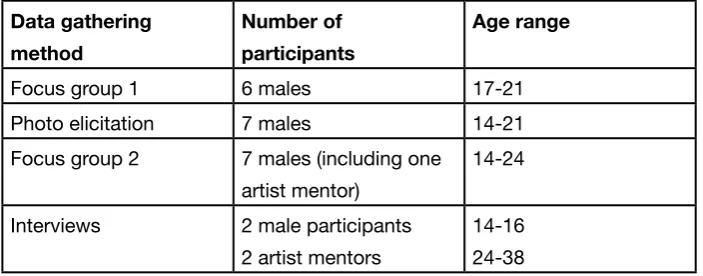
were conducted with younger participants also using their photographs during the conversation to ensure they had the opportunity to speak about their experiences and images. Seven participants completed the photographic component of the evaluation research (although one participant returned the camera without pictures) and these same young people participated in the second focus group or interview.
The professional artist mentors (2) were very different in terms of age, ethnicity, length of time painting and mentoring young people. One-on-one interviews were conducted with each mentor and the one mentor also participated in the second focus group.
Table 01: Young people participating in research activities
Data gathering method
Number of participants
Age range
Focus group 1 6 males 17-21 Photo elicitation 7 males 14-21 Focus group 2 7 males (including one
artist mentor)
14-24
Interviews 2 male participants 2 artist mentors
More than free paint December 2013
24
3. 3 Data collection
3.3.1 Pre evaluation research
Prior to the evaluation the researcher had been attending the B-Creative program sessions and engaging in participant observation including conversations with program mentors and participants. The focus of the research was to learn more about community-based arts programs as contexts for
civic engagement, especially with young people who have been identified as ‘disengaged’. During
this period of research an interview was conducted with the professional artist who runs the weekly workshops with the young people and one focus group with several of the program participants.
3.3.2 Evaluation
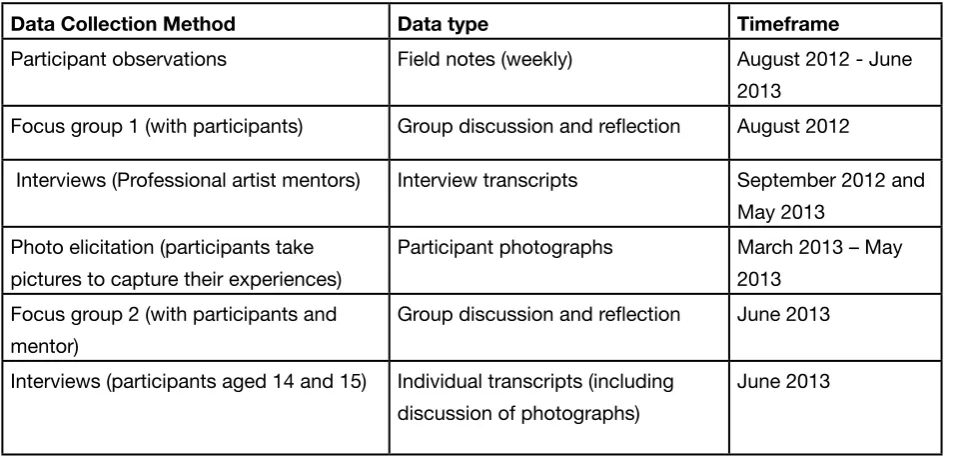
Victoria University was contracted to complete an evaluation of the B-Creative program for young people in January 2013. This research took place from March through to August of 2013 with the aims to (1) explore participants’ lives in and out of the program, focusing on their passion for arts, but including other aspects of their lives (e.g. schooling, family, hobbies) and (2) to evaluate the impact of the program upon the young people during the period of funding from the Department of Justice. The data gathering activities are detailed below in Table 2.
Table 02: Research activities for B-Creative! Program: Data collection, types and timeframes
Data Collection Method Data type Timeframe
Participant observations Field notes (weekly) August 2012 - June 2013
Focus group 1 (with participants) Group discussion and reflection August 2012
Interviews (Professional artist mentors) Interview transcripts September 2012 and May 2013
Photo elicitation (participants take pictures to capture their experiences)
Participant photographs March 2013 – May 2013
Focus group 2 (with participants and mentor)
Group discussion and reflection June 2013
Interviews (participants aged 14 and 15) Individual transcripts (including discussion of photographs)
June 2013
3.3.3 Photo elicitation
Photography is a means of self-expression; it is a way for people to represent their individual and collective experiences and actively engage in making memories that connect the personal with places and people. As part of the evaluation research, seven participants engaged in photographing different
aspects of their lives, with a specific focus on their experience in the program. Participant photographs
were used during interviews and assembled together during the focus group discussion.
More than free paint December 2013
25
3 RESEARCh METhODS AnD pARTICIpAnTS
25
While each photograph was not specifically discussed, participants often made references to their own or
More than free paint December 2013
More than free paint December 2013
27
4 RESEARCh FInDIngS
27
4
RESEARCh FInDIngS
Pre evaluation: Key research findings before program scale up
The first focus group, which was conducted months before the Department of Justice sponsored activities,
participants spent a lot of time working with mentors both drawing and working on their painting skills on a practice wall (not large collaborative pieces in public spaces). This session explored their engagement in the program and the role of school, parents and the community in their participation in arts.
Participants valued several aspects of the program including:
• Access to free paint during the workshop.
• Being able to refine their art skills with project mentors.
• Building motivation to continue with arts.
• Teachers and schools were often unsupportive of their artwork or skills (because they are graffiti
related).
Evaluating the program
More than free paint December 2013
28
Objectives
Themes linked to objective
Activities
Achievements
Move young people fr
om illegal to legal
art forms in Brimbank municipality and Decr
ease illegal tagging and bombing
in the Brimbank municipality
•
(Developing) futur
e aspira
-tions •
Sense of value and confi
-dence thr
ough support
•
Sense of belonging and con
-nection in the pr
ogram
•
Participation in pr
ogram sessions
•
W
orking with pr
ofessional commu
-nity artists •
Painting murals in community ‘hot
spots’
•
Engagement in painting legal walls
for council
Link youth people to alter
nate path
-ways and opportunities in the cr
eative arts • Pr ofessional development: Lear ning thr ough mentorship •
Arts skills and style develop
-ment
•
Participants worked collaboratively
on mural design and execution •
Participants (advanced) linked to
opportunities for independent commis
-sioned mural work •
Mentoring by pr
ofessional artists
(exposur
e to r
ole models)
•
W
orked individually (designs) and as
a team(mural cr
eation) to complete 6 murals
in the community •
Participant to co-pr
esent at aca
-demic confer
ence
•
Participants ar
e linked to other op
-portunities (pr
ofessional and educational)
outside of the pr
ogram
Pr
ovide meaningful opportunities for
young people to shar
e their talent, pas
-sion and cr
eativity with the community
•
Sense of value and confi
-dence thr ough support • Peer mentoring •
Sense of belonging and con
-nection
•
Co-cr
eation, design and the paint
-ing of symbols, characters and artistic style for community sites
•
Mural design and painting at public
sites in community •
Photographs fr
om pr
oject will be
shar
ed in publication
•
Practice canvases have been placed
in new section of V
isy Car
es Hub in Sunshine
Connect and engage young peo
-ple within their community thr
ough
participation in public art (graffiti mural creation)
•
Sanctioned Spaces for ex
-pr
ession and development
•
Role of mural cr
eation as
participating in public place-making
•
Ten to 20 young people partici
-pate in the design and painting of 6 murals acr
oss Brimbank
•
Cr
eation of murals that r
eflect each
artist (their aspirations, ideas)
•
Sense of r
esponsibility for other
‘disengaged’ young people •
Photographs r
epr
esenting the par
-ticipants and pr
ogram
•
Positive media published (2 local
newspaper articles) about the pr
ogram featur
-ing their murals •
Public launch of SPECTRUM mural
Table 03: Summary of objectives, themes, activities and achievements for the B
-Creative program
More than free paint December 2013
29
4 RESEARCh FInDIngS
29
4.1 Personal development
4.1.1 Professional development: Learning through mentorship
In reflecting on their experiences of the program participants identified mentors as important not only
in learning artistic skills, but about potential future pathways and necessary professional knowledge. Having arts mentors running the program gave young people positive role models to aspire to and learn from. In speaking about this, participants said that the program has been about developing not only their artistic skills and style but also in understanding the business aspects of being a professional artist such as creating designs for clients, negotiating content of murals, and understanding the infrastructure
of the professional art world. Participants reflected this learning in saying:
[We learn] the business side of things. So for people who actually want to turn what they do as a passion or a hobby into making money, providing some sort of financial relief for them -selves. It’s very helpful. It’s like setting up a business number and presenting yourself as a professional rather than an amateur.
(Frank, 21)
Learning from the artist mentors regarding the ways of practicing art as a trade was also something participants learned from mentors, Anthony (19 years) says:
I learnt a lot from M1 and I learnt a lot from M2 as well. And it’s the same thing – you just … you look at the way they paint and you kind of get experience …the way they approach like a wall and you see how they approach a program like this and they’re really organised and they’re professional and then you start thinking well maybe I should start addressing stuff like that.
Another participant identified his transition into doing commissioned work as a professional artist,
highlighting on the importance of more formal business practice and being able to satisfy the client.
Having like a business number to do jobs rather than asking to be paid in cash or having a business card instead of just saying “here, here’s my number… Consulting a client to do a job and being … having the ability to do what the client wants, not just what you want to do
(Frank, 21)
4.1.2 Arts skills and style development
Participants said one of the most important aspects of the program was the development of their
artistic skills related to aerosol arts. The program offers a safe and legal space to refine their skills
through practice each week. Many of the young artists who had been painting for a short amount of
time said they had learned techniques that are quite difficult such as getting straight and ‘skinny’ lines.
In speaking with the participants, I learned that this is the key to being a ‘successful’ street artist as they can easily paint letters and characters in their commissioned work.
Jake: Yeah, like I don’t know, I’ve developed a fair bit of skills just recently… I’ve started getting skinny lines, straight lines and the technique good.
AB: What kinds of things have you learned from working with M2?
31
More than free paint December 2013
Young people in the program also identified artistic ‘practices’ they learned such as approaches to
mural design and the importance of planning before going out to do a commissioned piece.
AB: What about when designing murals, like in the picture here, he is using his black book, (mentor artist keeps track of his inspirations from everyday life and ideas for mural design in moleskin black book common to many artists)
James: Yeah I know, his drawings are amazing.
AB: Will you keep a black book too?
James: Aww yeah I’ve got a few.
Another participant, who is one of the older group members described just being around others and learning through participation:
I think it’s like not a skill that you learn when you’re painting, it’s more experiencing their paint -ing and be-ing able to paint amongst people that are experienced…
(Anthony, 19)
Mentors’ reflections
Mentors identified the importance of having a ‘teacher’ or multiple mentors that teach you, directly (e.g.
direct instruction and guidance on techniques) and indirectly (e.g. observation of experienced artists).
Similar to other trades and in other types of arts practice, mentors reflected upon the role of these
individuals in learning and developing their arts and even other beliefs.
So, we were talking about how it has actually become like a lineage, so you take the same way you study like a system of martial arts and you have like a zezu or a sensei or whoever it is, they have learnt from someone, who has learnt from someone, who has learned from someone, so it becomes a direct lineage of.. of ideals, philosophies, practice, styles, techniques, do you know what I mean, that will like be embraced by a young person, and obviously you don’t want to mimic who has taught you, you want to make that style become your own style and then find your own voice and your own way to express what you want to express, you know what I mean? (M2)
I think that that kind of knowledge versus somebody sitting there and saying it directly, looking in my eyes its different … a direct transmission …its different from reading it and going aww, I’m going to copy that or this is how it should be done so… (M2)
They’re willing to listen and learn and stuff like that but I always make a point of em
-phasising that I’m not there as a teacher whose going to be like this is how you have to do this because you can’t teach any kind of art like that. More just as a kind of an aid or some form of mentoring, you know. (M1)
4.1.3 Peer mentorship
Another important type of mentorship was that which occurred between participants. Two of the program attendees have been painting for a long period of time, participating in council-led programs
and opportunities provided at alternative or ‘flexi’ schools. These two participants were still in close age
range to other participants (19 and 21 years), however, they are quite advanced in their skill and formal training in (graphic) design.
32
More than free paint December 2013I think it was like each artist looks at something differently and it’s good being mixed with other artists because you can discuss that and you might not think of one perspective and the other person might and you can from there get cross-perspectives and learn from each other.
(Anthony, 19)
The artist mentors also reflected on participants gains during the up scaling of the program, reporting that
But basically …. I think over the course of these six murals, most of you guys have probably im -proved your skills just on the basis of painting often, especially in an environment where you can take as long as you want really. (M1)
I think it is one of those things where I have seen over the years, crews come and crews go but I think what’s probably missing- and the crews that do well have mentors and people of different ages who sit and talk to each other – cause when I look back on it now, in a certain way… I had people to look up to, that again, it wasn’t my mum or it wasn’t my dad you know in an indirect way I was getting taught by friends (M2)
4.1.4 Sense of value and confidence through support
Participants also identified a sense of being ‘valued’ through their interaction with other participants and mentors seeing their work as being important in developing confidence. This highlights the potential for
the program to facilitate connection between participants and to continue to connect young people with positive mentors.
Anthony: before they [young people in program] come here they don’t see their … they don’t val -ue the ir art, they don’t val-ue their talent. They just like … they’re good at drawing, but because they’ve been drawing like that for such a long time, it’s hard for them to see their development. So, when someone else sees, you know, they’re valued and stuff, it’s like you kind of … they kind of get a better ego – not ego, but like a better…
Frank: Confidence
Jake: Encouragement
Anthony: … yeah, and self-esteem and stuff about their art. Like that’s what happened for me… The first time I come, which was like a few years ago, when Dash first saw me draw, he’s like, you know, I wasn’t good, but he saw potential, and kind of nurtured that potential and stuff. And now he’s come back, he’s like “Man” like you know “I could see that” you know and he’s encouraged me to keep going more and more. And that’s what I think a good mentor is. Like especially here, you know, there’s not many artists that … there’s a lot of artists around, but there’s not many artists that are putting their time and effort into like, you know, developing into somebody’s else’s like talent and stuff. So I think that’s pretty cool.
Mentors’ reflections
Being around other artists. Being around other artistic people. I think maybe in some cases, being maybe more confident or seeing … becoming a professional artist is a more realistic thing. Not that we’re like some wonder program, you know, it’s all up to you guys, but I think coming here regularly and talking about it and being around a lot probably has had a lot of really good influence on you guys in that respect. (M1)
[Name of participant] and [name of participant], I know they are on the verge of going, ‘you know what? I could probably make a living out of this if I want’ and how.. So just starting to think a bit more like, I’ve got a gift, I’ve got a talent, you know maybe I can marry the two things I enjoy doing, my passion, I can do something with it. (M2)
33
More than free paint December 2013
4.1.5 Future aspirations
Participants also said this aspect of the program (mentorship) was important so that participants would eventually be ready to leave the program and be prepared to pursue opportunities as professional artists. For example one participant stated:
Anthony: This is the better, so like … yeah, so they’re working towards a standard and they know if I do really good and I work hard on my art, then I can do a wall one day by myself.
Frank: Yeah.
Anthony: …and cause we do have enough funding to do that kind of thing, you know. And yeah it kind of encourages the kids, like, “I can get there one day” and that’s pretty much why I start -ed… So it’s like – yeah – it’s not only just a program to teach kids, but it’s to release kids as well.
AB: So like a pathway?
Anthony: Yeah.
Frank: It’s all the things we’ve learnt here. Practice into a professional environment.
Jake: Yeah.
Anthony: Cause you see in Fitzroy and stuff, like, there’s artists doing their own walls and they’re getting famous and they have all these things. But that’s because they’ve been given a chance.
The hopes and aspirations were not limited to individuals and their own life trajectories, participants
reflected on the potential for the program to be ‘known’ for producing good artists:
Cause imagine like, you know, this program, as small as it is now, in ten years it’s pretty much the same kind of, you know, it’s a small, it’s a simple, but the people that are coming out of here are travelling the world painting. You know, and they say “well I started” and they kind of, you know, they give this … they give praise to this thing in an interview in a magazine or something and they’d be like you know “If it wasn’t for this program, then I wouldn’t be here” kind of thing
(Anthony, 19)
In the second discussion group, I asked participants to reflect upon what they thought they would be doing in five years, to gain an understanding of the multiple roles the program can play in terms of development
and pathways. Many had aspirations to develop their art and make a profession out of doing public community art:
In five years, I would like to be an established artist, surviving off that, living to my own means, well-travelled - I’d like to see a lot more of the world and being inspired by other places and using that for my art and not working in retail basically. Doing what I love to and make money out of it.
(Frank, 21)
To live comfortably…Yeah, to be comfortable doing what I love to do, travel the world, paint, teach kids how to paint.
(Anthony, 19)
34
More than free paint December 2013A number of young people reflected about their futures in terms of taking on professional arts (e.g. design),
others in business:
James: Owning a successful business making money, have my own house
AB: What kind of business?
Anthony: Oh design and marketing and all that. Getting rich.
James: Yeah. I don’t know – visual designer.
AB: Yeah.
Anthony: Yeah, that’s what he’s going to do – visual design.
James: I don’t know, clothing brand, I don’t know. Being an artist as well.
---Jake: I don’t know, just having a solid career.
AB: Yeah.
Jake: Not like on and off sort of thing. Like a solid income coming in every week.
AB: Well like what kind of thing do you think you’ll be doing or are you interested in doing?
Jake: I’m not sure. Running some sort of business.
AB: Anything art-related or do you think you’ll do something else?
Jake: Possibly if I can improve..sort of the standard, then I’ll pursue it.
Other participants were interested in learning a trade and many made reference to finding something
‘stable’ and having a consistent income. Finally, during this conversation there were several participants
who said they weren’t sure what they would be doing in five years that they either hadn’t given it much
thought or they had not decided.
4.2 Social connection & community engagement
4.2.1 Sanctioned spaces for expression and creativity
The scaling up of the program built upon the existing aspects of the B-Creative program (e.g. BYS space for young people to meet and practice their art) by extending their sanctioned spaces from one community site in St Albans to six spaces across the municipality. Participants (legal) ‘spaces’ for artistic expression
and creativity were no longer limited to the practice wall at BYS, rather, several participants reflected on this
change as being important because it alters the way council is perceiving them:
...council trusts you enough to supply you a wall, supply the paint for you to do it. It’s kind of like sponsoring and through that they’re opening up doors for you to start your art.
(Anthony, 19)
35
More than free paint December 2013
35
4 RESEARCh FInDIngS
While these sanctioned spaces were important as being sites for young people to ‘have a say,’ using their artistic skills, these spaces were also bounded. For example, content of mural, design, colour schemes and who is responsible for painting each part, are bounded by community expectations (e.g. aesthetic appeal), the location and client needs (e.g. some give more creative freedom than others), and in terms of creating equal opportunities to participate. These different expectations and constraints provided opportunities for learning how to negotiate multiple aspects of painting that young people would not necessarily encounter
in doing illegal graffiti. For example, working as a team on a mural in public spaces facilitates social
interactions with community members, local business owners (e.g. ‘client’ they are painting for), media, and friend and family members. Such interactions can facilitate positive reinforcement about their artistic skills
and more positive encounters with ‘authority’ figures.
Participants also identified the program as creating a safe space for them to practice their art with others. Participants acknowledged the more ‘dangerous’ side of doing graffiti art outside the program and reflected
upon the opportunities to develop their art and avoid activities that can get them in trouble.
In addition, participants spoke about how illegal graffiti often leads to negative outcomes for young people
and programs like theirs can provide the opportunity to take a more positive path. In discussing this, one
participant identified a young person who had attended one session a year earlier and then discontinued, but who more recently was arrested and in the news for beating a woman excessively. He reflected on the
potential ‘safety’ the program could have offered and even the redirection this young man’s life could have taken if he came into contact with the group.
Anthony: I don’t want to just see like, you know, young kids coming … cause this is what kind of made me think about it. That young kid from [name of street gang] – what’s his name?
M1: [name], yeah.
Anthony: They were on the news recently and [name of street gang] and I was like “Man, that kid came here”. You know, he could have been a part of this and we could have changed his, kind of, scope on things.
Frank: Yeah, Yeah
AB: What was he being reported for?
Jake: They tried to …rob…
Anthony: Yeah and they, they, they bashed like a [nationality] woman to death at [Name of sub -urb] and I was just thinking man like we could have been a part of his life and sowed into his life [Frank: yeah]. Even if he did have an attitude, we could have, you know, been generous to him and shown him our time and just freaked him out like that. And, you know, that could have changed his life. But now he’s on the news and, you know, and I just thought about that. That messed me up.
James: He told me just this last year, he has stuffed up..I met him a long time ago, before he ran with [name of street gang] it’s like now he is like…
More than free paint December 2013
36
Anthony: Yeah, and that’s what I’m saying. When I heard that, that messed me up man like… We had the opportunity and we missed it.
AB: You feel that you could have…
Anthony: And that’s what this program is also – like a place like to cave everybody from the bad things that are out there, you know.
AB: So it’s sort of like a positive pathway do you think? [Anthony: Yeah] And I guess – yeah, I’ve seen how you guys have changed as a group too, over a like, you know, almost a year that I’ve been coming.
Anthony: Yeah.
AB: And it seems like, you know, at the beginning you guys were saying “Oh it’s all about free paint”, but now I really see that you guys have this cool like dynamic. There’s some of the older guys, there’s mentors, there’s younger guys and you guys kind of take care of each other and, you know, let each other know the ropes and stuff.
Frank: Mmm.
Anthony: Yeah.
AB: So if you like maybe he could have…
Anthony: He could’ve been a part of that.
Anthony: And because I still classify myself as a kid and I’m here like, you know, respecting what Seb does and he has the last say and Charlotte and yourself, so we kind of have to follow that too I think and make sure that no one else kind of comes and goes like that.
Participants acknowledged the ways in which funding for graffiti programs can provide the necessary
supplies (paint), environment (support, skill development) and opportunities (spaces to create free murals for local businesses) that can work to offer alternative pathways:
It’s the Department of Justice is giving us the money and we’re taking these people off the street, giving them another chance and offering them, you know, free paint as it is and walls and a space to paint.
(Frank, 21)
Mentor’s reflections
And yeah just a social space where they can talk about it and enjoy it without, you know, without being told off or without the threat of being arrested and things like that.. I don’t know, just creating an atmosphere of positivity so that the kind of negative elements of graffiti, which is the actual stuff that I genuinely would like to deter kids from getting into, isn’t kind of cultivated in the workshop. So that’s my main thing is just kind of reinforcing that the violence and territorial side of it is a shit side of it and that they can enjoy it but constantly keep in mind that it’s essentially about having fun and not about getting one over on people and being aggressive and intimidating which tends to fall into a lot of the time. (M1)
More than free paint December 2013
37
4 RESEARCh FInDIngS
37
4.2.2 Sense of belonging and connection
Through my observations over a period of a year and in examining focus group discussions and
photographs participants took, it is clear that the program brings young people together and can provide a foundation for developing a sense of belonging and connection with other artists. Working together over a period of time and engaging in program activities allowed for opportunities to establish friendships and learn more about each other’s lives. As articulated by one of the younger participants (James, 14):
AB: What are some of the reasons you keep coming back to the program
James: ..yeah gaining a lot of friendships and like kicking back with them you know.
AB: Do you hand out with these guys outside of the program much?
James: Awww, yea I kick it with Anthony sometimes.
As reflected in participants’ quotes in the previous section, they identified the importance of being in an
environment where other young people were doing the same artistic activities as them, this is especially
significant given that graffiti is an illegal art form and is most frequently carried out alone. The program
provides space for young people to congregate and do art individually but in the physical presence of other artists, learning from each other’s practice and style. This environment, combined with other important
elements identified by participants (e.g. free paint, food), foster a sense of connection. Belonging and
connection to the group are linked to collaboration and teamwork in creating the collective murals:
Yeah, the prize for me, honestly, is not seeing the end product on the wall. It’s the process. Like how we did it as a team.
(Anthony, 19)
Evaluator reflection: Challenges in and out of sanctioned spaces
More than free paint December 2013
38
Mentor’s reflections
One of the mentors reflected on his past and the ways in which he felt graffiti connected him to other
young people. One mentor highlighted the ways in which technology and the internet has changed this connection with others artists and that it is important to maintain spaces where young people of different ages can come together, this was the catalyst for belonging from his perspective:
before I smoked a cigarette, before I drunk alcohol, before I done any of this stuff. …. I was so happy to sit there, before I even snuck out or wrote.. I would sit up all night cause mum and dad told me to go to bed and I would sit there with a torch and I would sit and draw in my book, colour in all my pieces and so, it was such an innocent and naive thing, and I had no idea what it was, because it wasn’t like had access to (making techie nois
-es) boom there it is (referring to uploading or googling images or graf and other things), I didn’t know what I was doing, I didn’t know what I was doing until I met other kids that were doing the same thing and then I met older people and it’s like, ahh ok! I belong to something now and its really, really special.(M2)
Participants identified the need to make other people feel welcome in the group and create an environment
where other young people felt they belonged, which can involve ‘following’ the examples of program mentors to make it an inclusive path:
So I think for the next people that are coming in, we have to like embrace them and like make them feel welcome and it’s not just the leaders because it’s, you know, the leaders are just like leading the thing, you know.. As kids as well, we’ve got to kind of follow the leaders, you know?
(Anthony, 19)
More than free paint December 2013
39
4 RESEARCh FInDIngS
39
4.2.3 Role of mural creation as participating in public place-making
The process of creating a mural is different from illegal graffiti in that it requires a coordinated effort, taking
into account the needs of the community (e.g. the ‘client’ and service it provides to the community) and the audience (local community). It must also ‘bring together’ the ideas and voices of people from different generations and backgrounds. Delgado and Barton (1998) contend that it is the spaces in community (e.g. building walls) that are transformed “from their original purpose as part of a building structure to a message board for the internal and external community to see, read, and learn from.” (p. 347). Murals are created in ‘free spaces’ which are “particular sorts of public places in the community... [and] are the environments in which people are able to learn a new self-respect, a deeper and more assertive group identity, public skills, and values of cooperation and civic virtue”. Put simply, free spaces are settings between private lives and large-scale institutions where ordinary citizens can act with dignity, independence, and vision. (Evans & Boyte, 1986, p. 17). By providing young people access to these sites, the program has facilitated the development of ‘free spaces’ in which participants, who are also community members, are able to ‘claim’ the space, representing their creativity, skills, ideas and collective process in the form of a mural.
The activities, processes, and relationships forged in these spaces fit with Montero’s (2009) notions of
citizenship development which she states is the ‘production of words, symbols, meanings, and actions, which should be known by everyone because they affect the lives of the citizenry and the collective space they share’ (p.150). It is through this ‘place making’ that young people are able to display themselves and the broader community, becoming ‘recognised’ for their artwork.
AB: Yeah. What do you feel like when you see some of your guys’ pieces in Brimbank or in like the local paper, what do you think …
James: That we are getting recognized you know? That people start to realize that we should be painting more (AB: Yeah)
Over the past six months many aspects of the program intensified, such as participation (e.g. some weeks
required two days) and going to different sites across the municipality to work on the murals. Typically
the public experiences graffiti (e.g. tagging or bombing) in the absence of the artist, making it more of
an ‘underground’ art form associated with youth ‘sub culture’. In these free spaces young people can
paint together and on ‘display’ because they are able to be identified as the ‘group’ that has done public
art across Brimbank. This alternative way of being recognised connects them as valued members of the community who are not just young people but also artists with the public in intimate spaces in the community. Murals become part of community identity, contributing to the distinctive character of the area, essentially becoming part of the community’s story (see Appendix A for local newspaper articles).
Participants were imagining future projects that reflected the local place and story more directly:
But yeah like we definitely want to do other types of mural work and stuff like that, but like the potential for it is so big, you know, especially in places like Sunshine that’s been around for ages. We can look at the history of places where we’re painting and, you know, theme the murals based around that and things like that.
More than free paint December 2013
40
4.3 From passive to active participation: Increasing youth ownership
Well, all of us are learning pretty much as we go, but you know, if everyone takes it seriously to -gether, then we’re not just learning, we’re like achieving.
(Anthony, 19)
The recent scale up provided an intense period of increased activity for young people in the B-Creative program, resulting in their renewed enthusiasm to keep working on community public art projects. It is clear through participants’ discussions that mural creation has been a pedagogy that facilitated learning about what works and imagining ideas for what improvements can be made. This section highlights the participants’ voices in articulating the challenges of working as a group over the course of the project and shows the way in which the ‘ownership’ of the program is shifting as they contribute to the future directions of the program.
4.3.1 Future directions for the program
4.3.1.1 Raising the standard and expectations
What:
I think people not taking it as seriously as others is very up for me. Like, you know, like some -times I do it too, but I do it because the environment’s not like … I like working in environments where there’s hardworking people and not anyone slacking. Like cause you know if everyone’s taking it seriously and there’s some… that whole thing you know like just people taking it as seri -ously as others and, you know, actually having like not a prize, but like you’re not going to paint a wall when you get like, you know, a free voucher because you co-operated but like, you know, you see that there’s value behind these projects and stuff (Anthony, 19)
How:
• If we want to make really good quality murals with this, then we’ve got to start treating this like a professional art studio. You know. Because it won’t happen otherwise. (Anthony, 19)
• Use the “brainstorming sessions” to think of ways to incorporate everyone’s designs into the murals (M1)
• Using a rule that you must do your sketches or designs before you are allowed to paint
4.3.1.2 Making Brimbank an area known for public art
What:
Anthony: Cause you see in Fitzroy and stuff, like, there’s artists doing their own walls and they’re getting famous and they have all these things. But that’s because they’ve been given a chance.
AB: Opportunity, yeah.
Anthony: Someone’s given them an opportunity and trusted in them. So I think if we, you know, do the same thing, then why not have this the next Fitzroy or this area the next big thing.
Frank: Yeah, absolutely.
How:
• Raising the standard of their murals or ‘pieces’.
• Getting more participants to the program, more frequently.
• Using ‘incentives’ or mini competitions to ensure people contribute to all aspects of the design and planning of murals
More than free paint December 2013
41
4 RESEARCh FInDIngS
41
4.3.1.3 Having two groups based on skill levels
Anthony: People will learn from other people who are at the same level as them is easier than learning from someone who’s advanced. Because someone who’s advanced forgets what it’s like to be a beginner.
Frank: Yeah, that’s why …
Anthony: That’s why I think having two different groups in this program isn’t too bad an idea and in the intermediate and advanced group is probably good.
Mentor reflections
Yeah, it’s very hard to have that kind of perfect cohesive flow or momentum. It’s really difficult to get that and even when you’ve got people that are all highly skilled or stuff like that, it’s pretty difficult to strike that kind of balance especially since like the different skill levels. You can say that one way to organise a mural is to say alright anybody that, you know, somebody that is not good enough to paint this section should go and do that section, but then that becomes its own problem in that it becomes a boring thing to do. You know, nobody wants to paint the easy part. You know, because it’s dull or its … So it’s a challenge. I mean we’ll work through it, of course, but part of it is down to designing walls that accommodate everybody, you know? (M1)
Given importance of mentorship (both professional-level and peer-level) that is clear across a number of themes, it would be counterproductive to run separate groups permanently. It may be more useful to run several sessions separately or customize particular sessions for different skill levels.
Mentor reflections on program needs
1. Free walls or big practice boards:…one of the things you need to have is freewalls, you know like a spot where dudes can sort of go, paint where they want to paint and yeah just let them do it. That’s why at the BYS where they go to hangout, they need to have bigger boards not just little tiny boards, they need to make some big boards up so they can just like sit there and say this is my
design. (M2)
2. Using competitions and rewards in the program
M2 speaking of a past (graffiti art) council program in another state:
More than free paint December 2013
43
More than free paint December 2013
43
5 SUMMARY OF RECOMMEnDATIOnS
5
SUMMARY OF
RECOMMEnDATIOnS
Personal and professional development for participants:
• Continue to work with mentors, including guest mentors of other arts or professions
• Continue to have the program as a point of reference for other services and site to obtain additional information about services (Justice Services, health ).
• Continue with opportunities to develop their portfolios and CVs.
• Incorporate other workshops on web design and business development in arts.
For the Program:
• Continue to have a consistent space (BYS), food and paint for participants. • When possible provide transport to community sites (to paint murals).
• Raise the standard of the artwork by incorporating a system of rewards, incentives (e.g. mini competitions and rules about designs before painting).
• Conduct sessions for different skill levels in order to accommodate for different needs.
• A steady stream of funding for paint, materials, and community artist salaries so that community murals can continue.
Further develop the capacity of young people and continue to engage them in activities such as:
o Maintaining ‘public profile’ of the program through media sources.
o Producing a community exhibition with participants planning the event to facilitate
further ‘engagement’ with broader community.
o Producing project outputs (e.g. printed book highlighting participants murals and
photographs, visual documentaries).
More than free paint December 2013
More than free paint December 2013
45
pARTICIpAnT phOTO gALLERY
45
More than free paint December 2013
More than free paint December 2013
More than free paint December 2013
49
REFEREnCES
49
REFEREnCES
Allen, J. P. P. S. (1997). Preventing teen pregnancy and academic failure: Experimental evaluation of a developmentally. Child Develop
-ment, 68(4), 729. doi: 10.1111/1467-8624.ep9710021687
Bell, L. A., & Desai, D. (2011). Imagining otherwise: Connecting the arts and social justice to envision and act for change: special issue introduction. Equity & Excellence in Education, 44(3), 287-295.
Boyte, H., & Evans, S. (1986). Free spaces: The sources of democratic change in America, University of Chicago Press.
Catterall, J. S. (2009). Doing well and doing good by doing art. Los Angeles: I-Group Books.
Checkoway, B. (2011). What is youth participation? Children and Youth Services Review, 33(2), 340-345. doi: 10.1016/j.childy-outh.2010.09.017
Community Indicators Victoria (2011) Wellbeing Reports. Accessed at: http://www.communityindicators.net.au/wellbeing_reports/mel-bourne , Accessed on 7th October 2013.
Docuyanan, F. (2000). Governing graffiti in contested urban spaces. PoLAR: Political and Legal Anthropology Review, 23(1), 103-121.
Dovey, K., Wollan, S., & Woodcock, I. (2012). Placing Graffiti: Creating and Contesting Character in Inner-city Melbourne. Journal of
Urban Design, 17(1), 21-41.
Eccles, J. S., Barber, B. L., Stone, M., & Hunt, J. (2003). Extracurricular activities and adolescent development. Journal of Social Is -sues, 59(4), 865-889.
El-Haj, A., & Renda, T. (2009). Imagining postnationalism: Arts, citizenship education, and Arab American youth. Anthropology & Edu
-cation Quarterly, 40(1), 1-19.
Flanagan, C. A., Cumsille, P., Gill, S., & Gallay, L. S. (2007). School and community climates and civic commitments: Patterns for ethnic minority and majority students. Journal of Educational Psychology, 99(2), 421-431. doi: 10.1037/0022-0663.99.2.421
Ginwright, S., & James, T. (2002). From assets to agents of change: Social justice, organizing, and youth development. New Directions for Youth Development, (96), 27-46.
Grossman, M., & Sonn, C.C. (2010). New Moves: Understanding the impacts of The Song Room Programs for young people from refugee background. Evaluation Report.
Hansen, D. M., Larson, R. W., & Dworkin, J. B. (2003). What adolescents learn in organized youth activities: a survey of self reported developmental experiences. Journal of Research on Adolescence, 13(1), 25-55.
Halsey, M., & Young, A. (2006). ‘Our desires are ungovernable’Writing graffiti in urban space. Theoretical Criminology, 10(3), 275-306.
Heath, S. B., & Roach, A. (1999). Imaginative actuality: Learning in the arts during the nonschool hours. Champions of change: The impact of the arts on learning, 20-34.
Janosz, M., LeBlanc, M., Boulerice, B., & Tremblay, R. E. (1997). Disentangling the Weight of School Dropout Predictors: A Test on Two Longitudinal Samples. Journal of Youth and Adolescence, 26(6), 733-762. doi: 10.1023/a:1022300826371
Kahne, J. E., & Sporte, S. E. (2008). Developing citizens: The impact of civic learning opportunities on students’ commitment to civic participation. American Educational Research Journal, 45(3), 738-766.
Kramer, R. (2010). Painting with permission: legal graffiti in New York City. Ethnography, 11(2), 235-253.
Lachmann, R. (1988). Graffiti as career and ideology. American Journal of Sociology, 229-250.
Larson, R. W., Hansen, D. M., & Moneta, G. (2006). Differing profiles of developmental experiences across types of organized youth
activities. Developmental Psychology, 42(5), 849-862.
Madyaningrum, M. E., & Sonn, C. C. (2011). Exploring the meaning of participation in a community art project: A case study on the Seeming project. Journal of Community & Applied Social Psychology, 21(4), 358-370.
Mahoney, J. L., & Cairns, R. B. (1997). Do extracurricular activities protect against early school dropout? Developmental Psychology, 33(2), 241-253. doi: 10.1037/0012-1649.33.2.241