Effects of the random field on the magnetic behavior of a
nanoparticle with core/shell morphology
A. Zaim a, M. Kerouad and M. Boughrara
Laboratoire Physique des Matériaux et Modélisation des Systèmes (LP2MS), Unité Associée au CNRST-URAC: 08, Faculty of Sciences, University Moulay Ismail, B.P. 11201 Zitoune, Meknes, Morocco.
Abstract. We have used the effective field theory based on probability distribution method to investigate the hysteresis behavior of a magnetic nanoparticle with core/shell morphology in a random field. The hysteresis curves are obtained for different values of the random field and the temperature. We find a number of characteristic behaviors, such as the existence of double hysteresis loops for appropriate values of the system parameters. The remanent magnetization and the coercive field as a function of the temperature are examined.
1 Introduction
Magnetic nanoparticles have attracted a strong interest because of their outstanding properties, which is a result of their small size, and where both surface effects become dominant and quantum size effects occur. Magnetic nanoparticles have high potential for applications in diverse areas of high-density magnetic storage media [1, 2], magnetic resonance imaging [3], non-linear optics [4], ferrofluids [5], environmental remediation [6], catalysis [7] and biomedicine [8]. Theoretically, the magnetic properties of nanoparticles have been widely investigated by the use of various techniques, including the mean field model [9], effective-field theory [10-12], Monte Carlo simulations [13-16], Green's function technique [17-18] and Bethe Peiris approximation [19]. Some studies show that we can find in these systems a very rich critical behavior and many interesting phenomena. Zaim et al. [16] have discussed the magnetic behaviour of a ferrimagnetic core/shell nanoparticle. They have found that the system can exhibit one or even two compensation temperatures. Experimentally, the magnetic properties of magnetic nanoparticles were characterized by Mössbauer spectra, magnetization curve, ferromagnetic resonance [20], and EPR [21]. The forth is the applications of the nanoparticles and their assembly in various fields.
In particular, we call attention to the work of Kaneyoshi, [22] where he investigated the magnetization and the phase diagram of a nanoparticle described by the transverse Ising model within the two theoretical frameworks, namely the standard mean-field theory and the effective-field theory. However, the study the effects of the random magnetic field on the hysteresis behaviours of a nanoparticle with core/shell morphology has not been investigated. Therefore, the purpose of this study is to investigate the hysteresis behaviors of an Ising nanoparticle, using an effective field
a
e-mail : [email protected]
EPJ Web of Conferences
DOI: 10.1051/
C
Owned by the authors, published by EDP Sciences, 2012
, epjconf 20122/
29 00035 (2012)
theory based on a probability distribution method. We also study the temperature dependence of the coercivities and remanent magnetizations.
The paper is arranged as follows: In Section 2, we give the model and the formalism. In Section 3 we present the results and discussions, while section 4 is devoted to a brief conclusion.
2 Model and formalism
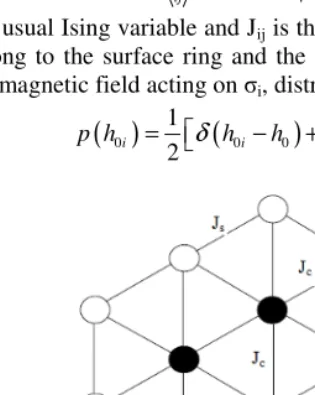
We consider an Ising nanoparticle model consists of two dimensional arrangement of spins, disposed in concentric hexagonal rings [22]. As shown in fig .1, the particle is composed of the surface shell and the core in which the core surrounded by the surface shell. Here, the model is taken into account the random magnetic field and the external magnetic field, which is quite different from that of Ref. [22]. The Hamiltonian of the model is given by
0
ij i j i i i
ij i i
J σ σ h σ h σ
Η = −
∑
−∑
−∑
(1)Where σi=±1 is the usual Ising variable and Jij is the exchange interaction. Jij takes the value Js if
both pseudo-spins belong to the surface ring and the value Jc otherwise. h is an external magnetic
field, h0i is the random magnetic field acting on σi, distributed according to a bimodal distribution:
( )
0(
0 0)
(
0 0)
1 2
i i i
p h = δ h −h +δ h +h (2)
Fig. 1. Schematic representation of a nanoparticle. Open circles indicate magnetic atoms at the surface shell and solid circles are magnetic atoms constituting the core.
Two longitudinal magnetizations on the shell surface, namely ms1 and ms2, and two longitudinal
magnetizations on the core, namely mc1 and mc2, within the framework of the effective field theory
with a probability distribution technique, can be obtained as,
(
) (
)
(
)
(
)
(
)
(
)
2 1
2 1
3 2 1
1 1 2 2 2
0 1 0
1 1 1 0 1 0
2
2 1 2 1 2 1 2
, , , ,
1 2
2
s s s c
s s
c
m C C m m m
f X h h f X h h
m
µ µ µ
µ µ µ µ
µ
− −
= =
−
= − + −
+ −
× +
∑ ∑
(3)
(
) (
)
(
)
(
)
(
)
2 2
2 1
4 2 2
2 1 1 1 2
0 1 0
2 1 2 1 2 1 2
s s s c
m C Cµ µ m µ m µ m µ
µ µ
− −
= =
= − + −
∑ ∑
(
) (
)
(
)
(
)
66 1 0 1 0
6 6
1 2 2
0
, , , ,
2 1 2 1 2
2
c c
c c s
f X h h f X h h
m Cµ m µ m µ
µ − − = + − = − +
∑
(6)(
) (
) (
) (
)
(
) (
)
(
) (
)
(
)
(
)
1 2 1 2
1 1 2 1
6 1 2 1 2
2 1 2 3 1 1 2 2
0 1 0 2 0 3 0
2 1 2 3 2 3 2 0 2 0
1 1 2 2
2 1 2 1 2 1 2 1 2
, , , ,
1 2 1 2 1 2 1 2
2
c c c c c
c c
s s s s
m C C C C m m m m
f X h h f X h h
m m m m
µ µ µ µ µ µ µ µ µ µ µ µ µ µ µ µ − − − = = = = − − = − + − + + − × − + − +
∑ ∑ ∑ ∑
(7) where(
)
(
)
1 2 2 1 2 1
s s c
X =J − µ +J − µ , (8)
(
)
(
)
2 2 2 2 2 1
s s c
X =J − µ +J − µ , (9)
(
)
1 6 2
c c
X =J − µ , (10)
and
(
)
(
)
(
)
(
)
2 1 2 2 2 1 1 2 2 2 2 3
c c c c c
X =J − µ +J − µ +J − µ +J − µ . (11)
The function is given by
(
, , 0)
tanh(
(
0)
)
f X h h = β X− −h h (12)
With β=1/kBT, T is the absolute temperature and kB is the Boltzmann factor. Ckl denote the binomial coefficient, Ckl =l k l!/ !
(
−k)
!.Furthermore, let us define the longitudinal magnetizations per site of the shell surface Ms, the
core Mc, and the total longitudinal magnetization of per site MT as follows:
(
1 2)
1 2
s s s
M = m +m , (13)
(
2 1)
1 6 7
c c c
M = m +m , (14)
(
)
(
2 2 2 1)
1
6 6
19
T s s c c
M = m +m + m +m . (15)
The coercive field hc is defined by
2 right left c
h h
h = − (16)
with hright and hleft being the points where the loop intersects the field axis.
The remanent magnetization Mr is defined by
1 2
2 r
M M
M = − (17)
with M1 and M2 are the values of positive and negative magnetization at a zero external field.
3 Results and discussions
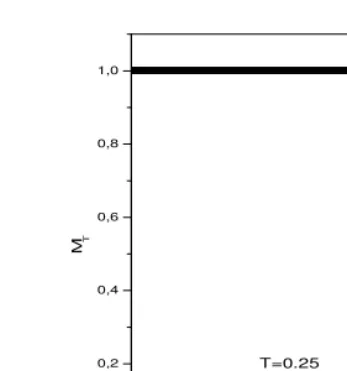
The total magnetization per spin MT as a function of the random magnetic field h0 for Js/Jc=1,
T/Jc=0.25 and the absence of the external magnetic field h=0, is shown in Fig. 2. We see that the
first-order transition from the ferromagnetic (MT≠0) to the paramagnetic (MT=0) state takes at
h0c=2.303. This type of behaviour of first-order transition has not observed in Ref. [22] where the
0,0 0,5 1,0 1,5 2,0 2,5 3,0 0,0
0,2 0,4 0,6 0,8 1,0
MT
h
0/Jc
T=0.25
Js/Jc=1,
Fig. 2. The total magnetization MT as a function of the random magnetic field h0 for Js/Jc=1, T/Jc=0.25
and h=0.
In order to investigated the influence of the random magnetic field h0 on the hysteresis behavior of a
ferromagnetic nanoparticle, a series of hysteresis loops for two regimes (h0<h0c and h0≥h0c) is plotted
in Fig. 3 with the fixed parameters, Js/Jc=1 and T/Jc=0.25. From Fig. 3a (h0<h0c), we can see that only
a normal hysteresis loop and that with increasing h0, the zone of the loop decreases. We also see that
two steps appear when the random magnetic field h0 approach to its critical value h0c=2.303. For
h0≥h0c (Fig. 3b), it is found that the shapes of the hysteresis loops changed from ferromagnetic
hysteresis loop to double hysteresis loops and that when h0 increases, the double hysteresis loops
stretch further out horizontally.
-1,0 -0,5 0,0 0,5 1,0
-1,0 -0,5 0,0 0,5 1,0
MT
h/J
c
h
0/Jc=2.1
1.75
2.28 J
s/Jc=1.0 and T/Jc=0,25
(a)
-1,0 -0,5 0,0 0,5 1,0
-1,0 -0,5 0,0 0,5 1,0
h
0/Jc=2.303
h
0/Jc=2.5
h
0/Jc=2.8
Js/Jc=1.0
T/Jc=0,25
MT
h/J
c
(b)
Fig. 3. The hysteresis loops for two regimes (a) h0<h0c and (b) h0≥h0c with the fixed parameters,
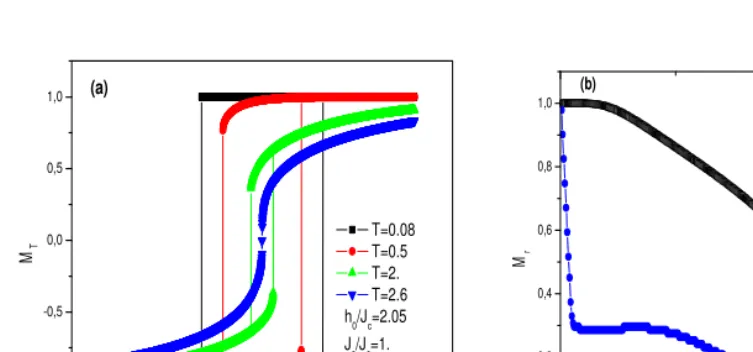
and lower; and the coercive field decreases. For T/Jc>Tc/Jc the hysteresis loop disappears (Tc=2.6).
The coercive field and its slope vanished at the curie temperature. We can see that when the temperature increases, the remanent magnetization decreases from its saturation value at low temperature region and vanishes at the critical temperature.
-1,0 -0,5 0,0 0,5 1,0
-1,0 -0,5 0,0 0,5 1,0
MT
h/J
c
T=0.08 T=0.5 T=2. T=2.6 h
0/Jc=2.05
J
s/Jc=1.
(a)
0 2
0,0 0,2 0,4 0,6 0,8
1,0 M
r
hc/Jc
h0/Jc=2.05
Js/Jc=1.
Tc/Jc
Mr (b)
0,0 0,2 0,4 0,6 0,8 1,0
h
c
/J
c
Fig. 4. a) The hysteresis loops for different values of the temperature with the fixed parameters, T/Jc=0.25, Js/Jc=1. b) The dependence of the coercive field hc/Jc and the remanent magnetization Mr as a
function of the temperature T/Jc.
4 Conclusion
In summary, we have studied the hysteresis behaviour of the ferromagnetic nanoparticle on an Ising model, where we have taken the coupling constants Jc and Js for the core and the surface shell
respectively. Using an effective field theory based on a probability distribution method we have discussed the influence of the random field on the magnetic properties of a nanoparticle with core/shell morphology. It is shown that the shapes of the hysteresis loops changed from ferromagnetic hysteresis loop to double hysteresis loops and that when h0 increases, the double
hysteresis loops stretch further out horizontally. It is also shown that, the coercive field and the remanent magnetization decreases with increasing temperature.
Acknowledgement
This work has been supported by URAC: 08, and the project No: A/030519/10 financed by A.E.C.I.
References
1. R. H. Kodama, A. E Berkowitz, E. J McNiff, Jr, S Foner, 'Surface spin disorder in NiFe2O4 nanoparticles' Phys. Rev. Lett. 77, 394 (1996)
2.
T. Hayashi, S. Hirono, M. Tomita and S. Umemura, Nature
381, 772 (1996)3. J. Kim, S. Park, JE. Lee, SM. Jin, JH. Lee, IS. Lee, I. Yang, JS. Kim, SK. Kim, MH. Cho and T. Hyeon, Angew. Chem. Int. Ed. 45, 7754, 2006
4. S. Nie and S. R. Emory, Science 275, 1102, 1997
6. D. W. Elliott, W.-X. Zhang, Environ. Sci. Technol. 35, 4922 (2001)
7. A.-H. Lu, W. Schmidt, N. Matoussevitch, H. Bönnemann, B. Spliethoff, B. Tesche, E. Bill, W. Kiefer, F. Schüth, "Nanoengineering of a Magnetically Separable Hydrogenation Catalyst".
Angewandte Chemie International Edition 43 (33) 4303, 2004.
8. A. P. Y. Wong and M. H. W. Chan, Phys. Rev. Lett. 65, 2567 (1990).
9. F. Michael, C. Gonzalez, V. Mujica, M. Marquez and M. A. Ratner Phys. Rev. B 76, 224409 (2007).
10. T. Kaneyoshi, J. Magn. Magn. Mater. 322, 3410 (2010). 11. T. Kaneyoshi, J. Magn. Magn. Mater. 322, 3414 (2010.
12. M. Keskin, N. Sarli and B. Deviren, Solid State Communications. 151, 1025 (2011). 13. A. Zaim, M. Kerouad, Y. El Amraoui, J. Magn. Magn. Mater. 321, 1077 (2009). 14. O. Iglesias, X. Batlle and A. Labarta, Phys. Rev. B 72, 212401 (2005).
15. M. Vasilakaki and K. N. Trohidou, Phys. Rev. B 79, 144402 (2009). 16. A. Zaim, M. Kerouad, Physica A 389, 3435 (2010).
17. J. M. Wesselinowa, J. Magn. Magn. Mater. 322, 234 (2010).
18. J. M. Wesselinowa, I. Apostolova, Journal of Applied Physics 104, 084108 (2008). 19. L. G. C. Rego and W. Figueiredo, Phys. Rev. B 64, 144424 (2001).
20. E. L. Bizdoaca, M. Spasova, M. Farle, M. Hilgendorff, F. J. Caruso, Magn. Magn. Mater. 240, 44 (2002).