ClinicoEconomics and Outcomes Research
Dovepress
ClinicoEconomics and Outcomes Research 2018:10 821–854
submit your manuscript | www.dovepress.com 821
R E v i E w
Open Access Full Text Article
open access to scientific and medical research
A methodological review of national and
transnational pharmaceutical budget impact
analysis guidelines for new drug submissions
Naghmeh Foroutan1,2
Jean-Eric Tarride1–3
Feng Xie1,3,4
Mitchell Levine1–3
1Department of Health Research
Methods, Evidence and impact (HEi), McMaster University, Hamilton, ON, Canada; 2Programs for Assessment
of Technology in Health (PATH), The Research institute of St. Joe’s, St Joseph’s Healthcare Hamilton, Hamilton, ON, Canada; 3Centre for
Health Economics and Policy Analysis (CHEPA), McMaster University, Hamilton, ON, Canada; 4Program
for Health Economics and Outcome Measures (PHENOM), Hamilton, ON, Canada
Introduction:Budget impact analysis (BIA) in health care, sometimes referred to as resource impact, is the financial change in the use of health resources associated with adding a new drug to a formulary or the adoption of a new health technology. Several national and transnational organizations worldwide have updated their BIA guidelines in the past 4 years. The aim of the present review was to provide a comprehensive list of the key recommendations of BIA guidelines from different countries that may be of interest for those who wish to build or to update BIA guidelines.
Methods:National and transnational BIA guidelines were searched in databases including MEDLINE, EMBASE, Cochrane, EconLit, CINAHL, Business Source Premier, HealthSTAR, and the gray literature including regulatory agency websites. Data were reviewed and abstracted based on key elements in a standard BIA model (analytical model structure, input and data sources, and reporting format).
Results:Eight national (Australia, UK, Belgium, Ireland, France, Poland, Brazil, and Canada) and one transnational (International Society for Pharmacoeconomics and Outcomes Research) BIA guidelines were included in this review, and a comprehensive list of BIA recommen-dations was identified. The review showed that certain recommenrecommen-dations such as patient population assessment, drug-related direct costs, discounting, and disaggregated results were common across the various jurisdictions. BIA guidelines differed from each other in terms of the number and scope of recommendations, the terminology used (eg, the definition of comparators or cost offsets) and the direction of the recommendations (ie, to include or not to include with respect to such items as off-label indications, indirect costs, clinical outcomes, and resource utilization).
Conclusion:While there was a common purpose for all of the BIA guidelines that were iden-tified, substantial differences did occur in the specific recommendations. The pharmaceutical financing system structure might explain why guidelines from the UK, Australia, and Canada have more country-specific recommendations. The desire to be consistent with adopted eco-nomic evaluation assumptions might be another reason for some observed differences between countries. Further research is required to assess the source of the heterogeneity between BIA recommendations are identified in different guidelines.
Keywords:budgetary impact, financial impact, resource impact assessment, pharmaceutical reimbursement, new drug submissions, guidelines
Introduction
The first budget impact analysis (BIA) analytic framework was published by Mauskopf1
in 1998. In 2001, Trueman et al2 provided essential suggestions for conducting a BIA,
Correspondence: Naghmeh Foroutan McMaster University, CRL Building, Main Street west, Hamilton, ON, Canada, L8S 4K1
Tel: +1 905 525 9140 ext 20210 Email [email protected]
Journal name: ClinicoEconomics and Outcomes Research Article Designation: Review
Year: 2018 Volume: 10
Running head verso: Foroutan et al
Running head recto: Pharmaceutical budget impact analysis guidelines for new drug submissions DOI: http://dx.doi.org/10.2147/CEOR.S178825
ClinicoEconomics and Outcomes Research downloaded from https://www.dovepress.com/ by 118.70.13.36 on 21-Aug-2020
For personal use only.
Dovepress
Foroutan et al
and the Polish BIA guidelines in 20043 followed the initial
framework of BIA proposed by Trueman et al.2 In 2005 in
Canada, the Patented Medicine Prices Review Board initiated the development of the Canadian BIA guidelines which were
subsequently published in 2007.4 The International Society
For Pharmacoeconomics and Outcomes Research (ISPOR) task force published the first transnational guidelines for
the execution of a BIA in 2007,5 followed by Germany6 and
France7 in 2008.
During the past decade, many jurisdictions around the world have updated their BIA guidelines, including the
Ire-land (2018),8 France (2018),9 UK (2017),10 Australia (2016),11
Poland (2016),12 and Belgium (2015).13 ISPOR published
their second task force report on good practices for
conduct-ing BIA in 2014.14 In Asia (ie, Iran,15–17 Thailand18) and Latin
America (ie, Brazil,19 Chile, Colombia, Cuba, and Mexico),
there have been initiatives regarding drug reimbursement decision making based on standard economic evaluation and BIA guidelines. Brazil has published their BIA guidelines in 2012, and Chile, Colombia and Mexico require BIA as
part of their Health Technology Assessment (HTA) process.20
A number of systematic reviews of BIA empirical
stud-ies have recently been published,21–25 and literature reviews
of national and transnational BIA guidelines have been conducted as part of national BIA guidelines development
(eg, France [2018],9 Belgium [2015],13 and Canada [2008]26).
However, the Belgian and the Canadian guidelines did not systematically review the BIA literature. In contrast, the French BIA guidelines provides a comprehensive review of the BIA literature, including 9 national BIA guidelines, 5 recommendations of good practices developed by national and international societies for health economics, and 14 methodological publications on existing BIAs, published
between 2000 and 2016.9 Nevertheless, the French review
did not provide sufficient details regarding the individual guidelines reviewed and cannot be used as a foundation for constructing a new set of BIA guidelines or updating existing versions. To illustrate, the results were briefly listed in a table in an aggregated form rather than providing a complete detailed list of the BIA recommendations. The present study has been designed to identify and abstract all guideline recommendations relating to three key aspects in designing a standard pharmaceutical BIA (analytical model structure, input data and sources, and reporting format). This paper presents a comparative review of the BIA key element recommendations that are discussed in national and transnational BIA guidelines and, also, provides a list of the relevant components that are needed in order to conduct a comprehensive pharmaceutical BIA.
Methods
Data sources
A systematic search of the literature was undertaken to iden-tify BIA guidelines published from 1998 to June 30, 2018. The following bibliographic databases were searched through the Ovid interface: MEDLINE, EMBASE, Cochrane, Econ-Lit, CINAHL, Business Source Premier, and HealthSTAR. We also searched the gray literature (Supplementary material S1) including International Network of Agencies for Health Technology Assessment (INAHTA) and non-INAHTA mem-bers (eg, National Institute for Health and Care Excellence, Pharmaceutical Management Agency as well as EUnetHTA, Health Technology Assessment International, International Health Economics Association, and International Society for Pharmacoeconomics and Outcomes Research). The search strategy included a combination of text words and Medical Subject Headings terms and synonyms of budget/financial analysis, guidelines, and methodology/modeling. The key-words used for the searches are shown in Supplementary material S1.
inclusion and exclusion criteria
The inclusion criteria were limited to BIA guidelines published since 1998 by different countries or international organizations (eg, ISPOR) that presented recommendations on all three key elements of designing a BIA (ie, analytical model structure,
input and data sources, and reporting format).14 The titles and
abstracts identified in these searches were screened to find eligible published national and transnational BIA guidelines (peer-reviewed or online multimedia). When a country or transnational BIA guideline was updated, we only included the latest updated version of the BIA guidelines for each organization in order to avoid duplication in data abstraction.
Citations that reported BIA for any specific drug or medi-cal device (empirimedi-cal studies), or review articles of empirimedi-cal BIAs, abstracts, and conference proceedings and method-ological publications other than guidelines for conducting a pharmaceutical BIA were excluded. National guidelines were excluded if they did not explicitly discuss the key elements of a BIA model or if they did not add any additional information beyond the guideline that had been adopted from, and where the latter was already included in the review.
Study selection, data abstraction, and
synthesis
Titles and abstracts of all articles were screened (level 1 screening) for inclusion by one reviewer. Following level 1 screening, the full text of the selected articles was retrieved
ClinicoEconomics and Outcomes Research downloaded from https://www.dovepress.com/ by 118.70.13.36 on 21-Aug-2020
Dovepress Pharmaceutical budget impact analysis guidelines for new drug submissions (level 2 screening) and assessed by two independent
review-ers for eligibility for final inclusion. The disagreement was resolved through consensus and, if persistent, arbitrated through discussion with a third person.
Using a data abstraction template, all included guide-lines were reviewed by two independent reviewers to abstract key elements which were discussed in each BIA guideline. An Excel-based data abstraction form was developed based on the predetermined BIA key elements in accordance with ISPOR BIA guidelines (For sake of simplicity and consistency with other BIA guidelines, in the present review, “ISPOR II Task Force report on BIA Good
Practice” was abbreviated to “ISPOR BIA guidelines”).14
All the listed recommendations were for a base-case BIA model. The Excel-based data abstraction form was initially tested using two (Irish and Belgian) BIA guidelines before being used to abstract the data/recommendations from all the included BIA guidelines.
For the purpose of this paper, the BIA key elements were categorized into three groups: analytic model structure, input and data sources, and the reporting format. In each category, we defined primary and secondary elements. The primary elements were the main components within each category (eg, perspective, time horizon, target population, scenarios to compare, costing, modeling, and uncertainty), and secondary elements were more specific and detailed considerations related to the primary elements (eg, off-label use, the degree of implementation, and scenario analysis). The analytic model structure contains a discussion of twelve primary BIA elements (eg, model design, model valida-tion, perspective, time horizon, target populavalida-tion, costing, comparators, discounting and inflation, and handling the uncertainty). The data input category mainly addresses data sources for market-share estimation and epidemiologic analyses. The reporting format section describes details for reporting BIA results based on the payer’s requirements and the standard practices in conducting and reporting BIAs (eg, aggregated and disaggregated results in each year of the time horizon and outcomes are presented in natural and monetary units). All terminologies, categories, and BIA key elements were defined in accordance with ISPOR
BIA guidelines.14
Results
Literature search results
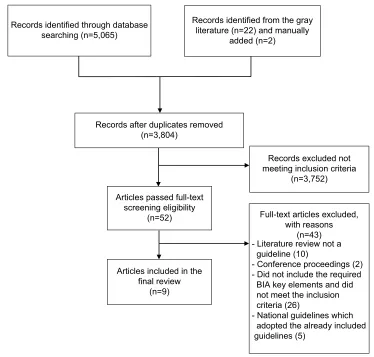
A total of 3,804 potential citations were identified through the systematic and the manual searches (having removed duplicates). Fifty-two citations were included after the title
and abstract review, of which 43 were excluded for not meet-ing the eligibility criteria, resultmeet-ing in a total of 9 national and transnational BIA guidelines published between 1998
and 2018.8–14,19,26 Figure 1 shows the detailed study selection
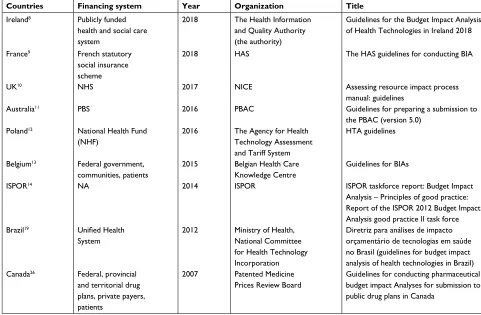
process, and a summary of the included guidelines in the review is shown in Table 1.
Country-specific (national) guidelines from eight coun-tries (Australia, UK, Belgium, Ireland, France, Poland, Brazil, and Canada) were included. The guidelines from five
coun-tries were excluded. Germany (2008),6 Thailand (2014),18 and
the USA27 each adopted the ISPOR BIA guidelines, while
the Wales28 and Scotland29 guidelines were derived from the
UK NICE recommendations.10 None of these five countries
provided any additional methodological information beyond the source guidelines that they had adopted (which were already included in this review as a primary guideline). A summary of the countries that have developed national BIA guidelines and their associated drug plans is provided in Supplementary material S2.
Guideline recommendations pertaining to
the BiA key elements
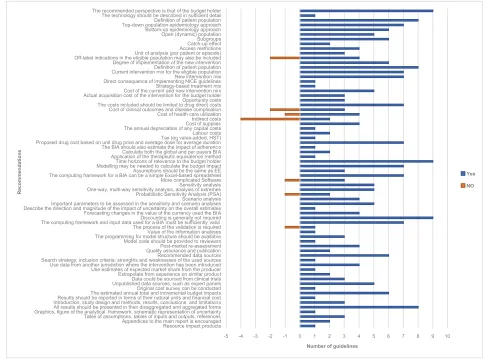
A comprehensive list of all the BIA guideline recommenda-tions was derived from the nine reviewed guidelines and is presented in Table 2. Figure 2 shows the number of guidelines that have made specific recommendations. The following sections provide a synthesis of the key similarities and dif-ferences among the nine guidelines.
Analytical model structure
Perspective
In most BIAs, using the perspective of the primary health
care budget holder is recommended. However, in the French,9
Polish,12 and Canadian26 BIA guidelines there is a
recom-mendation to use the patient’s perspective as complementary
analysis to the base-case analysis. In contrast, Australia11
explicitly requires the exclusion of any copayment from any other source beyond the identified budget.
Time horizon
It is recommended in the Polish12 and Belgian13 guidelines
to present the budget impact up to the steady state, with a minimum time horizon of 2–3 years. The minimum time
horizon in the Canadian BIA guidelines26 is 3 years, whereas
in the updated NICE10 and Australian11 guidelines a longer
time duration is recommended (6 and 5 years, respectively).
France9 and ISPOR14 recommend a BIA time horizon varying
from 3–5 and 1–5 years in the base-case analysis, respectively.
ClinicoEconomics and Outcomes Research downloaded from https://www.dovepress.com/ by 118.70.13.36 on 21-Aug-2020
Dovepress
Foroutan et al
The Brazilian guidelines have also taken a time horizon
from 1–5 years.19 The base-case analysis should estimate
the annual financial impact over a minimum timeframe of 5
years in the recently updated Irish guidelines.8 A comparison
of the time horizon recommended in different guidelines is shown in Figure 3.
Target population
Some guidelines have defined the target population as the “entire population of patients affected by the assessed indica-tions, targeted by the proposed medicine, over a specified time
horizon.8,12,14 French guidelines have introduced two population
groups to be included in the analysis, “the target population and the expected treated (forecasted population to be actually treated by the intervention in the real-life practice) population
for all indications.”9 Based on the Canadian BIA guidelines,
the target population is defined as “all drug plan beneficiaries who are expected to be diagnosed and treated for the conditions
of interest and are eligible to use the new drug.”26
Subpopulation analyses can be performed for BIA if there are appropriate justifications: by beneficiary, differences in safety, treatment effect, baseline risks, costs, or market
share.8,9,11,13,14,19 For the target population estimation, there are
two approaches: top-down or epidemiological and bottom-up or market-share (claim-based analyses). An epidemiological approach is usually preferred if the submission indicates a superior therapeutic conclusion in clinical studies, whereas a market-share approach might be preferred if the submission
indicates a noninferior therapeutic conclusion.11 In the
epide-miological approach, disease severity shifts, incidence, and prevalence are required, and it is usually inevitable to use data
from different sources.26 Apart from the UK,10 Poland,12 and
ISPOR14 (which only ask for the epidemiologic approach),
other guidelines recommend BIA results obtained from both epidemiologic and market-share approaches for all new drug submissions.
The degree of implementation (full replacement or partial substitution of existing technologies or shifts in the target
Figure 1 PRISMA flow diagram of search results.
Abbreviations: BiA, budget impact analysis; PRiSMA, Preferred Reporting items for Systematic Reviews and Meta-Analyses. Records identified through database
searching (n=5,065)
Records after duplicates removed (n=3,804)
Records excluded not meeting inclusion criteria
(n=3,752) Articles passed full-text
screening eligibility
(n=52) Full-text articles excluded,
with reasons (n=43) - Literature review not a guideline (10)
- Conference proceedings (2) - Did not include the required BIA key elements and did not meet the inclusion criteria (26)
- National guidelines which adopted the already included guidelines (5)
Articles included in the final review
(n=9)
Records identified from the gray literature (n=22) and manually
added (n=2)
ClinicoEconomics and Outcomes Research downloaded from https://www.dovepress.com/ by 118.70.13.36 on 21-Aug-2020
Dovepress Pharmaceutical budget impact analysis guidelines for new drug submissions
population, market growth, or expansion) is essential in both approaches and recommended by most guidelines. In the Canadian guidelines, it is advised that the treatment displace-ment assumptions regarding the changes to the market share of each competitor after the introduction of the new drug be
tested in the sensitivity analysis.26 The population is dynamic
in the Irish, Polish, Belgian, ISPOR and Brazilian guidelines, meaning that patients could be added to or removed from the analysis based on whether they meet the inclusion criteria
or not over time.8,12–14,19 In some cases, when the technology
applies to a well-defined group of patients, the BIA may
require a defined closed population.12
In addition, the French, Belgian, ISPOR (for the current
treatment mix) and Brazilian BIA guidelines9,13,14,19
recom-mend consideration of off-label usage in all indications for the assessed medicine as complementary to the base- case analysis; this is especially relevant if there is available evidence for cost-effectiveness and, more importantly, it is
noted by the payer.9 In the Canadian BIA guidelines, the
off-label use is only considered in the sensitivity analysis.26
The catch-up effect which applies to the chronic conditions for patients who switch to the new drug is recommended in
the Irish and ISPOR guidelines.8,14 Any planned local
regula-tions and legislaregula-tions which would limit new drug access in
a subpopulation should be considered.12,14,19,26
Scenarios to compare (comparators)
In most of the reviewed guidelines, the current scenario/ practice (including “no intervention”) should be “routine care” or the best clinical practice, including the most cost-effective alternatives. The new scenario is the “current scenario” with the new intervention added to or replacing
the current interventions entirely or partially.13,14 NICE
considers a broader picture of budget impact and defines the current and new scenarios as current and future clinical practice activities (at activity levels) resulting from adopting Table 1 Summary of nine included guidelines in the review
Countries Financing system Year Organization Title
ireland8 Publicly funded
health and social care system
2018 The Health information and Quality Authority (the authority)
Guidelines for the Budget impact Analysis of Health Technologies in ireland 2018 France9 French statutory
social insurance scheme
2018 HAS The HAS guidelines for conducting BiA
UK10 NHS 2017 NiCE Assessing resource impact process
manual: guidelines
Australia11 PBS 2016 PBAC Guidelines for preparing a submission to
the PBAC (version 5.0) Poland12 National Health Fund
(NHF)
2016 The Agency for Health Technology Assessment and Tariff System
HTA guidelines
Belgium13 Federal government,
communities, patients
2015 Belgian Health Care Knowledge Centre
Guidelines for BiAs
iSPOR14 NA 2014 iSPOR iSPOR taskforce report: Budget impact
Analysis – Principles of good practice: Report of the iSPOR 2012 Budget impact Analysis good practice ii task force Brazil19 Unified Health
System
2012 Ministry of Health, National Committee for Health Technology incorporation
Diretriz para análises de impacto orçamentário de tecnologias em saúde no Brasil (guidelines for budget impact analysis of health technologies in Brazil) Canada26 Federal, provincial
and territorial drug plans, private payers, patients
2007 Patented Medicine Prices Review Board
Guidelines for conducting pharmaceutical budget impact Analyses for submission to public drug plans in Canada
Abbreviations: BiA, budget impact analysis; HAS, French National Authority for Health; HTA, health technology assessment; iSPOR, international Society for Pharmacoeconomics and Outcomes Research; NHS, National Health System; NA, not applicable; NiCE, National institute for Health and Care Excellence; PBAC,
Pharmaceutical Benefits Advisory Committee; PBS, Pharmaceutical Benefits Scheme; RIA, resource impact assessment.
ClinicoEconomics and Outcomes Research downloaded from https://www.dovepress.com/ by 118.70.13.36 on 21-Aug-2020
Dovepress
Foroutan et al
Table 2
B
iA categories and recommendations of nine national and transnational B
iA guidelines
BIA primary elements BIA secondary elements ISPOR (2014) Canada (2007) Belgium (2012) France (2018) Ireland (2018) Poland (2016)
UK (2017)
Australia (2016)
Brazil (2012)
Perspective
The recommended perspective is that of the budget holder range from a single payer covering an entire health care system through speci
fic
providers
Yes
Yes (federal, provincial, and territorial drug plans, private payers) Yes (health care payers, patients, provider) Yes (French statutory social insurance scheme, patient, provider) Yes (publicly funded health and social care system) Yes (public payers, patients, hospitals) Yes (commissioner, provider) Yes (PBS/ RPBS; federal government; NiP) Yes (public and private systems; nation, states, or municipalities)
Technology
The technology should be described in sufficient detail to differentiate it from its comparators and to provide context for the study
Yes
(
Continued
)
ClinicoEconomics and Outcomes Research downloaded from https://www.dovepress.com/ by 118.70.13.36 on 21-Aug-2020
Dovepress Pharmaceutical budget impact analysis guidelines for new drug submissions
Table 2
(
Continued
)
BIA primary elements BIA secondary elements ISPOR (2014) Canada (2007) Belgium (2012) France (2018) Ireland (2018) Poland (2016)
UK (2017)
Australia (2016)
Brazil (2012)
Population size and characteristics
Definition of patient population
Yes (all patients eligible for the new intervention during the time horizon of interest, given any access restrictions)
Yes (defined as individuals insured by drug plans of interest and have the condition of interest) Yes (target and expected population)
Yes (target population should be defined based on the approved indication for the technology and also defined as those with a specified disease who may avail of the technology being considered in the defined time horizon)
Yes
(all patients
in whom a given health technology can be used in accordance with the assessed medical indications) Yes (resident and registered population)
Yes (number of patients will be treated and number of unit doses will be dispensed over the time horizon)
Yes
Top-down population approach: estimation of the number covered by the locally approved indications for the new technology which needs to reflect uptake, and changes in patterns of use
Yes
Yes (epidemiologic approach)
Yes
Yes
Yes (incidence and prevalence- based approach) Yes (epidemiologic approach) Yes (incidence and prevalence- based approach)
(
Continued
)
ClinicoEconomics and Outcomes Research downloaded from https://www.dovepress.com/ by 118.70.13.36 on 21-Aug-2020
Dovepress
Foroutan et al
Table 2
(
Continued
)
BIA primary elements BIA secondary elements ISPOR (2014) Canada (2007) Belgium (2012) France (2018) Ireland (2018) Poland (2016)
UK (2017)
Australia (2016)
Brazil (2012)
Bottom-up approach: this starts from the number of individuals likely to avail of the technology. it includes the number of individuals that will switch from an existing technology and the number of newly treated patients. These estimates may be informed by existing claim- based data Yes (claim- based approach)
Yes (define population
for
all indications of the intervention under study)
Yes (define population for all indications of the intervention under study)
Yes
Yes (market- share approach) Yes (claim- based approach)
Open (dynamic) population
Yes
Yes
Yes (population should be described for each year of the B
iA, and
expected changes in their sizes should be taken into account)
Yes
Yes
(
Continued
)
ClinicoEconomics and Outcomes Research downloaded from https://www.dovepress.com/ by 118.70.13.36 on 21-Aug-2020
Dovepress Pharmaceutical budget impact analysis guidelines for new drug submissions
Table 2
(
Continued
)
BIA primary elements BIA secondary elements ISPOR (2014) Canada (2007) Belgium (2012) France (2018) Ireland (2018) Poland (2016)
UK (2017)
Australia (2016)
Brazil (2012)
Subgroups
Yes
Yes
Yes
Yes (based on biologically plausible and justified evidence but not based on treatment response) Yes (stratify by beneficiary)
Yes
Catch-up effect
Yes
Yes
Access restrictions
Yes
Yes
Yes
Yes
Unit of analysis (per patient or episode) Yes (per patient or per episode of care) Yes (per unit dispensed) Yes (per episode)
Off-label indications in the eligible population may also be included Yes (for the current treatment mix)
No
Yes
Yes
No
Yes
Degree of implementation of the new intervention (substitution, combination, and expansion)
Yes
Yes
Yes
Yes
Yes
Yes
(
Continued
)
ClinicoEconomics and Outcomes Research downloaded from https://www.dovepress.com/ by 118.70.13.36 on 21-Aug-2020
Dovepress
Foroutan et al
Table 2
(
Continued
)
BIA primary elements BIA secondary elements ISPOR (2014) Canada (2007) Belgium (2012) France (2018) Ireland (2018) Poland (2016)
UK (2017)
Australia (2016)
Brazil (2012)
Comparators
Definition
Yes (B
iA
compares scenarios defined by sets of, rather than speci
fic
individual, interventions) Yes (two scenarios, reference and new drug scenario, should be compared for the treatment strategy)
Yes (cur
rent
situation that w
ould
change if the inter
vention
under consideration is intr
oduced
in the health care system; most cost- effectiv
e
alternativ
es)
Yes (B
iA
compares sets of interventions [scenarios] rather than individual interventions)
Yes
Yes (the assumptions concerning the “current scenario” and the “new scenario” should be described and justified in the analysis) Yes (PBS medicines that will be affected by the proposed listing; mixed treatment comparisons) Yes (comparison of two or more scenarios, which are representations of different market conditions)
Current intervention mix for the eligible population
Yes (the current mix may include no intervention as well as interventions that might be replaced by the new one) Yes (forecast version of the current market without the new drug)
Yes
Yes (scenarios without the intervention under study) Yes (baseline scenario that reflects the current
mix of
technologies and forecasts the situation should the new technology not be adopted) Yes (takes into account the interventions currently used in a given population including no intervention or interventions used in different conditions) Yes (set of therapeutic options currently available for the treatment of the disease)
(
Continued
)
ClinicoEconomics and Outcomes Research downloaded from https://www.dovepress.com/ by 118.70.13.36 on 21-Aug-2020
Dovepress Pharmaceutical budget impact analysis guidelines for new drug submissions
Table 2
(
Continued
)
BIA primary elements BIA secondary elements ISPOR (2014) Canada (2007) Belgium (2012) France (2018) Ireland (2018) Poland (2016)
UK (2017)
Australia (2016)
Brazil (2012)
New intervention mix
Yes (the introduction of a new intervention sets in motion various marketplace dynamics, including product substitution and possibly market expansion) Yes (new drug scenario is forecast version of the current market with introduction of the new drug)
Yes
Yes (scenarios with the intervention under study) Yes (new technology scenario, where the new drug is adopted)
Yes (reflects the market after the introduction of the new technology)
Yes (cost of each intervention included in the analysis will reflect the cost of the entire therapeutic package associated with that intervention)
Costs and outcomes
Direct cost consequence of implementing NiCE guidelines
Yes
(
Continued
)
ClinicoEconomics and Outcomes Research downloaded from https://www.dovepress.com/ by 118.70.13.36 on 21-Aug-2020
Dovepress
Foroutan et al
Table 2
(
Continued
)
BIA primary elements BIA secondary elements ISPOR (2014) Canada (2007) Belgium (2012) France (2018) Ireland (2018) Poland (2016)
UK (2017)
Australia (2016)
Brazil (2012)
Cost of the current and new intervention mix is determined by multiplying the budget holder’s price for each intervention by proportion of the eligible population using that intervention and by the number of people in the eligible population
Yes
Yes (treatment strategy-based approach)
Yes
Yes
Yes
Actual acquisition cost of the intervention for the budget holder
includes
any discounts, rebates, or other adjustments that may apply
Yes
Yes
Yes
(
Continued
)
ClinicoEconomics and Outcomes Research downloaded from https://www.dovepress.com/ by 118.70.13.36 on 21-Aug-2020
Dovepress Pharmaceutical budget impact analysis guidelines for new drug submissions
Table 2
(
Continued
)
BIA primary elements BIA secondary elements ISPOR (2014) Canada (2007) Belgium (2012) France (2018) Ireland (2018) Poland (2016)
UK (2017)
Australia (2016)
Brazil (2012)
Opportunity costs are the costs that arise when implementing the technology or clinical guidelines that might not being reflected in the “actual costs” at the time of doing B
iA
analysis
Yes
Yes
Yes (the cost of additional outlays in the health care system, related to the implementation of the assessed technology)
The costs included should be limited to direct costs associated with the technology that will accrue to the relevant payer(s)
Yes
Yes (direct drug cost)
Yes (drug administration costs, the cost of drug wastage and the cost of drug monitoring) Yes (actual payments and actual savings achieved by a public payer/ patient; taking into account the existing risk sharing schemes)
Yes
Yes (direct drug cost)
Yes (costs of the new drug and those directly associated with its use, as adjuvant medications or treatment of adverse events)
Cost of clinical outcomes and disease complication
Yes
No
No (health outcomes are not included; however cost consequences of health outcome, eg, treatment cost of adverse events, are included)
Yes (efficacy, effectiveness, and safety, cost offsets) Yes (direct clinical consequences)
(
Continued
)
ClinicoEconomics and Outcomes Research downloaded from https://www.dovepress.com/ by 118.70.13.36 on 21-Aug-2020
Dovepress
Foroutan et al
Table 2
(
Continued
)
BIA primary elements BIA secondary elements ISPOR (2014) Canada (2007) Belgium (2012) France (2018) Ireland (2018) Poland (2016)
UK (2017)
Australia (2016)
Brazil (2012)
Cost of health care utilization (eg, hospital days or physician visits)
Yes
No
Yes (eg, cost of treatment of adverse drug reactions) Yes (cost offsets)
Yes
indirect costs: the impact of the new intervention on productivity, social services, and other costs outside the health care system No (should not be included routinely in a B
iA
[except for the private payers or employers])
No
Maybe (can be quantified in a separate analysis)
No
Yes (eg, productivity cost)
No
Cost of supplies: the analytic framework should allow for cost- relevant details of how accompanying devices for the proposed medication are used
Yes
Yes
Yes
Yes
The annual depreciation of any capital costs should be included in the analysis
Yes
Labor costs
Yes
Yes (eg, staff training cost)
v
alue-added tax
Yes
(
Continued
)
ClinicoEconomics and Outcomes Research downloaded from https://www.dovepress.com/ by 118.70.13.36 on 21-Aug-2020
Dovepress Pharmaceutical budget impact analysis guidelines for new drug submissions
Table 2
(
Continued
)
BIA primary elements BIA secondary elements ISPOR (2014) Canada (2007) Belgium (2012) France (2018) Ireland (2018) Poland (2016)
UK (2017)
Australia (2016)
Brazil (2012)
Proposed drug cost based on unit drug price and average dose for average duration of time
Yes
Yes
Yes (technology cost)
Yes
Yes
Yes (changes in the number of units dispensed and costs over the time horizon) Yes (per patient, per time period)
The B
iA should
also estimate the impact of adherence or persistence on intervention effectiveness and safety if condition- related costs are included in the B
iA
Yes
Calculate both the global budget impact and separately the budget impact for the different health care payers (this implies that potential transfers of budgets between different levels of governments and/or patients)
Yes
Yes
(
Continued
)
ClinicoEconomics and Outcomes Research downloaded from https://www.dovepress.com/ by 118.70.13.36 on 21-Aug-2020
Dovepress
Foroutan et al
Table 2
(
Continued
)
BIA primary elements BIA secondary elements ISPOR (2014) Canada (2007) Belgium (2012) France (2018) Ireland (2018) Poland (2016)
UK (2017)
Australia (2016)
Brazil (2012)
Application of the therapeutic equivalence method in the comparison of costs is recommended
Yes
Time horizon
Bi
As should
be presented for the time horizons of relevance to the budget holder
1–5 years
3 years
3 years
3–5 years
5 years
2 years
5 years
6 years
1–5 years (subjected to budget holder’s needs)
Modeling
Modeling may be needed to calculate the budget impact for bringing together the best available data from different sources Yes (if an economic evaluation was performed, the B
iA
model should be consistent with the clinical and economic assumptions in EE)
Yes
Yes (according to the characteristics and the management of the disease of interest in France) Yes (based on the good modeling practice)
Yes
Yes
Yes
Assumptions should be the same as EE Yes (the justified comparator
in
an economic evaluation may be different from the comparator in the B
iA)
Yes
Yes
Yes
Yes
(
Continued
)
ClinicoEconomics and Outcomes Research downloaded from https://www.dovepress.com/ by 118.70.13.36 on 21-Aug-2020
Dovepress Pharmaceutical budget impact analysis guidelines for new drug submissions
Table 2
(
Continued
)
BIA primary elements BIA secondary elements ISPOR (2014) Canada (2007) Belgium (2012) France (2018) Ireland (2018) Poland (2016)
UK (2017)
Australia (2016)
Brazil (2012)
The computing framework for a B
iA can
be a simple cost calculator programmed in an Excel-based spreadsheet
Yes
Yes
Yes
Maybe (transparent and accessible to the decision maker) Yes (a resource impact template is an Excel spreadsheet)
Yes
Yes
More complicated software
Yes
Yes (decision tree, Markov model) No (simplest design) Yes (decision tree, Markov models, discrete event simulation)
Handling uncertainty and scenario analyses
Sensitivity analysis: parameter uncertainty in the input values
Yes
Yes
Yes
Yes
Yes
Yes
One-way and/ or multi-way sensitivity analysis, analysis of extremes
Yes
Yes
Yes
Yes
Yes
PSA is recommended in B
iA
No
Yes
Yes
(
Continued
)
ClinicoEconomics and Outcomes Research downloaded from https://www.dovepress.com/ by 118.70.13.36 on 21-Aug-2020
Dovepress
Foroutan et al
Table 2
(
Continued
)
BIA primary elements BIA secondary elements ISPOR (2014) Canada (2007) Belgium (2012) France (2018) Ireland (2018) Poland (2016)
UK (2017)
Australia (2016)
Brazil (2012)
Scenario analysis: structural uncertainty introduced by the assumptions made in framing the B
iA
Yes
Yes
Yes
Yes
Yes
important parameters to be assessed in the sensitivity and scenario analyses have been provided in the guidelines
Yes
Yes
Yes
Yes (population size [eg, the degree of possible abuse], costs of use and reimbursement conditions)
Yes
Yes
Describe the direction and magnitude of the impact of uncertainty on the overall estimates
Yes
(
Continued
)
ClinicoEconomics and Outcomes Research downloaded from https://www.dovepress.com/ by 118.70.13.36 on 21-Aug-2020
Dovepress Pharmaceutical budget impact analysis guidelines for new drug submissions
Table 2
(
Continued
)
BIA primary elements BIA secondary elements ISPOR (2014) Canada (2007) Belgium (2012) France (2018) Ireland (2018) Poland (2016)
UK (2017)
Australia (2016)
Brazil (2012)
Discount rate
An attempt should
be made
for forecasting changes in the value of the currency used the B
iA
over the time horizon
Yes
Yes
Yes (in certain circumstance) Yes (in certain circumstance)
Discounting is generally not required
Yes
Yes
Yes
Yes
Yes
Yes
Yes
Yes
Yes
v
alidation
The computing framework and input data used for a BiA must be sufficiently valid to credibly inform the budget holder’s decisions
Yes
Yes
Yes (face validity)
Yes
Yes
Yes (the template workbook enables the PBAC to validate the presented estimates)
Yes
The process of the validation is required
No
Yes (should be documented)
v
alue of the information analyses (the cost of extra data collection vs improved model precision)
Yes
(
Continued
)
ClinicoEconomics and Outcomes Research downloaded from https://www.dovepress.com/ by 118.70.13.36 on 21-Aug-2020
Dovepress
Foroutan et al
Table 2
(
Continued
)
BIA primary elements BIA secondary elements ISPOR (2014) Canada (2007) Belgium (2012) France (2018) Ireland (2018) Poland (2016)
UK (2017)
Australia (2016)
Brazil (2012)
The programming created by the developer of the budget impact model to perform the analysis (source code) should
be made
available for review (on the condition that property rights are respected)
Yes
Yes
Yes
Model code should be provided to reviewers
Yes
Postmarket reassessment: the observed costs in a health plan with the current interventions should be compared with the initial-year estimates from a B
iA
Yes
Yes
Yes
Yes
Quality assurance and publication Yes (for all resource impact products) Yes (quality use of medicines)
(
Continued
)
ClinicoEconomics and Outcomes Research downloaded from https://www.dovepress.com/ by 118.70.13.36 on 21-Aug-2020
Dovepress Pharmaceutical budget impact analysis guidelines for new drug submissions
Table 2
(
Continued
)
BIA primary elements BIA secondary elements ISPOR (2014) Canada (2007) Belgium (2012) France (2018) Ireland (2018) Poland (2016)
UK (2017)
Australia (2016)
Brazil (2012)
inputs and data sources Recommended data sources
Yes
Yes
Yes
Yes
Yes (quite comprehensive list)
Yes
Search strategy; inclusion criteria for data selection and source selection; strengths and weaknesses of the used sources, and methods of analysis should be presented
Yes
Use data from another jurisdiction where the intervention has been introduced
Yes
Yes
Maybe (might not be realistic in ireland) Yes (health systems comparable to the Brazilian system)
Use estimates of expected market share from the producer
Yes
Extrapolate from experience on product diffusion with similar interventions in the budget holder’s setting
Yes
Yes
(
Continued
)
ClinicoEconomics and Outcomes Research downloaded from https://www.dovepress.com/ by 118.70.13.36 on 21-Aug-2020
Dovepress
Foroutan et al
Table 2
(
Continued
)
BIA primary elements BIA secondary elements ISPOR (2014) Canada (2007) Belgium (2012) France (2018) Ireland (2018) Poland (2016)
UK (2017)
Australia (2016)
Brazil (2012)
Data could be sourced from clinical trials
Yes
Yes
Yes
Unpublished data sources, such as expert panels
Yes
Yes
Yes
Yes (taking into account the existing risk sharing schemes)
Yes
Original cost survey, obtaining primary data, by sampling, involving interviews with health professionals under study
Yes
Presenting results
The estimated annual total and incremental budget impacts should be reported separately for each year of the time frame Maybe (a table should show the total and disaggregated costs for each time period reported in the B
iA)
Only incremental impact
Yes
Yes
Yes
Yes
Results should be reported in terms of their natural units and financial cost
Yes
(
Continued
)
ClinicoEconomics and Outcomes Research downloaded from https://www.dovepress.com/ by 118.70.13.36 on 21-Aug-2020
Dovepress Pharmaceutical budget impact analysis guidelines for new drug submissions
Table 2
(
Continued
)
BIA primary elements BIA secondary elements ISPOR (2014) Canada (2007) Belgium (2012) France (2018) Ireland (2018) Poland (2016)
UK (2017)
Australia (2016)
Brazil (2012)
introduction, study design and methods, results, conclusions, and limitations Yes (very detailed)
Yes (not described in detail) Yes (not described in detail)
All results should be presented in their disaggregated and aggregated forms for each year of the timeframe Yes (results should be presented
in a
disaggregated manner) Yes (results should be presented in a disaggregated manner) Yes (results should be presented
in a
disaggregated manner)
Yes
Yes
Yes (results should be presented in a disaggregated manner) Yes (results should be presented in a disaggregated manner) Yes (according to the PBS and the RPBS, and for beneficiary type)
inclusion of graphics and figure of the analytical framework, schematic representation of uncertainty analyses
Yes
Table of assumptions, tables of inputs and outputs, appendices, and references
Yes
Yes
Yes
(
Continued
)
ClinicoEconomics and Outcomes Research downloaded from https://www.dovepress.com/ by 118.70.13.36 on 21-Aug-2020
Dovepress
Foroutan et al
Table 2
(
Continued
)
BIA primary elements BIA secondary elements ISPOR (2014) Canada (2007) Belgium (2012) France (2018) Ireland (2018) Poland (2016)
UK (2017)
Australia (2016)
Brazil (2012)
The addition of relevant appendices to the main report is encouraged. The appendices may cover literature search strategies, evidence summaries, intermediate results (eg, of individual Delphi panel rounds, and the names and addresses of participating experts and investigators)
Yes
Yes
Resource impact products: resource planner; resource impact reports and templates; resource impact statement
Yes
Abbreviations:
Bi
A, budget
impact ana
lysis; EE, economic evaluation;
iSPOR,
international Society for Pharmacoeconomics
and
Outcomes Research;
N
iCE, National
institute for Health and
Care Excellence; N
iP, National
immunization
Program; PBAC, Pharmaceutical Benefits Advisory Committee; PBS, Pharmaceutical Benefit Scheme; PSA, probabilistic sensitivity analysis; RPBS, Repatriation Schedule of Pharmaceutical Benefits.
ClinicoEconomics and Outcomes Research downloaded from https://www.dovepress.com/ by 118.70.13.36 on 21-Aug-2020
Dovepress Pharmaceutical budget impact analysis guidelines for new drug submissions
Figure 2 A schematic list of BiA recommendations in the reviewed guidelines.
Note: The positive and negative recommendations are illustrated in different colors.
Abbreviations: BiA, budget impact analysis; EE, economic evaluation; NiCE, National institute for Health and Care Excellence.
-5 -4 -3 -2 -1 0 1 2 3 4 5 6 7 8 9 10
The recommended perspective is that of the budget holder The technology should be described in sufficient detail Definition of patient population Top-down population epidemiology approach Bottom-up epidemiology approach Open (dynamic) population Subgroups Catch-up effect Access restrictions Unit of analysis (per patient or episode) Off-label indications in the eligible population may also be included Degree of implementation of the new intervention Definition of patient population Current intervention mix for the eligible population New intervention mix Direct consequence of implementing NICE guidelines Strategy-based treatment mix Cost of the current and new intervention mix Actual acquisition cost of the intervention for the budget holder Opportunity costs The costs included should be limited to drug direct costs Cost of clinical outcomes and disease complication Cost of health care utilization Indirect costs Cost of supplies The annual depreciation of any capital costs Labour costs Tax (eg value-added, HST) Proposed drug cost based on unit drug price and average dose for average duration The BIA should also estimate the impact of adherence Calculate both the global and per payers BIA Application of the therapeutic equivalence method Time horizons of relevance to the budget holder Modelling may be needed to calculate the budget impact Assumptions should be the same as EE The computing framework for a BIA can be a simple Excel-based spreadsheet More complicated Software Sensitivity analysis One-way, multi-way sensitivity analysis, analysis of extremes Probabilistic Sensitivity Analysis (PSA) Scenario analysis Important parameters to be assessed in the sensitivity and scenario analyses Describe the direction and magnitude of the impact of uncertainty on the overall estimates Forecasting changes in the value of the currency used the BIA Discounting is generally not required The computing framework and input data used for a BIA must be sufficiently valid The process of the validation is required Value of the information analyses The programming for model structure should be available Model code should be provided to reviewers Post-market re-assessment Quality assurance and publication Recommended data sources Search strategy; inclusion criteria; strengths and weaknesses of the used sources Use data from another jurisdiction where the intervention has been introduced Use estimates of expected market share from the producer Extrapolate from experience on similar product Data could be sourced from clinical trials Unpublished data sources, such as expert panels Original cost survey can be conducted The estimated annual total and incremental budget impacts Results should be reported in terms of their natural units and financial cost Introduction, study design and methods, results, conclusions and limitations All results should be presented in their disaggregated and aggregated forms Graphics, figure of the analytical framework, schematic representation of uncertainty Table of assumptions, tables of inputs and outputs, references Appendices to the main report is encouraged Resource impact products
Number of guidelines
Yes NO
Recommendations
the NICE guidelines in the NHS.10 In Canada, the
compara-tor definition is more market-oriented. According to the Canadian BIA guidelines, reference scenario is the current market-share distribution of all comparators without new drug, whereas new drug scenario is forecast market share
of same comparators with the inclusion of the new drug.26
Multidrug treatment (ie, treatment mix or set,14 treatment
set,9 treatment mix,11 and strategy-based treatment26) rather
than individual interventions is recommended in most of
the guidelines.8,9,11,12,14,19,26
Cost analysis
Ireland, France, Australia, Poland, ISPOR, Brazil and Canada consider costing based on multi-drug treatment strategy
(including adjunct therapies).8,9,11,12,14,19,26 The BIA should,
therefore, identify all medicines likely to be affected by the new drug.
Most of the guidelines agree on the fact that direct health care-related costs for the most relevant perspective should be included in the base-case, similar to the guidelines for
economic evaluations.8–10,12–14,19 However, the Australian11
and Canadian26 BIA guidelines exclude the costs associated
with changes in outcomes, costs associated with clinical consequences/complications (eg, adverse drug reactions), and resource utilization (eg, hospitalization, emergency room admission), while other guidelines suggest to review such nondrug related costs. In the latest version of the Irish guidelines, for pharmaceuticals, direct costs include the cost of the drug and any other drug-related costs (concomitant therapies, adverse events, and infusion-related costs such
as consumables and staffing).8 The impact on indirect, non-
health care-related costs (eg, productivity, transport, capacity, and workforce) are not usually included in a BIA base-case
analysis, except for the NICE guidelines (Table 2).8,9,13,14
ClinicoEconomics and Outcomes Research downloaded from https://www.dovepress.com/ by 118.70.13.36 on 21-Aug-2020
Dovepress
Foroutan et al
Other differences between BIA guidelines were related to the scope of costs (eg, costs related to personnel training, budget transfers between different governments and
patients).8,9,13,14 According to the Irish, Polish, and ISPOR
guidelines, it is important to consider additional resources that must be taken from the existing services when imple-menting a new technology, which are called “opportunity costs.” Opportunity costs are the costs that arise when imple-menting the technology or clinical guidelines that might not being reflected in the “actual costs” at the time of doing BIA
analysis.8,12,14 In the case of including condition-related costs
(ie, health outcomes and resource use), the actual opportunity costs are relevant in the ISPOR guidelines. In such cases analysts may use cost accounting approaches if actual
oppor-tunity costs are not available for a particular jurisdiction.14
According to the Irish guidelines “actual costs” are cash payments which occur from implementing the technology
or clinical practice guidelines.8 The BIA should clearly state
which unit of analysis is adopted in measuring the outcomes. There are two possible units of analysis: per patient or episode of care. Specified interventions may range from once-daily, repeated, periodic, or continuous interventions; it needs to be clear the number of times or the length of time people might experience the intervention or how many treatment
events might arise.8,11,19
Cost of the treatment should be adjusted to consider
mark-ups, discounts, inventory allowance,8,14,26 business-related
costs to the pharmacy covered by the drug plans, and dispens-ing fees and patient copayments, as requested by drug plans
in Canada.26 In the Canadian BIA guidelines, drug prices can
be obtained from provincial formulary websites, public drug plan databases, and manufacturers’ market access department
for preparing BIA reports.26 There are also recommendations
on how to deal with New Chemical Entities and generic drug
prices for BIAs in the Canadian BIA guidelines.26 In
Austra-lia, Pharmaceutical Benefits Advisory Committee (PBAC) also recommends “dispensed price for maximum amount”
for BIA.11 It is recommended that uncertainties regarding
the drug reimbursement price should be targeted through a
sensitivity analysis.26
In the Irish guidelines, the value-added tax could be
con-sidered if applicable,8 and in the Belgian and Canadian BIA
guidelines, protocol-driven costs should be excluded (eg, costs related to the patient enrollment process and additional
labora-tory tests specific to the clinical trial design).13,26 None of the
guidelines recommends inflation and discount rates; however, in the Canadian, Brazilian, Irish, and ISPOR BIA guidelines, they are permitted in the certain circumstances and if there is justification for being included (eg, confirmed information on pricing policy, implementation of an approved new policy rule in the near future, or price changes after patent expiration).
Modeling
Transparency, validity, simple, and user-friendly design along with explicit definitions and assumptions are the most favorable features of a BIA model. It is recommended that the model be designed based on the projected disease condition and be flexible enough to capture long-term outcomes/costs in the 0
1 2 3 4 5 6
Australia UK Ireland Belgium France Canada Poland ISPOR Brazil
Time horizon
Minimum Maximum
Figure 3 Time horizon recommended by nine reviewed guidelines.
Note: A range of time horizon is illustrated (in different color) for the guidelines/countries, if applicable.
Abbreviation: iSPOR, international Society for Pharmacoeconomics and Outcomes Research.
ClinicoEconomics and Outcomes Research downloaded from https://www.dovepress.com/ by 118.70.13.36 on 21-Aug-2020
Dovepress Pharmaceutical budget impact analysis guidelines for new drug submissions
chronic diseases.9 Similar to cost-effectiveness analyses, in the
Belgian and Brazilian BIA guidelines, decision trees or Markov models can be helpful to be consistent with the economic
evalu-ations.13,19 Most guidelines recommend using an Excel-based
model (rather than more complicated software) to calculate the
budget impact.9–11,14,19,26 This allows for extending the analysis to
the appropriate time horizon and using different data sources. Face, internal, and external validities have to be checked and documented. The model validity and transparency could be assessed using recommendations provided by ISPOR and the
Society for Medical Decision Making task force report.30
Handling the uncertainty
Decreasing the uncertainty is an essential consideration in BIA. Although probabilistic sensitivity analysis is not recom-mended in the Canadian BIA guidelines, one-way, univariate deterministic sensitivity analysis or multivariate scenario analysis are acceptable for the most important variables
such as prices, population and market shares.26 Sensitivity
analysis of data obtained from clinical trials,11 drug dosage,26
price,26 and market data from other jurisdictions14 are also
recommended.8,9,11,12,14,19,26
Scenario analysis is recommended by Ireland, France,
Australia, Belgium, and ISPOR.8,9,11,13,14 PBAC11 has provided
a very detailed list of recommended scenarios to be consid-ered in reporting the budget impact results, eg, the effects of promotional efforts on prescriber and consumer behavior. Risk sharing agreements with the manufacturers and a more extended introduction phase for the proposed drug have also been recommended by the UK and Australia for managing
uncertainty in early BIA results.10,11
input and data sources
National statistics and registries are recommended sources for epidemiologic data (eg, disease prevalence and
inci-dence).8,9,12,14,19,26 The best sources for the claim-based and
market research information are the payer database14 and
the manufacturer’s marketing department.14,26 In the Irish,
ISPOR, Brazilian and Canadian guidelines, data from foreign markets are acceptable if local information are not available
(Table 2).8,14,19,26 The BIA reports from manufacturers with
clear supporting data could also be helpful.14,26 Consensus
expert opinion is an option when market intelligence for
fore-casting the new drug market share is not available.8,12,14,19,26
Reporting format
There are specific requirements for reporting the results in the reviewed guidelines. Newly updated guidelines have put
more attention to the details and the manner BIA results are reported, mainly based on the policymakers’ interest and requirements.
Total and incremental impact on the primary payer’s budget should be presented in the Polish, Irish, French,
and Australian guidelines.8,9,11,12 The Canadian guidelines
only require the incremental impact on the annual budget.26
Results should be both aggregated and disaggregated in each year of the time horizon in the Irish, French and Australian
guidelines.8,9,11
The budget impact can be presented in natural (eg, number of unpaid working days) and monetary units separately for the
different health care payers.8 A table of assumptions, inputs,
and outputs, a schematic representation of any uncertainty analyses (eg, Tornado diagram), appendices, and references
should be included.9,14,19 Estimated financial implications
for the health budget (other health sectors), the impact of uncertainty (quantify how precise are the results), activities to support the quality use of medicines, and postmarketing
surveillance amendments are recommended by PBAC.11 In
their new resource impact assessment (RIA) manual, NICE classifies results as “substantial” if the implementation of a single recommendation in the UK costs higher than a specific
threshold.10
NICE recommends publishing the resource planner, a word file of resource impact reports, resource impact state-ments, quality assurance and publication, as well as making postpublication amendments. RIA results should be pub-lished at the same time as NICE evidence-based guidelines
and performed in parallel with economic evaluations.10
Discussion
In the present review, we identified BIA guidelines from Ire-land, France, UK, Australia, PoIre-land, Belgium, ISPOR, Brazil and Canada reviewed and all their recommendations related to the analytical model structure, input and data sources, and
reporting format of BIAs.8–14,19,26 It is the first peer-reviewed
evidence in the health literature in which a systematic review of national and transnational BIA guidelines was published as robust and comprehensive basis for the future research.
There are some similarities in guidelines recommendations (eg, using drug-related direct costs from the primary payer’s perspective, top-down or bottom-up approaches for population assessment, simple [not complicated] modeling techniques, and deterministic sensitivity analysis as the minimum requirements for a BIA base-case analysis). Differences between guidelines were related to number, scope, and direction (yes/no) of recommendations (eg,
ClinicoEconomics and Outcomes Research downloaded from https://www.dovepress.com/ by 118.70.13.36 on 21-Aug-2020