© 2014, IJCSMC All Rights Reserved
539
Available Online atwww.ijcsmc.com
International Journal of Computer Science and Mobile Computing
A Monthly Journal of Computer Science and Information Technology
ISSN 2320–088X
IJCSMC, Vol. 3, Issue. 9, September 2014, pg.539 – 546
RESEARCH ARTICLE
Region Detection and Matching for
Object Recognition
Manpreet Kaur
1, Silky Narang
2, Naseeb Singh Dhillon
3 1Student, Adesh Institute of Engineering and TechnologyUnder Punjab Technical University, Jalandhar- Kapurthala Highway, Near Pushpa Gujral Science City, Kapurthala, Punjab 144601, India
2Assistant Professor, Adesh Institute of Engineering and Technology
Under Punjab Technical University, Jalandhar- Kapurthala Highway, Near Pushpa Gujral Science City, Kapurthala, Punjab 144601, India
3Assistant Professor, Adesh Institute of Engineering and Technology
Under Punjab Technical University, Jalandhar- Kapurthala Highway, Near Pushpa Gujral Science City, Kapurthala, Punjab 144601, India
[email protected], [email protected], [email protected]
Abstract— Detecting regions is important to provide semantically meaningful spatial cues in
images. Matching establishes similarity between visual entities, which is crucial for recognition.
My thesis starts by detecting regions in both local and object level. Then, I leverage color intensity
cues of the detected regions to improve image matching for the ultimate goal of object recognition.
More specifically, my thesis considers four key questions: 1) How can I extract distinctively-shaped
local regions that also ensure repeatability for robust matching? 2) How can object-level shape
inform bottom-up image segmentation? 3) How should the spatial layout imposed by segmented
regions influence image matching for exemplar-based recognition? And 4) How can I exploit
regions to improve the accuracy and speed of dense image matching? I propose an adaptive color
quantization scheme to obtain a coarse image representation. The tiny regions are combined based
on color information. The proposed energy transform function using extracted color map is used as
a criterion for image segmentation. The motivation of the proposed method is to obtain the similar
and significant objects in different images. I propose Kernel based fuzzy C-means Algorithm on
color Quantized images using bacteria foraging Technique.
© 2014, IJCSMC All Rights Reserved
540
I. INTRODUCTION
The vision of objects is easy for the human because of the natural intelligence of segmenting, pattern matching and recognizing very complex objects. But for the machine, everything needs to be artificially induced and it is not so easy to recognize and identify objects. The task of segmenting objects within a scene is a prerequisite for most object recognition and classification systems. Once the relevant objects have been segmented and labeled, their relevant features can be extracted and used to classify, compare, cluster, or recognize the objects in question.
Dense correspondences will add richer information for segmentation and matching. Matching all the pixels between two images is a longstanding research problem in computer vision. Traditional dense matching problems—such as stereo or optical flow—deal with the ―instance matching‖ scenario, in which the two input images contain different viewpoints of the same scene or object. More recently, researchers have pushed the boundaries of dense matching to estimate correspondences between images with different scenes or objects. There are two major challenges when matching generic images: image variation and computational cost. Compared to instances, different scenes and objects undergo much more severe variations in appearance, shape, and background clutter. These variations can easily confuse low level matching functions. At the same time, the search space is much larger, since generic image matching permits no clean geometric constraints.
So our goal is to leverage low-level geometric information to build a high-level object recognition system that is robust to geometric variations. A key idea behind our approach is to strike a balance between robustness to image variations on the one hand, and accurate localization of pixel correspondences on the other for matching. We want to propose model that simultaneously regularizes match consistency at multiple spatial extents— ranging from an entire image, to coarse grid cells, to every single pixel on RGB images.We Propose Color Quantization with KFCM Algorithm.
II. RELATED WORK
A
.
Color Image Quantization
All
A color image quantization is a process that reduces the number of distinct colors used in an image, usually with the intention that the new image should be as visually similar as possible to the original image. The process of color image quantization is often broken into four phases, Heckbert[2].Phase 1 is sampling the original image for color statistics. Phase 2 is choosing a color map based on those statistics. Phase 3 is mapping the colors to their representative in the color map. Phase 4 is Quantizing and drawing the new image. Phase 4 is a trivial matter regardless of the quantization method. The other three phases however are more strongly connected. In particular the method used for phases 1 and 2 will determine the best method for accomplishing phase 3.In general algorithms for color quantization can be broken into two categories: Uniform and Non-Uniform. Uniform: Here the color space is broken into equal sized regions where the number of regions, NR is less than or equal to K. Non-Uniform: Here the manner in which the color space is divided is dependent on the distribution of colors in the image.Several heuristic techniques for color image quantization have been proposed in the literature. The median cut algorithm (MCA) divides the color space repeatedly along the median into rectangular boxes until the desired number of colors is obtained. Popularity Algorithm builds the color map by finding the K most frequently appearing colors in the original image. Therefore the colors are stored in a histogram. The K most frequently occurring colors are extracted and they are made the entries in the color table. Now the true image can be quantized. The variance-based algorithm (VBA) also divides the color space into rectangular boxes. However, in VBA the box with the largest mean squared error between the colors in the box and their mean is split. The octree quantization algorithm repeatedly subdivides a cube into eight smaller cubes in a tree structure of degree eight. Then adjacent cubes with the least number of pixels are merged. This is repeated until the required number of colors is obtained .M. G. Omran in his paper proposes Color image quantization based on PSO. The proposed approach is of the class of quantization techniques that performs clustering of the color space. The proposed algorithm randomly initializes each particle in the swarm to contain K centroids (i.e. color triplets). The K-means clustering algorithm is then applied to each particle at a user-specified probability to refine the chosen centroids. Each pixel is then assigned to the cluster with the closest centroid. The PSO is then applied to refine the centroids obtained from the K means algorithm.
B.
Clustering Technique
© 2014, IJCSMC All Rights Reserved
541
identification and image segmentation etc. The algorithm partition the data set X={x1,x2,x3,….,xn}εRpm into c
class with the result U={uik} εR cn
,where uik is the degree of membership of xk belonging to ith the cluster. In
this algorithm, every image pixel must be used for iterative calculation load is heavy. With color quantization, we used the representative color of each subset for FCM clustering, improving the running speed greatly. The data set in the quantized image is denoted as(Q,H), where
Q={x1,x2,x3,….,xq}εRpq,
H={h(1),h(2),….,h(q)},
h(k) is the number of pixels in the kth subset with the representative color xk. The fuzzy c-means (FCM)
clustering algorithm is an iterative clustering method that produces an optimal partition by minimizing the objective function.
……….. (1) By color quantization, objective function become
……….. (2) Where U={uik}is define as
………. (3) are c cluster centres computed with
………. (4)
With color quantization, formula (4) is replace with
…………. (5)
From mentioned above, because q is much smaller than n, the calculation load of objective function ,membership and centres are reduced greatly and the whole running speed of FCM is thus much improved.
There are many different algorithms for color quantization. Which one is best is dependent on the requirements of the system it is to be used in. The uniform quantization algorithms offer a quick and dirty means but can result in very poor quality depending on image characteristics. The non-uniform algorithms offer better consistent results at the cost of increased memory and time complexities. To have an exemplar based object recognition in an images, we propose bacteria Foraging Technique.
But working on large scale RGB images CQ-FCM increases with the time .Thus we want more robust approach ,we propose CQ-KFCM technique.
III.OUR PROPOSED METHOD
Bacteria Foraging Optimization is a population oriented algorithm used to search optimal solution. In this research each Pixel of the image is considered as bacteria and the color of the pixel is considered as bacteria food. The aim of the proposed algorithm is to minimize the food sources i.e. to reduce the number of colors in the image. In this research, all the pixels initially have some color and the purpose of this research is to optimize the number of colors in the image. All the colors in the image are evaluated as the number of pixels having that color. This evaluation defines the health status of all the colors present in the image. Depending upon the health status of the colors, all the colors in the image are divided into two categories popular colors and unpopular colors. If the health status of the color is high i.e. the color is present on too many pixels then that color is considered as popular color and all other colors whose health status is poor are considered unpopular colors. All the pixels in the image are compared with every other pixel in the image to find the most similar color to be eliminated. Approximate unpopular colors to nearest value in color map we have made.
© 2014, IJCSMC All Rights Reserved
542
Here, the kernel function K(x, c) is taken as the Gaussian radial basic function (GRBF) as follows: K(x,c) =exp(- ‖x-c ‖ 2/�2) where ‗�‘is the width parameter,
The Objective Function is
……….7
And
The fuzzy membership matrix u can be obtained from
……….8
The cluster center v can be obtained from:
……….9
The proposed KFCM algorithm is almost identical to the FCM, except, Eq. (8) is used instead of Eq. (3) to update the centers. In step 4, Eq. (9) is used instead of Eq. (5) to update the memberships.
IV.DESIGN METHODOLOGY
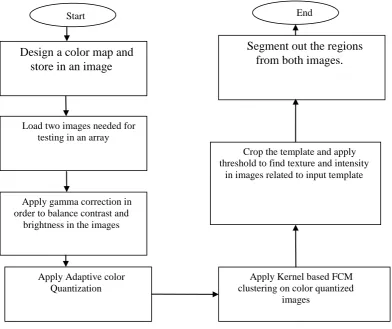
The proposed Algorithm Required following Steps Step 1) Generating synthetic RGB color map
Step 2) Applying gamma correction in order to adjust contrast of each intensity band Step 3) Color image quantization using bacteria foraging method
Step 4) Segmentation of image using Kernel based fuzzy c-means clustering method Step 5) Pattern template generation and thresholding for Matching
Fig. 1 A Flow Chart
End Start
Design a color map and
store in an image
Load two images needed for testing in an array
Apply gamma correction in order to balance contrast and
brightness in the images
Apply Kernel based FCM clustering on color quantized
images Apply Adaptive color
Quantization
Crop the template and apply threshold to find texture and intensity
in images related to input template
© 2014, IJCSMC All Rights Reserved
543
V. EXPERIMENTAL SETUP
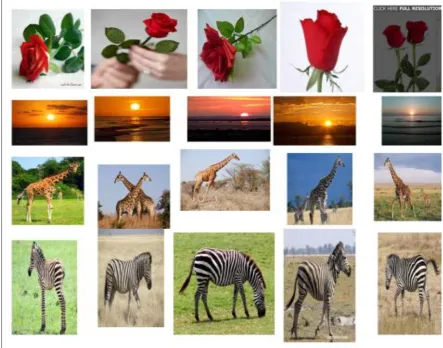
Proposed algorithm has been applied on different datasets collected from World Wide Web. In order to verify our algorithm we have implemented it on variety of Images. Few out of total images used for the experimental results have been shown below. Images have been chosen with different lightning conditions, objects, shapes and using different locations of the camera from the objects
.
© 2014, IJCSMC All Rights Reserved
544
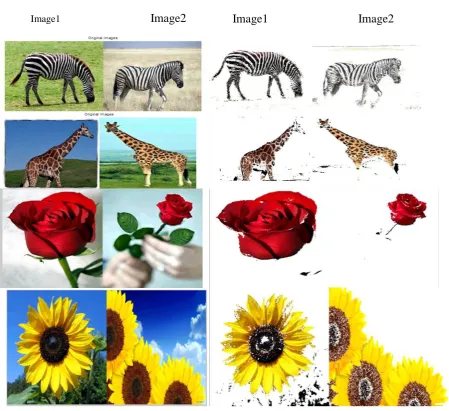
Fig. 3 Results a) Input Images image1 and image2 are two images we selected for region detection and matching. b) Output Images image1 and image2 are two images we get after applying CQ-FCM.
Table I Comparison Table between CQ-FCM and CQ-KFCM
Figure/Technique
CQ-FCM CQ-KFCM
Time(seconds) ROI1(%) ROI2(%) Time(seconds) ROI1(%) ROI2(%)
Figure 3.1 105.2356 25.8011 21.1978 11.9632 25.8211 21.5278
Figure 3.2 87.4552 21.1022 5.3233 11.7259 17.8256 7.5767
Figure 3.3 66.3534 38.2944 6.8567 12.0184 41.2644 7.2089
Figure 3.4 70.0691 32.5611 53.9978 12.0167 42.9511 49.9856
OUTPUT IMAGES INPUT IMAGES
© 2014, IJCSMC All Rights Reserved
545
In Table I we have Time: It is the time taken to implement the Fuzzy algorithm on Color Quantized Images.ROI (Region of Interest), It is a form of annotation, often associated with categorical or quantitative information (here it is for mean intensity), expressed as text or in structured form. ROI is a selected subset of samples within a dataset identified for object boundaries.ROI1 is for first Image and ROI2 is for second Image.
It has been found that if we increase the size of input images, it produces better results in segmentation but take more time for calculations. We have tried FCM algorithm but that takes too long for the segmentation process. The KFCM is fast and effective than FCM as it produces better segmentation because of induced kernel parameter for making clusters instead of Euclidian distance.
VI.CONCLUSIONS AND FUTURE SCOPE
We have presented an efficient Region Detection & Matching technique using the color quantization method with Kernel Based Fuzzy C-Means Algorithm of RGB images. In our work, we have chosen RGB images for object recognition. In first we make a synthetic colormap from combination of chosen primary colors and then loaded images have been quantized using bacteria foraging technique. The reason for doing this was to reduce the colors in the images for better segmentation. After that, whole quantized image pixels have been divided into kernel based fuzzy clusters by using KFCM. After that a patch has been generated for the chosen portion of an object and clusters have been filtered out which has same color as template patch. The proposed algorithm is implemented in MATLAB 2012b. The experimental results give satisfactory results and are more pleasing and comfortable. This is a Recognition Technique based on color, intensity and texture oriented. So in future, It can be tried to add other features in our algorithm like shape, size etc. of the objects for advance classification of Objects. The proposed technique can be further extended to test its performance on images corrupted with different kinds of noise. Performance can be evaluated by using some other parameters.
ACKNOWLEDGEMENT
This study was conducted by the first author under the supervision of the co-authors in partial fulfillment of the requirements of a Master Degree in Information Technology. The First author wishes to thank Assistant Professor Silky Narang and Assistant Professor Naseeb Singh Dhillon at Adesh Institute of Engineering and Technology, Faridkot under Punjab Technical University, Jalandhar for her support over the period in which this article was written.
REFERENCES
[1] Bansal, S. Aggarwal, D. , "Color Image Segmentation using CIELab Color Space using Ant Colony Optimization", International Journal of Computer Applications, pp. 28-34, 2011.
[2] Chang, C. H., Xu, P., Xiao, R. & Srikanthan, T. (2005). New adaptive color quantization method based on self organizing maps. IEEE Transactions on Neural Networks,16(1), 237-249.
[3] D. Q. Zhang and S. C. Chen, "Clustering incomplete data using kernel-based fuzzy c-means algorithm", Neural Processing Lett., vol. 18, no. 3, pp.155 -162 2003
[4] Heena and Aggarwal, H. , "Color Image Quantization Based on Euclidean Distance Using Bacteria Foraging Optimization," International Journal of Electronics and Computer Science Engineering, ISSN 2277-1956/V1N4-2285-2290
[5] Hogo, Mofreh A. (2010) ―Evaluation of E-learners Behaviour Using Different Fuzzy Clustering Models: A Comparative Study‖ IJCSIS Vol. 7, No. 2.
[6] H.P. Narkhede, ―Review on Image Segmentation Techniques ‖ International Journal of Science and Modern Engineering, Vol 1, Issue 8,July 2013.
[7] Ivancsy, Renata and Kovacs, Ferenc (2006) ―Clustering Techniques Utilized in Web Usage Mining‖ Proceedings of the 5th WSEAS Int. Conf. on Artificial Intelligence, Knowledge Engineering and Data Bases, Madrid, Spain.
[8] Jaechul Kim1, Ce Liu2 &FeiSha Kristen Grauman3 ―Deformable Spatial Pyramid Matching for Fast Dense Correspondences‖, Univ. of Texas at Austin1 Microsoft Research New England2 Univ. of Southern California ,IEEE 2013 .
[9] Kaur, Rajinder et al. , "Color Image Quantization based on Bacteria Foraging Optimization ", International Journal of Computer Applications, pp. 975 – 979, Volume 25, Issue 7, July 2011.
[10] Kumar, S., Singh, A., ―Pollination based optimization,‖ Presented at 6th International Multi Conference on Intelligent Systems, Sustainable, New and Renewable Energy Technology and Nanotechnology IISN2012, pp. 269-273, 2012.
© 2014, IJCSMC All Rights Reserved
546
[12] Nikhil R. Pal,Kuhu Pal, James M. Keller, and James C. Bezdek,‖ A Possibilistic Fuzzy c-Means Clustering Algorithm,‖IEEE Trans. on Fuzzy Systems, vol. 13, no. 4, pp. 517-530, Aug. 2005.
[13] Omran, M. G. ,Engelbrecht A. P. and Salman ,A. "A Color Image Quantization Algorithm Based on Particle Swarm Optimization," Informatica 29(2005)261-269.
[14] P. Scheunders, ―A Genetic C-Means Clustering Algorithm Applied to Color Image Quantization‖, Pattern Recognition, vol. 30, no. 6, pp. 859-866, 1997.
[15] R. B. Dubey, Sujata Bhatia, M. Hanmandlu, ShantaramVasikarla‖Breast Cancer Segmentation Using Bacterial Foraging Algorithm‖, IEEE 2013
[16] R. C.Gonzalez and Richard E. woods, ―Digital Image Processing‖, Pearson Education, Second Edition,2005.