A New Classification of 4-bit Optimal S-boxes and its Application to
PRESENT, RECTANGLE and SPONGENT
Wentao Zhang1, Zhenzhen Bao1, Vincent Rijmen2, Meicheng Liu1
1.State Key Laboratory of Information Security, Institute of Information Engineering, Chinese Academy of Sciences, Beijing 100093, China
2.KU Leuven, Dept. of Electrical Engineering ESAT/COSIC and iMinds, Security Dept.
{zhangwentao, baozhenzhen, liumeicheng}@iie.ac.cn
{vincent.rijmen}@esat.kuleuven.be
Abstract. In this paper, we present a new classification of 4-bit optimal boxes. All optimal 4-bit S-boxes can be classified into 183 different categories, among which we specify 3 platinum categories. Under the design criteria of the PRESENT (or SPONGENT) S-box, there are 8064 different S-boxes up to adding constants before and after an S-box. The 8064 S-boxes belong to 3 different categories, we show that the S-box should be chosen from one out of the 3 categories or other categories for better resistance against linear cryptanalysis. Furthermore, we study in detail how the S-boxes in the 3 platinum
categories influence the security of PRESENT, RECTANGLE and SPONGENT88 against differential
and linear cryptanalysis. Our results show that the S-box selection has a great influence on the secu-rity of the schemes. For block ciphers or hash functions with 4-bit S-boxes as confusion layers and bit permutations as diffusion layers, designers can extend the range of S-box selection to the 3 platinum
categories and select their S-box very carefully. For PRESENT, RECTANGLE and SPONGENT88
re-spectively, we get a set of potentially best/better S-box candidates from the 3 platinum categories. These potentially best/better S-boxes can be further investigated to see if they can be used to improve the security-performance tradeoff of the 3 cryptographic algorithms.
Key words:4-bit S-box, classification, block cipher, hash function, differential cryptanalysis, linear cryptanalysis, PRESENT, RECTANGLE, SPONGENT
1
Introduction
S-boxes are widely used in modern block ciphers and hash functions. Substitution-Permutation (SP) and Feistel network are the most common structures. In these structures, S-boxes are usually the only non-linear part. Therefore, S-boxes have to be chosen carefully to optimize the security-performance tradeoff. The most common sizes of S-boxes are 8-bit and 4-bit. AES [15] uses an 8-bit S-box, which has influenced many subsequent ciphers; while Serpent [2] and NOEKEON [14] use 4-bit S-boxes. In the past few years, as the need for security in RFID and sensor networks is dramatically increasing, many lightweight constructions have been proposed. Since a 4-bit S-box is usually much more compact in hardware than an 8-bit S-box, many lightweight block ciphers and hash functions use 4-bit S-boxes, such as LED [18], PHOTON [19], PRESENT [10], RECTANGLE [32] and SPONGENT [8].
For 4-bit S-boxes, the optimal values are known with respect to differential and linear cryptanalysis, an S-box attaining these optimal values is called an optimal S-box. In [22], Leander et al. classified all optimal 4-bit S-boxes into 16 affine equivalences; this result can be used to efficiently generate optimal S-boxes fulfilling additional criteria. However, for many constructions, the design criterion of being an optimal S-box is not enough, there are other important properties the designers should take into account. For example, the
c
design criteria of the Serpent S-box require that a 1-bit input difference must cause an output difference of at least two bits; later, such an criterion is adopted in the S-boxes of PRESENT, SPONGENT, LED and PHOTON.
Given an S-boxS, letCarD1Sdenote the number of times that a 1-bit input difference causes a 1-bit output
difference, andCarL1Sthe number of times that a 1-bit input selection pattern causes a 1-bit output selection
pattern. We refer to Section 2.1 for a precise definition ofCarD1SandCarL1S. For the PRESENT S-box, CarD1S=0 andCarL1S=8. In [26], linear hulls were used to mount an attack on 25-round PRESENT. Later,
a multidimensional linear attack on 26-round PRESENT was given in [12], which is the best shortcut attack on PRESENT so far. Both of the above attacks use the fact that the value ofCarL1Sof the PRESENT S-box
is relatively high, i.e.,CarL1S=8, which leads to a significant clustering of linear trails. For comparison,
the value ofCarD1Sof the PRESENT S-box is zero, the best shortcut differential attack on PRESENT only
reaches 18 rounds [30]. It can be seen that, with respect to security margin, there is a big gap between differ-ential cryptanalysis and linear cryptanalysis on PRESENT. More recently, Blondeau and Nyberg [7] showed that there exists a chosen-plaintext truncated differential attack for any known-plaintext multidimensional linear attack, hence, they have successfully derived a truncated differential attack on 26-round PRESENT from the multidimensional linear attack on 26-round PRESENT [12]. From this result, we can learn that a block cipher had better have almost the same security margin against differential-like attacks and linear-like attacks. Now, the questions come up. Is there any optimal S-box satisfyingCarD1S=0 andCarL1S=0? Is
there a better S-box for PRESENT with respect to the security against differential and linear cryptanalysis? These questions are part of motivation of this paper.
SPONGENT is a family of lightweight hash functions based on PRESENT. As PRESENT, the internal permutation of each SPONGENT variant uses SP-network with 4-bit S-boxes and a bit permutation. For the SPONGENT S-box,CarD1S=0 andCarL1S=4. RECTANGLE is designed with bit-slice technique.
RECTANGLE also uses SP-network with 4-bit S-boxes and a bit permutation. For the RECTANGLE S-box, CarD1S=2 andCarL1S=2. With respect to security of PRESENT and RECTANGLE, differential and
linear cryptanalysis are the most effective methods. Differential cryptanalysis is also an important method for the cryptanalysis of SPONGENT. Then, one may wonder if the security margin of PRESENT can be improved when replacing its S-box by the SPONGENT or RECTANGLE S-box. Moreover, is the S-box selection of SPONGENT and RECTANGLE optimal with respect to differential and linear cryptanalysis? In this paper, we will partly answer these questions.
1.1 Contributions
In Section 3 of this paper, we firstly prove thatCarL1S≥2 for any optimal S-box. Moreover, ifCarL1S=2,
then the S-box must be in 4 (out of 16) affine equivalent classes; ifCarL1S=3, then the S-box must be in 8
(out of 16) affine equivalent classes. We call the subset of optimal S-boxes with the same values ofCarD1S
andCarL1Sa Num1-DL category. We show that all optimal 4-bit S-boxes can be classified into 183 different
Num1-DL categories. Among all the 183 Num1-DL categories, there are 3 categories with the minimal value ofCarD1S+CarL1S, we call the 3 categories platinum Num1-DL categories. The SPONGENT and
RECTANGLE S-boxes belong to the 3 platinum Num1-DL categories, while the PRESENT S-box does not belong to the 3 platinum Num1-DL categories. About hardware area of the 3 platinum Num1-DL categories, our experimental results show that the difference between different S-boxes is small, which seems to suggest that designers can focus on security instead of hardware area when selecting an S-box from the 3 platinum Num1-DL categories.
There are 4 measures to evaluate the security of a cipher against differential and linear cryptanalysis. In Section 4, we give a brief discussion on the 4 measures, and show why it is appropriate to use the heuristic measure for the study in this paper.
SPONGENT) S-box. The 8064 S-boxes belong to 3 different categories. Fix the PRESENT permutation, when combining with the 8064 S-boxes, we get 8064 SP-network schemes. Similarly, for each of the 5 SPONGENT variants, fix the permutation layer, we can also get 8064 SP-network schemes. We show that, for each of the 6 fixed permutation layers, if the S-box comes from 2 out of the 3 categories, then there exists a linear trail with only one active S-box in each round. Hence, for SP-network schemes with the PRESENT or SPONGENT permutation layer, to avoid such weak linear trails and get better resistance against linear cryptanalysis, the S-box should be chosen from 1 out of the 3 categories or other categories.
In Section 6, we investigate how the S-boxes in the 3 platinum Num1-DL categories influence the secu-rity of PRESENT, RECTANGLE and SPONGENT against differential and linear cryptanalysis. We focus on 64- and 88-bit block length. Consider the following SP-network schemes. For 64-bit block length, the S-box is chosen from the 3 platinum Num1-DL categories, the diffusion layer is either the PRESENT permutation or the RECTANGLE permutation. Thus, there are 6 combinations. For 88-bit block length, the S-box is also chosen from the 3 platinum Num1-DL categories, the diffusion layer is either the SPONGENT88permutation layer or the RECTANGLE88permutation, there are also 6 combinations. For each of these 12 combinations, we use the heuristic measure to evaluate which are the best possible S-box candidates. Our results show that the S-box selection has a significant influence on the security of PRESENT, RECTANGLE and SPON-GENT. For PRESENT, there are 336 potentially best S-boxes, which does not include the PRESENT S-box. For RECTANGLE, there are 128 potentially best S-boxes, which includes the RECTANGLE S-box. For SPONGENT88, we present 4 potentially better S-boxes when considering differential cryptanalysis more important than linear cryptanalysis for hash functions. We want to point out that these results do not mean any security weakness of PRESENT, RECTANGLE or SPONGENT. However, these results show that there are potentially better S-box selections for PRESENT and SPONGENT, which means, by choosing another S-box, it is possible to improve the hardware/software performance of PRESENT and SPONGENT with a fixed level of security margin. Since any platinum Num1-DL category is not always the best choice, we suggest that designers can extend the range of the S-box selection to the 3 platinum Num1-DL categories and select their S-box carefully, when designing a block cipher or a hash function using 4-bit S-boxes as confusion layer and a bit permutation as diffusion layer.
We want to point out main differences of this work and Saarinen’s work [28]: Saarinen’s work only considered properties of S-boxes, while we consider not only certain properties of S-boxes but also influence of S-box selection on the security of PRESENT, RECTANGLE and SPONGENT. In [28], 4 PE classes are specified as “golden” S-boxes. In the end of Section 6.1, we will explain that none of the golden S-boxes belong to the 3 platinum Num1-DL categories; moreover, all of the golden S-boxes are not good choices for PRESENT, RECTANGLE and SPONGENT.
2
Preliminaries
2.1 Optimal S-box, Affine and PE Equivalence,m-resilient Boolean Function
Given an S-box mapping nbits to mbitsS:Fn
2 →F2m, we callS ann×mS-box. In this paper, we only concentrate on 4×4 S-boxes.
LetSdenote a 4×4 bijective S-box. Let△I,△O∈F24, defineNDS(△I,△O)as: NDS(△I,△O) =♯{x∈F24|S(x)⊕S(x⊕ △I) =△O}. LetΓI,ΓO∈F4
2, define the imbalanceImbS(ΓI,ΓO)as:
ImbS(ΓI,ΓO) =|♯{x∈F24|ΓI·x=ΓO·S(x)} −8|. where “·” denotes the inner product onF4
2. Define the differential-uniformity ofSas:
Di f f(S) = max
Define the linearity ofSas:
Lin(S) = max
ΓI,ΓO̸=0ImbS(ΓI,ΓO)
The smaller the value ofDi f f(S), the more secure the S-box against differential cryptanalysis. Similarly, the smaller the value ofLin(S), the more secure the S-box against linear cryptanalysis. For any bijective 4×4 S-box,Di f f(S)≥4 andLin(S)≥4 [22]. An S-box attaining these minima is called an optimal S-box. Definition 1 ([22]).Let S be a4×4S-box. S is called anoptimal S-boxif it satisfies the 3 conditions:
1. S is bijective, i.e., S(x)̸=S(x′)for any x̸=x′. 2. Di f f(S) =4.
3. Lin(S) =4.
Letwt(x)denote the Hamming weight of a binary vectorx. DefineSetD1S[32] as:
SetD1S={(△I,△O)∈F24×F24|wt(△I) =wt(△O) =1and NDS(△I,△O)̸=0}.
DefineSetL1S[32] as:
SetL1S={(ΓI,ΓO)∈F24×F24|wt(ΓI) =wt(ΓO) =1 and ImbS(ΓI,ΓO)̸=0}.
LetCarD1Sdenote the cardinality ofSetD1S, andCarL1Sthe cardinality ofSetL1S.
Definition 2 ([22]). Two S-boxes S and S′ are called affine equivalentif there exist two invertible4×4
matrices A,B over F2, and constants a,b∈F24such that S′(x) =B(S(A(x)⊕a))⊕b.
Given an S-boxS, the values ofDi f f(S)andLin(S)both remain unchanged when applying an affine transformation in the domain or co-domain ofS[11, 25]. Especially, the following theorem holds.
Theorem 1 ([22]). Let S and S′ be two affine equivalent S-boxes. If S is an optimal S-box, then S′ is an
optimal S-box as well.
According to Theorem 1, all optimal S-boxes can be divided into equivalence classes using affine equiva-lence relation. It is a surprising fact that all 4×4 optimal S-boxes can be split into only 16 affine equivalence classes [22]. Let{Gi,0≤i≤15}denote the representatives for the 16 equivalence classes, we refer to [22]
for the 16 representatives, which are also listed in Table 1 for clarity.
Table 1.([22]) Representatives for All 16 Affine Equivalence Classes of Optimal 4×4 S-boxes
G0 0, 1, 2, 13, 4, 7, 15, 6, 8, 11, 12, 9, 3, 14, 10, 5
G1 0, 1, 2, 13, 4, 7, 15, 6, 8, 11, 14, 3, 5, 9, 10, 12
G2 0, 1, 2, 13, 4, 7, 15, 6, 8, 11, 14, 3, 10, 12, 5, 9
G3 0, 1, 2, 13, 4, 7, 15, 6, 8, 12, 5, 3, 10, 14, 11, 9
G4 0, 1, 2, 13, 4, 7, 15, 6, 8, 12, 9, 11, 10, 14, 5, 3
G5 0, 1, 2, 13, 4, 7, 15, 6, 8, 12, 11, 9, 10, 14, 3, 5
G6 0, 1, 2, 13, 4, 7, 15, 6, 8, 12, 11, 9, 10, 14, 5, 3
G7 0, 1, 2, 13, 4, 7, 15, 6, 8, 12, 14, 11, 10, 9, 3, 5
G8 0, 1, 2, 13, 4, 7, 15, 6, 8, 14, 9, 5, 10, 11, 3, 12
G9 0, 1, 2, 13, 4, 7, 15, 6, 8, 14, 11, 3, 5, 9, 10, 12
G10 0, 1, 2, 13, 4, 7, 15, 6, 8, 14, 11, 5, 10, 9, 3, 12
G11 0, 1, 2, 13, 4, 7, 15, 6, 8, 14, 11, 10, 5, 9, 12, 3
G12 0, 1, 2, 13, 4, 7, 15, 6, 8, 14, 11, 10, 9, 3, 12, 5
G13 0, 1, 2, 13, 4, 7, 15, 6, 8, 14, 12, 9, 5, 11, 10, 3
G14 0, 1, 2, 13, 4, 7, 15, 6, 8, 14, 12, 11, 3, 9, 5, 10
G15 0, 1, 2, 13, 4, 7, 15, 6, 8, 14, 12, 11, 9, 3, 10, 5
Table 2.([22]) Number ofb∈F24\ {0}such thatdeg(Sb) =2,3
S-box G0 G1 G2 G3 G4 G5 G6 G7 G8 G9 G10 G11 G12 G13 G14 G15
deg(Sb) =2 3 3 3 0 0 0 0 0 3 1 1 0 0 0 1 1
deg(Sb) =3 12 12 12 15 15 15 15 15 12 14 14 15 15 15 14 14
Definition 3 ([22]).Two S-boxes S and S′ are calledpermutation-then-XOR equivalentif there exist two
4×4permutation matrices P0,P1over F2, and constants a,b∈F24such that S′(x) =P1(S(P0(x)⊕a))⊕b.
The equivalence is calledPE equivalencefor short.
Note that if two S-boxes are PE equivalent, then they must be affine equivalent.
Definition 4. Let f be a Boolean function f:F2n→F2, define the Walsh Coefficient of f at a as:
fW(a) =
∑
x∈F2n
(−1)f(x)⊕a·x.
Ann-variable Boolean function f is balanced if its output in the truth table contains equal number of 0 and 1. f is balanced if and only if fW(0) =0.
Definition 5 ([31]).A Boolean function f is m-resilient if and only if its Walsh Coefficient satisfy fW(a) =0 for any0≤wt(a)≤m.
For anyb∈F24, define the corresponding component Boolean functionSbof an S-boxSas: Sb:F24→F2,Sb(x) =b·S(x).
Letdeg(f)denote the algebraic degree of the Boolean function f, the algebraic degree is invariant un-der affine equivalence. Table 2 [22] gives the number ofb∈F24\ {0} such thatdeg(Sb) =2,3 for the 16
representative optimal S-boxes.
2.2 Differential Trail, Difference Propagation, Linear Trail and Linear Propagation
Differential cryptanalysis (DC) [5] and linear cryptanalysis (LC) [23] are among the most powerful tech-niques available for block ciphers. Letβ be a Boolean transformation operating on n-bit vectors that is a sequence ofrtransformations:
β=ρ(r)◦ρ(r−1)◦ ··· ◦ρ(2)◦ρ(1).
In this paper,β refers to a key-alternating block cipher [15] or a permutation of a hash function, the round keys (or constants) are added to the state by means of an XOR. Thus, a difference in differential cryptanalysis considered in this paper is referred to as an XOR.
Adifferential trail[15] Qover an iterative transformation consists of a sequence of r+1 difference patterns:
Q= (q(0),q(1),q(2),···,q(r−1),q(r)). The probability of a differential step is defined as:
Prob(q(i−1),q(i)) =2−n×♯{x∈F2n|ρ(i)(x)⊕ρ(i)(x⊕q(i−1)) =q(i)}.
Prob(Q) =
∏
i
Prob(q(i−1),q(i)).
Note that such an approximation is independent of the values of the round keys. Adifference propagation [15] is composed of a set of differential trails, the probability of a difference propagation(a′,b′)is the sum of the probabilities of allr-round differential trailsQwith initial differencea′and terminal differenceb′:
Prob(a′,b′) =
∑
q(0)=a′,q(r)=b′
Prob(Q) (1)
The correlationC(f,g)between two binary Boolean functionsf(a)andg(a)is defined as: C(f,g) =2×Prob(f(a) =g(a))−1.
Alinear trail[15]U over an iterative transformation consists of a sequence ofr+1 selection patterns (also known as linear mask):
U= (u(0),u(1),u(2),···,u(r−1),u(r)).
Thecorrelation contribution[15] of a linear trail is the product of the correlation of all its steps: Cor(U) =
∏
i
C(u(i)·ρ(i)(a),u(i−1)·a). (2)
Alinear propagationis composed of a set of linear trails, the correlation of a linear propagation(u,w)is the sum of the correlation contributions of allr-round linear trailsUwith initial selection patternwand final selection patternu:
Cor(u,w) =
∑
u(0)=w,u(r)=u
Cor(U). (3)
Note that the correlation contribution of the linear trails are signed and their sign depends on the value of the round keys. The square of a correlation (contribution) is called correlation potential. The following theo-rem gives the expected value of the correlation potentialCor(u,w)2over all possible values of the expanded key.
Theorem 2 ([15]).The average correlation potential between an input and an output selection pattern is the
sum of the correlation potentials of all linear trails between the input and output selection patterns:
E(Cort2) =
∑
i(Cori)2 (4)
where Cort is the overall correlation, and Corithe correlation contribution of a linear trail.
To attack ab-bit block cipher using DC, there must be a predictable difference propagation over all but a few rounds with a probability significantly larger than 2−b. Similarly, to attack ab-bit block cipher using LC, there must be a predictable linear propagation over all but a few rounds with a correlation potential significantly larger than 2−b.
2.3 An Extension of RECTANGLE - RECTANGLE88
3
A New Classification of 4-bit S-boxes
The subset of 4×4 optimal S-boxes with the same values ofCarD1SandCarL1Sis called a category, the
following is a formal definition.
Definition 6. An(nd,nl)-Num1-DL categoryis defined as a subset of all4×4optimal S-boxes which satisfy CarD1S=nd and CarL1S=nl. The category is also called aNum1-DL categoryfor short.
We are especially interested in those categories with lowCarD1Sand lowCarL1S. It can be easily seen
that 0≤CarD1S≤16 and 0≤CarL1S≤16. Obviously, the (0,0)-Num1-DL category is the best case,
however, the following theorem shows that there does not exist such an optimal S-box.
Theorem 3. Let S denote an optimal S-box, then CarL1S≥2. In other words, there does not exist an optimal
S-box with CarL1S=0or CarL1S=1.
Proof:Letx= (x3,x2,x1,x0)andS(x) = (f3(x),f2(x),f1(x),f0(x)), wherexiis thei-th bit ofx, and fj(x)the j-th bit ofS(x). SinceSis bijective, each Boolean functionfj(0≤j≤3)) is balanced.
Firstly, we show that there exist at least 2 Boolean functions fj1 and fj2 (0≤j1,j2≤3) with algebraic degree 3, equivalently speaking, there exist at most 2 Boolean functions with algebraic degree less than 3. Proof by contradiction. Assume that there exist 3 (or 4) out of the 4 Boolean functions fj(j=0,1,2,3) with
algebraic degree less than 3. Then, for each of the 7 (or 15) non-zero linear combinations of these 3 (or 4) functions, the algebraic degree is also less than 3. However, according to Table 1, for any optimal S-box, there are at most 3 out of the 15 component functions with algebraic degree less than 3, which is a contradiction.
According to Siegenthaler’s inequality [29], ann-variable Boolean function with degreen−1 is not 1-resilient. Particularly, if the degree of fjis 3, then there exists 0≤i≤3 such that fj(x)⊕xiis not balanced,
which means that(2i,2j)∈SetL1
S. Since there exist at least 2 functions fj1 andfj2with algebraic degree 3, we can get that there are at least 2 elements inSetL1S, i.e.,CarL1S≥2.
Note that it was also reported in [22] that there is no (0,0)-Num1-DL S-box. Similar to the proof of Theorem 3, we can prove the following 2 theorems.
Theorem 4. Let S denote an optimal S-box. If S is affine equivalent to G9,G10,G14or G15, then CarL1S≥3.
Proof: IfSis affine equivalent toG9,G10,G14 or G15, firstly we show that there exist at least 3 Boolean functions fj1, fj2 and fj3 (0≤ j1, j2, j3≤3) with algebraic degree 3. Proof by contradiction. Assume that there existw≥2 Boolean functions fk1,···,fkw with algebraic degree less than 3. Then, there exist at least
2w−1≥3 non-zero linear combinations of the mfunctions with algebraic degree less than 3. However, according to Table 1, for any S-box which is affine equivalent toG9,G10,G14orG15, there is only 1 out of the 15 component functions with algebraic degree less than 3, which is a contradiction.
Since there exist at least 3 functions fj1, fj2 and fj3 with algebraic degree 3, similar to the reasoning in Theorem 3, we can get that there are at least 3 elements inSetL1S, i.e.,CarL1S≥3.
Theorem 5. Let S denote an optimal S-box. If S is affine equivalent to G3,G4,G5,G6,G7,G11,G12or G13,
then CarL1S≥4.
Proof: IfSis affine equivalent to G3,G4,G5,G6,G7,G11,G12 or G13, then the algebraic degree is 3 for each of the 15 component functions according to Table 1. Hence the algebraic degree is 3 for each of the 4 Boolean functions fj(x), j=0,1,2,3. Similar to the reasoning in Theorem 3, we can get that there are at
least 4 elements inSetL1S, i.e.,CarL1S≥4.
According to Theorem 4 and 5, we can get the following corollary.
Corollary 1. If CarL1S=2, then S is in the 4 affine equivalence classes corresponding to G0,G1,G2and
G8; if CarL1S=3, then S is in the 8 affine equivalence classes corresponding to G0,G1,G2,G8,G9,
Corollary 1 indicates that we can restrict the search of S-boxes withCarL1S=2 within the 4 (out of
16) affine equivalence classes, and the search of S-boxes withCarL1S=3 within the 8 (out of 16) affine
equivalence classes. In the following, we present an efficient way which can experimentally classify all 4×4 optimal S-boxes into different categories.
Given an S-boxS, the values ofCarD1SandCarL1Sare not generally invariant under the affine
equiva-lence relation, but the two values are invariant under the PE equivaequiva-lence relation.
Theorem 6. Let S and S′be two PE equivalent S-boxes, then CarD1S=CarD1S′ and CarL1S=CarL1S′.
Every 4×4 optimal S-box can be written asB(Gi(A(x)⊕a))⊕b, whereGi(0≤i≤15) is a representative
S-box listed in Table 1,AandBare two invertible 4×4 matrices overF2,aandbare two constants overF24. The number of 4×4 invertible matrices is∏3i=0(24−2i) =20160. At the first sight, up to adding constants, we need to consider 16×20160×20160≈232.6S-boxes. However, this number can be decreased greatly due to the following Lemma.
Lemma 1. Let M denote a4×4matrix over F2:
M=
a03 a02 a01 a00
a13 a12 a11 a10
a23 a22 a21 a20
a33 a32 a31 a30
where ai j∈F2,0≤i,j≤3. Let ri=ai3||ai2||ai1||ai0denote the nibble consisting of the 4 bits in the i-th row,
ai0is the least significant bit. There are 840 matrices satisfying the following 2 conditions:
1. invertible. 2. r0<r1<r2<r3.
we call such a matrix a row-increasing matrix.
Proof:Given an 4×4 invertible matrix, there are 4!=24 different matrices obtained by permuting the 4
rows. Among the 24 matrices, only one matrix satisfies the conditionr0<r1<r2<r3. Therefore, there are 20160/24=840 invertible row-increasing matrices.
According to Lemma 1, every 4×4 optimal S-box is PE equivalent to an S-box with the formM1(Gi(M0T(x))), 0≤i≤15,M0andM1are two row-increasing matrices. Hence, up to PE equivalence, we only need to con-sider 16×840×840=11289600≈223.43S-boxes. By exhaustively checking all the 11289600 S-boxes, we have the following result.
Result 1 All optimal4×4S-boxes can be split into 183 different Num1-DL categories. Table 3 gives the
details, the symbol “X” at position(i,j)means that there exist optimal S-boxes satisfying CarD1S=i and CarL1S=j. From Table 3, the following facts are of interest:
1.No Num1-DL category satisfies that CarL1S=0or CarL1S=1.
2.The minimal possible value for CarD1Sis 0. When CarD1S=0, the minimal possible value for CarL1S is 4, i.e., the(0,4)-Num1-DL category.
3.The minimal possible value for CarL1Sis 2. When CarL1S=2, the minimal possible value for CarD1S is 2, i.e., the(2,2)-Num1-DL category.
Note that the first fact in Result 1 is in accordance with Theorem 3. The SPONGENT S-box belongs to the(0,4)-Num1-DL category, the RECTANGLE S-box belongs to the(2,2)-Num1-DL category. Moreover, we experimentally verify Corollary 1, our results show that there exist S-boxes withCarL1=2 in each of the 4 affine equivalence classes corresponding toG0,G1,G2andG8, and there exist S-boxes withCarL1S=3
in each of the 8 affine equivalence classes corresponding toG0,G1,G2,G8,G9,G10,G14andG15.
one active S-box in each round, hence we only consider the Num1-DL categories with low values ofCarD1S
andCarL1S. For each Num1-DL category satisfyingCarD1S+CarL1S≤8, by checking all the S-boxes (out
of 11289600 S-boxes) in this category, we get the following result.
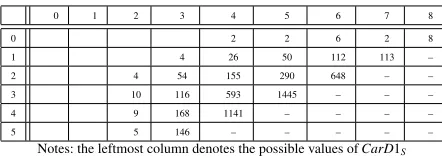
Result 2 There are 24 Num1-DL categories satisfying CarD1S+CarL1S≤8. Table 4 gives the number of
PE classes for each of the 24 Num1-DL categories. Moreover, we have the following facts: 1.Consider the sum of the values in row 0, there are 20 PE classes satisfying CarD1S=0.
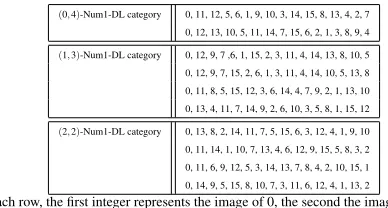
2.Restricting CarD1S+CarL1S≤4, there are 3 Num1-DL categories:(0,4)-,(1,3)-,(2,2)-Num1-DL category. We call these 3 categoriesplatinum Num1-DL categories. Table 5 lists representative S-boxes for each PE class in each of the 3 platinum Num1-DL categories.
Generally, the S-boxes in a Num1-DL category belong to many affine equivalence classes. For example, (0,8)-Num1-DL category includes 8 PE classes, and the 8 PE classes belong to 5 affine equivalence classes. In Result 2, the first fact is in accordance with Fact 4 in [22]. For the (2,2)-Num1-DL category, the 4 representative S-boxes are respectively PE equivalent to the 4 representative S-boxes given in [32], appearing in the same order.
In hardware implementation, an S-box is usually realized in combinatorial logic, where area requirement is a very important aspect. A bit-permutation is realized by wiring, which needs a negligible amount of area. Hence, for one PE class, up to permutations of input bits and output bits, only 256 S-boxes need to be investigated with respect to hardware area. There are 10 PE classes in the 3 platinum Num1-DL categories,
Table 3.183 Num1-DL Categories: marked byX
0 1 2 3 4 5 6 7 8 9 10 11 12 13 14 15 16
0 X X X X X
1 X X X X X X X X X X
2 X X X X X X X X X X X X X
3 X X X X X X X X X X X X X X
4 X X X X X X X X X X X X X X X
5 X X X X X X X X X X X X X X X
6 X X X X X X X X X X X X X X
7 X X X X X X X X X X X X X X
8 X X X X X X X X X X X X X
9 X X X X X X X X X X X X X
10 X X X X X X X X X X X X X
11 X X X X X X X X X X X X X
12 X X X X X X X X X X X
13 X X X X X X X X X X
14 X X X X X X X X
15 X X
16
Notes: the leftmost column denotes the 17 possible values ofCarD1S
the uppermost row denotes the 17 possible values ofCarL1S
Table 4.Number of PE Classes in the 24 Num1-DL Categories satisfyingCarD1S+CarL1S≤8
0 1 2 3 4 5 6 7 8
0 2 2 6 2 8
1 4 26 50 112 113 –
2 4 54 155 290 648 – –
3 10 116 593 1445 – – –
4 9 168 1141 – – – –
5 5 146 – – – – –
Notes: the leftmost column denotes the possible values ofCarD1S
the uppermost row denotes the possible values ofCarL1S
Table 5.Representative S-boxes for the 3 platinum Num1-DL categories
(0,4)-Num1-DL category 0, 11, 12, 5, 6, 1, 9, 10, 3, 14, 15, 8, 13, 4, 2, 7 0, 12, 13, 10, 5, 11, 14, 7, 15, 6, 2, 1, 3, 8, 9, 4
(1,3)-Num1-DL category 0, 12, 9, 7 ,6, 1, 15, 2, 3, 11, 4, 14, 13, 8, 10, 5 0, 12, 9, 7, 15, 2, 6, 1, 3, 11, 4, 14, 10, 5, 13, 8 0, 11, 8, 5, 15, 12, 3, 6, 14, 4, 7, 9, 2, 1, 13, 10 0, 13, 4, 11, 7, 14, 9, 2, 6, 10, 3, 5, 8, 1, 15, 12
(2,2)-Num1-DL category 0, 13, 8, 2, 14, 11, 7, 5, 15, 6, 3, 12, 4, 1, 9, 10 0, 11, 14, 1, 10, 7, 13, 4, 6, 12, 9, 15, 5, 8, 3, 2 0, 11, 6, 9, 12, 5, 3, 14, 13, 7, 8, 4, 2, 10, 15, 1 0, 14, 9, 5, 15, 8, 10, 7, 3, 11, 6, 12, 4, 1, 13, 2
Note: In each row, the first integer represents the image of 0, the second the image of 1, and so on.
Table 6.Maximal and Minimal GEs for 64 S-boxes from each platinum PE classes
PE Class (0,4)1(0,4)2(1,3)1 (1,3)2(1,3)3(1,3)4(2,2)1(2,2)2(2,2)3(2,2)4
Max(GEs) 24.68 25.02 24.02 23.68 24.02 23.35 23.35 23.01 23.02 23.34
Min(GEs) 23.02 23.36 22.35 22.00 23.02 22.35 21.35 21.00 21.01 21.68
Gates(GEs): NAND (1), NOR (1), AND (1.33), OR (1.33), XOR (2.67), NOT (0.67).
we call them platinum PE classes for simplicity. Due to the limitation of computational resources, we only choose 64 S-boxes from each of the 10 platinum PE classes for study. We use a C program extended from [17] to calculate the minimum possible area of an S-box. Since the program is a heuristic algorithm, it can not be guaranteed that the result is the smallest one. Table 6 summarizes our experimental results, where (nd,nl)idenote thei-th PE class (corresponding to thei-th representative in Table 5) in the(nd,nl)-Num1-DL
category,MaxandMinrespectively denote the maximal and minimal area among the 64 values. According to Table 6, the difference between different S-boxes in the same PE class is small (not more than 2.01 GE) , which seems to suggest that designers can focus on security instead of hardware area when selecting an S-box from a platinum PE class.
4
Measures for Evaluating the Security against DC and LC
Kanda et al. [20] classified 4 measures to evaluate the security of a cipher against DC and LC as follows: 1. Precise measure: The maximum probability of difference propagations, and the maximum average
cor-relation potential of linear propagations.
2. Theoretical measure: The upper bound of the maximum probability of difference propagations, and the upper bound of the maximum average correlation potential of linear propagations.
3. Heuristic measure: The maximum probability of differential trails, and the maximum correlation poten-tial of linear trails.
4. Practical measure: The upper bound of the maximum probability of differential trails, and the upper bound of the maximum correlation potential of linear trails.
For many modern ciphers, such as AES and Serpent, it is almost computationally infeasible to perform an evaluation using the precise measure or the theoretical measure. For ciphers with good diffusion , such as Serpent [2], the heuristic measure is only effective for a small number of rounds. On the other hand, many ciphers evaluated with the practical measure are practically secure against DC and LC, such as AES and NOEKEON, hence the practical measure is the most common measure.
Consider the following SP-network schemes. Fix the permutation layer of PRESENT, RECTANGLE or SPONGENT, the S-box can have many different choices. Then, for each scheme, we wonder which S-boxes are the best with respect to DC and LC? If an S-box can result in a differential or linear trail with only one active S-box in each round, then such an S-box is not a good candidate, we will explain in detail in Section 5 and Section 6. Since the larger the value ofCarD1 (CarL1), the more likely that there exists a differential (linear) trail with only one active S-box in each round (see Section 5). Hence, in this paper, we mainly concentrate on S-boxes in the 3 platinum Num1-DL categories. In Section 5 and Section 6, we adopt the heuristic measure for the study. One may say that, for such schemes, the clustering of differential/linear trails must not be neglected [6, 12, 26, 30, 32], hence it needs to use the precise (or the theoretical) measure to evaluate the clustering of differential/linear trails. However, we think that it is still appropriate to use the heuristic measure for the study. The following gives the reasons.
In [32], the designers presented their evaluation on the clustering of differential/linear trails of RECTAN-GLE, which took them several days. For comparison, by using the heuristic measure, our experiments show that it only needs several minutes for the evaluation of RECTANGLE, and several seconds for the evaluation of PRESENT. Note that the total number of schemes investigated in this paper is 4368 (see Table 5), hence it needs an extremely huge computational effort to evaluate the clustering of differential/linear trails for all the schemes investigated in this paper.
Let rDp denote the highest number of rounds of an exploitable differential distinguisher by using the
precise measure, andrLpthe highest number of rounds of an exploitable linear distinguisher by using the
precise measure, definerp≡max{rDp,rLp}. For a fixed permutation, among all the S-box candidates, the
smaller the value ofrp, the better the scheme, because schemes with the minimalrpneed the least number of
rounds to resist against DC and LC. LetrDhdenote the highest number of rounds of an exploitable differential distinguisher by using the heuristic measure, andrLhthe highest number of rounds of an exploitable linear
distinguisher by using the heuristic measure, definerh≡max{rDh,rLh}. Based on equations (1) and (4),
we haverDp≥rDhandrLp≥rLh, thusrp≥rh. The smaller the value ofrDp−rDh(rLp−rLh), the less
the clustering of differential (linear) trails. Based on the known results on PRESENT, RECTANGLE and SPONGENT [1, 6, 12, 26, 30, 32], the differencerDp−rDh(orrLp−rLh) between the two measures are as
follows: For PRESENT against DC, the difference is 16−14=2; for PRESENT against LC, the difference is 24−16=8. For RECTANGLE against DC, the difference is 14−14=0; for RECTANGLE against LC, the difference is 14−13=1. For SPONGENT88 against LC, the difference is 23−22=1. Based on the above results, we expect that there exist S-boxes with a small value of bothrDp−rDhandrLp−rLhfor each
fixed permutation layer. For such schemes, ifrhreaches the minimal, we expect that it is very likely thatrp
also reaches the minimal. Hence, it is reasonable to make the following assumption:
Assumption 1 For each fixed permutation layer, consider the SP-network schemes investigated in this paper.
Among those with a minimal value of rh, there exist some schemes satisfying rDp−rDh≤2and rLp−rLh≤2.
Under Assumption 1, for each fixed permutation layer, the best schemes using the precise measure are the best schemes using the heuristic measure with a great probability.
By using the heuristic measure, for each combination of a fixed permutation layer and a platinum Num1-DL category, we can discard a large proportion of the S-box candidates and concentrate only on S-boxes with the minimal value ofrh(we will present the results in Section 6). We emphasize that this is the first step. For
such cipher designs, designers must take differential/linear clustering into consideration. Ideally, designers can make a further selection from the schemes with the minimal value ofrhby selecting an S-box which has
Table 7.Representative S-boxes for the 14 PE Classes Satisfying the Design Criteria of PRESENT S-box
(0,4)-Num1-DL category 0, 11, 12, 5, 6, 1, 9, 10, 3, 14, 15, 8, 13, 4, 2, 7 0, 12, 13, 10, 5, 11, 14, 7, 15, 6, 2, 1, 3, 8, 9, 4
(0,6)-Num1-DL category 0, 3, 5, 14, 13, 4, 8, 2, 10, 12, 9, 7, 6, 11, 15, 1 0, 14, 12, 3, 5, 8, 10, 15, 7, 4, 2, 9, 11, 1, 13, 6 0, 10, 15, 3, 7, 1, 4, 13, 14, 5, 8, 6, 9, 12, 2, 11 0, 12, 13, 11, 6, 15, 10, 5, 7, 9, 4, 2, 8, 3, 1, 14
(0,8)-Num1-DL category 0, 5, 7, 10, 3, 12, 13, 6, 11, 2, 14, 1, 4, 9, 8, 15 0, 13, 14, 2, 12, 7, 11, 1, 5, 3, 8, 4, 9, 10, 6, 15 0, 13, 5, 2, 11, 7, 6, 12, 3, 4, 10, 9, 14, 8, 1, 15 0, 10, 7, 9, 12, 5, 2, 15, 6, 13, 1, 4, 11, 8, 14, 3 0, 12, 7, 10, 6, 9, 1, 4, 3, 15, 14, 5, 8, 2, 13, 11 0, 12, 9, 3, 6, 11, 10, 13, 14, 7, 2, 4, 5, 8, 15, 1 0, 3, 5, 12, 6, 13, 10, 7, 14, 8, 2, 11, 9, 4, 15, 1 0, 7, 14, 11, 10, 1, 4, 8, 6, 9, 13, 2, 5, 12, 3, 15
5
A Relation of the S-box Selection, the Value of
CarL
1
Sand the Security of
PRESENT and SPONGENT
The block length of PRESENT is 64 bits. For SPONGENT [8], the block length of the internal permutation has 5 choices: 88, 136, 176, 240 and 272 bits , which are denoted as SPONGENTbrespectively,bis the block
length. In this section, we focus on these 6 block lengths. The design criteria of the PRESENT S-box are as follows: 1. Optimal.
2. CarD1S=0.
3. ForΓI,ΓO∈F24such thatwt(ΓI) =wt(ΓO) =1 it holds thatImbS(ΓI,ΓO) =2.
4. No fixed point, i.e.,S(x)̸=xfor anyx∈F24.
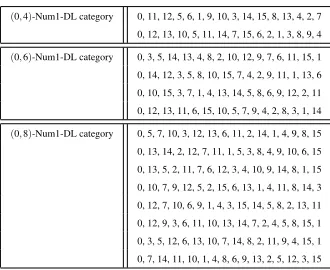
There are 20 PE classes satisfying criteria 1 and 2. Among the 20 PE classes, 14 PE classes satisfy criterion 3. We list the 14 representative S-boxes in Table 7. The PRESENT S-box belongs to the (0,8) -Num1-DL category. The SPONGENT S-box fulfills the design criteria of the PRESENT S-box. Moreover, the designers claim that, for most SPONGENT variants, the best linear propagation based on single-bit selection patterns has exactly one linear trail [9]. The SPONGENT S-box belongs to the(0,4)-Num1-DL category.
Up to adding constants before and after an S-box, which does not change any of the design criteria 1-3 of the PRESENT S-box and moreover does not change the probability of the best differential trail and the correlation potential of the best linear trail , there are 14×4!×4!=8064 S-boxes. The 8064 S-boxes belong to 3 different categories. Fix the permutation of PRESENT (or the permutation layer of the SPONGENT internal permutation), we wonder which are the best choices among the 8064 S-boxes.
For the schemes investigated in this section, if the bestr-round linear trail has only one active S-box in each round, then its correlation potential is 2−4r+4, with the correlation potential 2−2in the 0-th and(r−1)-th round, and 2−4in each of the otherr−2 rounds. Thus, whenr=b4, the correlation potential of such a linear trail is 2−b+4, which means there exists a b4-round exploitable linear distinguisher. Forb=64 andb=88, our experiments show that there exist some S-boxes such that the correlation potential of the best b4-round linear trail is less than or equal to 2−b(see Table 10 and Table 12).
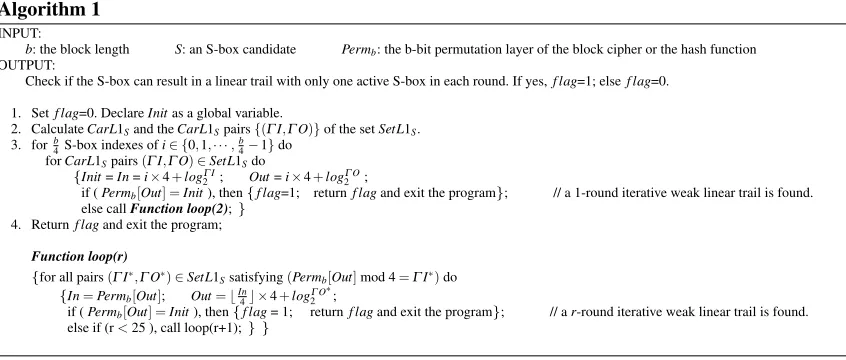
Based on the above discussion, we decide to discard the S-boxes which can result in a linear trail with only one active S-box in each round. Note that ar-round iterative linear trail can be used to construct a r′-round linear trail for anyr′≥r. Algorithm 1 is designed to detect if an S-box can result in ar-round
Algorithm 1
INPUT:
b: the block length S: an S-box candidate Permb: the b-bit permutation layer of the block cipher or the hash function
OUTPUT:
Check if the S-box can result in a linear trail with only one active S-box in each round. If yes,f lag=1; elsef lag=0.
1. Setf lag=0. DeclareInitas a global variable.
2. CalculateCarL1Sand theCarL1Spairs{(ΓI,ΓO)}of the setSetL1S.
3. forb
4S-box indexes ofi∈ {0,1,···,b4−1}do forCarL1Spairs(ΓI,ΓO)∈SetL1Sdo
{Init=In=i×4+logΓI
2 ; Out=i×4+log2ΓO;
if (Permb[Out] =Init), then{f lag=1; returnf lagand exit the program}; // a 1-round iterative weak linear trail is found.
else callFunction loop(2);} 4. Returnf lagand exit the program;
Function loop(r)
{for all pairs(ΓI∗,ΓO∗)∈SetL1Ssatisfying(Permb[Out]mod 4=ΓI∗)do
{In=Permb[Out]; Out=⌊In4⌋ ×4+logΓ
O∗
2 ;
if (Permb[Out] =Init), then{f lag= 1; returnf lagand exit the program}; // ar-round iterative weak linear trail is found.
else if (r<25 ), call loop(r+1);} }
Table 8.Number of the Remaining S-boxes using Algorithm 1 for the 6 Block Lengths
block length (bits) 64 88 136 176 240 272
number of remaining S-boxes 96 112 32 48 64 0
iterative linear trail with only one active S-box in each round, note that such a linear trail is connected by the elements inSetL1S. We only check up to 25 rounds for practical reasons (nevertheless, we point out
that it can not exclude the possibility that more S-boxes may be discarded if more rounds are checked). For each fixed block length, the experimental results show that a vast majority of the 8064 S-box candidates are discarded. Leteidenote the vector with a single one at positioni(counting from zero). Since all of the round
input/output selection patterns belong to the set{ei}, for simplicity, we useIn(Out) to denote the subscript
of the input (output) selection pattern of the S-box layer. By running Algorithm 1, we get the following result.
Result 3 For each of the 6 block lengths, fix the corresponding permutation layer, when combining with the
8064 S-boxes, there are 8064 SP-network schemes. Discard the S-boxes which can result in a linear trail with only one active S-box in each round using Algorithm 1, we have the following facts:
1.Table 8 gives the number of the remaining S-boxes, which shows that more than98.6 percent of the 8064 S-boxes are discarded for each block length.
2.For 64-, 88-, 136-, 176- and 240-bit block length, all of the remaining S-boxes belong to the(0,4) -Num1-DL category; for 272-bit block length, there is no S-box left.
From the second fact of the above result, it can be seen that the security of the investigated schemes against LC has a strong relation with the value ofCarL1S. For each of the 6 block lengths, among the 8064
S-boxes, every S-box in(0,6)-Num1-DL and(0,8)-Num1-DL categories can result in a linear trail with only one active S-box in each round. For 272-bit block length, fix the permutation layer of SPONGENT272, for each of the 8064 S-box candidates, there exists a linear trail with only one active S-box in each round. Hence, we get a new design criterion for the S-box of PRESENT-like or SPOGNENT-like schemes.
Design Criterion 1 For 64-bit (88-, 136-, 176- and 240-bit respectively) block length, fix the permutation
layer of PRESENT (the corresponding SPONGENT variant). For better resistance against LC, besides the 4 design criteria for the S-box, designers should add CarL1S=4as a new design criterion.
For 272-bit block length, fix the permutation layer of SPONGENT272. For better resistance against LC,
Since there are 2 PE classes in the (0,4)-Num1-DL category. Design criterion 1 means that the S-box should be chosen from 1152 out of the 8064 S-boxes for the 5 block lengths.
6
An Investigation of the S-box Selection of PRESENT, RECTANGLE and
SPONGENT
Due to the huge computational effort required to run the experiments, we only focus on 64- and 88-bit block lengths in this section. Consider the following SP-network schemes. For 64-bit block length, the S-box is chosen from the 3 platinum Num1-DL categories:(0,4)-,(1,3)- and(2,2)-Num1-DL category, the diffusion layer is either the PRESENT or RECTANGLE permutation. Thus, there are 6 combinations. For 88-bit block length, the S-box is also chosen from the 3 platinum Num1-DL categories, the diffusion layer is either the SPONGENT88permutation layer or the RECTANGLE88permutation, there are also 6 combinations. Hence, 12 combinations in total. In Section 6.3, we consider both DC and LC for the security of the 12 combinations using the heuristic measure. Since DC is more important than LC for hash functions, in Section 6.4, we only consider DC for the 12 combinations.
Definition 7. Let b denote the block length. For a b-bit block cipher (or permutation of a hash function), let Probrdenote the probability of the best r-round differential trail, and Corrthe correlation of the best r-round linear trail. Define rminas
rmin=min
r {Probr≤2
−band Cor
r2≤2−b}.
IfProbr>2−b(orCorr2>2−b), then there exists ar-round differential (or linear) trail which can be
distinguished with a pseudo-random permutation. According to the above definition, an attacker can not derive an effectivermin-round differential/linear trail, the highest number of rounds of an effective differential
or linear trail isrmin−1, that is to say,rh=rmin−1. In this section, we use the values ofrmin,Probrmin and
Corrmin for a comparative study. Generally speaking, the smaller the value of rmin, the better the scheme
against DC and LC. For schemes with the same value ofrmin, the smaller the value ofProbrmin (orCorrmin),
the better the scheme against DC (or LC).
6.1 Influence of S-box Selection and Differential/Linear Trails with One Active S-box per Round
The(0,4)-,(1,3)- and(2,2)-Num1-DL category includes 2, 4 and 4 PE classes respectively, see Table 5. Up to adding constants before and after an S-box, which does not change the probability of the best differential trail and the correlation potential of the best linear trail, there are 1152 S-boxes in the (0,4)-Num1-DL category, 2304 S-boxes in the(1,3)-Num1-DL category and 2304 S-boxes in the(2,2)-Num1-DL category. By checking all the 10 representative S-boxes of the 3 platinum Num1-DL categories, we get the following result. For any of the investigated schemes, if ar-round linear trail has only one active S-box in each round, then its correlation potential is 2−4r+4, with the correlation potential 2−2in the 0-th and(r−1)-th round, and 2−4in each of the otherr−2 rounds; if ar-round differential trail has only one active S-box in each round, then its differential probability is between 2−3r and 2−3r+2, with the differential probability 2−2or 2−3in the 0-th and(r−1)-th round, and 2−3in each of the otherr−2 rounds. Note that, if an S-box comes from the(0,4)-Num1-DL category, then there does not exist a differential trail with only one active S-box in each round. Hence, for 64-bit block length, if there exists such a weak linear trail, thenrmin≥17; if there exists
such a weak differential trail, thenrmin≥22. For 88-bit block length, if there exists such a weak linear trail,
thenrmin≥23; if there exists such a weak differential trail, thenrmin≥30. We can see later in Section 6.3,
there exist S-boxes satisfying thatrmin<17 for 64-bit block length andrmin<23 for 88-bit block length.
Table 9.Number of the Remaining S-boxes for the 12 Combinations
RECTANGLE64Perm.
PRESENT Perm. SPONGENT88Perm. /RECTANGLE88Perm.
(0,4)-Num1-DL 96 112 96
(1,3)-Num1-DL 384 592 384
(2,2)-Num1-DL 528 640 528
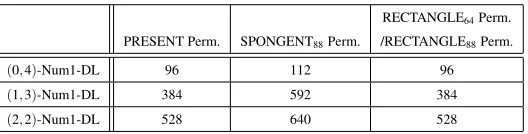
for the differential case. For schemes using the RECTANGLE or RECTANGLE88 permutation, we extend the idea of Algorithm 2 in [32] to perform the filtering, which uses the fact that thei-th (i= 0,1,2,3) bit of an S-box output will be thei-th bit of an S-box input in the next round, hence the number of remaining S-boxes only depends on properties of the S-boxes and not on the block length. Table 9 presents our experimental results of the number of remaining S-boxes for the 12 combinations.
In [28], 4 PE classes are specified as “golden” S-boxes. For each of the 4 PE classes,CarD1S=0 and CarL1S=8, thus none of the golden S-boxes belong to the 3 platinum Num1-DL categories. Fix the
RECT-ANGLE permutation, when combining with these golden S-boxes, we get 2304 SP-network schemes. For each of the 2304 schemes, there exists a linear trail with only one active S-box in each round. Thus, together with Result 3, we get that all of the golden S-boxes are not good choices for PRESENT, RECTANGLE and SPONGENT.
6.2 Search Algorithm for the Best Differential/Linear Trail
Matsui proposed a branch-and-bound search algorithm [24] for determining the best differential/linear trail of DES-like cryptosystems in 1994. From the results in [3], it can be deduced that, the weaker the diffusion layer of a cipher, the more effective the search algorithm. The diffusion layers of DES, PRESENT, RECTANGLE and SPONGENT are all bit permutations. Hence, Matsui’s work on DES motivates us to adopt the heuristic measure on PRESENT, RECTANGLE and SPONGENT.
Ohta et al. [27] improved Matsui’s search algorithm by introducing the concept of search pattern to reduce unnecessary search candidates before the search, and applied their improved algorithm on DES and FEAL. Later, Aoki et al. [3] further improved Ohta’s search algorithm by discarding more unnecessary search patterns, and applied their algorithm on FEAL. Based on these 3 previous work, we have written a program for the search of the best differential/linear trails for PRESENT, RECTANGLE and the internal permutation of SPONGENT respectively.
Algorithm 2 presents main steps of our programs for search of the best differential trail, which can be modified accordingly for search of the best linear trail. A search pattern for ther-round best differential trail is a set ofrvalues, each value is a differential probability for each round.Bestndenote the probability of the
bestn-round differential trail, andBestnthe temporary value ofBestnduring the search. The search algorithm
requires thatBestn≥Bestn.
6.3 Experimental Results
In the following, we present our experimental results by running Algorithm 2. The experiments have been performed using 4 computers: 3 with Intel Core i7 (or i5) CPU, and 1 with Intel Xeon E7-2820 (16 cores) CPU. It took us about 4 weeks to do all the experiments.
For each combination, letNdenote the number of the remaining S-boxes (see Table 9), the permutation layer is fixed, thus we haveNSP-network schemes. Among theNschemes, generally speaking, the smaller the value ofrmin, the better the scheme against DC and LC. Here are some notations:
Algorithm 2
Goal:Search for the bestn-round differential, 1≤n≤N.
Initialization phase:Set the initial values ofBestn, 1≤n≤N.
Procedure(n)(1≤n≤N){
1. Pattern Generation phase: Generate all of then-round search patterns with various probabilities. Firstly, for each search pattern(p1,p2,···,pn), if
there exist 1≤i≤nand 0≤r≤n−1 such thati+r−1≤nandpi×pi+1···×pi+r−1>Bestr, then discard the search pattern. Next, use the previous
i-round search patterns (1≤i<n) to further discard the non-existentn-round search patterns. 2. Search phase:
For the current value ofBestn, do{
(a) For each remaining candidate for the search pattern(p1,p2,···,pn)withp1×p2× ··· ×pn=Bestn, try all the possible differential trails. If
there exist a differential trail satisfying this pattern, then i. Bestn=Bestn;
ii. ifn<N, call Procedure(n+1); iii. ifn=N, return.
(b) Bestn=2−1×Bestn }
}
– NumRm: the number of schemes that the correspondingrminreach the minimum valueRm
– num: the number of schemes with the valuesProbRm andCor
2
Rm in the same row
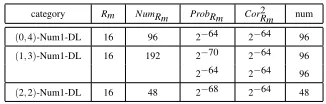
Tables 10-13 summarize our experimental results for each fixed permutation. The result in Table 11 is in accordance with that in [32]. From Table 10-13, we get the following results:
1. With the PRESENT permutation layer, the values ofRmare the same for the 3 combinations. There are
336 S-boxes (up to adding constants before and after an S-box, similarly hereinafter) such that the value ofrminreach the minimumRm=16.
2. With the RECTANGLE permutation layer, the (1,3)- and (2,2)-Num1-DL categories are better. There are 128 S-boxes such that the value ofrminreach the minimumRm=15. Note that RECTANGLE uses one
of these 128 S-boxes.
3. With the SPONGENT88permutation layer, the (1,3)- and (2,2)-Num1-DL categories are better. For the (1,3)-Num1-DL category,Rm=19; for the (2,2)-Num1-DL category,Rm≤19.
4. With the RECTANGLE88permutation layer, the (2,2)-Num1-DL category is the best. There is only one S-box such that the value ofrminreach the minimumRm=17.
In Table 12, for the two combinations marked with “*”, we have not finished the experiments for all of the corresponding S-boxes. However, we derived the value ofRmfor one combination and a good estimate ofRm
for the other, which are enough for us to derive the above results. The 3 main reasons are as follows. Firstly, the search programs for schemes using the RECTANGLE88permutation run much faster than those using the SPONGENT88permutation layer, due to the rotation equivalence of the RECTANGLE88 permutation (every trail has 22 rotation-equivalent variants). However, there is no such symmetry for the SPONGENT88 permutation layer. Secondly, it is a trial-and-error process to derive the value ofRmfor each combination,
thus the experiments may need to be performed several times for different number of rounds. Thirdly, the number of remaining S-boxes is big for the 2 combinations, i.e., 592 and 640 respectively.
Table 10.Experimental Results With the PRESENT Permutation
category Rm NumRm ProbRm Cor2Rm num
Table 11.Experimental Results With the RECTANGLE Permutation
category Rm NumRm ProbRm Cor2Rm num
(0,4)-Num1-DL 16 16 2−64 2−80 16 (1,3)-Num1-DL 15 64 2−74 2−66 16 2−71 2−66 16 2−65 2−66 16 2−65 2−64 16 (2,2)-Num1-DL 15 64 2−73 2−64 8 2−72 2−64 8 2−69 2−64 16 2−67 2−66 8 2−66 2−74 4 2−66 2−72 8 2−66 2−70 4 2−66 2−66 8
Table 12.Experimental Results With the SPONGENT88Permutation Layer
category Rm NumRm ProbRm Cor2Rm num
(0,4)-Num1-DL 21 8 2−118 2−88 4 2−117 2−88 4 (1,3)-Num1-DL* 19 ? ≤2−91 2−90 ? (2,2)-Num1-DL* ≤19 ? ≤2−88 2−90 ?
Table 13.Experimental Results With the RECTANGLE88Permutation
category Rm NumRm ProbRm Cor2
Rm num
(0,4)-Num1-DL 22 96 2−88 2−118 84 2−88 2−116 8 2−88 2−114 4 (1,3)-Num1-DL 18 56 2−93 2−92 8 2−93 2−88 10 2−92 2−88 2 2−91 2−92 4 2−91 2−90 2 2−90 2−88 2 2−88 2−92 8 2−88 2−90 6 2−88 2−88 14 (2,2)-Num1-DL 17 1 2−88 2−88 1
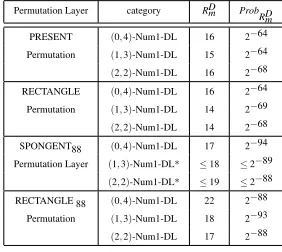
Table 14.Results for the 12 Combinations when only Considering DC
Permutation Layer category RDm ProbRD m
PRESENT (0,4)-Num1-DL 16 2−64 Permutation (1,3)-Num1-DL 15 2−64 (2,2)-Num1-DL 16 2−68 RECTANGLE (0,4)-Num1-DL 16 2−64 Permutation (1,3)-Num1-DL 14 2−69 (2,2)-Num1-DL 14 2−68 SPONGENT88 (0,4)-Num1-DL 17 2−94 Permutation Layer (1,3)-Num1-DL* ≤18 ≤2−89
(2,2)-Num1-DL* ≤19 ≤2−88 RECTANGLE 88 (0,4)-Num1-DL 22 2−88
Permutation (1,3)-Num1-DL 18 2−93 (2,2)-Num1-DL 17 2−88
6.4 For Hash Functions - When DC is More Important than LC
Table 15.4 Potentially Better S-boxes for SPONGENT88
0, 6, 12, 1, 5, 9, 11, 14, 3, 13, 15, 8, 10, 7, 4, 2 0, 6, 5, 8, 10, 13, 15, 1, 12, 9, 11, 7, 3, 14, 4, 2 0, 3, 5, 12, 10, 13, 15, 2, 6, 9, 11, 7, 1, 14, 8, 4 0, 12, 10, 5, 3, 15, 13, 2, 6, 11, 9, 14, 8, 1, 7, 4
pseudo-random, which includes the requirement that there is no effective linear distinguisher. Therefore, we decide to consider the following question: For each of the 12 combinations, when only considering DC for the remaining S-boxes obtained in Section 6.1 (see Table 9), what results can we get? At first thought, the (0,4)-Num1-DL category should be the best choice, however, we will show that it is not always the case.
For each scheme, definerDmin=minr{Probr≤2−b}. For each combination, letRDm denote the minimal
value ofrDminamong theNschemes. Table 14 summarizes our experimental results, and we get the following results:
1. With the PRESENT permutation, the (1,3)-Num1-DL category is the best. The minimal value ofrDminis RDm=15.
2. With the RECTANGLE permutation, the (1,3)- and (2,2)-Num1-DL categories are better. The minimal value ofrD
minisRDm=14.
3. With the SPONGENT88 permutation layer. Note that we have not exhausted all the S-box candidates in the (1,3)- and (2,2)-Num1-DL categories. From the known results, it seems that the (0,4)-Num1-DL category is the best and the minimal value ofrDminisRDm=17.
4. With the RECTANGLE88permutation, the (2,2)-Num1-DL category is the best. The minimal value of
rminD isRDm=17.
Potentially Better S-boxes for SPONGENT88 For SPONGENT88, there exists a 17-round differential trail
with probability 2−86[4], which is better than the 17-round differential trail of SPONGENT88given by its designers in [9, Table 4]. Moreover, there exists a 22-round linear trail with correlation potential 2−84for SPONGENT88(only one active S-box in each of the 22 rounds).
With the permutation layer of SPONGENT88, we found 4 S-boxes in the (0,4)-Num1-DL category such that the probability of the best 17-round differential trail is 2−94 and the correlation potential of the best 21-round linear trail is 2−88for each of the 4 schemes. It can be seen that the 4 S-boxes are potentially better than the SPONGENT88S-box with respect to the security against both DC and LC. The 4 S-boxes are listed in Table 15, which can be used for further investigation.
6.5 A New Design Criterion
For SP-network schemes with the SPONGENT88 permutation layer, when considering both DC and LC, based on the results in Section 5 and Table 12, it can be deduced that an S-box withCarD1S=0 is not an
optimal choice, while(1,3)- and (2,2)- Num1-DL categories are better choices. On the other hand, when considering DC more important than LC, it seems that(0,4)-Num1-DL category is the best choice. For SP-network schemes with RECTANGLE-like permutations, based on the results in Tables 10-14, it seems that the(2,2)-Num1-DL category is always an optimal choice. We have the following design criterion.
Design Criterion 2 For block ciphers (or hash functions) using4×4S-boxes as confusion layers and bit
7
Summary and Discussion
We presented a new classification of all the 4-bit optimal S-boxes according to the values ofCarD1Sand CarL1S. All the optimal 4-bit S-boxes can be classified into 183 different Num1-DL categories, among
which we specify 3 platinum Num1-DL categories with the minimal value ofCarD1S+CarL1S=4. Under
the design criteria of the PRESENT (or SPONGENT) S-box, we showed that the value ofCarL1Shas a huge
influence on the security of PRESENT and SPONGENT with respect to the security against LC, and we pre-sented further design criteria of 4-bit S-boxes for SP-network schemes with the PRESENT (or SPONGENT) permutation layer. We studied in detail how the S-boxes in the 3 platinum Num-1 DL categories influence the security of PRESENT, RECTANGLE and SPONGENT against DC and LC. Our results showed that, for block ciphers or hash functions with 4-bit S-boxes as confusion layer and bit permutations as diffusion layers, designers can extend the range of S-box selection to the 3 platinum Num1-DL categories and select the S-box carefully.
Based on our experimental results, there are 336 potentially best S-boxes for PRESENT, 128 potentially best S-boxes for RECTANGLE, and 4 potentially better S-boxes for SPONGENT88. To judge if a potentially best (better) S-box is a real best (better) S-box, it needs to investigate the clustering of differential/linear trails. In this respect, the approach used in [1] is of interest, we leave it for further study. The NOEKEON S-box belongs to the(7,6)-Num1-DL category. Serpent uses 8 S-boxes, among them, 3 S-boxes belong to the (0,6)-Num1-DL category, and the other 5 S-boxes belong to the (0,8)-Num1-DL category. It is also interesting to investigate the influence of the 3 platinum Num1-DL categories on the security of NOEKEON and Serpent against DC and LC.
Acknowledgments
We would like to thank anonymous referees for their helpful comments of SAC’2014 and FSE’2015. We also thank Andrey Bogdanov for his helpful discussions which help us to improve the quality of this paper. The main work in this paper was performed while Wentao Zhang was a visitor at KU Leuven. The research presented in this paper is supported by the National Natural Science Foundation of China (No.61379138), the Research Fund KU Leuven (OT/13/071), and the “Strategic Priority Research Program” of the Chinese Academy of Sciences (No.XDA06010701).
References
1. Abdelraheem, M.A.: Estimating the Probabilities of Low-Weight Differential and Linear Approximations on PRESENT-Like Ciphers. In: Kwon T., Lee M.-K., and Kwon D. (eds.): ICISC 2012, LNCS, vol. 7839, pp. 368– 382, Springer, Heidelberg (2013)
2. Anderson, R., Biham, E., Knudsen, L.R.: Serpent: A Proposal for the Advanced Encryption Standard. NIST AES proposal (1998)
3. Aoki, K., Kobayashi, K., Moriai, S.: Best Differential Characteristic Search of FEAL. In: Biham, E. (ed.) Fast Software Encryption, LNCS, vol. 1267, pp. 41–53. Springer, Heidelberg (1997)
4. Bao, Z., Zhang, W., Lin, D.: Speeding up the Search Algorithm for the Best Differential and Best Linear Trails, to appear in Inscrypt’2014.
5. Biham, E., Shamir, A.: Differential Cryptanalysis of DES-like Cryptosystems. Journal of Cryptology 4(1), 3–72 (1991)
6. Blondeau, C., Gerard, B.: Multiple Differential Cryptanalysis: Theory and Practice. In: Joux, A. (ed.) FSE 2011. LNCS, vol. 6733, pp. 35–54. Springer, Heidelberg (2011)
![Table 1. ([22]) Representatives for All 16 Affine Equivalence Classes of Optimal 4×4 S-boxes](https://thumb-us.123doks.com/thumbv2/123dok_us/7936538.1317658/4.612.243.370.510.663/table-representatives-afne-equivalence-classes-optimal-s-boxes.webp)