Available Online at www.ijcsmc.com
International Journal of Computer Science and Mobile Computing
A Monthly Journal of Computer Science and Information Technology
ISSN 2320–088X
IJCSMC, Vol. 3, Issue. 3, March 2014, pg.351 – 358
RESEARCH ARTICLE
REAL-TIME COMPRESSION STRATEGY
ON VARIOUS POINT CLOUD STREAMS
Miss R.SARANYA*1
M.Tech Student
Department of Computer Science and Engineering PRIST University Pondicherry, India.
DR.S.THIRUNIRAI SENTHIL*2
Head of the Department
Department of computer science and engineering PRIST University Pondicherry, India.
ABSTRACT
The Lossy based compression technique is used to compress the 3d image. These techniques exploit the spatial and temporal
redundancy within the point data. To design an effective compression algorithm for point cloud computation by increasing its
efficiency and space vector. so we perform a spatial decomposition based on octree data structures. By encoding their
structural differences, we can successively extend the point clouds at the decoder. Another approach reduces coding
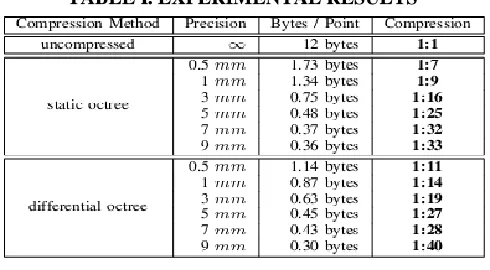
complexity and coding precision. Our experimental results show a strong compression performance of a ratio of 14 at 1 mm
coordinate precision and up to 40 at a coordinate precision of 9 mm.
KEYWORDS: Point Cloud, Coordinate Precision, Spatial Decomposition
I. INTRODUCTION
A. Octree Based Point Cloud Compression
An octree is a tree-based data structure for organizing sparse 3-D data. We will learn how to use the octree implementation for detecting spatial changes between multiple unorganized point clouds which could vary in size, resolution, density and point ordering. By recursively comparing the tree structures of octree, spatial changes represented by differences in vowel configuration can be identified.
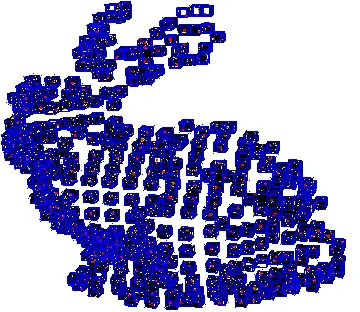
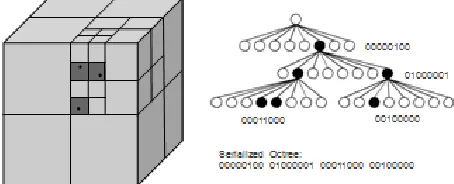
An octree is a tree data structure suitable for sparse 3D data, where every branch node represents a certain cube or cuboids bounding volume in space. Starting at the root, every branch has up to eight children, one for each sub-octant of the node bounding box. An example is shown in Fig. 1 and in the left half of Fig. 2 . Common implementations create an object in memory for each node, holding 8 pointers to other nodes. If a child node does not exist, it is represented by a NULL pointer.
Figure 1. Sample octree for the Stanford bunny data set
The depth of the octree is limited either directly or by specifying a target leaf box size. When constructing the octree, every point is added iteratively by traversing the tree in depth first order starting at the root, and determining the correct child octant in every branch, creating new children as necessary until the point can be appended to the list of points stored in each leaf node. If only the leaf node occupancy is of interest, each leaf node contains a single Boolean variable.
The bit positions specify the vowel/child in the octree they occupy. The right hand side of Fig.2 illustrates this byte stream representation for the octree in the left half. Note that this stream encodes the whole octree structure, and the size of this stream is n bytes, where n is the number of branch nodes. To fully reconstruct the point cloud, however, some additional parameters such as the root bounding volume and the octree depth need to be encoded.
The octree implementation provides efficient nearest neighbor search routines, such as "Neighbors within Voxel Search", "K Nearest Neighbor Search" and "Neighbors within Radius Search". It automatically adjusts its dimension to the point data set. A set of leaf node classes provide additional functionality, such as special "occupancy" and "point density per vowel" checks. Functions for serialization and deserialization enable to efficiently encode the octree structure into a binary format. Furthermore, a memory pool implementation reduces expensive memory allocation and deallocation operations in scenarios where octree needs to be created at high rate.
B. Temporal Compression
The output byte stream of the octree serialization is already a compact description of the spatial point distribution. Due to the lack of direct correspondences between points of different point clouds in the stream, the detection of changes within the point distribution is challenging. To this end, we propose a novel double-buffering octree scheme which extends our octree capabilities and enables comparison and differential coding of consecutive octree data structures.
Figure 2. Illustration of the differential encoding technique of consecutive octree data structures
output stream. Implementation
Each uncompressed point is described with 3 float values for x, y, z, for a total of 12 bytes per point (bpp). The symbol frequencies of the range coder are encoded with 4 byte integer resolution. . In our experiments, we use a single threaded implementation of the proposed compression technique running on a standard consumer PC.
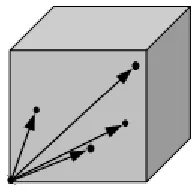
Figure 3. Illustration of Point Details Encoding
The principle of point detail coding can be applied to different kinds of point component information that is assigned to each point, e.g. color, normal’s, etc. Instead of referencing the vowels origin coordinate, we compute and transmit the average color and perform an encoding of the color differences analogously to the Cartesian point detail differences. For other information, e.g. surface normal vectors, different approaches have been shown to perform well, e.g., converting the normal’s from Cartesian space to polar space first. Assuming similar component information of neighboring points, the differentially encoded point components are characterized by reduced entropy which is exploited during subsequent entropy coding. Since point clouds can be enriched with arbitrary additional dimensions that can exhibit largely varying properties, it makes sense to analyze and fine tune these encoding details as needed instead of relying on one generic approach.
II. COMPRESSION ARCHITECTURE
Since their respective symbol frequencies are possibly different, these streams are consumed by the entropy encoder separately and multiplexed into a joint output data stream, which constitutes the compressed point cloud data to be written to e.g. a network stream or file. Note that for speed considerations, we use an integer-arithmetic variant of an arithmetic coder for entropy coding, a so called range coder. Prior to every entropy encoded bit stream, corresponding symbol frequency tables are additionally en- coded.
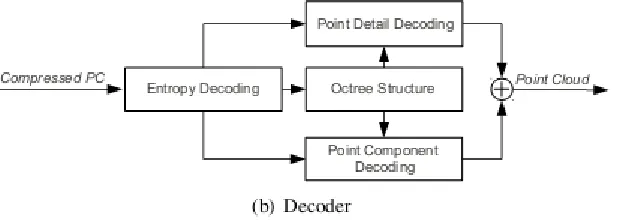
Figure 4. Schematic Overview of the Encoding and Decoding Architecture
The decoder (illustrated in Fig. 4(b)) performs demultiplexing followed by entropy decoding of the individual data streams. The serialized binary octree description is fed to the respective deserialization routines used to decode and reconstruct a coherent double buffered octree structure. Whenever leaf vowels are constructed during the deserialization process, their absolute position is fed to the point detail decoding and point component decoding routine. This enables us to recover the original point set of the encoded point cloud together with its respective point component information.
III. PERFORMANCE ANALYSIS OF POINT DETAIL CODING
Figure 5. Comparison of the compression performance using static octree and the differential double-buffering octress, both without point detail encoding
With reduced compression precision, the compression ratio further increases and reaches a rate of about 0.5 bpp at 5 mm and of about 0.3 bpp at 9 mm. interestingly; the difference in performance between the static and the differential octree compression approach also decreases with reduced coding precision.
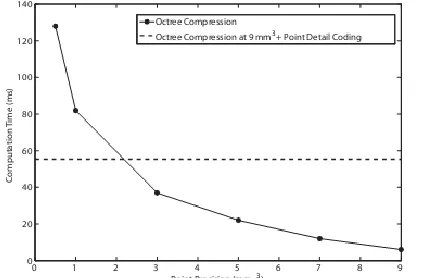
We further analyzed the compression performance when encoding additional point detail information (see Fig.12). In this experiment, we fixed the octree vowel resolution to 9 mm and used point detail encoding to achieve the different target resolutions.
Figure 6. Computation time of differential octree coding per frame (point cloud) as a function of point precision is shown by the solid line. The computation time of differential octree coding at a fixed point precision of 9mmcombined with point detail coding is visualized by the dotted line
using the point detail coding approach. As can be seen in Figures 5 and 6 (b), for our test system, the gain in compression performance by using differential octree encoding are roughly canceled out when applying the point detail coding scheme, at the advantage of reaching constant computation times per frame.
The obtained results are to be understood as being qualitative, as they depend on the run-time behavior of the implementation that may vary between parameterization and different hardware setups (core processor, cache sizes, bus, memory, etc.). Note that additional performance could be also achieved by parallelizing the proposed approach. For instance, the compressed frame rate can be doubled
Figure 7. Compression performance of differential octree coding at different point precision levels is shown in black. The overhead in compression performance of differential octree coding at a fixed point precision of 9mm combined with point detail coding is shown in gray.
Relatively easily by creating two compression instances, one for even and one for odd frame numbers. This way, every frame is encoded relative to the second-to-last frame. Both streams can then be processed in parallel, as they are completely independent of each other, and the point differences will likely be only slightly bigger than differences between directly adjacent frames. Alternatively, one could prepartition the point space into subareas, rendering our approach suitable for e.g. multi- core architectures.
TABLE I. EXPERIMENTAL RESULTS
IV. CONCLUSION
models,‖ in Proceedings of the Euro graphics Symposium on Point-based Graphics, Zurich,Switzer- land, 2004, pp. 95–102. [4] B.Merry, P.Marais,and J.Gain,―Compression of dense and regular point clouds, ―Computer Graphics, vol. 25, no. 4, pp. 709– 716, 2006
[5] J.Zhang and C. Owen, ―Octree-based animated geometry compression, ―in Proceedings of the Data Compression Conference, Snowbird, UT, USA, 2004, pp. 508–517.
[6] J.Zhang and C.Owen,―Octree-based animated geometry compression, ―in Proceedings of the Data Compression Conference, Snowbird, UT,USA, 2004, pp. 508–517.
[7] G.Nigel and N.Martin, ―Range encoder range encoding: An algorithm for removing redundancy from a digitized message,‖ in Proceedings of the Video & Data Recording Conference, Southampton, UK, July 1979,p. 2427.
[8] R.Rusu, Z.Marton, N.Blodow, M.Dolha, and M.Beetz,―Towards 3d point cloud based object maps for household environments,‖ Robotics an Autonomous Systems, vol. 56, no. 11, pp. 927–941, 2008.
[9] J.Lengyel,―Compression of time-dependent geometry, in Proceedings of the 1999 Symposium on Interactive 3D Graphics, Atlanta, GA, USA,1999, pp. 89–95.
[10] S.Fleishman,D.Cohen-Or,M.Alexa, and C.Silva,―Progressive point set surfaces,ACM Transactions on Graphics (TOG), vol. 22, no. 4, pp.997–1011, 2003.
AUTHORS PROFILE
Miss R.SARANYA, Presently Pursuing Final Year M.TECH CSE, In PRIST University, Puducherry Campus,
Puducherry, India
Dr.S.THIRUNIRAI SENTHIL,M.C.A,M.Phil.,Ph.D., Sri Vinayaka Mission University Salem, in
2010, Presently he is a Working Professor, Head Of Department in Computer Science and Engineering at PRIST