© 2016, IJCSMC All Rights Reserved 152
Available Online atwww.ijcsmc.com
International Journal of Computer Science and Mobile Computing
A Monthly Journal of Computer Science and Information Technology
ISSN 2320–088X
IMPACT FACTOR: 5.258
IJCSMC, Vol. 5, Issue. 4, April 2016, pg.152 – 158
A X-Or Base Image Encryption And Data
Security Through Higher LSB Data
Hiding Approach
Anuja R. Yeole
1, Prof. Mahip M. Bartere
21
Master of Engineering Scholar, Computer Science & Engg., Department G. H. Raisoni College of Engg and Management, Amravati, India
2
Guide, Computer Science & Engg., Department
G. H. Raisoni College of Engg and Management, Amravati, India 1
[email protected]; 2 [email protected]
Abstract: This project proposes double layer encryption and double layer hiding which is supposed to give security to the secret images and the secret data. The project speaks of usage of X- or base visual cryptography and higher LSB data hiding method. Visual cryptography (VC) is a technique that focuses on keeping the content of message secret and not seen by human eye directly. The original motivation of visual cryptography is to secured share secret images in which has no computer formed in this form; however, devices with computational powers are present everywhere (e.g., smart phones). We propose to provide double security and less complexity compared to existing system.
Keywords: visual cryptography, X-or base cryptography, higher LSB data hiding method, image security.
I. INTRODUCTION
The visual cryptography (VC) is a technique where secret images must be encrypted into no. of shares, with each recipient holding one or more shares. Anyone who holds fewer than number of shares they don’t read the information which is visible and these are the secret images. Stacking the n shares opens to the human to read the image and he will see by his eyes directly. Secret images are of many types which are images, hand printed documents, photographs, and many others. Sharing and delivering secret images is also known as a visual secret sharing (VSS) scheme.
© 2016, IJCSMC All Rights Reserved 153
II. LITERATURE SURVEY
In 1995: Moni Naor and Adi Shamir propsed a visual cryptography in that consider a new type of cryptographic scheme which can decode concealed images without any cryptographic calculation. This scheme is secure and easy to implement but there is a conventional share are not friendly.
In 2001: Giuseppe Atenies,Carlo Blundob, Alfredo De Santisb, Douglas R. proposed a extended capabilities of visual cryptography to share the secret information but these shares are meaningful shares but this have poor display quality.
In 2004: Jessica Fridrich, Miroslav Goljan, David Soukal proposed a Perturbed Quantization Steganography with Wet Paper Codes they produce a new approach to passive warden steganography. But there is a less security for the perturbed steganography
In 2006: Zhi Zhou, Gonzalo R. Arce, Fellow and Giovanni Di Crescenzo propsed a halftone visual cryptography this paper proposed to achieve visual cryptography via halftoning. This method used in a number of visual secret sharing applications which require high quality visual images such as watermarking, electronic cash. But it has side effects on pixel expansion.
In 2007: Ching-nung Yang And Tse-shih Chen proposed a Extended Visual Secret Sharing Schemes: Improving The Shadow Image Quality in this paper they present a new EVSS scheme by using gray and white subpixel to represent a secret pixel and then gives a clearer shadow images. But it displays low quality images.
In 2011: Feng Liu and Chuan Kun Wu proposed a Embedded extended visual cryptography scheme this paper propose a construction of EVCS which is realized by embedding random shares into a meaningful covering shares and we call it embedded extended visual cryptography. This embedded EVCS has competitive visual quality and it improves a visual quality of the shares. But it has poor display quality of the recovered images.
In 2011: InKoo Kang, Gonzalo R. Arce, Heung-Kyu Lee proposed a color extended visual cryptography using error diffusion. This paper introduces a color visual cryptography encryption method that produces a meaningful color shares via visual information pixel. It is used for color images. But it has poor display quality of the recovered images.
© 2016, IJCSMC All Rights Reserved 154
In 2012: Kai-hui lee, pei-ling chiu proposed an extended visual cryptography algorithm for general access structure. This problem solves a existing EVCS scheme. This approach can be used for binary secret images in non-computer aided environment. It is used for modifying the display quality of the cover images. But it reduces the display quality of the recovered images.
In 2012: Cheng Guo, Chin-Chen Chang, Chuan Qin proposed a Multi-threshold Secret Image Sharing Scheme Based on MSP. In this paper multiple secret images can be shared among a group of participants and each secret image is associated with access structure. It can achieve both the high visual quality of the shadow images and high embedding capacity. But these images detected by steganography.
In 2012: Chun-Yuan Hsiao, Hao-Ji Wang proposed a Enhancing Image Quality in Visual Cryptography with Colors. In this paper they use the color model of ateniese et al. to improve the image quality of the reconstructed image of Chiu’s image secret sharing scheme. The intuition behind is that a color pixel can be used either as a white or black one, thus solving the problem that the share images do not produce (when stacked) enough black pixels for the reconstructed image in. The technical difficulty of this work is how and where to inject the color pixels so that both the shares and the reconstructed images have high quality.
In 2014: Kai-Hui Lee and Pei-Ling Chiu proposed a Digital Image Sharing by Diverse Image Media. This paper proposes possible ways to hide the noise- like share to reduce the transmission risk problem for the share. This is the first attempt to share images via heterogeneous carriers in VSS scheme. But it has less security and single layer hiding.
In 2015: Sheetal A. Kulkarni and Shubhangi B. Patil proposed a A Robust Encryption Method for Speech Data Hiding in Digital Images for Optimized Security. In this paper the encryption algorithm applied with embedding method is the robust secure method for data hiding.
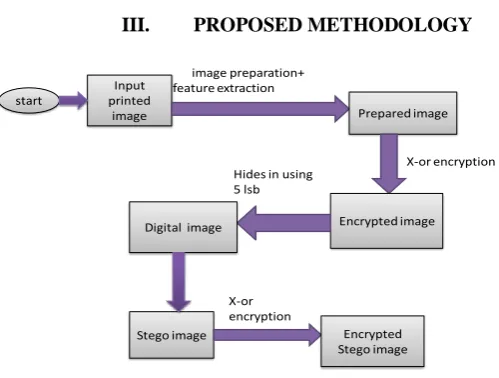
III. PROPOSED METHODOLOGY
Input printed
image Prepared image
Encrypted image Digital image
Stego image Encrypted
Stego image image preparation+
feature extraction
X-or encryption Hides in using
5 lsb
X-or encryption start
© 2016, IJCSMC All Rights Reserved 155 A. Steps for above process
Step1: start
Step2: input an image
Step3: image preparation on input image means unwanted data will be avoided and feature extraction on image
Step4: then get prepared image and in prepared image there is a secret data Step5: then encrypt the prepared image
Step6: we get encrypted image and in encrypted image there is a secret data Step7: so encrypted image and secret data will be hides in carrier image Step8: hence we get new stego image
Step9: again we encrypt the stego image hence we get new encrypted image and in encrypted image there is a secret data.
Encrypted
stego image Stego image
Prepared image
stop
X-or decryption
X-or decryption
Extract secret image
Extract secret data
image start
Fig3.2 Double Layer Extraction Process
B. Steps for above figure
Step1: input an encrypted image
Step2: decrypt the image
© 2016, IJCSMC All Rights Reserved 156 Step4: extract encrypted image from stego image
Step5: decrypt encrypted image
Step6: hence we get prepared image
Step7: extract secret data from prepared image
Step8: stop
Input image
Create RGB
share
Green share
Red share Blue share
X-or encrypt R share
X-or encrypt G share
X-or encrypt B share
Encrypted R
share Encrypted G share Encrypted B share
Final
encrypted
RGB image
X-or key
Fig3.3 X-or base encryption process
C. Steps for above process
Step 1: An input image will be selected. It must be RGB Image.
Step 2: Red, Green and blue channels are distributed from the input image.
Step 3: Encrypt each channel using XOR based encryption method using 8 bit random key generated using X-OR key
Step 4: Combine all Red, green and Blue channels to create final encrypted RGB image.
© 2016, IJCSMC All Rights Reserved 157
Input encrypted
image
Create RGB
share
Green share
Red share Blue share
X-or decrypt R share
X-or decrypt G share
X-or decrypt B share
decrypted R
share decrypted G share decrypted B share
Final
decrypted
RGB image
X-or key
Fig3.4. X-or based decryption process
D. Steps for above process
Step 1: Select an encrypted image.
Step 2: Separate Red, Green and Blue channels from an encrypted Image.
Step 3: Decrypt Red, Green and Blue using XOR based decryption method with random key generated using X-OR key which is used for encryption.
Step 4: combine all decrypted image shares to create final resultant decrypted image.
Step 5: End.
E. Steps for data hiding process
step1: given encrypted image it consist of pixels
step2: pixel consist of RGB channel
Step3: suppose R is 8bit, G is 8bit and B is 8bit
Step4: divide the 8 bit of every RGB channel into groups of (3, 5)
© 2016, IJCSMC All Rights Reserved 158 Step6: then secret data converted to binary form
step7: then we sample the binary data to 5 groups
Step8: then we replace 5groups of binary data to our given RGB
Step9: hence we get new RGB values
Step10: from this new RGB values we make pixel
Step11: hence we get hided data.
References
[1] M. Naor and A. Shamir, “Visual cryptography,” in Advances in Cryptology, vol. 950. New York, NY, USA: Springer-Verlag, 1995, pp. 1–12.
[2] G. Ateniese, C. Blundo, A. D. Santis, and D. R. Stinson, “Extended capabilities for visual cryptography,” Theoretical Comput. Sci., vol. 250, nos. 1–2, pp. 143–161, Jan. 2001.
[3] J. Fridrich, M. Goljan, and D. Soukal, “Perturbed quantization steganography with wet paper codes,” in Proc. Workshop Multimedia Sec.,Magdeburg, Germany, Sep. 2004, pp. 4–15.
[4] Z. Zhou, G. R. Arce, and G. D. Crescenzo, “Halftone visual cryptography,” IEEE Trans. Image Process., vol. 15, no. 8, pp. 2441–2453,Aug. 2006. [5] C. N. Yang and T. S. Chen, “Extended visual secret sharing schemes: Improving the shadow image quality,” Int. J. Pattern Recognit. Artif. Intell., vol. 21, no. 5, pp. 879–898, Aug. 2007.
[6] F. Liu and C. Wu, “Embedded extended visual cryptography schemes,” IEEE Trans. Inf. Forensics Security, vol. 6, no. 2, pp. 307–322, Jun. 2011.
[7] I. Kang, G. R. Arce, and H. K. Lee, “Color extended visual cryptography error diffusion,” IEEE Trans. Image Process., vol. 20, no. 1,pp. 132–145, Jan. 2011.
[8] C. Guo, C. C. Chang, and C. Qin, “A multi-threshold secret image sharing scheme based on MSP,” Pattern Recognit. Lett., vol. 33, no. 12, pp. 1594–1600, Sep. 2012.
[9] Chun-Yuan Hsiao, Hao-Ji Wang, “Enhancing Image Quality in Visual Cryptography with Colors,” 2012 IEEE, International Conference on Information Security and Intelligence Control (ISIC), Page(s): 103 – 106, 2012.
[10] X. Wu, D. Ou, Q. Liang, and W. Sun, “A user-friendly secret image sharing scheme with reversible steganography based on cellular automata,” J. Syst. Softw., vol. 85, no. 8, pp. 1852–1863, Aug. 2012.11.
[11] K. H. Lee and P. L. Chiu, “An extended visual cryptography algorithm for general access structures,” IEEE Trans. Inf. Forensics Security, vol. 7, no1, pp. 219–229, Feb. 2012.
[12] Kai-Hui Lee and Pei-Ling Chiu, “Digital Image Sharing by Diverse Image Media,” IEEE Transactions on Information Forensics and Security, Vol. 9, No. 1, January 2014.