Available Online atwww.ijcsmc.com
International Journal of Computer Science and Mobile Computing
A Monthly Journal of Computer Science and Information Technology
ISSN 2320–088X
IMPACT FACTOR: 5.258
IJCSMC, Vol. 5, Issue. 4, April 2016, pg.486 – 490
PIR Based Blind Walking Stick
Ms. Ragini Singh
*1,
Arjun Succena
#2, Neha Singh
#3*
Assistant Professor, Department of Instrumentation and Control Engineering
#
Department of Instrumentation and Control Engineering
Galgotias College of Engineering and Technology, Greater Noida, Uttar Pradesh, India – 201310 Email IDs - [email protected]*1,[email protected]#2, [email protected]#3
Abstract— This work tries to improve the quality of sticks which are being used by blind people. Proposed here is an advanced blind walking cane that allows visually challenged people to navigate with ease using advanced technology. It is an economical but better and improved version of blind walking stick with minimal development cost.
The project is divided into two modules, the sensor monitoring system and communication system.
Keywords— ―PIR Sensor‖, ―Moisture sensor‖, ―RF transceiver‖, ―microcontroller‖, ―ETA‖
I. INTRODUCTION
There is a new trend for Assistive Technologies which are digital or electronic in nature that can convey information about the environment in real time. Electronically aided white canes have been around for some time now. There has been a lot of research in this field since VLSI was introduced. This field is called Electronic Travel Aids (ETAs). From using ultrasonic sensors and infrared sensors to high spatial resolution beams, a lot of aids have been developed or are under development. New technologies utilizing the Internet of Things (IoT) have also been researched using a combination of Bluetooth, WiFi, and Android or iOS operating systems as platforms for interaction.
Rising popularity and utility of smartphones has allowed increasingly efficient and easy to use applications controlling ETAs to reach the hands of the common people. Even so, ETAs are a relatively new field of research and has a lot of scope for implementation of new technologies to make the lives of the physically handicapped safer and easier. With the advent of ULSI, embedded systems are getting smaller and packing more power, thereby making small electronics wearable and intelligent.
II. LITERATURE SURVEY
This section describes appropriate related works on the development of smart canes intended for visually-impaired people.
Technology can help in reducing many barriers that people with disabilities face. These kinds of technologies are referred to as Assistive Technologies (AT). There are many types of disabilities, including physical disabilities, hearing impaired, and visually-impaired. AT has been utilized in assisting them. However, developing an AT is expensive, making their selling price high.
A few of them are enumerated below-
"Project Prakash" is a project by Dr. Pawan Sinha, MIT, USA, which is a humanitarian mission to help the blind children by training them to utilize their brains to learn a set of objects around them [10].
Another system utilizes two sets of ultrasonic sensors to detect obstacles in front and below the stick. These sensors use Pulse Width Modulation to change the vibration pattern for differing range of obstacles [11]. A smart walking stick developed by researches in Coimbatore use various sensors for obstacles, pot holes, and moisture detection viz. Ultrasonic sensor, Pit sensor, and moisture sensors respectively. The stick fails to detect dynamic obstacles not directly in the range of the ultrasonic sensor [12][13].
III.PROPOSED SYSTEM
The proposed system aims to enable the visually challenged to navigate through a course of dynamic objects. The stick consists of the following sensors –
1. PIR SENSOR
A Passive Infrared Sensor (HC-SR501 Pyroelectric Infrared Module KG001) is an electronic sensor that measures the infrared light radiating from objects in its field of view. They are often referred to as “Pyroelectric” or “IR Motion” sensors. The PIR sensor, as the name suggests, works by identifying infrared radiation from objects in front of it.
A dynamic obstacle, for example – a human being, presents a heat signature. The PIR sensor detects this IR heat signature and responds by sending a signal to the connected Relay which then turns on the Vibrating Motor. The vibrating feedback informs the user about the presence of a dynamic obstacle in its path.
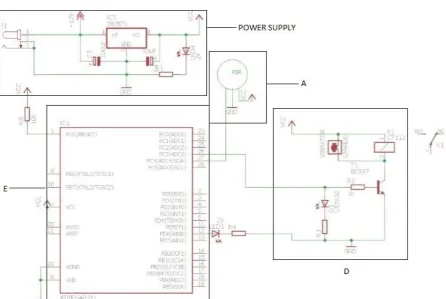
The IC BISS0001 converts the output of preceded sensor into digital form. PIR here works in retriggering state. Digital data from PIR goes to PC4 ADC pin of the microcontroller. It turns the PC3 pin, used as output pin, ON. Current from PC3 flows into LED D1 and the relay circuit. Relay is an electromechanical switch connected to the vibration motor. LED „D1‟ glows and along with the vibration motor which starts vibrating, indicating the presence of an obstruction in front of the user.
2. MOISTURE SENSOR
Fig 3 : Block diagram of the proposed system.
Fig 4 : Circuit Diagram of proposed system. The various sections have been marked corresponding to the block diagram.
3. RADIO FREQUENCY TRANCEIVER & VIBRATION MOTOR
When the stick is misplaced, it can be found using the wireless remote that activates the buzzer and hence helps in determining the location of the stick. The stick can be located within a radius of 15 meters.
A vibrating motor is a compact size, coreless, DC motor that is used to inform the user by vibrating, instead of sound. The system uses a bar-type vibrating motor that responds to signals produced by the microcontroller in response to the PIR sensor.
The proposed system has used an ATmega8 microcontroller that reads the output from the PIR sensor and in turn switches the relay that controls the Vibrating Motor. The system utilizes two ports – C and D for controlling the Motor and the PIR sensor.
IV.RESULTS AND FUTURE SCOPE
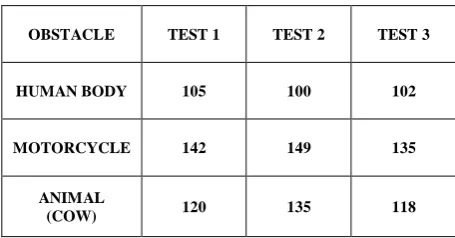
environment. The circuit that has been designed for the object detection has provided an accuracy of 1 meter. The detection range for various objects in cm are as listed in the below table:
OBSTACLE TEST 1 TEST 2 TEST 3
HUMAN BODY 105 100 102
MOTORCYCLE 142 149 135
ANIMAL
(COW) 120 135 118
Table 1 : Response of sensor for various objects (in cm).
The stick performed reasonably well under well lit conditions and during the day. The sensor reacted immediately to any form of motion. The moisture circuit performed impeccably and there was no error in its performance.
The device can be modified by adding ultrasonic sensors for the detection of static objects. But the issue of the user being able to differentiate the signals would remain. Another modification that can improve the device is the addition of a GPS module. A GPS module can provide the real time location of all static objects in an open environment that can be mapped via satellite. It can also be used along with a voice feedback that could tell the user about the objects in its path, using a combination of GPS and the internet. A voice in functionality could be used to input the destination into the stick and the stick would be able to chart the path to the destination from the source using the shortest path that has the least number of obstacles for the visually-impaired to follow.
V. CONCLUSIONS
The field of ETAs is still new and there is scope for a lot of research and improvement. The model using PIR Sensor is still a first of its kind and has a lot of scope for improvement. It holds many advantages over those utilizing infrared and laser mapping techniques and can be used to help many visually impaired people.
REFERENCES
[1] Mohd Helmy Abd Wahab, Amirul A. Talib, Herdawatie A.Kadir, Ayob Johari, A.Noraziah, Roslina M. Sidek, Ariffin A. “Smart cane: assistive cane for visually impaired people”, IJCSI, Vol.8 Issue 4, July 2011.
[2] Abhishek Choubey, Dattatray Patil, “RFID Based Cognition Device for Assistance to Blind and Visually Challenged Persons for Indoor Use”, International Journal of Engineering and Innovative Technology (IJEIT) Volume 1, Issue 6, June 2012.
[3] João José, Miguel Farrajota, João M.F. Rodrigues, J.M. Hans du Buf, “The Smart Vision Local Navigation Aid for Blind and Visually Impaired Persons” International Journal of Digital Content Technology and its Applications Vol.5 No.5, May 2011.
[4] Amit Kumar, Rusha Patra, M. Mahadevappa, J. Mukhopadhyay and A. K. Majumdar, A technical note on “An embedded system for aiding navigation of visually impaired persons”.
[5] Larisa Dunai, Guillermo Peris Fajarnes, Victor SantiagoPraderas, Beatriz Defez Garcia, Ismael Lengua Lengua “Real–Time Assistance Prototype – a new Navigation Aid for blind people” 978-1-4244-5226-2/10/$26.00 ©2010 IEEE.
[6] Jack M. Loomis, Reginald G. Golledge and Roberta L. Klatzky, “Navigation System for the Blind: Auditory Display Modes and Guidance” Vol. 7, No. 2, April 1998, 193–203.
[8] Sylvain Cardin, Daniel Thalmann and Frederic Vexo, “Wearable Obstacle Detection System for visually impaired People”.
[9] Rohit Sheth “Smart White Cane- an Elegant and Economic Walking Aid”, AJER, Vol. 3, Issue 10, 2014.
[10] “Project Prakash” – Dr. Pawan Sinha, MIT.
[11] Mohammad Hazzaz Mahmud, “Smart walking stick - an electronic approach to assist visually disabled persons”, IJSER, Vol. 4, Issue 10, October 2013
[12] G.Gayathri, “Smart Walking Stick for visually impaired”, IJECS, Vol. 3, Issue 3, March 2014.