Decryption
Mariya Georgieva1 and Fr´ed´eric de Portzamparc1,2,3,4 Gemalto, 6 rue de la Verrerie 92190, Meudon, France1
INRIA, Paris-Rocquencourt Center2,
UPMC Univ Paris 06, UMR 7606, LIP6, F-75005, Paris, France3 CNRS, UMR 7606, LIP6, F-75005, Paris, France4
[email protected],[email protected]
Abstract. We analyse the security regarding timing attacks of imple-mentations of the decryption in McEliece PKC with binary Goppa codes. First, we review and extend the existing attacks, both on the messages and on the keys. We show that, until now, no satisfactory countermea-sure could erase all the timing leakages in the Extended Euclidean Algo-rithm (EEA) step. Then, we describe a version of the EEA never used for McEliece so far. It uses a constant number of operations for given public parameters. In particular, the operation flow does not depend on the input of the decryption, and thus closes all previous timing attacks. We end up with what should become a central tool toward a secure implementation of McEliece decryption.
1
Introduction
Context of this work. Code-based cryptography relies on the hardness of de-coding, that is recovering m and e when given only c = mG+e and G(for m ∈Fkq,G∈Fqk×n and e∈ Fnq). Indeed, decoding was proved to be exponen-tially difficult in the Hamming weight ofewhen no structure is known onGin [2]. However, the error weight is critical for security for another reason: contrary to the public parameters of the code which are fixed at set by an external entity, the error may vary at each encryption, and may even be chosen by any public user (in some situations).
to the best of our knowledge, no decryption algorithm requiring a number of steps independent of the error weight was described. The work of Bernstein et al. in [4] claims to achieve this goal, but some steps of the decryption (including the extended Euclidean algorithm (EEA) in the decoding) are skipped in the description, and no implementation is publicly available.
Our contributions. First, we gather the different weaknesses revealed in [12,1,15,16]. In particular, we detail the attacks of Strenzke and show that they can be ex-tended to bypass the countermeasure of [15]. All these attacks targeted only one of the two known methods for decoding a binary Goppa code (namely Patter-son algorithm). Along with our presentation, we evaluate how/if those threats transpose to the other decoding method (ie the alternant decoder). Our central contribution consists in describing an EEA tailored for the alternant decoder which has a flow of operations independent of the error vectors (Alg. 10). It was inspired by a work of Berlekamp [3]. We explain step-by-step the construction of the algorithm, and provide completeness proofs (which we could not find in the literature).
2
McEliece Public-Key Encryption
We recall in Alg. 1 the encryption and decryption in McElice PKC instantiated with a binary Goppa code, that isq= 2. The public key isGak×nmatrix over
Fq whose rows generate a Goppa code described by the secret elementsx∈Fnqm
andg(z)∈Fqm[z] of degreet.
Algorithm 1McEliece Cryptosystem
Parameters :Field sizeq, code lengthnand dimensionk, parametersm, tsuch that n−mt60. Plaintext space:Fkq. Ciphertext space:Fnq.
KeyGen :Pick a supportx∈Fnqm, a polynomialg∈Fqm[x] of degreet,Ga generator
matrix ofG(x, g).Public key :Gpub =SGP,tthe correction capacity of the code
G(x, g).
Private key : Tt at-decoder for G(x, g) , Sa random full rank (n−k)×(n−k) matrix ,Pa randomn×npermutation matrix.
Encrypt : 1: Inputm∈Fkq.
2: Generate random e ∈ Fnq with wH(e) =t.
3: Outputc=mGpub+e.
Decrypt : 1: Inputc∈Fnq.
2: Compute ¯m=Tt(cP−1)).
3: If decoding succeeds, outputS−1m¯, else output⊥.
Now we detail the possible decoders Tt for a binary Goppa code. Suppose one wants to decode an encoded message m∈ Fk
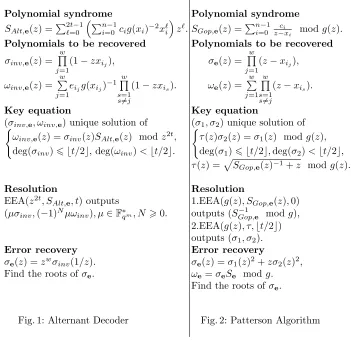
exist for decoding. The one uses the fact that Goppa codes belong to the larger class of alternant codes, so we refer to this method as the Alternant Decoder. The other one, called Patterson Algorithm, is specific to binary Goppa codes. For both, the main steps are :
1. Compute the polynomial syndrome S(z), a univariate polynomial de-duced fromc, but depending only one.
2. Solve thekey equation, which is an equation whose unkowns are univariate polynomials, using an EEA. The solutions give access to theerror locator polynomialσe(z), whose roots are related to the support elements xij in
the error positions ij. It also the yields theerror evaluator polynomial
ωe(z) (helpful to find the values of the errors).
3. Find the roots of σe(z). Here e∈F2n, so eij 6= 0 implies thateij = 1.
The polynomial syndromes, key equations and their resolutions are specific to each method. We briefly sum them up.
Polynomial syndrome Polynomial syndrome
SAlt,e(z) =
P2t−1 `=0
Pn−1
i=0 cig(xi)−2x`i
z`. S
Gop,e(z) =P
n−1 i=0
ci
z−xi modg(z).
Polynomials to be recovered Polynomials to be recovered
σinv,e(z) =
w Q
j=1
(1−zxij), σe(z) =
w Q
j=1
(z−xij),
ωinv,e(z) =
w P
j=1
eijg(xij)
−1Qw s=1 s6=j
(1−zxis). ωe(z) =
w P
j=1 w Q
s=1 s6=j
(z−xis).
Key equation Key equation
(σinv,e, ωinv,e) unique solution of (σ1, σ2) unique solution of (
ωinv,e(z) =σinv(z)SAlt,e(z) modz2t,
deg(σinv)6bt/2c, deg(ωinv)<bt/2c. (
τ(z)σ2(z) =σ1(z) mod g(z), deg(σ1)6bt/2c,deg(σ2)<bt/2c,
τ(z) =p
SGop,e(z)−1+z modg(z).
Resolution Resolution
EEA(z2t, S
Alt,e, t) outputs 1.EEA(g(z), SGop,e(z),0)
(µσinv,(−1)Nµωinv), µ∈Fq∗m, N >0. outputs (SGop,−1 e modg),
2.EEA(g(z), τ,bt/2c) outputs (σ1, σ2).
Error recovery Error recovery
σe(z) =zwσinv(1/z). σe(z) =σ1(z)2+zσ2(z)2, Find the roots ofσe. ωe=σeSe modg.
Find the roots ofσe.
Completeness proofs are classic coding theory literature. For details, see for instance [7][Ch. 12§9] for the Alternant Decoder and [18,9] for Patterson Algo-rithm.
The extended Euclidean Algorithm which is used in all the available im-plementations (see [5,6,14,13]) consists in successive Euclidean divisions as in Alg. 2. Its complexity is inO(deg(a)2) field multiplications. It is to be noticed that asymptotically better algorithms exist, generally referred to as Fast EEA or HGCD (for Half-GCD), with complexity O(deg(a) log deg(a)). The reason not to use them here is that constants are hidden in the O (see for details [19]). Consequently, for the degrees at stake in McEliece decryption (6200), those are not more efficient than Alg. 2.
Algorithm 2Extended Euclidean Algorithm (EEA)
Input: a(z), b(z),deg(a)>deg(b), df in
Output: u(z), r(z) withb(z)u(z) =r(z) moda(z) and deg(r)6d
1: r−1(z)←a(z), r0(z)←b(z),u−1(z)←1, u0(z)←0,
2: i←0
3: whiledeg(ri(z))> df indo
4: i←i+ 1
5: qi←ri−2(z)/ri−1(z) (quotient of the Euclidean division ofri−2(z) byri−1(z))
6: ri←ri−2(z)−qi(z)ri−1(z) (rest of the Euclidean division ofri−2(z) byri−1(z))
7: ui←ui−2(z)−qi(z)ui−1(z)
8: end while
9: N←i
10: return uN(z), rN(z)
For the EEA executions solving the key equations (EEA in Alternant decoder, second EEA in Patterson algorithm), the paragraph§5 of [18] gives refined com-plexities of respectively 7.5twH(e) and 3.5twH(e). For the syndrome polynomial inversion in the Patterson decoding (first EEA), a quick analysis shows that, the number of field multiplications is bounded by 2t2. We obtain with an error vector of weightta cost in field multiplications of 7.5t2for the Alternant decoder and 5.5t2for Patterson algorithm. This is why Patterson algorithm is generally preferred.
3
Decryption oracle attacks
3.1 Plaintext-recovery attacks
In [12,1,15], the authors described attacks using the same framework. They ex-ploit a decryption oracle to recover the plaintext from an encrypted messagec. Those focus only on Patterson method for decoding (Fig. 2). Here, we apply the different attacks proposed to both decoding algorithms in order to determine which one is the most resistant.
Generic attack scenario. The common framework is summed up in Alg. 3.
Algorithm 3Framework for message-recovery attacks on a decryption device. Input: A valid ciphertextc=mGpub+e, a decryption deviceD.
Output: The error vectoreand plaintextm.
1: fori= 0, . . . , n−1do
2: Modifycintoc?i=c+ (0, . . . ,0, 1 |{z} i−th bit
,0, . . .).
3: Request decryptionD(c?i).
4: Deduce by timing analysis or power consumption ofDwhetherei= 0 orei= 1. 5: end for
6: Solve the linear system with unknownm:mGpub=c+e. 7: return Plaintextm.
Alg. 3 describes an attack against a McEliece encryption scheme. The same framework is applicable against Niederreiter encryption when a public encryption keyHpub is known. It suffices to replace Step 2 by
2: Modifycintoc?i =c+H(i)
pub, whereH (i)
pub denotes thei-th row ofHpub. In CCA2 conversions, a condition is imposed to the error. Ciphertext manip-ulation is detected thanks to a test on the validity of the error and the algorithm outputs a failure: the attacker only checking the output does not recover infor-mation except that the ciphertext was not valid.
Historically, the first method was explained in [17] and refined in [1]. It dates back to 2008 and focuses on the determination of the roots of the error loca-tor polynomial σe(z) (Figure 2). The authors of [1] and [17] propose convicing
countermeasures against this weakness (see [1][Alg. 4]). Indeed, when starting the root-finding step, errors of weight lower thantcan be detected thanks to the low degree of the error locator polynomial. This makes this step rather simple to protect. Unfortunately, this is not sufficient to discard attacks following the framework of Alg. 3. The reason is that, as first noticed in [12], the EEA deter-mining σe also has an execution time depending on the error weight. Now we
Exploitation of EEA leakages The authors of [12] focused on Patterson algorithm (Fig. 2). In the second EEA, implemented as in Alg. 2, the number of iterations in thewhile loop depends on the weight of the error. To do so, they show that the outputσ1(z), σ2(z) satisfy the relations:
deg(σ2(z)) = N X
i=1
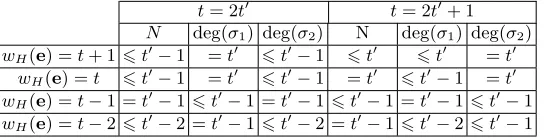
deg(q(1)i) deg(σ1(z)2+zσ2(z)2) =wH(e)(2) Thanks to relations (1) and (2), they deduce that, assuming that all the Eu-clidean divisions in the second EEA have a quotient of degree one (which happens with probability (1−2−m)N), the numberNof iterations in thewhileloop varies as in Table 1. These variations of N can be detected either by measuring time execution or counting the number of patterns on a power consumption trace. Thus, they provide a successful tool to perform Alg. 3 and recover a plaintext.
Countermeasure. To protect against the previous attack, the authors of [12] propose to check the degrees of the polynomials processed by the EEA during its execution instead of checking only the output. We recall that, in Patterson’s decoding, the error locator polynomial is split into even and odd part: σe(z) =
σ1(z)2+zσ2(z)2. [12] gives a precise description of the degrees to be expected forσ1(z) andσ2(z) according to the weight of the error, recalled in Table 1.
t= 2t0 t= 2t0+ 1 N deg(σ1) deg(σ2) N deg(σ1) deg(σ2) wH(e) =t+ 16t0−1 =t0 6t0−1 6t0 6t0 =t0
wH(e) =t 6t0−1 =t0 6t0−1 =t0 6t0−1 =t0 wH(e) =t−1 =t0−16t0−1 =t0−16t0−1 =t0−16t0−1 wH(e) =t−26t0−2 =t0−16t0−2 =t0−16t0−26t0−1
Table 1: Degrees of the output polynomials of EEA(g(z), τ(z),bt/2c).
They deduce Alg. 4, a modified EEA which detects the ciphertext manip-ulation and completes the computation to take same execution time both on the ciphertextcand on the twistedc?i. With this version, the authors claim to obtain a decryption time taking a constant number of clock cycles. This would discard a timing attack. However, no power consumption trace is analyzed. It remains unclear whether the extra manipulation in Step 9 of Alg. 4, whose execu-tion implies thatei= 1, is undetectable. In particular, eachwhileiteration will not have the same execution time. Fakely executing those steps at each iteration would have a serious impact on the performances.
Algorithm 4Protected EEA for Patterson decoding Beginning as is Alg. 2.
7: ui←ui−2(z)−qi(z)ui−1(z)
Caset= 2t0.
8: if deg(ri)< t0 then
9: Manipulate ri so that deg(ri) = deg(ri−1)−1.
10: end if
Case t = 2t0 +
1
8: if deg(ri)6t0and deg(vi)< t0 then
9: Manipulate ri so that deg(ri) = deg(ri−1)−1.
10: end if
End as is Alg. 2.
(Fig. 1) prone to leak information when the error weight varies. The equivalent of Relations (1) and (2) in this context is
deg(σinv(z)) = N X
i=1
deg(qi) = (
wH(e) if 06∈x
wH(e)−1 if 0∈x. (3)
Looking at the degree of the output polynomial of the EEA in Alg. 1, we have the following link with the weight of the error vector (α denotes the position of the support such that xα = 0): The error locator polynomial is deduced
deg(σinv) ifeα= 0 deg(σinv) ifeα= 1 wH(e) =t t t−1 wH(e) =t+ 1(ei= 0) t t−1 wH(e) =t−1(ei= 1) t−1 t−2
Table 2: Degrees of the output polynomials of EEA(zt, S
e(z),bt/2c).
from σinv(z) when the weight of the error vector is known. Indeed, when 0 is a possible error position, one cannot determine with certainty the degree of
σe(z) from the degree of its reciprocal polynomialσinv(z). The reason is that for
any polynomial p(z) ∈Fq[z], p(z) andzp(z) have same reciprocal polynomial. After computing a polynomial σinv(z) of degree d, if 0 belongs to the support, there are two possibilities, either the indexα such thatxα = 0 is not an error position,σe is not divisible byz, then deg(σe) = deg(σinv) andσe(z) is equal to
zdeg(σinv)σinv(z−1), orαis an error position, andσ
e(z) =zdeg(σinv)+1σinv(z−1).
Therefore, in this case, looking at the degree of σinv does not distinguish manipulated ciphertexts from correct ones, and the EEA cannot be correctly protected by this method.
decoder. It always detects ciphertext manipulation provided that 0 is not an element of the support, and somehow restores a usual behavior of the EEA (that is, that of a valid ciphertext). The final output will not be the correct plaintext, but this is not a problem as long as the attacker cannot extract information from this result. However, we note that this protection has the same drawbacks as its Patterson equivalent: eachwhileexecution does not have same execution time.
Algorithm 5Protected EEA for Alternant decoder Beginning as is Alg. 2.
7: vi←vi−2(z)−qi(z)vi−1(z)
8: if deg(ri)< tthen
9: Manipulateriso that deg(ri) = deg(ri−1)−1 10: end if
End as is Alg. 2.
3.2 Secret decryption key recovery attacks
We address a different kind of physical attack initiated by Strenzke in [15,16] against McEliece encryption using Patterson decoding. It aims at recovering the secret key.
Generic attack scenario. The attack scenario is the following. The attacker has acces to a decryption deviceDon which he can perform physical measurements. He also knows a public encryption key, so that he can generate codewords with errors of his choice. By observing the decryption phase (more precisely, the EEA execution), Strenzke shows that one can deduce information on the support elements corresponding to the error positions. Roughly, the reason is that when a polynomial condition on those elements is satisfied, the number of iterations of the while loop in Alg. 2 is reduced compared to the average number of iterations necessary to perform the EEA for error vectors of same weight. The attack consists in scanning a lot of error positions and collect sufficiently many polynomial relations so that the algebraic system obtained can be solved.
We sum up in Alg. 6 the global attack framework arising from [16].
The polynomialsPw will be elementary symmetric polynomials of the form, for an errore= (0, . . . , ei1, . . . , eiw, . . . ,0) with wH(e) =wandj>0:
ωj(e) = X
16`1<···<`j6w
xi`1. . . xi`j.
That is,ωj(e) is the evaluation of thejthelementary symmetric polynomial in
Algorithm 6Framework for key-recovery attacks on a decryption device. Input: A decryption deviceD, public encryption keyGpub.
Output: The secret supportx.
1: forwwell-chosen error weightsdo
2: for(i1, . . . , iw) subset of{0, . . . , n−1}do
3: Pick a low-weight error vectore= (0, . . . , ei1, . . . , eiw, . . . ,0) withwH(e) =w.
4: Request decryptionD(e).
5: Perform timing or power consumption analysis ofD(e).
6: if EEA execution is faster than average (more precise conditions in this Sec-tion)then
7: Deduce a polynomial condition onxi1, . . . , xiw(Pwis a polynomial depend-ing only onw):
Pw(xi1, . . . , xiw) = 0 (4)
8: end if
9: end for
10: end for
11: Solve the non-linear system of all the collected equations (4). 12: return Secret supportx= (x0, . . . , xn−1).
State-of-the-art. More precisely, Strenzke uses errors of weights w= 1, w = 4 andw= 6. Forw= 6, errors such that Eq. (4) is satisfied are harder to find than for w = 4. For this reason, his strategy consists in collecting as many Eq. (4) withw= 1 andw= 4 as possible. He obtains a linear system of rankn−m(in some casesn−m−1) in thenelements of the support. Then, he selects subsets of errors of weightw= 6 to look for Eq. (4). These subsets are chosen so as help the polynomial system solving. According to Strenzke, for an encryption scheme with parameters m= 10, n= 2m, t = 40, it takes about 15,000,000 decryption queries to collect enough equations and 28 hours to solve the algebraic system. Eventually, the full secret supportxis recovered by the attacker, and then the Goppa polynomial is easy to find. Indeed, it is well explained in [8][p. 125] how, given the public key, it is possible to recover one from the other in polynomial time.
First example of leakage exploitable by Framework 6. The first attack resorting to the method of Alg. 6 was proposed by Strenzke in [15]. It focuses on the second EEA of Patterson alg. with errors of weight w= 4. In this case,
Se(z) =
P4 j=1
1 z−xij =
ωe(z) σe(z), and
ωe(z) = (xi1+xi2+xi3+xi4)
| {z }
ω1(e)
z2+xi1xi2xi3+xi1xi2xi4+xi1xi3xi4+xi2xi3xi4
| {z }
ω3(e)
If ω1(e) = 0, then Se(z) =
ω3(e)
σe(z), and S
−1
e modg = ω3(e)−1σe(z) therefore
τ(z) = q
S−e1(z) +z modg(z) =
p
ω3(e)−1σe(z) +zandτ(z) has degree lower
thanbt/2c(forw= 4 we have deg(τ(z)) = 2). As a consequence, thewhiletest in EEA(g(z), τ(z),bt/2c) is never fulfilled and the number of iterationsNis equal to 0. When ω1(e)6= 0, deg(τ(z))>bt/2cwith overwhelming probability (τ(z) is a reduction modulo a polynomial of degreet), so that N >0. This allows to collect many equations of the form
xi1+xi2+xi3+xi4 = 0.
As Strenzke explains, the final system’s rank never exceedsn−m. So it is not sufficient in practice to recover the private key and one has to assume that some other parts of private elements are required. Still, he proposes a counter-measure to avoid this information leakage.
Countermeasure to protect Second EEA by Strenzke. Strenzke proposes to detect the polynomials τ(z) leading to this leakage by checking if deg(τ(z)) <bt/2c. This can be done just after the determination ofτ(z). If so, manipulateτ(z) so that is has degree t−1.
Algorithm 7 Patterson decoding with Strenzke’s countermeasure against weight 4 errors leakages
Input: n−k-bit syndromes=HeT withwH(e)6btc, private key (x, g(z)) Output: The error vectore.
1: Polynomial Syndrome Determination:Idem Fig. 2. Computation ofτ(z):
2: Findf(z) such thatf(z)Se(z) = 1 modg(z) by·, f(z) = EEA(g(z), Se(z),0) 3: Setτ(z) =p
f(z) +z. 4: if deg(τ(z))<bt/2cthen
5: Manipulateτ(z) so that deg(τ(z)) =t−1. 6: end if
7: Error Locator Polynomial Determination & Error Vector Determina-tion
Idem Fig. 2.
This countermeasure avoids leaking information only in the second EEA, only when decoding errors of weight 4. Exploitable leakages remain, as shown in the next paragraph.
here, and complete it with the analogous result for the second EEA (which we could not find in [16]).
Lemma 1. LetC =G(x, g(z))be a binary Goppa code andSe(z)the polynomial
syndrome associated to an error e with wH(e) 6deg(g)/2−1. Write Se(z) =
ωe(z)
σe(z) modg(z). Let NI andNK be the number of iterations of thewhile loop
respectively inEEA(g(z), Se(z),0) andEEA(g(z), τ(z),bt/2c). Then
NI 6deg(ωe(z)) + deg(σe(z))andNK 6deg(ωe(z))/2. (5)
Proof. The result on NI is proved in [16][Corollary 1]. RegardingNK, observe thatv0has degree 0 andvNK =σ2(z) has degree deg(ωe)/2 (since by derivating
the relationσ=σ2
1+zσ22 we obtainωe=σ22). As the degrees are raised at least by one at each iteration, we obtainNK 6deg(ωe)/2.
Let’s apply this small weight error vectors. Note that, for any errore, deg(σe) =
wH(e).
For an error weight w = 4. Pick e = (0, . . . , ei1, . . . , ei4, . . . ,0). We know that ωe(z) = ω1(e)z2+ω3(e). Lemma 1 gives the number NI of iterations in EEA(g(z), Se(z),0) satisfies
xi1+xi2+xi3+xi4 6= 0 =⇒NI = 6,
xi1+xi2+xi3+xi4 = 0 =⇒NI = 4.
Therefore, even if the second EEA has been protected with Strenzke’s counter-measure, errors of weight w = 4 leak the same information in the first EEA. This does not give enough equations. To complete the algebraic system, the idea is to use error weightsw= 6.
For an error weight w = 6. For e = (0, . . . , ei1, . . . , ei6, . . . ,0), we develop
SGop,e(z) :
SGop,e(z) =
ω1(e)z4+ω3(e)z2+ω5(e)
σe(z)
.
Strenzke’s purpose is to detect for whicheis holds thatω3(e) =ω1(e) = 0. These cases are exactly those withSe(z)−1=ω5(e)−1σe(z) and hence deg(τ(z))<
bt/2c, so that the number of iterations in the second EEA is 0provided that Strenzke’s counter-measure is not applied. This is a somehow surprising proposition, since this criterion can be rendered useless by a counter-measure already proposed by the same author.
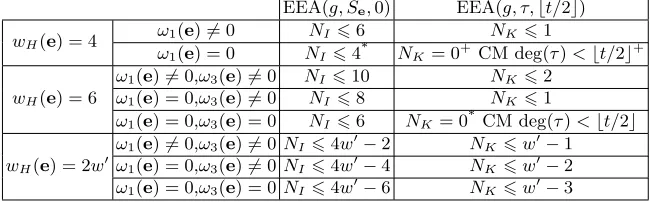
EEA(g, Se,0) EEA(g, τ,bt/2c)
wH(e) = 4 ω1(e)6= 0 NI66 NK61
ω1(e) = 0 NI64* NK = 0+ CM deg(τ)<bt/2c+
wH(e) = 6
ω1(e)6= 0,ω3(e)6= 0 NI 610 NK62 ω1(e) = 0,ω3(e)6= 0 NI68 NK61
ω1(e) = 0,ω3(e) = 0 NI66 NK = 0* CM deg(τ)<bt/2c
wH(e) = 2w0
ω1(e)6= 0,ω3(e)6= 0 NI64w0−2 NK 6w0−1 ω1(e) = 0,ω3(e)6= 0 NI64w0−4 NK 6w0−2 ω1(e) = 0,ω3(e) = 0NI64w0−6 NK 6w0−3
Table 3: Overview of small- error-weight message attacks. Cases marked with a * or a+are proposed resp. in [15] and [16].
the degree ofωe. For example, withw = 6, the attacker may observe NK = 1 whereasω1(e) is not zero. This remark leads Strenzke to discard those cases for an attack as long as no way of distinguishing thoses cases is found. We propose such distinguisher, by usingNI to determine ifω1(e) is zero, asω1(e) = 0 implies
NI 68. Indeed, an attacker observing the errors ewith (NI, NK) = (10,1) can conclude that ω1(e) 6= 0 (cf Table 3). We may have (NI, NK) = (8,1) when
ω1(e)6= 0 if three cancellations occur in the 12 intermediate polynomials, which has probability p3 = 123
2−3m(1−2−m)9 ≈2.10−7 form = 10 (we model the leading coefficients as random elements ofF2m). When samplingxerror vectors,
we expect to findp3xsuch misleading cases. With the numbers of samples from [16][Table 2], the probability to find one is not negligible. If at least one wrong equation is deduced, the system to solve has no solution and the attack fails. We propose to avoid this problem by using errors with w>8.
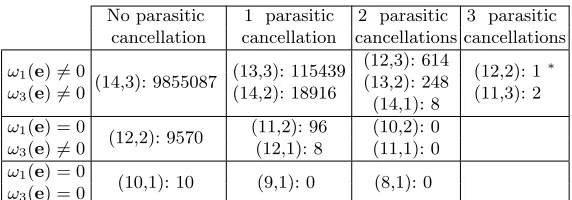
Example w = 8. We sampled randomly 10,000,000 errors e of weight 8 and collected the couples (NI, NK) in Table 4. When wH(e) = 8, there are more possibilities than withw= 6. Samples with (NI 612, NK 62) do not necessarily have ω1(e) = 0: this happens with probability p03 =
17 3
2−3m(1−2−m)14 ≈ 6.10−7 for m = 10 (we found 3). In particular, the case marked with a ∗ in
Table 4 would make the attacker to think erroneously that the corresponding error vector satisfies ω1(e) = 0. However, the number of parasitic cancellations necessary to provide values (NI, NK) compatible with (ω1(e), ω3(e)) = (0,0) is 6, which happens with probabilityp03=
17 6
2−6m(1−2−m)11≈10−14form= 10. If ω1(e) = 0 but ω3(e) 6= 0, then a couple (10,1) is found if 3 cancellations occur. This has probability 2−mp0
3 ≈6.10−10 (asω1 takes all the values ofF2m
No parasitic 1 parasitic 2 parasitic 3 parasitic cancellation cancellation cancellations cancellations
ω1(e)6= 0
ω3(e)6= 0 (14,3): 9855087
(13,3): 115439 (14,2): 18916
(12,3): 614
(12,2): 1∗ (11,3): 2 (13,2): 248
(14,1): 8 ω1(e) = 0
(12,2): 9570 (11,2): 96 (10,2): 0 ω3(e)6= 0 (12,1): 8 (11,1): 0 ω1(e) = 0
(10,1): 10 (9,1): 0 (8,1): 0 ω3(e) = 0
Table 4: Number of samples for each (NI, NK) for 10,000,000 error vectors with
w= 8. Code parameters: m= 10, n= 2m, t= 40. See text for explanation on∗.
to recover information on the support even if the countermeasure deg(τ)<bt/2c
is implemented.
Small weight error messages in Alternant decoder We determine if an attacker can retrieve any information by applying Alg. 6 if the Alternant decoder is implemented. Lemma 2, which is analogous to Lemma 1, analyses the impact of small weight error messages on the EEA.
Lemma 2. Let e be an error with wH(e) 6 t. Then SAlt,e(z) =
ωinv,e(z) σinv,e(z) modz2t and the number of iterations N of the while loop of the Alternant
decoder in the EEA satisfies
N 6Nmax= min(deg(σinv,e),deg(SAlt,e)−deg(ωinv)) (6)
Specific case of weight 1 errors. If w = 1, we always have deg(ωinv) = 0 and deg(σinv) = 1exceptif the error is positioned in the zero element of the support. Indeed, in this case, the polynomial syndrome is a constant: Se(z) = g(0)12 and thewhileloop is never executed.
Error weights w >1. We suppose that no error occurred in the zero element of the support so that deg(σinv) =wH(e) always holds (the coefficient ofzwinσinv isxi1. . . xiw). Therefore, faster decryptions indicate the cancellation of a leading
coefficient in the intermediate values, but in the alternant decoder we found no way of determining which intermediate value was concerned. If by any chance a power analysis can ensure that it is the first intermediate polynomial (that is, the syndrome polynomialSAlt,e(z)) that has a degree smaller than expected,
then the information recovered would be: w
X
j=1
g(xij)
−2 w X
j=1
x2it−1
We observe that the equations written thanks to this method are more com-plex than with Patterson algorithm, at least for two reasons. First, they are not directly polynomial, and the degrees implied are much higher. Second, as bothx andghave to be unknown ([8][p. 125]), additive unknowns are necessary: either
t+ 1 to describe the secret polynomial’s coefficients, or nif we introduce new equationsyi =g(xi)−2. We conclude that the alternant decoder is intrinsically more resistant to Strenzke’s attacks. However, the overall security is still not clear due to the uncertainty on the countermeasure (described in Alg. 5) against Alg. 3.
4
Extended euclidean Algorithm with constant flow
We expose a way of implementing the EEA algorithm unused so far for McEliece decryption. It has the very interesting property of requiring a number of opera-tions depending only on the Goppa polynomial degreet andnoton the weight of the error introduced in the ciphertext. Therefore, the attacks of 3.1 and 3.2 are not possible.
It is inspired by Berlekamp’s work in [3] (which as followed by other works of optimization in the VLSI community, amongst many others [10,11]). We could find no reference to it in any paper related to McEliece. On the contrary, de-signing such an algorithm is desirable goal according to the conclusion of [16]. The reason may be that [3] has a very limited access, and we could find no com-pleteness proofs of the algorithm proposed. Here, we transform smoothly the original EEA (Alg. 2) into successive version gaining in regularity (Algorithms 8 and 9). We end up with Alg. 10, which is simpler and more regular than all the previous ones. At each step, we give and prove (in Appendix) the form of the outputs and intermediate values. Finally, each execution of Alg. 10 costs, in field multiplications, exactly 16t2 (2ttimes a loop costing 4×2t).
In the rest of this article we will set N be the number of Euclidean di-visions performed during EEA(z2t, S
Alt(z), t) in Alg. 2, di = deg(ri(z)), and
δi= deg(qi(z)) = deg(ri−2)−deg(ri−1).
For any polynomialP(z)∈Fqm[z], we denote its coefficients by Pj even for
j >deg(P) (in which case Pj = 0), so that
P(z) = +∞
X
j=0
Pjzj =Pdeg(P)zdeg(P)+· · ·+P0.
Regarding the δi’s, we prove the following result which will be very useful to design an algorithm with regular pattern:
Lemma 3. Let theδi’s be defined as previously during the execution ofEEA(z2t, Se(z), t),
then it holds that
N X
i=1
δi= deg(uN(z)) = deg(ωinv,e) =wH(e)−1.
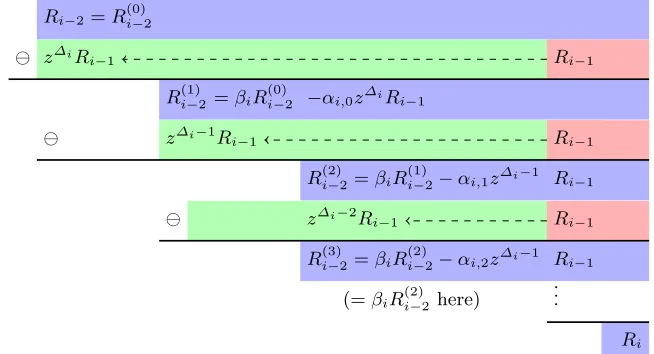
Unrolling Euclidean divisions In Alg. 8, we decompose each Euclidean divi-sion into a number of polynomial subtractions depending only onδi the degrees of the quotients. We explicit the intermediate values of the Euclidean division of Ri−2(z) byRi−1(z), that we denote byR
(0)
i (z), . . . , R (δi+1)
i (z). To do so, we eliminate in each R(ij)(z) (for 0 6 j 6 δi+ 1) the term zdi−2−j, whether the associated coefficient is zero or not. This is why we perform the Euclidean divi-sions in a way to avoid the dividivi-sions by a field elements (Steps 7 to 11 of Alg. 8). Consequently, the outputs are multiple of the outputs of Alg. 2 with the same inputs.
Proposition 1 (Comparison of Algorithms 2 and 8). Let a(z) and b(z)
be two polynomials with deg(a(z)) > deg(b(z)), and d a non-negative integer. ui(z), vi(z), ri(z), qi(z)are the intermediate values in Alg. 2, andUi(z), Vi(z), Ri(z)
are the intermediate values in Algorithm 8. It holds that, for all i=−1, . . . , N, there existsλi∈F∗qm such that:
Ri(z) =λiri(z),
Ui(z) =λiui(z).
As a consequence,∆i= deg(Ri−2)−deg(Ri−1) = deg(ri−2)−deg(ri−1) =δifor
all i.
There are two problems with Alg. 8: the first one is that the innerforloop ((Steps 7 to 11) has a variable length, and contains a multiplicationzδi−(j−1)Ri(z)
which depends on the iteration, which will produce a recognizable pattern and the second problem is that the while loop leads to a variable number of op-erations according to the input. Alg. 9 is a first step towards the resolution of the second problem. It is not realistic (it requires that Alg. 8 has already been executed and observed), but it eases the proofs of completeness of Alg. 10, which solves both issues.
Regular polynomial shift pattern. In Alg. 9, we perform the Euclidean division in such a way that we only multiply the operand by z at each for iteration. This can be done by splitting in two phases each Euclidean divisions. The first phase (Steps 4 to 7) ”re-aligns” the operands ˜Ri−2 and ˜Ri−1 so that they both have same degreed= deg(R−1(z))(= 2t). Doing so, the second phase (Steps 8 to 12) compute the polynomial subtractions (corresponding to Steps 9-10 of Alg. 8) and perform a shift ”re-aligning” the operands. A consequence is that the polynomials ˜Ri(z) are of the formzkiRi(z) and the degreesd
i are lost. This problem will be solved in Alg. 10.
Proposition 2 (Comparison of Algorithms 8 and 9).For eachi= 1, . . . , N, after Step 13 of Alg. 9, it holds that
Algorithm 8EEA with unrolled Euclidean Division
Input: a(z) =z2t, b(z) =Se(z).
Output: U(z) =λNσe(z), R(z) =λNωe(z) (for someλN∈F∗qm).
1: R−1(z)←a(z), R0(z)←b(z),U−1(z)←1, U0(z)←0,i←0.
2: whiledeg(Ri(z))> tdo
3: i←i+ 1
4: R(0)i−2(z)←Ri−2(z),Ui(0)−2(z)←Ui−2(z)
5: ∆i←deg(Ri−2)−deg(Ri−1)
6: βi←LC(Ri−1(z)).
7: forj= 0, . . . , ∆ido
8: αi,j←R(i,dj)
i−2−j,
9: R(ij−+1)2 (z)←βiRi(j−)2(z)−αi,jz∆i−jRi−1(z)
10: Ui(−j+1)2 (z)←βiU (j)
i−2(z)−αi,jz
∆i−jUi−1(z)
11: end for
12: Ri(z)←R(∆i+1)
i−2 (z),Ui(z)←U (∆i+1)
i−2 (z) 13: end while
14: N←i.
15: return UN(z), RN(z)
Ri−2=R (0)
i−2
z∆iRi
−1 Ri−1
R(1)i−2=βiR (0)
i−2 −αi,0z
∆iRi
−1
z∆i−1Ri
−1 Ri−1
R(2)i−2=βiR (1)
i−2−αi,1z∆i−1 Ri−1
z∆i−2Ri
−1 Ri−1
R(3)i−2=βiR (2)
i−2−αi,2z∆i−1 Ri−1
(=βiR(2)i−2 here)
. . .
Ri
Algorithm 9Toy EEA with regular shift pattern
Input: a(z) =z2t, b(z) =Se(z), d= 2t
Output: UN˜ (z) =zd−dN−1+1σe(z),RN˜ (z) =zd−dN−1+1ωe(z).
1: ˜R−1(z)←a(z),R˜0(z)←zb(z), ˜U−1(z)←1,U˜0(z)←0.
2: fori= 1, . . . , Ndo
3: R˜(0)i−2(z)←Ri˜−2(z), ˜U (0)
i−2(z)←Ui˜−2(z) 4: forj= 1, . . . , ∆i−1do
5: Ri˜−1(z)←zRi˜−1(z)
L1 6: Ui˜−1(z)←zUi˜−1(z)
7: end for
8: forj= 0, . . . , ∆ido
9: αi,j˜ ←R˜i,d(j), ˜βi←Ri˜−1,d. 10: R˜(ij−+1)2 (z)←z
˜
βiR˜(i−j)2(z)−αi,j˜ Ri˜−1(z) L2
11: U˜i(−j+1)2 (z)←z
˜
βiU˜i(−j)2(z)−αi,j˜ Ui˜−1(z)
12: end for
13: Ri˜(z)←R˜(∆i+1)
i−2 (z), ˜Ui(z)←U˜ (∆i+1)
i−2 (z) 14: end for
15: return UN˜ (z),RN˜ (z)
zd−di−2Ri −2
zd−di−1Ri −1
˜
Ri(1)−2=z(βiz
d−di−2Ri
−2 −αi,0zd−di−1Ri−1)
zd−di−1Ri −1
˜
R(2)i−2=z(βiR˜ (1)
i−2− αi,1zd−di−1Ri−1)
zd−di−1Ri −1
˜
Ri(3)−2=z(βiR˜ (2)
i−2 −αi,2zd−di−1Ri−1)
(=zβiR˜(2)i−2 here)
. . .
zd−diRi zd−di−1+1Ri
L1
L2
Fig. 4: ”Re-aligned” Euclidean division ofRi−2byRi−1: inputs and outputs are degree−dpolynomialszd−di−2R
Complete Regular Flow EEA. To design a real constant flow algorithm, we merge the loops L1 andL2 in a common pattern so as to be indistinguish-able (Steps 5 to 7 of Alg.10). They differenciate by the assignements which are performed in Steps 14- 15 and 18-19. To know when polynomials substractions have to be stopped, we collect in a counterδ the number of shifts necessary to re-align the operands. Finally, when the polynomials σinv and ωinv have been computed, the extra executions of the main loop (Steps 4 to 22) consist in shift-ing the operands. therefore, the number of iterations can be safely set to the maximum value (ie 2t to decode the errors with wH(e) = t)), and the while loop is replaced by for.
Proposition 3 (Comparison of Algorithms 8 and 10.). For each i = 1, . . . , N, after steps 21, it holds that:
ˆ
R2(δ1+···+δi)(z) =z
d−di−1+1R i(z), ˆ
U2(δ1+···+δi)(z) =z
d−di−1+1Ui(z). The outputs of Alg. 10 are, for some µ∈F∗
qm:
ˆ
Rd(z) =zd−wH(e)+1RN(z) =µzd−wH(e)+1ωinv(z), ˆ
Ud(z) =zd−wH(e)+1U
N(z) =µzd−wH(e)+1σinv(z).
Therefore, provided 0 is not an element of x, ˆUd(z) allows to recover the er-ror positions without ambiguity. Transposing this result to Patterson decoding requires to adapt both EEA’s. The adaptation of the second one is straightfor-ward. For the first one (syndrome inversion), a problem arises: the analogous of Proposition 3would yield ˆUNI(z) = µz
ki(S−1
Gop,e modg) for some ki >0, and we found no way of determining whenz is a factor of SGop,−1 e modg. However, we can protect the second EEA to avoid the attack of 3.2.
5
Conclusion
We proposed an algorithm determining the error-locator polynomial costing al-ways 16t2 field multiplications on any input. It contains a test depending on secret data, followed by two balanced branches. The indistinguishability of those branches by an attacker is crucial for the security of the decryption, and depends on the architecture of the implementation.
AcknowledgementsWe are thankful to Jean-Charles Faug`ere, Aline Gouget, Ludovic Perret and anonymous reviewers for their comments in the preparation of this paper.
References
Algorithm 10 EEA with regular flow
Input: a(z) =z2t, b(z) =Se(z), d= 2t
Output: Udˆ (z) =µzd−wH(e)+1σinv(z), ˆRd(z) =µzd−wH(e)+1ωe(z) for someµ∈F∗
qm.
1: ˆR−1(z)←a(z),Rˆ0(z)←zb(z),
2: ˆU−1(z)←1,Uˆ0(z)←0,
3: δ← −1.
4: forj= 1, . . . , ddo
5: αj←Rjˆ−1,d, βj←Rjˆ−2,d.
6: tempR(z)←zαjRjˆ−2(z)−βjRjˆ −1(z)
.
7: tempU(z)←zαjUjˆ−2(z)−βjUjˆ−1(z)
.
8: if αj= 0 (ie deg( ˆRj−1)<deg( ˆRj−2))then
9: δ←δ+ 1. 10: else
11: δ←δ−1. 12: end if
L 13: if δ <0then
14: ( ˆRj(z),Rjˆ −1(z))←( ˆRj−1(z), tempR)
15: ( ˆUj(z),Ujˆ −1(z))←( ˆUj−1(z), tempU)
16: δ←0. 17: else
18: ( ˆRj(z),Rjˆ −1(z))←(tempR,Rjˆ −2(z))
19: ( ˆUj(z),Ujˆ −1(z))←(tempU,Ujˆ−2(z))
20: δ←δ. 21: end if
22: end for
23: return Udˆ (z),Rdˆ (z)
2. E. Berlekamp, R. McEliece, and H. van Tilborg. On the inherent intractability of certain coding problems. Information Theory, IEEE Transactions on, 24(3):384– 386, May 1978.
3. E. Berlekamp, G. Seroussi, and T. Po. A hypersystolic Reed–Solomon decoder. In V. K. Bhargava, S. B. Wicker, IEEE Communications Society, and IEEE Infor-mation Theory Society, editors,Reed-Solomon codes and their applications, pages 205–241. IEEE Press Piscataway, NJ, 1994.
4. D. J. Bernstein, T. Chou, and P. Schwabe. McBits: fast constant-time code-based cryptography. In G. Bertoni and J.-S. Coron, editors, Cryptographic Hardware and Embedded Systems – CHES 2013, volume 8086 of Lecture Notes in Computer Science. Springer-Verlag Berlin Heidelberg, 2013. Document ID: e801a97c500b3ac879d77bcecf054ce5,http://cryptojedi.org/papers/#mcbits. 5. B. Biswas.Aspects de mise en oeuvre de la cryptographie bas´ee sur les codes. These,
Ecole Polytechnique X, Oct. 2010.
6. S. Heyse. Implementation of McEliece Based on Quasi-dyadic Goppa Codes for Embedded Devices. In B.-Y. Yang, editor,PQCrypto, volume 7071 ofLecture Notes in Computer Science, pages 143–162. Springer, 2011.
8. R. Overbeck and N. Sendrier. Code-based cryptography. In D. Bernstein, J. Buchmann, and E. Dahmen, editors, Post-Quantum Cryptography, pages 95– 145. Springer Berlin Heidelberg, 2009.
9. N. Patterson. The algebraic decoding of Goppa codes. IEEE Transactions on Information Theory, 21(2):203–207, 1975.
10. D. Sarwate and N. Shanbhag. High-speed architectures for reed-solomon decoders.
Very Large Scale Integration (VLSI) Systems, IEEE Transactions on, 9(5):641–655, Oct 2001.
11. D. Sarwate and Z. Yan. Modified euclidean algorithms for decoding reed-solomon codes. InInformation Theory, 2009. ISIT 2009. IEEE International Symposium on, pages 1398–1402, June 2009.
12. A. Shoufan, F. Strenzke, H. G. Molter, and M. St¨ottinger. A Timing Attack against Patterson Algorithm in the McEliece PKC. In D. Lee and S. Hong, editors,ICISC, volume 5984 ofLecture Notes in Computer Science, pages 161–175. Springer, 2009. 13. A. Shoufan, T. Wink, H. Molter, S. Huss, and E. Kohnert. A Novel Cryptopro-cessor Architecture for the McEliece Public-Key Cryptosystem. Computers, IEEE Transactions on, 59(11):1533–1546, Nov 2010.
14. F. Strenzke. A Smart Card Implementation of the McEliece PKC. In P. Samarati, M. Tunstall, J. Posegga, K. Markantonakis, and D. Sauveron, editors,Information Security Theory and Practices. Security and Privacy of Pervasive Systems and Smart Devices, volume 6033 ofLecture Notes in Computer Science, pages 47–59. Springer Berlin Heidelberg, 2010.
15. F. Strenzke. A Timing Attack Against the Secret Permutation in the Mceliece PKC. InProceedings of the Third International Conference on Post-Quantum Cryptog-raphy, PQCrypto’10, pages 95–107, Berlin, Heidelberg, 2010. Springer-Verlag. 16. F. Strenzke. Timing Attacks against the Syndrome Inversion in Code-Based
Cryp-tosystems. In P. Gaborit, editor, PQCrypto, volume 7932 of Lecture Notes in Computer Science, pages 217–230. Springer, 2013.
17. F. Strenzke, E. Tews, H. G. Molter, R. Overbeck, and A. Shoufan. Side Channels in the McEliece PKC. InProceedings of the 2Nd International Workshop on Post-Quantum Cryptography, PQCrypto ’08, pages 216–229, Berlin, Heidelberg, 2008. Springer-Verlag.
18. Y. Sugiyama, M. Kasahara, S. Hirasawa, and T. Namekawa. A method for solving key equation for decoding Goppa codes. Information and Control, 27(1):87 – 99, 1975.
19. K. Thull and C. Yap. A Unified Approach to HGCD Algorithms for polynomials and integers., 1990. Manuscript. Available from http://cs.nyu.edu/cs/faculty/yap/allpapers.html/.
A
Proofs of completeness
Proof of Proposition 1. We recall of theRi(z)’s are computed: setR−1(z) =
r−1(z) =a(z) and R0(z) =r0(z) =b(z). Then, for 16i6N , setR (0) i−2(z) =
Ri−2(z) and recursively
R(i−j+1)2 (z) =βiR (j)
i−2(z)−αi,jzδi−jRi−1(z) (8) withαi,j=R
(j)
i,di−2−j,βi= LC(Ri−1(z)).Ri(z) is defined byRi(z) =R (δi+1)
In essence we have to prove thatR(δi+1)
i−2 (z) is the rest of the Euclidian division ofRi−2(z) byRi−1(z). First, we prove by induction onjthat, for all 16i6N and 0 6j 6δi+ 1, there exists a polynomialfi,j(z)∈ Fqm[z] and a non-zero
scalar µi,j such that
R(i−j)2(z) =µi,jR (0)
i−2(z)−fi,j(z)Ri−1(z) and deg(R (j)
i−2(z))6di−2−j. (9) Forj = 0, pickfi,0(z) = 0, µi,0= 1 and notice that deg(R
(0)
i−2) =di−2 . Now at stepj >0, supposeR(i−j)2(z) =µi,jR
(0)
i−2(z)−fi,j(z)Ri−1(z), then
R(ij−+1)2 (z) =βiR (j)
i−2(z)−αi,jzδi−jRi−1(z) =µi,jβi
| {z } µi,j+1
R(0)i−2(z)−(fi,j(z) +αi,jzδi−j)
| {z }
fi,j+1(z)
Ri−1(z).
Regarding the degree, if deg(R(i−j)2)< di−2−j, thenR (j)
i−2,di−2−j= 0, soαi,j = 0 and deg(R(i−j+1)2 ) = deg(Ri(−j)2) 6di−2−(j+ 1). If deg(R
(j)
i−2) =di−2−j, then observe thatLC(βiR
(j)
i−2) =LC(Ri−1(z))Ri,di−2−j andLC(αi,jz δi−jR
i−1(z)) =
Ri,di−2−jLC(Ri−1(z)), so that the leading monomials cancel, and therefore deg(R(ij−+1)2 )6di−2−(j+ 1).
Thanks to Eq. (9), we know that at stepj =δi+ 1 :
Ri−2(z) =fi,δi+1(z)Ri−1(z) +µi,δi+1R
(δi+1)
i−2 (z) and deg(R (δi+1)
i−2 )6di−1−1. Thanks to the induction hypothesis Ri−2(z) = λi−2ri−2(z) and Ri−1(z) =
λi−1ri−1(z), so we have
ri−2(z) =λi−1λ−i−12fi,δi+1(z)ri−1(z) +λ
−1
i−2µi,δi+1R
(δi+1)
i−2 (z).
By unicity in the Euclidean division, we setλi=λi−2µ−i,δ1i+1 it follows that:
R(δi+1)
i−2 (z) =λiri(z), λi−1λi−−12fi,di−2−di+1(z) =qi(z). (10)
For (Ui(−j)2(z)), we would prove the same way that Ui(−j)2(z) = µi,jU (0) i−2(z)−
fi,j(z)Ui−1(z) with the same µi,j and fi,j(z). Therefore, thanks to the induc-tion hypothesis (Ui−2(z) =λi−2ui−2(z) andUi−1(z) =λi−1ui−1(z)),
ui−2(z) =λi−1λi−−12fi,δi+1(z)
| {z }
qi(z)(10)
ui−1(z) +λi−−12µi,δi+1
| {z } λ−i1(10)
U(δi+1)
i−2 (z).
With Eq. (10), we see thatU(δi+1)
i−2 (z) =λiui−2(z)−λiqi(z)ui−1(z) =λiui(z).
Proof of Proposition 2. The operands at entering the main forloop (Steps 2-14 of Alg. 9) are by induction hypothesis
( ˜Ri−2,R˜i−1) =zd−di−2Ri−2(z), zd−di−2+1Ri−1(z)), (fori= 1, we have indeed ( ˜R−1,R˜0) = (R−1(z), zR0(z))).
The main loop is decomposed into two phases:L1 (Steps 4-7) andL2(Steps 8-12).L1consists in shiftingzd−di−2+1Ri(z) up-wise until it has a non-zerod-th coefficient (ieit has degreed), that is exactly∆i−1 =di−2−di−1−1 times, so that after Step 7 ˜Ri−1(z) =zd−di−1Ri−1(z).
L2(Steps 8-12) performs a twisted Euclidean division ofRi−2(z) byRi−1(z) on the shifted values ˜Ri−2(z)zd−di−2Ri−2(z) and ˜Ri−1(z) =zd−di−1Ri−1(z). We prove that, after Step 12, ˜R(δi+1)
i−2 (z) =z
d−di−1+1Ri(z). To do so, we show the following link between the intermediate results of Algorithms 8 (R(ij−)2(z)) and 9 ( ˜R(ij−)2(z)): for 06j6∆i+ 1,
˜
R(ij−)2(z) =zd−di−2+jR(j)
i−2(z). (11)
This is done by induction onj. Forj= 0, we have ˜R(0)i−2(z) =zd−di−2R
i−2(z) =
zd−di−2R(0)
i−2(z). Then, suppose ˜R (j)
i−2(z) = z
d−di+jR(j)
i−2(z). So, it holds that ˜
Ri(j−)2,d =R(i−j)2,d−d
i−2+j, and LC( ˜Ri−1(z)) = LC(Ri−1(z)), so that ˜αi,j =αi,j
and ˜βi=βi. Now ˜R (j+1)
i−2 (z) is given by: ˜
R(i−j+1)2 (z) = zβ˜iR˜ (j)
i−2(z)−α˜i,jR˜i−1(z)
= zzd−di−2+jβ
iR (j)
i−2(z)−αi,jzd−di−1Ri−1(z)
= zd−di−2+j
βiR (j)
i−2(z)−αi,jzδi−(j)R˜i−1(z)
= Eq (8)z
d−di−2+jR(j)
i−2(z).
So (11) is proved by induction. With j = δi + 1, we obtain ˜R (δi+1)
i−2 (z) =
zd−di−1+1R(δi+1) i−2 (z) =z
d−di−1+1R
i(z) (thanks to Eq. (10)): the announced re-sult holds for ˜Ri(z). The proof is exactly the same for ˜Ui by substitutingR by
U in the previous proof.
Proof of Proposition 3. By induction, we suppose that ˆR2(δ1+···+δi−1)(z) =
zd−di−2+1R
i−1(z). As in the proof of Proposition 2, we distinguish several phases when iterating the main for loop L (Steps 4-22). First, for j = 0, . . . , δi−1,
ˆ
R2(δ1+···+δi−1)+j=z
d−di−2+1R
i−1(z) has degree lower thandandLconsists in shifting ˆRup-wise (up to a multiplicative constant) as L1in Alg 9. In addition, we update the counterδto record the degree difference betweenRi−2 andRi−1. Indeed, this phase stops whenzd−di−2+1+jR
i−1(z) reaches degreed, that is when
Euclidean division ofRi−2(z) byRi−1(z) asL2in Alg 9. The intermediate results are exactly those detailed in Proposition 2. The difference here is that, prior to computing the last step of the division,δis equal to−1, so that the intermediate values are swapped, and the announced result for ˆR2(δ1+···+δi)(z) holds.
We deduce that ˆR2(δ1+···+δN)(z) =z
d−dN−1+1R
N(z) =λNzd−dN−1+1σinv(z) and the same proof shows that
ˆ
U2(δ1+···+δN)(z) =z
d−dN−1+1U
N(z) =λNzd−dN−1+1ωinv(z). The following iterations (j >2wH(e)) consists only in shifts. Indeed, as
deg(zd−dN−1+1R
N(z)) =wH(e) + 1 + deg(ωe(z))62wH(e),