Available Online at www.ijcsmc.com
International Journal of Computer Science and Mobile Computing
A Monthly Journal of Computer Science and Information Technology
ISSN 2320–088X
IJCSMC, Vol. 2, Issue. 12, December 2013, pg.145 – 152
RESEARCH ARTICLE
A hybrid IP Trace Back Scheme Using Integrate
Packet logging with hash Table under Fixed Storage
SSVR Kumar Addagarla1, Usha Nag S2
1
Dept of Comp Science, Prasiddha College of Engineering & Technology, Amalapuram, India 2
Dept of Comp Science, Prasiddha College of Engineering & Technology, Amalapuram, India
1
[email protected]; [email protected]
Abstract - The Internet has been widely applied in various fields, more and more network security issues emerge and catch people’s attention. However, adversaries often hide themselves by spoofing their own IP addresses and then launch attacks. For this reason, researchers have proposed a lot of traceback schemes to trace the source of these attacks. Some use only one packet in their packet logging schemes to achieve IP tracking. Others combine packet marking with packet logging and therefore create hybrid IP traceback schemes demanding less storage but requiring a longer search. In this paper, we propose a new hybrid IP traceback scheme with efficient packet logging aiming to have a fixed storage requirement for each router (under 320 KB) in packet logging without the need to refresh the logged tracking information and to achieve zero false positive and false negative rates in attack-path reconstruction. In addition, we use a packet’s marking field to censor attack traffic on its upstream routers. Lastly, we simulate and analyze our scheme, in comparison with other related research, in the following aspects: storage requirement, computation, and accuracy.
Keywords: Spoofing; DDos; hybrid IP traceback; packet logging; packet marking
I. INTRODUCTION
With the rapid growth of the Internet, various internet applications are developed for different kinds of
users. Due to the decreasing cost of Internet access and its increasing availability from a plethora of
devices and applications, the impact of attacks becomes more significant. To disrupt the service of a
server, the sophisticated attackers may launch a distributed denial of service (DDoS) attack. Based on the
attacks and software exploit attacks [8]. The major signature of flooding-based attacks is a huge amount
of forged source packets to exhaust a victim’s limited resources. Another type of DoS attack, software
exploit attacks, attacks a host using the host’s vulnerabilities with few packets (e.g., Teardrop attack and
LAND attack). Since most edge routers do not check the origin’s address of a packet, core routers have
difficulties in recognizing the source of packets. The source IP address in a packet can be spoofed when
an attacker wants to hide himself from tracing. Therefore, IP spoofing makes hosts hard to defend
against a DDoS attack.
For these reasons, developing a mechanism to locate the real source of impersonation attacks has
become an important issue nowadays.
For tracing the real source of flooding-based attack packets, we propose a traceback scheme that marks
routers’ interface numbers and integrates packet logging with a hash table to deal with these logging and
marking issues in IP traceback. Packet marking can be put into two categories, deterministic packet
marking (DPM) and probabilistic packet marking (PPM). Belenky and Ansari [3], [4] propose DPM
traceback schemes to mark a border routers’ IP address on the passing packets. However, IP header’s
identification field is not enough to store the full IP address. For this reason, the border router divides its
IP into several segments and computes the digest of its IP. Then it randomly chooses a segment and the
digest to mark on its passing packets.When the destination host receives enough packets, it can use the
digest to assemble the different segments. On the other hand, Savage et al. [8] propose a PPM scheme
with edge sampling which is called FMS. Song and Perrig [20] propose the AMS scheme. Yaar et al. [2]
propose the FIT scheme. Al-Duwari and Govindarasu [1] propose the probabilistic pipelined packet
marking (PPPM) scheme. Gong and Sarac [6] propose a practical packet marking scheme. These
probability-based schemes require routers to mark partial path information on the packets which pass
through them with a probability. That is to say, if a victim collects enough marked packets, it can
reconstruct the full attack path. Since flooding-based traceback schemes need to collect a large amount
of attack packets to find the origin of attacks, these schemes are not suitable for tracing the origins of
software exploit attacks.
Most current tracing schemes that are designed for software exploits can be categorized into
three groups: single packet, packet logging [7], [8], and hybrid IP traceback [1], [8], [6], [5]. The basic
idea of packet logging is to log a packet’s information on routers. Huffman codes [8], Modulo/ Reverse
modulo Technique (MRT) [5] and Modulo/Reverse modulo (MORE) [6] use interface numbers of
routers, instead of partial IP or link information, to mark a packet’s route information. Each of these
methods marks routers’ interface numbers on a packet’s IP header along a route. However, a packet’s IP
header has rather limited space for marking and therefore cannot always afford to record the full route
marking field temporarily logged on routers. We find these tracing methods still require high storage on
logged routers. Also, their schemes cannot avoid a false positive problem because their packet digests in
each log table may have collision, and their schemes even have false negative problem when routers
refresh logged data.Apart from these,we find their exhaustive searching quite inefficient in path
reconstruction. For these reasons, we propose a traceback scheme that marks routers’ interface numbers
and integrates packet logging with a hash table to deal with these logging and marking issues in IP
traceback.
Our hybrid IP traceback scheme designed to achieve the following properties:
Our storage requirement for an arbitrary router is bounded above by the number of paths to the router, and thus every router does not need to refresh logged tracking information.
Our scheme achieves zero false positive and false negative rates in attack-path reconstruction.
We have higher efficiency in path reconstruction.
Our scheme can censor attack traffic.
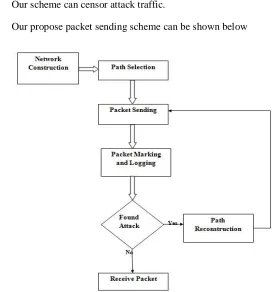
Our propose packet sending scheme can be shown below
Routers’ interface numbers and integrates packet logging with a hash table marks interface numbers of
routers on packets so as to trace the path of packets. Since the marking field on each packet is limited,
our packet-marking scheme may need to log the marking field into a hash table and store the table index
on the packet. We repeat this marking/logging process until the packet reaches its destination. After that,
we can reverse such process to trace back to the origin of attack packets[6]. The entire work of this
paper is divided into five different modules. They are:
Network topology Construction
Path Selection
Packet Sending
Packet Marking and Logging
Path Reconstruction
II.Network topology Construction
A Network Topology may consist of the number of routers that are connected with local area
networks. Thus, a router can either receive data from the nearer router or from the local area network. A
border router receives packets from its local network [5]. A core router receives packets from other
routers. The number of routers connected to a single router is called as the degree of a router. This is
calculated and stored in a table. The Upstream interfaces of each router also have to be found and stored
in the interface table.
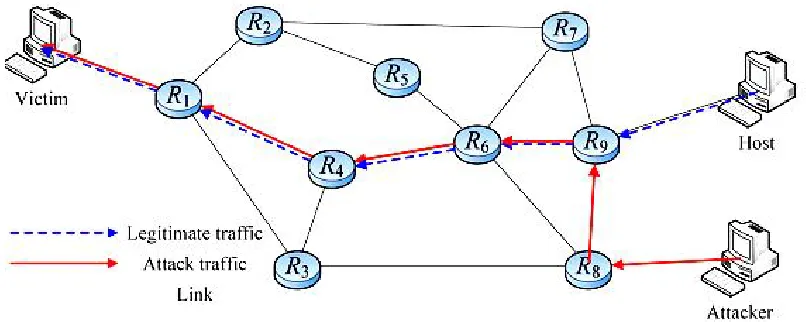
As the network topology shows in Fig. 2, a router can be connected to a local network or other routers,
or even both. A border router receives packets from its local network. A core router receives packets
from other routers [4]. For example, serves as a border router when it receives packets from Host.
However, it becomes a core router when receiving packets from the assumptions of our scheme are as
follows.
1) A router creates an interface table and numbers the up-stream interfaces in advance. 2) A router knows whether a packet comes from a router or a local network.
3) Such a traceback scheme is viable on every router.
4) The traffic route and network topology may be changed, but not often.
If we use the identification field to mark a packet, it can lead to identification number collision in the
reassembling process.
III. Path Selection
The path is said to be the way in which the selected packet or file has to be sent from the source
to the destination [3][2]. The Upstream interfaces of each router have to be found and it is stored in the
interface table.With the help of that interface table, the desired path between the selected source and
IV. Packet Sending
One of the Packet or file is to be selected for the transformation process.The packet is sent along the
defined path from the source LAN to destination LAN[1][5].The destination LAN receives the packet
and checks whether that it has been sent along the defined path or not.
V. Packet Marking and Logging
Packet marking is the phase, where the efficient Packet Marking algorithm is applied at each
router along the defined path. It calculates the Pmark value and stores in the hash table. If the Pmark is
not overflow than the capacity of the router, then it is sent to the next router. Otherwise it refers the hash
table and again applies the algorithm. The packet marking and logging scheme and Notations are shown
below.
Figure 2. Network Topology for path construction
Notations:
Ri {R1,R2,R3……Ri,…..Rx} Routers in the internet
D(Ri) The degree of Ri
UIi The upstream interface number of the router Ri in the route r
P The received packet
H() A hash function
M The size of a hash table (i.e the number of slots in a hash table)
C1,c2 Constant
HT An m entries hash table
(HT[0] is reserved)
HT[index].mark:HT[index]’s mark field
HT[index].UI:HT[index]’s UI field
% The modulo operations
Packet Marking and Logging Scheme
Input: P, UIi
begin
1. marknew=P.mark X (D(Ri)+1) + UIi+1
2. if marknewis overflow then
3. index=h=H(P.mark)
4. probe=0
5. while not(HT[index] is empty or HT[index] is equal to (P.mark, UIi))
6. probe++
7. index=(h+c1 x probe + c2 x probe2)%m
8. end while
9. if HT[index] is empty then
10. HT[index].mark=P.mark
11. HT[index].UI=UIi
12. Endif
13. marknew=index x (D(Ri)+1)
14. endif
15. P.mark=marknew
16. Forward the packet to the next router
End
VI. Path Reconstruction
Once the Packet has reached the destination after applying the Algorithm, there it checks
whether it has sent from the correct upstream interfaces. If any of the attack is found, it request for the
Path Reconstruction. Path Reconstruction is the Process of finding the new path for the same source and
Path Reconstruction Scheme
Begin
1. UIi=markreq%(D(Ri)+1)-1
2. If UIi = -1 then
3. Index = markreg/(D(Ri)+1)
4. If not index = 0 then
5. UIi =HT[index].UI
6. markold = HT[index].mark
7. send reconstruction request with markold to upstream router by UIi
8. else
9. this router is the nearest border router to the attacker
10. endif
11. else
12. markold =markreq/(D(Ri)+1)
13. send reconstruction request with markold to upstream router by UIi
14. endif
End
VII. CONCLUSION
In this paper, we propose a new hybrid IP traceback scheme for efficient packet logging aiming to have a
fixed storage requirement in packet logging without the need to refresh the logged tracking information.
Also, the proposed scheme has zero false positive and false negative rates in an attack-path
reconstruction. Apart from these properties, our scheme can also deploy a marking field as a packet
identity to filter malicious traffic and secure against DoS/DDoS attacks. Consequently, with high
accuracy, a low storage requirement, and fast computation, our scheme can serve as an efficient and
secure for hybrid IP traceback. As for our future work, we would like to come up with another version of
the scheme which uses a 16-bit marking field to avoid the problem caused by packet fragmentation.
REFERENCES
[1] B.Al-Duwari andM. Govindarasu, “Novel hybrid schemes employing packet marking and logging for IP traceback,” IEEE Trans. Parallel Distributed Syst., vol. 17, no. 5, pp. 403–418, May 2006.
[2] A. Appleby, Murmurhash 2010 [Online]. Available: http://sites.google. com/site/murmurhash/
[3] A. Belenky and N. Ansari, “IP traceback with deterministic packet marking,” IEEE Commun. Lett., vol. 7, no. 4, pp. 162–164, Apr. 2003.
[5] S. M. Bellovin, M. D. Leech, and T. Taylor, “ICMP traceback messages,” Internet Draft: Draft-Ietf- Itrace-04.Txt, Feb. 2003.
[6] H. Burch and B. Cheswick, “Tracing anonymous packets to their approximate source,” in Proc. USENIX LISA 2000, New Orleans, LA, Dec. 2000, pp. 319–327.
[7] CAIDA’s Skitter Project CAIDA, 2010 [Online]. Available: http://www.caida.org/tools/skitter/