Bricklayer Attack: A Side-Channel Analysis on
the ChaCha Quarter Round
Alexandre Adomnicai1,3, Jacques J.A. Fournier2, and Laurent Masson1 1
Trusted Objects, Aix-en-Provence, France, {a.adomnicai, l.masson}@trusted-objects.com
2
CEA-Leti, Grenoble, France, [email protected] 3
EMSE, Gardanne, France,
Abstract. ChaChais a family of stream ciphers that are very efficient on constrainted platforms. In this paper, we present electromagnetic side-channel analyses for two different software implementations ofChaCha20
on a 32-bit architecture: one compiled and another one directly written in assembly. On the device under test, practical experiments show that they have different levels of resistance to side-channel attacks. For the most leakage-resilient implementation, an analysis of thewholequarter round is required. To overcome this complication, we introduce an optimized attack based on a divide-and-conquer strategy namedbricklayer attack.
Keywords: ChaCha, Implementation, Side-channel attacks
1
Introduction
ChaCha [7] is a family of stream ciphers introduced by Daniel J. Bernstein in 2008. It is a variant of the Salsa20 family [8], which is part of the eSTREAM portfolio [4], providing better diffusion for similar performances. ChaCha is an ARX-based cipher, which means that it only uses modular additions, rotations and bitwise XORs. It has been widely adopted for encryption, as well as for ran-dom number generation in many operating systems (e.g.Linux, OpenBSD) and protocols (e.g.SSH, TLS). Moreover, the upcoming version 1.3 of the Transport Layer Security (TLS) protocol [36] will allow Authenticated Encryption with As-sociated Data (AEAD) cipher suites only, leavingAES-CCM[32],AES-GCM[38] and ChaCha20-Poly1305[26] as the only three options. This update should sig-nificantly increase the use of ChaCha in the near future. On top of that, the Internet of Things (IoT) should be in favour of the ChaCha deployment (e.g. Apple HomeKit for IoT devices [2]), since its instances are cheaper than AES
on microcontrollers that do not have any dedicated cryptographic hardware. For instance, on Android phones, HTTPS connections from Chrome browsers to Google now useChaCha20-Poly1305[12].
Recently, studies have been carried out to evaluate its physical security, espe-cially regarding fault attacks [33,25]. However, only one side-channel analysis has been proposed so far [22]. We believe that further work must be undertaken in this field sinceChaChais particularly well suited for embedded devices.
Our contribution. In this paper, we focus on the side-channel analysis of
ChaChaby taking two different implementations into consideration.
First, we investigate the OpenSSL C source code compiled on a 32-bit ARM microcontroller. It results in a straightforward attack path, which consists in targeting each 32-bit key word independently.
The second target is an assembly implementation which saves some memory accesses. We highlight that, on the device under test (DUT), this slight modifi-cation protects from the only side-channel attack published to date. Neverthe-less, our implementation remains vulnerable even though attack paths are more complex. We tackle this problem by introducing thebricklayer attack, which is based on a divide-and-conquer approach, and emphasize that attacking from the keystream rather than from the input is way more efficient.
Outline. First, we present theChaChafamily of stream ciphers before providing an outline of side-channel attacks. Then, we describe our approaches on perform-ing electromagnetic analyses dependperform-ing on software implementations of ChaCha. Subsequently, we present our practical results and discuss the feasibility of con-ducting these attacks in real-world scenarios. Finally, we analyze the overhead introduced by the masking countermeasure in the specific case of ChaCha20.
2
The ChaCha family of stream cipher
As its predecessor, and unlike traditional stream ciphers,ChaChadoes not have an initilization phase since it works like a block cipher used in counter (CTR) mode [19]. Its core is an ARX-based function which maps a 512-bit input block to a 512-bit output key stream. Input blocks are built by arranging data in a 4×4 matrix where each element is a 32-bit word. The encryption key fills half of the matrix as it is 256-bit long, while the two remaining quarters are repectively occupied by the inputs and the constant ‘expand 32-byte k’. This constant aims at reducing the amount of data an attacker can control while the inputs refer to a nonce which is built from the block counter and the initial vector (IV).
‘expa’ ‘nd 3’ ‘2-by’ ‘te k’
k0 k1 k2 k3
k4 k5 k6 k7
nonce0 nonce1 nonce2 nonce3
The core function is defined by iterating several rounds on the input block, where each round consists of four parallel quarter round (QR) operations. A QR updates 4 words (i.e.a block quarter) as defined in Algorithm1wheremeans addition modulo 232,⊕means XOR and≪means left bitwise rotation. Algorithm 1 ChaChaquarterround(a, b, c, d)
a = b; d ⊕= a; d ≪= 16;
c = d; b ⊕= c; b ≪= 12;
a = b; d ⊕= a; d ≪= 8;
c = d; b ⊕= c; b ≪= 7;
Depending on the round number (enumerated from 0), each QR operates either on a column, or on a diagonal.
0 1 2 3
4 5 6 7
8 9 10 11
12 13 14 15
(a) Even round
0 1 2 3
4 5 6 7
8 9 10 11
12 13 14 15
(b) Odd round
ChaChaR refers to a specific instance whereR rounds are used. Several vari-ants are defined with 8, 12 or 20 rounds, defining different trade-offs between security and performance. Recently, it has been shown under certain assump-tions thatChaCha12is sufficiently secure to ensure a 256-bit security level [14]. Nevertheless,ChaCha20remains the most widespread instance for security mar-gins. In many implementations, ChaChaR uses R
2 iterations of double rounds
instead ofRrounds, which consists in a column round and a diagonal one. On top of iterating several rounds on the input block, an additional step is required. The reason is that while QRs scramble blocks beyond recognition, they are invertible. Therefore, applying the reverse of each operation in the reverse order leads to the original block and thus, the encryption key.ChaChaprevents this by adding the original block to the scrambled one, word by word, in order to generate the pseudo-random block. The whole encryption process is detailed in Algorithm2.
3
Background on Side-Channel Attacks
3.1 Correlation Electromagnetic Analysis
Algorithm 2 ChaChaR encryption Require:
n-bit plaintextP
encryption keyk
counterctr
IViv
Ensure: n-bit ciphertextC
forifrom 0 to n 512
do
B←init(k, ctr, iv) .input block initialization
B0←B .working variable
forjfrom 0 to R2 −1do quarterround(B00, B
0
4, B
0
8, B
0
12) .column rounds
quarterround(B10, B
0
5, B
0
9, B
0
13) quarterround(B20, B
0
6, B
0
10, B
0
14) quarterround(B30, B
0
7, B
0
11, B
0
15) quarterround(B00, B
0
5, B
0
10, B
0
15) .diagonal rounds
quarterround(B10, B
0
6, B
0
11, B
0
12) quarterround(B20, B
0
7, B
0
8, B
0
13) quarterround(B30, B
0
4, B
0
9, B
0
14) end for
B←BB0 .final block addition
Ci←Pi⊕B
ctr←ctr+ 1
end for
on a given processor with its own physical characteristics. Electronic circuits are inherently leaky as they produce emissions that make it possible for an attacker to deduce how the circuit works and what data is being processed. Because these emissions are nothing more than side effects, their use to recover cryptographic keys has been termed ‘side-channel attacks’. Since the publication of Differen-tial Power Analysis (DPA) [24], it is common knowledge that the analysis of the power consumed by the execution of a cryptographic primitive might reveal information about the secret involved.
A few years later, Correlation Power Analysis (CPA) has been widely adopted over DPA as it requires fewer traces and has been shown to be more efficient [11]. The principle is to target a sensitive intermediate state of the algorithm and try to predict its value from the known input and different key guesses. Then, to uncover the link between these predictions and the leakage measurements, the Pearson correlation coefficient between these two variables is computed using an appropriate leakage model. The Hamming weight (HW) and the Hamming distance (HD) model are the most commonly used models to simulate the leakage of a cryptographic device. For each key hypothesis, it results in a value between
Corr(X, Y) = r E(X·Y)−E(X)·E(Y)
E(X−E(X))2·E(Y −E(Y))2
(1)
where E(X) is the expected value of the random variable X. Finally, the hy-pothesis which matches with the real key should return a significantly higher coefficient than the other hypotheses. This attack remains valid when analyzing electromagnetic emanations [20,35] instead of power consumption, since they are mainly due to the displacement of current through the rails of the metal layers. In this case, we talk about Correlation ElectroMagnetic Analysis (CEMA).
3.2 Selection Function
The intermediate state y on which the side-channel attack focuses is defined by a selection function ϕ(x, k) =y, which is part of the encryption algorithm. It depends on x, a known part of the input and on k, an unknown part of the secret key. Usually, selection functions are chosen to be easy to compute, typically at the beginning of the encryption or decryption process. Furthermore, a valuable property for selection functions is high non-linearity as it ensures a good distinguishability between the correct and incorrect key guesses. Indeed, correlation between the leakage and the prediction will be close to zero if the key guess is incorrect due to their non-linear relationship.
In case of ARX structures, the non-linearity only relies on modular additions, while diffusion is provided by rotations (diffusion within single words) and XORs (diffusion between words). Although the carry propagation in the modular addi-tion results in some non-linearity, it is not as good a candidate as S-boxes. It can be explained by the fact that most significant bits in the output of a modular ad-dition are more subject to non-linearity than least significant ones. However, side channel attacks remain possible as shown in numerous publications [27,10,43].
4
Side-Channel Overview of ChaCha
4.1 ChaCha Case Study
with other data during the first round (after which they have been updated) and again during the final block addition.
An attack that takes advantage of the first round has already been published in [22]. The attack on the ith column round (0< i <4) relies on the selection function defined by
ϕ0
noncei,˜kikki+4
=noncei⊕˜ki
≪16ki+4 (2)
where ˜ki = ki constanti. Hence, as soon as a couple (˜ki, ki+4) has been
recovered, one just has to subtract the corresponding constant word in order to get ki. However, this selection function forces the attacker to target two key words at once, which results in a key search space |K|= 264. Since the bit-size of the targeted subkey determines the memory complexity of the side-channel attack, one can understand why this would be undoable in practice. To get around this problem, the authors exploit the QRs’ intermediate states in order to operate step by step. They propose to first recoverki by targetingnoncei⊕k˜i and then take advantage of its knowledge to find ki+4. Therefore, recoveringki andki+4 requires the knowledge ofnoncei. However, the paper also describes an attack path that allows to recover the entire key with the knowledge of only two words. This latter exploits several intermediate states in the first two rounds.
Regarding the final block addition, an attacker could chooseϕ(x, k) =x k where x refers to a keystream word and refers to modular subtraction. Compared to the previous attack path, it has the advantage of recovering all key words using the modular substraction as selection function. Moreover, all keystream words are pseudorandom values, which is not necessarily the case for nonces. However, this selection function requires the knowledge of the keystream (i.e.both plaintext and ciphertext).
Throughout this paper, we will make the assumption that an attacker has access to all this information. In Sect. 6 we discuss the attacks’ feasibility in practice and thus, whether our assumptions are reasonable.
4.2 Implementation Aspects
When targeting software implementations on load/store architectures, data trans-fers due to memory accesses (i.e.loads and stores between memory and registers) are known to leak the most information compared to arithmetic and logic oper-ations [31,13], which only occur between registers and are usually unexploitable in practice [9]. Our practical experiments on the DUT presented in Sect.6 veri-fied this hypothesis. Therefore, the intermediate values that are manipulated by these senstive operations should be easiest to target, introducing a direct link between selection functions and implementation aspects.
4.3 OpenSSL Implementation
First, we decided to attack a C implementation of ChaCha20 in order to see how compilers can deal with ARX structures and memory accesses. To do so, we compiled the ChaCha20C implementation from OpenSSL (version 1.0.1f) for an ARM Cortex-M3 microcontroller using the GNU ARM C compiler 5.06 (update 2). Regardless of the optimization level chosen (from -O0to -O3), as detailed in AppendixA, within a QR, each addition and each rotation is followed by aSTRinstruction. Hence, these memory accesses allowed us to carry out the attacks described above. Practical results are briefly presented in Sect. 6 for comparative purposes.
4.4 Side-Channel Analysis of the Salsa20 Quarter Round
In the next section, we show how memory accesses can be easily managed to remove the leakage of intermediate states within a QR. This implies to target the QR output without taking its intermediate values into consideration, making the attacks presented in [22] irrelevant in this case. Although such an analysis has already been performed onSalsa20[30], it does not apply toChaCha. Algorithm 3 Salsa20quarterround(a, b, c, d)
b ⊕= (a d) ≪ 7; c ⊕= (b a) ≪ 9; d ⊕= (c b) ≪ 13; a ⊕= (d c) ≪ 18;
In the case ofSalsa20, as described in Algorithm3, the update of the second input only depends on itself and two others (the first and the last). This allows to recover the key words involved in this computation as first/last input words, with two other ‘non-key’ operands (i.e.constant and nonce). The attack consists in performing a CPA on a 32-bit value using a divide-and-conquer (D&C) approach, which consists in separating the attack intod32
necomputations onn-bit windows in parallel. The other key words that do not match these requirements were retrieved by using the knowledge of those which have been previously recovered. This allowed to keep a search space of 232 instead of 264. On top of providing better diffusion, the ChaCha QR gives each input word a chance to affect the other three twice. This adjustment makes the attack irrelevant againstChaCha
since the key search space cannot be less than 264 in any case.
5
Side-Channel Analysis of the Quarter Round
Throughout this section, for greater clarity, we assume that all operators are left-associative so that
5.1 Optimizing Memory Accesses
A solution to overcome attacks on intermediate states within QRs is a straight-forward assembly implementation, which is a good way to reduce memory access instructions for load/store architectures. As explained in [9], for some instances of ARX lightweight block ciphers likeSimonandSpeck[5], it is possible to keep the whole state in registers during the entire encryption process. Thereby, they can be implemented in assembly without having to execute a singleSTR instruc-tion during the whole encrypinstruc-tion process, drastically reducing the amount of leakage.
Unfortunately, in the case of ChaCha, the state consists of 16 32-bit words. Therefore, it would require a 32-bit CPU with at least 16 general-purpose regist-fers (excluding the stack pointer, the program counter and other specific cases such as hardwired registers) to avoid memory accesses. As our chip only has 13 general-purpose registers, we implemented ChaCha so that word values are loaded into registers at the beginning of each QR and are then stored in RAM at the end. Furthermore, during the last round, related key words are also loaded into registers at the beginning of QRs, resulting in
quarterround0(x0, x5, x10, x15, k1, k6)
quarterround0(x1, x6, x11, x12, k2, k7)
quarterround0(x2, x7, x8, x13, k3, k4)
quarterround0(x3, x4, x9, x14, k0, k5)
where quarterround’(a, b, c, d, x, y) = quarterround(a, b, c, d) (0, x, y,0). This method protects against leakages that would allow an attack from the keystream using the modular subtraction as selection function. Thus, these el-ementary implementation tricks imply to analyze the side-channel resilience of thewhole QR.
5.2 Focusing on the Quarter Round
As every word influences the three others, and is updated twice, the simplest selection function would be defined by focusing, during the first column rounds, on the word which is completely updated at first, resulting in having
ϕ1(noncei, kikki+4) =noncei⊕˜ki≪16ki+4⊕ki≪12k˜i. (3) However, as previously mentioned, this implies a side-channel attack on 64 bits, which is not feasible in practice. Therefore, we investigated the relevance of the D&C approach in this specific case. Figure3sketches how key words are involved in computations. It results that targetingnbits ofy=ϕ1(noncei, kikki+4) does
ki+4
ki ˜
ki
y
A B C
≪16 ≪12
Fig. 3: D&C approach on the ChaChaQR,n= 8
one of 12, some bits of ˜ki may overlap. Hence, the key search space depends on the windows’ size.
|K|=
24n, ifn≤4 23n+4, if 4≤n≤12 22n+16, if 13≤n≤16 2n+32, otherwise
(4)
Furthermore, rotations are discarded from the selection function, resulting in
ϕ2,n
noncei,k˜ A i kk
B i kk
B i+4k˜k
C i
=nonceAi ⊕˜k A i nk
B i+4⊕k
B i nk˜
C i (5) where superscripts refer to intervals that define n-bit windows.
In order to evaluate this method, we performed software simulations using the HW model (without any additional noise) and random nonces. As expected, the right key matches with the highest correlation coefficient. Nevertheless, some other hypotheses also lead to the maximum coefficient as shown in Fig. 4, re-sulting in collisions.
Definition 1 (Collision).Letϕ(n, k)be a selection function andκbe the right key hypothesis. A collision is an hypothesis κ0 such that ϕ(n, κ) =ϕ(n, κ0) for all n.
Key hypotheses
0 50 100 150 200 250 300
Correlation coefficient-0.4
-0.2 0 0.2 0.4
Fig. 4: Attack simulation onϕ2,2
This observation bring us to Proposition1whose proof is given in AppendixB. Proposition 1. An attack onϕ2,n returns up ton·2
n+2
Another point that has not been discussed so far is the drawback caused by carry propagations. Except when focusing on the least significant bits (LSBs), one has no way of knowing if subkeys involved in additions are affected by a carry. Thus, the positions of targeted windows are very important. Plus, we made the choice to dissociate ˜ki from ki in order to prevent from erroneous predictions ofkAi nconstant
A i andk
C
i nconstant C
i. For instance, in Fig.3, ˜
kCi is the only hypothesis which could be erroneous due to a carry propagation on its addend. As a result, an attacker should mount one attack taking this carry into consideration, and another one without. This would mean that the total number of collisions would be doubled. Although this selection function may provide some information, we chose to investigate a more efficient attack path.
5.3 Benefits of the Reverse Function
The ChaCha QR is trivially invertible and the inverse quarter round (IQR) is defined in Algorithm4.
Algorithm 4 ChaChainv quarterround(a, b, c, d)
b ≫= 7; b ⊕= c; c = d;
d ≫= 8; d ⊕= a; a = b;
b ≫= 12; b ⊕= c; c = d;
d ≫= 16; d ⊕= a; a = b;
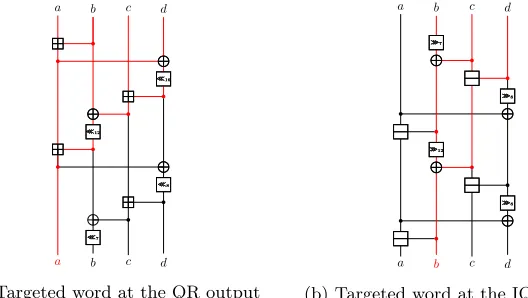
What matters here is that each input word does not have a chance to influence the other three, since the first word does not impact the update of the second one as illustrated in Fig.5b.
a b c d
≪ ≪ ≪16
≪ ≪≪12
≪ ≪≪8
≪≪≪7
a b c d
≪ ≪ ≪16
≪ ≪≪12
≪ ≪≪8
≪≪≪7
(a) Targeted word at the QR output
a b c d
≫ ≫ ≫7 ≫ ≫ ≫8 ≫ ≫ ≫12 ≫ ≫ ≫8
a b c d
≫ ≫ ≫7 ≫ ≫ ≫8 ≫ ≫ ≫12 ≫ ≫ ≫8
(b) Targeted word at the IQR output
Hence, the overall selection can be defined as below ϕ3
bkckd˜i, kbkkc
=bkb≫7
⊕ckc ≫12
⊕ckcd˜i
(6) where ˜di = di noncei. Regarding the D&C approach where rotations are discarded, it results in the following selection function.
ϕ4,n
bkckd˜i, k A b kk
B c kk
C c
=bAnk A b
⊕cBnk B c
⊕cCnk C c nd˜
C i
(7) As less words are involved, the key search space is reduced and still depends on the windows’ size.
|K|=
23n, ifn≤12 22n+12, if 12≤n≤20 2n+32, otherwise
(8)
However, since the rotations are less pronounced, key words do not overlap if the windows’ size does not exceed 12 bits, as depicted in Fig.6. Throughout the rest of this section, we only consider the case wheren≤12.
kc
kb
y
A B C
≫7 ≫12
Fig. 6: D&C approach on theChaChaIQR,n= 8
As before, key hypotheses might be affected by carry propagations. However, another advantage ofϕ4,noverϕ2,nis that one knows theentire32-bit minuend (i.e.borc). Thus, depending on its value, one can calculate the probability of a carry propagation. For instance, when targetingk[bx,x+n[, the probability is
p=Pkb[0,x[ > b[0,x[=
2x−b[0,x[+ 1
2x . (9)
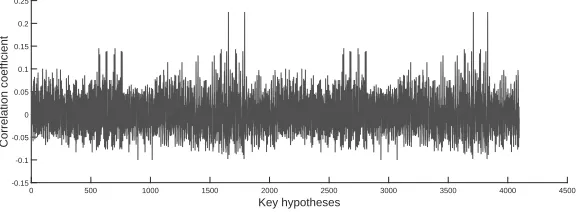
For our simulation withn= 4, we took a carry into consideration only ifp >0.75. On top of providing a smaller key search space, ϕ4,n is less prone to collisions as shown by our simulation depicted in Fig.7.
Proposition 2. An attack onϕ4,n returns 4 collisions.
Proof. Flipping the MSB of the minuend/subtrahend also flips the MSB of the modular difference. Therefore, in the case ofϕ4,n, flipping the MSB of twon-bit key windows leads to the same output. As a result, the number of collisions is equal to 1 + 32
= 4. ut
Key hypotheses
0 500 1000 1500 2000 2500 3000 3500 4000 4500
Correlation coefficient
-0.15 -0.1 -0.05 0 0.05 0.1 0.15 0.2 0.25
Fig. 7: Attack simulation onϕ4,4
5.4 Overview of the Brickerlayer Attack
Once collisions have been found usingϕ2,norϕ4,n, one has to reiterate the same procedure on different windows. Instead of executing several attacks in parallel, we suggest to take advantage of windows that have been previously recovered, in order to target larger ones. For instance, once 4 collisions have been found after an attack on ϕ4,n, one can target ϕ4,m, where m > n, with a complexity
|K|= 23(m−n)+1.
Proceeding in this sequential manner has two advantages. First, taking the carry propagation into consideration is only necessary during the first attack. This property is especially interesting forϕ2,n since there is no way to estimate carry propagations in this case. Second, each attack cancels collisions from the previous ones, since the positions of the collision bits are changed. For instance, regardingϕ4,n where collisions only depend on MSBs, the bricklayer approach transforms previous collisions into the predictions’ lower bits, allowing the cor-rect collision to stand out. This property is less efficient in the case ofϕ2,nsince collisions depends on all bits of the n-bit word. Therefore, the correct collision does not stand out directly but some wrong hypotheses are still discarded.
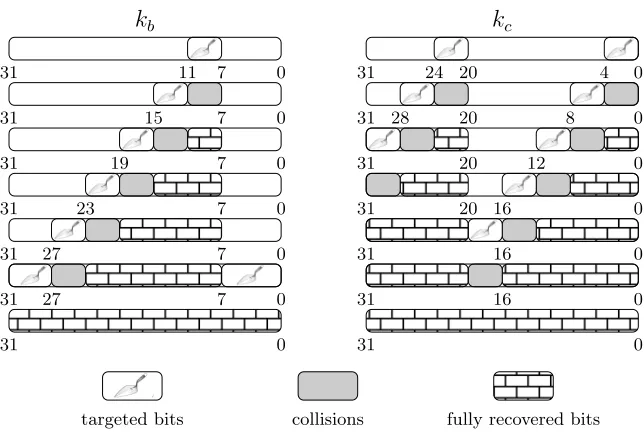
An example application of the bricklayer attack using ϕ4,n is depicted in Fig. 8. Note that from the fourth step, the attack focuses two key windows instead of three because rotations lead to a position that has already been re-covered. Finally, the last step considers the entire 32-bit output word usingϕ3
and the known bits/collisions.
6
Applications in Practice
6.1 Practical Experiments
k
ck
b31 24 20 4 0
31 11 7 0
31 28 20 8 0
31 15 7 0
31 20 12 0
31 19 7 0
31 20 16 0
31 23 7 0
31 16 0
31 27 7 0
31 16 0
31 27 7 0
31 0
31 0
targeted bits collisions fully recovered bits
Fig. 8: Bricklayer attack example on IQR
to avoid synchronization complications. EM emanations were measured using a Langer LF-U 5 near-field probe (100kHz-50MHz) and a LeCroy WaveSurfer 10 oscilloscope sampled at 10GS/s. The signal was amplified using a Langer PA 303 BNC preamplifier, providing a gain of 30dB. We used the same leakage model as for our simulations, since our microcontroller leaks the HW of intermediate values.
First, we tried to perform correlation analyses by focusing on arithmetic operations, without success. Figure9 emphasizes that attacking the final block addition during executions of quarterround’ was not successfull, whereas for the compiled C version (which stores the intermediate values in RAM), we were able to retrieve the key bits. This reinforced our assumption that, depending on the computing platform, memory accesses can be the only source of exploitable leakage for software implementations.
In order to put the bricklayer attack into practice, the following hard-coded input block was used to encrypt 250kB of data, where the counter (i.e.nonce0)
was incremented for each 512-bit block.
61707865 3320646e 79622d32 6b206574 ad0578e5 e962fc0a 42ffc031 75018bee b7ae69dc f1490ca8 89ac12fd be8466d3 00000000 f1d69cbf 8e34191d 7024af3b
(a) Attack on the final block addition (C compiled)
(b) Attack on the final block addition (ARM Assembly)
Fig. 9: Impact of memory accesses on electromagnetic leakage
Figure 11 depicts all the correlation curves corresponding to each step of the bricklayer attack when targeting k2 and k7. We incremented the windows’
length by 4 at each step, exactly as illustrated in Fig. 8, resulting in an overall computational complexity of 213. All CEMAs were computed by halving the key search space. Consequently, some results do not appear clearly on charts and have to be deduced.
The first step, which targets k237 ...20kk 3...0
7 kk
10...7
2 , returned the collisions
Γ = {γ1, γ2, γ3, γ4} = {56,176,2096,2232}. For the next stages, each key
hy-pothesis κ ∈ K was coupled to each collision γj ∈ Γ and was placed at the index i = κ· |Γ|+j of the prediction vector. Thus, higher coefficients at in-dexes i revealed the correct collision of the previous step γj by computing j = imod|Γ|. Finally, the new collisions are equal to (i−j)/|Γ|. For in-stance, Fig. 11b indicates that the maximum coefficient appears at indexes i∈ {6499,6979}. Both indexes are congruent to 3 modulo 4, which means that γ3=k
23...20
7 kk
3...0
7 kk
10...7
2 . As a result, the collisions fork 27...24
7 kk
7...4
7 kk
14...11 2
are defined by Γ ={1624,1744,3664,3800}. The remaining steps followed the same methodology, making it possible to recover k2 and k7 entirely. Obviously,
this can be applied on other IQRs in parallel to recover the whole encryption key.
A drawback of the D&C method is the number of required measurements, since the leakage of the omitted bits influences the attacked ones. Thus, more traces are needed in order to average out noise. Figure 12compares, regarding the number of measurements, an attack on the QR usingϕ2,3with the first step
0 500 1000 1500 2000 2500 -0.05
0 0.05 0.1 0.15
(a)κ=k237 ...20kk 3...0 7 kk
10...7 2
0 1000 2000 3000 4000 5000 6000 7000 8000 9000 0
0.05 0.1 0.15
(b)κ=k277 ...24kk 7...4 7 kk
14...11 2
0 1000 2000 3000 4000 5000 6000 7000 8000 9000 0.05
0.1 0.15 0.2 0.25
(c)κ=k317 ...28kk 11...8 7 kk
18...15 2
0 100 200 300 400 500 600 0.15
0.2 0.25 0.3
(d)κ=k715...12kk 22...19 2
0 50 100 150 200 250 300 0.1
0.15 0.2 0.25 0.3
(e)κ=k197 ...16kk 26...23 2
0 1000 2000 3000 4000 5000 6000 7000 8000 9000 0.2
0.3 0.4 0.5 0.6
(f)κ=k312 ...27kk 6...0 2
Fig. 11: CEMAs to recoverk2 andk7
(a) Attack on the QR usingϕ2,3 (b) Attack on the IQR usingϕ4,4
Fig. 12: Correlation coefficients to recover 12 key bits
6.2 Attacks’ Feasibility on Existing Protocols
assump-tion that could be available in an evaluaassump-tion laboratory but might be hard to set up in practice, leaving the attacks from nonces more realistic. Therefore, we discuss whether the knowledge of nonces is a fair assumption.
By definition, the single requirement for a cryptographic nonce is to be used only once. Therefore, a simple counter could suit the need. However, in cases where many different keys are used, some protocols (e.g. TLS) force a part of the nonce (e.g.the IV) to be random in order to thwart multi-key attacks [28]. This leaves the block counter as the only predictable part of the nonce. Therefore, if this latter is defined onnbits, then a correlation analysis cannot recover more than 2·n key bits. As a result, it introduces a protocol-level countermeasure which protects a large part of the key.
Still, existing protocols are not defined in this way. For instance, the Secure Shell (SSH) protocol uses the packet sequence number as a 64-bit IV [1] whereas the remaining 64 bits are used for the block counter, which is reset for each packet. Consequently, observing an entire SSH session makes it possible to pre-dict the entire nonce, giving an attacker the opportunity to recover all key words as soon as enough packets are transmitted.
Furthermore, another construction that can be encountered in practice is
XChaCha20, which is implemented in the Sodium crypto library [18]. This con-struction was first proposed forSalsa20[6] and aims at extending the nonce to 192 bits so that it can be picked at random. The main idea is to encrypt a block with a fixed keykand 128 bits of the random nonce, without executing the final block addition. The first and last 16 bytes of the output result in a 256-bit subkey k0. Finally, the regularChaCha20algorithm is executed using the 64 remaining bits of the 192-bit nonce as IV, andk0 as encryption key. Note thatXChaCha20
is intrinsically resistant against attacks from the keystream, since the final block addition is omitted during the subkey generation. However, the 192-bit nonce must be transmitted in clear and can be entirely known by the attacker.
These real life case studies introduce the need of dedicated countermeasures against side-channel attacks whenChaChais deployed in such conditions.
7
Towards a Secure Implementation
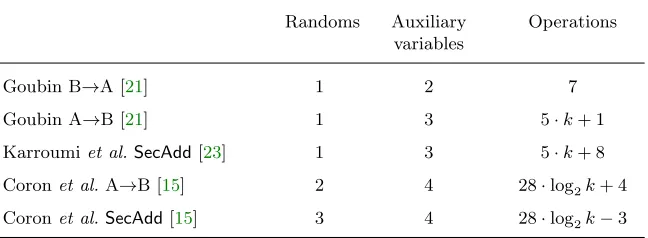
To overcome this complication, there are two main approaches. The first one is to switch from one masking scheme to the other whenever necessary. The first conversion algorithms, described by Goubin in [21], have complexity ofO(1) for boolean to arithmetic andO(k) for arithmetic to boolean, wherekrefers to the addends’ bit size. The latter was then improved by Coronet al.toO(logk) [15]. The second approach is to directly perform an addition on the masked val-ues, eliminating the need for conversions [23]. However, secure adders usually rely on the recursion formulae involved in arithmetic to boolean conversions. Consequently, they inherit from the same complexity. Some properties of these algorithms are listed in Table 1.
Table 1: Several algorithms’ parameters for first-order masking
Randoms Auxiliary variables
Operations
Goubin B→A [21] 1 2 7
Goubin A→B [21] 1 3 5·k+ 1
Karroumiet al.SecAdd[23] 1 3 5·k+ 8
Coronet al.A→B [15] 2 4 28·log2k+ 4
Coronet al.SecAdd[15] 3 4 28·log2k−3
Variants based on precalculations have also been proposed, where time-memory tradeoffs ensure better performances for arithmetic to boolean con-versions [17], as well as for secure adders [40].
The best method, in terms of performance, depends on the algorithm to be protected. For instance, masks conversions are more efficient when several arith-metic operations are processed sucessively, since only one aritharith-metic to boolean conversion is ultimately required. Otherwise, secure adders can lead to better performances as shown by a practical comparison between HMAC-SHA-1 and
Speck in [15]. In order to give an insight into the overhead introduced by a first-order masking, we implemented the two secure adders listed in Table1 in C language, using the same compilation options as described in Sect.4.3. This allowed us to compare, in terms of performance, our secure implementations of
Table 2: Running time in clock cycles to encrypt a 512-bit block using
ChaCha20on an ARM Cortex-M3
Time Penalty factor
ChaCha20unmasked 4 380 1
ChaCha20with Karroumiet al.SecAdd[23] 121 618 28
ChaCha20with Coronet al.SecAdd[15] 93 993 22
to be carried out to determine which algorithms could minimize memory access within QRs and how to securely manage them.
These practical results point out how difficult it is to effectively secure ARX ciphers’ implementations. However, masking is not the only answer to side-channel attacks and is often combined withhidingcountermeasures. The princi-ple of hiding is to randomize an algorithm execution by running its operations at different moments in time, during each execution [41,37]. This can be achieved by randomly inserting dummy operations andshuffling. Shuffling intends to ran-domly change the sequence of operations that can be computed in arbitrary or-der. In practice, hiding countermeasures increase the number of traces needed to carry out an attack [34,16].
RegardingChaCha, operations within a QR cannot be shuffled as they are ex-ecuted sequentially. On the other hand, each QR can be computed independently from the other, but this is only true for a single round because of switching from column to diagonal rounds. However, there are many ways to implement hiding in practice and further investigations will have to be carried out on the specific case of ChaCha.
8
Conclusions and Further Work
This paper presents side-channel analyses ofChaChabased on leakages related to memory accesses. Our study emphasizes that quantifying the signal available to the attacker at the instruction level could allow to strengthen implementations without much effort.
Finally, we discuss possible countermeasures at several levels and highlight how expensive it is to implement first-order masking for ChaCha20 with practical measurements. Therefore, further work must be undertaken to propose efficient secure implementations of ChaCha.
References
1. [email protected] Authenticated Encryption Mode (May 2016),
http://bxr.su/OpenBSD/usr.bin/ssh/PROTOCOL.chacha20poly1305
2. iOS 10 Security White Paper. Tech. rep., Apple Inc. (March 2017),https://www. apple.com/business/docs/iOS_Security_Guide.pdf
3. Aumasson, J.P., Fischer, S., Khazaei, S., Meier, W., Rechberger, C.: New Fea-tures of Latin Dances: Analysis of Salsa, ChaCha, and Rumba. Cryptology ePrint Archive, Report 2007/472 (2007),http://eprint.iacr.org/2007/472
4. Babbage, S., Borghoff, J., Velichkov, V.: The eSTREAM Portfolio in 2012,http: //www.ecrypt.eu.org/ecrypt2/documents/D.SYM.10-v1.pdf
5. Beaulieu, R., Shors, D., Smith, J., Treatman-Clark, S., Weeks, B., Wingers, L.: SIMON and SPECK: Block Ciphers for the Internet of Things. Cryptology ePrint Archive, Report 2015/585 (2015),http://eprint.iacr.org/2015/585
6. Bernstein, D.J.: Extending the Salsa20 nonce, https://cr.yp.to/snuffle/ xsalsa-20081128.pdf
7. Bernstein, D.J.: ChaCha, a variant of Salsa20. In: SASC - The State Of The Art Of Stream Ciphers. pp. 273–278 (2008), http://cr.yp.to/chacha/ chacha-20080128.pdf
8. Bernstein, D.J.: The Salsa20 Family of Stream Ciphers, pp. 84–97. Springer Berlin Heidelberg, Berlin, Heidelberg (2008), http://dx.doi.org/10.1007/ 978-3-540-68351-3_8
9. Biryukov, A., Dinu, D., Großsch¨adl, J.: Correlation Power Analysis of Lightweight Block Ciphers: From Theory to Practice, pp. 537–557. Springer International Pub-lishing, Cham (2016),http://dx.doi.org/10.1007/978-3-319-39555-5_29
10. Boura, C., Lvque, S., Vigilant, D.: Side-Channel Analysis of Grostl and Skein. In: 2012 IEEE Symposium on Security and Privacy Workshops. pp. 16–26 (May 2012),
https://www.ieee-security.org/TC/SPW2012/proceedings/4740a016.pdf
11. Brier, E., Clavier, C., Olivier, F.: Correlation Power Analysis with a Leakage Model, pp. 16–29. Springer Berlin Heidelberg, Berlin, Heidelberg (2004), http: //dx.doi.org/10.1007/978-3-540-28632-5_2
12. Bursztein, E.: Speeding up and strengthening HTTPS connections for Chrome on Android . Tech. rep. (April 2014),https://security.googleblog.com/2014/04/ speeding-up-and-strengthening-https.html
13. Callan, R., Zaji´c, A., Prvulovic, M.: A Practical Methodology for Measuring the Side-Channel Signal Available to the Attacker for Instruction-Level Events. In: Proceedings of the 47th Annual IEEE/ACM International Symposium on Mi-croarchitecture. pp. 242–254. MICRO-47, IEEE Computer Society, Washington, DC, USA (2014),http://dx.doi.org/10.1109/MICRO.2014.39
14. Choudhuri, A.R., Maitra, S.: Differential Cryptanalysis of Salsa and ChaCha – An Evaluation with a Hybrid Model. Cryptology ePrint Archive, Report 2016/377 (2016),http://eprint.iacr.org/2016/377
Springer Berlin Heidelberg, Berlin, Heidelberg (2015),https://doi.org/10.1007/ 978-3-662-48116-5_7
16. Courouss´e, D., Barry, T., Robisson, B., Jaillon, P., Potin, O., Lanet, J.L.: Runtime Code Polymorphism as a Protection Against Side Channel Attacks. Cryptology ePrint Archive, Report 2017/699 (2017),http://eprint.iacr.org/2017/699
17. Debraize, B.: Efficient and Provably Secure Methods for Switching from Arithmetic to Boolean Masking, pp. 107–121. Springer Berlin Heidelberg, Berlin, Heidelberg (2012),https://doi.org/10.1007/978-3-642-33027-8_7
18. Denis, F.: The XChaCha20-Poly1305 construction, https://download. libsodium.org/doc/secret-key_cryptography/xchacha20-poly1305_
construction.html
19. Dworkin, M.J.: SP 800-38A 2001 Edition. Recommendation for Block Cipher Modes of Operation: Methods and Techniques. Tech. rep., Gaithersburg, MD, United States (2001)
20. Gandolfi, K., Mourtel, C., Olivier, F.: Electromagnetic Analysis: Concrete Results, pp. 251–261. Springer Berlin Heidelberg, Berlin, Heidelberg (2001), http://dx. doi.org/10.1007/3-540-44709-1_21
21. Goubin, L.: A Sound Method for Switching between Boolean and Arithmetic Masking, pp. 3–15. Springer Berlin Heidelberg, Berlin, Heidelberg (2001), https: //doi.org/10.1007/3-540-44709-1_2
22. Jungk, B., Bhasin, S.: Don’t fall into a trap: Physical side-channel analysis of chacha20-poly1305. In: Design, Automation Test in Europe Conference Exhibition (DATE), 2017. pp. 1110–1115 (March 2017)
23. Karroumi, M., Richard, B., Joye, M.: Addition with Blinded Operands, pp. 41– 55. Springer International Publishing, Cham (2014),https://doi.org/10.1007/ 978-3-319-10175-0_4
24. Kocher, P.C., Jaffe, J., Jun, B.: Differential power analysis. In: Proceedings of the 19th Annual International Cryptology Conference on Advances in Cryptology. pp. 388–397. CRYPTO ’99, Springer-Verlag, London, UK, UK (1999),http://dl. acm.org/citation.cfm?id=646764.703989
25. Kumar, S.V.D., Patranabis, S., Breier, J., Mukhopadhyay, D., Bhasin, S., Chat-topadhyay, A., Baksi, A.: A Practical Fault Attack on ARX-like Ciphers with a Case Study on ChaCha20. In: 2017 Workshop on Fault Diagnosis and Tolerance in Cryptography, FDTC, Taipei, Taiwan (2017)
26. Langley, A., Chang, W., Mavrogiannopoulos, N., Strombergson, J., Josefsson, S.: ChaCha20-Poly1305 Cipher Suites for Transport Layer Security (TLS). RFC 7905, RFC Editor (June 2016),http://tools.ietf.org/rfc/rfc7905.txt,http: //tools.ietf.org/rfc/rfc7905.txt
27. Lemke, K., Schramm, K., Paar, C.: DPA on n-Bit Sized Boolean and Arithmetic Operations and Its Application to IDEA, RC6, and the HMAC-Construction. In: CHES. pp. 205–219 (2004), http://www.iacr.org/archive/asiacrypt2007/ 31560191/31560191.pdf
28. Luykx, A., Mennink, B., Paterson, K.G.: Analyzing multi-key security degradation. Cryptology ePrint Archive, Report 2017/435 (2017), http://eprint.iacr.org/ 2017/435
29. Maitra, S.: Chosen IV Cryptanalysis on Reduced Round ChaCha and Salsa. Dis-crete Appl. Math. 208(C), 88–97 (Jul 2016),http://dx.doi.org/10.1016/j.dam. 2016.02.020
31. McCann, D., Eder, K., Oswald, E.: Characterising and Comparing the Energy Consumption of Side Channel Attack Countermeasures and Lightweight Cryptog-raphy on Embedded Devices. Cryptology ePrint Archive, Report 2015/832 (2015),
http://eprint.iacr.org/2015/832
32. McGrew, D., Bailey, D.: AES-CCM Cipher Suites for Transport Layer Secu-rity (TLS). RFC 6655, RFC Editor (July 2012), http://tools.ietf.org/rfc/ rfc6655.txt
33. Mozaffari-Kermani, M., Azarderakhsh, R.: Reliable Hash Trees for Post-Quantum Stateless Cryptographic Hash-based Signatures. In: 2015 IEEE International Sym-posium on Defect and Fault Tolerance in VLSI and Nanotechnology Systems (DFTS). pp. 103–108 (Oct 2015)
34. Patranabis, S., Roy, D.B., Vadnala, P.K., Mukhopadhyay, D., Ghosh, S.: Shuffling across rounds: A Lightweight Strategy to Counter Side-Channel Attacks. In: 2016 IEEE 34th International Conference on Computer Design (ICCD). pp. 440–443 (Oct 2016)
35. Quisquater, J.J., Samyde, D.: ElectroMagnetic Analysis (EMA): Measures and Counter-measures for Smart Cards, pp. 200–210. Springer Berlin Heidelberg, Berlin, Heidelberg (2001),http://dx.doi.org/10.1007/3-540-45418-7_17
36. Rescorla, E.: The Transport Layer Security (TLS) Protocol Version 1.3. Internet-Draft draft-ietf-tls-tls13-21, Internet Engineering Task Force (Jul 2017), https: //tlswg.github.io/tls13-spec/draft-ietf-tls-tls13.html, work in Progress 37. Rivain, M., Prouff, E., Doget, J.: Higher-order masking and shuffling for software implementations of block ciphers. Cryptology ePrint Archive, Report 2009/420 (2009),http://eprint.iacr.org/2009/420
38. Salowey, J., Choudhury, A., McGrew, D.: AES Galois Counter Mode (GCM) Cipher Suites for TLS. RFC 5288, RFC Editor (August 2008), http://www. rfc-editor.org/rfc/rfc5288.txt
39. Shi, Z., Zhang, B., Feng, D., Wu, W.: Improved Key Recovery Attacks on Reduced-Round Salsa20 and ChaCha, pp. 337–351. Springer Berlin Heidelberg, Berlin, Hei-delberg (2013),http://dx.doi.org/10.1007/978-3-642-37682-5_24
40. Vadnala, P.K., Großsch¨adl, J.: Faster Mask Conversion with Lookup Tables, pp. 207–221. Springer International Publishing, Cham (2015), https://doi.org/10. 1007/978-3-319-21476-4_14
41. Veyrat-Charvillon, N., Medwed, M., Kerckhof, S., Standaert, F.X.: Shuffling against Side-Channel Attacks: A Comprehensive Study with Cautionary Note, pp. 740–757. Springer Berlin Heidelberg, Berlin, Heidelberg (2012),https://doi.org/ 10.1007/978-3-642-34961-4_44
42. Yadav, P., Gupta, I., Murthy, S.K.: Study and analysis of eSTREAM cipher Salsa and ChaCha. In: 2016 IEEE International Conference on Engineering and Tech-nology (ICETECH). pp. 90–94 (March 2016)
43. Zohner, M., Kasper, M., St¨ottinger, M.: Butterfly-Attack on Skein’s Modular Addition, pp. 215–230. Springer Berlin Heidelberg, Berlin, Heidelberg (2012),
A
ARM Instructions for Implementations of ChaCha’s
QR
-O0Compilation
LDR r1 ,[ sp ,#0 x10 ] LDR r0 ,[ sp ,#0 x00 ] ADD r0 , r0 , r1 STR r0 ,[ sp ,#0 x00 ] LDR r1 ,[ sp ,#0 x00 ] LDR r0 ,[ sp ,#0 x30 ] E O R S r0 , r0 , r1 L S L S r1 , r0 , # 1 6 LDR r2 ,[ sp ,#0 x00 ] LDR r0 ,[ sp ,#0 x30 ] E O R S r0 , r0 , r2
ORR r0 , r1 , r0 , LSR #16 STR r0 ,[ sp ,#0 x30 ] LDR r1 ,[ sp ,#0 x30 ] LDR r0 ,[ sp ,#0 x20 ] ADD r0 , r0 , r1 STR r0 ,[ sp ,#0 x20 ] LDR r1 ,[ sp ,#0 x20 ] LDR r0 ,[ sp ,#0 x10 ] E O R S r0 , r0 , r1 L S L S r1 , r0 , # 1 2 LDR r2 ,[ sp ,#0 x20 ] LDR r0 ,[ sp ,#0 x10 ] E O R S r0 , r0 , r2
ORR r0 , r1 , r0 , LSR #20 STR r0 ,[ sp ,#0 x10 ] LDR r1 ,[ sp ,#0 x10 ] LDR r0 ,[ sp ,#0 x00 ] ADD r0 , r0 , r1 STR r0 ,[ sp ,#0 x00 ] LDR r1 ,[ sp ,#0 x00 ] LDR r0 ,[ sp ,#0 x30 ] E O R S r0 , r0 , r1 L S L S r1 , r0 ,#8 LDR r2 ,[ sp ,#0 x00 ] LDR r0 ,[ sp ,#0 x30 ] E O R S r0 , r0 , r2
ORR r0 , r1 , r0 , LSR #24 STR r0 ,[ sp ,#0 x30 ] LDR r1 ,[ sp ,#0 x30 ] LDR r0 ,[ sp ,#0 x20 ] ADD r0 , r0 , r1 STR r0 ,[ sp ,#0 x20 ] LDR r1 ,[ sp ,#0 x20 ] LDR r0 ,[ sp ,#0 x10 ] E O R S r0 , r0 , r1 L S L S r1 , r0 ,#7 LDR r2 ,[ sp ,#0 x20 ] LDR r0 ,[ sp ,#0 x10 ] E O R S r0 , r0 , r2
ORR r0 , r1 , r0 , LSR #25 STR r0 ,[ sp ,#0 x10 ]
-O3Compilation
LDR r1 ,[ sp ,#0 x10 ] LDR r0 ,[ sp ,#0 x00 ] ADD r0 , r0 , r1 STR r0 ,[ sp ,#0 x00 ] LDR r1 ,[ sp ,#0 x00 ] LDR r0 ,[ sp ,#0 x30 ] E O R S r0 , r0 , r1 ROR r0 , r0 , # 1 6 STR r0 ,[ sp ,#0 x30 ] LDR r1 ,[ sp ,#0 x30 ] LDR r0 ,[ sp ,#0 x20 ] ADD r0 , r0 , r1 STR r0 ,[ sp ,#0 x20 ] LDR r1 ,[ sp ,#0 x20 ] LDR r0 ,[ sp ,#0 x10 ] E O R S r0 , r0 , r1 ROR r0 , r0 , # 2 0 STR r0 ,[ sp ,#0 x10 ] LDR r1 ,[ sp ,#0 x10 ] LDR r0 ,[ sp ,#0 x00 ] ADD r0 , r0 , r1 STR r0 ,[ sp ,#0 x00 ] LDR r1 ,[ sp ,#0 x00 ] LDR r0 ,[ sp ,#0 x30 ] E O R S r0 , r0 , r1 ROR r0 , r0 , # 2 4 STR r0 ,[ sp ,#0 x30 ] LDR r1 ,[ sp ,#0 x30 ] LDR r0 ,[ sp ,#0 x20 ] ADD r0 , r0 , r1 STR r0 ,[ sp ,#0 x20 ] LDR r1 ,[ sp ,#0 x20 ] LDR r0 ,[ sp ,#0 x10 ] E O R S r0 , r0 , r1 ROR r0 , r0 , # 2 5 STR r0 ,[ sp ,#0 x10 ]
Assembly Coded
P U S H { r4 - r7 } LDR r4 , [ r0 ] LDR r5 , [ r1 ] LDR r6 , [ r2 ] LDR r7 , [ r3 ]
ADD r4 , r4 , r5
EOR r7 , r7 , r4
ROR r7 , r7 , #16
ADD r6 , r6 , r7
EOR r5 , r5 , r6
ROR r5 , r5 , #20
ADD r4 , r4 , r5
EOR r7 , r7 , r4
ROR r7 , r7 , #24
ADD r6 , r6 , r7
EOR r5 , r5 , r6
ROR r5 , r5 , #25
B
Proof of Proposition
1
Proof. We first prove the specific case whereκ= ˜kCi kk B i+4kk
B i kk˜
A
i is such that ϕ2,n
x,k˜Ai , k
B i , k
B i+4,˜k
C i
=xfor allx.
Letϕ2,n(·, a, b, c, d) be the function that mapsx∈Z2n to ϕ2,n(x, a, b, c, d). From the definition ofϕ2,n, we can trivially ensure that if ϕ2,n(·, a, b, c, d) is an identity function onZ2n, thenϕ2,m(·, a, b, c, d) is an identity function onZ2m for
m < n.
If b, d are both multiples of 2m for m ≤ n, the addition terms modulo 2n do not interfere with the lowermbits. Hence if we split the numbers into lower m and uppern−mbits, i.e.x=x·2m+x, we can split ϕ2,n(x, a, b, c, d) into two separate actions:ϕ2,n−m(x, a, b, c, d) onZ2n−mandϕ2,m(x, a,0, c,0) onZ2m.
The latter of these,ϕ2,m(x, a,0, c,0) gives the identity function ifa=c. Since we may pick the largest suchm≤nso that 2mdividesbandd, where m=ncorresponds to the case whenb=d= 0 inZ2n, what remains to be solve
is the case where eitherb ordis odd.
A class of identity functions onZ2n is defined byϕ2,n(·,0, b,0, d) where bnd= 0. Moreover, XORing with 2
n−1
has the same effect as adding 2n−1, so we get identify functions ϕ2,n(·, a, b, c, d) for b, d∈Z2n and a, c ∈ {0,2
n−1 }
whenever anbn cn d = 0. Afterwards, XORing x with 2 n
−1 returns 2n−1−xin Z2n, thusϕ2,n(·,2n−1, b,2n−1, d) is an identity function when
b = d. Finally, these two may be combined: a, c ∈ {2n−1−1,2n−1} makes ϕ2,n(·, a, b, c, d) an identity function ifanb=cnd.
In all classes of solution,banddare either both odd or both even. We focus on the case where they are both odd as the basic solution. We can picka, cin 8 different ways, eithera, c∈ {0,2n−1} or a, c∈ {2n−1,2n−1−1}, an arbitrary odd d, and then solve forb. Thus, there are 2n+2 solutions withb, dodd.
For them lower bits, we have b=d= 0 and needa=c to get an identity function, which gives 2msolutions. For the uppern−kbits, we get the 2n−m+2 solutions found above. We now have to add up the counts for different values of m. For m= 0, . . . , n−2 this is straightforward. However, the casesm=n−1 andm=n(i.e.b=d= 0) are both a little different, but are easy to check: they have 3·2nand 2n solutions, respectively. In fact, for these two cases we may use that adding 2n−1 is the same as XORing with 2n−1, soϕ2,n(·, a, b, c, d) becomes an identity function for b, d∈ {0,2n−1} ifa⊕b⊕c⊕d= 0.
All in all, this result inn·2n+2 identity functions.
attack onϕ2,3withκ= (000k001k001k000)2 only returns 36 collisions.
How-ever, the simulation presented in Fig.4also returnsn·2n+2collisions despite the fact thatκ= (00k01k11k11)2 does not define an identity function.
Finally, if n >4, there are less than n·2n+2 collisions since some key bits