Binding Post-Quantum Commitment Scheme
Daniel Cabarcas1, Denise Demirel2, Florian G¨opfert3, Jean Lancrenon4, and Thomas Wunderer5
1
National University of Colombia, Columbia,[email protected]
2 Technische Universit¨at Darmstadt, Germany,
3
Technische Universit¨at Darmstadt, Germany,
4
University of Luxembourg, Luxembourg,[email protected]
5 Technische Universit¨at Darmstadt, Germany,
Abstract. Commitment schemes are among cryptography’s most im-portant building blocks. Besides their basic properties, hidingness and bindingness, for many applications it is important that the schemes ap-plied support proofs of knowledge. However, all existing solutions which have been proven to provide these protocols are only computationally hiding or are not resistant against quantum adversaries. This is not suitable for long-lived systems, such as long-term archives, where com-mitments have to provide security also in the long run. Thus, in this work we present a new post-quantum unconditionally hiding commit-ment scheme that supports (statistical) zero-knowledge protocols and allows to refreshes the binding property over time. The bindingness of our construction relies on the approximate shortest vector problem, a lattice problem which is conjectured to be hard for polynomial approxi-mation factors, even for a quantum adversary. Furthermore, we provide a protocol that allows the committer to prolong the bindingness prop-erty of a given commitment while showing in zero-knowledge fashion that the value committed to did not change. In addition, our construc-tion yields two more interesting features: one is the ability to “convert” a Pedersen commitment into a lattice-based one, and the other one is the construction of a hybrid approach whose bindingness relies on the discrete logarithm and approximate shortest vector problems.
Keywords: unconditionally hiding commitments, post-quantum, lattice-based cryptography, long-term security, proof of knowledge
1
Introduction
cryptographic concepts and services, such as zero-knowledge protocols [6, 8], se-cret sharing [22], key exchange [5], and others. A commitment scheme allows one to publicly commit to a hidden value which may be later revealed. It is required that 1) once the value has been committed to, it can no longer be changed by its owner, and 2) the value remains hidden until the owner chooses to reveal it. A scheme possessing the first property is said to be binding, and one with the second property is calledhiding.
Especially for long-lived systems such as long-term archiving (e.g., [14]), one would like these security properties to both holdperfectly, i.e. even in the pres-ence of computationally unbounded adversaries. However, it is well-known (and easy to see) that this is impossible. Thus, the best one can hope for is a scheme that is computationally binding and unconditionally (i.e. statistically or per-fectly) hiding, or vice-versa. In other words, given a fixed commitment scheme, at least one of these two properties will fail for this scheme, given enough time. In addition to the basic properties (bindingness and hidingness), many appli-cations require commitment schemes with additional functionalities. Arguably one of the most important among those are proof of knowledge protocols. They allow, for instance, a committer to convince a challenger that it can open a com-mitment, without revealing any additional information about the opening value or secret.
Benhamouda et al. [4] presented an interesting lattice-based commitment scheme supporting proofs of knowledge. The authors show that the scheme is unconditionally binding and computationally hiding even for a polynomial time quantum adversary. This scheme can consequently be considered as post-quantum secure. Nevertheless, since it is only computationally hiding, it can not be used in a long-term setting processing secret data. This is due to the fact that an attacker can simply store the commitment, wait until it has access to enough resources to solve the computational problem providing the hiding property, and recover the secret. Therefore, long-term secure commitment schemes must pro-vide unconditional hidingness from the very beginning. In addition, since in a long-term setting it is not reasonable to dismiss the future existence of efficient quantum computers, the schemes must also be post-quantum secure. Developing an unconditionally hiding commitment scheme supporting proofs of knowledge provides another valuable property for long-lived systems. They allow to prolong the computational binding property over time while allowing the committer to prove in zero-knowledge fashion that the value committed to did not change. How to achieve this for the Pedersen commitment scheme has been shown by Demirel et al. [10]. In this work we show how this can be transferred to the post-quantum world.
1.1 Contribution and Roadmap
scheme, which so far has been proven to support proofs of knowledge and offers prolongable bindingness.
In Section 3 we introduce LPCom and prove that correctly instantiated it is unconditionally hiding and computationally binding under standard lattice assumptions. Section 4 shows how to perform proof of knowledge protocols for LPCom. These protocols are used in Section 5 to construct proof of message equality protocols, from which we build a protocol for prolonging the bindingness of LPCom. Finally, in Section 6 we discuss how the proofs of message equality can also be used to convert a Pedersen commitment into anLPComcommitment, allowing to provide double-hardness (i.e. the security is based on two different hardness assumptions). This is desired in long-term systems, since it can prevent a loss in security in case of a sudden breakthrough on cryptanalysis.
2
Background and Notation
2.1 General Notation
Throughout the paper, vectors will be denoted by small bold letters (e.g. v), while matrices will be denoted by capital bold letters (e.g. A). We will write
kvk for the euclidian norm of the vector v. Furthermore, for q ∈ Z we write Zq instead of Z/qZ. Sometimes, abusing notation, we identify elements in Zq
with elements in Z. For this, we will identify a residue class in Zq with its
representative of smallest absolute value whenever necessary. We also extend this identification coordinate-wise to elements of Zn
q. It should always be clear
from the context when an element inZq is viewed as an element inZ. Using this
notation, we define the lengthkvkfor an elementv ∈Zn
q, by taking the norm of
the corresponding element inZn. Notice that this length function still satisfies
the triangular inequality.
A function f :Z→Ris said to be negligible (inx) if for every positive integer c, we have|f(x)| <1/xc for every sufficiently large x. Based on this notation,
a (probability) function p:Z →[0,1] is called overwhelming (in x) if 1−pis negligible (in x). The statistical distance is a measure for the difference of two probability distributions. For a precise definition we refer to [11].
2.2 Lattices
A subset Λ ⊂ Rn is called a lattice in Rn if there exists an m ∈[0, n] and m R-linearly independent vectors b1, . . . ,bm such that Λ = Zb1+. . .+Zbm. In
this case, the vectors b1, . . . ,bm are called a basis of the lattice Λ. The
funda-mental parallelepiped of a basis is defined asP ={Pm
i=1αibi|αi∈[0,1)}. The
dimension dim(Λ) of a latticeΛis denoted by the maximal number ofR-linearly independent lattice vectors. A lattice Λ ⊆ Rn has full rank if dim(Λ) =n. A
latticeΛ⊆Rn is called an integer lattice ifΛ⊂
Zn. The determinant det(Λ) of
basis chosen but only on the lattice itself. A lattice Λ ⊆Rn is called q-ary for
some integer q if it is an integer lattice containing qZn as a sublattice. In the
following, we will only be dealing withq-ary lattices, which by definition are full ranked. Typically, aq-ary lattice is given in form of a matrix A∈Zm×n. More
precisely, for a matrixA∈Zm×n we define theq-ary lattice
Λq(A) ={y∈Zm| ∃x∈Znq :Ax=y modq}.
While algebraic problems related to lattices (such as calculating intersections and sums of lattices or checking whether a certain vector is a lattice vector) are typically easy, certain geometric problems are believed to be hard, even in the presence of quantum computers. The arguably most important lattice problem is the Shortest Vector Problem (SVP): Given a lattice Λ, find a shortest non-zero lattice vector. The length of a shortest non-non-zero lattice vector is referred to asλ1(Λ). More general, for a latticeΛ⊂Rn andi∈N, byλi(Λ) we denote
the radius of the smallest n-dimensional ball centered around the origin that contains at leastiR-linearly independent lattice vectors. We call λi(Λ) the i-th
successive minimum ofΛ.
The Gaussian heuristic is typically considered a good tool for estimating the size of the successive minima of a lattice and frequently used in lattice-based cryptography. In its original form, it estimates the number of lattice points in a given set. We give a version of it that is used to estimate the last successive minimum of a lattice.
Assumption 1 (Gaussian Heuristic) The m-th successive minimum of an m-dimensional latticeΛ can be approximated by
λm(Λ)≈
det(Λ)
Vm
1/m
,
whereVm is the volume of anm-dimensional ball with radius one.
Formbig enough, we have
Vm1/m=
πm/2 Γ(m/2 + 1)
1/m
≥ π
1/2 (m/2)m/21/m
= r
2π m.
Combining this with the Gaussian heuristic leads to the assumption
λm(Λ)≤
r m 2πdet(Λ)
1/m
. (1)
Rather than the SVP, the hardness of lattice-based schemes is typically based on a relaxation denoted by α-SVP: Given a lattice Λ and some α≥ 1, find a non-zero lattice vector of norm at most αλ1(Λ). This problem is conjectured to be hard as long as α is polynomial in the lattice dimension and the lattice contains no trivial non-zero vectors (in aq-ary lattice, we say vectors inqZn are
One might ask how hard finding non-trivial short lattice vectors is in practice. Gama and Nguyen [12] identified the hermite factor δ as the main parameter determining the hardness of finding a lattice vector shorter than a given length. The hermite factorδof a lattice vectorv in anm-dimensional latticeΛis given by
δm= det(Λ) 1/m
kvk .
Current estimates claim that finding vectors with hermite factor δ = 1.01 is hard, and already slightly smaller hermite deltas are considered out of reach for a foreseeable future. LetΛbe aq-ary lattice andqbe minimal with this property. Then the trivial vectors areqZn, and therefore we can conclude thatα-SVP on
Λ is considered to be hard as long as αis polynomial in the lattice dimension andαλ1(Λ)< q.
Lattice-based cryptographic schemes often make use of values that are sam-pled according to a discrete Gaussian distribution. Recall that the continuous Gaussian distributionDσ with Gaussian parameter σ is defined by its density
functionρσ(x) = exp(−πx2/σ2)/σ. Likewise, the n-dimensional discrete
Gaus-sian distributionsDn
v,σ centered around somev ∈Rn with Gaussian parameter
σis defined by
Pr[Dvn,σ =x] = Pρσ(kx−vk)
w∈Znρσ(kwk)
.
For a probability distributionD on a setX we use the notation x←$ D in order to say thatx is sampled according toD. Ifx is sampled uniformly on a setX, we simply writex←$ X.
2.3 Commitment Schemes
A commitment scheme consists of three probabilistic polynomial-time (PPT) algorithms (GenCom,Com,Unv) of the following form.
GenCom(1κ,1k) Thegeneration algorithm GenComtakes as input 1κand 1k, for security parametersκandk, and outputs a public commitment keypk. Note thatpk defines a message spaceM.
Com(pk, v) Thecommitment algorithm Comtakes as input a valuev∈ M and a commitment keypkand outputs a commitmentcand an opening valuer. Unv(pk, c, v, r) The unveil algorithm takes as input a commitment key pk, a
valuev, a commitmentc, and an opening valuer, and returnsv or⊥. We will suppose implicitly the presence of pk in the remainder, omitting it in the notation.
A commitment scheme is called:
Correct if for all v ∈ M, the unveil algorithm returns v with overwhelming probability whenever the inputs were computed honestly, i.e.,
for someεnegligible ink.
Statistically Hiding if for any pairv, v0∈ Mthe distribution of the random-ized commitments output byCom(pk, v) andCom(pk, v0) is statistically close inκ.
Computationally Binding if for any probabilistic polynomial-time adversary P, the probability to find pairs of opening values (v, r) and (v0, r0) with v 6= v0 to the same commitment value c that get accepted by the unveil algorithm is negligible, i.e.,
Pr[Unv(pk, c, v, r) =v∧Unv(pk, c, v0, r0) =v0∧v 6=v0 : (c, v, r, v0, r0)←P(pk)]≤ε
for someεnegligible ink.
In addition we want to have the following property.
Prolongable Bindingness: A commitment scheme provides prolongable bind-ingness if for any commitmentc1=Com1(pk1, v) a polynomial time bounded party that knows the opening values can generate a new commitment c2 = Com2(pk2, v) with a higher security level, such that it can prove in statistical zero-knowledge fashion that it can open both commitments to the same valuev.
While statistical and perfect hidingness are typically considered equivalent, the situation is not so easy when commitments must be valid for a long time. While perfectly hiding schemes do not provide any information abut the mes-sage, statistically hiding schemes allow an attacker to gain a negligible amount of information. One might think that an attacker can store the old commit-ments, wait until it has access to enough computational resources and use those resources to amplify this information. However, this would require him to run a big amount of independent attacks, which is impossible since it has only access to a polynomial number of commitments.
Our scheme is crafted such that κ allows to bound the information that can be extracted by an outside attacker. Note that this is independent of the underlying computational hardness guaranteeing the binding property tuned by the security parameterk.
3
LPCom
: A new Lattice-Based Commitment Scheme
3.1 Description of the Scheme
Figure 1 describes our commitment scheme LPCom. The generation algorithm GenComchooses a lattice dimensionm, a message space rankn, a modulusq, a Gaussian parameterσ, and an error boundB. It then samples two matricesA1 andA2 defining the commitment function, and sets a message spaceM.
The commitment algorithmComsamples a randomness valuerand a Gaus-sian error termeand computes the commitment corresponding to the value and those randomizers.
The unveil algorithmUnvchecks if the error term used in the commitment is small enough (i.e. smaller thanB) and returns the value if and only if this is the case.
GenCom(1κ,1k) Set appropriate parametersn, m, q ∈
ZandB, σ ∈R+ and
sample two matricesA1 $
←Zm×n q ,A2
$
←Zm×k
q such thatA= A1A2∈
Zmq ×(n+k)has trivial kernel. Furthermore, define the message spaceMas
a subgroup of Znq.
Com(v ∈ M) Sampler←$ Zkq ande
$
←Dm
σ, calculate
c=com(v,r,e) =A1v+A2r+e∈Zmq ,
and outputc,r.
Unv(c,v,r) Returnv ifkc−A1v−A2rk ≤B, and⊥if not. Fig. 1.LPCom
3.2 Correctness, Hidingness, and Bindingness
The unveil function obviously accepts an honestly created commitment as long as the sampled error termehas norm less or equal thanB. Since technically the Gaussian distribution Dm
σ is not bounded, in theory it might happen that an
honestly created commitment gets rejected by the unveil funtion. However, the following theorem provides a condition on the parameters such that the chance of this happening is negligible.
Theorem 1 (correctness) Let n, k, m, q∈Z,σ∈R+, andA1∈Zmq ×n,A2∈
Zmq ×k. Let B ∈R with B > σ
p
Pr[Unv(com(v, r, e), v, r) =v:r←$ Znq, e
$
←Dmσ] >1−( B
σ√m
√
2πeexp(−π( B σ√m)
2))m.
Proof:Follows directly from Lemma 2.10 in Micciancio and Regev [19]. Using Lemma 2.10 Micciancio and Regev [19], we can bound the probability that a valid commitment of a messagev∈Zn
q gets accepted by
Pr(kek ≤B|e←$ Dmσ)>1−
B
σ√m
√
2πeexp
−π( B σ√m)
2
m
.
In Section 1 we established that in order to guarantee long-term security of a commitment scheme it is necessary to have an unconditional hiding property. We show in the following that with the correct instantiation LPCompossesses this very property.
For this, we need the following two auxiliary lemmas about the so called smoothing parameter [19]. Roughly speaking, the smoothing parameter bounds the necessary size of a Gaussian error one has to add to a random lattice vectors to completely hide the lattice.
Lemma 1 (Micciancio and Regev [19]) For any m-dimensional lattice Λ and >0,
η(Λ)≤
r
ln(2m(1 + 1/))
π ·λm(Λ).
Lemma 2 (Gentry, Peikert, and Vaikuntanathan [13]) Let Λ0 be an m-dimensional integer lattice. Then for any ∈ (0,1/2), any σ ≥ η(Λ0), the
distribution of(Dσ modΛ0)is within statistical distance at most2of uniform
over(Zm modΛ0).
In the following theorem we provide conditions under which LPComis sta-tistically hiding.
Theorem 2 (hiding) LPCom is statistically hiding if σ > q
ln(2m(1+1/))
π ·
λm(Λq(A2))for some εnegligible inκ.
Proof: Since Zmq is a group, it suffices to show that for r
$
←Zkq and e
$
← Dm σ,
the distribution ofA2r+e modqis statistically close to uniform. Forx∈Zmq
we define
pA2(x) := Pr[A2r+e=x modq:r
$
←Zkq,e
$
Note that
pA2(x)∼
X
r∈Zkq
Pr[A2r+e=x modq:e $
←Dσm]
∼ X
r∈Zkq
X
v∈Zm
Pr[A2r+e+qv=x:e $
←Dmσ].
By definition we haveΛq(A2) ={A2r |r∈Zk}+qZm. In order to make this
representation as a sum unique, we can writeΛq(A2) ={A2r|r∈ {0,1, . . . , q− 1}k}+q
Zm, sinceAhas trivial kernel and thus the columns ofA2areZq-linearly
independent. Consequently, summing over all elements in {A2r+qw2 | r ∈
Zkq,w2∈Zm} is equivalent to iterating all lattice vectors inΛq(A2). This leads to
pA2(x)∼
X
w∈Λq(A2)
Pr[w+e=x:e←$ Dσm]
= Pr[e=x modΛq(A2) :e $
←Dmσ]. The constant of proportionality can be determined via
1 =c X
x∈Zmq
Pr[e=x modΛq(A2) :e $
←Dσm]
=c· q
m
det(Λq(A2))
X
x∈P(Λq(A2))
Pr[e=x modΛq(A2) :e $
←Dmσ]
=c· q
m
det(Λq(A2)) ,
where P(Λq(A2)) denotes the fundamental parallelepiped of an arbitrary but fixed basis ofΛq(A2). This shows that
pA2(x) =
det(Λq(A2)) qm Pr[D
m
σ =x modΛq(A2)]. Since
σ > r
ln(2m(1 + 1/))
π ·λm(Λq(A2)),
Lemma 1 shows thatσ≥η(Λq(A2)). Starting from Lemma 2 withΛ0 =Λq(A2), we can conclude that
2ε >Dist(Dσm modΛ0,Unif(Z m
q ) modΛ0)
= X
x∈P(Λ0)
Pr[e=x modΛ 0:e $
←Dmσ]−Pr[e=x modΛ0:e←$ Zmq ]
= X
x∈P(Λ0)
Pr[e=x modΛ0:e←$ Dmσ]− 1
Therefore, the statistical distance between the distributionY ofA2r+e modq, wherer←$ Zkq,e
$
←Dmσ and the uniform distribution inZq is bounded by
2 Dist(Y,Unif(Zmq ))
= X
x∈Zmq
Pr[x=y:y $
←Y]−Pr[x=y:y←$ Zm q ] = q m
det(Λ0) X
x∈P(Λ0)
Pr[x=y:y $
←Y]−q−m
= q
m
det(Λ0) X
x∈P(Λ0)
det(Λ0)
qm Pr[x=y modΛ
0:y $
←Dmσ]−q−m
= X
x∈P(Λ0)
Pr[x=y modΛ0:y←$ Dmσ]−
1 det(Λ0)
≤2ε,
which shows that Dist(Y,Unif(Zm
q ))≤ε.
SinceLPComwith the correct instantiation is statistically hiding it can only achieve computational bindingness. We show that LPCom is computationally binding by relating its binding property to solving the hard lattice problem α-SVP. In Section 2.2 we already discussed the hardness of this problem.
Theorem 3 (binding) LPComis computationally binding as long as for any probabilistic polynomial-time algorithm the probability of solving α-SVP in the m-dimensional q-ary lattice Λq(A) with approximation factor α= λ 2B
1(Λq(A)) is
negligible in the security parameterk.
Proof: Assume to the contrary that one can find two different opening triples that lead to the same (valid) commitment in polynomial time, i.e. one can find distinct (v1,r1,e1),(v2,r2,e2)∈Znq ×Zkq ×Zmq withke1k ≤B,ke2k ≤B such that A1v1+A2r1+e1=A1v2+A2r2+e2.We can rewrite this equation as
A
v 1−v2
r1−r2
=A1(v1−v2) +A2(r1−r2) =e2−e1.
Since A has trivial kernel and the triples (v1,r1,e1) and (v2,r2,e2) are distinct, we havee2−e16=0. This means we found a non-zero vectore=e2−e1 in the latticeΛq(A) of length at most 2B in polynomial time, a contradiction.
3.3 Instantiation
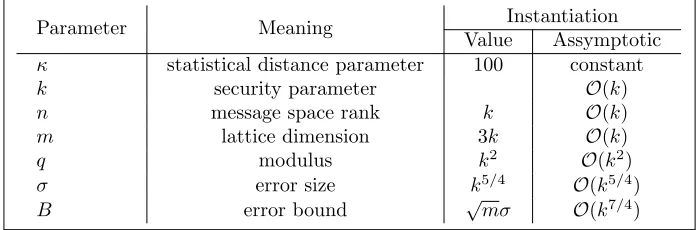
computationally binding is non-trivial. Theorem 4 shows that the parameter set proposed in Figure 2 leads to a secure and correct instantiation. The remaining parameter to tweak the security isk.
Recall that breaking the binding property ofLPComrequires an attacker to find a non-zero lattice of length at mostB=√mσ. A straightforward calculation shows that with the instantiation given in Figure 2 such a vector would have hermite factorδ=k5/(36k). This value tends to one very fast, which implies that finding such a vector is considered computationally infeasible even for moderate values ofk. A possible instantiation would be to choosek= 128, which leads to a hermite factor of approximatelyδ= 1.005. Lindner and Peikert [15] estimated the time to find such a vector to be more than 2128seconds, which is way beyond what is possible for the foreseeable future. Note, however, that the parameter sets presented in Figure 2 are not at all optimized for concrete instantiations. Since this work is mainly dealing with long-term security, we leave the task to find optimized parameter sets that meet specific security levels as an interesting future work.
Parameter Meaning Instantiation
Value Assymptotic κ statistical distance parameter 100 constant
k security parameter O(k)
n message space rank k O(k)
m lattice dimension 3k O(k)
q modulus k2 O(k2)
σ error size k5/4 O(k5/4)
B error bound √mσ O(k7/4)
Fig. 2.Parameter Set forLPCom
Theorem 4 Consider LPCom. Suppose that Equation (1) holds for the lattice Λq(A), and that for any PPT algorithm the probability of solving α-SVP in
Λq(A)with (polynomial) approximation factorα≤2
√
3·k7/4 is negligible in the security parameter k.
Then for sufficiently large security parameter k,LPCom with the instantiation from Figure 2 is correct, statistically hiding, and computationally binding.
Proof:
Correctness:Following Theorem 1, the probability that a valid commitment gets rejected is bounded from above by
B
σ√m
√
2πeexp(−π( B σ√m)
2) m
=√2πeexp(−π)
m
,
Hiding:Forε= 2−κandm big enough, Equation (1) leads to
r
ln(2m(1 + 1/))
π ·λm(Λq(A))≤ r
ln(2m(1 + 2κ))
π ·
r m 2πdet(Λ)
1/m
≤ln(m)·√m·q1/3. Inserting the parameters from Figure 2 shows that r
ln(2m(1 + 1/))
π ·λm(Λq(A))≤ln(3k)·
√
3k·k2/3=√3 ln(3k)·k7/6< k5/4=σ forksufficiently large. The rest follows from Theorem 2.
Binding:By Theorem 3 it suffices to show the upper bound onα= 2B λ1(Λq(A))
stated in the theorem. Since triviallyλ1(Λq(A))≥1 holds, we have
α= 2
√
mσ λ1(Λq(A))
≤2√mσ= 2√3·k7/4.
4
Proof of Knowledge for
LPCom
In a proof of knowledge, a proverP convinces a verifierV that it has knowledge of a secret without revealing anything about the secret apart from what is revealed by the claim itself (see Bellare and Goldreich [2] for a formal definition). In our case the claim is a commitment and the secret consists of the corresponding opening values.
Fist, in Section 4.1 we give a definition of Σ∗-protocols. Then in Section 4.2 the proof of knowledge protocol for LPCom is defined. Finally, Section 4.3 provides an instatiation ofLPComsuch that the proof of knowledge protocol is aΣ∗-protocol, while still being statistically hiding and computationally binding.
4.1 Σ∗-Protocols
Definition 1 Let (P,V)be a two-party protocol, where PandV are PPT, and letL,L0 ⊆ {0,1}∗be languages with witness relationsR ⊆ R0⊆ {0,1}∗×{0,1}∗. (That is, for all a ∈ {0,1}∗ we have a ∈ L(0) if and only if there exists some b ∈ {0,1}∗ such that (a, b) ∈ R(0). In this case b is called a witness for a ∈
L(0).) Then (P, V) is called aΣ∗-protocol forR,R0 with completeness error α, challenge set C ={0,1}, public input x, and private input w, if and only if it satisfies the following conditions:
Three-move form: The protocol is of the following form: The prover P, on input(x, w), computes a commitmenttand sends it toV. The verifierV, on inputx, then draws a challengec← C$ and sends it to P. The prover sends a response sto the verifier. Depending on the public input xand the protocol transcript (t,c,s), the verifier finally accepts (ok = 1) or rejects (ok = 0) the proof. The protocol transcript (t,c,s) is called accepting, if the verifier accepts the protocol run.
Completeness: Whenever(x, w)∈ R, the verifierVaccepts with probability at least1−α.
Computational special soundness: There exists a PPT algorithm E (the knowledge extractor) such that for any PPT algorithm A (the adversary), we have that
Pr[(x, w)∈ R/ 0)∧(ok0 =ok00= 1) : (x,(t,0, s0),(t,1, s00))←A,
ok0←V(x,(t,0, s0)), ok00←V(x,(t,1, s00)), w←E(x,(t,0, s0),(t,1, s00)]
is negligible.
Special honest-verifier statistical zero-knowledge (HVSZK): There ex-ists a PPT algorithm S (the simulator) taking x∈ L and c∈ C as inputs, that outputs (t,s) so that the triple (t,c,s) is statistically indistinguishable from an accepting protocol transcript generated by a real protocol run.
Remark 1 We give a few informal remarks on the properties defined in Defi-nition 1.
1. The completeness error α accounts for the fact that even an honest prover is not able to answer all challenges correctly. Note that the same holds true for theΣ0 protocol defined by Benhamouda et al.
2. The intuitive meaning of computational special soundness is the following. If a public inputxand two accepting transcripts that answer both challenges to the same commitment are given as an output of a PPT algorithm, one can extract a witnessw for x∈ L0 in polynomial time (with overwhelming probability).
4. Intuitively, the zero-knowledge property means that real protocol runs with honest prover and verifier can efficiently be simulated, hence revealing no additional information about the witness.
4.2 Proof of Knowledge Protocol
One well known approach for proving knowledge in perfect zero-knowledge fashion is to use a cut-and-choose based proof similar to the one proposed by Schnorr [23]. Our approach is based on a modification of this proposal introduced by Benhamouda et al. [3, 4].
Informally, the main idea of the protocol is the following. The prover wants to show that it can open a commitment c =com(v,r,e). In order to do so it chooses a random commitment c0 =com(v0,r0,e0) and sends it to the verifier. The prover is then asked by the verifier to either openc0orc+c0. Note that the prover can indeed open c+c0 (with overwhelming probability), sincec+c0 = com(v+v0,r+r0,e+e0). The hidden caveat of this approach is that by opening
c+c0 the verifier learnse+e0, which is Gaussian distributed centered around
e and hence contains information about e, and thus about v. This leakage of information would violate the hiding property of the commitment scheme. In order to overcome this problem one uses a technique called rejection sampling, described in the following.
Rejection sampling is a standard technique used in statistics and well known in lattice-based cryptography (see [16, 17]). It is used to transform one proba-bility distribution into another. This is needed for our protocol to transform a Gaussian distribution that is centered around some e into one that is centered around zero and independent ofe.
Theorem 5 Let V be a subset of Zmin which all elements have norm at most
T,α∈R+ and hbe a probability distribution on V. ForM = exp(2
√
κ α +
1 2α2)
andσ≤αT, the statistical distance of the output distribution of
1. v←$ h 2. z←$ Dm
v,σ
3. output(v,z)with probabilitymin Dmσ(z)
M Dm
v,σ(z)
,1, else output ⊥
and the output distribution of
1. v←$ h 2. z←$ Dσm
3. output(v,z)with probability1/M, else output ⊥
is bounded by exp(−κ).
The Protocol
Let n, m, κ, k, q ∈ Z, σ, σ0 ∈ R+, T =
√
mσ, α = σ0/T, M = exp(2 √
κ α +
1 2α2), A1∈Zmq ×n,A2∈Zmq×k. Also letM ⊂Znq be a subgroup and
com:M ×Zk q ×Z
m q →Z
m
q ,(v,r,e)7→A1v+A2r+e
be the corresponding commitment function described in Figure 1. Furthermore, let B ∈ R+ and Unv and Unv2B be the corresponding unveil functions with
boundB and 2B respectively as described in Figure 1.
Finally, letComabe an auxiliary computationally binding and statistically hiding
commitment scheme with message space Zm
q and Unva be the corresponding
unveil function.
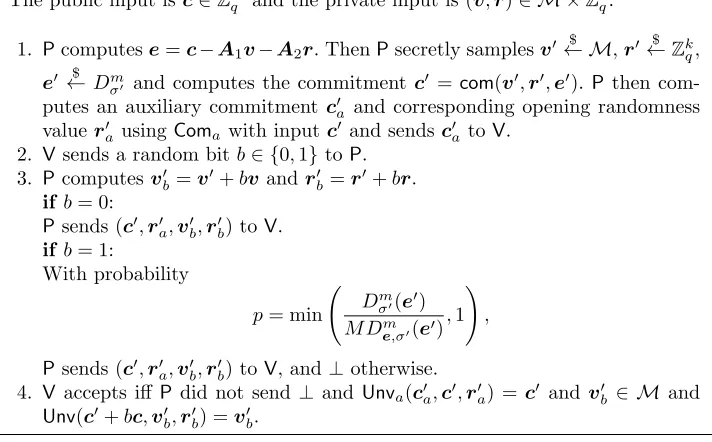
Figure 3 describes the proof of knowledge protocol forLPCom.
The public input isc∈Zmq and the private input is (v,r)∈ M ×Z k q.
1. Pcomputese=c−A1v−A2r. ThenPsecretly samplesv0 $
← M,r0←$ Zkq,
e0 ←$ Dmσ0 and computes the commitment c0 =com(v0,r0,e0). Pthen
com-putes an auxiliary commitment c0a and corresponding opening randomness
valuer0a using Coma with inputc0 and sendsc0a to V.
2. Vsends a random bitb∈ {0,1}toP. 3. Pcomputesv0
b=v0+bv andr0b=r0+br.
if b= 0:
Psends (c0,r0a,v0b,r0b) toV. if b= 1:
With probability
p= min D
m σ0(e0)
M Dm
e,σ0(e0)
,1 !
,
Psends (c0,r0a,v0b,r0b) toV, and⊥otherwise.
4. V accepts iff P did not send⊥ and Unva(c0a,c0,r0a) =c0 and v0b ∈ M and
Unv(c0+bc,vb0,r0b) =v0b.
Fig. 3.Proof of Knowledge
Remark 2 The auxiliary commitment used during the protocol is needed to guarantee the zero-knowledge property in case of an abort happening. This can be seen in the proof of Theorem 7 in the following Section 4.3.
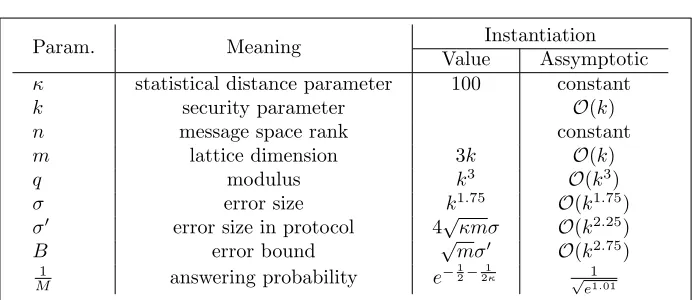
4.3 Instantiation
Param. Meaning Instantiation Value Assymptotic κ statistical distance parameter 100 constant
k security parameter O(k)
n message space rank constant
m lattice dimension 3k O(k)
q modulus k3 O(k3)
σ error size k1.75 O(k1.75)
σ0 error size in protocol 4√κmσ O(k2.25)
B error bound √mσ0 O(k2.75)
1
M answering probability e
−1 2−
1
2κ √1
e1.01
Fig. 4.Parameter Set for Proof of Knowledge
Theorem 6 Consider LPCom. Suppose that Equation (1) holds for the lattice Λq(A), and that for any PPT algorithm the probability of solving α-SVP in
Λq(A)with (polynomial) approximation factorα≤2
√
3·k7/4 is negligible in the security parameter k.
Then for sufficiently large security parameter k,LPCom with the instantiation from Figure 4 is correct, statistically hiding, and computationally binding.
Proof: Similar to the proof of Theorem 4. The following theorem shows that the protocol defined in Figure 3 is in fact a Σ∗-protocol for the instantiation proposed in Figure 4.
Theorem 7 With the parameters as given in Figure 4 and sufficiently large security parameter kthe protocol defined in Figure 3 is aΣ∗-protocol with com-pleteness error overwhelmingly close to 12− 1
2M for the relations
R={(c,(v,r))∈Zmq ×(M ×Z k
q)|v=Unv(c,v,r)} and
R0 ={(c,(v,r))∈Zmq ×(M ×Z k
q)|v=Unv2B(c,v,r)}.
Proof: Obviously, the protocol is given in the three-move form.
Completeness: Assume Pis an honest prover and letcbe the public input and (v,r) with (c,(v,r))∈ Rbe the private input ofP. First consider the caseb= 0. In this casePalways answers the challenge by sending (c0,r0a,v0,r0). Note that
v0 ∈ M. We have Unv
a(c0a,v0a,r0a) = v0a (with overwhelming probability), so
the first of the three accepting conditions is satisfied. Sincec0 =com(v0,r0,e0) and e0 ←$ Dm
σ0, we have Unv(c0,v0,r0) =v0 with overwhelming probability by
Theorem 1.
Now consider the caseb= 1. Then by Theorem 5 the proverPanswers the chal-lenge by sending (c0,r0a,v0+v,r0+r) with probability overwhelmingly close to
1
M, and⊥otherwise. In the following we consider the case thatPdoes not abort.
Note that v0 +v ∈ M. As before, Unva(c0a,v0a,r0a) = v0a (with overwhelming
that, after the rejection sampling performed in the protocol, the distribution of
e0+eis statistically close toDm
σ0 by Theorem 5. Hence it follows from Theorem
1 thatUnv(c0+c,v0+v,r0+r) =v0+v with overwhelming probability, since
c0+c=com(v0+v,r0+r,e0+e).
In conclusion the verifier V accepts with probability overwhelmingly close to 1
2(1 + 1
M), since both cases b= 0 and b= 1 are equally likely.
Computational special soundness: Assume a public input c and two accepting transcripts (c0a,0,(c0,r0a,v00,r00)) and (c0a,1,(c00,r00a,v001,r001)) are given as an out-put of a probabilistic polynomial time algorithmA. Since the auxiliary commit-ment schemeComais computationally binding, we havec0=c00with
overwhelm-ing probability, which we will therefore assume from now on. Thus by definition of the accepting condition of the protocol we havev0,v1∈ Mand
kc0−A1v00−A2r00k ≤B andkc0+c−A1v100−A2r001k ≤B. Hence v001−v00∈ Mand by linearity and the triangular inequation we obtain
kc−A1(v001−v00)−A2(r001−r00)k ≤2B, and thus (c,(v00
1−v00,r100−r00))∈ R0.
HVSZK: Let c and b ∈ {0,1} be given. The simulator S samples v0 ← M$ ,
r0 ←$ Zkq, e0
$
← Dmσ0 and computes the commitment c0 = com(v0,r0,e0)−bc.
ThenS computes an auxiliary commitmentca and corresponding opening
ran-domness valuera usingComa with inputc0.
First consider the caseb= 0. In this caseS outputs (ca,0,(c0,ra,v0,r0)).
Obvi-ously this is statistically indistinguishable from real protocol runs.
Now consider the case b = 1. With probability M1 the simulator outputs (ca,1,(c0,ra,v0,r0)). Otherwise,S computes an auxiliary commitment cba and
corresponding opening randomness valuerca using Coma with input0and
out-puts (cba,1,⊥). From the statistical hidingness of the auxiliary commitment and
Theorem 5, it follows that this output is statistically indistinguishable from real protocol runs. (In order to see this, recall that the rejection sampling performed in the protocol is used to makee+e0 Gaussian distributed around zero, which consequently makes e0 Gaussian distributed around−e.) Remark 3 Note that finding witnesses forL0 is nearly as hard as finding wit-nesses forL. In order to see this notice the following. To find witnesses forx∈ L
one needs to solveα-SVP in a certain lattice with approximation factorα. This is exactly what the binding property ofLPComis based on (see Theorem 3) and addressed in Theorem 6. Finding witnesses forx∈ L0 implies solving(2α)-SVP in the same lattice. However, doubling the desired approximation factor does not makeα-SVP considerably easier.
is necessary to repeat the proof of knowledge protocol multiple times in order to amplify the advantage an honest prover has over a dishonest prover. The verifier then must make a decision whether the prover is honest or not, based on the percentage of accepting protocol runs.6 We now discuss this in further detail.
In N repetitions of the protocol, an honest prover is expected to be able to answer N/2(1 + 1/M) challenges, while a dishonest prover is expected to only give N/2 correct answers. A natural choice for the verifier is therefore to accept the prover as honest if and only if it receives more thanN/2(1 + 1/(2M)) correct answers. In the following, we will show thatN = 4kM2is a good choice for the number of protocol runs that provides the desired result when using this criterion.
For this, we will model the number of correct answers given by an honest prover as the output of a binomial distribution with parameters N and p = (1 + 1/M)/2. It is well known that for largeN, this binomial distribution can be approximated by a continuous Gaussian distribution with meanN pand standard deviation pN p(1−p). Let p⊥,h denote the probability that, given the natural
accepting condition described above, the verifier does not accept an honest prover as such after N protocol runs. An easy calculation shows that
p⊥,h≈Pr[x≤N(1 + 1/(2M))/2 :x
$
←DN p,√N p(1 −p)] = Pr[x≤ −N/(4M) :x←$ D√
N(1−1/M2)/4].
WithN = 4kM2>4k(M2−1), this leads to the estimation p⊥,h≈Pr[x≤ −
4k(M2−1)
4M :x
$
←D√
4k(M2−1)(1−1/M2)/4]
= Pr[x≤ −√k·√k(M 2−1) M :x
$
←D√
k(MM2−1)]
The well-known fact
Pr[x >√kσ:x←$ Dσ]≤
exp(−πk) 2π√k ,
shows that we can estimate the probability of an honest prover to get rejected to be negligible in k.
The analysis of accepting a dishonest prover is similar. Since it has only a suc-cess probability overwhelmingly close top= 1/2, we can estimate its probability pa,d to get accepted by
pa,d≈Pr[x > N(1 + 1/(2M))/2 :x
$
←D
N p,√N p(1−p)] = Pr[x > kM :x←$ D√
kM].
6
5
Prolonging the Security of
LPCom
This section shows how to prolong the bindingness of our unconditionally hiding commitment scheme LPCom in the following way. Given an old commitment to a certain value the commitment owner generates a new commitment - with renewed parameters - to the same value. The owner then proves in perfect zero-knowledge fashion that it can open the old and the new commitment to the same value. This effectively rejuvenates the owner’s bind to the value in question, without damaging secrecy in any way, as long as both commitment schemes are unconditionally hiding.
A protocol for the proofs of message equality needed in the prolonging pro-cedure is presented in Section 5.1. Details on the prolonging propro-cedure itself are described in Section 5.2.
5.1 Proof of Message Equality
In a proof of message equality protocol, a proverP convinces a verifier Vthat it can unveil two commitments generated using two (different) instantiations of LPComto the same value. As long as the two commitments are computationally binding, the verifier then can be assured that the prover committed to the same value in both commitments. The basic idea of our approach is to run two proof of knowledge protocols in parallel using the same auxiliary value and is based on the methods of [6] and [20].
Let n, m1, m2, k1, k2, q1, q2 ∈ Z, σ1, σ2, σ01, σ02 ∈ R+, T1 =
√
m1σ1, α1 = σ01/T1,M1= exp(
2√κ α1 +
1 2α2
1
),T2=
√
m2σ2, α2=σ20/T2,M2= exp( 2√κ
α2 +
1 2α2
2
),
A1,1 ∈ Zm1×n
q1 ,A1,2 ∈ Z
m1×k1
q1 , A2,1 ∈ Z
m2×n
q2 , A2,2 ∈ Z
m2×k2
q2 . Also let
M1 ⊂ Znq1 and M2 ⊂ Z
n
q2 be two isomorphic subgroups, ϕ : M1 → M2 be
a group isomorphism, and com1:M1×Zkq11×Z
m1
q1 →Z
m1
q1 , (v1,r1,e1)7→A1,1v1+A1,2r1+e1
com2:M2×Zkq22×Z
m2
q2 →Z
m2
q2 , (v2,r2,e2)7→A2,1v2+A2,2r2+e2
be the corresponding respective commitment functions described in Figure 1. We say two values v1 ∈ M1 and v2 ∈ M2 are equal (with respect to ϕ) if
v2=ϕ(v1).
Also let B1, B2 ∈ R+ and Unv1, Unv2 be the unveil functions corresponding
to the respective commitment functions with bound B1 andB2 respectively, as described in Figure 1. Furthermore, let Unv1,2B1, and Unv2,2B2 denote the
un-veil functions corresponding to the respective commitment functions with bound 2B1 and 2B2respectively.
Finally, let Com1,a and Com2,a be two auxiliary computationally binding and
statistically hiding commitment schemes with message space Zm1
q1 and Z
m2
q2
re-spectively, andUnv1,a andUnv2,a be the corresponding unveil functions.
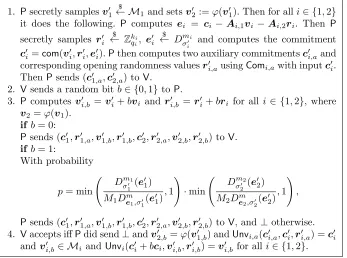
The public input is (c1,c2)∈Zm1
q1 ×Z
m2
q2 and the private input is (v1,r1,r2)∈
M1×Zk1
q1 ×Z
k2
q2.
1. Psecretly samplesv01 $
← M1and setsv02:=ϕ(v01). Then for alli∈ {1,2} it does the following. P computes ei = ci −Ai,1vi−Ai,2ri. Then P
secretly samples r0i ←$ Zki
qi, e
0
i
$
← Dmi
σ0
i
and computes the commitment
c0i=com(v0i,ri0,e0i).Pthen computes two auxiliary commitmentsc0i,aand corresponding opening randomness valuesr0i,ausingComi,awith inputc0i.
ThenPsends (c01,a,c02,a) toV. 2. Vsends a random bitb∈ {0,1}toP.
3. Pcomputes v0i,b =v0i+bvi and r0i,b =r0i+bri for all i ∈ {1,2}, where
v2=ϕ(v1). if b= 0:
Psends (c01,r01,a,v01,b,r01,b,c02,r02,a,v20,b,r02,b) toV. if b= 1:
With probability
p= min
Dm1
σ0 1(e
0 1) M1Dme1,σ10
(e0 1)
,1 !
·min
Dm2
σ0 2 (e
0 2) M2Dme2,σ02
(e0 2)
,1 !
,
Psends (c0
1,r01,a,v01,b,r01,b,c02,r02,a,v02,b,r02,b) toV, and⊥otherwise.
4. Vaccepts iffPdid send⊥andv0
2,b=ϕ(v01,b) andUnvi,a(c0i,a,c0i,r0i,a) =c0i
andv0i,b∈ Mi andUnvi(c0i+bci,v0i,b,r
0
i,b) =v
0
i,b for alli∈ {1,2}.
Fig. 5.Proof of Message Equality
Theorem 8 With the indexed parameters as given in Figure 4 and sufficiently large security parameters k1 and k2 the protocol defined in Figure 5 is a Σ∗ -protocol with completeness error overwhelmingly close to 12− 1
2M1M2 for the
re-lations
R={((c1,c2),(v1,r1,r2))∈(Zmq11×Z
m2
q2 )×(M ×Z
k1
q1 ×Z
k2
q2)| v1=Unv1(c1,v1,r1)∧ϕ(v1) =Unv2(c2, ϕ(v1),r2)} and
R0={((c1,c2),(v1,r1,r2))∈(Zm1
q1 ×Z
m2
q2 )×(M ×Z
k1
q1 ×Z
k2
q2)| v1=Unv1,2B1(c1,v1,r1)∧ϕ(v1) =Unv2,2B1(c2, ϕ(v1),r2)}.
Proof:Similar to the proof of Theorem 7, since this is essentially the protocol
defined in Figure 3 run twice in parallel.
5.2 Prolonging the Bindingness
In the prolonging algorithm presented in Figure 6 we show how to prolong the bindingess of a commitmentc1to a messagev. Possible instantiations ofLPCom that can be used for prolonging are ones according to Figure 4. However, since other parameter choices are possible we give the more general result here.
The first step to prolong the bindingness of a commitmentc1is to generate a new commitmentc2to the same (or an equivalent) value. Two values are consid-ered equivalent if a signalized isomorphism between the two message spaces maps one value to the other. A possible way to achieve isomorphic message spaces is to use message spaces isomorphic to Zn
2, i.e.M={0, q/2}2 (see Remark 4 for more details).
In Section 3.3 we showed that violating the bindingness of LPCom instan-tiated with parameters according to Figure 2 gets increasingly harder with in-creasing security parameterk. It is easy to see that the same is true ifLPComis instantiated according to Figure 4. If both schemes are instantiated according to Figure 4, violating the binding property of the new commitment (instantiated with security parameterk2) is in fact harder than violating the bindingness of the old commitment (instantiated with security parameter k1) as long ask2> k1.
LetCom1 (and the corresponding unveil function) be a correct, statistically hiding, and computationally binding instantiation ofLPComsuch that the follow-ing holds: When usfollow-ingCom1, the protocol for proving message equality defined in Figure 5 is a Σ∗-protocol. The procedure to prolong the bindingness to a commitmentc1=Com(v) works as described in Figure 6.
1. Choose a new security parameter k2 for the desired security level. 2. Create a new instantiationCom2ofLPComwith security parametersκ, k2
and parameters (e.g. according to Figure 4) such that the following con-ditions are satisfied:
• Com2is correct, statistically hiding, and computationally binding.
• The message spaceM2 ofCom2 is isomorphic to the message space
M1ofCom1.
• When usingCom2, the proof of knowledge protocol defined in Figure 5 is aΣ∗-protocol.
3. Specify an isomorphismϕ:M1→ M2. (See Remark 4.)
4. The committer creates a new commitment c2 to the value ϕ(v) using Com2.
5. Using the protocol defined in Figure 5, the committer shows in statistical zero-knowledge fashion that it can open c1 and c2 to the same valuev (orϕ(v)) with the corresponding unveil functions.
Remark 4 Note that the isomorphism ϕ needs to be publicly stored with the commitment in order to extract the old value v from the new value ϕ(v). Al-ternatively, one can choose the message spaces such that there is a canonical isomorphism between them and specify “canonical” in the prolonging protocol. We now provide one possible canonical choice. Always let the message spaces
M ⊆ Znq be of the form M = Gn, where G = {0, q
2} is the (uniquely deter-mined) subgroup of Zq of order two. Note that q is required to be even for this
to be possible. If now M1 =Gn1 andM2 =Gn2 are of this form, then there is a unique isomorphism ϕ0 : G1 → G2 mapping the non-zero element of G1 to the non-zero element of G2. Applying this isomorphism in every coordinate, ϕ0 naturally extends to an isomorphism ϕ:Gn1 →Gn2.
6
Switching from Pedersen Commitment to
LPCom
Up until now in practice usually Pedersen commitments are used when an un-conditionally hiding commitment scheme is required. This is due to the fact that this commitment scheme is very efficient. In [10], the authors show that the bindingness of Pedersen commitments can also be prolonged. However, this is only secure as long as the discrete logarithm problem remains unbroken, in particular not in the presence of a quantum adversary. Thus, in this section we want to discuss how to proceed if a Pedersen commitment must be replaced by a prolongable post-quantum commitment, i.e. by the construction presented in this work.
We discuss the following approach to switch from Pedersen commitments to our lattice construction. One creates a new commitment using our lattice construction and shows in statistical zero-knowledge fashion that one can open the lattice and the Pedersen commitment to the same value. In order for this to work, one needs a protocol for proving message equality of two commitments, where one is created using our construction and the other using the Pedersen construction. Since our protocol and the protocol for proving message equality for Pedersen commitments follow essentially the same idea (see [20]), this should be a straightforward generalization of our protocol proposed in Figure 5. Remember that for the protocol to work it is crucial that the underlying massage spaces are isomorphic. In the following, we argue that it is possible to use isomorphic message spaces in both constructions.
In Pedersen commitments, the message spaceMPis essentially a cyclic group
of orderp, wherepis a sufficiently large prime. In our lattice construction the message spaceML is a subgroup ofZnq for some integers qand n. In order for
MP and ML to be isomorphic, we must have that |ML| =|MP| =p. Since
of course the order of the subgroup |ML| divides the group order |Zmq | =qm,
we obtain p | qm, hence p | q, since p is prime. In particular we have p ≤ q.
Since typical values forpare much larger than typical lattice moduliq, the most efficient choice is settingq:=pandML=Zq.
to the same value v: one generated using the Pedersen commitment scheme and the second one using LPCom. The advantage of this approach is that the bindingness of the commitment relies on two hardness problems, namely the discrete logarithm problem andα-SVP. Notice that since the hidingness of both commitment schemes is unconditionally, there is no disadvantage regarding the hiding property. On the downside this instantiation is very inefficient, at least with respect to the lattice commitment. This is because typical lattice moduliq have size about 13 bit, while usually the group orderpof the message space in a Pedersen scheme is of size about 190 bits (see [10]). However, this is a first step in the direction of double hardness for commitment schemes and we leave the task to find more efficient constructions for future work. One promising direction is to combine schemes using ideal lattices [18] with Pedersen commitments as shown for encryption schemes by [3].
7
Conclusion and Future Work
In this paper, we proposed and assessed the security of LPCom, a new lattice-based, unconditionally hiding commitment scheme with prolongable computa-tional bindingness. In addition, we provided two asymptotic parameter sets: one tuned for efficiency and a second one that supports proofs of knowledge and message equality. Since LPCom is based on α-SVP, it is reasonable to view it as a good building block for long-term secure cryptographic services, e.g. digital document archiving, in the event quantum computing becomes practical. Fur-thermore, through a simple security prolonging procedure we are able to convert a Pedersen commitment into a lattice-based commitment usingLPCom.
promising building block for long-lived systems and we plan to work on these matters in the future.
Acknowledgments
This work has been co-funded by the DFG as part of project Future Public-Key Encryption and Signature Schemes and Long-Term Secure Archiving within the CRC 1119 CROSSING. In addition, this project has received funding from the European Union’s Horizon 2020 research and innovation program under Grant Agreement No 644962.
References
1. Ambainis, A., Rosmanis, A., Unruh, D.: Quantum attacks on classical proof sys-tems: The hardness of quantum rewinding. In: FOCS 2014, Philadelphia, PA, USA, October 18-21, 2014. pp. 474–483 (2014)
2. Bellare, M., Goldreich, O.: On defining proofs of knowledge. In: Advances in Cryp-tology - CRYPTO ’92, Santa Barbara, California, USA, August 16-20, 1992, Pro-ceedings. pp. 390–420 (1992)
3. Benhamouda, F., Camenisch, J., Krenn, S., Lyubashevsky, V., Neven, G.: Bet-ter zero-knowledge proofs for lattice encryption and their application to group signatures. In: Advances in Cryptology - ASIACRYPT 2014, Kaoshiung, Taiwan, R.O.C., December 7-11, 2014. Proceedings, Part I. pp. 551–572 (2014)
4. Benhamouda, F., Krenn, S., Lyubashevsky, V., Pietrzak, K.: Efficient zero-knowledge proofs for commitments from learning with errors over rings. IACR Cryptology ePrint Archive 2014, 889 (2014),http://eprint.iacr.org/2014/889
5. Canetti, R., Halevi, S., Katz, J., Lindell, Y., MacKenzie, P.: Universally compos-able password-based key exchange. In: Cramer, R. (ed.) Advances in Cryptology, EUROCRYPT 2005, pp. 404–421. Springer Berlin Heidelberg (2005)
6. Chaum, D., Pedersen, T.P.: Wallet databases with observers. In: Advances in Cryp-tology - CRYPTO ’92, Santa Barbara, California, USA, August 16-20, 1992. pp. 89–105 (1992)
7. Cramer, R.: Modular Design of Secure Yet Practical Cryptographic Protocols (1997),https://books.google.de/books?id=kMZcAAAACAAJ
8. Damgard, I.: Commitment schemes and zero-knowledge protocols. In: Damgard, I. (ed.) Lectures on Data Security, Lecture Notes in Computer Science, vol. 1561, pp. 63–86. Springer Berlin Heidelberg (1999)
9. Damg˚ard, I.: Onσ−Protocols (2010)
10. Demirel, D., Lancrenon, J.: How to securely prolong the computational bindingness of pedersen commitments. Cryptology ePrint Archive, Report 2015/584 (2015),
http://eprint.iacr.org/
11. Ducas, L., Durmus, A., Lepoint, T., Lyubashevsky, V.: Lattice signatures and bimodal gaussians. In: Advances in Cryptology - CRYPTO, Santa Barbara, CA, USA, August 18-22, 2013. Proceedings, Part I. pp. 40–56 (2013)
13. Gentry, C., Peikert, C., Vaikuntanathan, V.: Trapdoors for hard lattices and new cryptographic constructions. In: Proceedings of the 40th Annual ACM Symposium on Theory of Computing, Victoria, British Columbia, Canada, May 17-20, 2008. pp. 197–206 (2008)
14. Haber, S.: Content Integrity Service for Long-Term Digital Archives. In: Archiving 2006. pp. 159–164. IS&T, Ottawa, Canada (2006)
15. Lindner, R., Peikert, C.: Better key sizes (and attacks) for lwe-based encryption. In: Topics in Cryptology - CT-RSA 2011, San Francisco, CA, USA, February 14-18, 2011. pp. 319–339 (2011)
16. Lyubashevsky, V.: Lattice-based identification schemes secure under active attacks. In: Public Key Cryptography - PKC 2008, Barcelona, Spain, March 9-12, 2008. Proceedings. pp. 162–179 (2008)
17. Lyubashevsky, V.: Lattice signatures without trapdoors. In: Advances in Cryp-tology - EUROCRYPT 2012 Cambridge, UK, April 15-19, 2012. Proceedings. pp. 738–755 (2012)
18. Lyubashevsky, V., Peikert, C., Regev, O.: On ideal lattices and learning with errors over rings. J. ACM 60(6), 43 (2013),http://doi.acm.org/10.1145/2535925
19. Micciancio, D., Regev, O.: Worst-case to average-case reductions based on gaussian measures. SIAM J. Comput. 37(1), 267–302 (2007),http://dx.doi.org/10.1137/ S0097539705447360
20. Moran, T., Naor, M.: Split-ballot voting: Everlasting privacy with distributed trust. ACM Trans. Inf. Syst. Secur. 13(2) (2010)
21. Pass, R.: Limits of provable security from standard assumptions. In: Proceedings of STOC 2011, San Jose, CA, USA, 6-8 June 2011. pp. 109–118 (2011)
22. Pedersen, T.P.: Non-interactive and information-theoretic secure verifiable secret sharing. In: CRYPTO. pp. 129–140 (1991)