Preimages for Step-Reduced SHA-2
⋆Jian Guo1⋆⋆ and Krystian Matusiewicz2
1
Division of Mathematical Sciences School of Physical and Mathematical Sciences
Nanyang Technological University, Singapore
2
Department of Mathematics Technical University of Denmark, Denmark
Abstract. In this paper, we present a preimage attack for 42 step-reduced SHA-256 with time complexity 2251.7 and memory requirements
of order 212
. The same attack also applies to 42 step-reduced SHA-512 with time complexity 2502.3 and memory requirements of order 222. Our
attack is meet-in-the-middle preimage attack.
Keywords: preimage attack, SHA-256, SHA-512, meet-in-the-middle, hash function
1
Introduction
A novel class of collision attacks on MD family developed by Wang et al [23, 25, 26] opened a new chapter in the history of cryptographic hash functions. Soon after MD5 was broken, a theoretical break of SHA-1 was announced [24] and refined [4].
Weaknesses of so many of these popular designs against collision attacks nat-urally raised the question about their level of resistance against potentially much more devastating preimage attacks. While collision attacks, especially practical, are dangerous in some scenarios, violating the preimage resistance makes the function practically useless. Unlike collision attacks, for which their impact can be sometimes mitigated by using solutions like RMX [6], the preimage attacks are more devastating. Once they are found, the only solution seems to be re-placing the function with another, secure one. This motivated the community to study the popular designs also from the point of view of preimage resistance.
Preimage attacks were soon found for MD4 [28, 12, 1], reduced round MD5 and other hashes, such as HAVAL [19, 2, 21]. Finally, a preimage attack on the full MD5 was presented recently by Sasaki and Aoki [22].
The security of SHA-1 against preimage attacks was also investigated by De Canni´ere and Rechberger and an attack on 45 rounds out of 80 was presented in [3].
⋆
The paper was merged and will appear in ASIACRYPT 2009.
⋆⋆
SHA-256 One of the very few well-known designs from the MD family that has not been compromised yet is the current U.S. Government standard SHA-256 [16]. Due to its much more complicated structure, especially of the message expansion, attacking it seems quite a difficult task. The progress of cryptanalysis of SHA-256 has been steady but rather slow [5, 27, 13, 14, 7, 18, 17]. The best publicly known collision attack [7, 17] covers 24 steps out of the total 64. At the rump session of CRYPTO 2008 Sasaki announced a 36-step preimage attack [20], but the details have not been made public. Recently, a preimage attack on a variant reduced to 24 steps was presented [8].
SHA-256 warrants the attention for at least two reasons. The first one is its standardization and a recent move to replace the broken predecessor SHA-1 with it. The more we know about the security of reduced and simplified variants, the better we understand the complete construction and the security margin it offers.
Moreover, the NIST competition for the new hashing standard SHA-3 uses SHA-2 as some kind of a benchmark for the relative performance of the candi-dates. Advances in the cryptanalysis of SHA-2 may improve our understanding of how fast a secure cryptographic hash function can be.
Our Contribution We contribute to the cryptanalysis of SHA-2 by presenting
a theoretical preimage attack on a variant of SHA-256 reduced to 42 steps, around 66% of the total of 64 steps for this function. We build upon the general framework developed for a number of MD hashes by Sasaki and Aoki, and add more dedicated tricks exploiting the details of the construction of SHA-2. We show how to use message expansion in both directions, achieve better partial matching and how to transfer the influence of some of the message words to be able to use them for word compensation somewhere else. Combining all those methods allows us to achieve 42 steps.
This paper is organized as follows. We start with a description of SHA-2 in Section 2 and move on to explain the general idea of the preimage attack in Section 3. Then, in Section 4, we delve into the details of the improvements, explaining how to use them to achieve more steps. Finally, we present the com-plete attack algorithm in Section 5 and establish its computational complexity. In the conclusions, we summarize the main points of this work and consider some possible research directions to extend the current results.
2
Description of SHA-2
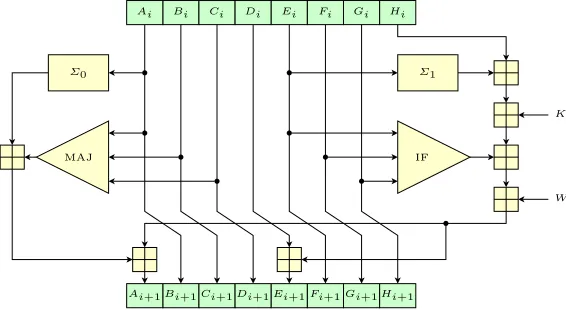
SHA-256 [16] is an iterated hash function based on the Merkle-Damg˚ard design that uses a compression function mapping 256 bits of the state and 512 bits of the message block to 256 bits of the new state. The compression function consists of 64 identical steps presented in Fig. 1 that update 256-bit internal state Si = (Ai, . . . , Hi) using one word of the expanded message Wi and a constant Ki to produce a new state Si+1 = (Ai+1, . . . , Hi+1). After the last
function is computed as a word-wise sum modulo 232 of the previous state S0
and the output of the last step S64, i.e. (A0+A64, . . . , H0+H64). The step transformation employs bitwise Boolean functions
MAJ(A, B, C) = (A∧B)∨(A∧C)∨(B∧C) ,
IF(E, F, G) = (E∧F)∨(¬E∧G)
and two diffusion functions
Σ0(x) = (x≫2)⊕(x≫13)⊕(x≫22) ,
Σ1(x) = (x≫6)⊕(x≫11)⊕(x≫25)
built from 32-bit word rotations towards least significant bit (≫) and bitwise XORs denoted by⊕.
Σ0
MAJ
Σ1
IF
Ki
Wi Ai Bi Ci Di Ei Fi Gi Hi
Ai+1Bi+1Ci+1Di+1Ei+1Fi+1Gi+1Hi+1
Fig. 1.One step of the SHA-256 compression function updates the state of eight chain-ing variablesA, . . . ,H using one wordWiof the expanded message.
The message expansion function splits 512-bit message block into 16 words
Mi,i= 0, . . . ,15, and expands them into a vector of 64 32-bit wordsWi accord-ing to the followaccord-ing formula:
Wi= (
Mi for 0≤i <16,
σ1(Wi−2) +Wi−7+σ0(Wi−15) +Wi−16 for 16≤i <64.
(1)
The functionsσ0 andσ1 are defined asσ0(x) = (x≫7)⊕(x≫18)⊕(x≫3) andσ1(x) = (x≫17)⊕(x≫19)⊕(x≫10), where≫denotes a shift towards least significant bit and + is addition modulo 232.
3
The Preimage Attack
match split
Target
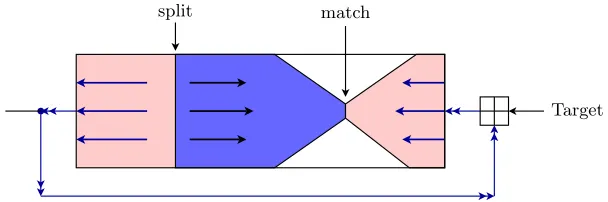
Fig. 2.Pseudo-Preimage Attack for Davies-Meyer Hash Functions
1. Split the compression function into two chunks, where the values in one chunk do not depend on some message wordWq and the values in the other chunk do not depend on another message wordWp (p6=q). We follow the convention and call such words neutral with respect to the first and second chunk, respectively.
2. Fix all other values except for Wp, Wq to random values and assign random values to the chaining registers at the splitting point.
3. Start the computation both backward and forward from the splitting point to form two lists Lp, Lq indexed by all possible values of Wp and Wq and containing the computed values of the chaining registers at the matching point.
4. Compare two lists to find partial matches (match for one or few registers instead of full chaining) at the matching point.
5. Repeat the above three steps with different initial configurations (values for splitting point and other message words) until a full match is found. 6. Note that the match gives a pseudo-preimage as the initial value is
deter-mined during the attack. However, it is possible to convert pseudo-preimages to a preimage using a generic technique described in [15, Fact 9.99].
With the work effort of 232compression evaluations (assuming 32-bit registers),
we obtain two lists, each one containing close to 232 values of the register to
match. When we consider all of the 264 possible pairs, we expect to get around
232matches. This means that after 232computations we get 232matches on one
register, effectively reducing the search space by 232. Leaving all the other
reg-isters to chance allows us to find a complete match and thus a pseudo-preimage in 2256−32= 2224 computations if the internal state is 256 bits.
4
Finding independent chunks for SHA-2
The main challenge in this type of preimage attack is to find two sufficiently long sequences of steps (chunks) that can be made independent from the two different neutral words.
with during the attack. Such methods are unique for each particular function and strongly depend on the details of the design.
In this section we present three tricks developed for SHA-2 that allow us to get more steps.
4.1 Using Message Expansion
Two-way expansion The two neutral message words do not need to be taken
from the set{W0, . . . , W15}. The message expansion (1) of SHA-2 works in such a way that all the expanded message words can be determined from any consec-utive 16 wordsWz, . . . , Wz+15, 0≤z≤48. Once we choose any 16 consecutive
words, we can determine the other ones recursively in both directions. Assume we start with {Wz, . . . , Wz+15}. To determine the optimal choice of the
split-ting point and the neutral words, let us first expand the message words in both directions. For backward direction:
Wz−1=Wz+15−σ1(Wz+13)−Wz+8−σ0(Wz) , (2)
Wz−2=Wz+14−σ1(Wz+12)−Wz+7−σ0(Wz−1) , (3) Wz−3=Wz+13−σ1(Wz+11)−Wz+6−σ0(Wz−2) , (4) Wz−4=Wz+12−σ1(Wz+10)−Wz+5−σ0(Wz−3) , (5) Wz−5=Wz+11−σ1(Wz+9)−Wz+4−σ0(Wz−4) , (6) Wz−6=Wz+10−σ1(Wz+8)−Wz+3−σ0(Wz−5) , (7) Wz−7=Wz+9−σ1(Wz+7)−Wz+2−σ0(Wz−6) , (8) Wz−8=Wz+8−σ1(Wz+6)−Wz+1−σ0(Wz−7) , (9) Wz−9=Wz+7−σ1(Wz+5)−Wz−σ0(Wz−8) , (10) Wz−10=Wz+6−σ1(Wz+4)−Wz−1−σ0(Wz−9) , (11) Wz−11=Wz+5−σ1(Wz+3)−Wz−2−σ0(Wz−10) . (12)
and for forward direction:
Wz+16 =σ1(Wz+14) +Wz+9+σ0(Wz+1) +Wz , (13)
Wz+17=σ1(Wz+15) +Wz+10+σ0(Wz+2) +Wz+1 , (14) Wz+18=σ1(Wz+16) +Wz+11+σ0(Wz+3) +Wz+2 , (15) Wz+19=σ1(Wz+17) +Wz+12+σ0(Wz+4) +Wz+3 , (16) Wz+20=σ1(Wz+18) +Wz+13+σ0(Wz+5) +Wz+4 , (17) Wz+21=σ1(Wz+19) +Wz+14+σ0(Wz+6) +Wz+5 , (18) Wz+22=σ1(Wz+20) +Wz+15+σ0(Wz+7) +Wz+6 , (19) Wz+23 =σ1(Wz+21) +Wz+16+σ0(Wz+8) +Wz+7 , (20)
From above, we see that choosingWz+8andWz+9as neutral words is reasonable
as those two message words appear late in forward and backward directions, re-spectively. We can use{Wz−4, . . . , Wz+8}as the first chunk which is independent
from Wz+9, and{Wz+9, . . . , Wz+22} as the second chunk which is independent
Message compensation Using the message stealing technique explained below in Section 4.2, we can move the splitting point four steps earlier, betweenWz+4
and Wz+5, and “steal” Wz+8 back to the first chunk to preserve neutrality.
Now, the first chunks becomes {Wz−4, . . . , Wz+4, Wz+8} and the second one
{Wz+5, Wz+6, Wz+7, Wz+9, . . . , Wz+22}.
With the help ofWz+5 andWz+7, we can extend the first chunk for several
more steps. We note thatWz+5 is used in (10) and (5), we compensate them by
usingWz+7andWz+12. By “compensating” we mean making the equation value
independent fromWz+5 by forcingWz+7−σ1(Wz+5) =C (C is some constant,
we use 0 for simplicity) andWz+12−Wz+5=C.Wz+7is also used in (8), however
we can use Wz+9 to compensate for it, i.e. setWz+9=σ1(Wz+7) =σ21(Wz+5).
ThenWz+9 andWz+12 are used in steps above, so we continue this recursively
and finally have the following constraints that ensure the proper compensation of values ofWz+5.
Wz+7 =σ1(Wz+5) , (21) Wz+9 =σ21(Wz+5) , (22) Wz+11 =σ31(Wz+5) , (23) Wz+13 =σ41(Wz+5) , (24) Wz+15 =σ51(Wz+5) , (25)
Wz+12 =Wz+5 , (26)
Wz+14 = 2σ1(Wz+5) . (27)
Now, {Wz−10, . . . , Wz+4} are all independent fromWz+5 (or Wz+9 as there is
a bijection between them). The first chunk becomes{Wz−10, . . . ,Wz+4, Wz+8}
and the second one {Wz+5, Wz+6, Wz+7,Wz+9, . . . , Wz+22}.
A similar compensation is difficult in the forward direction as message words
Wz, . . . , Wz+7 are used in consecutive steps. If we use any of them, all of them
have to be used. However, we already usedWz+5 andWz+7 above.
In total, there are 33 steps in both chunks, regardless of the choice ofz. We will pick a particular value ofz later in Section 4.3.
4.2 Message Stealing
What we call a message stealing technique allows us to have more steps around the splitting point by shifting some messages related to those two neutral message words so that the neutrality property is preserved. Such shifting can only be done when it does not alter the behavior of the step function.
Message stealing makes use of the absorption property of the function IF(x, y, z) =
xy⊕xz. Ifxis 1(all bits are 1), then IF(1, y, z) = y which means z does not affect the result of IF function in this case; similarly whenxis0(all bits are 0),
y does not affect the result. When we want to control partial output (few bits), we need to fix the corresponding bits ofxinstead of all bits ofx.
Σ0 MAJ Σ1 IF Ki Wi Σ0 MAJ Σ1 IF Ki+1 Wi+1 Σ0 MAJ Σ1 IF Ki+2 Wi+2 Σ0 MAJ Σ1 IF Ki+3 Wi+3 splitting point 0 1 (a) Σ0 MAJ Σ1 IF Ki Σ0 MAJ Σ1 IF Ki+1 Wi+1 Σ0 MAJ Σ1 IF Ki+2 Wi+2 Σ0 MAJ Σ1 IF Ki+3 Wi Wi
Wi+3 Wi
(b)
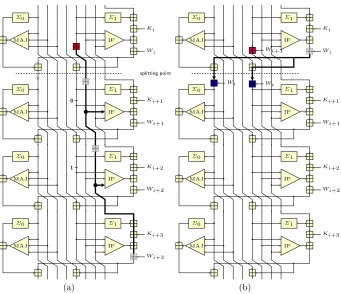
Fig. 3. Message stealing allows to (a) move the addition ofWi+3 upwards provided
that the IF functions absorb the appropriate inputs; (b) moveWione step downwards.
to stepiand moveWi to stepi+ 1 while keeping the final output after stepi+ 3 unchanged.
Assume we want to transfer upwards a message word Wi+3. Due to the
absorption property of IF, we can moveWi+3 to stepi+ 2 (adding it to register Gi+2) if all the bits of Ei+2 are fixed to 1. This is illustrated in Fig. 3(a).
Similarly, we can further moveWi+3 to stepi+ 1 (adding it to registerFi+1) if
all the bits ofEi+1 are 0. Then, we still can move it upwards by transferring it
to registerEi after step transformation in stepi.
The same principle applies if we want to transfer only part of the register
Wi+3. If l most significant bits (MSB) ofWi+3 are arbitrary and the rest is set
to zero (to avoid interference with addition on least significant bits), we need to fixl MSB ofEi+2 to one andlMSB ofEi+1 to zero.
Asl MSB ofEi+1 need to be 0, we need to use l MSB ofWi to satisfy this requirement. This reduces the space ofWi to 232−l. Similarly, we need to choose thoseWi that fixlMSB ofEi+2 to one. This further reduces the space ofWi to 232−2l. We choose l= 10 so that we have more or less same space for both W
The important thing to note here is that if we fix the values ofFi+1, Gi+1
and of the sum Di+1+Hi+1 (this is possible since Si+1 is a splitting point we
have complete control over), we can precompute the set of good values for Wi and store them in a table. Then, we can later recall them at no cost.
On the other hand, message word Wi can be moved to step i+ 1 with no constraint, as shown in Fig. 3(b).
This essentially swaps the order of the two wordsWi and Wi+3 which was
used in message compensation.
4.3 Indirect Partial Matching
In this section we explain how to use a modified partial matching method to extend the attack by 9 more steps. The basic partial matching technique would give us 7 more steps [8], since we need at least one register to perform the matching and the computation backward “looses” one register per step. However, using some tricks we explain below we can get two more steps.
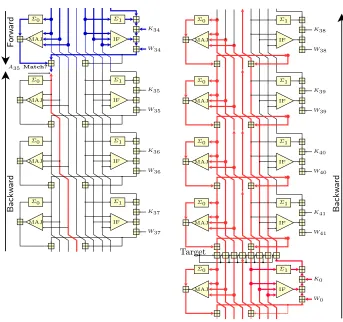
The partial matching is shown in Fig 4. Let us fix z = 11 (this choice will become clear in a moment). The two neutral words areW16andW19and the cor-responding chunks are{W1, . . . , W15, W19}and{W16, W17,W18, W20, . . . , W33}. We want to gain two more steps, one step at each end of both chunks, where message wordsW0 andW34 are used.
We compute the value ofA35 from both directions and try to find matches, other seven registers are computed and checked ifA35 matches. In the forward direction, A35 can be calculated from S34 and W34. S34 is independent from W19, howeverW34is not. Substitutingz= 11 into (20) we getW34=σ1(W32) +
W27+σ0(W19)+W18and see that althoughW34is not neutral aboutW19, it can be expressed as a sum of two independent functions ofW19 andW16. Moreover, the value of W34 is added to get the value of A35, so we can express A35 as
ψ(W16) +σ0(W19).
Similarly, we compute backward and expressA35asµ(W19)−W16. Now we need to find matches such that ψ(W16) +σ0(W19) =µ(W19)−W16, which is equivalent to ψ(W16) +W16 = µ(W19)−σ0(W19). Let us define ψ′(W16) := ψ(W16) +W16andµ′(W19) :=µ(W19)−σ0(W19). Instead of finding matches for A35 directly, we can computeψ′ andµ′ independently and match.
This is possible only when both message words used at the beginning and the end of the partial match can be expressed as a sum of two independent functions. This is true whenz= 11 and it explains our choice.
4.4 Overview of the Attack
B a c k w a rd F o rw a rd B a c k w a rd Σ0 MAJ Σ1 IF K40 W40 Σ0 MAJ Σ1 IF K39 W39 Σ0 MAJ Σ1 IF K38 W38 Target Σ0 MAJ Σ1 IF K0 W0 Σ0 MAJ Σ1 IF K41 W41 A35Match?
Σ0 MAJ Σ1 IF K37 W37 Σ0 MAJ Σ1 IF K36 W36 Σ0 MAJ Σ1 IF K35 W35 Σ0 MAJ Σ1 IF K34 W34
Fig. 4.Partial Matching
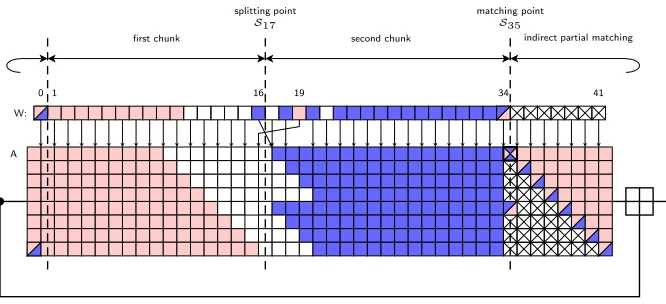
W19andW16. RegisterA35is the matching point and is outlined with a bold line ( ). Finally, registers that depend on both neutral variables in a complicated way are drawn as crossed-out boxes ( ) and empty boxes represent registers independent from both neutral words.
5
Algorithm and Complexity
Once we have explained all the elements of our attack, we can put them together in one algorithm as described below.
1. Randomly choose the values for internal chaining S17 (after the movement
of message words by message stealing) and message words not related to neutral words, i.e.W11,W12,W13,W14,W15,W17,W21. Let us call this an initial configuration.
A
1 19
second chunk first chunk
16 34
0 41
W:
indirect partial matching splitting point
S17
matching point S35
Fig. 5.Separation of chunks and dependencies of state words in the attack.
as in (21)-(27). Compute backward and find ψ′(W16) as described in
Sec-tion 4.3. Store the result (W16, ψ′(W16)) in a listL
p.
3. For all possibleW19(there are 2ldifferent values), compute forward and find
µ′ as described in Section 4.3. Store the result (W19, µ′(W19)) in a listL
q. 4. Compare the values of ψ′ and µ′ and find matches. If a match is found,
compute other registersB35, . . . , H35and see whether they match from both directions. If they do, compute the pseudo-preimage asS0 andW0, . . . , W15.
5. Repeat steps 1 - 4 with different initial configurations until a full match is found.
6. Repeat step 5 to find sufficiently many pseudo-preimages, then find a preim-age according to Fact 9.99 [15].
The computational complexity for step 2 and 3 is 2l−1 and 231−2l (We estimate this by approximating one chunk as half of the compression function, it is less in fact), and it generates 232−lpairs. The chance for one pair to be a good match is 2−256, so we need to repeat step 1-3 for 2256−32+ltimes. The overall complexity for finding one pseudo-preimage becomes 2224+l·(2l−1+ 231−2l). Choosing the optimal value l = 10, the complexity is 2245.32. According to Fact 9.99 [15],
sufficiently many pseudo-preimages in step 6 in our case is 2(256−245.32)/2= 25.34,
then the overall complexity for finding preimage is 2(256+245.32)/2+1= 2251.66.
Length of Preimages The preimages are of at least two blocks, last block
Multi-Preimages and Second Preimages We note that the method con-verting pseudo-preimage to preimages can be further extended to find multi-preimages. We find firstk block multi-collisions [9], then follow the expandable message to link to the final block. This gives 2k multi-preimages with additional
k2n/2 computations, which is negligible whenk is much less than 2(n−l)/2. We
need additional 128kbytes memory to store the kblock multi-collisions. We note most of the message words are randomly chosen, it naturally gives second preimages with high probability. Above multi-preimages are most prob-ably multi-second preimages.
6
Conclusions
In this paper we presented a preimage attack on a version of SHA-256 reduced to 42 steps out of 64. This number of steps is possible thanks to four new techniques we presented: message stealing, two-way message expansion, message compensation and indirect partial matching. Each one of them allows to improve over the standard preimage attack and allows to add more steps.
The same attack also works for SHA-512 as the message expansion is the same and the attack does not depend on the details of functionsσ0/1andΣ0/1.
We also expect that a variant of this attack would work for the function DHA-256 [11].
The preimage attack we presented creates a very interesting situation for SHA-256 when a preimage attack, covering 42 steps, is much better than the best known collision attack, with only 24 steps. Our attack does not convert to collision attack because of the complexity above the birthday bound. However, we believe that the existence of such a preimage attack suggests that a collision attack of similar length could be also possible.
In that light, the problem of finding collisions for reduced variants of SHA-256 definitely deserves more attention.
Acknowledgement
We would like to thank Lars R. Knudsen, Christian Rechberger, and the anony-mous reviewers of ASIACRYPT 2009 for the helpful comments. Jian Guo was supported in part by the Singapore Ministry of Education under Research Grant T206B2204. Krystian Matusiewicz was supported by grant 274-07-0246 from the Danish Research Council for Technology and Production Sciences.
References
2. Jean-Philippe Aumasson, Willi Meier, and Florian Mendel. Preimage attacks on 3-pass HAVAL and step-reduced MD5. In Selected Areas in Cryptography -SAC 2008, volume 5381 ofLNCS, pages 120–135. Springer, 2009.
3. Christophe De Canni`ere and Christian Rechberger. Preimages for reduced SHA-0 and SHA-1. In David Wagner, editor,Advances in Cryptology – CRYPTO 2008, volume 5157 ofLNCS, pages 179–202. Springer, 2008.
4. Christophe De Canni´ere and Christian Rechberger. Finding SHA-1 characteristics: General results and applications. InAdvances in Cryptology – ASIACRYPT 2006, volume 4284 ofLNCS, pages 1–20. Springer, Dec 2006.
5. Henri Gilbert and Helena Handschuh. Security analysis of SHA-256 and sisters. In Selected Areas in Cryptography 2003, volume 3006 of LNCS, pages 175–193. -Verlag, 2003.
6. Shai Halevi and Hugo Krawczyk. Strengthening digital signatures via randomized hashing. InAdvances in Cryptology – CRYPTO 2006, volume 4117 ofLNCS, pages 41–59. Springer, 2006.
7. Sebastiaan Indesteege, Florian Mendel, Bart Preneel, and Christian Rechberger. Collisions and other non-random properties for step-reduced SHA-256. In Work-shop Records of SAC 2008, pages 257–274, 2008.
8. Takanori Isobe and Kyoji Shibutani. Preimage attacks on reduced Tiger and SHA-2. InFast Software Encryption – FSE 2009, LNCS. Springer, 2009. to appear. 9. Antoine Joux. Multicollisions in iterated hash functions. application to cascaded
constructions. InAdvances in Cryptology – CRYPTO 2004, volume 3152 ofLNCS, pages 306–316. Springer, 2004.
10. John Kelsey and Bruce Schneier. Second preimages on n-bit hash functions for
much less than 2n
work. InAdvances in Cryptology – EUROCRYPT 2005, volume 3494 ofLNCS, pages 474–490. Springer, 2005.
11. Jesang Lee, Donghoon Chang, Hyun Kim, Eunjin Lee, and Deukjo Hong. A new 256-bit hash function dha-256 - enhancing the security of sha-256. NIST - First Cryptographic Hash Workshop, October 31-November 1, 2005.
12. Ga¨etan Leurent. MD4 is not one-way. InFast Software Encryption – FSE 2008, volume 5086 ofLNCS, pages 412–428. Springer, 2008.
13. Krystian Matusiewicz, Josef Pieprzyk, Norbert Pramstaller, Christian Rechberger, and Vincent Rijmen. Analysis of simplified variants of SHA-256. In Western European Workshop on Research in Cryptology – WEWoRC 2005, volume P-74 of Lecture Notes in Informatics. Gesellschaft f¨ur Informatik, 2005.
14. Florian Mendel, Norbert Pramstaller, Christian Rechberger, and Vincent Rijmen. Analysis of step-reduced SHA-256. InFast Software Encryption – FSE 2006, vol-ume 4047 ofLNCS, pages 126–143. Springer, 2006.
15. Alfred J. Menezes, Paul C. van Oorschot, and Scott A. Vanstone. Handbook of Applied Cryptography. CRC Press, 2001. available online fromhttp://www.cacr. math.uwaterloo.ca/hac/.
16. National Institute of Standards and Technology. Secure hash standard (SHS). FIPS 180-2, August 2002.
17. Somitra Kumar Sanadhya and Palash Sarkar. New collision attacks against up to 24-step sha-2. In Dipanwita Roy Chowdhury, Vincent Rijmen, and Abhijit Das, editors,INDOCRYPT, volume 5365 ofLecture Notes in Computer Science, pages 91–103. Springer, 2008.
19. Yu Sasaki and Kazumaro Aoki. Preimage attacks on 3, 4, and 5-pass HAVAL. In Advances in Cryptology – ASIACRYPT 2008, volume 5350 of LNCS, pages 253–271. Springer, 2008.
20. Yu Sasaki and Kazumaro Aoki. Preimage attacks on MD, HAVAL, SHA, and others. CRYPTO 2008 Rump session presentation, August 2008. Slides available athttp://rump2008.cr.yp.to/.
21. Yu Sasaki and Kazumaro Aoki. Preimage attacks on step-reduced MD5. In Infor-mation Security and Privacy – ACISP 2008, volume 5107 ofLNCS, pages 282–296. Springer, 2008.
22. Yu Sasaki and Kazumaro Aoki. Finding preimages in full MD5 faster than ex-haustive search. InAdvances in Cryptology – EUROCRYPT 2009, volume 5479 of LNCS, pages 134–152. Springer, 2009.
23. Xiaoyun Wang, Xuejia Lai, Dengguo Feng, Hui Chen, and Xiuyuan Yu. Crypt-analysis of the hash functions MD4 and RIPEMD. InAdvances in Cryptology – EUROCRYPT 2005, volume 3494 ofLNCS, pages 1–18. Springer, 2005.
24. Xiaoyun Wang, Yiqun Lisa Yin, and Hongbo Yu. Finding collisions in the full SHA-1. InAdvances in Cryptology – CRYPTO 2005, volume 3621 ofLNCS, pages 17–36. Springer, 2005.
25. Xiaoyun Wang and Hongbo Yu. How to break MD5 and other hash functions. In Advances in Cryptology – EUROCRYPT 2005, volume 3494 ofLNCS, pages 19–35. Springer, 2005.
26. Xiaoyun Wang, Hongbo Yu, and Yiqun Lisa Yin. Efficient collision search attacks on SHA-0. In Advances in Cryptology – CRYPTO 2005, volume 3621 ofLNCS, pages 1–16. Springer, 2005.
27. Hirotaka Yoshida and Alex Biryukow. Analysis of a SHA-256 variant. InSelected Areas in Cryptography – SAC 2005, volume 3897 ofLNCS, pages 245–260. Springer, 2006.