Single Block Attacks and Statistical Tests on
CubeHash
Benjamin Bloom
∗Alan Kaminsky
†August 21, 2009
Abstract
This paper describes a second preimage attack on the CubeHash cryp-tographic one-way hash function. The attack finds a second preimage in less time than brute force search for these CubeHash variants: CubeHash
r/b-224 for b >100; CubeHashr/b-256 forb >96; CubeHashr/b-384 for
b > 80; and CubeHashr/b-512 for b > 64. However, the attack does
not break the CubeHash variants recommended for SHA-3. The attack requires minimal memory and can be performed in a massively parallel fashion. This paper also describes several statistical randomness tests on CubeHash. The tests were unable to disprove the hypothesis that Cube-Hash behaves as a random mapping. These results support CubeCube-Hash’s viability as a secure cryptographic hash function.
1
Introduction
Invented by Daniel Bernstein, CubeHash [3] is a cryptographic one-way hash function submitted as a candidate to the NIST SHA-3 hash function competi-tion. CubeHash has three parameters:
• r, the number of mixing rounds applied to each message block (r≥1).
• b, the length of a message block in bytes (1≤b≤128).
• h, the size of the hash value in bits (h= 8,16,24, . . . ,512).
“CubeHashr/b-h” denotes the CubeHash variant with certain parameter choices; for example, CubeHash1/128-512.
CubeHash is expected to be stronger (more resistant to attack) as the num-ber of mixing roundsris increased and as the message block size bis reduced. The CubeHash variants recommended in the original SHA-3 submission are 224, 256, 384, and CubeHash8/1-512. Later (after the work described in this paper was done), Bernstein revised
the recommended variants for SHA-3 to be CubeHash16/32-224, CubeHash 16/32-256, CubeHash16/32-384, and CubeHash16/32-512 [5]. Several attacks and collisions on reduced-strength variants of CubeHash have been reported [1, 2, 8, 9, 10, 11, 12, 13, 18]. None of these break the CubeHash variants recommended for SHA-3 (neither the original nor the revised variants).
We describe a second preimage attack on CubeHash. It is called a “single block attack” because it finds a second preimage consisting of a single message block. The attack finds a second preimage in less time than brute force search (fewer than 2h hash function evaluations for an h-bit hash) for these
Cube-Hash variants: CubeCube-Hashr/b-224 for b > 100; CubeHashr/b-256 for b > 96; CubeHashr/b-384 forb >80; and CubeHashr/b-512 forb >64. Note that the attack works equally well for any number of mixing rounds r. However, the attack does not break the CubeHash variants recommended for SHA-3. The attack requires minimal memory and can be performed in a massively parallel fashion.
In addition, several statistical randomness tests can be performed on Cube-Hash using the single block attack methodology. To our knowledge, this paper is the first to report the results of statistical randomness tests on CubeHash. The tests failed to disprove the hypothesis that CubeHash behaves as a random mapping.
The paper is organized as follows. Section 2 describes the single block attack. Section 3 describes the implementation of the attack as a massively parallel program for a hybrid parallel computer and reports the program’s performance. Section 4 gives examples of second preimages found using the parallel program. Section 5 describes the statistical tests and their results. Section 6 compares the single block attack to previously reported attacks.
2
Single Block Attack
2.1
Hash Computation
The CubeHash state consists of 128 bytes. The state bytes are organized into 32 words, with four bytes per word in little-endian order. The state words are designatedx00000throughx11111. Wordx00000contains byte 0 (least significant)
through byte 3 (most significant), wordx00001contains bytes 4–7, and so on.
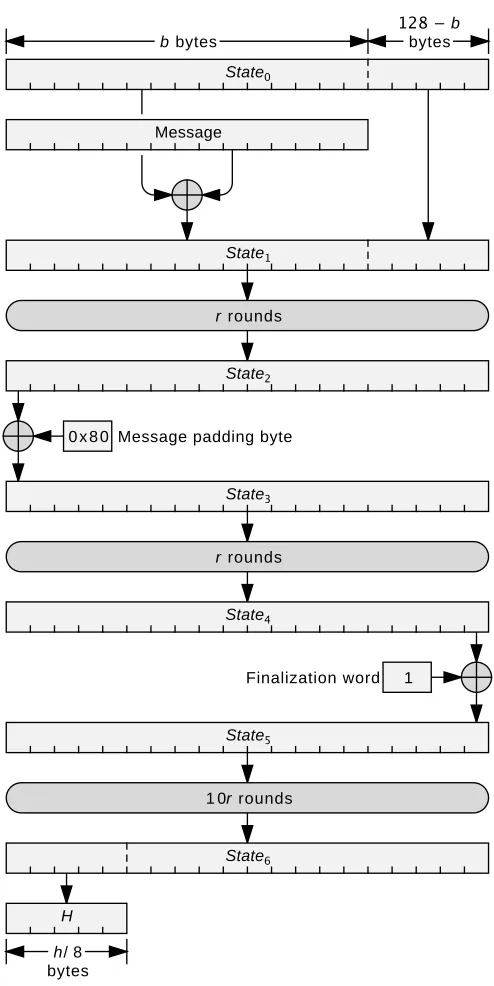
The hash of ab-byte message is computed as follows using CubeHashr/b-h (Figure 1). This is the procedure for hashing a message consisting of a single b-byte block. CubeHash can hash a message of any size; the procedure for doing so is described in [3].
1. Set the state to the initialization vector (IV). The initialization vector is described later. This is shown asState0in Figure 1.
2. Exclusive-or theb bytes of the message into the firstbbytes of the state, yieldingState1. (The last 128−bbytes ofState1 remain the same as the
State
Message
b bytes bytes
b
State
r rounds
State
0 x 8 0 Message padding byte
State
r rounds
State
1 Finalization word
State
1 0r rounds
State
H
h/ 8 bytes
3. Applyrmixing rounds to the state, yieldingState2. The round function
is described later.
4. Exclusive-or a message padding byte of 0x80 into the first byte of the state, yieldingState3.
5. Applyrrounds to the state, yieldingState4.
6. Exclusive-or the number 1 into the last word of the state, yieldingState5.
7. Apply 10r rounds to the state, yielding State6. (Steps 6–7 finalize the
computation.)
8. The hash of the message,H, is the firsth/8 bytes of the final state.
The round function does the following invertible transformation on the Cube-Hash state [3].
1. Addx0jklm intox1jklm modulo 232, for each (j, k, l, m).
2. Rotatex0jklm upwards by 7 bits, for each (j, k, l, m).
3. Swapx00klm withx01klm, for each (k, l, m).
4. Exclusive-orx1jklm into x0jklm, for each (j, k, l, m).
5. Swapx1jk0mwithx1jk1m, for each (j, k, m).
6. Addx0jklm intox1jklm modulo 232, for each (j, k, l, m).
7. Rotatex0jklm upwards by 11 bits, for each (j, k, l, m).
8. Swapx0j0lm withx0j1lm, for each (j, l, m).
9. Exclusive-orx1jklm into x0jklm, for each (j, k, l, m).
10. Swapx1jkl0 withx1jkl1, for each (j, k, l).
The IV is computed by setting state wordx00000 toh/8,x00001 tob,x00010
to r, and x00011 through x11111 to 0, then applying 10r rounds to the state,
yieldingState0[3].
2.2
Attack Computation
Because the CubeHash round function is invertible, the initial state can be computed by working backwards from the final state. The single block attack, first reported in [7], is based on this ability.
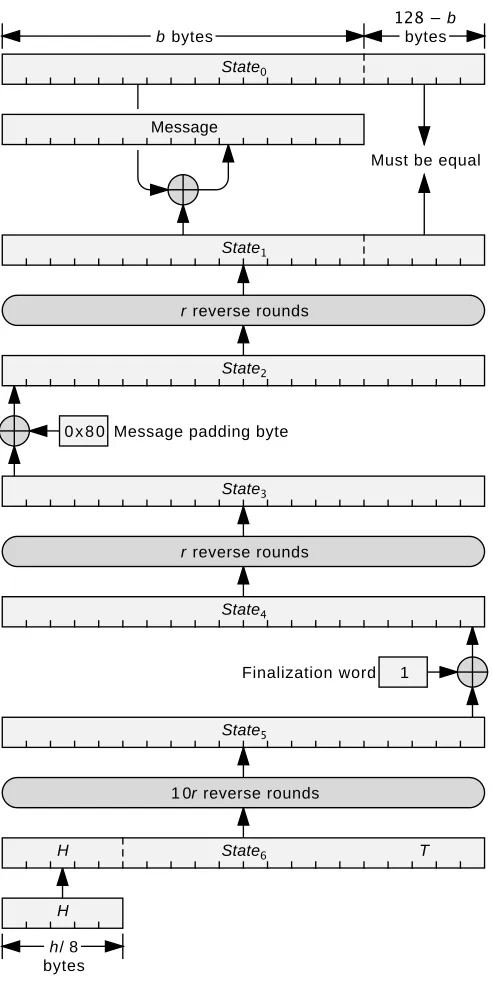
Given the hash valueH of some message, ab-byte second preimage message is computed as follows using CubeHashr/b-h(Figure 2).
1. Set the firsth/8 bytes of the final state to the hash valueH and set the last 128−h/8 bytes to a trial value T, yielding State6. The manner of
choosing the trial value is described later.
2. Apply 10rreverse rounds to the state, yieldingState5. The reverse round
function does the steps of the round function in reverse order, substituting downward rotations for upward rotations and subtraction modulo 232for
addition modulo 232.
3. Exclusive-or the number 1 into the last word of the state, yieldingState4.
4. Applyrreverse rounds to the state, yieldingState3.
State
Message
b bytes bytes
b
State
Must be equal
r reverse rounds
State
0 x 8 0 Message padding byte
State
r reverse rounds
State
1 Finalization word
State
1 0r reverse rounds
State
H
H T
h/ 8 bytes
6. Applyrreverse rounds to the state, yieldingState1.
7. If the last 128−b bytes ofState1 are not equal to the last 128−b bytes
of the IV (State0), then the trial was unsuccessful.
8. Otherwise, the trial was successful. The second preimage is computed by exclusive-oring the firstbbytes ofState1 with the firstb bytes of the IV.
Repeating the above procedure with different values of T will eventually generate a second preimage. The manner of choosingT values is not critical. For example, a sequence of consecutive values could be used, or randomly-chosen values could be used.
Assuming that CubeHash (in either the forward or the reverse direction) behaves as a random mapping, for an arbitrary trial value T, the probability that the final 128−bbytes ofState1are equal to the corresponding bytes of the
IV is 2−8(128−b). Therefore, the expected number of trials to achieve success is
28(128−b). If 28(128−b)<2h, then the single block attack finds a second preimage
with fewer expected trials than brute force search. In other words, the single block attack is more effective than brute force search forh= 224 andb >100, forh= 256 and b >96, forh= 384 andb >80, and forh= 512 andb >64.
Note that the expected number of trials to achieve success does not depend on the number of roundsr. Of course, the running time of the attack compu-tation increases asr increases.
Also note that for b = 128, the probability of success is 1; in other words,
any value ofT immediately produces a second preimage.
3
Parallel Implementation
The single block attack was implemented as a Java program, using the Parallel Java Library [15, 16], to run on a hybrid SMP cluster parallel computer—that is, a cluster of compute nodes, each node being a shared memory multiprocessor (SMP), or multicore, computer. The program is available at [17].
When executed on one processor, the single block attack program does the following. The program generates a random b-byte message and computes its hash using CubeHashr/b-h. The program then doesntrials in sequence. (r,b,h, n, and the pseudorandom number generator seed are specified on the command line.) Each trial carries out the attack computation with a different trial value T from 0 throughn−1. Each trial’s outcome is success (a second preimage was found) or failure. The program counts the number of successes and records the smallest value ofT that yielded a second preimage. The program reports those results as well as the original message, the second preimage derived from the smallest successfulT, and the hash valueH.
When executed in parallel, the single block attack program runs with Kp
1 1 0 1E2
1E3 1E4
K t = 1
K t = 2
K t = 3 K t = 4
Running Time vs. Processors
Processes, Kp
Running time (sec)
0 1 2 3 4 5 6 7 8 9 1 0 0 5 1 0 1 5 2 0 2 5 3 0 3 5 4 0
K t = 1 K t = 2 K t = 3 K t = 4
Speedup vs. Processors
Processes, Kp
Speedup
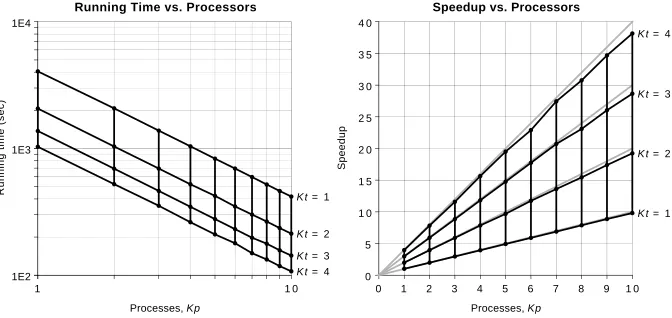
Figure 3: Program performance for CubeHash1/127-512, 232trials
and records the smallest successful T for that thread’s portion of the trials. When all trials have finished, the threads on each node do a shared-memory parallel reduction to combine the per-thread results, yielding the total number of successes and the smallest successfulT for that node. The processes on all the nodes then do a message-passing parallel reduction to combine the per-node results, yielding the total number of successes and the smallest successful T for the entire program run. One process reports the results. Apart from the final reductions, the program executes in a massively parallel fashion with no communication or coordination among the threads or processes.
The single block attack program was run on a hybrid SMP cluster paral-lel computer with ten nodes, each node a Sun Microsystems workstation with two AMD Opteron 2218 dual-core CPUs, a 2.6 GHz clock, and 8 GB of main memory. The nodes are connected by a dedicated 1 Gbps switched Ethernet network. On this computer, the program can scale up to as many asKp = 10 processes andKt = 4 threads per process; that is, 40 processors. The nodes use the SunOS 5.10 operating system and the Sun JDK 1.5.0 15 HotSpot Server Java Virtual Machine (JVM).
Figure 3 plots the running time and the speedup of the single block attack program for CubeHash1/127-512 with 232 trials versus the number of parallel
processors. Speedup is the running time of a sequential version of the program (with one process, no multithreading, and no message passing) relative to the running time of the parallel program. The program experiences speedups 95% of the ideal or better all the way out to 40 processors. Complete running time measurements are available at [17].
For CubeHash1/127-512, the single block attack program takes 4,059 seconds to do 232trials on one processor, or 945 nsec per trial. Since forr= 1 each trial
cycles per round. For comparison, the CubeHash speeds reported by the eBASH Project [14] for a C program on x86-architecture processors range from 21 to 535 cycles per round. (These are derived from the median speed of CubeHash8/1-512 in cycles per byte for long messages, divided by 8 rounds per byte.)
4
Attack Results
The single block attack program was executed with parameter settingsr={1, 2, 4, 8}rounds per message block,b={127, 126, 125}bytes per message block, h= 512-bit hash value,n= 232trials, and 100 different pseudorandom number
generator seeds. The program was also executed with parameter settingsr={1, 2, 4, 8}rounds per message block,b= 124 bytes per message block,h= 512-bit hash value, n = 240 trials, and 10 different pseudorandom number generator
seeds. Some of the second preimages found are listed below, along with the decimal trial numbersT that generated the second preimages; complete results are available at [17]. The messages and hash values are given in hexadecimal, with each pair of digits representing one byte.
In the following examples, the original message consists of the firstb bytes of this sequence of 128 bytes:
951fefce947916ccbaf6134ab2b377a54db9f0b7c1f4932b5bc68147dce57828 ba5b054f446fecc05c9086e96555fada9118b5598364d1b023f425bcdd094505 7c33e9fbbc20ff096ba9740f4d278f4922d5178ae650210fa9680512bf998ef1 2e9f246b5266e40c6240b7a681566d4a3817c19319bbcaede6cf93df7635ebdf
CubeHash1/127-512—second preimage forT = 190:
634a7948fcfdfc384e0e6f9bcff365aec19076d0629d9225ff717f9a6c0b832c bfb27a6ef39927000b59695995efade283b695b4233f48147a0eba13b4e9e775 251f70b402da5b7e52b8306ba46aacc0655a5f0e73b7f9321f520ed656dbcb3f 5f4c8490bc02885ba622e9155703e0ec845d19a459b4563f686661af8c2320
Hash value of original message and second preimage:
9975b5bb8fb33005a6bc7414d13d470581474a69f6c2cb01e3e8fe8150996272 4d3633a9ab53cdbe8cbf8d61fa9650d0e16e0be832c607eaeaed2bb1f58a078e
CubeHash2/126-512—second preimage forT = 92,677:
cf9f6826607b68a01f1241715c38440c6b34c28fa356c3bbc0d7a6440870b8c5 02a8443c503630361feebe7a9638c77469250f39285ab31b035e28de492ecfce ce4d446a36b40a90e90ab9e89424fc30aeaa25f97aa717a978735c9a2c028a77 b3e1fd5b96cedbe6902f4ae272e8a42d21b2993a266ebd0bfc9eb03c9147
Hash value of original message and second preimage:
CubeHash4/125-512—second preimage forT = 10,746,494:
985de06c0e2484aed791dafa9eeb4e28a3a635d43cd6e02c3712f4d150516602 7290996865b1e7248bc12f6bbc426553fcad2a666517c935a5dda79539fd3739 5739d14b83a03a862f0b12af35a4ad3584cf98818c5c99927822dad8a8b5d65a 6d1e047614a6c62c00607b470ae2937b6f8b11779d76e0f9bb5295305f
Hash value of original message and second preimage:
f3a508e80f39cf1ec5a079559a65f49eb8df6e86d67cd4455084dd06219af708 233b89c4b6443fc4ccd077c8358e59c6ffd6871bb5880d13291bf4dcaa778808
CubeHash8/124-512—second preimage forT = 2,860,087,247:
d901bc3da81f07c292d9d074825b0fddafb87304fde1fe54fd9cd7c88befbfbf 644e39d6d437a99ab9d19dc4f5c3fbf2a61a51533afa4f27c7fabc51c356bb1e 2b23d1252ca8e4c421a883c2c43d69adbf7a2adc257b219408717ad04ec13b21 6cf31959fed1e6450c1795280361003affbb2cfa6bc0aa786f434911
Hash value of original message and second preimage:
b130c28fbb1dc8aa1135c2a85e46826ab272247a61c246a041664b1e9bad2bd2 e14c0e0f19386c4838b2214140e6477d7b1b1804128fd9e13a039c8ad26f5ba6
As mentioned previously, the single block attack succeeds with probability 1 forb = 128 and any trial value T; no search is required. Here is the second preimage of the original message for CubeHash8/128-512 withT = 0:
bdcbaa75be2f003456bd95652dc85f04a0d2bd31947435600ca3ea077d884d79 da4d7cf62a490188d908d8722af8ee10b56fa22ba06873a83203c5b1d8c3ebfc dfb180cc60bca3dbf086977ab41515749577f1aef8bb1af2b7f20f811aa54b86 a5a82b8d88d83a56aadb3d642128007dfaf964bb4dc2e1c3c6fe4e8b19362d65
Hash value of original message and second preimage:
2631bf00ee41369ce3a19ac4a91cf5df4fd9cffb18278d5f32b193b4bf82c58c 73bd83bdcd81a0729ee9a6b862948edbe2a160ea9b8403e710328711e66d9311
5
Statistical Tests
5.1
Number of Successful Trials
Under the null hypothesis that CubeHash behaves as a random mapping, when the single block attack program doesntrials with CubeHashr/b-h, the expected number of successessisn·2−8(128−b)and the expected number of failures isn−s.
The single block attack program performs aχ2 test on the observed number of
successesoto attempt to disprove the null hypothesis. Theχ2statistic is
χ2 = (o−s)
2
s +
((n−o)−(n−s))2
n−s =
(o−s)2
s +
(o−s)2
Table 1: χ2 Tests of Number of Successful Trials
b= 127 b= 126 b= 125 b= 124
n= 232 n= 232 n= 232 n= 240
r= 1
s 16,777,216 s 65,536 s 256 s 256
o 16,768,519 o 66,254 o 290 o 290
χ2 4.52604 χ2 7.86639 χ2 4.51563 χ2 4.51563
p 0.033383 p 0.005036 p 0.033587 p 0.033587
r= 2
s 16,777,216 s 65,536 s 256 s 256
o 16,764,484 o 66,086 o 300 o 277
χ2 9.70003 χ2 4.61585 χ2 7.56250 χ2 1.72266
p 0.001843 p 0.031678 p 0.005960 p 0.189351
r= 4
s 16,777,216 s 65,536 s 256 s 256
o 16,763,353 o 66,188 o 304 o 209
χ2 11.4999 χ2 6.48667 χ2 9.00000 χ2 8.62891
p 0.000696 p 0.010869 p 0.002700 p 0.003309
r= 8
s 16,777,216 s 65,536 s 256 s 256
o 16,767,205 o 64,713 o 203 o 287
χ2 5.99701 χ2 10.3354 χ2 10.9727 χ2 3.75391
p 0.014330 p 0.001305 p 0.000925 p 0.052684
Under the null hypothesis,χ2obeys a chi-squared distribution with one degree
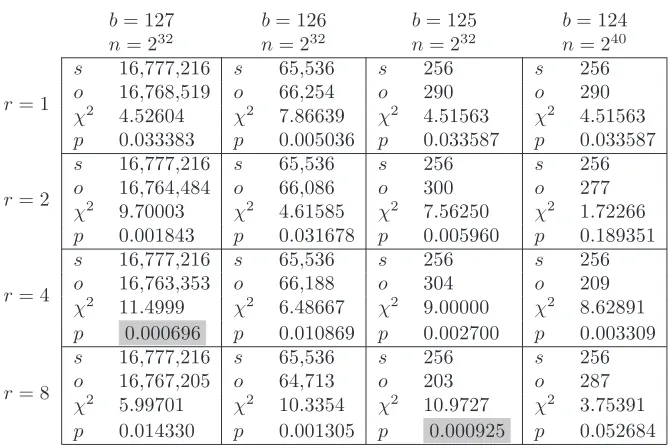
of freedom. For each CubeHash variant tested, Table 1 shows the results of the program run with the largest value of the χ2 statistic, including the
ex-pected number of successess, the observed number of successeso, χ2, and the
significance (p-value) ofχ2.
In 1,238 of the 1,240 program runs the null hypothesis was not rejected, and in two of the program runs the null hypothesis was rejected, at a significance of 0.001. (These two runs are highlighted in Table 1.) However, we cannot conclude that CubeHash does not behave as a random mapping on the basis of these two runs, because at a significance of 0.001 we would expect the null hypothesis to be rejected about one in 1,000 times by chance even if the null hypothesis is true.
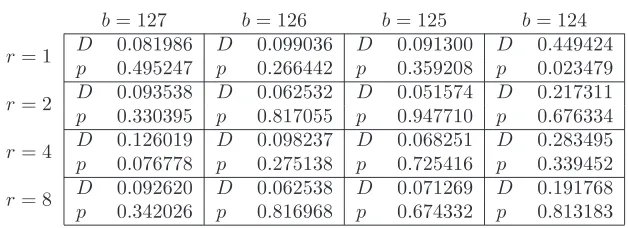
For each CubeHash variant, a Kolmogorov-Smirnov (K-S) test was per-formed to test the null hypothesis that theχ2values from that variant’s program
0 . 0 0 . 5 1 . 0 1 . 5 2 . 0 2 . 5 3 . 0 3 . 5 4 . 0 4 . 5 5 . 0 0 . 0
0 . 1 0 . 2 0 . 3 0 . 4 0 . 5 0 . 6 0 . 7 0 . 8 0 . 9 1 . 0
Chi−square statistic
Cumulative probability
Figure 4: Expected (red) and observed (black) cumulative distributions ofχ2
for CubeHash1/127-512
Table 2: K-S Tests ofχ2Distributions
b= 127 b= 126 b= 125 b= 124
r= 1 Dp 0.0819860.495247 Dp 0.0990360.266442 Dp 0.0913000.359208 pD 0.4494240.023479
r= 2 D 0.093538 D 0.062532 D 0.051574 D 0.217311 p 0.330395 p 0.817055 p 0.947710 p 0.676334 r= 4 D 0.126019 D 0.098237 D 0.068251 D 0.283495 p 0.076778 p 0.275138 p 0.725416 p 0.339452 r= 8 D 0.092620 D 0.062538 D 0.071269 D 0.191768 p 0.342026 p 0.816968 p 0.674332 p 0.813183
5.2
Number of Failures Before First Success
The single block attack program does a series of trials withT = 0,1,2, . . . and records the smallest T that yielded a second preimage. In other words, the series of trials yielded T failures in a row before the first success. Under the null hypothesis that CubeHash behaves as a random mapping, the probability of experiencingT failures followed by one success is
0 1 0 0 2 0 0 3 0 0 4 0 0 5 0 0 6 0 0 7 0 0 8 0 0 9 0 0 1 0 0 0 1 1 0 0 1 2 0 0 0 . 0
0 . 1 0 . 2 0 . 3 0 . 4 0 . 5 0 . 6 0 . 7 0 . 8 0 . 9 1 . 0
Smallest successful T
Cumulative probability
Figure 5: Expected (red) and observed (black) cumulative distributions of small-est successfulT for CubeHash1/127-512
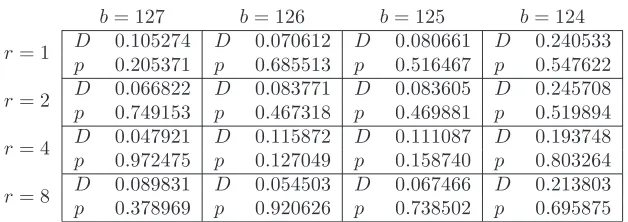
Table 3: K-S Tests of Smallest SuccessfulT Distributions
b= 127 b= 126 b= 125 b= 124
r= 1 D 0.105274 D 0.070612 D 0.080661 D 0.240533 p 0.205371 p 0.685513 p 0.516467 p 0.547622 r= 2 D 0.066822 D 0.083771 D 0.083605 D 0.245708 p 0.749153 p 0.467318 p 0.469881 p 0.519894 r= 4 D 0.047921 D 0.115872 D 0.111087 D 0.193748 p 0.972475 p 0.127049 p 0.158740 p 0.803264 r= 8 D 0.089831 D 0.054503 D 0.067466 D 0.213803 p 0.378969 p 0.920626 p 0.738502 p 0.695875
wherep= 2−8(128−b)is the probability of success on each trial. The cumulative
probability distribution is
Pr[≤T failures] =
T X
i=0
(1−p)ip = 1−(1−p)T+1 (3)
6
Related Work
Most of the reported attacks on CubeHash rely on the specific structure of Cube-Hash’s round function. These include attacks based on differential pathways in the round function [1, 2, 8, 9, 10, 11, 12, 13] and attacks based on symmetries in the internal state transformed by the round function [2].
In contrast, Bernstein (in the original CubeHash submission, [4]) reported
generic collision and second preimage attacks that work for any hash function using an invertible round function and that do not rely on the hash function’s specific structure. For CubeHash with ab-byte message block, the second preim-age attack computes the initial state forward through the round function to an intermediate state S, computes the final state backward through the inverse round function to another intermediate stateS′, and looks for a collision in the
last 128−b bytes of S and S′. Khovratovich et al. [18] reported this same
attack. Aumassonet al. [2] pointed out that this attack could look for collisions in the state after each step of the round function, not just between applications of the round function.
Like Bernstein’s generic second preimage attack, our single block attack is a generic attack that works for any hash function using an invertible round function. However, the single block attack computes the final state backward through the inverse round function all the way to the initial state and looks for a match with the last 128−b bytes of the IV, rather than meeting in the middle and looking for a collision. Because the single block attack looks for an exact match rather than a collision, the expected number of trials (28(128−b)) is
large, but no memory is required (apart from storage for the CubeHash state itself). In contrast, a birthday-paradox collision search requires many fewer tri-als (√28(128−b)) but also requires copious memory. Furthermore, on a cluster
parallel computer, the single block attack executes in a massively parallel fash-ion with almost no interprocessor communicatfash-ion (only one final reductfash-ion). A birthday-paradox collision search on a cluster parallel computer requires exten-sive interprocessor communication (see, for example, [6]).
7
Conclusion
References
[1] J.-P. Aumasson. Collision for CubeHash2/120-512. NIST hash-forum mail-ing list, December 4, 2008. http://ehash.iaik.tugraz.at/uploads/a/ a9/Cubehash.txt
[2] J.-P. Aumasson, E. Brier, W. Meier, M. Naya-Plasencia, and T. Peyrin. Inside the hypercube. In14th Australasian Conference on Information Se-curity and Privacy (ACISP 2009),July 2009.
[3] D. Bernstein. CubeHash specification (2.B.1). Extracted from CubeHash submission to the NIST SHA-3 Competition. http://csrc.nist.gov/ groups/ST/hash/sha-3/Round1/documents/CubeHash.zip
[4] D. Bernstein. CubeHash appendix: complexity of generic attacks. Ex-tracted from CubeHash submission to the NIST SHA-3 Competition. http://csrc.nist.gov/groups/ST/hash/sha-3/Round1/documents/ CubeHash.zip
[5] D. Bernstein. CubeHash parameter tweak: 16 times faster. July 15, 2009. http://cubehash.cr.yp.to/submission/tweak.pdf
[6] D. Bernstein, T. Lange, C. Peters, R. Niederhagen, and P. Schwabe. FSB-day: Implementing Wagner’s generalized birthday attack against the SHA-3 candidate FSB. Cryptology ePrint Archive Report 2009/292, June 17, 2009.http://eprint.iacr.org/2009/292
[7] B. Bloom and S. Janis. Inference attacks on CubeHash. Rochester Institute of Technology, Department of Computer Science, Parallel Computing II class project, May 13, 2009.http://www.cs.rit.edu/~ark/spring2009/ 736/team/1/
[8] E. Brier, S. Khazaei, W. Meier, and T. Peyrin. Attack for CubeHash-2/2 and collision for CubeHash-3/64. NIST hash-forum mailing list, February 3, 2009. http://ehash.iaik.tugraz.at/uploads/3/3a/Peyrin_ch22_ ch364.txt
[9] E. Brier, S. Khazaei, W. Meier, and T. Peyrin. Real collisions for CubeHash-4/64. NIST hash-forum mailing list, July 6, 2009. http:// ehash.iaik.tugraz.at/uploads/9/93/Bkmp_ch464.txt
[10] E. Brier, S. Khazaei, W. Meier, and T. Peyrin. Real collisions for CubeHash-4/48. NIST hash-forum mailing list, July 16, 2009.
[11] E. Brier and T. Peyrin. Cryptanalysis of CubeHash. InInternational Con-ference on Applied Cryptography and Network Security (ACNS ’09), June 2009.
[13] W. Dai. Collision for CubeHash2/12. January 17, 2009. http://www. cryptopp.com/sha3/cubehash2.pdf
[14] ECRYPT Benchmarking of Cryptographic Systems: Measurements of hash functions. Version 2009.04.22. http://bench.cr.yp.to/results-hash. html
[15] A. Kaminsky. Parallel Java: A unified API for shared memory and cluster parallel programming in 100% Java. In 21st IEEE International Parallel and Distributed Processing Symposium (IPDPS 2007),March 2007. [16] A. Kaminsky. Parallel Java Library. http://www.cs.rit.edu/~ark/pj.
shtml
[17] A. Kaminsky. Single block attacks and statistical tests on CubeHash web site.http://www.cs.rit.edu/~ark/parallelcrypto/cubehash01/