Small Public Keys and Fast Verication for
M
ultivariate
Q
uadratic Public Key Systems
Albrecht Petzoldt1, Enrico Thomae2, Stanislav Bulygin3, and Christopher Wolf4
1,3Technische Universität Darmstadt and
Center for Advanced Security Research Darmstadt (CASED)
1[email protected],3[email protected] 2,4Horst Görtz Institute for IT-security
Faculty of Mathematics
Ruhr-University of Bochum, 44780 Bochum, Germany
2Enrico.Thomae.rub.de,4[email protected], 4[email protected]
Abstract. Security of public key schemes in a post-quantum world is a challenging taskas both RSA and ECC will be broken then. In this paper, we show how post-quantum signature systems based on Multivariate Quadratic (MQ) polynomials can be improved up by about 9/10, and 3/4, respectively, in terms of public key size and verication time. The exact gures are 88% and 73%. This is particularly important for small-scale devices with restricted energy, memory, or computational power. In addition, we show that this reduction does not aect security and that it is also optimal in terms of possible attacks. We do so by combining the priory unrelated concepts of reduced and equivalent keys. Our new scheme is based on the so-called Unbalanced Oil and Vinegar class ofMQ-schemes. We have derived our results mathematically and veried the speed-ups through a C++ implementation.
Key words: Multivariate Quadratic Cryptography, Post-Quantum Cryptography, Implemen-tation, Unbalanced Oil and Vinegar, UOV Signature Scheme
Current Version: 2011-06-03
1 Introduction
When nding an old sonnet of Shakespeare, we can usually determine its validity accurately by checking the wording, the ink, the paper, and so on. Similar techniques apply in disputes over last willsor other documents of historical or nancial interest. Even if they are several decades old, we can fairly certainly determine if they have been written by the person in question and sometimes even date them accurately.
For digital documents, this is a much more dicult task. They are electronically signed with the help of so-called digital signature schemes. The ones widely used today are Digital Signature Algorithms (DSAs) based on RSA and elliptic curve cryptography (ECDSA). Unfortunately, all these schemes are broken if large enough quantum computers will be built. The reason is the algorithm of Shor which breaks all cryptographic algorithms based on the diculty of fac-toring and the discrete logarithm (DL) problem [Sho97]. This covers DL over numbers, RSA, and ECDSA. Even if unlikely now, quantum computers may be available in the medium fu-ture and are hence a concern for long-term-validity of authentication data. We must be sure that a document signed today is not repudiated 50 years later. Likewise, we do not want a signature that is generated today to be forged in the future. So to guard security even in the presence of quantum computers, post-quantum cryptography is needed and has hence become a vital research area [BBD09]. One possible solution in this context is the so-calledMultivariate Quadratic cryptography. It is widely believed that it is secure against quantum computers.
In addition,MultivariateQuadratic (or MQfor short) signature schemes have nice properties
RSA and ECDSA. Note that ECDSA is the most ecient of the three. However, even when comparing to signature generation in MQ and ECC, the rst are a factor of 250 faster on
FPGA than the latter [BERW08]. Similar results have been demonstrated for comparison with RSA and ECC in software [YCC04, YCCC06, CCC+08, CCC+09]. One of the main reasons for this higher eciency is the comparably small nite elds, e.g. F28 which allows for ecient
hardware and software implementations. The other operations usually boil down to vector-matrix functions, which can be implemented eciently, too. As an immediate consequence, we can use
MQschemes in restricted devices, i.e. with low energy or computational power.
Another point is the high exibility ofMQ-schemes. This allows for the use of sparse polynomials
in the private key as done in the TTS schemes of Yang, Chen, and Chen [YCC04]. This leads both to a signicant reduction of the time needed for signature generation, as well as for the size of the private key. Another way to reduce the private key is by choosing the coecients of the private maps from smaller elds (e.g. F16 instead of F256)), [CCC+08]. In addition, we want to
mention the so-called similar keys which exploit linear relations between public and private key [HWCL05]. However, they are not applicable to UOV and hence, do not achieve such a drastic reduction in size. Finally, one research direction deals with reducing the public key directly. In [PBB10, PBB11] it is shown how to reduce the public key size of the UOV scheme by choosing public coecients in a structured way, cf. sect. 3.
1.1 Outline of Multivariate Quadratic Schemes
The main idea behind Multivariate Quadratic cryptography is to choose a system F of m
quadratic polynomials in nvariables which can be easily inverted. Here F is called the central
map. In addition, we need invertible ane maps S and T to hide the structure of the central
map F. The public key of the cryptosystem is now composed as P = T ◦ F ◦S. For a secure
MQ-system, P must be dicult to invert. The private key consists of (F, T, S) and therefore allows ecient inversion ofP. More details onMQ-systems are given in sect. 2. A more detailed
overview onMultivariateQuadratic schemes can be found in [Wol05, WP05b].
Generation x= (x1, . . . , xn) 6
private:S−1
u
6 private:F−1
y
Verication public:
p(1), . . . , p(m)
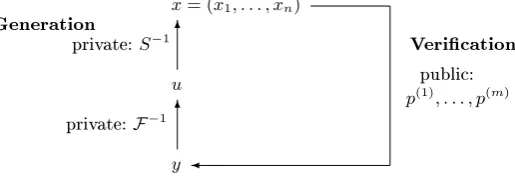
Fig. 1. Graphical representation of the UOV trapdoor(F,S)for signature generation and verication.
Given is a hash valuey∈Fmand a signaturex∈Fn.
Note that some MQ-schemes, e.g. the Unbalanced Oil and Vinegar (UOV) signature scheme
considered in this paper, omitT and construct their public key as P :=F ◦S. See Fig. 1 for an
overall picture of signature generation and verication for UOV.
1.2 Achievement
Combining two previously unrelated ideas, we deal with reducing the size of the public key. For
MQschemes like Unbalanced Oil and Vinegar (UOVsee below), typical choices of parameters
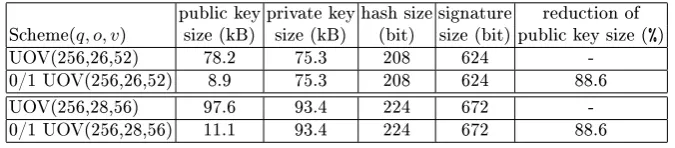
(88.6% reduction). A similar approach for Unbalanced Oil and Vinegar was previously exploited in [PBB10, PBB11] but did not allow such drastic reductions. In addition, our modication also works for restricting the choice of the coecients. By choosing them partially to be 0 or 1 only, verication time is reduced by up to 72%. This way,MQverication can be performed in
low-power, low-energy devices. For example for mobile devices, we can easily imagine a scenario where a server signs data which needs to be veried by a (comparably restricted) phone. As further contribution, using Turán graphs we demonstrate that this reduction in size does not aect security. This is due to an observation regarding equivalent keys of [WP05a, WP11]. Moreover, we show that our size reduction is tight in the sense that any further reduction would reduce the security.
1.3 Organization
The structure of this paper is as follows: After giving some introduction in sect. 1, we continue with the background on MQ-schemes and in particular UOV in sect. 2. In sect. 3, we review
the cyclic construction from [PBB10]. This is followed by a security proof regarding cyclic keys in UOV in sect. 4. Using these results, we outline our new constructions, its implementation, eciency, and security implications in sect. 5. The paper concludes with sect. 6. In app. A, we give some background on Turán graphs, and in app. B, we show how this relates to our monomial ordering in sect. 5.3.
2 Multivariate Quadratic Cryptography
2.1 Notation
Solving non-linear systems ofm equations innvariables over a nite eld is a dicult problem
in general. Restricting to the seemingly easy case of quadratic equations is still dicult. Actually this problem is also known as MQ-problem which is proven to be NP-hard in the worst-case
[GJ79], even overF2.
LetP be a MQsystem of the form
p(1)(x1, . . . , xn) = 0
p(2)(x1, . . . , xn) = 0
... (1)
p(m)(x1, . . . , xn) = 0,
with
p(k)(x1, . . . , xn) := X
1≤i≤j≤n
γ(ijk)xixj+ X
1≤i≤n
βi(k)xi+α(k). (2)
Letπ(k)be the coecient vector ofp(k)(x1, . . . , xn) w.r.t. lexicographic order of monomials, i.e.
π(k)= (γ11(k), γ12(k), . . . , γ(1kn), γ22(k), γ23(k), . . . , γnn(k), β1(k), . . . , βn(k), α(k)).
LetMP be the corresponding coecient matrix
MP :=
π(1)
...
π(m)
Denote with MQ(Fn,Fm) the class of Multivariate Quadratic polynomial systems in n input
variables andmpolynomials each, as dened in (2). We now have the public key of multivariate
schemes as a vector P ∈ MQ(Fn,Fm). Each coecient is a quadratic polynomial p(i) from F[x1, . . . , xn]and 1≤i≤m
P :=
p(1)(x1, . . . , xn) ...
p(m)(x1, . . . , xn)
.
In the following we omit the constant and linear part of p(k) as it was shown as early as 1998
that it does not contribute to the security of UOV [KS98, KPG99].
Note that the ordering of monomials (and thus coecients) in the matrixMP does not necessarily have to be lexicographic ordering. We may want to order monomials of the public key in a certain way. Therewith, the ordering of coecients (columns of MP) is then changed accordingly.
2.2 Unbalanced Oil and Vinegar
In this subsection we introduce the Oil and Vinegar Signature Scheme, which was proposed by J. Patarin in [Pat97].
Let Fq be a nite eld. Denote the number of oil variables by o ∈ N, the number of
vine-gar variables by v∈N and setn:=o+v. Let V :={1, . . . , v}and O := {v+ 1, . . . , n} denote
the sets of indices of vinegar and oil variables. The private key F := (f(1)(u), . . . , f(m)(u)) is dened by
f(k)(u1, . . . , un) := X
i∈V,j∈O e
γij(k)uiuj+ X
i,j∈V,i≤j e
γij(k)uiuj. (3)
It is important for nding a pre-image that the variables inf(k)are not completely mixed, i.e. oil
variables are only multiplied by vinegar variables and never by oil variables. This construction leads to an ecient way to invert F. If we assign arbitrary values to the vinegar variables and
if we set m =o we obtain a system of o linear equations in ovariables. With high probability
this system has a solution. If not we try again with a dierent choice for the vinegar variables
x1, . . . , xv. In the public keyP, the central mapF is hidden by composing it with a linear map
S :Fnq →Fnq, i.e. P :=F ◦S.
Fnq Fmq
Fnq P
S
F
Signature generation: To sign a document d, one uses a hash function H : F?q → Fmq to compute the hash value h =H(d) ∈Fqm. After that one computes rsty := F−1(h) and then
z:=S−1(y). The signature of the documentdisz∈Fn
q. In a slight abuse of notation we write
F−1(h) for nding one (of possibly many) pre-image of hunder F.
Signature verication: To verify the authenticity of a signature, one computes the hash value h of the corresponding document and the value h0 = P(z). If h = h0 holds, the signature is accepted, otherwise rejected.
In his original paper [Pat97], Patarin suggested to use o=v (Balanced Oil and VinegarOV).
3 Reviewing Cyclic Keys
In this section we review the approach of [PBB10] to create a UOV-based scheme with a partially cyclic public key.
Remember that, in the case of the Unbalanced Oil and Vinegar signature scheme [KPG99], the public key P is given as the concatenation of the central UOV-map F and a linear invertible
mapS, i.e.
P =F ◦S. (4)
In [PBB10] it is observed, that this equation (after xing the ane map S), leads to a linear
relation between the coecients of the quadratic monomials ofP and F of the form
p(ijk)= n X
r=1 n X
s=r
αrsij ·frs(k), (5)
wherep(ijk) and fij(k) are the coecients of xixj in the k-th component of P and F respectively and the αrsij are given as
αrsij =
sri·ssi (i=j)
sri·ssj+srj·ssi otherwise
. (6)
Heresij ∈Fdenote the coecients of the linear mapS. LetD:= v·(v2+1)+ov be the number of
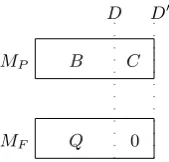
non-zero quadratic terms in any component ofF andD0 := n·(n2+1) be the number of quadratic terms in the public polynomials. Let MP and MF be the coecient matrices of P and F respectively (w.r.t. graded lexicographical ordering of monomials). The matrices MP and MF are divided into submatrices as shown in Figure 2. Note that, due to the absence of oil × oil
terms in the central polynomials, we have a block of zeros in the middle ofMF.
Q B
0 C D D0
MP
MF
Fig. 2. Layout of the matricesMP andMF
Furthermore, the authors of [PBB10] dened the so called transformation matrixAU OV ∈FDq×D containing the coecientsαrs
ij of equation (5)
AU OV = αrsij
(1≤r ≤v, r≤s≤nfor the rows, 1≤i≤v, i≤j≤n for the columns),i.e.
AU OV =
α1111 α1112. . . α11vn α1211 α1212. . . α12vn
... ...
αvn11 αvn12 . . . αvnvn
. (7)
With this notation, equation (5) yields
If matrixAU OV is invertible, this equation has a solution for Q. Experiments indicate that this condition is fullled with high probability. By solving equation (8) forQ, the authors of [PBB10]
were able to insert a partially circulant matrix B into the UOV public key. By doing so, they
reduced the public key size of the scheme by a factor of 6. After choosing matrixB, we can use
alg. 1 to compute the corresponding key. Note that byT :=S−1 and
αrsij =
tri·tsi (i=j)
tri·tsj+trj·tsi otherwise (9)
we derive a map AbU OV = (αrsij) with1 ≤r, s≤nand 1≤i, j ≤v that maps the public to the private coecients, i.e.
Q=MP ·AbU OV. (10)
Algorithm 1 summarizes key generation:
Algorithm 1 Key Generation for UOV schemes
1: Choose ano×D matrixB(e.g. partially circulant or generated by an LRS).
2: Choose randomly a linear mapS (represented by ann×n-matrixS). IfS is not invertible, choose again.
3: Compute forSthe corresponding transformation matrixAUOV (using equations (6) and (7)). IfAUOVis not
invertible, go back to step 2.
4: Solve the linear system given by equation (8) to get the matrixQand there with the coecients of the central
polynomials.
5: Compute the public key asP=F ◦ S.
4 Security of UOV
Due to equivalent keys [WP05a, WP11] UOV contains a lot of redundancy. We show which part of the public key is important for security and which part can be chosen such that the public key gets as small as possible.
It is rather intuitive that the linear and constant part of the public key do not provide extra security because we can easily separate them from the quadratic part. This was previously exploited by Kipnis and Shamir in their cryptanalysis of (balanced) Oil and Vinegar [KS98]. But it is quite surprising that also a fraction of the quadratic part is not essential for security. This is implied by the observation of equivalent keys by Wolf and Preneel [WP11]. Remember
p(k)(x) for 1 ≤k ≤o are the public polynomials andf(k)(u) are the private polynomials. The private linear transformation was denoted byS, i.e. Sx=u. We call a polynomialf0 equivalent
to the private polynomialf if it has the same structure, i.e. no quadratic terms in oil variables.
The following transformationΩ on the variablesu preserves the structure off.
Ω= Ω
(1) v×v 0
Ωo(2)×v Ωo(3)×o
!
Letu0 :=Ωuand u0|C0u0 a private polynomial denoted in quadric form. This means thatC0 is
a matrix in Fn×n. The vinegar variables u01, . . . , u0v are expressed as sums of vinegar variables
u1, . . . , uv by transformation Ω and thus no quadratic term in oil variables occurs in f(u) =
u|Ω|C0Ωu. By
ˆ
CandC0describe equivalent private maps of the public mapCeand thusSandΩSare equivalent private keys. Let
S=
S(1)S(2) S(3)S(4)
By choosing Ω for whichΩ(1)S(1) =I,Ω(2)S(2)+Ω(3)S(4) =I and Ω(2)S(1)+Ω(3)S(3)= 0 hold, we get a private key Seof following form
e
S =
I S0
0 I
. (11)
For a key recovery attack it is sucient to nd any of the equivalent keys. Thus an attacker can search for a private key of form (11).
Remark 1. If the private linear mapS is of form (11), the following condition on the coecients
of the public and private map hold
γij(k)=eγ (k)
ij for allkand i, j∈V, i≤j
This means we can assume that the attacker actually knows or even chooses all coecients of squared vinegar variables in the private map. This means that the γ(ijk) with i, j ∈ V in the
public map do not hide any secret and thus we can choose them in an arbitrary way, e.g. matrix
B cyclic or even xed.
Proposition 1. The rst v(v+1)
2 coecients in the public key P do not provide any security in the sense of key recovery attacks. Arbitrarily xing these coecients does not leak information about the private key.
By equation (8) we are even able to choose the rst v(v+1)
2 +ov coecients of P of a special shape and thus save memory. Proving the security of this construction is not as obvious as in the latter construction. We have to show that additionally xing ov coecients does not leak any
information about the private maps S or F, i.e. we have to show that the remaining non-zero
coecients eγ (k)
ij for i ∈ V and j ∈ O are not biased by the xed choice of P, i.e. uniformly distributed over the random choice of elements inS.
Usually, we x values on the central polynomialsF and then compute the public polynomialsP
for a given linear transformationS. However, for this construction we turn things around by rst
xing the public polynomials and then computing the missing parts of the central polynomials. Intuitively, this should be equally secure. We capture this in the following proposition and also give a necessary condition onB for the security ofF,P, S.
Claim. The rst v(v+1)
2 +ov coecients in the public key P do not provide any security in the sense of key recovery attacks. Fixing these coecients at random does not leak information about the private key.
We have to show that despite of xing B we do not get systematic dependencies among the
coecients eγ (k)
ij , i.e. for every choice of S we get another private map F. In other words, we could reach qn2 choices of private coecients eγij(k) (with i ∈ V, j ∈ O,1 ≤k ≤ o) by choosing S. Due to equivalent keys the space of private maps F decomposes into equivalence classes.
As every attacker can choose a private key S according to (11) it is sucient to show that we
could produce at least one element out of every class, i.e. that we can reach exactlyqov choices
of private coecients. Restricting (10) to the ov columns which produce the coecients eγij(k)
We now use S according to (10) and now obtain the system BA0 = MF0 linear in the sij for 1≤i≤v,v+ 1≤j≤n, an(D×ov)-matrixA0, a xed(o×D)-matrixBand an(ov×o)-matrix
MF0. The question is, whether the map BA0 is injective, i.e. whether all possible choices for the
private coecients eγ (k)
ij can occur. Without loss of generality we restrict our argumentation to the rst column. There are exactly v non-zero entries (that are the variables sij for 1 ≤i≤v and j = v+ 1) in the rst column of matrix A0. The restricted map is injective, i.e. we can
produce all possible choices of coecients eγ (k)
ij in the rst column ofMF0 , i the corresponding
v columns of B have full rank. This is the constraint we fulll by construction ofB in section
5.2. Using more rened methods and in particular a heavier machinery, it should be possible to formally prove the above claim. Because of the above claim the following scheme is as secure as the standard UOV scheme. In comparison to the case of Algorithm 2 the (o×D) matrix
B is a xed part of the algorithm. In the remainder of this paper, we refer to this scheme as
Compressed UOV.
Algorithm 2 Key Generation for Compressed UOV
1: Choose randomly a linear mapS (represented by ann×n-matrixS). IfS is not invertible, choose again.
2: Compute forSthe corresponding transformation matrixAUOV (using equations (6) and (7)). IfAUOVis not
invertible, go back to step 1.
3: Solve the linear system given by equation (8) to get the matrixQand therewith the quadratic coecients of
the central polynomials.
4: Compute the public key asP=F ◦S.
5 The New Construction
We are now investigating, how much additional structure we can hide in B in order to speed
up the verication process. We choose elements of the matrixB uniformly at random from the
ground eld F2. In order to make sure that message recovery attacks are still dicult, we have
to choose the ordering of monomials appropriately, as explained in sect. 5.3.
5.1 Message Recovery Attacks
Let MP = (B|C) with B a (o×D) matrix. After we claimed that choosing B xed does not leak to an attacker information about the private key, we have to clarify how structured B can
be chosen without decreasing security against message recovery attacks. Obviously B = 0 is a bad trail, as this would implyC = 0. We also have to assure that B has full rank, as otherwise C would also not have full rank. In general our goal is that solving a system with the coecient
matrixMP overFq using Gröbner bases should be as dicult as solving a random instance over
Fq.
We now rst introduce our choice of B. Afterwards we explain, why message recovery remains
hard and also why this is the smartest way to chooseB, i.e. this is the shortest public key one
can hope for.
5.2 Choice of B
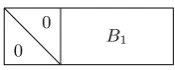
The rst(o×o)block inB can be chosen to be the identity matrixI as every attacker is able to
remaining partB1 ofB has to be chosen in such a way that there are no systematic dependen-cies, i.e. every m columns with m≥o have a big chance to have full rank. Otherwise we could
produce large zero-blocks which would decrease the complexity of Gröbner Bases algorithms.
0
0 B1
Fig. 3. Structure of matrixB.
We suggest to choose every element of the matrix B1 uniformly at random fromF2. Note that
for such B1 the rank property above is fullled with overwhelming probability. Note that B is no longer part of the public key. OnceB is constructed, it is xed, and thus is a part of the key
generation algorithm.
5.3 Ordering of monomials
As opposed to the method described in [PBB10, PBB11], we need to choose a special monomial ordering for our construction. In order to understand why and how this monomial ordering is constructed, let us recall how direct (Gröbner) attacks on multivariate signature schemes work. In the message recovery attack, the attacker is facing the problem of solving the public UOV system P(x) = h directly. This system is dened over Fq and has o equations and n= o+v variables. Such a system has on average qn−o = qv solutions. Consider the values of v usually
used (e.g. v = 52), such a system has a huge amount of solutions (for q = 28 and v = 52 it is 2416). Gröbner bases methods have a great diculty in solving such a system in this case, since they have to describe a huge variety. Since an attacker is interested in only one solution for the signature forgery, recovering all solutions is unnecessary. By xing values of any v variables in
the public system, an attacker obtains a quadratic system in o variables and o equations. On
average such a system has a unique solution. Solving the new system with Gröbner bases is much easier.
Going back to the matrix MP we see that C contains coecients of monomialsxixj withi, j∈
{xv+1, . . . , xn}, since the ordering we chose in sect. 3 is the graded lexicographic ordering. Now if the attacker xes values for variablesxv+1, . . . , xn, the monomials represented byC will become constants. Therewith, the resulting quadratic system will have only quadratic terms over F2 coming from the matrix B1. Clearly, Gröbner bases computations will be much easier then,
since the attacker does not have to deal withF28 arithmetics that much. Thus we have to ensure
that an attacker is not able to remove many monomials with coecients in F28 by assigning v
variables to some values.
Note that we do not consider monomials of the form x2i. If such monomials remain after xing v variables they do not force us to calculate in F28 as they are linear due to the Frobenius
ho-momorphism. Note that for UOV over elds with odd characteristic, it makes sense to consider such monomials.
Denote by C the set of monomials whose coecients are contained in the matrix C. We can
represent this set as a graph G(V, E) with V := {x1, . . . , xn} being the vertices and E :=
{e(xi, xj)|xixj ∈ C} being the edges. By construction we have |E| = o(o2+1). In the following our goal is to construct the graph G in the way, such that the induced monomial ordering
to be xed. Note also that by monomial ordering we do not mean a monomial well-ordering as in the theory of Gröbner bases, but just some ordering of monomials w.r.t. which the columns of the coecient matrixMP are ordered.
For the following we need two denitions.
Denition 1. LetG(V, E)be a graph. A subsetV0 ⊆V is called a k-independent set, if|V0|=k
and {e(vi, vj) :vi, vj ∈V0} ∩E =∅.
Denition 2. For a graph G(V, E) the set V0 ⊆V is called a k-clique, if |V0|=k and all the
vertices vi∈V0 are pairwise connected, i.e.{e(vi, vj) :vi, vj ∈V0} ⊆E.
We observe the following. IfGcontains ano-independent set, an attacker is able to xvvariables
in such a way that all the monomials in C are removed.
So our task is to choose the edges ofGin such a way, thatG does not contain ak-independent
set (for minimal k). For xed k, the problem of nding a graph without k-independent set
and minimal number of edges is solved by the complementary Turán graph. Details about the denition and basic properties of the Turán graph can be found in app. A.
So we start with k = 1 and construct the complementary Turán graph CT(n,1). We then increase k until the number of edges in CT(n, k) will be less or equal to o·(o2+1). If the number of edges in CT(n, k) is less than o·(o2+1), we add arbitrarily edges until we reach the number of monomials inC. By doing so we get a graph GwithCT(n, k)≤G.
Example 1. In our case (o= 26, v = 52) we nd a solution for k= 8and thus it is assured that at least 30 monomials overF28 remain after xingvvariables. The best attack on this parameter
set is called HybridF5 [BFP09] and uses xingvand then guessing two variables before applying
FaugèresF5algorithm [Fau02] to compute Gröbner Bases. But even if we x/guessv+2variables, there will remain at least 24 monomials over F28. So an attacker can not hope to transfer the
system into a smaller eld. More details to these experiments can be found in app. B.
Once we have constructed our graph G as above, it denes which monomials should be in C.
Therefore, we can now dene an induced ordering on quadratic monomials, such that monomials from C are bigger than those that are not from this set. For the monomials not being in C we
dene real squares (i.e.x2i fori= 1, . . . , n) to be smaller than other monomials. Once we dened
an ordering of monomials, it is xed and is a system parameter.
Let us investigate the eect of the new ordering on the construction of matrixAU OV. In sect. 3 the columns of the matrixAU OV corresponded to the rstDmonomials w.r.t. graded lexicographical ordering. Now we have to choose the columns of A^U OV in such a way that they correspond to the rst D monomials in the monomial ordering dened above. With respect to the graph G,
if the i-th edge of complementary graph G (which is actually a subgraph of the Turán graph
T(n, k)) connects the verticesvi1 and vi2, we have
^
AU OV =
α1111 α1222. . . α11nn αe111 αe112 . . . αe11D−n α1211 α1222. . . α11nn αe112 αe122 . . . αe12D−n
... ...
αvn11 αvn22 . . . αvnnnαe1vn αevn2 . . . αevnD−n
. (12)
Here, the coecientsαrsii are given by (6) and theαersi are given by
e
αrsi =
srvi1·ssvi2 (vi1=vi2)
srvi1·ssvi2 +srvi2 ·ssvi1 otherwise
With this notation we have (as in sect. 3)
B =Q·A^U OV, (14)
whereQcontains the coecients of the non-zero terms of F (in lexicographical order).
In Algorithm 3 the matrix B is chosen as shown in Figure 3 with a xed matrix B1 ∈R Fo2×µ (µ=D−o).
Algorithm 3 Key Generation for reduced UOV schemes
1: Choose randomly a linear mapS (represented by ann×n-matrixS). IfS is not invertible, choose again.
2: Compute forSthe corresponding transformation matrixA^UOV(using equations (6), (13) and ((12)). IfA^UOV
is not invertible, go back to step 1.
3: Solve the linear system given by equation (14) to get the matrixQand therewith the quadratic coecients
of the central polynomials.
4: Compute the public key asP=F ◦S.
5.4 Eciency of the Verication Process
During the verication process one has to evaluate for each public polynomial the equations
Pi(z) = (z1, . . . , zn)·Pi·(z1, . . . , zn)T,1≤i≤o,
with z = (z1, . . . , zn) being the signature of the message and Pi being the (upper triangular) matrix representing the i-th public polynomial.
To evaluate this equation for a randomly chosenPione needs n·(n2+1)+nF256-multiplications for
each of the opolynomials, oro·n·(n2+3) F256-multiplications and the same number of additions
for the whole key.
For our reduced version we can do better. When evaluatingPi(z)we test for each element ofPi if it is an element ofF2. If this is the case, we further test if the element is 0 or 1. If it is 0, then we do not have to do anything. If it is 1, then we have to carry out one addition. Only in the case of the element being inF256\F2, we have to carry out one multiplication.
By this strategy we are able to reduce the number of F256-multiplications needed during the
verication process to o·o·(o2+1) +n. Additionally we need o·n·(n+ 1) if clauses and on averageo·n·(n4+1)+o·(o2+1) +nadditions.
5.5 Further Security Considerations
In this section we discuss the security of schemes generated by alg. 2 under known attacks against UOV-like schemes [KS98, KPG99, WBP04, YC04b, YC04a, YCC04, BWP05, YC05, BFP09]. These include
(1) Direct attacks (2) Rank attacks
(3) UOV-Reconciliation attack (4) UOV attack
Direct attacks. The most straightforward way for an attacker to forge signatures is the so called direct attack, i.e. the attacker tries to solve the public systemP(x) =h by a dedicated solv-ing algorithm like e.g. Gröbner Basis algorithms (Buchberger, F4, F5) or one of the XL-family (Mutant-XL, FXL).
As before to reduce the complexity of the attack one xes v variables before applying the
algo-rithm. For our experiments below we rst created a determined system by xingv of the
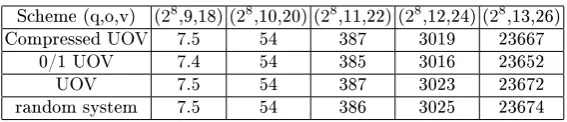
vari-ables and then solved the resulting system (in degree reversed lexicographical ordering) by theF4 [Fau99] algorithm. For doing so, we used MAGMA ver. 2-13 and the command GroebnerBasis. Table 1 shows the results.
Scheme (q,o,v) (28,9,18) (28,10,20) (28,11,22) (28,12,24) (28,13,26)
Compressed UOV 7.5 54 387 3019 23667 0/1 UOV 7.4 54 385 3016 23652 UOV 7.5 54 387 3023 23672 random system 7.5 54 386 3025 23674
Table 1. Running time of direct attacks against UOV schemes (in sec)
As the table shows, the running time of direct attacks against our schemes is nearly the same as for the standard UOV scheme and for random systems. So, foro≥26equations [BFP09] our scheme appears to be secure against direct attacks.
UOV-Reconciliation.
Denition 3. Let p(x) =p(x1, . . . , xn) be a quadratic multivariate polynomial and
dp(x,c) =p(x+c)−p(x)−p(c) +p(0)
its discrete dierential. We dene Hp to be the symmetric matrix such that
dp=xT ·Hp·c
For the matrixHpi representing the quadratic part of thei-th public polynomial we write in short
Hi. Analogous, we denote the symmetric matrix representing the homogeneous quadratic part of the i-th central polynomial by Qi (i= 1, . . . , o).
The goal of the UOV-Reconciliation attack is to nd a change of variables which brings the matricesHi into UOV-form, which means that the lower righto×o submatrix is the zero ma-trix. By doing so, the attacker creates an equivalent private key and therefore is able to forge signatures for arbitrary messages.
To achieve this goal, the attacker has to solve several multivariate quadratic systems. The com-plexity of the attack is mainly determined by the comcom-plexity of the rst step which is the solving of a quadratic system ofo equations inv variables. Table 2 shows the time MAGMA needs for
solving this initial system for our schemes and the standard UOV scheme.
Since, for the parameters proposed in Subsection 2.2, the UOV scheme is believed to be secure against the UOV-Reconciliation attack, we can assume the same for our schemes.
Scheme (q,o,v) (28,9,18) (28,10,20) (28,11,22) (28,12,24) (28,13,26)
Compressed UOV 7.4 54 386 3013 23658 0/1 UOV 7.3 55 384 3018 23654 UOV 7.5 54 388 3019 23665
Table 2. Running time of the UOV-Reconciliation attack (in sec)
UOV scheme, all the matrices Qi representing the homogeneous quadratic parts of the central equations have full rank n. This prevents the MinRank attack. Furthermore, all the variables x1, . . . , xn appear in every of theo central equations, which prevents HighRank attacks. All in all, this is not very surprising as rank attacks usually only work against private keys of the STS structure [WBP04]. Still, to be on the safe side, we also veried that our new construction does not fall to this previously known attack.
Original UOV Attack. The goal of the original UOV attack [KPG99] is to nd the pre-image of the oil subspaceO={x∈Fn
q :x1 =· · ·=xv = 0}under the ane invertible transformationS. To achieve this, one forms a random linear combination P =Po
j=1βjHj, multiplies it with the inverse of one of theHi and looks for invariant subspaces of this matrix. For each parameter set (28, o, v)listed in the table we created 100 instances of our two schemes and the standard UOV. Then we attacked these instances by the UOV-attack to nd out the number of trials we need to nd a basis ofS−1(O).
Scheme (q,o,v) (256,5,7) (256,8,11) (256,12, 15) (256,15, 18) Compressed UOV 1728 532614 847362 1146382
0/1 UOV 1726 532682 847394 1157638 UOV 1734 531768 852738 1182621
Table 3. Average number of trials in the UOV-attack
Summary of Further Security Considerations. As the previous four subsections showed, known attacks against the UOV signature scheme do not work signicantly better against our schemes, which means that they can not use the special structure of our public key. So, in this sense our scheme appears to be secure and we do not have to adapt our parameter sets.
It might also be possible that dedicated attacks against our scheme exist. Still, the security considerations we presented above suggest that such attacks would be very dicult to mount.
5.6 Parameters and Implementation
In this section, we give our choice of parameters and show how they transfer to a practical C++ implementation. More concrete and based on the security considerations of sect. 5.5, we propose for our scheme the same parameters as for the standard UOV scheme, namely eld size q= 256,(o, v) = (26,52). Additionally, Table 4 gives one more conservative parameter set, namely(q, o, v) = (256,28,56).
6 Conclusion
In this paper, we have shown thatMultivariateQuadratic public key schemes can benet from
much smaller public key sizes (cf. Table 4) without any degeneration of security. The overall idea requires some exibility in the private key. To our knowledge, only the two MQ-schemes
UOV and Rainbow have these. UOV was covered in this article. However, Rainbow has a more dicult internal structure, so we have to leave a concrete application of our improvement to Rainbow as an open question, which we plan to address.
public key private key hash size signature reduction of Scheme(q, o, v) size (kB) size (kB) (bit) size (bit) public key size (%)
UOV(256,26,52) 78.2 75.3 208 624 -0/1 UOV(256,26,52) 8.9 75.3 208 624 88.6 UOV(256,28,56) 97.6 93.4 224 672 -0/1 UOV(256,28,56) 11.1 93.4 224 672 88.6
Table 4. Proposed parameters for UOV schemes
The security proof made use of the idea of equivalent keys. Hereby, each public key can be assigned many private keys. We have turned this idea around by considering transformations of the public keyP instead and showed that an attacker does not gain from this specic structure
as he can generate it himself and we will derive an equally useful private key(F,S).
Intel Dual Core 2 2.53 GHz AMD Athlon XP 2400+ 2.00 GHz
(o, v) standard UOV 0/1 UOV reduction factor standard UOV 0/1 UOV reduction factor
(26,52) 0.49 ms 0.14 ms 71 % 0.68 ms 0.19 ms 72 % (28,56) 0.54 ms 0.14 ms 72 % 0.74 ms 0.20 ms 73 % (32,64) 0.75 ms 0.20 ms 72 % 1.03 ms 0.28 ms 73 %
Table 5. Running time of the verication process
As we can enforce a specic form on the public keyP, we can also use it to speed up public key
operations, namely verication of signatures. As we see in Table 5, this reduces the overall time by about 73% or a markable factor of 3.7.
As the construction is very general, it can be used on other platforms (e.g. GPU, FPGA) as well. We actually expect similar gains in area reduction or speed there, too.
From a theoretical perspective, forcing a specic structure on the central polynomials F or the
public polynomials P are equivalent: We can do either. Hence, for specic application domains
it might be useful to nd a certain trade-o. For example, we could reduce the computational workload on a server based on the maximal available memory on a smart card.
All in all, the usability gap between RSA and ECC on the one side and post-quantum cryptog-raphy on the other side is shrinking again. For specic applications, the latter could actually be of use in practice.
Acknowledgements
Bibliography
[BBD09] Daniel J. Bernstein, Johannes Buchmann, and Erik Dahmen. Post-Quantum Cryp-tography. Springer, 2009. ISBN 978-3-540-88701-0.
[BERW08] Andrey Bogdanov, Thomas Eisenbarth, Andy Rupp, and Christopher Wolf. Time-area optimized public-key engines: -cryptosystems as replacement for elliptic curves? In Elisabeth Oswald and Pankaj Rohatgi, editors, CHES, volume 5154 of Lecture Notes in Computer Science, pages 4561. Springer, 2008.
[BFP09] Luk Bettale, Jean-Charles Faugère, and Ludovic Perret. Hybrid approach for solving multivariate systems over nite elds. In Journal of Mathematical Cryptology, 3:177 197, 2009.
[BWP05] An Braeken, Christopher Wolf, and Bart Preneel. A study of the security of Unbal-anced Oil and Vinegar signature schemes. In The Cryptographer's Track at RSA Con-ference 2005, volume 3376 of Lecture Notes in Computer Science. Alfred J. Menezes, editor, Springer, 2005. 13 pages, cf http://eprint.iacr.org/2004/222/.
[CCC+08] Anna Inn-Tung Chen, Chia-Hsin Owen Chen, Ming-Shing Chen, Chen-Mou Cheng, and Bo-Yin Yang. Practical-sized instances of multivariate pkcs: Rainbow, tts, and lic-derivatives. In Johannes Buchmann and Jintai Ding, editors, PQCrypto, volume 5299 of Lecture Notes in Computer Science, pages 95108. Springer, 2008.
[CCC+09] Anna Inn-Tung Chen, Ming-Shing Chen, Tien-Ren Chen, Chen-Mou Cheng, Jintai Ding, Eric Li-Hsiang Kuo, Frost Yu-Shuang Lee, and Bo-Yin Yang. Sse implementa-tion of multivariate pkcs on modern x86 cpus. In Christophe Clavier and Kris Gaj, editors, CHES, volume 5747 of Lecture Notes in Computer Science, pages 3348. Springer, 2009.
[Fau99] Jean-Charles Faugère. A new ecient algorithm for computing Gröbner bases (F4).
Journal of Pure anNational Institute of Standards and Technologyd Applied Algebra, 139:6188, June 1999.
[Fau02] Jean-Charles Faugère. A new ecient algorithm for computing Gröbner bases with-out reduction to zero (F5). In International Symposium on Symbolic and Algebraic
Computation ISSAC 2002, pages 7583. ACM Press, July 2002.
[GJ79] Michael R. Garey and David S. Johnson. Computers and Intractability A Guide to the Theory of NP-Completeness. W.H. Freeman and Company, 1979. ISBN 0-7167-1044-7 or 0-7167-1045-5.
[HWCL05] Yuh-Hua Hu, Lih-Chung Wang, Chun-yen Chou, and Feipei Lai. Similar keys of multivariate quadratic public key cryptosystems. In Yvo Desmedt, Huaxiong Wang, Yi Mu, and Yongqing Li, editors, Cryptology and Network Security, 4th Interna-tional Conference, CANS 2005, Xiamen, China, December 14-16, 2005, Proceedings, volume 3810 of Lecture Notes in Computer Science, pages 211222. Springer, 2005. [KPG99] Aviad Kipnis, Jacques Patarin, and Louis Goubin. Unbalanced Oil and Vinegar
signature schemes. In Advances in Cryptology EUROCRYPT 1999, volume 1592 of Lecture Notes in Computer Science, pages 206222. Jacques Stern, editor, Springer, 1999.
[KS98] Aviad Kipnis and Adi Shamir. Cryptanalysis of the oil and vinegar signature scheme. In Advances in Cryptology CRYPTO 1998, volume 1462 of Lecture Notes in Com-puter Science, pages 257266. Hugo Krawczyk, editor, Springer, 1998.
[PBB10] Albrecht Petzoldt, Stanislav Bulygin, and Johannes Buchmann. A multivariate sig-nature scheme with a partially cyclic public key. In Proceedings of SCC'10, pages 229235, 2010.
[PBB11] Albrecht Petzoldt, Stanislav Bulygin, and Johannes Buchmann. Linear recurring se-quences for the UOV key generation. In D. Catalano, editor, Proceedings of PKC'11, volume 6571 of LNCS, pages 335350. Springer, 2011.
[Sho97] Peter W. Shor. Polynomial-time algorithms for prime factorization and discrete logarithms on a quantum computer. SIAM Journal on Computing, 26(5):14841509, October 1997.
[WBP04] Christopher Wolf, An Braeken, and Bart Preneel. Ecient cryptanalysis of RSE(2)PKC and RSSE(2)PKC. In Conference on Security in Communication Net-works SCN 2004, volume 3352 of Lecture Notes in Computer Science, pages 294 309. Springer, September 810 2004. Extended version: http://eprint.iacr.org/ 2004/237.
[Wol05] Christopher Wolf. MultivariateQuadratic Polynomials in Public Key Cryptography.
Ph.D. thesis, Katholieke Universiteit Leuven, Belgium, November 2005. http:// hdl.handle.net/1979/148, 156+xxiv pages.
[WP05a] Christopher Wolf and Bart Preneel. Superuous keys in Multivariate Quadratic
asymmetric systems. In Public Key Cryptography PKC 2005, volume 3386 of Lecture Notes in Computer Science, pages 275287. Serge Vaudenay, editor, Springer, 2005. Extended version http://eprint.iacr.org/2004/361/.
[WP05b] Christopher Wolf and Bart Preneel. Taxonomy of public key schemes based on the problem of multivariate quadratic equations. Cryptology ePrint Archive, Report 2005/077, 12th of May 2005. http://eprint.iacr.org/2005/077/, 64 pages. [WP11] Christopher Wolf and Bart Preneel. Equivalent keys in multivariate quadratic public
key systems. Journal of Mathematical Cryptology, 2011. 45 pages, to appear. [YC04a] Bo-Yin Yang and Jiun-Ming Chen. All in the XL family: Theory and practice. In
ICISC 2004, pages 6786. Springer, 2004.
[YC04b] Bo-Yin Yang and Jiun-Ming Chen. Theoretical analysis of XL over small elds. In ACISP 2004, volume 3108 of LNCS, pages 277288. Springer, 2004.
[YC05] Bo-Yin Yang and Jiun-Ming Chen. Building secure tame-like multivariate public-key cryptosystems: The new TTS. In ACISP 2005, volume 3574 of LNCS, pages 518531. Springer, July 2005.
[YCC04] Bo-Yin Yang, Jiun-Ming Chen, and Yen-Hung Chen. TTS: High-speed signatures on a low-cost smart card. In CHES 2004, volume 3156 of LNCS, pages 371385. Springer, 2004.
A The Turán graph
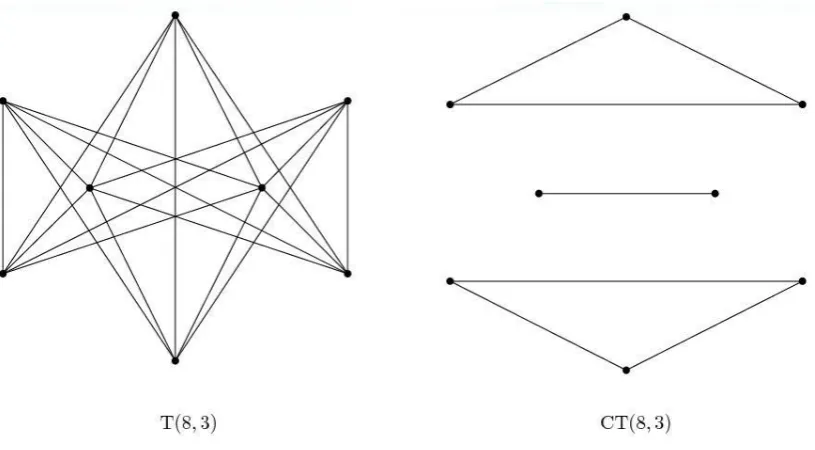
The Turán graph T(n, k) (named after the Hungarian mathematician Pal Turán) is dened as follows: The setV ofnvertices is partitioned intoksubsetsA1, . . . , Ak, whose sizes are as equal as possible, i.e. Sk
i=1Ai=V,Ai∩Aj =∅, ||Ai| − |Aj|| ≤1 for i6=j.
Two vertices are connected by an edge whenever they belong to dierent subsets, i.e.
e(vi, vj)∈E ⇔vi∈Ar, vj ∈As withr 6=s. The number of edges in T(n, k) is given by 12 ·Pk
i=1|Ai| ·(n− |Ai|) and is upper bounded by 1− 1
k
·n2
2 .
Since every set of(k+ 1)vertices contains at least two vertices in the same subsetAi, the Turán graph does not contain a (k+ 1)clique. According to Turán's theorem it is the graph with the maximum possible number of edges with this property.
The complementary graph of the Turán graphT(n, k)is denoted byCT(n, k). Here, two vertices
are connected by an edge if they belong to the same subset, i.e. e(vi, vj)∈E ⇔ ∃r s.t. vi, vj ∈
Ar.
The number of edges is given by|E|=Pk i=1
|Ai|
2
, which is bounded from below by n 2 ·
n k−1
. Since every set of (k+ 1) vertices contains at least two vertices from the same subset Ai, the graphCT(n, k) does not contain a(k+ 1)independent set. From Turán's theorem it follows that CT(n, k) is the graph with the minimal number of edges with this property. We have used this property in sect. 5.3 to nd an optimal monomial ordering.
Figure 4 shows forn= 8 andk= 3 the Turán and the complementary Turán graph.
B Details of the Experiments from Example 1
The parameters we are working with are (o, v) = (26,52)
n=o+v= 78
D= v·(v2+1) +o·v= 2730
D2= o·(o2+1) = 351
Finding the optimal k
In this step we want to nd the minimal k∈ N such that the number of edges in the
comple-mentary Turá graph CT(n, k) (see app. A) is less or equal toD2.
k 1 2 3 4 5 6 7 8
# edges in CT(78, k) 3003 1482 975 722 570 468 396 342
> D2> D2> D2> D2> D2> D2 > D2 ≤D2
To obtain the total number of 351 monomials in C, we add 9 arbitrarily chosen edges to
CT(78,8). This yields graphG(see sect. 5.3).
Fixing of variables
InCT(78,8), the 78 vertices are divided into 8 groupsA1, . . . , A8 as follows
i 1 2 3 4 5 6 7 8
|Ai|10 10 10 10 10 10 9 9
When attacking the scheme directly, an attacker xes a certain number of variables before applying a Gröbner basis method. Since the number of edges in the graph is given by
k X
i=1
|Ai| 2
,
it is obvious, that the best strategy for the attacker is to remove from each group Ai approxi-mately the same number of vertices. Note that by removing r vertices using the above strategy
the attacker creates the graphCT(n−r, k).
When xing v out of the n variables, the attacker creates the graph CT(o, k). In our exam-ple, we get the graphCT(26,8)with 26 vertices divided into 8 groupsA0i as follows:
i 1 2 3 4 5 6 7 8
|A0i|4 4 3 3 3 3 3 3
The number of edges in this graph is P8 i=1
|A0i| 2
= 30.
When xing/guessingv+ 2 = 28variables, the attacker implicitly creates the graphCT(24,8), whose vertices are divided into 8 groupsA00i as follows:
i 1 2 3 4 5 6 7 8
The number of edges in this graph is P8 i=1
|A00i| 2
= 24.
The following table shows for some values of o the optimal number k, as well as the
num-ber of monomials in C and the minimal number of monomials remaining inC after guessingv
(denoted by|C|v) andv+ 2variables (|C|v+2).
o 10 18 26 28 30 32 36 40 44 48
k 7 8 8 8 8 8 9 9 9 9
|C| 55 171 351 406 465 528 666 820 990 1080 |C|v 3 12 30 36 42 48 54 70 86 105