Electronic Thesis and Dissertation Repository
11-29-2018 2:00 PM
Quantification of Uncertainties in Inline Inspection Data for
Quantification of Uncertainties in Inline Inspection Data for
Metal-loss Corrosion on Energy Pipelines and Implications for Reliability
loss Corrosion on Energy Pipelines and Implications for Reliability
Analysis
Analysis
Tammeen Siraj
The University of Western Ontario
Supervisor Dr. Wenxing Zhou
The University of Western Ontario
Graduate Program in Civil and Environmental Engineering
A thesis submitted in partial fulfillment of the requirements for the degree in Doctor of Philosophy
© Tammeen Siraj 2018
Follow this and additional works at: https://ir.lib.uwo.ca/etd
Part of the Civil Engineering Commons, and the Structural Engineering Commons
Recommended Citation Recommended Citation
Siraj, Tammeen, "Quantification of Uncertainties in Inline Inspection Data for Metal-loss Corrosion on Energy Pipelines and Implications for Reliability Analysis" (2018). Electronic Thesis and Dissertation Repository. 5864.
https://ir.lib.uwo.ca/etd/5864
This Dissertation/Thesis is brought to you for free and open access by Scholarship@Western. It has been accepted for inclusion in Electronic Thesis and Dissertation Repository by an authorized administrator of
i
Abstract
One of the major threats to the oil and gas transmission pipeline integrity is metal-loss
corrosion. Pipeline operators periodically inspect the size of the metal loss corrosion in a pipeline
using in-line inspection (ILI) tools to avoid pipe failure which may lead to severe consequences.
To predict pipe failure efficiently, reliability-based corrosion management program is gaining
popularity as it effectively incorporates all the uncertainties involved in the pipe failure prediction.
The focus of the research reported in this thesis is to investigate the unaddressed issues in the
reliability-based corrosion assessment to assist in better predicting pipe failure.
First, a methodology is proposed to facilitate the use of RSTRENG (Remaining Strength of
Corroded Pipe) and CSA (Canadian standards association) burst pressure capacity models in
reliability-based failure prediction of pipelines. Use of RSTRENG and CSA models require the
detail geometric information of a corrosion defect, which may not be available in the ILI reports.
To facilitate the use of CSA and RSTRENG models in the reliability analysis, probabilistic
characteristics of parameters that relate the detailed defect geometry to its simplified characterizing
parameters was derived by using the high-resolution geometric data for a large set of external
metal-loss corrosion defects identified on an in-service pipeline in Alberta, Canada.
Next, a complete framework is proposed to quantify the measurement error associated with
the ILI measured corrosion defect length, effective length, and effective depth of oil and gas
pipelines. A relatively large set of ILI-reported and field-measured defect data is collected from
different in-service pipelines in Canada and used to develop the measurement error models. The
ii
effective length, and effective depth is the weighted average of the measurement errors of the
corresponding Type I and Type II defects and the weighted factor is the likelihood of ILI reported
corrosion defect being a Type I defect (without cluster error) or a Type II defect (with clustering
error). A log-logistic model is proposed to quantify the weighted factor. The application of the
proposed measurement error models is demonstrated by evaluating probability of failure of a real
corroded pipe joint through system reliability analysis.
Keywords: Gas transmission pipeline, metal-loss corrosion, in-line inspection (ILI), measurement
error, maximum defect depth, average defect depth, corrosion defect length, effective area,
iii
Dedication
To my mother Fouzea Yeasmin and my sister Tanzina Siraj Tannee
iv
Co-Authorship Statement
A version of Chapter 2 co-authored by Tammeen Siraj and Wenxing Zhou has been published in
International Journal of Pressure Vessel and Piping, 2018, 166(2018): 107-115, DOI:
10.1016/j.ijpvp.2018.08.007.
A version of Chapter 3 co-authored by Tammeen Siraj and Wenxing Zhou is under review by
v
Acknowledgments
First, I wish to express my deepest gratitude to my supervisor Dr. Wenxing Zhou, who has
guided and inspired me through my PhD. His profound knowledge and the clarity of understanding
on different underlying methods always inspired me to grow as a researcher. Not to mention, I was
always impressed by his dedication towards his work, critical thinking, and his interpersonal skill.
He always welcomed and managed time for discussion whenever I needed his advice on my
research, even in his busiest days. This thesis would have not been possible without his persistent
help.
I would like to thank Mohammad Al-Amin and Terry Huang from TransCanada for their
valuable comments and suggestions on my research. I would also like to extend my appreciation
to members of my thesis examination committee for their advice and critical assessment on my
thesis. I gratefully acknowledge the financial support provided by the Natural Sciences and
Engineering Research Council of Canada (NSERC) and TransCanada Corp.
I am thankful to my colleagues of our research group for their encouragement and assistance.
My special thanks go to all my friends from Bangladeshi community at London for making my
graduate life so enjoyable and supporting me during my ups and downs.
Finally, I would like to thank my parents, my sister and my brother, for all their love and
encouragement throughout my life. My husband, who has always inspired me to give my best
efforts and made me believe in my abilities, I am thankful to him for always being by my side. My
daughter, Ilham khan, I would like to thank her for bringing unbounded joy and happiness in my
vi
Table of Contents
Abstract ... i
Dedication ... iii
Acknowledgments...v
Table of Contents ... vi
List of Tables ... ix
List of Figures ...x
List of Symbols ... xii
1 Introduction ...1
Background ...1
Objective and Research Significance...6
Scope of the Study ...6
Thesis Format...8
Reference...8
2 Evaluation of Statistics of Metal-loss Corrosion Defect Profile to Facilitate Reliability Analysis of Corroded Pipelines ...12
Introduction ...12
Burst Pressure Capacity Models ...15
Statistical Analysis of Defect Geometric Data ...17
Data Description ... 17
Statistical Analysis ... 20
Practical Implications...25
Probability of Burst of Corroded Pipeline ... 25
Analysis Cases and Probabilistic Characteristics of Input Parameters... 27
vii
conclusion ...39
Reference...40
3 Quantification of Measurement Errors in the Lengths of Metal-loss Corrosion Defects Reported by Inline Inspection Tools ...43
Introduction ...43
Corrosion Defect Data ...45
Overview of ILI and Field Measured Data ... 45
Corrosion Data Matching ... 48
Preliminary Data Analysis ...52
Classification of Type I and Type II Defects ...53
Identification of Influencing Parameter ... 53
Framework for Determining PID ... 56
Evaluation of PID ... 57
Measurement Error ...62
Implications for Reliability Analysis ...65
Numerical Example ... 65
Analysis Results ... 68
Conclusion ...69
Reference...70
4 Quantification of Measurement Errors Associated with the Effective Portion of the Corrosion Defects reported by the In-line Inspections ...75
Introduction ...75
RSTRENG model ...77
Measurement Error Models for Effective length and Depth ...78
viii
Measurement Error Models ... 81
Application in Reliability Analysis ...86
Probability of Burst of the Corroded Pipelines ... 86
Analysis Cases and Input of the Reliability Analysis... 87
Analysis Results and Discussion ... 90
Conclusion ...92
References ...93
5 Effects of In-line Inspection Sizing Uncertainties on System Reliability of Corroded Pipelines ...96
Introduction ...96
Reliability Analysis of Corroded Pipe Joint ...98
Burst Pressure Capacity Models ... 98
Probability of Burst of the Corroded Pipe Joint ... 99
Input of the Reliability Analysis ...102
Attributes of Pipe Joint ... 102
Analysis Cases and Probabilistic Characteristics of Random Variables ... 105
Results and Discussion ...110
Conclusion ...115
References ...117
6 Summary, Conclusions and Recommendations for Future Study ...120
General ...120
Recommendations for Future Study ...122
ix
List of Tables
Table 2.1 Basic statistics of μ, λ and η ... 24
Table 2.2 Attributes of representative pipelines considered in the analysis ... 28
Table 2.3 Probabilistic characteristics of random variables in the reliability analysis ... 31
Table 3.1 Empirical 𝑃𝐼𝐷 calculation for corrosion defect data ... 57
Table 3.2 Four possible outcomes for the predicted and actual defect type ... 61
Table 3.3 Basic statistics of defect length measurement error ... 63
Table 3.4 Statistical information of basic random variables ... 68
Table 3.5 Results of the reliability analysis of the corroded pipeline example ... 69
Table 4.1 Basic statistics of effective length and depth measurement error ... 83
Table 4.2 Summary of analysis scenarios ... 87
Table 4.3 Probabilistic characteristics of random variables in the reliability analysis ... 89
Table 5.1 Detail measurements of the DMAs of the pipe joint ... 105
Table 5.2 Probabilistic characteristics of random variables in the reliability analysis ... 109
x
List of Figures
Figure 1.1 Electrochemical cell in buried pipeline (Hopkins 2014) ... 2
Figure 1.2 Schematic illustration of a typical corrosion defect geometry ... 3
Figure 2.1 Typical defect characterization ... 14
Figure 2.2 (a) Laser scan picture of a segment of a pipe joint, and (b) Laser scan picture of a
corrosion defect of the corresponding pipe segment ... 19
Figure 2.3. Relationships between (a) dmax and l, and (b) davg and l ... 20
Figure 2.4. Relationship between (a) μ and dmax ,(b) μ and l, (c) λ and dmax, (d) η and dmax, (e) λ and
l, (f) η and l, and (g) λ and η ... 22
Figure 2.5. Cumulative probability plots for (a) 𝜇, (b) 𝜆, and (c) 𝜂 ... 25
Figure 2.6 Probability of failure for various analysis cases ... 38
Figure 2.7 Comparison of probabilities of failure for steel grades X42, X52, and X70 with (a)𝑙 =
250 mm, 𝑑𝑚𝑎𝑥−𝐼𝐿𝐼⁄ = 0.5 𝑡𝑛 and 𝑈𝐹 = 0.8, (b) 𝑙 = 50 mm, 𝑑𝑚𝑎𝑥−𝐼𝐿𝐼⁄𝑡𝑛 = 0.3 and 𝑈𝐹 = 0.72
... 39
Figure 3.1 Schematic diagram of ILI measured, and Laser scanned corrosion defect (DMA and
cluster)... 47
Figure 3.2 Laser scan picture of ILI to field corrosion anomaly matching ... 49
Figure 3.3 Classification of ILI detected target defects ... 49
Figure 3.4 Histograms of ILI-reported defect sizes (a) depths of clusters, (b) lengths of clusters,
(c) depths of DMA, and (d) lengths of DMA ... 51
Figure 3.5 Field measured defect length vs. ILI measured defect length for (a) all defects (Type I
and Type II), (b) for Type I defects, and (c) for Type II defects ... 53
xi
Figure 3.7 Relationship between defect classification and s for corrosion defect data ... 56
Figure 3.8 Framework for determining PID ... 56
Figure 3.9 Empirical values of PID as a function of 𝑠𝑘/𝑡𝑛 ... 58
Figure 3.10. A schematic of k-fold cross validation ... 59
Figure 3.11. Fitted log-logistic functions for PID ... 59
Figure 3.12 z-score of empirical cumulative distribution function (CDF) vs. the logarithmic value of (a) 𝜀1, (b) 𝜀2, and (c) 𝜀3 ... 64
Figure 4.1 Evaluation of effective portion of a corrosion defect ... 78
Figure 4.2. Schematic representation of ILI and Laser scanned corrosion defect along with their river bottom profile ... 80
Figure 4.3. The empirical CDF and CDF of fitted lognormal distributions plotted in the lognormal probability paper for (a) 𝛼1, (b) 𝛼2, (c) 𝛼3, (d) 𝛿1, (e) 𝛿2, and (f) 𝛿3 ... 83
Figure 4.4. Relationship between (a) α1 and δ1, (b) α2 and δ2, and (c) α3 and δ3 ... 84
Figure 4.5. Reliability index, β for different analysis scenarios for (a) DMA, and (b) Cluster .... 91
Figure 5.1 Schematic representation of ILI reported corrosion defects in a pipe joint (a) 0-6.53m, and (b) 6.53m-12.4m of a 12.4m pipe joint ... 104
xii
List of Symbols
𝐴 or 𝐴𝑒𝑓𝑓 = Effective area of a corrosion defect
COV = Coefficient of variation
CDF = Cumulative density function
𝑐𝑗 = The relative contribution of the j-th defect to Pf for pipe system
DMA = Insolated individual anomaly
𝐷 = Actual diameter of the pipe
𝐷𝑛 = Nominal diameter of the pipe
𝑑𝑚𝑎𝑥 = Maximum corrosion defect depth (actual or Laser scanned)
𝑑𝑚𝑎𝑥−𝐼𝐿𝐼 = ILI measured maximum corrosion defect depth
𝑑𝑎𝑣𝑔 = Average corrosion defect depth (actual or Laser scanned)
𝑑𝑒𝑓𝑓 = Effective corrosion defect depth (actual or Laser scanned)
𝑑𝑒𝑓𝑓−𝐼𝐿𝐼 = ILI measured effective defect depth
FORM = First order reliability method
FS = Factor of safety
𝐹𝑆𝑗 = Factor of safety at j-th corrosion defect
𝐹(𝑥) = Cumulative distribution function of random variable 𝑋
𝑔(∙) = Limit state function
𝑔𝑗(∙) = The j-th limit state function
ILI = In-line inspection
𝑙 or 𝑙𝑎 = Corrosion defect length (Actual or Laser scanned)
𝑙𝐼𝐿𝐼 = ILI measured corrosion defect length
𝑙𝑒𝑓𝑓 = Effective corrosion defect length (Actual or Laser scanned)
𝑙𝑒𝑓𝑓−𝐼𝐿𝐼 = ILI measured effective corrosion defect depth
𝑀 = Folias or bulging factor
MOP = Maximum operating pressure
𝑃𝑏 = Pipe burst pressure
PDF = Probability density function
xiii
𝑃𝑓 = Probability of failure
𝑃𝑓𝑗 = Probability of failure for j-th corrosion defect
𝑃𝐼𝐷 = Probability of a corrosion defect being Type I
𝑃𝑜 = Maximum operating pressure
𝑠 = Shortest distance to the surrounding corrosion anomalies
SMYS = Specified minimum yield strength
SMTS = Specified minimum tensile strength
𝑡 = Actual wall thickness of the pipe
𝑡𝑛 = Nominal wall thickness of the pipe
𝑼 = vector of independent standard normal variates
𝑈𝐹 = Utilization factor/safety factor
𝒖∗(𝑗) = Design point involving the whole system associated with 𝛽
𝑗
𝒙 = Value of the vector 𝑿
𝒁 = Correlated standard normal variates transformed from vector 𝑿
𝜉 = Model error associated with the burst pressure capacity models
𝜌 = Pearson correlation
𝛽 = Reliability index
Φ(∙) = CDF of standard normal distribution
∑ = The correlation matrix of the 𝑟-dimensional standard normal
= distribution function
𝜇 = Ratio between average defect depth and maximum defect depth
𝜆 = Ratio between effective defect length and defect length
𝜂 = Ratio between effective defect depth and maximum defect depth
𝜀𝑑 = ILI vendor specified additive error for corrosion defect length
𝜀𝑙 = ILI vendor specified additive error for corrosion defect depth
𝜎𝑦 = Pipe yield strength
𝜎𝑢 = Pipe tensile strength
𝜎𝑓 = Flow stress
xiv
𝜀2 = Defect length measurement error for Type I cluster
𝜀3 = Defect length measurement error for Type II defect
𝛼1 = Effective length measurement error for Type I DMA
𝛼2 = Effective length measurement error for Type I cluster
𝛼3 = Effective length measurement error for Type II defect
𝛿1 = Effective depth measurement error for Type I DMA
𝛿2 = Effective depth measurement error for Type I cluster
1
Introduction
Background
Pipelines are the most efficient and economic systems to transport large quantities of crude
oil and natural gas from the production sites to the end users. According to Natural Resources
Canada, there are 840,000 kilometers of transmission, gathering and distribution pipelines in
Canada. Of this amount, about 117,000 kilometers of pipelines are large-diameter transmission
lines which covers most provinces with significant pipeline infrastructure (NRCan 2016). It is a
challenging task to maintain such a vast pipeline network across the country; therefore, a practical
strategy for inspecting and monitoring pipeline network is of critical importance to prevent
possible failure.
Metal-loss corrosion is one of the main deteriorating mechanisms that compromise the
structural integrity and safe operation of underground oil and gas pipelines (Vanaei et al. 2017).
Corrosion in steel pipelines is an electro-chemical process that causes the pipes to deteriorate by
reacting with its surrounding environment; whereas, the pipeline acts as the electrode, and the
surrounding soil works as the electrolyte (Davis 2000). The coupled action of oxidation at anode
with the removal of electrons and consumption of these electrons through a reduction action by
the oxidant (such as, oxygen) forms the metal loss corrosion. Figure 1.1 shows a corrosion cell in
a buried pipeline, where the anode, cathode and electrode exist in the same pipeline and the
Figure 1.1 Electrochemical cell in buried pipeline (Hopkins 2014)
Most of the pipelines were protected by external coating and cathodic protection (CP) from
corrosion. However, corrosion may commence due to a breakdown of the coating and/or the CP
system (Hopkins 2014). As a result, it is crucial for pipeline operators to implement an effective,
efficient corrosion management program to prevent failure and ensure safe operation of pipelines.
Periodic inspection and maintenance is central to the pipeline corrosion management program
(Alamilla et al. 2009; Miran et al. 2016). The high-resolution inline inspection (ILI) tools
employing the magnetic flux leakage (MFL) or ultrasonic technologies (UT) are widely used to
locate and measure corrosion defects on a pipeline. The in-line inspection corrosion data used for
the analysis of the present study are all come from the MFL tool. During in-line inspections, MFL
tools produce a magnetic flux in the pipe wall and the distortion from the flux field (also known
as leakage) resulting from the presence of a corrosion defect correlate with the corrosion defect
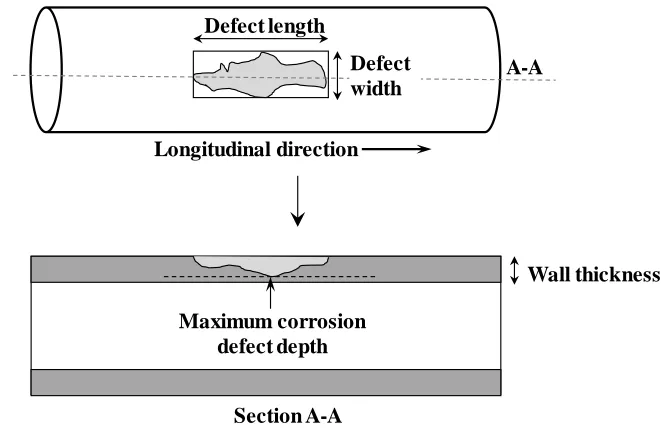
geometry (i.e. corrosion defect depth, length, and width, see Figure 1.2). It should be noted that
Electrolyte (surrounding soil)
Corrosion pit
Ion flow
Cathode area (-)
Anode area (+)
Electron flow, 2e
Oxidation:
2
𝐹 2𝐹
2−
MFL tool can differentiate the corrosion defects located on the external and internal surfaces of
the pipe wall and the present study deals only with the corrosion on the external surface of a
pipeline.
Figure 1.2 Schematic illustration of a typical corrosion defect geometry
Despite the immense advancement of the ILI technology, there are still inherent uncertainties
associated with the ILI tool measurements due to imperfections in the tools and associated sizing
algorithms (Al-Amin et al., 2012; Nessim et al., 2008). It is important to quantify these
measurement uncertainties, as they may affect the accuracy of the corrosion defect assessment.
Corrosion defect assessment is a crucial part of corrosion management program of a pipeline,
whereas steps of corrosion management program involve in-line inspection, corrosion defect
assessment and corrosion mitigation (Kishawy and Gabbar 2010). Over the past few decades, the
reliability-based corrosion management programs are increasingly adopted by pipeline operators
as, it can incorporate the uncertainties associated with parameters used in the corrosion assessment.
The parameters associated with the corrosion assessment involves the pipe mechanical and
Longitudinal direction
A-A
Section A-A Defect length
Wall thickness
Maximum corrosion defect depth
geometric parameters (i.e. pipe diameter, internal pressure, yield strength of the steel pipe etc.) and
the geometric dimension associated with the corrosion defect (i.e. corrosion defect depth, length
etc.). As probabilistic characteristics of the measurement uncertainties associated with ILI tools
are required in the reliability analysis, studies have been conducted in the past decade to facilitate
the use of reliability-based corrosion management programs, such as the development of
probabilistic corrosion defect depth growth models (Al-Amin & Zhou, 2013; Maes et al., 2009;
Zhang & Zhou, 2013) and corrosion defect depth measurement error models (Caleyo et al. 2007;
Nessim et al. 2008; Al-Amin et al. 2012) based on ILI data.
Furthermore, oil and gas transmission pipelines, which are often operated at high internal
pressures, may fail by burst due to the reduced pipe wall thickness caused by metal loss corrosion.
A key component of reliability based corrosion management program is to predict the probability
of the internal pressure of a pipeline exceeding the burst pressure capacity of a corroding pipeline
over a period of time (Zhang and Zhou 2014). There are several empirical burst pressure capacity
models currently used in practice, e.g. the B31G and B31G Modified models (Kiefner and Vieth
1989), Det Norske Veritas (DNV) model (DNV-RP-F101 2010a), the Canadian Standards
Association (CSA) model (CSA 2015), and PCORRC and RSTRENG models (Zhou and Huang
2012) with varying degrees of predictive accuracy. Zhou and Huang (2012) quantified the model
errors associated with the empirical burst pressure capacity models. Furthermore, several
researchers (Ahammed & Melchers, 1996; Amirat et al., 2008; Zhou, 2010) also worked on the
methodologies to evaluate the reliability of corroding pipelines. However, there still exist
knowledge gaps and unaddressed issues that limit the application of the reliability-based
Burst pressure capacity models such as, the B31G, B31G Modified models, DNV model
uses the simple geometric dimensions of a corrosion defect (i.e. corrosion defect length and
maximum defect depth). On the other hand, the burst pressure capacity models such as RSTRENG
and CSA use the detail geometric corrosion dimensions derived from the river-bottom profile of a
corrosion defect, whereas the river-bottom profile referred to the two-dimensional projection of a
three dimensional corrosion defect. According to Zhou and Huang (2012), the RSTRENG and
CSA models are considered the most accurate burst capacity models compared with the other
empirical models available. However, these models (i.e. RTSRENG and CSA models) are not
easily applicable to corrosion defect assessments, as the required detail geometric characterizations
of corrosion defects (derived from the river-bottom profile of a corrosion defect), are not always
available from the ILI data.
Typically, the burst pressure at a corrosion defect is a function of the corrosion defect depth
and length, along with the other physical and mechanical parameters of the pipeline. Measurement
error models for ILI-measured maximum defect depth have been investigated by several
researchers (e.g. Al-Amin et al. 2012; Caleyo et al. 2007; Nessim et al. 2008); on the other hand,
the measurement error for the ILI-measured defect length has not been reported in the literature.
Ellinger and Moreno (2016) pointed out a poor correlation between the ILI-reported defect lengths
and corresponding field-measured defect lengths, which is largely due to the existence of
clustering errors. In this study, the clustering error referred to the phenomena introduced during
the ILI by erroneously including or excluding multiple or a single corrosion anomaly in or from a
corrosion cluster. In cases where ILI tools do provide defect geometric characterization in addition
measurement errors associated with the ILI-reported detailed defect geometry within the context
of the involvement of such geometry in the burst pressure prediction model such as RSTRENG.
Objective and Research Significance
The research conducted in this thesis is financially supported by Natural Sciences and
Engineering Research Council (NSERC) of Canada and TransCanada Ltd. The objective of this
research is summarized as follows:
1) Evaluate statistics of the detailed geometric defect profile to facilitate the use of RSTRENG
(Remaining Strength of Corroded Pipe) and CSA (Canadian standards association) burst pressure
capacity models in reliability analysis of corroded pipelines
2) Develop measurement error models associated with the corrosion defect length, and
measurements associated with the effective portion of a defect, reported by ILI
3) Investigate implication of measurement error models for corrosion defect length and
measurement associated with effective portion of a corrosion defect in the system reliability
analysis.
It is expected that the outcome of this research will facilitate in accurately predicting the
reliability-based assessment of corroded pipelines as well as the pipeline integrity management
program.
Scope of the Study
This thesis consists of four main topics that are presented in Chapters 2 to 5, respectively.
pressure capacity models in the reliability analysis of corroded pipelines. The use of the CSA and
RSTRENG burst pressure capacity models is desirable in the reliability analysis of corroded
pipelines because they incorporate detailed defect geometric information and have relatively small
model uncertainties. Since the detailed defect geometric information is not always available from
ILI of corroded pipelines, this study facilitates the use of CSA and RSTRENG models in the
reliability analysis by deriving probabilistic characteristics of parameters that relate the detailed
defect geometry to its simplified characterizing parameters based on the high-resolution geometric
data for a large set of external metal-loss corrosion defects identified on an in-service pipeline in
Alberta, Canada.
Chapter 3 presents a framework to quantify the measurement error associated with lengths
of corrosion defects on oil and gas pipelines reported by ILI tools based on a relatively large set
of ILI-reported and field-measured defect data collected from different in-service pipelines in
Canada. A log-logistic model is proposed to quantify the likelihood of a given ILI-reported defect
being a Type I defect (without cluster error) or a Type II defect (with clustering error). The
measurement error associated with the ILI-reported length of the defect is quantified as the average
of those associated with the Type I and Type II defects, weighted by the corresponding
probabilities obtained from the log-logistic model.
Chapter 4 presents the quantification of measurement error associated with the effective
portions of a corrosion defect in an oil and gas pipe joint reported by ILI tools based on ILI and
field measured corrosion defect data of several pipelines currently in service in Canada. The study
specifically quantifies the measurement of effective length and effective depth of a corrosion
associated with the ILI data into the proposed measurement error for effective length and effective
of a corrosion defect. Consequently, the measurement error model quantified in this study will
enable the use of RSRENG model in corrosion assessment, if ILI-reported defect profiles are
available.
Chapter 5 presents the sensitivity of system reliability of corroded pipe joints to the proposed
measurement error model for ILI measured corrosion defect length and measurement error model
for ILI measured dimension for effective portion of a corrosion defect. The system reliability of a
corroded pipelines is compared with the ILI vendors provided measurement errors for corrosion
defects to the proposed measurement error models. A pipe joint that is a part of a pipeline currently
in service in Canada is used as a case study.
Thesis Format
This thesis is prepared as an Integrated-Article Format as specified by the School of Graduate
and Postdoctoral Studies at Western University, London, Ontario, Canada. A total of 6 chapters
are included in this thesis. Chapter 1 presents a brief introduction with background, objective, and
scope of the study. Chapter 2 to 5 consists of the main body of the thesis, each chapter addresses
an individual topic and the key part of the published papers and submitted manuscripts. Finally,
the last Chapter of this thesis consists of conclusion of the thesis and the future work.
Reference
Ahammed, M., and Melchers, R. E. (1996). “Reliability estimation of pressurised pipelines subject
to localised corrosion defects.” International Journal of Pressure Vessels and Piping, 69(3),
Al-Amin, M., and Zhou, W. (2013). “Evaluating the system reliability of corroding pipelines based
on inspection data.” Structure and Infrastructure Engineering, 10(9), 1161–1175.
Al-Amin, M., Zhou, W., Zhang, S., Kariyawasam, S., and Wang, H. (2012). “Bayesian Model for
Calibration of ILI Tools.” 9th International Pipeline Conference, IPC2012-90491, Calgary,
Alberta, Canada, September 24–28, 201–208.
Alamilla, J. L., Espinosa-Medina, M. A., and Sosa, E. (2009). “Modelling steel corrosion damage
in soil environment.” Corrosion Science, 51(11), 2628–2638.
Amirat, A., Benmoussat, A., and Chaoui, K. (2008). “Reliability assessment of underground
pipelines under active corrosion defects.” 1st African InterQuadrennial ICF Conference on
Damane and Fracture Mechanics-Failure Analysis of Engineering Materials and Structures,
Algiers, Algeria, 83–92.
Caleyo, F., Alfonso, L., Espina-Hernández, J. H., and Hallen, J. M. (2007). “Criteria for
performance assessment and calibration of in-line inspections of oil and gas pipelines.”
Measurement Science and Technology, 18(7), 1787–1799.
CSA. (2015). “CSA Z662: Oil and gas pipeline systems.” Canadian Standard Association,
Mississauga, Ontario, Canada.
Davis, J. R. (2000). Corrosion: Understanding the basics. ASM International, Ohio, USA.
DNV-RP-F101. (2010). Recommended practice: Corroded pipelines. Det Norske Veritas, Hovik.
Ellinger, M. A., and Moreno, P. J. (2016). “ILI-to-Field Data Comparisons - What Accuracy Can
2016, Calgary, Alberta, Canada, 1–8.
Hopkins, P. (2014). “Assessing the significance of corrosion in onshore oil and gas pipelines.”
Underground pipeline corrosion, Detection, analysis and prevention, M. E. Orazem, ed.,
Woodhead Publishing, UK, 62–84.
Kiefner, J. F., and Vieth, P. H. (1989). A modified criterion for evaluating the remaining strength
of corroded pipe. PR 3-805, American Gas Association, Washing- ton, D.C.
Kishawy, H. A., and Gabbar, H. A. (2010). “Review of pipeline integrity management practices.”
International Journal of Pressure Vessels and Piping, 87(7), 373–380.
Maes, M. A., Faber, M. H., and Dann, M. R. (2009). “Hierarchical modeling of pipeline defect
growth subject to ILI uncertainty.” ASME 28th International Conference on Ocean, Offshore,
and Archtic Engineering, OMAE2009-79470, Honolulu, Hawaii, USA.
Miran, S. A., Huang, Q., and Castaneda, H. (2016). “Time-Dependent Reliability Analysis of
Corroded Buried Pipelines Considering External Defects.” Journal of Infrastructure Systems,
22(3), 04016019.
Nessim, M., Dawson, J., Mora, R., and Hassanein, S. (2008). “Obtaining Corrosion Growth Rates
From Repeat In-Line Inspection Runs and Dealing With the Measurement Uncertainties.” 7th
International Pipeline Conference, ASME, Calgary, Alberta, Canada, 593–600.
NRCan. (2016). “Pipelines Across Canada.”
<https://www.nrcan.gc.ca/energy/infrastructure/18856> (Sep. 16, 2018).
inspection (ILI), and corrosion growth rate models.” International Journal of Pressure
Vessels and Piping, 149(2017), 43–54.
Zhang, S., and Zhou, W. (2013). “System reliability of corroding pipelines considering stochastic
process-based models for defect growth and internal pressure.” International Journal of
Pressure Vessels and Piping, Elsevier Ltd, 111–112, 120–130.
Zhang, S., and Zhou, W. (2014). “An Efficient methodology for the reliability analysis of
corroding pipelines.” Journal of Pressure Vessel Technology, 136(4), 041701.
Zhou, W. (2010). “System reliability of corroding pipelines.” International Journal of Pressure
Vessels and Piping, 87(10), 587–595.
Zhou, W., and Huang, G. X. (2012). “Model error assessments of burst capacity models for
corroded pipelines.” International Journal of Pressure Vessels and Piping, 99–100(2012), 1–
2
Evaluation of Statistics of Metal-loss Corrosion
Defect Profile to Facilitate Reliability Analysis of
Corroded Pipelines
Introduction
The structural integrity of oil and gas pipelines may be compromised by metal loss corrosion
defects. Pipeline operators commonly employ high-resolution inline inspection (ILI) tools to
detect, locate, and size corrosion defects. Over the last decade or so, the reliability-based corrosion
management program is being increasingly used (Cosham and Hopkins 2002; Stephens 2006;
Stephens and Nessim 2006; Zhou et al. 2015) as it provides an effective framework to handle the
uncertainties involved in the pipeline corrosion management. A crucial component of such a
program is to predict the probability of burst of the corroded pipeline, i.e. the probability of the
pipeline operating pressure exceeding its burst pressure capacity. Several semi-empirical burst
capacity models for corroded pipelines are widely used in practice, for example, the American
Society of Mechanical Engineers (ASME) B31G and B31G Modified models, the DNV and CSA
models that are recommended in Det Norske Veritas (DNV) OS-F101 and Canadian Standards
Association (CSA) Z662-15 respectively, the PCORRC and RSTRENG models (Cronin 2000;
Zhou and Huang 2012). These models generally predict the burst capacity as functions of the defect
depth and length, pipe geometry (i.e. diameter and wall thickness), and material strength (e.g.,
yield strength, tensile strength, or flow stress). The geometry of a typical metal-loss corrosion
defect on a pipeline is illustrated in Figure 1. The length and depth of the defect are measured in
the longitudinal and through-wall thickness directions, respectively, of the pipeline. Based on the
defect geometry employed, the aforementioned burst capacity models can be classified as Type I
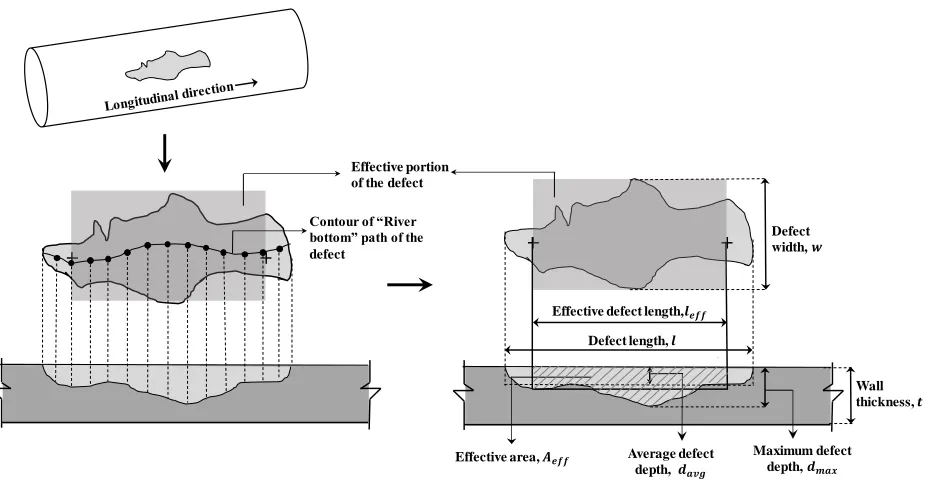
require simplified characterizing parameters for the defect geometry, namely the maximum defect
depth and length (Figure 2.1), to predict the burst pressure. On the other hand, Type II models,
which include the RSTRENG and CSA models, require a so-called river-bottom defect profile
(Figure 2.1) to predict the burst pressure. In particular, the RSTRENG model (Kiefner and Vieth
1989) involves identifying the effective portion of the defect profile that leads to the lowest
predicted burst pressure, whereas the CSA model (CSA 2015) involves evaluating the average
depth from the defect profile.
The burst capacity models are not perfectly accurate and therefore involve model errors.
Zhou and Huang (2012) evaluated model errors associated with the aforementioned burst capacity
models based on a large database of full-scale burst tests of corroded pipes reported in the
literature. According to their report, Type II models are markedly more accurate than Type I
models; this is expected since the former incorporate more information about the defect geometry
than the latter in predicting the burst capacity. It follows that Type II models are more
advantageous than Type I models in the reliability-based corrosion defect assessment. However,
while ILI tools always report the maximum depth and length for a given detected corrosion defect,
they quite often do not provide its detailed defect profile. To facilitate the use of Type II models
in the reliability analysis, it is therefore desirable to develop statistical relationships between the
defect profile and its simplified characterizing parameters.
Reports of statistical relationships between the defect profile and simplified characterizing
parameters are scarce, if any, in the literature. The Canadian oil and gas pipeline standard CSA
Z662-15 (CSA 2015) recommends that the ratio of the maximum to average defect depths be
variation (COV) of 50% and a lower bound of unity. As indicated in Z662-15, this distribution is
derived based on the geometry of defects on the full-scale corroded pipe sections reported by
Kiefner and Vieth (1989). It is however unclear how many data points are used to derive the
distribution (a total of 98 corroded pipe sections are reported by Kiefner and Vieth (1989)) and
how well the distribution fits the data. Furthermore, to the best of our knowledge, relationships
between the effective portion of the defect profile and maximum defect depth or length are
unavailable in the literature. It is therefore necessary to fill the above-described knowledge gap to
improve the pipeline corrosion management practice.
Figure 2.1 Typical defect characterization
The objective of the work reported in this paper is to collect the geometric data of a large
number of naturally-occurring corrosion defects on pipelines and employ the collected data to
derive statistical relationships between the defect profile and its simplified characterizing
parameters. To this end, defect geometric data for 470 external corrosion defects measured by laser
Effective portion of the defect Contour of “River bottom” path of the defect
Effective defect length,
Defect length,
Defect width,
Average defect depth,
Maximum defect depth, 𝒙
Effective area,
scanning devices are collected from an in-service natural gas pipeline located in Alberta, Canada.
Statistical analyses are then carried out to derive the probability distributions of the
average-to-maximum depth ratios, ratio between the average depth of the effective defect profile and
maximum depth of the overall defect profile, and ratio between the length of the effective defect
profile and length of the overall defect profile. The implications of the obtained results are then
investigated by using the B31G Modified, CSA and RSTRENG models to evaluate the
probabilities of burst of several representative pipelines containing corrosion defects with
ILI-reported defect dimensions.
The rest of the paper is organized as follows. Section 2.2 briefly reviews the B31G Modified,
RSTRENG and CSA models. Section 2.3 describes the defect geometric data collected from the
gas pipeline in Alberta and statistical analyses carried out to develop the relationship between the
defect profile and its simplified characterizing parameters. The implications of the obtained results
for the reliability analysis of corroded pipelines are presented in Section 2.4, followed by
concluding remarks in Section 2.5.
Burst Pressure Capacity Models
The CSA and RSTRENG models are both Type II burst capacity models and reviewed in
this section. The B31G Modified model is a representative Type I burst capacity model and serves
as a basis for the CSA and RSTRENG models; therefore, the B31G Modified model is also
reviewed. Let Pb denote the burst pressure capacity of a pipeline at a given corrosion defect. Then
Pb can be evaluated using the B31G Modified, CSA and RSTRNG models, respectively, as
B31G Modified model
𝑃𝑏 =
2𝑡(𝜎𝑦 68.95)
𝐷 [
1 −0.85𝑑𝑚𝑎𝑥
𝑡 1 −0.85𝑑𝑚𝑎𝑥
𝑀𝑡
], 𝑑𝑚𝑎𝑥
𝑡 ≤ 0.8
(2.1)
CSA model
𝑃𝑏 = 𝜉22𝑡𝜎𝑓 𝐷
1 −𝑑𝑎𝑣𝑔𝑡
1 −𝑑𝑡𝑀𝑎𝑣𝑔
(2.2)
𝜎𝑓 = {
1.15𝜎𝑦 𝜎𝑦 ≤ 2 1𝑀𝑃𝑎
0.9𝜎𝑢 𝜎𝑦 > 2 1𝑀𝑃𝑎
(2.3)
𝑀 =
{
√1 0.6275 𝑙2
𝐷𝑡− 0.003375 𝑙4
(𝐷𝑡)2,
𝑙2
𝐷𝑡≤ 50
3.3 0.032 𝑙2 𝐷𝑡,
𝑙2
𝐷𝑡> 50
(2.4)
RSTRENG model
𝑃𝑏 = 𝑚𝑖𝑛{𝑃𝑏𝑗} 𝑗 = 1, 2, … , 𝑛 (2.5)
𝑃𝑏𝑗 = 𝜉32𝑡(𝜎𝑦 68.95) 𝐷
1 −𝑙𝐴𝑗
𝑗𝑡
1 −𝑀𝐴𝑗
𝑗𝑙𝑗𝑡
𝑑𝑚𝑎𝑥
𝑡 ≤ 0.8 𝑗 = 1, 2, … , 𝑛
(2.6)
where, in Eqs. (2.1) through (2.6), dmax, davg and l denote the maximum depth, average depth, and
length of the corrosion defect respectively; D and t are the pipe outside diameter and wall
thickness, respectively; y, u and f are the pipe yield strength, tensile strengths, and so-called
flow stress, respectively; y + 68.95 (MPa) is an empirical equation employed in the B31G
Modified and RSTRENG models to determine f, M is the Folias or bulging factor to account for
B31G Modified, CSA, and RSTRENG models, respectively. To apply the RSTRENG model, one
needs to generate n sub-defects based on the defect profile, each sub-defect being a contiguous
portion of the overall defect. The area and length of the j-th (j = 1, 2, …, n) sub-defect are denoted
by Aj and lj, respectively, and the corresponding Folias factor Mj is evaluated by replacing l with lj
in Eq. (2.4). The sub-defect that has the lowest burst capacity is defined as the effective portion of
the overall defect, with the corresponding area and length defined as the effective area (Aeff) and
length (leff) of the defect, respectively (see Figure 2.1). It should be clarified that the B31G
Modified, CSA, and RSTRENG models as originally proposed do not include the model errors,
i.e. 𝜉1, 𝜉2 and 𝜉3 respectively. They are included in Eqs. (2.1), (2.2) and (2.6), respectively,
because the model error is a key random variable that must be considered in the reliability analysis
of corroded pipelines.
Statistical Analysis of Defect Geometric Data
Data Description
The corrosion geometric data analyzed in this study are collected from the corrosion
assessment field reports for an in-service natural gas pipeline located in Alberta, Canada. Due
primarily to the deterioration of the coating condition, ILI tools found a significant number of
corrosion defects on the external surface of the pipeline. The assessment reports were prepared by
the contractors retained by the pipeline operator to excavate and repair corroded pipe joints (a
typical pipe joint is about 12 m long) that contained critical defects and were therefore deemed in
need of repair based on fitness-for-service assessments of defects using the relevant ILI
information. The reports reviewed in this study cover a period of 7 years, from 2004 to 2011. For
each of the excavated pipe joints, the repair crew used a high-resolution laser-scanning device to
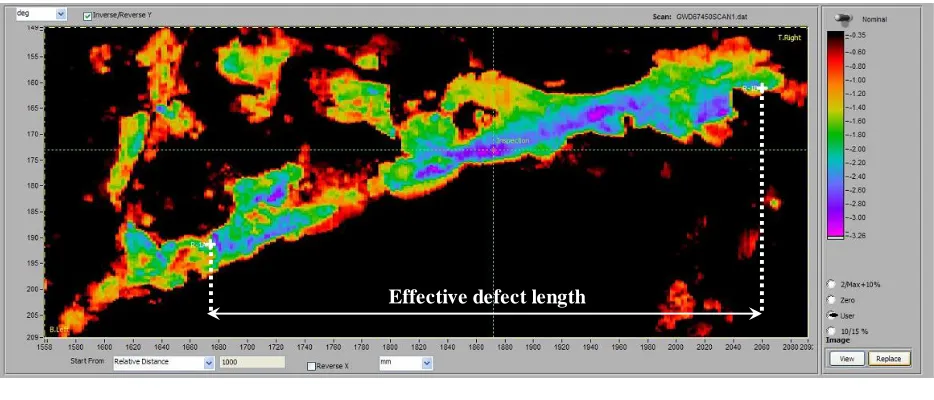
into several segments [see Figure 2.2(a)]. Figure 2.2(b) depicts the laser-scanned image for one
arbitrarily selected defect in the pipe segment shown in Figure 2.2(a). The RSTRENG model was
employed afterward to evaluate the burst capacities at the defects based on the laser-scanned defect
geometry. The reports document key geometric data for the defects, including dmax, davg, l, Aeff, and
leff, obtained from the laser scanning device and RSTRENG assessments. It must be emphasized
that although all the excavated pipe joints contained critical corrosion defects, the laser scan
captured the geometry of all the defects (i.e. critical as well as non-critical defects) on a given
joint. Therefore, the defect geometric data collected from the assessment reports are considered
representative of the entire defect population as opposed to the population of critical defects only.
(a)
(b)
Figure 2.2 (a) Laser scan picture of a segment of a pipe joint, and (b) Laser scan picture of
a corrosion defect of the corresponding pipe segment
By reviewing the assessment reports, the geometric data for a total of 470 corrosion defects
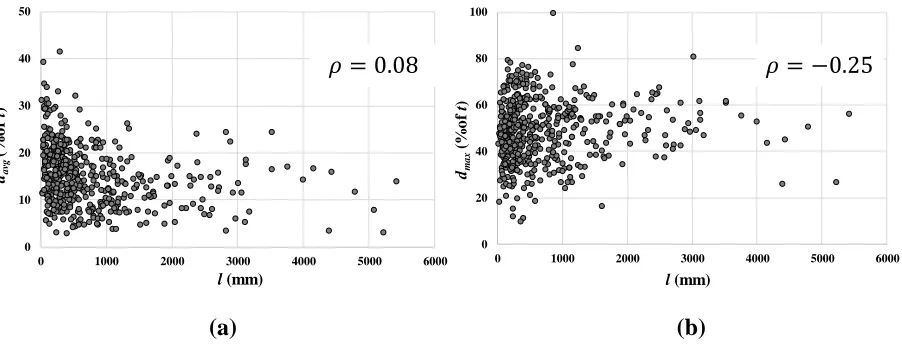
were collected. The values of dmax, davg, and l for these defects range from 9.9 to 84.6% of the pipe
wall thickness (t), from 2.9 to 41.5%t, and from 16 to 5420 mm, respectively. Figure 2.3 depicts
the relationships between dmax andl, and between davg and l for the 470 defects. The Pearson
correlation coefficients (i.e. ) evaluated from the data are shown in the corresponding panels of
the figure. The figure suggests that there are negligible correlations between dmax andl, and davg
and l.
(a) (b)
Figure 2.3. Relationships between (a) dmax andl, and (b) davg and l
Statistical Analysis
For the statistical analyses, the following quantities are defined.
𝜇 = 𝑑𝑎𝑣𝑔
𝑑𝑚𝑎𝑥 (2.7a)
𝜆 =𝑙𝑒𝑓𝑓
𝑙 (2.7b)
𝜂 = 𝐴𝑒𝑓𝑓
𝑙𝑒𝑓𝑓𝑑𝑚𝑎𝑥 (2.7c)
It follows from Eq. (2.7) that (0 < ≤ 1) is the average-to-maximum depth ratio; (0 < ≤ 1)
is the ratio between the effective length and total length of the defect, and (0 < ≤ 1) is the ratio
between the average depth (i.e. Aeff/leff) of the effective portion of the defect and dmax. Given dmax,
l, , and , one can evaluate davg = dmax, leff = l and Aeff = ldmax. Figure 2.4 depicts the
relationships between and dmax, and l, and dmax, and dmax, and l, and l, and and ,
with the corresponding Pearson correlation coefficients given in the corresponding panels of the 0
10 20 30 40 50
0 1000 2000 3000 4000 5000 6000
dav
g
(%
o
f
t)
l (mm)
0 20 40 60 80 100
0 1000 2000 3000 4000 5000 6000
dm
ax
(%
o
f
t)
l (mm)
figure. The figure suggests that there are negligible correlations between and dmax, and l, and
dmax, and dmax, and l, and and , and a relatively strong correlation between and l.
(a) (b)
(c) (d)
0 0.2 0.4 0.6 0.8 1
0 20 40 60 80 100
μ
dmax (%t)
0 0.2 0.4 0.6 0.8 1
0 1000 2000 3000 4000 5000 6000
μ
l (mm)
0 0.2 0.4 0.6 0.8 1
0 20 40 60 80 100
λ
dmax (%t)
0 0.2 0.4 0.6 0.8 1
0 20 40 60 80 100
η
dmax (%t)
𝜌 = −0.22 𝜌 = −0.31
(e) (f)
(g)
Figure 2.4. Relationship between (a) and dmax ,(b) and l, (c) and dmax, (d) and dmax,
(e) and l, (f) and l, and (g) and
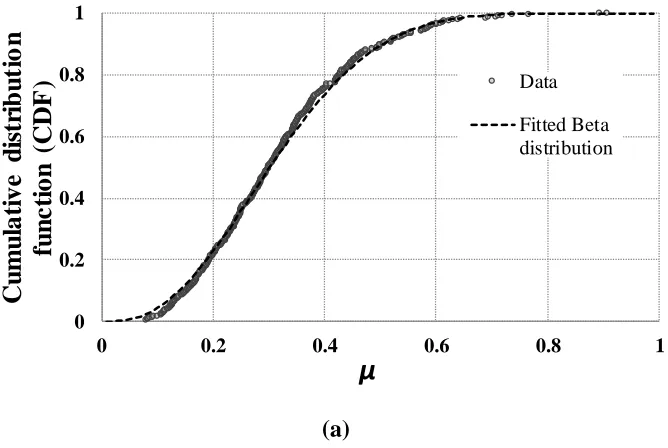
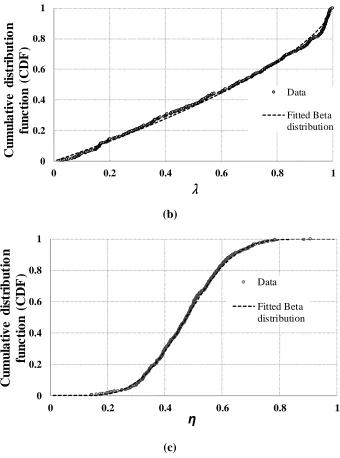
Figure 2.5 depicts the empirical cumulative distribution functions (CDF) of , and
obtained from the 470 data points, whereby the empirical CDF for the i-th (i = 1, 2, …, 470) data
point equals i/471, as well as CDF of the corresponding best-fit distributions. Given that , and
are all bounded between zero and unity, the standard beta distribution is a natural choice to fit
the data. The Kolmogorov-Smirnov test (Ang and Tang 1975) confirms that the standard beta
distribution is the best fit distribution for , and compared with the gamma, lognormal, and
0 0.2 0.4 0.6 0.8 1
0 1000 2000 3000 4000 5000 6000
λ
l (mm)
0 0.2 0.4 0.6 0.8 1
0 1000 2000 3000 4000 5000 6000
η
l (mm)
0 0.2 0.4 0.6 0.8 1
0 0.2 0.4 0.6 0.8 1
η
λ
𝜌 = −0.67 𝜌 = −0.13
exponential distributions. The means, coefficients of variation (COV) and corresponding
distribution parameters q and r for , and are summarized in Table 2.1. The probability density
function (PDF) of a standard beta-distributed variate Y, fY(y), is given by
𝑓𝑌(𝑦) =𝐵(𝑞,𝑟)1 𝑦𝑞−1(1 − 𝑦)𝑟−1 (0 ≤ y ≤ 1) (2.8)
𝐵(𝑞, 𝑟) =Γ(𝑞)Γ(𝑟)Γ(𝑞 𝑟) (2.9)
where B(q, r) is the beta function; (•) is the gamma function, and the mean and COV of Y are
given by q/(q+r) and √𝑞(𝑞 𝑟 1)𝑟 , respectively. Table 2.1 indicates that for the 470 defects analyzed,
davg is on average 32% of dmax; leff is on average 61% of l, and Aeff/leff is on average 48% of dmax.
Furthermore, , and all have relatively high variability with COV values ranging from about
25 to 50%.
It is noted that the probabilistic characteristics of , and obtained in the present study
are based on the corrosion defect data collected from a single in-service pipeline and may not be
applicable to other pipelines, if the morphology of the corrosion defect is largely influenced by
relevant pipe attributes such as the coating properties, as well as properties of the surrounding
soils. The potential dependence of the corrosion morphology on the coating and soil properties is
Table 2.1 Basic statistics of μ, λ and η
Parameter Mean COV Best-fit distribution
Beta distribution parameters
q r
0.32 44% Beta
(Lower bound = 0; Upper bound = 1)
3.242 6.912
0.61 49% 1.025 0.655
0.48 27% 6.795 7.444
(a) 0 0.2 0.4 0.6 0.8 1
0 0.2 0.4 0.6 0.8 1
(b)
(c)
Figure 2.5. Cumulative probability plots for (a) 𝝁, (b) 𝝀, and (c) 𝜼
Practical Implications
Probability of Burst of Corroded Pipeline
The practical implications of the parameters , and described in Section 2.3 for the
evaluation of the probability of burst of corroded pipelines are discussed in this section. The limit
0 0.2 0.4 0.6 0.8 1
0 0.2 0.4 0.6 0.8 1
C u m u la ti v e d is tr ib u ti o n fu n c ti o n (CD F )
λ
Data Fitted Beta distribution 0 0.2 0.4 0.6 0.8 10 0.2 0.4 0.6 0.8 1
state function, g, for the evaluation of the probability of burst of a pipeline containing a corrosion
defect is expressed as,
𝑔 = 𝑃𝑏− 𝑝 (2.10)
where p is the pipeline operating pressure, Pb is the pipe burst pressure capacity at the defect, and
g ≤ 0 represents burst (i.e. failure).
The probability of failure (burst), Pf, is given by,
𝑃𝑓 = ∫𝑔≤0𝑓𝑿(𝒙)𝑑𝒙 (2.11)
where 𝑓𝑿(𝒙) denotes the joint PDF of the vector of n random variables, X = [X1, X2, …, Xn]T (T
denotes transposition), that are involved in the limit state function, including the defect geometric
dimensions, pipe yield or tensile strength, model error and pipeline operating pressure. The
first-order reliability method (FORM) (Melchers 1999a) is employed in this study to evaluate the
integral in Eq. (2.11). It follows that Pf is approximated by (-), where (•) is the CDF of the
standard normal distribution function, and is the reliability index representing the shortest
distance between the origin and limit state surface in the standard normal space. The value of is
obtained through a constrained optimization analysis in the FORM with the constraint being g ≤ 0
in the standard normal space.
To carry out the FORM analysis, the vector of random variables X needs to be transformed
to a vector of n independent standard normal variates U = [U1, U2, …, Un]T. If the individual
random variables in X are mutually independent, the transformation can be straightforwardly
−(•) is the inverse of the standard normal distribution function, and F
i(xi) is the CDF of Xi (Der
Kiureghian 2005). If the individual random variables in X are correlated, the Nataf transformation
(Der Kiureghian 2005) is commonly used. That is, X is first transformed to a set of n correlated
standard normal variates Z = [Z1, Z2, …, Zn]T through the inverse normal transformation, and Z is
then transformed to U through U = L-1Z, where L is the lower-triangular matrix obtained from the
Cholesky decomposition of the correlation matrix associated with Z. Empirical equations have
been developed by Der Kiureghian and Liu (Der Kiureghian and Liu 1986) to evaluate the
correlation coefficient between Zi and Zk given the correlation coefficient between Xi and Xk (i, k
= 1, 2, …, n) for various marginal distributions. The difference between the two correlation
coefficients is in general small; therefore, the former can be considered to approximately equal the
latter. Note that the reliability analysis carried out in the present study corresponds to the defect
assessment to identify critical defects to be repaired immediately after ILI. Therefore, the analysis
does not consider the growth of corrosion defects over time or fluctuation of the pipeline operating
pressure with time; in other words, the time-invariant reliability analysis is carried out.
Analysis Cases and Probabilistic Characteristics of Input
Parameters
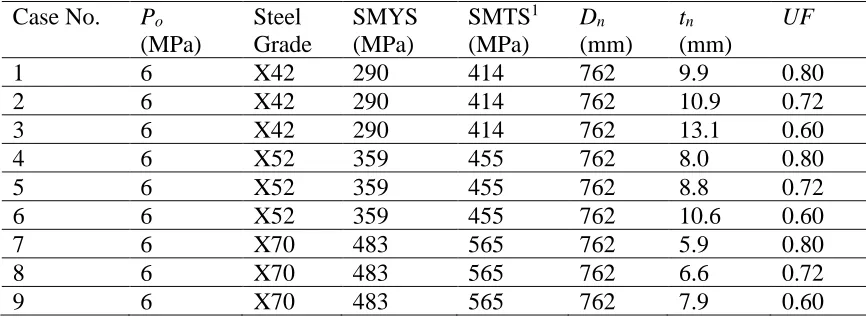
The analysis considers nine representative natural gas pipelines corresponding to a nominal
pipe outside diameter of 762 mm, three pipe steel grades (X42, X52 and X70), and a maximum
operating pressure (MOP) of 6.0 MPa. The nominal pipe wall thicknesses (tn) of the nine analysis
cases are determined as follows:
where Po denotes MOP; SMYS is the specified minimum yield strength of the pipe steel; Dn
denotes the nominal pipe outside diameter, and UF (UF < 1) is the utilization factor (i.e. safety
factor) that limits the pipe hoop stress due to MOP to a fraction of SMYS. Three values of UF,
namely 0.80, 0.72 and 0.60, that are typical for natural gas transmission pipelines in Canada are
considered in the analysis. Table 2.2 summarizes the attributes of the nine pipeline cases
considered in the analysis.
Table 2.2 Attributes of representative pipelines considered in the analysis
Case No. Po
(MPa)
Steel Grade
SMYS (MPa)
SMTS1
(MPa)
Dn
(mm) tn
(mm)
UF
1 6 X42 290 414 762 9.9 0.80
2 6 X42 290 414 762 10.9 0.72
3 6 X42 290 414 762 13.1 0.60
4 6 X52 359 455 762 8.0 0.80
5 6 X52 359 455 762 8.8 0.72
6 6 X52 359 455 762 10.6 0.60
7 6 X70 483 565 762 5.9 0.80
8 6 X70 483 565 762 6.6 0.72
9 6 X70 483 565 762 7.9 0.60
1 SMTS denotes the specified minimum tensile strengths
For each of the analysis cases, it is assumed that the pipeline contains a corrosion defect
with the ILI-reported maximum depth (dmax-ILI) and length (lILI). Four
𝑑max−𝐼𝐿𝐼
𝑡𝑛 values (0.3, 0.4, 0.5
and 0.6), and five 𝑙𝐼𝐿𝐼 values (50, 150, 250, 350, and 500 mm) are considered such that the failure
probability of a given pipeline is analyzed for 20 different sets of dmax-ILI and lILI. For each set of
dmax-ILI and lILI, three reliability analyses are carried out by employing the B31G Modified, CSA
and RSTRENG models, respectively. The analysis employing the B31G Modified model involves
dmax and l, which can be evaluated from dmax-ILI and lILI, respectively, by considering the
analyses employing the CSA and RSTRENG models, , and are used to evaluate davg, leff and
Aeff from dmax and l, i.e. davg = dmax for the CSA model, and leff = l and Aeff = ldmax for the
RSTRENG model. The probabilistic characteristics of parameters , and are given in Table
2.1. Based on the results shown in Figure 2.4, , , , dmax, and l are considered mutually
independent except that λ and l are considered correlated with the corresponding correlation
coefficient equal to -0.67 in the reliability analysis. This correlation coefficient is assumed to be
the same as that in the correlated normal space in the FORM analysis. To investigate the sensitivity
of the analysis results to the correlation between λ and l, FORM analyses are also carried out by
assuming λ and l to be independent.
Table 2.3 summarizes the probabilistic characteristics of the random variables associated
with the pipe geometric and material properties, and dmax and l. It is assumed that all the random
variables in the table are mutually independent. Statistical information provided in Annex O of
CSA Z662-15 (CSA 2015b) indicates that t/tn generally follows a normal distribution with the
mean ranging from 1.0 to 1.01 and COV ranging from 1.0 to 1.7%. Hence, t/tn is assigned a normal
distribution with the mean equal to unity and COV equal to 1.5% in the present study. The actual
pipe outside diameter typically equals the nominal outside diameter with negligible uncertainty
(CSA 2015b). It is also indicated in CSA Z662-15 that both normal and lognormal distributions
are adequate to characterize y/SMYS and u/SMTS, with the mean values close to 1.1 and COV
values ranging from 3 to 3.5%. Jiao et al.(Jiao et al. 1995) suggested that 𝑃 𝑃⁄ 𝑜 (i.e. ratio of the
maximum annual pressure and MOP) follows a Gumbel distribution with a mean between 1.03
and 1.07 and a COV between 1 and 2%. Hence, the present study considers 𝑃 𝑃⁄ 𝑜 follows a Gumbel
the model errors associated with various burst pressure capacity models based on 150 full-scale
burst tests of pipe segments containing single isolated natural corrosion defects. The probabilistic
characteristics of model errors associated with the B31G Modified (1), CSA (2) and RSTRENG
(3) models, respectively, as shown in Table 2.3 are based on the results reported by Zhou and
Huang (2012). The characteristics of the three model errors suggest that the CSA and RSTRENG
models are markedly more accurate than the B31G Modified model.
The ILI-reported maximum defect depth and defect length are assumed to be related to the
actual maximum defect depth and defect length, respectively, by additive measurement errors
(DNV-RP-F101 2010b; Zhou and Nessim 2011) as follows:
𝑑max−𝐼𝐿𝐼 = 𝑑𝑚𝑎𝑥 𝜀𝑑 (2.13)
𝑙𝐼𝐿𝐼 = 𝑙 𝜀𝑙 (2.14)
where 𝜀𝑑 and 𝜀𝑙 are the measurement errors associated with dmax-ILI and lILI, respectively. It is
commonly assumed in the literature (Caleyo et al. 2007; DNV-RP-F101 2010b; Zhou and Nessim
2011; Zhou et al. 2015) that 𝜀𝑑 and 𝜀𝑙 are normally-distributed random variables with a zero mean.
The standard deviations of 𝜀𝑑 and 𝜀𝑙 can be derived from ILI tool specifications (Stephens and
Nessim 2006). For example, typical ILI tool specifications state that dmax-ILI is within dmax±10%tn
80% of the time, and that lILI is within l±10 mm 80% of the time (Stephens and Nessim 2006). It
Table 2.3 Probabilistic characteristics of random variables in the reliability analysis
Variable Distribution Mean COV (%) Source
t/tn Normal 1.0 1.5
CSA (2015)
y/SMYS Lognormal 1.1 3.5
u/SMTS Lognormal 1.09 3.0
D/Dn Deterministic 1.0 0
P/Po Gumbel 1.0 3.0 Jiao et al. (1995)
d (%tn) Normal 0 7.8* Stephens and Nessim
(2006)
l (mm) Normal 0 7.8*
Gumbel 1.297 25.8
Zhou and Huang (2012)
Lognormal 1.103 17.2
Normal 1.067 16.5
*The values are standard deviation.
Analysis Results and Discussion
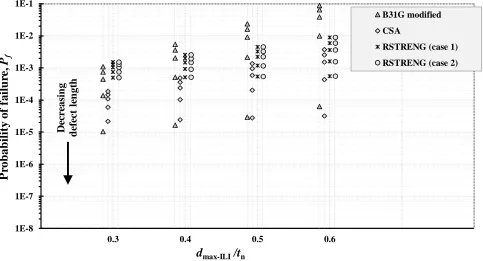
The results of the reliability analysis are shown in Figure 2.6. In this figure, the probability
of failure (i.e. burst), Pf, are plotted against
𝑑max−𝐼𝐿𝐼
𝑡𝑛 (i.e. 0.3, 0.4, 0.5, and 0.6). Nine cases with
different combinations of the steel grade (X42, X52, and X70) and 𝑈𝐹 (0.72, 0.8, and 0.6) are
shown in Figures 2.6(a)-(i). Each of the 𝑑max−𝐼𝐿𝐼
𝑡𝑛 values on the horizontal axis corresponds to four
vertical lines representing results of the reliability analysis based on the B31G Modified model,
CSA model, RSTRENG model with independent λ and l (case 1), and RSTRENG model with
correlated λ and l (case 2), respectively. The five points on a given vertical line in the order of the
highest to the lowest points correspond to lILI of 500, 350, 250, 150, and 50 mm, respectively. In
other words, the greater is the ILI-reported defect length, the higher is the failure probability with
all the other parameters being the same.
Figures 2.6(a)-(i) show that Pf corresponding to the B31G Modified model increases
shown in Figure 2.6(a), when the defect length increases from 50 to 150 mm with 𝑑max−𝐼𝐿𝐼𝑡
𝑛 = 0.3,
Pf increases approximately by 500%, 100%, and 40%, respectively, corresponding to the B31G
Modified, CSA, and RSTRENG models (for both cases 1 and 2). As 𝑑max−𝐼𝐿𝐼𝑡
𝑛 increases from 0.4 to
0.5 with lILI = 150 mm, Pf increases by approximately 160%, 60%, and 20%, respectively,
corresponding to the B31G Modified, CSA, and RSTRENG (both cases 1 and 2), respectively.
These results suggest that the Pf corresponding to the B31G Modified model is highly sensitive to
the change in the defect size, compared with those corresponding to the CSA and RSTRENG
models. For a given defect with relatively large 𝑑max−𝐼𝐿𝐼𝑡
𝑛 and lILI (e.g. for the defect with
𝑑max−𝐼𝐿𝐼
𝑡𝑛 =
0.6 and lILI = 500 mm shown in Figure 2.6(a)), Pf corresponding to the B31G Modified model can
be order-of-magnitude higher than those corresponding to the CSA and RSTRENG models.
Figure 2.6 also indicates that Pf corresponding to the RSTRENG model varies in a more
gradual fashion in response to the change in the defect sizes compared with those corresponding
to the B31G Modified and CSA models. This is likely attributed to that the use of and , both of
which are less than unity, for converting dmax and l to leff and Aeff makes the calculated failure
probability less sensitive to the changes in 𝑑max−𝐼𝐿𝐼𝑡
𝑛 and lILI. The values of Pf corresponding to the
two cases of RSTRENG models are practically identical for all the analysis cases considered. This
suggests that the correlation between and l has virtually no effects on Pf. It follows that such a
correlation can be ignored, and and l can be simply considered as independent in the reliability
analysis.
Figure 2.6 suggests that Pf corresponding to the CSA model is sensitive to the steel grade,