COMPUTERIZED ENTERPRISE RESOURCE PLANNING STRATEGY ON REVENUE COLLECTION IN COUNTY GOVERNMENT OF KERICHO,
KENYA
IRENE CHELANGAT NGENO D53/KER/PT/28461/2014
A RESEARCH PROJECT SUBMITTED TO THE SCHOOL OF BUSINESS IN PARTIAL FULFILMENT FOR THE DEGREE OF MASTER OF BUSINESS
ADMINISTRATION (STRATEGIC MANAGEMENT OPTION) OF KENYATTA UNIVERSITY
ii
DECLARATION
This project is my original work and has not been presented for a degree or other award in any university.
Signature_____________________________Date__________________________ Ngeno Irene Chelangat
Department of Business Administration
SUPERVISOR
I confirm that the work reported in this project was carried out by the candidate with my approval as the University Supervisor.
Signature_____________________________Date__________________________
Dr. Kipkorir Sitienei Chris Simon Department of Business Administration, School of Business,
iii
DEDICATION
iv
ACKNOWLEDGEMENTS
The fruitful finishing of this project would not have been conceivable were it not for some individuals giving me their recommendations and support whether good or material. In spite of the fact that I may exclude every one of their names in this part, I would like to appreciate their efforts and contributions.
To start with, I wish to thank our Living and Almighty God for His care and numerous favors. Besides, I thank my Supervisor Dr. Kipkorir Sitienei Chris Simon for his endeavors, responsibility, support, tolerance and insightful exhortation. I acknowledge the assistance received from the County Government of Kericho, department of finance for your support.
v
TABLE OF CONTENTS
DECLARATION...ii
DEDICATION...iii
ACKNOWLEDGEMENTS ...iv
TABLE OF CONTENTS ...v
LIST OF TABLES ...viii
LIST OF FIGURES ...ix
OPERATIONAL DEFINITION OF TERMS ...x
ABBREVIATIONS AND ACRONYMS ...xii
ABSTRACT ...xiii
CHAPTER ONE: INTRODUCTION ...1
1.1 Background to the Study ...1
1.1.1 Computerized Enterprise Resource Planning ...1
1.1.2 Revenue Collection ...2
1.1.3 County Government of Kericho ...4
1.2 Statement of the Problem ...4
1.3 Objectives of the Study ...6
1.3.1 General Objective ...6
1.3.2 Specific Objectives ...6
1.4 Hypothesis of the Study ...7
1.5 Significance of the Study ...7
1.6 Scope of the Study ...8
1.7 Limitations of the Study...8
1.8 Organization of the Study ...8
CHAPTER TWO: LITERATURE REVIEW ...10
vi
2.1.1 Technology Acceptance Model (TAM) ...10
2.1.2 System Theory ...11
2.1.3 Control Theory ...14
2.1.4 Unified theory of acceptance and use of technology (UTAUT) ...16
2.2 Empirical Review...17
2.2.1 Automation and Revenue Collection ...18
2.2.2 Integrated Internal Control Process and Revenue Collection ...21
2.2.3 Efficiency and Revenue Collection...23
2.2.4 Human Resource Management System and Revenue Collection ...26
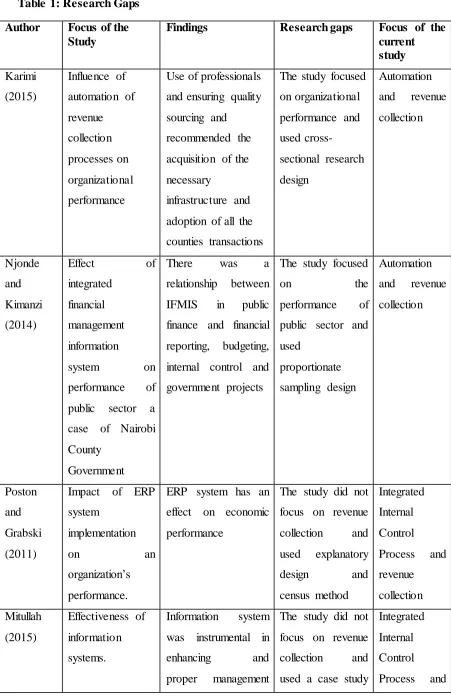
2.3 Summary of Literature Reviewed and Research Gaps ...28
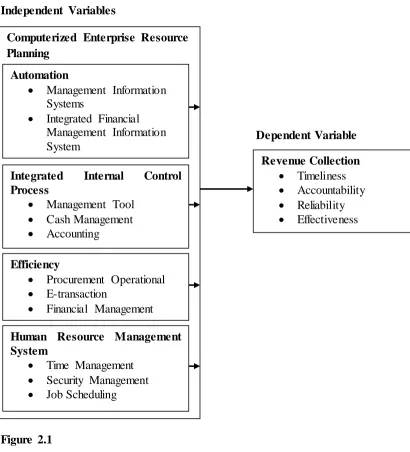
2.4 Conceptual Framework ...33
CHAPTER THREE: RESEARCH METHODOLOGY ...34
3.1 Research Design...34
3.2Target population ...34
3.3SamplingDesign ...35
3.4 Data Collection ...36
3.4.1 Validity...37
3.4.2 Reliability...38
3.5Data Analysis ...39
3.6 Ethical Considerations ...41
CHAPTER FOUR: DATA ANALYSIS, INTERPRETATION AND DISCUSSION ...42
4.1Response Rate ...42
4.2Demographic Information...42
4.3 Computerized Enterprise Resource Planning and Revenue Collection ...45
vii
CHAPTER FIVE: SUMMARY, CONCLUSIONS AND
RECOMMENDATIONS...56
5.1 Summary ...56
5.1.1 Automation...56
5.1.2 Integrated Internal Control Process ...56
5.1.3 Efficiency ...57
5.1.4 Human Resource Management ...57
5.2 Conclusions ...57
5.3 Recommendations ...58
5.4 Suggestion for further Studies ...59
REFERENCES...60
APPENDICES ...67
APPENDIX I: Questionnaire ... 67
APPENDIX II: Letter from Ministry of Education ...71
APPENDIX III: Letter of Approval from Graduate School ...73
viii
LIST OF TABLES
Table 1: Research Gaps... 30
Table 2: Distribution of the Target Population ... 34
Table 3: Sample Size... 36
Table 4: Reliability Test Results ... 39
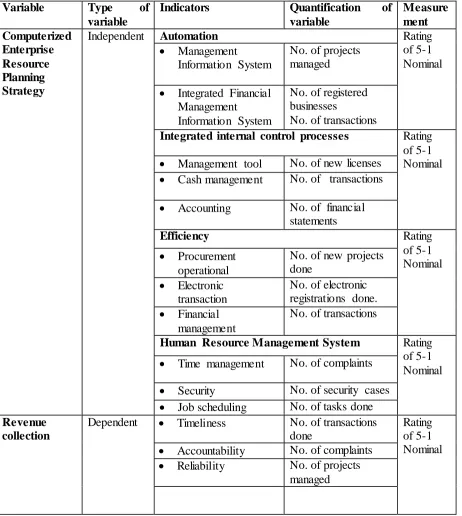
Table 5: Operationalization and measurement of variables ... 40
Table 6: Response Rate... 42
Table 7: Respondents’ Age ... 43
Table 8: Respondents’ Length of Work ... 45
Table 9: Automation and Revenue Collection ... 46
Table 10: Integrated Internal Control Process and Revenue Collection ... 47
Table 11: Efficiency and Revenue Collection ... 48
Table 12: Human Resource Management and Revenue Collection ... 49
Table 13: Revenue Collection... 51
Table 14: Correlation Analysis using SPSS 17.0... 52
Table 15: Coefficient of Determination ... 53
Table 16: Analysis of Variance (ANOVA)... 53
ix
LIST OF FIGURES
x
OPERATIONAL DEFINITION OF TERMS
Automation The use of machines and technology to make processes run on their own without manpower
Efficiency Achievement of or capacity to finish work with a minimum use of time and exertion
Enterprise Resource Planning System
Bookkeeping focused, social database based, multi-module yet incorporated, programming framework for recognizing and arranging the asset needs of an association
Computerized Enterprise Resource Planning Strategy
Refer to the automation, integration of internal control, efficiency and human resource system.
Human Resource Management The process of combining all the systems to do with managing human resources in a business so that they work effectively together for the best results.
Integrated Internal Control Process
Alludes to a procedure, affected by an association's board of chiefs, administration, and other faculty, designed to give sensible affirmation with respect to the achievement of destinations identifying with operations, reporting, and consistence
xi
xii
ABBREVIATIONS AND ACRONYMS CCP County Connectivity Project
COA Charts of Accounts DV Dependent variable
ERP Enterprise Resource Planning
GCCN Government Common Core Network GDC Government Data Center
GDP Gross domestic product HR Human Resource
IPPD Integrated Personnel Payroll Data
IPSAS International Public Sector Accounting Standards IS Information Systems
IT Information Technology KRA Kenya Revenue Authority LIC’s Low-Income Countries
MDG’s Millennium Development Goals MIS Management Information System NOFBI National Optic Fibre Backbone OR Operations Research
PC Personal Computer
PFM Public Financial Management SIBET Soft Issues Bid Evaluation Tool SPSS statistical package for social science TPB Theory of Planned Behavior
xiii ABSTRACT
1
CHAPTER ONE
INTRODUCTION 1.1Background to the Study
The adoption of Information Communication and Technology (ICT) for enterprise is going past really shopping for an office laptop and connecting it to the net. It is made greater beneficial if its installation with integrated information structures to aid the practical regions of the enterprise. Those regions include operations and management of accounting, budget, production, manufacturing, transportation, income and distribution, human useful resource, deliver chain, client dating and e-commercial enterprise. An example of this kind of system is the enterprise resource planning (ERP) software (Torach, 2011).
Tadjer (2010) emphasizes that ERP systems are one database, one utility and a unified interface across the complete agency”. ERP structures offer specific advantages to the companies imposing them. This they do by means of enhancing the decision making method of the corporations through the availability of appropriate and timely data (Hunton, Lippincott & Reck 2013). Globalization has necessitated most groups to standardize processes and study the best practices embedded in ERP systems, which ensure high-quality and predictability in their worldwide commercial enterprise pursuits through decreasing cycle time from order to shipping (Ross, 2013). With the evolvement of ERP structures, the interest in the impact that those systems have on organizational performance has risen (Sundtoft, Hald & Mouritsen, 2013).
1.1.1 Computerized Enterprise Resource Planning
2
the income framework to accomplish reconciliation and data sharing to improve proficiency and viability of the framework. All Sectors of the County should set up a compelling and proficient income accumulation framework in checking system that guarantees satisfactory supervision of the planned projects and venture exercises to upgrade responsibility and ingestion of assets Amin, (2012). Mechanization of income accumulation frameworks and structures is instrumental in enhancing and rearranging organization of tax collection through using current innovations for instance ICT.
In the present focused, quick paced business scene, getting the most out of accessible assets is impossible yet rather a need. Associations are adopting an exceptionally proactive strategy to frameworks modernization and operations with an end goal to expand productivity and adequacy in their operations. Framework automation enables firms to computerize new stages of their income gathering frameworks keeping in mind the end goal to receive most extreme rewards (CyberTek, 2012). System modernization provides measureable improvements in the efficiency and effectiveness of development and maintenance activities with on-time delivery and predictable quality (UNCTAD, 2008). This study will investigate the effects of automated strategy on revenue collection in Kericho County.
1.1.2 Revenue Collection
3
The requirement for extra income is generous in many creating nations, yet enhancing income preparation has significance past that. Necessities for alleviating destitution and enhancing framework are considerable: accomplishing the governments set goals, for example, could necessitate low-wage nations to raise their assessment Gross Domestic Product (GDP) proportions by around high rate focuses United Nations (2005).
The Commission on Revenue Allocation (CRA) will increase funding to counties that increase their revenue raising measures. CRA Director of Research and Policy Linet Oyugi argue that counties were required to automate tax collection to seal loopholes for corruption and increase revenue collection. Oyugi said two per cent of the National Revenue has been equally given out to all the counties for fiscal management and warned that counties that would not automate their revenue collection by 2017 would have to explain the failure. She said automation was a proven method of avoiding pilferage and therefore must be embraced by every county, in order to put in place systems for enhanced accountability of the collected revenue. “The commission understands that counties inherited dysfunctional financial management systems from the defunct Local Authorities and that is why we are working on investing in modern systems as they would make tracking revenue collection easier,” she said Oyugi added that county governments was required to bank collected revenue in the County Revenue Fund to avoid losses of taxpayers’ monies to unscrupulous county officials.
4
fields of Managerial Accounting, Management and Computer Sciences (Laudon & Laudon, 2010).
1.1.3 County Government of Kericho
Kericho County is one of the 47 counties of Kenya. It has a population of 752,396 (2009 census) and an area of 2,111 km2. Kericho County Assembly is composed of 47 members and 17 of whom are nominated to satisfy Article 177 (b) and (c) on gender, youth, minorities, marginalized groups and persons with disabilities. The membership is well diverse with the varying ages, education and technical skills.
Strategic planning for the Kericho County government is a critical component in positioning the Assembly and equipping it with a focused framework for dealing with its legislative, oversight and representation functions. The strategic planning framework of Kericho County is based on the Balanced Scorecard (BSC) approach, which is a strategic planning and management system with a balance set of linked objectives and performance indicators in different perspectives. One of the strategic objectives of Kericho County is having a representative capacity through external linkages and partnership with various stakeholders to foster sustainable development and improving use of ICT for public information dissemination (Kericho County Government Report of 2017).
1.2 Statement of the Problem
5
from the County Governments which will ultimately negate the national economy. The County Governments get their revenue from taxation, permit fees, CESS, license fees and other sources. However, their over-reliance on the National Government for funds to a point of calling for a national referendum to have their allocation increased implies that there exists a myriad of challenges in revenue collection at County level.
Ngotho and Kerongo (2014) found out that compliance level affects collection of revenue by the revenue collection body. Non-compliance to remission of taxes has been found to be a key determinant of revenue collection. A study by Naibei, Momanyi and Oginda (2012) showed that Kenya is among many developing countries struggling with the problem of tax non-compliance by the tax payers. When the County Governments fail to optimally collect requisite revenues, the public will negatively be affected by being denied vital services. The County Government employees are bound to fail to be adequately remunerated. Moreover, the National Government will be overburdened by the financial demand from the County Governments which will ultimately negate the national economy.
6
show that at the organizational level, ERP has very positive impact on the performance of companies. This was a comparative study focusing on ERP and organizational performance. This study focused on the effect of computerised enterprise resource planning strategy on revenue collection in County Government of Kericho, Kenya.
1.3 Objectives of the Study
This section comprises of the general objective and specific objectives of the study.
1.3.1 General Objective
The general objective of this study was to investigate computerized enterprise resource planning strategy on revenue collection in county government of Kericho, Kenya
1.3.2 Specific Objectives
i) To determine the effect of automation on revenue collection in County Government of Kericho, Kenya.
ii) To establish the effect of integrated internal controls on revenue collection in County Government of Kericho, Kenya.
iii) To identify the effect of efficiency on revenue collection in County Government of Kericho, Kenya.
7 1.4 Hypothesis of the Study
H01: There is no significant effect of automation on revenue collection
H02: There is no significant effect of integrated internal controls on revenue collection
H03: There is no significant effect of efficiency on revenue collection
H04: There is no significant effect Human Resource management system on revenue collection
1.5 Significance of the Study
One way of optimizing revenue collection is through automation or computerization. That is why the integrated Financial Management System was established. However, there have been some challenges in the implementation process and thus expected impacts have not been realized. The findings were used by stakeholders to make appropriate decisions on how to effectively adopt a Management Information System (MIS) that includes automated revenue collection protocols.
The study was beneficial to various stakeholders; this study was an instant source of information to county governments’ management on the various strategic alignment practices being adopted by them and other potential strategies that they can employ towards attainment of their goals. This study was helpful since it helped the county governments in controlling much more effectively the execution and realization of their strategies as it was able to incorporate the possible risks to be faced in their operation if automation of revenue collection strategy was not achieved.
8
organization performance. When effectively implemented the level of revenue collected was enhanced and such resources supported the effective delivery of services to residents in County Government of Kericho.
1.6 Scope of the Study
The study was conducted in 2016 and was limited to the County Government of Kericho, The geographical scope of the study was limited to Kericho Town and focused on the effects of automation strategy on revenue collection. The study targeted key informants for data collection who come into contact with automation of revenue collection within the county government of Kericho.
1.7 Limitations of the Study
The study relied on questionnaires with both closed and open ended questions to collect data. Closed ended questions have the disadvantage of limiting the responses whereby the respondent is compelled to answer questions according to the researcher’s choice. However, to overcome this, the researcher ensured that the questions were well thought out and comprehensive enough to cover all important aspects of the study objectives. The study also focused on some of the very busy senior managers scheduling and rescheduling to meet. However, time was observed regarding appointment.
1.8 Organization of the Study
9
10
CHAPTER TWO LITERATURE REVIEW 2.1 Theoretical Review
The purpose of this review is to examine the corpus of theory that has accumulated in regard to an issue, concept, theory, phenomena. The study was guided by four theories namely; Technology Acceptance Model (TAM), System theory, Control theory, and Unified Theory of Acceptance and Use of Technology (UTAUT).
2.1.1 Technology Acceptance Model (TAM)
Proposed by Davis, Venkatesh and Morrisin 1989, the theory is most commonly used model to predict the user acceptance of information systems/technology, TAM was developed on the base of the Theory of Reasoned Action (TRA) by Fishbein and Ajzen (1975). According to TRA, the behavior of an individual is predicted by the beliefs, attitudes and intentions. TRA states that the behavior intentions determine the actual behavior. TRA is utilized largely to foresee the behavior in different areas including information systems Hebert et.al. (1994))
11
conduct of genuine framework utilization at the area. Seen usability is the level of absence of exertion required by the client in embracing a given innovation.
According to Praveena and Thomas (2013) the attitude construct was removed in many of the IS researches as attitude was found to partially mediate the impact of belief on intention. In spite of the fact that a considerable measure of scientists has upheld the ease of use of TAM in different settings, TAM has additionally been condemned by a few analysts. Benbasat and Barki (2007) states that "Hat based research has given careful consideration to the forerunners of its conviction develops". Cap has likewise been scrutinized to foresee just introductory acknowledgment (Praveena & Thomas, 2013).
This theory was relevant to the study as it is an information systems theory that models how users come to accept and use technology. This model suggests that the acceptability of an information system is determined by two main factors: operational efficiency and effectiveness. The attitude toward adoption will decide about the adopter’s positive or negative behavior in the future concerning new technology. The Technology Acceptance Model helped managers and decision makers to acquire knowledge on effective adoption of computerized system towards effective revenue collection and motivate users to accept the systems.
2.1.2 System Theory
12
'general framework hypothesis', a multidisciplinary field (1968). A few impacts from the possibility approach can be found in framework hypothesis.
Gerald & Phil (2009) have characterized at its least complex a framework as an accumulation of interrelated parts which shapes some entirety. Normal frameworks included are the nearby planetary group, the human body, correspondence systems and social frameworks. Frameworks might be "shut" or ''open". Shut framework are those, which, for all commonsense reasons for existing, are totally self-supporting and consequently don't interface with their condition.
An illustration would be a space explorer's life-bolster pack. Open frameworks are those which interface with their condition, whereupon they depend for acquiring basic data sources and for release of their yields. Social frameworks e.g. (associations) are constantly open frameworks. There are three noteworthy attributes of open frameworks are as per the following: They get information sources or vitality from their condition, they change over these contributions to yields and they release their yields into their condition.
13
Maintenance sub-system is concerned with the relative stability or predictability of the organization. Adaptive sub-systems are the first three sub-systems above serve the organization as it is. The adaptive sub-systems by comparison are concerned with what the organization might become. They deal with issues of change in the environment e.g. as in marketing research and development and automated management information systems. Managerial sub-systems comprise the controlling and coordinating activities of the total system. They deal with the coordination of sub-cultures, the resolutions of conflict, and the coordination of external requirements with the organization’s resources. In this study the Kericho County Government is the total system and the automated MIS is the adaptive sub-system.
The data methodology must be attempted on a framework. For this situation the framework is the Management Information System gone for enhancing income accumulation. This investigation will accordingly be guided by the frameworks hypothesis. The frameworks way to deal with Management was created amid the late 1950s. Many pioneers have made noteworthy commitments to this approach. The frameworks hypothesis has crucial components that incorporate an association is a framework comprising of many interrelated and related parts or sub frameworks.
14
This theory is relevant to the study as it treats businesses as open systems, meaning they exist in an environment of some kind and must make constant adjustments on their strategies based on adoption of new technologies to survive in that environment. Systems theory is also used as a tool to enable the organization to be able to interact with the environment properly and how a business can function effectively. For instance, the parts of a business do not operate in isolation from each other. Instead, anything that happens in one department affects what happens in every other.
2.1.3 Control Theory
Control hypothesis as proposed by Lee & Markus in 1967is an interdisciplinary branch of building and science that courses of action with the direct of dynamical systems with information sources, and how their lead is adjusted by feedback. The ordinary objective of control speculation is to control a structure, consistently called the plant, so its yield takes after a desired control signal, called the reference, which may be a settled or advancing regard. To do this a controller is arranged; for this circumstance the ERP System gotten by the range governing body of Kericho screens the yield and complexities it and the reference. The refinement among genuine and looked for yield, called the error hail, is associated as feedback to the commitment of the system, to pass on the genuine yield closer to the reference. A couple of subjects examined in control speculation are trustworthiness (paying little mind to whether the yield will converge to the reference regard or influence about it), controllability and detectable quality.
15
differential conditions depicting the framework. In spite of the fact that a noteworthy utilization of control hypothesis is in charge frameworks building, which manages the plan of process control frameworks for industry, different applications go a long way past this. As the general hypothesis of input frameworks, control hypothesis is valuable wherever criticism happens. A couple of illustrations are in physiology, gadgets, atmosphere displaying, machine plan, biological communities, route, neural systems, predator-prey connection, quality expression, and creation hypothesis.
From a data administration point of view, administration control characterizes the choice space of the people inside an association to influence their conduct (Brinberg & Snodgrass, 1998). Administration control empowers associations to build the likelihood that workers settle on choices and take activities that are in the associations' best advantage (Chow, Shields & Wu 1999). It can be contended that fundamental to all controls is the data that connections chiefs and representatives. Data frameworks and control frameworks are observed to be interlaced. For instance, Simons (1995) saw administration control as formal, data based schedules and strategies that supervisors use to keep up or modify designs in hierarchical exercises.
16
The theory was relevant to the study as it deals with the behavior of dynamical systems with inputs, and how their behavior is modified by feedback. This address the integrated internal control theory that focuses on the controlling the system to ensure efficiency and smooth running of the organization. The theory focuses weakly on human resource management system which controls roles, workload and behaviors of personnel in the organization.
2.1.4 Unified theory of acceptance and use of technology (UTAUT)
The Unified Theory of Acceptance and Use of Technology (UTAUT) is an innovation acknowledgment display figured in 2003 by Venkatesh and others in "Client acknowledgment of data innovation toward a brought together view". The UTAUT plans to disclose client expectations to utilize a data framework and consequent utilization conduct.
17
Bagozzi studied the model and its ensuing expansions, expressing "UTAUT is a good natured and insightful introduction," yet that it gives a model 41 free factors for foreseeing goals and no less than 8 autonomous factors for anticipating conduct," and that it added to the investigation of innovation reception "achieving a phase of mayhem." He proposed rather a brought together hypothesis that clings the "many fragments of information" to clarify basic leadership.
Van Raaij and Schepers (2008) in 01.0 light of the fact that its high R2 is just accomplished while directing key associations with up to four factors. They additionally called the gathering and naming of things and builds hazardous in light of the fact that an assortment of divergent things was consolidated to mirror a solitary psychometric develop.
This theory was relevant to the study as it aims to explain how the County government of Kericho use computerized enterprise resource planning system in enhancing County government systems of operations towards effective revenue collection. The theory also tries to explain the degree of acceptance of the use of information technology. Developing Information and Communication Technology (ICT) can assume a critical part in battling defilement in broad daylight back frameworks by advancing more noteworthy completeness and straight forwardness of data crosswise over government foundations.
2.2Empirical Review
18 2.2.1 Automation and Revenue Collection
Automation integrate the use of technologies to enhance the revenue collection through the use of hardware and software so as to cub the reductions of revenue collections (Ireland, 1994 as cited in Gitaru, 2017). Automation of process have assisted to a great extent to tax clearance time (Haughton and Desmeulus, 2001). Automation of tax system has significant effect on the staffing, tax assessments and proper accountability so as to curb embezzlements. It is important that synchronozations and integration of system is fundamental in the whole process of automation (Dramod, 2004). Automation is increasely being used not only in revenue colleciton administration but also used in other governmental and non-govermental institution in maximizing the compnay objective and its smooth running (De Wulf and Sokol, 2005).
Owino, Senaji, Eng and Ntara (2017) study examined on the effect of innovation in revenue collection processes on organizational performance of Nairobi City County. The design of this research was a descriptive survey research. The population for this study composed of 13 top level managers, 41 middle level managers and 102 low level managers. Stratified proportionate random sampling technique was used to select the sample of 111 respondents. The study used a semi structured self-administered questionnaire to collect data from the respondents. The study found that that online billing process had very great extent on organizational performance.
19
analyzing tax automation and administration cost, time efficiency and effectiveness of revenue collection. Some of the results are consistent with the notion that automation leads to efficiency in tax administration. The study concluded that the primary aim of computerized revenue collection (automation system) must be to dramatically increase cash receipts in order to effectively sustain the utility and generate an acceptable return on investment related to the system.
A study carried out by Karimi (2015) in Meru County, sought to assess the influence of automation of revenue collection processes on organizational performance. The study concluded that concluded that effective implementation of public procurement processes in Meru county procurement department is affected by procurement planning followed by transparency and then record management and ICT are the major factors. It was further concluded that the current phenomenon of procurement process in public sector can be achieved if the public procuring entities ensure that there is transparency in procurement procedure, use of professionals and ensuring quality sourcing and recommended the acquisition of the necessary infrastructure and adoption of all the counties transactions.
20
Kamau (2014) study sought to determine the impact of adoption of technology as a vital device in improving expense consistence in Kenya. The investigation concentrated on the extensive citizens of Kenya Revenue expert. The examination presumes that in fact the selection of innovation impacts on the duty consistence levels of the expansive citizens. Additionally, it was concluded that the Kenya Revenue Authority has effectively implemented its Internet and Communication Technology strategy.
Pollock’s (2004) contemplate pointed on ERP frameworks use in a UK college brings up that the uniqueness of a college set up makes most business ERP frameworks incongruent with their capacities. This requires a custom improvement of a framework good with the structure and elements of a particular college. The decision of either a custom improvement or selection of a promptly accessible framework ought to be educated by educated by an exhaustive frameworks investigation and outline assessment while putting the institutional key goals into thought (Basoglu & Kerimoglu, 2007). This can be accomplished by drawing up an intricate usage system to control the procedure.
21
regularly scheduled installment mode which can be effortlessly electronic as the allowed framework seems to be.
Governments in creating nations are progressively investigating strategies and frameworks to modernize and enhance open monetary administration. For instance, finished the years, there has been a presentation of the - (IFMIS) as a standout amongst the most well-known money related administration change hones, gone for the advancement of productivity, adequacy, responsibility, straightforwardness, security of information administration and extensive budgetary announcing. The degree and usefulness of an IFMIS differs crosswise over nations, however ordinarily it speaks to a gigantic, unpredictable, key change prepare Chene (2009).
2.2.2 Integrated Internal Control Process and Revenue Collection
Internal control systems are automated process used in business to review the controls and performance of a firm (Millichamp, 2000). The use of integrated internal control process is important in improvement of business functions (Hamed, 2009). Hongming & Yanan (2012) uses an example of human nervous system which each functions are done autonomous but work together resembles an integrated internal control process. The exchange of information assists the human resource work smoothly and efficiently. According to COSO report of 2012 internal control enable organization to avoid risk in their daily revenue collection. Besides ensuring efficiency and effectiveness accountability and integrity of accounting record is crucial in the whole revenue collection process.
22
Commission 2013 framework in its conceptualization. The study arrived at mixed results in terms of the relationship and nature of association between the components and revenue fund management. In addition, the study did not provide enough evidence to believe whether or not there existed significant differences in internal control among county governments in Kenya. This alluded to inconsistencies in implementation of internal control among the devolved units.
Rodin-Brown (2008) study highlight that an IFMIS is a data framework that tracks monetary occasions and abridges money related data. It underpins sufficient administration revealing, arrangement choices, trustee duties and the planning of auditable budgetary proclamations. In its essential shape, an IFMIS is minimal more than a bookkeeping framework designed to work as per the necessities and particulars of the earth in which it is introduced Rodin-Brown (2008). When all is said in done terms, it alludes to the mechanizing of budgetary operations.
Poston & Grabski (2011) investigated the impact of ERP system implementation on an organization’s performance. They examined 50 companies adopting ERP systems over a three-year post-implementation phase. They concentrated on three major areas, which they presumed would illustrate ERP system effects on economic performance. These were internal coordination costs, decision information costs and external coordination costs. All of them are included with more detailed cost categories.
23
that electronic procurement leads to more market transactions. This led to the conclusion that electronic procurement increases market transparency, lowers search and supplier switching costs and improves the management of supply chain and contradicts the predictions that ICT will lead to a dominance of network-like organizational form and an increasing reliance on hybrid forms of organizing economic transactions.
Mitullah (2015) did a survey of 175 local authorities in Kenya on the effectiveness of information systems. Most of these Local authorities faced a number of challenges in realizing their mandate for instance delivery of infrastructure and services due to poor management systems. The study concluded that information system was instrumental in enhancing and proper management of resources at the local authorities
Hwang (2012) examine whether the implementation of ERP impacts both business strategy and organizational capabilities which enhances firm performance, after a secondary data collected from more than400 firms the study found that ERP implementation has a positive impact when a firm employs a prospector business strategy that will lead to enhances the firm’s ability to achieve higher levels of financial performance moreover the study reports the mediating effect of business strategy and organizational capabilities on the relationship between ERP implementation and firm performance.
2.2.3 Efficiency and Revenue Collection
24
resources, evaluation and control and inadequate senior management. Bikas and Andruskaite (2013) opined that the introduction of reforms in central government tax system there are extensive improvement in government revenue. These reforms have enhanced efficient revenue collection in major African countries. Awitta (2010) and Gachanja (2012) argues that there is less literature on tax collection efficiency.
Ataro, Muturi, Aizenman & Wandera (2016) study examined on factors affecting revenue collection efficiency in County Governments in Kenya. The researcher used stratified sampling technique to select employees from the various departments. Stratified sampling techniques identified subgroups in the population and their proportions and selects from each subgroup to form a sample. The finding of the study was that land rates are the main sources of revenue collection. The study found out that respondents understand competencies used to collect revenue such as training of staff to improve on the efficiency of revenue collection. The study found out that respondents know internal control systems.
25
Ssweanyana & Busler (2012) examined the extent of adoption and usage of ICT on one hundred and ten firms in Uganda with respect to the contribution of ICT to the firm. The study illustrated that the majority of respondents strongly agree that ICT provides increased savings, increased efficiency, improved service delivery, low transaction costs, and improved market performance to the organization that invests in IT systems. The results further revealed that the adoption and usage of ICT by firms in developing countries follow the same pattern as in developed countries, and they only differ in the level of usage and adoption.
As per Swami and Matengu (2011) in their investigation on the effect of ERP in bookkeeping frameworks, a case between ERP clients and IT officers, discoveries demonstrated that will be that both ERP clients and Information innovation officers are not content with the preparation that they got. A high rate of reactions demonstrated a reasonable sign that clients were not sufficiently prepared to play out their day by day obligations. Their discoveries additionally uncovered that Managers were content with the announcing as they trusted that reports were effectively gotten to while staff individuals accepted something else. This could be on account of the supervisors had addressed that they had been sufficiently prepared in the framework and this some way or another helped them to know how to control the information. Staff then again battle to create reports from the framework.
26
processes (physical and online), wrong communication and lack of options for feedback.
Muzividzi’s (2013) assessment on the Public Financial Management (PFM) frameworks of Zimbabwe governments demonstrated that money related arranging, control and checking are essential capacities in deciding the adequacy of PFM frameworks in government line services. Be that as it may, the difficulties of having an utilitarian planning process, interior controls and talented staff keep on resulting in wasteful aspects in money related reports.
2.2.4 Human Resource Management System and Revenue Collection
27
According to Janet, Midiwo, Elegwa & Gichuhi (2015) research on influence of Human Resource Information Systems’ e-Recruitment on the Performance of Kenyan Public Universities. This study used a descriptive survey method. The target population of the study was human resource information system users and service providers. Questionnaires and interview tools were used to collect data. Stratified sampling was adopted to identify category of university staff for the study. The findings indicate that human resource management system application on recruitment provide quality, accurate and consistent data that enables effective and efficient decision making for organizational competitive advantage, while lack of financial support and poor computer competency impede the effective application of human resource information systems.
Burke(2001) study recommend that human issues have the greatest effect on the procedures as they contend that when execution is fruitful, it is on the grounds that an engaged consideration was focused to the individual needs. Human issues identify with the relational abilities of the people required with the venture and become possibly the most important factor beginning with the pre-arranging stage, the endorsement procedure, extend arranging and venture usage through the move to generation status.
28
innovations into business processes play a vital role in the era of information. Companies aiming to achieve and sustain competitive advantage should adopt ERP systems to benefit from the useful information for decision making.
Ashbaugh and Rowan (2012) summarized the technology features of a modern HRM
system. In addition, scholars have already studied the relationship or connection of
ERP implementation with HRM. For instance, Ashbaugh and Rowan (2012) argued
that the major difference between ERP and its predecessors e.g., MRP II is the linkage
of financial and HRM applications through a single database in a software application
that is both rigid and flexible. Wright and Wright (2012) listed two of the most-cited
HRM risks in an ERP system which included lack of user involvement and inadequate
training.
Sylvestre and Sayed (2006) supplied another often overlooked HRM factor when
implementing an ERP system that is, the result of high stress levels on the staff,
particularly in the finance or accounting departments, which are already under stress
from the heavy workload in a legacy system. Li (2001) studied the HRM function
module in an ERP system. He insisted that the practical HRM system should be built
up to improve incentive mechanism and to strengthen the training of employees while
applying ERP.
2.3 Summary of Literature Reviewed and Research Gaps
29
a computer system. System theory explain how an integrate system work together as organism system. This can be used to explain automation, integrated internal control process and human resource management system integrated to form one system. It does not link any these variable to performance or revenue collection nor does it explain efficiency. Control theory contrite on explain integrated internal control process and does not explain much on automation, efficiency and human resource management system. Unified theory of acceptance and use of technology uniquely explain the expectation of user of ERPs this address the human behavioral aspect which address the efficiency and performance in revenue collection.
30 Table 1: Research Gaps
Author Focus of the Study
Findings Research gaps Focus of the
current study Karimi
(2015)
Influence of automation of revenue collection processes on organizational performance
Use of professionals and ensuring quality sourcing and recommended the acquisition of the necessary
infrastructure and adoption of all the counties transactions
The study focused on organizational performance and used
cross-sectional research design
Automation and revenue collection
Njonde and Kimanzi (2014)
Effect of
integrated financial management information
system on
performance of public sector a case of Nairobi County
Government
There was a relationship between IFMIS in public finance and financial reporting, budgeting, internal control and government projects
The study focused
on the
performance of public sector and used
proportionate sampling design
Automation and revenue collection
Poston and Grabski (2011)
Impact of ERP system
implementation
on an
organization’s performance.
ERP system has an effect on economic performance
The study did not focus on revenue collection and used explanatory design and census method
Integrated Internal Control Process and revenue collection Mitullah
(2015)
Effectiveness of information systems.
Information system was instrumental in enhancing and proper management
The study did not focus on revenue collection and used a case study
31
of resources at the local authorities
and explanatory research design
revenue collection
Muthama (2013)
Effects of revenue system modernization on revenue
collection at Kenya Revenue Authority
The number of transactions and the revenue collected increased after the implementation
compared to the years before the implementation
The study did not focus on revenue collection. The study used descriptive design and a stratified sampling method
Efficiency and revenue collection
Ssweanya na and Busler (2012)
Extent of adoption and usage of ICT on one hundred and ten firms in Uganda with respect to the contribution of ICT to the firm
Adoption and usage of ICT by firms in developing countries follow the same pattern as in developed countries, and they only differ in the level of usage and adoption.
The study did not focus on revenue collection. The study used a survey research design and a stratified
sampling method
Efficiency and revenue collection
Aggarwal and Kapoor (2012)
Strategic role of HRIS towards business
competitiveness
HRIS has potential to organizational wide range decision support and it can help an organization to achieve both strategic and operational objectives
The study did not focus on revenue collection. The study used
descriptive survey research design and a
proportionate sampling method
Human Resource Management Systems and revenue collection
Owino et al (2017)
Innovation in revenue collection processes on
Online billing process had very great extent on organizational
Concentrate on innovation only and performance
where the
Computerized ERP systems and
32 organizational
performance of Nairobi City County
performance. immediate
research looks in ERP system and revenue collection. revenue. Tetteh (2012) Automation System Procedure of the Ghana Revenue
Authority on the Effectiveness of Revenue
Collection
Automation leads to efficiency in tax administration.
There was a positive
impact of
automation system usage and the cost of tax administration
The research concentrated only in automation systems
procedures and was done in Ghana
The research would look at computerized systems in Kenya.
Kamau (2014)
Impact of adoption of technology as a vital device in improving expense consistence in Kenya.
Examination
presumes that in fact the selection of innovation impacts on the duty
consistence levels of the expansive
citizens.
Concentrated on the use of technology through internet and communication technology strategy. Focused computerized ERP system specifically automation, HRM system, efficiency and IFMIS. Otieno et
al (2013)
Investigation on the impact of Information Systems on Revenue Collection.
Information frameworks has influence revenue collection.
Focused only information
system.
It focused on computerized ERP system.
33 2.4 Conceptual Framework
The dependent variable in this research was revenue collection measured in terms of accuracy of information and reports, timeliness of generating the reports and the transparency of the process for public scrutiny. The independent variables were automation strategy with enterprise Resource Planning strategy, integrated internal controls, efficiency and reliability as the major components discussed in the literature review.
Independent Variables
Dependent Variable
Figure 2.1
Conceptual Framework of the Study Source: Researcher (2016)
Revenue Collection
Timeliness
Accountability
Reliability
Effectiveness Computerized Enterprise Resource
Planning Automation
Management Information Systems
Integrated Financial Management Information System
Integrated Internal Control Process
Management Tool
Cash Management
Accounting
Efficiency
Procurement Operational
E-transaction
Financial Management Human Resource Management System
Time Management
Security Management
34
CHAPTER THREE RESEARCH METHODOLOGY 3.1 Research Design
This study employed a descriptive research design. According to Kothari (2004), the major purpose of descriptive survey is to explain the existing fame of a phenomenon, figuring out the nature of the winning situations, practices, attitudes and looking for correct descriptions. Saunders Lewis and Thornhill, (2009) imply that descriptive studies layout allows set up causal relationships between variables by way of laying emphasis on reading a state of affairs or a problem. The selected design was, therefore, taken into consideration suitable for the study as it entailed exam of relationships among variables. The design was additionally selected since it allowed the researcher to take a broad view of the findings to a bigger populace and it was more particular and correct because it worried description of occasions in a carefully considered way.
3.2Target population
The target population of the study was 30 senior revenue staff and 90 support staff County Government of Kericho, (Human Resource department records of 2016).
Table 2: Distribution of the Target Population
Level Target Population
Senior County Officers 30
Support staff 90
Total 120
Source: Human Resource Department Records of 2016
35 3.3 Sampling Design
As indicated by Lucey (2000), testing configuration is the determination of individual perceptions proposed to yield some information about populace of worry for measurable deduction. Mugenda and Mugenda (2003) state that examining is the way toward choosing for think about various people whose qualities speak to those of an extensive gathering. The sample was chosen by simple random sampling amongst the employees of Kericho County Government, Kenya. In the study participants were selected randomly, random sampling ensures that only those who are positively supportive of the exercise are involved.
Taro Yamane’s formula became used to determine the sample size. The components assumes ordinary distribution and changed into consequently taken into consideration appropriate for figuring out the proper sample size from the entire population due to the fact the study will contain all of the departments. According to Hussey and Hussey (1997) a sampling error of less than 10% and confidence levels of more than 90% is acceptable, the study therefore will adopt a sampling error of 5% to determine the minimum sample size that was used for the purposes of this study.
The formula for determining sample size is shown below: n= N
1+N (e)2
Where: n=sample size N=population size
е= level of precision/sampling error at .05 n= 120
36
The sample size to be used was 92 respondents which made up for 76.7%of the target population. The sample size was differentiated in their strata based at the 76.7%. This was executed according to stratified method. This become ideal for the reason that respondents belong to different categories and every category has one-of-a-kind position from each other. This is shown in Table 2
Table 3: Sample Size
Level Target Population Sample size
Senior County Officers 30*0.767 23
Support staff 90*0.767 69
Total 120*0.767 92
Source; Researcher, (2016)
3.4 Data Collection
Questionnaires were used to collect primary data. A questionnaire is a rundown of an examination questions asked to respondents and intended to remove particular data. Two sets of questionnaires (senior county officers and support staff) were used. The two questionnaires consisted of mainly closed-ended items and a few open-ended items.
37 3.4.1 Validity
As indicated by Orodho (2005) validity is how much a test measures what it implies to quantify. To upgrade legitimacy, the scientist presented the instruments to specialists in examine for judgment. The scientist likewise led a pilot concentrate to the respondents who were excluded in the real investigation whereby improper poll things were disposed of, rethought or blended. The guiding included people who were not included in the primary exercise.
Validity could be characterized as the degree to which contrasts in watched scale scores reflect genuine contrasts between objects on the qualities being measured, as opposed to orderly or irregular mistake Neuman, (2003). Legitimacy is the degree to which an arrangement of measured things mirror the hypothetical build that those things are relied upon to gauge (Hair, 2006).
Karanja's (2002) clarification that for look into instruments to be viewed as substantial there ought to be proof of substance importance representativeness to factors under investigation. Content approval of the surveys was built up by submitting them to chief. The clearness of dialect, appropriateness of things, the ampleness of reason and the accomplishment of objectivity were the principle focuses considered in the approval. Recommendations were considered in the last correction of the instruments.
38
gathering of information starts and 10% of the example estimate is viewed as satisfactory pilot contemplate that is purposively chosen. The goal of guiding was to dispense with questionable things and enable preparatory information investigation to test whether the techniques were fitting.
3.4.2 Reliability
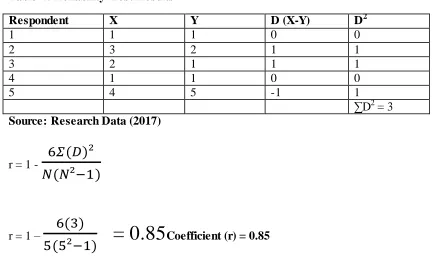
To guarantee consistency, the pre-test information was subjected to unwavering quality tests utilizing the Split–half technique to decide the interior consistency of each instrument. Orodho (2005) refers split-half method as a type of reliability testing based on the co-efficient of internal consistency of a research instrument. Each instrument was conceptualized as having two sections; odd numbered things and even numbered things. The Split– half system included scoring odd things versus even things of the instrument for every individual and after that ascertaining a connection coefficient for the two arrangements of scores. The relationship coefficient demonstrated how much the two sections of the instrument give comparable results and therefore delineate the internal consistency of the instrument. The instrument was partitioned into two equivalent parts for the most part regarding even and odd numbered things and scored independently after was tried. Spearman Brown Prophesy recipe was utilized.
r = 1 -
6𝛴(𝐷)²𝑁(𝑁²−1) Where r = Correlation coefficient
N = Sample
Σ = Summation of scores D = Deviation
39 Table 4: Reliability Test Results
Respondent X Y D (X-Y) D2
1 1 1 0 0
2 3 2 1 1
3 2 1 1 1
4 1 1 0 0
5 4 5 -1 1
∑D2 = 3 Source: Research Data (2017)
r = 1 -
6𝛴(𝐷)²
𝑁(𝑁²−1)
r = 1 –
6(3)
5(5²−1)
= 0.85
Coefficient (r) = 0.85The study obtained a correlation coefficient of 0.85 which implied that the instrument was reliable.
3.5 Data Analysis
Data was analyzed using descriptive statistics with the aid of statistical package for social science (SPSS).Descriptive statistics was used to describe, summarize, and organize the data. Five sets of these methods were used: frequency distributions, measures of central tendency, and measures of dispersion, skewness and kurtosis. Frequency distributions, ordered arrangement of all variables, showing the number of occurrences in each category Norusis, (2010), was used to summarize data. The data was then displayed (presented) using tables, bar graphs and pie charts.
A simple regression model was used in determining the level of influence the independent variables have on dependent variable as shown below:
40 Where Y= Revenue Collection
X1= Automation
X2= Integrated Internal Control Process X3= Efficiency
X4= Human Resource Management
Table 5: Operationalization and measurement of variables
Variable Type of
variable
Indicators Quantification of
variable Measure ment Computerized Enterprise Resource Planning Strategy
Independent Automation Rating
of 5-1 Nominal
Management
Information System
No. of projects managed
Integrated Financial Management
Information System
No. of registered businesses
No. of transactions
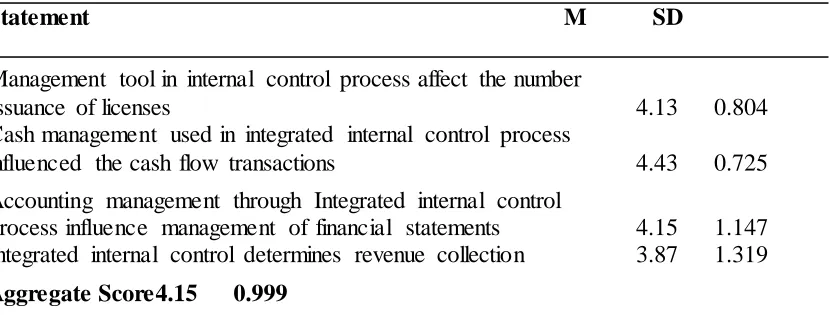
Integrated internal control processes Rating of 5-1 Nominal
Management tool No. of new licenses
Cash management No. of transactions
Accounting No. of financial statements
Efficiency Rating
of 5-1 Nominal
Procurement operational
No. of new projects done
Electronic transaction
No. of electronic registrations done.
Financial management
No. of transactions
Human Resource Management System Rating of 5-1 Nominal
Time management No. of complaints
Security No. of security cases
Job scheduling No. of tasks done Revenue
collection
Dependent Timeliness No. of transactions done
Rating of 5-1 Nominal
Accountability No. of complaints
41 3.6 Ethical Considerations
Ethics in research includes what is correct and not appropriate in leading examination and is a fundamental piece of any exploration contemplates. Morals in look into was considered in the entire research prepare: from the idea of the issue being examined; the announcing of the hypothetical system; the setting of the examination; the information accumulation instruments that were utilized; the information gathering techniques; the exploration subjects; the strategies of information investigation; and information detailing.
42
CHAPTER FOUR
DATA ANALYSIS, INTERPRETATION AND DISCUSSION 4.1 Response Rate
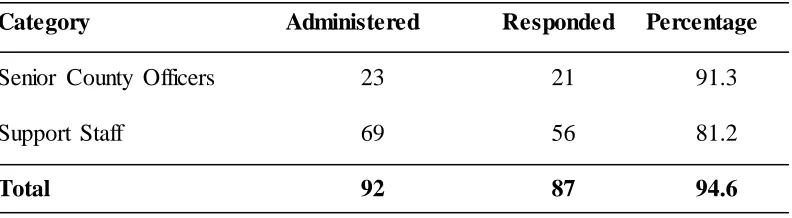
Out of 92questionnaires administered to the respondents, returned their questionnaires forming a response rate of 83.8%. The overall response rate was 85.3%. This is shown in Table 4.1.
Table 6: Response Rate
Category Administered Responded Percentage
Senior County Officers 23 21 91.3
Support Staff 69 56 81.2
Total 92 87 94.6
Source: Research Data (2017)
Mugenda and Mugenda, (2003) notes that a response rate of 50% is adequate for analysis and reporting, a response rate of 60% is good and that of 70% and above is very good. This therefore meant that the response rate of 94.6% was appropriate for the study. The survey return rate was high on the grounds that the specialist guaranteed that the respondents had been sharpened preceding organization of the questionnaires.
4.2 Demographic Information
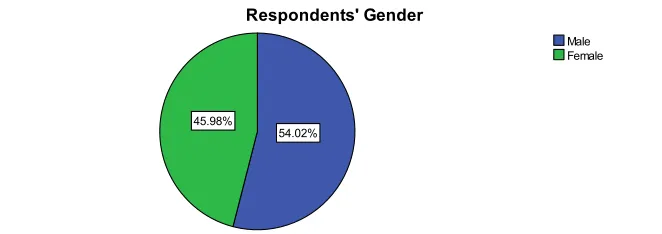
43 Figure 2: Respondents’ Gender
Source: Research Data (2017)
Figure ii shows that majority 54.02% of the respondents were male and 45.98% were female. The findings show that all the genders were well represented in the study.
Table 7: Respondents’ Age
Frequency Percent Cumulative Percent
Valid >25 10 11.5 11.5
25 - 35 28 32.2 43.7
36 - 45 32 36.8 80.5
<45 17 19.5 100.0
Total 87 100.0
Source: Research Data (2017)
44 Figure3: Respondents’ Level of Education Source: Research Data (2017)
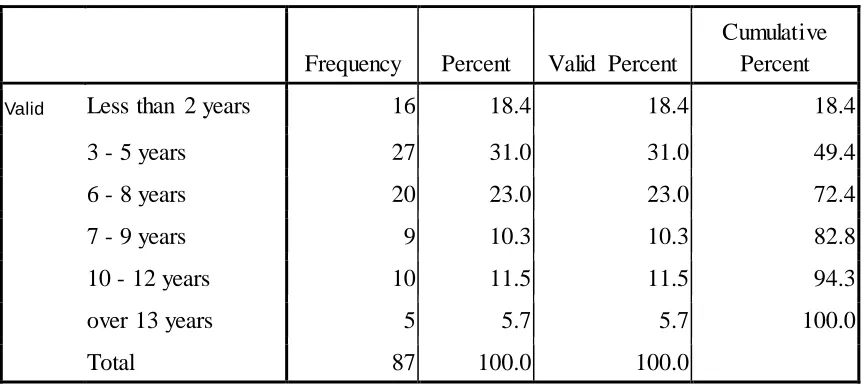
45 Table 8: Respondents’ Length of Work
Frequency Percent Valid Percent
Cumulative Percent
Valid Less than 2 years 16 18.4 18.4 18.4
3 - 5 years 27 31.0 31.0 49.4
6 - 8 years 20 23.0 23.0 72.4
7 - 9 years 9 10.3 10.3 82.8
10 - 12 years 10 11.5 11.5 94.3
over 13 years 5 5.7 5.7 100.0
Total 87 100.0 100.0
Source: Research Data (2017)
Table 6 shows that majority of respondents who had worked in Kericho for a period between 3 and 5 years accounted 31.0% followed by 23.0% between 6 and 8 years, 18.4% less than 2 years, 11.5% between 10 and 12 years, 10.3% between 7 and 9 years and 5.7% over 13 years. Cumulatively, 82.8& of the respondents had worked for 7 years and above in Kericho County, Kenya.
4.3 Computerized Enterprise Resource Planning and Revenue Collection