Public participation and the fiscal implementation of devolved government in kenya: a case of bomet county
KIPKIRUI NELSON MUTAI C153/CTY/PT/26735/2011
A RESEARCH PROJECT REPORT SUBMITTED TO THE SCHOOL OF HUMANITIES AND SOCIAL SCIENCES IN PARTIAL FULFILMENT OF THE REQUIREMENTS FOR THE AWARD OF THE DEGREE OF MASTEROF PUBLIC POLICY AND ADMINISTRATION OF KENYATTA UNIVERSITY
ii
DECLARATION
This research project report is my original work and has not been presented for a degree in any other university.
Signature _______________________________ Date ____________________ Nelson Mutai
C153/CTY/PT/26735/2011
This research project report has been submitted for examination with my approval as the university supervisor
Signature _______________________________ Date ____________________ DR. WASONGA JOSEPH
iii
DEDICATION
iv
ACKNOWLEDGEMENT
v ABSTRACT
vi
ABBREVIATIONS AND ACRONYMS
DFRD - District Focus for Rural Development
ICPAK - Institute of Certified Public Accountants Kenya LATF - Local Authority Transfer Fund
MCA - Member of County Assembly
OECD - Organization for Economic Co-operation and Development PA - Provincial Administrattion
PCT - Public-Choice Theory
PFM - Public Financial Management
SID - Society for International Development SPSS - Statistical Package of Social Science TI - Transparency International
UNDESA - United Nations Department of Economic and Social Affairs
vii
TABLE OF CONTENTS
DECLARATION ... ii
DEDICATION ... iii
ACKNOWLEDGEMENTS... iv
ABSTRACT ... v
ABBREVIATIONS AND ACRONYMS ... vi
TABLE OF CONTENTS ... vii
LIST OF TABLES ... xi
LIST OF FIGURES ... xiiii
DEFINITION OF OPERATIONAL TERMS ... xiiii
CHAPTER ONE ... 1
INTRODUCTION ... 1
1.1 Background to the study ... 1
1.2 Statement of the Problem ... 7
1.3 Objectives of the Study ... 9
1.4 Research Questions ... 9
1.5 Research Assumption ... 9
1.6 Justification and significance of the study ... 10
1.7 Scope of the Study... 11
1.8 Research Limitations ... 11
CHAPTER TWO ... 13
LITERATURE REVIEW ... 13
viii
2.2 Theoretical Review ... 13
2.2.1 Public Choice Theory... 13
2.2.2 Fiscal Decentralization Theory ... 15
2.3 Empirical Review ... 18
2.3.1 Public Participation and Fiscal Planning... 18
2.3.2 Public Oversight and Fiscal Policy Implementation. ... 22
2.3.3 Public participation in Monitoring and Evaluation of Fiscal Policy ... 26
2.3.4 Summary and Study Gaps ... 28
2.4 Conceptual Framework ... 29
CHAPTER THREE ... 31
RESEARCH METHODOLOGY ... 31
3.1 Introduction ... 31
3.2 Study Region ... 31
3.3 Research Design ... 31
3.4 Target Population ... 32
3.5 Sampling Design and Sampling Techniques ... 33
3.6 Data Collection ... 34
3.7 Validity and Reliability of Research Instruments ... 35
3.8 Data examination and Presentation ... 36
3.9 Ethical Considerations ... 36
CHAPTER FOUR ... 38
DATA ANALYSIS AND RESULTS ... 38
4.1 Introduction ... 38
4.2 Response Rate ... 38
4.3 Geographic Information ... 39
ix
4.3.2 Age of the Respondent ... 40
4.3.3 Level of Education ... 41
4.3.4 Length of Living and Working in Bomet County ... 42
4.4 Public Participation on fiscal Implementation ... 42
4.4.1 Public involvement in Fiscal Implementation ... 43
4.4.2 Extent of public involvement in Bomet County ... 43
4.4.3 Awareness of Involvement in Fiscal Implementation ... 44
4.4.4 Mode of communication that the County Government uses to inform the Public . 45 4.5 Public Participation and Fiscal Planning ... 46
4.5.1 Public Involvement in Fiscal Planning Implementation ... 46
4.5.2 Public involvement in Fiscal Planning ... 47
4.5.3 What the County Government should have done to increase Participation in Fiscal Planning ... 47
4.6 Public Participation and Fiscal Oversight of Bomet County ... 49
4.6.1 Public Participation and Fiscal Oversight ... 49
4.6.2 Public Participation in Fiscal Oversight ... 49
4.6.3 Influence of Public Participation on Fiscal Oversight... 50
4.7 Public Participation and Monitoring and Evaluation ... 52
4.7.1 Public Participation and Monitoring and Evaluation ... 52
4.7.2 Monitoring and Evaluation of fiscal implementation ... 53
CHAPTER FIVE ... 54
SUMMARY, CONCLUSIONS AND RECOMMENDATIONS ... 54
5.1 Introduction ... 54
x
5.3 Discussion ... 55
5.4 Conclusions ... 57
5.5 Recommendation... 58
5.6 Recommendations for Further Research ... 59
REFERENCES ... 60
Appendices ... 65
Appendix I: Questionnaire ... 65
Appendix II: Work plan ... 69
xi
LIST OF TABLES
Table 3.1: Target population ... 32
Table 4.2: Sampling Design ... 34
Table 4.4: Age of the Respondent ... 40
Table 4.5: Length of living and working in Bomet County ... 42
Table 4.6: Response on Public Participation on Budget making ... 43
Table 4.7: Extent of public involvement in Bomet County ... 44
Table 4.8: Awareness of Involvement in Fiscal Implementation Process... 45
Table 4.9: Public Participation and Fiscal Planning ... 46
Table 4.10: Public involvement in Fiscal Planning ... 47
Table 4.11: Public Participation in Fiscal Oversight ... 50
Table 4.12: Public Participation and Monitoring and Evaluation... 52
xii
LIST OF FIGURES
xiii
DEFINITION OF OPERATIONAL TERMS
Community Development – this is the involvement and commitment of citizens in the community project with aim of improving or positively changing the picture of the community.
Decentralization – it is the process of shifting powers and authoritative roles from the local government to the regional administration.
Delegation – this is the technique of governance whereby responsibility of decision making is transferred from the central government to devolved organization that are not fully controlled by the government but they are accountable to some defined functions.
Development – this is the modification of the environment with the aim of improving the state and living standards of people by proper use of public resources.
Devolution – It is a technique of governance where there is reciprocal, mutual benefit, and coordination of relationships between central and local governments.
Fiscal decentralization –This involves dedication of powers to county levels regarding collection of revenues and resources for delivery of public service.
1
CHAPTER ONE INTRODUCTION 1.1 Background to the study
The origin of federalism and decentralisation systems can be traced back in Germany after the adverse effect of the World War II. However, Potter and Graham (2014) assert that more than 80 million people live in an advanced decentralised nation with 16 regions, also known as Länder in Germany. The German Länder, as it is the case of counties in Kenya, has their own way of administration, governments and parliaments. The Länder has been given mandate over certain areas of concern including internal security and police, education principle, and also the penal system or operating time for businesses. Approximately 70 per cent of the levies are distributed in approximately equal proportions to the federal centre and also to the Länder. Part of the taxes levied on beer or inheritance, for example, go exclusively to the Länder. Federalism has been accepted widely in Germany due to its reflections the enormous regional affiliations and interests. Furthermore, it also safeguards the interests of minority groups and addresses their issues, respect and reflects them in regional politics (Peschke, 2014).
2
are occurring in a few nations in Africa, especially since the Nineteen Nineties, have looked for after to hinder with the past through decentralization of forces to bring down local governments.
In countries like Rwanda and Republic of South Africa, decentralization was primarily an elementary and pressing remedial approach, and was incorporated in response to the political and economic challenges and setbacks in their history. The institutionalization and incorporation of devolution in continent isn't distinctive in Africa (Kobia & Bagaka, 2013). Kibua and Mwabu (2008) stated that, in order to register effective delivery of public services in African nations and different developing countries has for a protracted period of time been hindered by extremely centralized government bureaucracies. Whereas castigating localized systems citing Zimbabwe as a reference, Moyo (2014) states that it's clear this system of a highly-centralized state in Zimbabwe has increased autocracy, unskilled leaders, corruption and exclusion of voters from taking part in governance and policy making process has been interfered with. Given the urgent need of development and prosperity, restoration of public confidence, massive reduction of income disparity and eradication of corruption in Kenya, implementation of the new constitution has been given priority because it addresses such shortcomings that hinder development (Bigambo, 2014).
3
sectors were given consideration. Nonetheless, the citizen’s rights and privileges have been safeguarded in the constitution restricting politicians from oppressing the public. With the devolved government, counties are bounded and are at different levels of development with each other and also availability of resources differs. It is thus up to the county management to listen to the people’s grievances and address them with the basic being given priority.
Basing on IEA Research paper by Mwenda (2010), devolution is a device which was aimed at eradicating uneven disbursement of public resources in a democratic society, so as to outdo corruption and embezzlement of public funds. Loughlin and Keating (2013) advanced that the pertinent issues of devolution can be addressed fully by establishing proper political, institutional and social economic environments that will enhance even growth and development in all spheres of the country.
4
and assets and to push their improvement; to protect and advance the premiums and privileges of minorities and underestimated groups; to encourage social and monetary improvement and in this manner the arrangement of available administrations in whole locales of the nation is upgraded. Moreover, to affirm even dispensation of national and local assets in Kenya; to advertise the decentralization of State functions, their capacities and administrations, from the focal legislature of the republic of Kenya; and to facilitate governing rules and conjointly advance partition of forces (Kimenyi, 2012).
In any case, Kenya ended up free with an exceedingly decentralized Constitution with counties. Assessments emerged from various studies that attempted to move powers from the county governments to the central levels. Notwithstanding, because of centralization of a definitive administration, the county chamber and different associations were observed to be of no significance. On account of Kenya, it existed at a few focuses political developments that maintain centralization of forces and county administration. Similarly, since the last half of the 1990s, gave the weight to political democratization and diminishment of destitution, conveyance of administration for county residents wound up unavoidable, and a succession of changes focusing on budgetary decentralization were coordinated (de la Porte & Heins, 2016).
5
lacking enactment to represent the embezzlement of Public Finances however not after the execution of the new Constitution 2010 and the new Public Finance Management Act and different enactments and each portrayed unmistakably how every one of these workplaces will work to guarantee reasonable and straightforward resource administration.
In dealing with devolution conflicts, one area that may need attention is human resource vis-à-vis social justice. This is because the conflicts of developing countries are dealt with on ethnicity backgrounds. In Kenya, National Cohesion Commission was introduced with an advanced role of de- ethicizing government institutions as well as devolved units. In order to determine whether devolution of government functions will enhance cohesion and conflict resolutions, several studies have to be carried out. Rakodi (2014) recognizes utilization of human resource as the basis of social justice at its most crucial level. In a sense to him, underutilization or segregated utilization suffices conflict.
6
endeavors of authorizing its established command. Maybe it has cruised into issuing alerts and dangers without making any primer move against the individuals who drive
against the constitution.
There have been a lot of corruption cases in the public sector experienced over years and
fraud related cases where public funds are embezzled ending up in the hands of corrupt
individuals (Amasava, 2013). One of the loopholes to corruption in the county has been realized to have been as a result of county leaders holding up the governors at ransom and inadvertently leading to embezzlement of public funds by the leaders. Critics have factored out that this is a way of devolving corruption. The governors on their part have raised concern over the increment of county budget allocation from the current percentage to 45% citing development as the main agenda. With 57.2% as the absorption rate for development expenditure, Bomet County was ranged as the top county by the 2014/2015 county budget implementation review. Expenditure on the members of county assembly had an annual absorption rate of 57.7% which again raised a lot of questions relating to corruption. From the report, the recurrent expenditure was at 54.8% absorption rate. This expenditure rates made the public to file a petition in court concerning public participation in budget making process which is actually constitutional.
7 1.2 Statement of the Problem
In the year 2010, Kenyans were very happy with the introduction of the new system of governance which made them to vote overwhelmingly. Embedded in the Constitution is the urge of transforming Kenya into a nation with transparency, accountability government that enhances service delivery to the citizens and facilitate inclusivity in government (World Bank, 2012). Despite all the positive speculations, misunderstanding over matters embezzlement of public finances and corruption emerged as soon as the second year in office of the elected leaders.
8
In regard to the report on towards hazy horizons by Transparency International (2014); a survey that sought to determine the extent of implementation of devolution and governance reforms in Kenya, 36% of the respondents opine that among other factors that hinders devolution, corruption is the main problem. Other factors were political instability and inadequate funds to facilitate devolution with 20% of the respondents citing the same.
9 1.3 Objectives of the Study
The study was focused to address the following specific objectives:
1) To determine the public participation process of fiscal planning in Bomet County
2) To determine the scope of the public participation in the oversight of fiscal implementation of Bomet County
3) To evaluate how the public participates in monitoring and evaluation of fiscal implementation of Bomet County
1.4 Research Questions
The objectives of the study were translated into the following research questions: 1) How does the public participate in fiscal planning at Bomet County?
2) What is the extent of public Participation on the oversight of fiscal implementation of Bomet County?
3) What is the extent of public involvement in monitoring and evaluation of fiscal implementation of Bomet County?
1.5 Research Assumptions
This study was based on the following stipulated assumptions
1) Public participation results into significant fiscal planning in Bomet County. 2) Public Participation brings proper supervision of fiscal implementation in Bomet County.
10 1.6 Justification and significance of the study
Scholars and upcoming researchers will find a reference in this study when conducting research relating to devolution and public participation. The study also will help the government’s policy makers in finding the possible solution to arising problems pertaining devolution. This study therefore was justified in the advent of the new constitutional dispensation in Kenya. The country is currently undergoing a constitutional reform from the British constitution that lasted for nearly 50 years to the new one that was voted by 67% of Kenyans in the August 5th 2010 referendum. In some quarters of a fiscal year, the new governance system was regarded as semi federal by both government levels. Devolution being treated as a new venture in Kenya, teething challenges are anticipated in the full incorporation of the new constitution. Perhaps, all these problems led to justification of this study because it will provide ways in which such problems could be solved through public participation in policy making. This research study will help the government’s policy makers by providing an affirmative monitoring and evaluation basis for the chronological implementations of devolution organs and provide solutions to the problems highlighted by the findings of the study regarding devolution process. The study findings aided the government in the regions of planning for fiscal functions of devolution. The study findings are instrumental to the policy makers and stakeholders in the sector of public financial management and in drafting principles that would benefit both the county government and the local government.
11
the ability to underline the propelling factors that helps steer the devolution process in affirmative public participation in policy making. Other citizens in other counties used this study as a tool for monitoring and evaluating the progress of devolution in their counties and plan early to counter the identified fiscal problems.
1.7 Scope of the Study
The research focused on extent of public engagement on fiscal implementation of Bomet County. Bomet County has been outlined as the case study where proper approaches will be used to carry out the study that will engage local administrative units, civil societies and citizens. The study bounds itself to public participation which was assumed to have a positive impact on fiscal implementation of delocalized government.
1.8 Research Limitations
The former well known system of governance, the provincial administration paved way for devolution which was happily received by Kenyans. It may seem to be too early to judge the proceedings of devolution but its effect can be realized through ongoing implementations. However, it is ye not clear whether the doubts that accompany devolution are due to its infancy or are as a result of misunderstanding among the people.
12
respondents that the information collected was to be handled confidentially and used solely for the purpose of this study.
13
CHAPTER TWO LITERATURE REVIEW 2.1 Introduction
In this chapter, the theories that underpin the study are discussed broadly. Empirical review and related literature are also considered and discussion of related articles on inclusivity and corporate governance and the role of public participation in administration are presented in this chapter.
2.2 Theoretical Review
The two theories that underpinned this study are public choice theory and fiscal decentralization theory. This study reviews the two theories, contributions of the theories towards organization theory, and the extant empirical work and develops testable propositions.
2.2.1 Public Choice Theory
14
study of market behaviour and public cooperation in basic leadership (Amoako & Goh, 2015). The suspicions underlining the study of conduct on private market condition is that self-premium is constantly given priority by financial specialists and expert. Public choice business analysts make comparative presumption that other than individuals acting in the political commercial centre have a few interests for others, their fundamental motivation, regardless of whether they are administrators, voters, legislators, lobbyists, is self-interest (Anderson, 2014).
15
The financial significance of this theory is that it is pertinent in different particular financial territories including money related standards, task of voter based systems, budgetary, development of unique premiums and protected structure as featured by Gasco and Equiza (2004). Also, this theory is fitting in this study since it is the public’s hope that their voices could be heard and their needs and thoughts could be actualized into strategy that advances obligation and responsibility in controlling public assets which can additionally be bolstered by devolution. Besides, the most rigorous public choice study does not guarantee that the idea of self-intrigue can portray all political decision making. The belief of unselfishness or other individual views about the public interest do play an urgent and key part in the plan of public policy. In this manner, neither belief nor self-intrigue ought to be respected as an elite causal component in the political field (Cascón-Pereir, 2015).
2.2.2 Fiscal Decentralization Theory
16
Effectiveness is viewed as the monetary esteem apparent as the "amplification" of social welfare.
Preferably, every public advantage and administration conveyance ought to be provided in the law that would most completely disguise its points of interest and the hidden costs. According to Wolman et al., (1997), Public sector delivery and share of products and services are in this way characteristically political; however, nearly conceivable expense and administration bundles should indicate "the total inclinations of network individuals". Governance values incorporate responsiveness and responsibility, assorted variety, and political commitment. Decentralization conveys portion basic leadership closer to the citizens and different intrigued partners. This advances more noteworthy responsiveness of local experts and propelled responsibility to the inhabitants. This is because of desires from the local chiefs to be more mindful of the issues and interests of their nearby surroundings than unified policy makers. Besides, to the degree that responsibility ought to be showed through nearby races, those races are frequently determined by issues of local resource conveyance, while national decisions are infrequently concerned with administration of service delivery.
17
less concentrated, the state's fiscal structure will likewise tend be more decentralized, with different aspects held consistent. In this manner, county governments ought to deal with their own-sources, revenues and use adequately to allow some caution in coordinating the interests of citizens and the taxes collected (Ngallawa, 2013).
As indicated by Boserup (2013), Fiscal Decentralization additionally has been built up as a major aspect of a world-wide "change" plan, reverberated by various institutions like the World Bank, USAID, the Asian Development Bank, and others. The theory has additionally turned into a basic piece of monetary advancement and administration approaches in creating transitional economies. In a joint effort with "globalization," financial decentralization and the need for local tact and delocalization of power is seen by the World Bank as a standout amongst the most noteworthy powers moulding administration and current improvement (World Bank, 1999).
18 2.3 Empirical Review
2.3.1 Public Participation and Fiscal Planning
According to OECD, (2010) report, a good number of civil servants, scholarly researchers, and government expertise view public involvement as one solution to the absence of popular backup for accountable fiscal principles. Public inclusion in civic affairs is both “means” and “ends” of well-functioning democratic government. It is a fundamental segment of undertakings to enhance official obligation in administration of devolution that comes to fruition when subjects feel associated particularly to their governing body. Inclusivity ensures that individuals are put decisively with respect to suitability, responsiveness, straightforwardness and obligation in government. Along these lines, the governing body ends up being more open to in terms of information sharing. In this manner, open duty propels shared points of interest: inhabitants of a given county end up being open to methodologies that the county government employ in administration and development of county projects; and by exploiting the experience and fitness of their counterparts, leaders can produce all the more great and responsive government (Boserup, et al. 2013).
19
This is snared by obstacles to be included in government due to the fact and fear that their decisions are discarded, unwillingness of leaders and time factor (Snyder & Diesing, 2015). In any case, the positive effect of participation has manifested itself through voting and participating in budgeting process. Berman (2015) has battled that the citizens with greater hope on devolution have to take on stage and question the county government about the progress of projects in the county but the lazy ones can’t.
The management boards of trustees can enable people to get involved in a given region. However, it might be tedious and might not have the general population picture or portrayal. More escalated approaches, for example, citizen boards, might be noteworthy in significant strategy matters, yet are expensive and can pull in broad responsibilities (Whittington, et al. 2015). By all means, analysts have explained that cooperation is most gainful when it happens right on time in the process with the goal that it can really impact choices, when it is two-way deliberative correspondence instead of basically one-way data appropriation.
20
data with respect to national government budget participation is adapted on individual cases, national overviews have additionally been utilized to address the cross-sectional models. One investigation on budget hones crosswise over different sorts of national governments built up broad utilization of 276 EBDON of open hearings and budget synopsis archives, yet least use of different strategies included in the study (Krenjova & Raudla, 2013).
One of the commands and strategies of decentralized government as provided in the Constitution of Kenya 2010 in Article 174 is to acknowledge the privilege of regional governments to control their own particular undertakings and upgrade in their development and projects (Republic of Kenya, 2010). In such manner subsequently, individuals will get a feeling of personality and self-strengthening. Given this arrangement of government, the endeavors of residents will be perceived by their inclination to add to the development of the country. The other rule is to recognize the interests and privileges of minorities and marginalized groups. Subsequently these groups won't feel sidelined. This will advance a feeling of solidarity as they won't feel as if their interests have not been tended to (Bigambo, 2014).
21
the Public Financial Management (PFM) Act is an Act of Parliament with the order of giving successful administration of public funds by both levels of governments. In building up the PFM Act, Parliament was obviously mindful of the hugeness of having a decent PFM framework in discovering the achievements or disappointments of devolution (SID, 2012).
It is unmistakably discovered that a unitary system of government particularly in Africa gathers control in the inside and advances the capacity of the ethno-provincial groups that deal with the organizations of the local government to improve their interests and qualities to the detriment of different citizens, especially those that are not politically very much associated with politics (Kimenyi and Meagher, 2004). In the eastern Africa, Uganda for instance has been experiencing a noteworthy decentralization program since the late 1980s (Mitchinson, Cottage, Auldyn, and Ramsey, 2003). (Kimenyi and Meagher, 2004) pose it that an exceedingly restricted state is continuously transforming into a decentralized one because of the exchange of forces, parts and administrations from local government to the county level.
22
with an accentuation on the improvement instead of the change or decrease of public specialist (Ahmad, Brosio, & González, 2006). Green (2011) characterized devolution as the expulsion of control over the accumulation or potentially appropriation of public assets from the focal government level to a level underneath it.
2.3.2 Public Oversight and Fiscal Policy Implementation.
The national situated organization strategy allude to such broad issues and issues as expanding the measures of organization out in the public administration, strengthening responsibility approaches, guaranteeing straightforwardness in the arrangement of public administrations, connecting with the general population and the general common society groups in strategies of policy making, improving confidence in the nation and rendering a superior and quality public administration conveyance (Milakovich & Gordon, 2013).
23
Investment in budgeting process is a novel method of administration that envelops numerous partners with public offices to include basic leadership inside the networked condition of present day public administration (Hong, 2015). To that extent, law based social orders are concerned with the part of citizens in the budgeting and planning procedure has relentlessly extended over ongoing decades. One of the significant reasons is the presumption that discourses between top administration and citizens is a vital system for encouraging responsibility in challenged territories. Such discourse is an important instrument to upgrade citizen’s confidence in government. In addition, it adjusts budgetary choices to genuine citizen’s needs and preference. As per Kim and Schachter (2013), participation can nourish pertinent data into planning. Citizens in urban areas with more cooperation were observed to be not so much negative but rather more strong of local governments.
Ebdon and Franklin (2015), abridged five helpful after-effects of national cooperation in planning which are; enlightening basic leadership, teaching members about importance of public participation in budgeting process, picking up opinions for budget recommendations, compelling basic leadership, and advancing trust and enhancing a feeling of network. The approach of citizen based budgeting (CBB) developed as an indispensable piece of a native local administration strategy. CBB is basically a planning approach where the citizens are included straightforwardly or by indirectly to the planning and budgeting procedures of endorsement, usage, checking and assessment (Wates, 2014).
24
participatory budgeting process and implementation. The procedure which goes for expanding the level of responsibility, offers a strategy through which the nationals are empowered to express their suppositions and wishes. CBB is consolidated to reinforce responsibility; however this isn't the main objective. A portion of alternate parts incorporate tending to the wastefulness in asset sharing, the disappointment of disseminating the assets in light of the requirements and the inadequate operation of public society sector (Wates, 2014).
25
According to Colombage (2014) report, it is clearly indicated that devolution could even lead into entrenching disparities if the right principles are not implemented. A rushed transition may result to failure in counties by giving them responsibilities before they have organized themselves and posses the capacity to conduct the process of devolution. Kenya’s counties begin from very different positions, but scholars at the World Bank say the immediate concern should be preserving existing service delivery; any drastic move to reshape sharing of resources away from affluent towards marginalized counties could bring out the best in severe fiscal stress, or even the elapse of primary service delivery. Mungai (2013 noted that experts warned that it will take time for Kenyans to fully understand how the new government will operate, and without skilful administration in both national and county levels, the key promise of the country’s new Constitution could end up being stillborn.
Many individuals had suppositions and expectation that devolution would enhance public participation in basic leadership, recognize the premiums and privileges of minorities and marginalized groups, guarantee equal sharing of national and county bread, and trigger national union. Nearly a decade into devolution, the fantastic desires have missed the mark, while the budgetary expenses have set off some to call for an existing incorporated framework of governance or a decrease in the number of counties in the nation. At a certain point, such negative observation is viewed as out of line. Devolution of capacity to new political and administrative units was continually going to be a monotonous procedure and the few years that have passed are roughly brief time (Lynch, 2014).
26
In any case, as supported by Peschke (2014), the desire of every single political segment and gatherings to ceaselessly counsel with each different adds to soundness and the authenticity of conclusions. In Kenya, there are different mishaps relating to devolution. In the first place, some accepted that all expenses would be met through the exchange of national incomes with the county governments. As an outcome, Lynch (2014) pose it that a few citizens are irate that they are being troubled with extra demands that raises the average cost for basic items, however which is by all accounts baited by an enlarged wage and remittance charge and outside excursions for county managers, when contrasted with any substantive advancement.
In any case, unavailability of clarity on capacities and duties is connected with duplication, money related wastefulness, loopholes and constrained coordination between policies that started at various classes for instance, by the national government under Vision 2030, MPs through the Constituency Development Funds, non-government players, and recently settled County Integrated Development Plans. Maybe, an excessive amount of vitality is connected on political fights. Amid the last race, parliamentary dockets were the most fervently of the non-presidential elective positions, yet it is currently evident that county power as far as dealing with a financial budget is concerned with the ability to sensitively make appointments, offer tenders, and start ventures is commanded to the governor (Lynch, 2014).
2.3.3 Public participation in Monitoring and Evaluation of Fiscal Policy
27
possessed with the capacity to question systems and procedures at the county level. In any case, because of absence of responsibility instruments have controlled defilement and the legislative issues of support. The two are maybe among the most serious dangers to devolution at the level of area.
With the guide of an intricate monitoring and evaluation system on the county government under the Ministry of Planning and National Development checking directorate, the county government is functional. In any case, this approach of monitoring and assessment is famished of assets and is subsequently not completely operational. The inaccessibility of unproductive monitoring on a very basic level undermines execution and responsibility inside the county administration in Kenya. Moreover while it is shown by different markers, the pointers that delineate duty in area advancement are less and not helpful in checking duty execution (TISA, 2010). Fisher (2014) pose it that the points of confinement of expanding supervision to carp corruption, taking note of that for all intents and purposes, the specific individuals with the full order of observing and implementing disciplines might be discovered degenerate. He kept on arguing that observing public projects is of public advantage, which can prompt free-rider issues. Local professionals are additionally encouraged to offer Grassroots checking which will help decrease corruption cases and improve gathering of opinions and information from the general public.
28
responsibility, adequacy, and even productivity of state associations are concerned. Such challenges factors out the absence of a sound hypothesis underlying budget related TAIs. Though Kaufman may have discovered mainstream gatherings as insufficient, others would contend that their availability achievement, by opening up a formerly shut process to well-known commitment.
With the presentation of declined stores framework, Social Accountability instruments have been figured out. These in this way have generally been driven by the common society, academic and research organizations. These methodologies ought to be systematized inside the Social Monitoring Framework at level of county government as a major aspect of national commitment. The CBMS strategy ought to be considered as an indispensable strategy in such manner.
Mutuiri (2012) broke down organization and execution of the local authority transfer fund (LATF) in Nyeri County, an essential devolution instrument for addressing disparities crosswise over local authorities. In another investigation (Mwabu & Kibua, 2008), examined administration procedure has been organized and the variables that are affecting the process of institutionalization. Little articles on devolution exists in Kenya particularly as to financial difficulties confronting the execution of devolution in every county. This investigation will go into filling this loophole.
2.3.4 Summary and Study Gaps
29
assumption of administration. The part of public cooperation is emphasized over by the Constitution. The public has been ordered to take an interest and be occupied with the authoritative and other utilitarian exercises of Parliament and its boards of trustees. One of the objectives of decentralization is to devote forces of self-administration to the public and conceptualize the involvement of the citizens in the activity of the state powers and in settling on decisions affecting them.
According to Goetz and Jenkins (2005), a helpful system for acknowledgment of responsibility which can be connected to budget related issues with a specific end goal to evaluate their impact is to inspire public support and participation. This study will give two noteworthy ideas of responsibility which are to provide data about one's activities, and justification for their rightness and executions.
2.4 Conceptual Framework
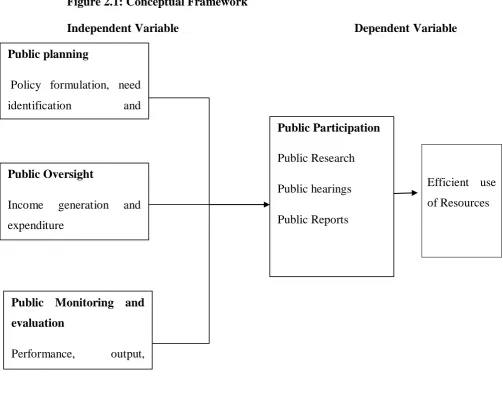
30 Figure 2.1: Conceptual Framework
Independent Variable Dependent Variable
Efficient use of Resources
1
Source: Researcher, (2015) Public Oversight
Income generation and expenditure
Public Monitoring and evaluation
Performance, output, outcomes and impact Output
Public planning
Policy formulation, need identification and
consensus building Public Participation
31
CHAPTER THREE RESEARCH METHODOLOGY 3.1 Introduction
In this section, the regions of concern covered incorporate the physical area of the examination, design of study, unit of investigation, the target population and sampling method, data accumulation systems, data analysis, data presentation, legitimacy and dependability of research instruments.
3.2 Study Region
This study was carried out in Bomet county public workplaces situated in the southern part of Rift valley. The enrolled county number 36, has Bomet town as its headquaters focus and covers an aggregate geological zone of 1,997.90 Sq Km. The County is occupied by individuals from various ethnic groups living together with the public will of improving things for who and what is to come. However, the bigger percentage of inhabitants are the Kipsigis. The neighbouring counties are Nyamira County toward the South, Narok County toward the East and Kericho County toward the North. The main towns and market found in Bomet area include: Bomet town, Sotik town, Mulot showcase, Silibwet advertise, Kaplong advertise, Ndanai advertise, Siongiroi showcase, Chebunyo advertise, Sigor market and Mogogosiek advertise among others.
3.3 Research Design
32
was applied. As per Cooper and Schindler (2008), a descriptive research is aimed at discovering the nature of a given phenomena without necessarily conducting a study on the subjects involved.
3.4 Target Population
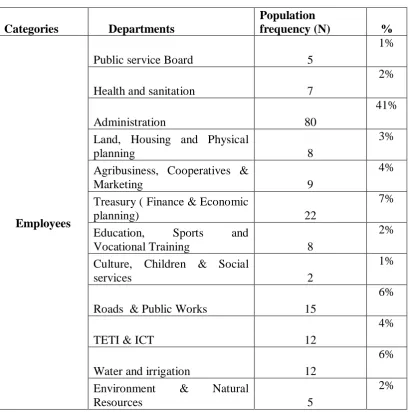
The population for this research include the civil servants who are working in different County Government offices, provisional administration and the civil society. The dissemination of these groups of interests was arrived at as appeared in Table 3.1:
Table 3.1: Target population
Categories Departments
Population
frequency (N) %
Employees
Public service Board 5
1%
Health and sanitation 7
2%
Administration 80
41% Land, Housing and Physical
planning 8
3% Agribusiness, Cooperatives &
Marketing 9
4% Treasury ( Finance & Economic
planning) 22
7% Education, Sports and
Vocational Training 8
2% Culture, Children & Social
services 2
1%
Roads & Public Works 15
6%
TETI & ICT 12
4%
Water and irrigation 12
6% Environment & Natural
Resources 5
33 County
Assembly
Members and staff of County
Assembly 52
21% Provincial
Administration Chiefs 5 2%
Civil Society
Members and staff of
Non- governmental
organizations 11 4%
TOTAL 253
Source: County Government of Bomet Public Service Board, (2015)
3.5 Sampling Design and Sampling Techniques
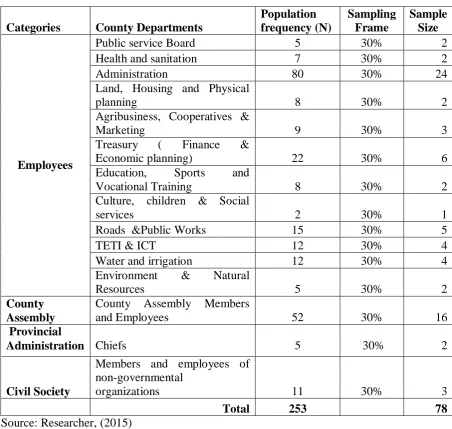
34 Table 4.2 : Sampling Design
Categories County Departments
Population frequency (N) Sampling Frame Sample Size Employees
Public service Board 5 30% 2
Health and sanitation 7 30% 2
Administration 80 30% 24
Land, Housing and Physical
planning 8 30% 2
Agribusiness, Cooperatives &
Marketing 9 30% 3
Treasury ( Finance &
Economic planning) 22 30% 6
Education, Sports and
Vocational Training 8 30% 2
Culture, children & Social
services 2 30% 1
Roads &Public Works 15 30% 5
TETI & ICT 12 30% 4
Water and irrigation 12 30% 4
Environment & Natural
Resources 5 30% 2
County Assembly
County Assembly Members
and Employees 52 30% 16
Provincial
Administration Chiefs 5 30% 2
Civil Society
Members and employees of non-governmental
organizations 11 30% 3
Total 253 78
Source: Researcher, (2015)
Kothari (2004) discovered that a considerable and efficient sampling technique is non-probability sampling procedure where samples are chosen due to their access ability. This sampling procedure was arguably preffered since it is fast, cheap, and also due to the availability of subjects.
3.6 Data Collection
35
The secondary sources of data included libraries, business articles and journals, internet sources, and published SMEs articles that are directly related to the study topic.
Questionnaire, as defined by McLean, (2006) is a of set of questions that are structured precisely and distributed to the samples with the aim of gathering data about some topic(s) which the researcher will use to draw conclusion about the entire population. The questionnaire was inclusive of both open and close ended items. The questionnaire should be structured with ease of understanding in order for the respondents to complete them unanimously without complications, and it is less costly and should be quicker than other methods while reaching out a larger sample (Bryman, 2008 and Cohen, 2007). In regard to this conclusion, the questionnaire was thus structured in appropriate language. The distribution of questionnaires to the sub-counties offices were administered by a research assistant who is well conversant to the area.
3.7 Validity and Reliability of Research Instruments
36
the researcher to be comfortable with study materials, area and additionally administration system so as to distinguish items that require change.
The unwavering quality of a research instrument concerns the degree to which the instrument is steady. In spite of the fact that trickiness is constantly present to a specific degree, there was generally a decent arrangement of consistency in the after-effects of a quality instrument gathered at different circumstances.
3.8 Data examination and Presentation
Data analysis includes diminishing the amassed information to a reasonable size, creating outlines, searching for designs, and applying factual systems to produce data that was used to answer the study inquiries of the research and present outcomes in justifiable and persuading way.
Descriptive statistics was used to break down the information. Measures of central tendencies (mean, mode and middle) were utilized to discover how the information has a tendency to concur while measures of fluctuation/scattering (standard deviation and change) were likewise used to decide the degree to which the information differ from a central position. Qualitative data was broke down by use of substance analysis and inductions made thereof. Presentation of data was by use of recurrence tables, rates, pie diagrams and reference diagrams.
3.9 Ethical Considerations
37
38
CHAPTER FOUR
DATA ANALYSIS AND RESULTS
4.1 Introduction
The exploration objective was to set up public interest and the monetary execution of regressed government in Kenya. This section introduces the analysis, findings and the discussions basing on the objective, the degree to which general society partakes in financial arranging of Bomet County, the degree to which the public takes an interest in the oversight of monetary usage of Bomet County, and on the degree to which people in general takes an interest in observing and assessment of financial execution of Bomet County. The analysis is displayed in mean and standard deviations while the discoveries are introduced in recurrence appropriations and tables.
4.2 Response Rate
39 Table 4.3: Response Rate
Frequency Percent
Questionnaires filled and returned 58 66.7%
Questionnaires unreturned 29 33.3%
Questionnaires administered 87 100%
4.3 Demographic Information
The study sought to know the demographic features of the respondents. The results are presented in the following sections. The geographic information considered in this study included the sex, age, the length of continuous service of the respondent and the level of education.
4.3.1 Gender response
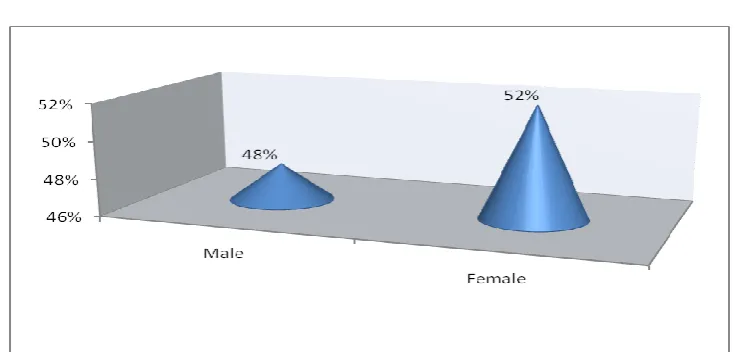
The study found out the many of the staff were female (52%) while the remaining 48% were male as presented in Figure 4.2
Figure 4.2: Respondents Gender
40
The results above indicates that majority of the respondents (52%) were female while 48% were male. This showed that the majority of respondents who participated in the study were female workers. However this was a fair distribution which depicts a fair balance of gender, accommodating the opinions and views from both sides of the gender divide.
4.3.2 Age of the Respondent
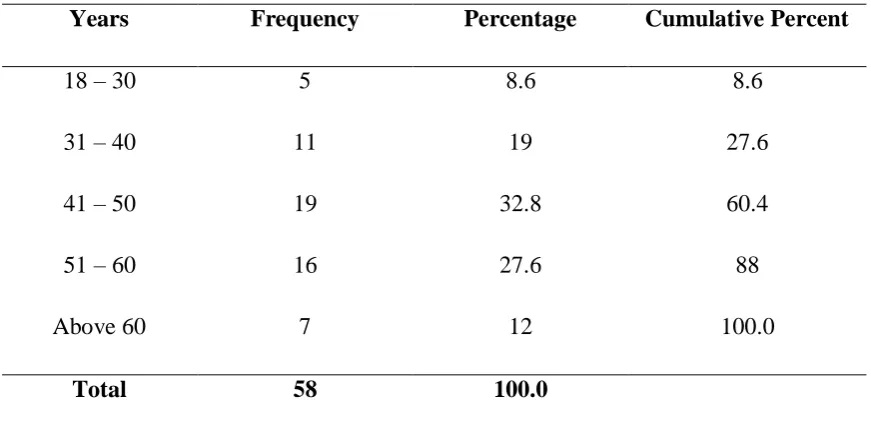
The question about the ages of the respondents are as indicated in the table 4.4 below.
Table 4.4: Age of the Respondent
Years Frequency Percentage Cumulative Percent
18 – 30 5 8.6 8.6
31 – 40 11 19 27.6
41 – 50 19 32.8 60.4
51 – 60 16 27.6 88
Above 60 7 12 100.0
Total 58 100.0
Source: Research Data (2018)
41
government therefore they understand the need for the County Government to involve the public in fiscal implementation.
4.3.3 Level of Education
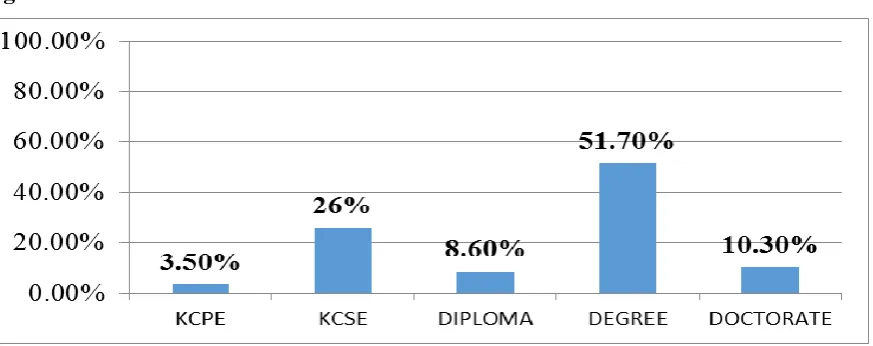
The study also sought to know the highest academic qualification of the respondents. These results are as presented in figure 4.3 below. The level of education was critical in that public participation requires staff who can frame questions clearly, respond to questions appropriately and provide suitable reports of the process.
Figure 4.3: Level of Education
Source: Research Data (2018)
42
4.3.4 Length of Living and Working in Bomet County
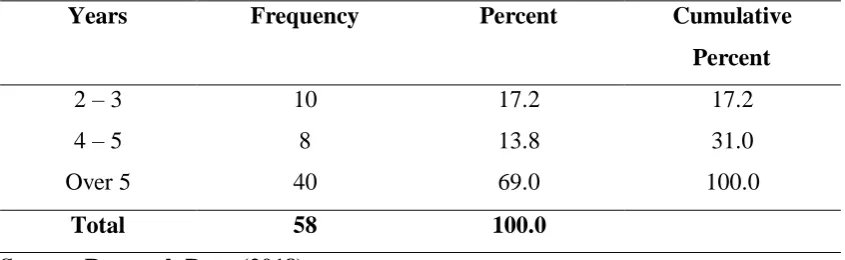
The study also sought to establish the length of living and working in Bomet County. The length of living and working in Bomet County for the respondents was important for the study as it would give credence on the understanding of the public participation process within the County.
Table 4.5: Length of living and working in Bomet County
Years Frequency Percent Cumulative
Percent
2 – 3 10 17.2 17.2
4 – 5 8 13.8 31.0
Over 5 40 69.0 100.0
Total 58 100.0
Source: Research Data (2018)
Majority of the respondents (69%) indicated that they had lived and worked in Bomet County for more than 5 years while another 17.2% indicated that they had lived and worked for between 2 and 3 years. The remaining 13.8% indicated the duration they have worked in the county for between 4 and 5 years. The results indicate that majority of the respondents have lived and worked in Bomet County for a long time and therefore they understand the services delivered by the County Government and the need to include the public in fiscal management and thus the chances of getting reliable information is high.
4.4 Public Participation on fiscal Implementation
43
4.4.1 Public involvement in Fiscal Implementation
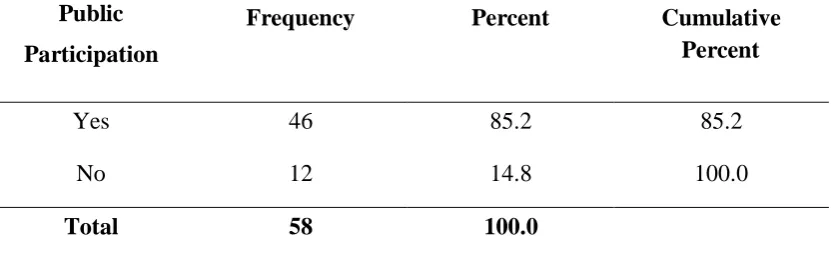
The respondents were requested to indicate whether the County Government involves the locals in budget making. The results were presented in table 4.6 below.
Table 4.6: Response on Public Participation on Budget making Public
Participation
Frequency Percent Cumulative
Percent
Yes 46 85.2 85.2
No 12 14.8 100.0
Total 58 100.0
Source: Research Data (2018)
The result shows that 85.2% of the respondents said that the public do participate in budget making while 14.8% said that the public does not participate in budget making in Bomet County. The results indicate that the County Government was involving the public in budget making and these is in order to comply with the law that requires the county governments to involve the public in fiscal implementation while at the same time ensuring that there is prudent management of resources and distribution.
4.4.2 Extent of public involvement in Bomet County
44
Table 4.7: Extent of public involvement in Bomet County
Response on public involvement Mean Std. Deviation
County forums 4.1241 0.9555
Barazas 3.9104 0.7362
Civic education forums 3.8955 0.8378
County Harambee 2.3897 0.8420
Investment Workshops 2.2931 1.0110
Source: Research Data (2018)
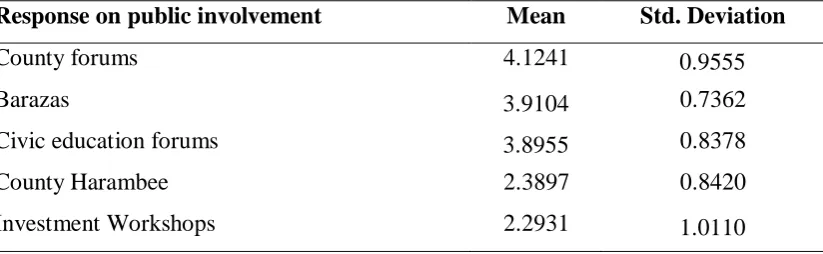
Table 4.7 shows the results with regard to the extent to which public are involved in fiscal implementation. The results show that the county forum with a mean of 4.1241 was mostly used means of public participation. The study further established that Barasas (mean=3.9104) and civic education forums (mean=3.8955) was used to involve the public. The low standard deviation variation indicates that the respondents were in agreement on the extent the County Government was using the various medium to involve the public. The results indicate that county harambee (mean=2.3897) and investment workshops (mean=2.2931) was not used medium for public participation. The result implies that the County Government was using several means to ensure that there is adequate participation of the public in fiscal implementation.
4.4.3 Awareness of Involvement in Fiscal Implementation
45
Table 4.8: Awareness of Involvement in Fiscal Implementation Process
Frequency Percent
Yes 19 33%
No 39 67%
Total 58 100%
Source: Research Data (2018)
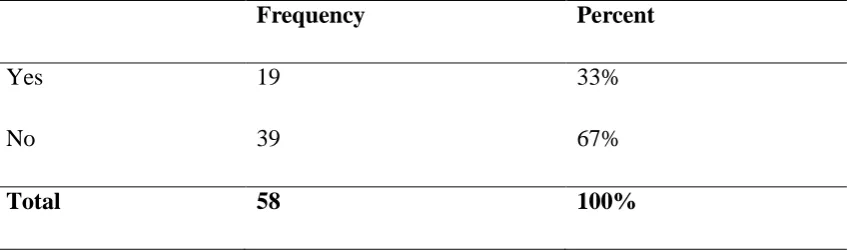
Sixty seven percent (67%) of the respondents indicated that they are not aware that they should be involved in fiscal implementation process while 33% were aware. This implies that citizens in Bomet County are not aware that they should be involved in fiscal implementation process.
4.4.4 Communication Mode used by Bomet County to inform the Public
46
problems, and additionally to register their views on them. In line with the findings a key respondent was quoted saying;
“I have heard about this budget on the radio but we have not had a chance to
meet the people in charge of these budgets to educate us more on how they are
supposed to benefit us”, “I thought that is the work of our elected leaders”.
These findings however differs with Blanchet-Cohen (2014), who observes that aside from creating awareness and interest among citizens, organizations focused on giving voice to citizens’ problems and solutions, proposing for more interactive forms of communication rather than the top-down methods.
4.5 Public Participation and Fiscal Planning
4.5.1 Public Involvement in Fiscal Planning Implementation
The respondents were asked to indicate whether there is sufficient public involvement in fiscal planning implementation. The results are presented in table 4.9.
Table 4.9: Public Participation and Fiscal Planning
Fiscal Planning Frequency Percent Cumulative Percent
No 14 24.1 24.1
Yes 44 75.9 100.0
Total 58 100.0
Source: Research Data (2018)
47
indicate that the County Government was involving the public in fiscal planning and this ensures that the public have a say in affairs that affect the County.
4.5.2 Public involvement in Fiscal Planning
This section of the questionnaire sort to get from the respondents on extent to believe that public is involved in fiscal planning of Bomet County. The results are presented in Table 4.10 below
Table 4.10: Public involvement in Fiscal Planning
Public involvement in fiscal planning Mean Std. Deviation
Consensus building 3.9483 1.1396
Need identification 3.8414 0.9235
Policy formulation 3.7931 0.7436
Source: Research Data (2018)
The results on public participation and fiscal planning was that the Bomet County Government offers consensus building with a mean of 3.9483, need identification with a mean of 3.8414 and policy formulation with a mean of 3.7931. This indicates that public involvement in fiscal planning was being undertaken in order to build consensus among the residents of the county on the fiscal policies that have been put in place and these ensures that the needs of the residents is implemented by the County Government.
4.5.3 What the County Government should have done to increase Participation in Fiscal Planning
48
Figure 4.4: What the County Government should have done to Increase Participation in Fiscal Planning.
Source: Research Data (2018)
The findings of the study indicated that the majority of the respondents (82%) want the county government to hold public information fora with the people, 77% indicated that it should have involved the local in decision making, while 68% indicated that it should have involved the local people at the budget making process. This implies that in order for the Bomet County to have had increased participation in fiscal planning, process, the county government should have held public information forums with the people. It was observed that citizen were forced to walk out of some county fiscal planning public participation meetings in protest, accusing the county government of trying to use them to justify squandering public funds. One of the key informants stated that:
“We are called to come and attend meetings in the name of public participation, only
to be read by the rubber stamping of the financial budgetary allocation to the projects
that do not exist. We have seen other citizen been called to meeting where they discuss
issues that concern them. It could have been better for us to get involved before they
49
4.6 Public Participation and Fiscal Oversight of Bomet County 4.6.1 Public Participation and Fiscal Oversight
This section of the questionnaires was intended to establish whether the public participate in fiscal oversight in Bomet County.
Figure 4.5: Public Participation and Fiscal Oversight
29.30% 70.70%
No
Yes
Source: Research Data (2018)
The results show that 70.70% of the respondents said that there is public participation in fiscal oversight in the County while 29.3% of the respondents said that there was no public participation in fiscal oversight. The participation of the general public in fiscal oversight ensures that the County Government implements the policies that have been budgeted for within the financial year and this is meant to ensure that the public gets value for their resources.
4.6.2 Public Participation in Fiscal Oversight
50
Table 4.11: Public Participation in Fiscal Oversight
Public participation in Fiscal Oversight Mean Std. Deviation
Expenditure 3.8069 1.05977
Income generation 3.6138 .95577
Source: (Researcher 2018)
The results on the extent to which the public participated in fiscal oversight was that they were concerned with expenditure (mean=3.8069) and income generation (mean=3.6138). This implies that the public was more concerned with the way in which the County Government was spending resources and this ensures that there is management of resources.
4.6.3 Influence of Public Participation on Fiscal Oversight
51
Figure 4.6: Influence of Public Participation on Fiscal Oversight
Source: Research Data (2018)
According to the findings, majority of the respondents, (50%) indicated that public awareness can lead to increased participation in budget making process in their County to a very great extent, 41% indicated to great extent, 3% were Neutral, 4% indicated to a little extent, while only 2% were on the opinion that public awareness does not lead to increased participation in budget making process. This implies that participation can lead to increased fiscal oversight in Bomet County to a very great extent.
52
4.7 Public Participation and Monitoring and Evaluation
Monitoring and evaluation is increasingly becoming an essential program management tool for both the County Government and the public as it enables them to assess development projects being undertaken by focusing on efficiency, effectiveness and impact.
4.7.1 Public Participation and Monitoring and Evaluation
The respondents were requested to indicate the extent to which the public participates in monitoring and evaluation of fiscal policy implementation of Bomet County. The results were presented in table 4.12.
Table 4.12: Public Participation and Monitoring and Evaluation
Frequency Percent Cumulative
Percent
Yes 35 60.3 60.3
No 23 39.7 100.0
Total 58 100.0
Source: Research Data (2018)
53
enhance the equality of opportunities. In line with the findings, a key respondent from the county administration quoted:
“If they don’t consult the local citizen in what they need to do, how will the county government know the actual need of its citizen that is why we are faced
by citizen complaints and lack of interest on what the county government is
doing”.
4.7.2 Monitoring and Evaluation of fiscal implementation
The respondents were asked to indicate the extent to which the public was involved in monitoring and evaluation of fiscal implementation in Bomet County.
Table 4.13: Monitoring and Evaluation of Fiscal Implementation
Source: Research Data (2018)
The results in table 4.13 show that the respondents were in agreement to a large extent that the fiscal output with a mean of 4.0153 was used by the public as a monitoring and evaluation measure then fiscal impact with a mean of 3.8472 while fiscal performance with a mean of 3.6897 was also used by the public. This indicates that the fiscal output was of concern to the public and this enabled them to monitor and evaluate fiscal implementation in the county. It was noted from key informants that;
“It may sound overly simplistic, but it is worth stating: A large part of
successfully lobbying public participation involves officials and
administrators actually and actively listening to what their constituents have
to say”.
Monitoring and Evaluation Mean Std. Deviation
Fiscal output 4.0153 0.9392
Fiscal impact 3.8472 0.8269
54
CHAPTER FIVE
SUMMARY, CONCLUSIONS AND RECOMMENDATIONS
5.1 Introduction
This chapter summarizes the findings and analysis on the public participation and the fiscal implementation of devolved government in Kenya. It sets out to discuss the summary of the findings, draw conclusions and make recommendations.
5.2 Summary of the Findings
The findings indicate that majority of the respondents were versed with the research subject matter and had first degree qualification and will be better placed to understand the questions. In addition, most of the respondents had worked for over 3 years in the Bomet County as well as in the defunct Bomet County Council (previously) and therefore are assumed to be better understand public participation on implementation of fiscal policies at the county. Therefore the objective of the study were to which the public participates in fiscal planning, level of public participation in the oversight of fiscal implementation programmes and finally to determine the extent to which the public participates in the monitoring and evaluation of fiscal implementation.
55
This indicates that public involvement in fiscal planning was being undertaken in order to build consensus among the residents of the county on the fiscal policies that have been put in place and these ensures that the needs of the residents is implemented by the County Government. On the issue of fiscal oversight, the findings show that 70.70% of the respondents indicated that there is public participation in fiscal oversight in the County while 29.3% of the respondents said that there was no public participation in fiscal oversight. Further, 60.3% had participated in public and monitoring and evaluation of fiscal implementation while 39.7% of the respondnets said that the public does not participate in monitoring and evaluation of fiscal implementation. As a result of this, the mmonitoring and evaluation of the performance of public programs in the County has helped to increase the county’s level of effectiveness accountability. Further, the results show that to a large extent, fiscal output with a mean of 4.0153 was used by the public as a monitoring and evaluation measure. This indicates that the fiscal output was of concern to the public and this enabled them to monitor and evaluate fiscal implementation in the county.
5.3 Discussion