
Scholarship@Western
Scholarship@Western
Electronic Thesis and Dissertation Repository
2-8-2019 11:00 AM
Autonomous and Real Time Rock Image Classification using
Autonomous and Real Time Rock Image Classification using
Convolutional Neural Networks
Convolutional Neural Networks
Alexis David Pascual
The University of Western Ontario Supervisor
McIsaac, Ken
The University of Western Ontario Co-Supervisor Osinski, Gordon
The University of Western Ontario
Graduate Program in Electrical and Computer Engineering
A thesis submitted in partial fulfillment of the requirements for the degree in Master of Engineering Science
© Alexis David Pascual 2019
Follow this and additional works at: https://ir.lib.uwo.ca/etd Part of the Electrical and Computer Engineering Commons
Recommended Citation Recommended Citation
Pascual, Alexis David, "Autonomous and Real Time Rock Image Classification using Convolutional Neural Networks" (2019). Electronic Thesis and Dissertation Repository. 6059.
https://ir.lib.uwo.ca/etd/6059
This Dissertation/Thesis is brought to you for free and open access by Scholarship@Western. It has been accepted for inclusion in Electronic Thesis and Dissertation Repository by an authorized administrator of
classification algorithm to classify 9 different types of rock images using a with the image fea-tures extracted autonomously. Through this method, they achieved a test accuracy of 96.71%.
Within the last few years, Convolutional Neural Networks (CNNs) have been shown to be
per-form better than other algorithms in classifying images of everyday objects. In light of this
development, this thesis demonstrates the use of CNNs to classify the same set of rock images.
With the addition of dataset augmentation, a 3-layer CNN is shown to have a significant
im-provement over Shu et. al.’s results, achieving an average accuracy of 99.60% across 10 trials
on the test set. Multiple CNN operations with similar output shapes have been designed and
appended to an existing architecture to expand hyperparameter considerations. These
Com-binational Fully Connected Neural Networks achieves an accuracy of 99.36% on the test set.
The resulting models are also shown to be lightweight enough that they can be deployed on
a mobile device. To tackle a more interesting and practical problem, CNNs have also been
designed to classify natural scene images of rocks, an inherently more complex dataset. The
task has been simplified into a binary classification problem where the images are classified
into breccia and non-breccia. This thesis shows that a Combinational Fully Connected Neural
Network achieves an accuracy of 93.50%, better than a 5-layer CNN, which achieves 89.43%.
Keywords: Computer Vision, Machine Learning, Convolutional Neural Networks,
Geol-ogy, Planetary Science, Planetary Exploration
Abstract i
List of Figures vi
List of Tables ix
List of Appendices x
1 Introduction 1
1.1 Motivation . . . 1
1.2 Tasks and Thesis Contribution . . . 3
1.3 Thesis Outline . . . 3
2 Review of Related Literature 4 2.1 Images and Image Classification . . . 4
2.1.1 An introduction to images . . . 4
2.1.2 Image Feature Representations . . . 7
First-Order Statistics . . . 8
Second-Order Statistics from Gray Level Co-occurence Matrices . . . . 8
2.2 Training a Classifier . . . 11
2.3 Classification Algorithms . . . 12
2.3.1 Unsupervised learning . . . 12
K-means . . . 12
Anomaly Detection . . . 13
2.3.2 Supervised learning . . . 14
Logistic Regression . . . 15
2.5.1 AlexNet and the Rise of ConvNets . . . 27
2.5.2 Defining Convolutional Neural Networks . . . 29
Convolutional Layer . . . 29
Pooling Layer . . . 32
Fully Connected Layers . . . 33
2.6 ConvNet Architectures . . . 34
AlexNet . . . 34
VGG . . . 35
ResNet . . . 37
Inception, InceptionV2, and InceptionV3 . . . 38
DenseNet . . . 43
MobileNet . . . 44
2.7 Transfer Learning . . . 44
2.8 Implementation . . . 46
3 Rock Image Classification with Convolutional Neural Networks 48 3.1 Related Work . . . 48
Manual Feature Selection . . . 49
Unsupervised Feature Selection . . . 50
Shu et. al.’s Results . . . 51
3.2 Applying a Convolutional Neural Network on the Dataset . . . 51
3.2.1 Data Augmentation . . . 52
3.2.2 Transfer Learning . . . 53
Transfer Learning Results . . . 55
3.2.3 Training a Custom Network from Scratch . . . 57
Experimental Setup . . . 57
Results . . . 58
Experimental Setup II . . . 60
Results II . . . 60
3.2.4 Fully Connected Combinational Network . . . 62
Results . . . 66
3.3 Model Deployment on an iPad . . . 66
3.4 Summary . . . 68
4 Natural Scene Rock Image Classification 69 4.1 Related Work . . . 70
4.2 ConvNets on Natural Scene Rock Images . . . 72
4.2.1 Dataset . . . 72
4.2.2 Transfer Learning . . . 75
Experimental Setup . . . 75
Results . . . 77
4.2.3 Custom Networks . . . 78
Experimental Setup . . . 78
Results . . . 79
4.3 Summary . . . 81
5 Conclusion 83 5.1 Summary . . . 83
5.2 Future Work . . . 85
A Training and Validation Graphs for Chapter 3: 9-Class Rock Dataset 86
B Training and Validation Graphs for Chapter 4: Breccia vs Non-Breccia 93
2.1 Image Recognition is being able to tell that this is an image of a dog and Object
Detection is pointing out where in the image is the dog. Image courtesy of
Tamu and Dr. Hanif Ladak . . . 5
2.2 Color Map. Image reproduced from [8]. . . 5
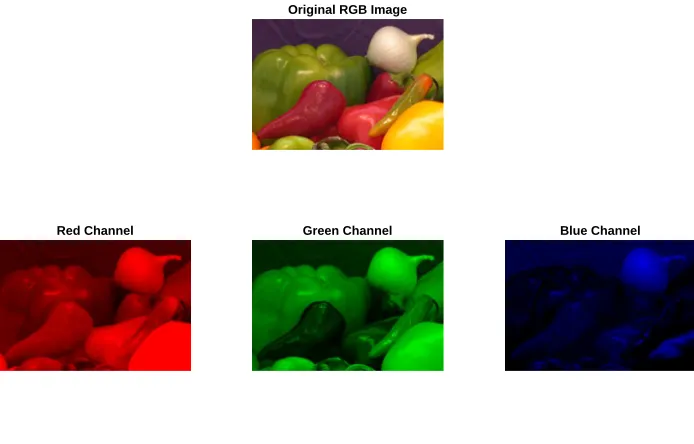
2.3 Image broken down to individual RGB channels. . . 6
2.4 Histogram of a sample image. . . 7
2.5 Image example for GLCM creation. Image referenced from [15]. . . 9
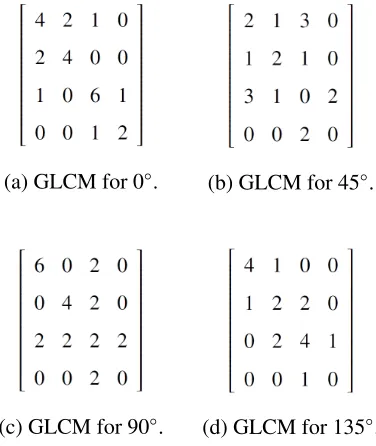
2.6 GLCM reference table. (i,j) is the number of times pixel values i and j have been neighbours with each other in one particular direction. . . 9
2.7 GLCM values for a given image in Figure 2.5. . . 10
2.8 K-means algorithm visualization. a) Unclassified data points. b) Initialization of two centroids denoted by the red and blue ”x”. c) The data points are labelled according to their proximity with the centroid. d) The centroids are adjusted to reflect the average of all points belonging to its own class label. The data points are then re-labelled, based on proximity with the new centroids. e,f) The process is repeated until no new data points are re-labelled to a different class. Image taken from [16]. . . 13
2.9 Point anomaly illustration . . . 14
2.10 Sigmoid Function Graph. Image taken from [19]. . . 17
2.11 SVM visualization. . . 17
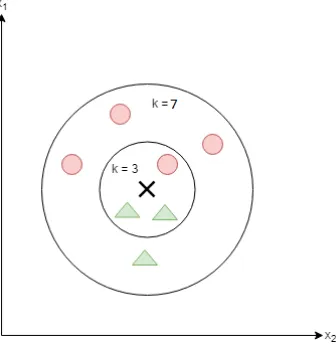
2.12 KNN Visualization. . . 18
2.13 Decision Tree Visualization taken from [20]. . . 19
2.14 ANN Neuron illustration. . . 19
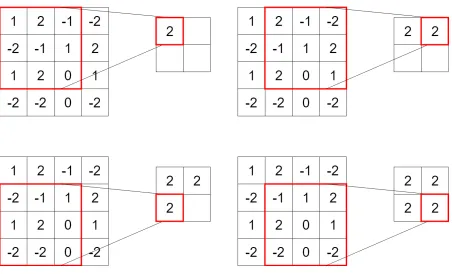
2.19 Convolution Demonstration. . . 30
2.20 Edge Detection with Sobel Kernels. Top: horizontal edge detection kernel. Bottom: vertical edge detection kernel . . . 32
2.21 Rectified Linear Units activation function graph. . . 32
2.22 Max Pooling. . . 33
2.23 AlexNet Simplified. . . 34
2.24 AlexNet feature map visualization taken with permission from [43]. . . 36
2.25 VGG Architecture taken with permission from [48]. . . 37
2.26 Residual Networks Building Blocks taken with permission from [50]. . . 38
2.27 34-layer Residual Network Architecture taken with permission from [50]. . . . 39
2.28 Inception Module taken with permission from [52]. . . 41
2.29 GoogleNet architecture taken with permission from [52]. . . 42
2.30 Inception V3 Module taken with permission from [56]. . . 43
2.31 Inception-Resnet Module A taken with permission from [55]. . . 43
2.32 DenseNet Module taken with permission from [57]. . . 44
2.33 MobileNet splitting convolution layer into depth-wise convolution and point-wise convolutions. Image taken from [58]. . . 45
3.1 Sample image for each class in Shu et. al.’s dataset [7]. From top to bottom, left to right: Andesite, Dolostone, Granite, Limestone, Oolitic Limestone, Peri-dotite, Red Granite, Rhyolite, Volcanic Breccia. . . 49
3.2 Unsupervised Feature Learning Diagram. Image taken with permission from [7]. 51 3.3 Data Augmentation Operations. . . 53
3.6 Screenshots of an iPhone simulator to test the functionality of the app. . . 67
4.1 Sample rock images in Dunlop et. al.’s dataset [73]. . . 70
4.2 Individual rocks segmented from the original image taken from [73]. . . 71
4.3 Results of rock image classification from [73]. . . 72
4.4 Sample images from the database. . . 73
4.5 Sample images in the database of different rocks that contain similarly looking rock hammers. . . 74
4.6 Sample Breccia Image. . . 75
4.7 Sample Non-Breccia Image. . . 76
4.8 Cropped Breccia Images. . . 77
4.9 Cropped Non-Breccia Images. . . 77
4.10 Breccia CFCN Model Architecture. . . 82
A.1 Training and validation graphs for VGG16, VGG19, and ResNet50. . . 87
A.2 Training and validation graphs for MobileNet, InceptionV3, and InceptionRes-NetV2. . . 88
A.3 Training and validation graphs for the DenseNet networks. . . 89
A.4 Training and validation graphs for the 1-layer networks. . . 90
A.5 Training and validation graphs for the 1-layer networks. . . 91
A.6 2 Layer and 3 Layer network loss and accuracy during training. . . 92
A.7 CFCN loss and accuracy during training. . . 92
B.1 Training and validation graphs for VGG16, VGG19, and ResNet50. . . 94
B.2 Training and validation graphs for MobileNet, InceptionV3, and InceptionRes-NetV2. . . 95
B.3 Training and validation graphs for the DenseNet networks. . . 96
B.4 2 Layer and 3 Layer network loss and accuracy during training. . . 97
3.2 Results from [7]. . . 52
3.3 Pre-trained networks number of trainable parameters. . . 55
3.4 Transfer learning results for each network. . . 56
3.5 Custom Networks number of trainable parameters. . . 58
3.6 Custom Networks number of trainable parameters. . . 58
3.7 Custom Networks Results. . . 59
3.8 Custom Networks Results. . . 60
3.9 Custom Networks Average Accuracy and Loss across 10 trials. . . 61
3.10 Output shape for each layer in the 3-layer network. . . 62
3.11 Output shape for each layer in another 3-layer network that follows the same ”path” as the previously created 3-layer network. . . 63
3.12 Output shape for each layer in another network that follows the same ”path” as the previously created 3-layer network. . . 63
3.13 Combinational Fully Connected Network Results. . . 66
3.14 iPad deployment results. . . 67
4.1 Hyperparameters used for Transfer Learning as well as training the custom networks. . . 78
4.2 Transfer learning results for each network. . . 79
4.4 Custom Networks Results. . . 79
4.3 Custom linear network architecture with 5 convolutional layers. . . 80
Appendix A Training and Validation Graphs for Chapter 3: 9-Class Rock Dataset . . . . 86
Appendix B Training and Validation Graphs for Chapter 4: Breccia vs Non-Breccia . . . 93
1.1
Motivation
Traditionally, geological exploration and mapping is a tedious and manual process: a geologist
goes out in the field, and brings with them a plethora of equipment (compass, GPS, clinometer,
camera, protractors, mapping pens and erasers, etc.) and painstakingly records all of these
information in a notebook [1]. Subsequently, when there is an interesting rock that needs to be
looked at, the geologists takes a sample, and brings it back to the lab for examination. Although
nothing could replace the nostalgia of writing with pen and paper, a lot of the grunt work of
field work could be automated. This leaves more time for the geologist to do more scientific
work.
Seeing the need to simplify the field exploration process, a research group under the
super-vision of Dr. Gordon Osinski (Dept. Earth Sciences) at the University of Western Ontario is
developing an iPad application that combines all of the tasks into one. Geologists could now
simply bring just one device to the field and record data as opposed to having to worry about
taking with them other equipment. At the end of the exploration, the geologists could then
up-load all of their data into a database for safekeeping, where they could retrieve data and review
their trip on a website.
Among the data that is being uploaded into this database are images of outcrops and
sam-ples alongside the geologist’s notes. Often, the notes describe the outcrop and in the image, i.e.
its lithology (rock type), orientation, composition. In other words, the geologists are uploading
labelled images of rocks into the database. A question now arises: would it be possible to build
a model that would classify images of rocks based on the uploaded images?
Identifying outcrop lithology is paramount in geological mapping and exploration because
it gives valuable insight about the area under examination, i.e. it’s geologic history, origin,
and nature. Also, making accurate geologic maps has a profound impact on numerous other
fields of study. For instance, mining and resource exploration rely on accurate maps to know
where a valuable mineral could be feasibly extracted; civil and structural engineering require
solid geological information in building dams, roads and buildings; and environmental
geo-sciences depend upon geological maps to predict hazards [1]. Therefore, a system that could
automatically classify outcrop lithology would have multiple benefits to the geologist:
• Unknown rocks could be identified without bringing back samples to the laboratory;
• When linked back to the field notebook application, geologists would be able to know where else a particular kind of rock could be found;
• Accurate geological maps could be made with significant ease;
• Geologists could have access to the classifier as learning tool in identifying rocks;
Applications outside of this planet could also be forseen. Planetary rovers like the Mars
Sci-ence Laboratory Rover are equipped with a suite of instruments that are collecting a plethora
of scientific data [2]. However, communication with the rovers from Earth remains an issue.
For one, as the rover travels farther distances in each mission, the amount of data that can be
sent to Earth is reduced which potentially results in missed opportunities in terrain in long
tra-verses [3]. As well, many tasks require several steps of human intervention to perform such as
approaching a rock outcrop and placing an instrument against it [4]. So with the long, arduous
process it takes to send commands and receive data from the rover, a lot of time and data is
wasted. For this reason, autonomous targeting systems like the OASIS (Onboard Autonomous
Science Investigation System) and AEGIS (Autonomous Exploration for Gathering Increased
This research explores the use of Convolutional Neural Networks (CNNs/ConvNets) in classi-fying rock images and takes a step towards identiclassi-fying rocks in natural scene images. First, we
establish the effectiveness of CNNs in identifying rock images. Then, leveraging the amount of labelled images in the aforementioned database, we use CNNs to create a ”Breccia” (a rock
that containing angular fragments that are cemented together) and a ”Non-Breccia” classifier
in natural scene images. Although very challenging, classifying natural scene images is
im-portant because the idea is that geologists would bring this system to the field where it would
be very difficult to take clean and uniform images of rocks. Therefore, to prove that a sys-tem could be created to classify natural scene images of rocks, a simple binary classifier of
Breccia/Non-Breccia is first developed. Finally, the rock image classifier would then be de-ployed in a lightweight and portable device, such as an iPad to create a system that geologists
could take into the field.
This system has potential to automatically and reliably classify a large number of images
for a short amount of time and energy. However, it is not meant to replace geologists
alto-gether as there is no forseeable way that a computer could be smarter than trained geologists in
classifying rocks. This is merely a tool that could help point geologists in the right direction.
1.3
Thesis Outline
The rest of this thesis is laid out as follows: Chapter 2 provides a literature review on common
techniques used in classifying images of everyday objects as well as images of rocks. Also, a
background on CNNs will be provided in this chapter. Chapter 3 discusses the work of Shu
et. al. [7] and applying a CNN on a dataset of clean images of rocks. Chapter 4 presents the
Review of Related Literature
2.1
Images and Image Classification
2.1.1
An introduction to images
When human beings look at images, the identification of what is in the image and where it is
in the image almost comes naturally. For instance, if shown an image of a dog (Figure 2.1),
anyone would be able to point out that it is an image of a dog (image classification) and where
it exactly is in the image (object detection). However, this process is more complicated for a
computer because for one, a CPU is no match for the human brain and two, to a computer an
image is simply a 2-dimensional matrix of numbers.
Formally defined, an image is a matrix of numbers containing visual information. Each
picture element (pixel) of this matrix represents a screen brightness level on that position of the
matrix. A color map defines how to map a pixel value with a particular shade of gray onto the
screen. On a gray scale image, this pixel value is commonly referred to asgray level. Figure
2.2 shows a sample image matrix mapped to a screen, in reference to a color map.
Figure 2.1: Image Recognition is being able to tell that this is an image of a dog and Object
Detection is pointing out where in the image is the dog. Image courtesy of Tamu and Dr.
Hanif Ladak
Figure 2.2: Color Map. Image reproduced from [8].
In the case of color images, each pixel in the matrix is an array of 3 values each
correspond-ing to color or brightness dependcorrespond-ing on the color map. The most commonly used color map is
the RGB space, where each value in the array represents the brightness level of the red, green,
Original RGB Image
Red Channel Green Channel Blue Channel
Figure 2.3: Image broken down to individual RGB channels.
Plenty of other color spaces exist, one of which is the Hue, Saturation, and Value (HSV)
space where the colors in the image are modelled to be similar to how humans perceive color.
Another commonly used color space in digital videos is the YCbCr, where visual information
is stored as values of Luminance (Y) and Chrominance(Cr and Cb). The pattern persists,
however, in that pixels in color images are usually composed of an array of 3 values.
Even though computers ”see” images as merely matrices, important visual information
about the image can be inferred from these matrices [8, 9]. For example, in natural scene
images, pixel values in a neighbourhood are highly correlated. Looking at the green channel
image in Figure 2.3, a random pixel in the middle of the onion on the top right part of the
image is guaranteed to have an adjacent pixel that has a value very close if not identical to it.
This maintains a consistent color gradient pointing towards the existence of an object within a
localized area in the image.
Another interesting property of images is that edges of objects could be deduced with a
sharp difference between adjacent pixels [8, 9]. As an example, in Figure 2.2, a vertical edge could be inferred from a sudden change of 0 to 127 and 0 to 255 in the pixel values in the first
and second columns of the image. The same is true in deducing horizontal edges in that there
Figure 2.4: Histogram of a sample image.
Traditionally, the pipeline for image classification is as follows: first, nfeatures from the
image is extracted, then thesenfeatures are combined to create an n-dimensionalfeature vector
which represents each image. Thisndimensional feature vector could be thought of as a point
in anndimensionalfeature space. Therefore, each image in the dataset exists as a point in this
ndimensional feature space.
Features with which to represent images are not only limited to edges and neighbourhood
pixel values, however, and research is being actively done on figuring out the best features to
use in representing an image [10–13]. Some of the most popular feature representations used
in computer vision are highlighted below.
2.1.2
Image Feature Representations
One of the more intuitive ways to represent an image is by looking at the raw pixel values
in the images themselves. After all, the pixels themselves contain information about color or
brightness. Information garnered from raw pixel values has been dubbedfirst-order statistics
First-Order Statistics
• Mean (average gray level intensity within the image)
¯
I = 1 N
N
X
i=1
I(i) (2.1)
• Median (middle gray level value when the gray levels are sorted)
Imedian =
n+1
2 th (2.2)
• Standard Deviation (amount of variation between the gray levels)
Isd=
v t
1
N−1
N
X
i=1
(I(i)−I¯)2 (2.3)
• Skewness (measures of the asymmetry of the distribution of the histogram)
skewness=
1 N
PN
i=1(I(i)−I¯)3
q1
N
PN
i=1(I(i)−I¯)2
3
(2.4)
• Kurtosis (measures the sharpness of the peak of the distribution of the histogram)
kurtosis=
1 N
PN
i=1(I(i)−I¯)4
q1
N
PN
i=1(I(i)−I¯)2
4
(2.5)
where: I =Image matrix
N =Total number of pixels in the image
Second-Order Statistics from Gray Level Co-occurence Matrices
On the other hand, Haralick et. al. [15] developed another way of looking at the texture of
images by first creating a Gray Level Co-occurence Matrix (GLCM) and then extracting
infor-mation from this matrix. The concept is based on the assumption that the texture of the image
can be gleaned from the relationship of the gray levels have with each other within the image.
there would also be four different GLCM’s. To illustrate further, Figure 2.6 shows how a typical GLCM would look like for the image shown in Figure 2.5. (0,0) would be the number of times
the gray level value 0 had a neighbouring pixel whose value is also 0. (0,1) would then be the
number of times gray level values 0 and 1 were neighbours with each other and so on. Keep
in mind that the definition of ”neighbour” is a function of the direction to which the adjacent
pixel is located, as well as the distancedwhich defines the scope of the neighbourhood.
Figure 2.5: Image example for GLCM creation. Image referenced from [15].
Figure 2.6: GLCM reference table. (i,j) is the number of times pixel values i and j have been
With this, Figure 2.7 shows the actual values of the four matrices given Figure 2.5.
(a) GLCM for 0◦. (b) GLCM for 45◦.
(c) GLCM for 90◦. (d) GLCM for 135◦.
Figure 2.7: GLCM values for a given image in Figure 2.5.
From these matrices, Haralick et. al. defined 14 textural features that can be used to
de-scribe the texture of an image. Some of the textural features are outlined below. The complete
list can be found at [15].
• Angular Second Momentum (measures the smoothness or uniformity of the image)
AS M= X
I1,I2
P(I1,I2)2 (2.6)
• Contrast (measures local level variations)
Contrast =−X
I1,I2
|I1−I2|2logP(I1,I2) (2.7)
• Correlation (measures pixel correlation in two different directions)
Correlation= X
I1,I2
(I1−µ1)(I2−µ2)P(I1,I2)
δ1δ2
(2.8)
• Inverse Difference Moment (measures the homogeniety of the image)
Homogeniety= X
I1,I2
P(I1,I2)
1+|I1−I2|2
2.2
Training a Classifier
The selection of features to represent an image is very important because the classifiers depend
on these features to make a decision on whether or not an image belongs to a particular class.
Usually, features are chosen such that there is a clear and distinguishable difference between images belonging in different classes. If for example the features chosen do not represent the image well (i.e. there is little variation between features of images belonging in different classes), then the classifiers would fail to be accurate.
After careful selection of the features, the next step is to train a classification algorithm.
Generally, each classification algorithm takes an input feature vector, performs a number of
operations on them, and then outputs a prediction for which class the input feature belongs.
Training a classifier then entails that the algorithm learns to adjust its parameters so that it could
output better predictions and differentiate between classes effectively. Some of the commonly used classification algorithms will be discussed in the next section.
With a huge enough database, a collection of the chosen feature vectors is used to create a
training set, avalidation set, and atest set. Typically, a dataset is split into around 70% training
set, and 15% for both the validation and the test set. From the names themselves, the training
set is used to train the classifier. The validation set is used to check how the classifier performs
during training, which would then indicate if training is sufficient or not. If so, then the model is saved for further testing. Otherwise, training will continue. Finally, the test set is used to see
how well the model generalizes into never before seen data.
During the selection of features, it is also important to consider how many features to use.
If too many features were selected, this not only increases the computational resources to train
excellent accuracy on the training set but fails to generalize on the validation or test set. In
other words, the classifier ”memorized” the distinguishing features on the training set but fails
on never before seen data.
2.3
Classification Algorithms
The following section outlines the different classification algorithms commonly used in im-age classification. Take note however, that these algorithms are common across classification
problems, not just image classification.
As was alluded to in previous sections, the training set is fed into a classification algorithm
that takes in an input feature vector and outputs a prediction for which class that particular
feature vector belongs to. Often, this output is a probability that each input belongs to classyi.
There are 2 types of classification algorithms which will be described below.
2.3.1
Unsupervised learning
Unsupervised learning is an umbrella term for algorithms which make predictions without
looking at the class labels of each feature vector. Because of this, unsupervised learning
al-gorithms do not have prior knowledge of how many classes there are in each dataset. These
types of algorithms are more powerful, however, in that they can usually generalize better with
completely new input. At the same time, these algorithms can point towards similarities and
differences among objects beyond their class labels. Although these algorithms would not be explicitly used in this research, a brief spiel for unsupervised learning algorithm is given for a
potential future application.
K-means
One of the most common unsupervised learning algorithms is the the K-means algorithm. This
algorithm attempts to cluster the dataset into K predetermined classes regardless of whether
there are actually K classes in the dataset or not. This is done by first randomly selecting K
Figure 2.8: K-means algorithm visualization. a) Unclassified data points. b) Initialization of
two centroids denoted by the red and blue ”x”. c) The data points are labelled according to their
proximity with the centroid. d) The centroids are adjusted to reflect the average of all points
belonging to its own class label. The data points are then re-labelled, based on proximity with
the new centroids. e,f) The process is repeated until no new data points are re-labelled to a
different class. Image taken from [16].
Anomaly Detection
An anomaly can be defined as an instance or an object that does not conform to what is deemed
”normal” [17]. In terms of finance and credit cards, detecting anomalies could be seen as
detecting fraudulent purchases. In the same context, apoint anomaly [18] is one instance of
fraud where a purchase has been made in a country different from where the owner is currently at. A contextual anomaly [18] on the other hand is when the user goes on a vacation to a
Figure 2.9: Point anomaly illustration
2.3.2
Supervised learning
In training a supervised classification algorithm, the class labels for each feature vector is
known to the classifier and it uses these class labels to compare its prediction to the actual
class label of each feature vector. Keep in mind that since we are dealing with classification
problems, the output of the algorithms takes on discrete values which pertain to the object’s
class label. And in some cases, the output of the algorithms is the probability that an object
belongs to a particular class. The difference between the output of the algorithm and the actual class label is usually represented using aCost Function.
In learning how to predict correctly, the goal of training classification algorithms is to
minimize this cost function. Since the output of the classifiers is often a probability, minimizing
the cost function entails that the classifiers output a probability as close to 1 as possible for the
correct class and as close to 0 as possible for incorrect classes. Say for example we have a
dataset with 5 classes, y ∈ [cat,dog,goat,sheep, f ish]. When given an image of a dog, we want the output predictions of the algorithm be [0,1,0,0,0] where the algorithm is absolutely
sure that the image is that of a dog, and not of anything else. Otherwise, a predictions of say
[0.4,0.3,0.2,0,0.1] means that the algorithm is unsure about the class label of the image.
In general, the process is that upon making a prediction, the cost function is calculated to
see how far offthe prediction is from the true value. The classifier then adjusts its parameters in such a way that wrong predictions are penalized and correct predictions are reinforced.
To elaborate further, the most common supervised classification algorithms are outlined
hθ(~x)=g(θT~x)= 1
1+e−θT~x (2.11)
hθ(~x)= g(θT~x)= 1
1+e−(θ1x1+θ1x1) (2.12)
g(z)= 1
1+e−z (2.13)
where:g(z)=sigmoid function
θ1, θ2 =parameters to optimize
A plot of the sigmoid function is shown in Figure 2.10. Notice that g(z) approaches 1 as
z → ∞, g(z) approaches 0 as z → −∞. Therefore, we can approximate thatg(z) outputs the probability that a feature vector~xbelongs to classy = 1. Conversely, the probability that the same feature vector~xbelongs to classy=0 is 1−g(z)
Formally:
P(y= 1|~x;θ)= hθ(~x)=g(z) (2.14)
P(y=0|~x;θ)=1−hθ(~x)=1−g(z) (2.15)
∴P(y|~x;θ)=[hθ(~x)]y[1−hθ(~x)]1−y (2.16)
For all training samples m, the product of all the probabilities shown in equation 2.16 can
be thought of as theLikelihood Function where it measures how likely that the input feature
L(θ)=
m
Y
i=1
[hθ(x~(i))]y
(i)
[1−hθ(x~(i))]1−y
(i)
(2.17)
The goal of training this particular classifier therefore is to maximize the likelihood of an
input belonging in classy= 1. Therefore, we need to find the values ofθT such that
g(z)→1 fory=1 and
g(z)→0 fory= 0
This basically indicates that we want the classifier to be 100% sure in determining whether
an input belongs to classy= 1 or not. One of the ways that this could be done is viaStochastic Gradient Ascent:
θB θ+α· ∇θJ(θ;~x;y) (2.18)
where:α= learning rate
∇θ =gradient of the loss function with respect to parameterθi
L(θ;~x;y)= likelihood function parametrized byθ
This gives a parameter update rule as follows:
θj Bθj+α((y( i)−
hθ(x(i)))x(ji) (2.19)
The learning rate determines how fast the algorithm learns by scaling the change in the
parameters up or down. A lower learning rate means that the parameters would update slower,
therefore increasing the time it takes to train the algorithm. However, if the learning rate is too
Figure 2.10: Sigmoid Function Graph. Image taken from [19].
Support Vector Machines
Whenm samples with n dimensions are plotted inton dimensional feature space, the aim of
Support Vector Machines(SVM) is to find an optimal hyperplane that separates one class from
another. The separating hyperplane is optimal in such a way that the closest points to the
boundary are at a maximum distance from said boundary. To visualize, five samples of class
cross and classcircle with features x1 and x2 were plotted in Figure 2.11. Even though both
of the red lines separates the two classes, it does not do so very well as opposed to the solid
line in the middle as this line has the maximum distance between the boundary and the closest
points from each class.
K-Nearest Neighbours
K-Nearest Neighbours is a supervised classification algorithm where a training sample is
as-signed a class via majority vote of the K nearest points in its neighbourhood. In Figure 2.12,
say we have an unknown point which is represented by theX in the middle. If we set K = 3, meaning we will only consider the 3 nearest neighbours of point x, we will assign classgreen
triangleto point x. However, if we setK= 7, we will assign classred circletox.
Figure 2.12: KNN Visualization.
A KNN algorithm withK =1 is simply known as the Nearest Neighbour algorithm(NN).
Decision Trees
Finally, a Decision Tree is a classification algorithm where each internal node represents a
discriminative decision between features and whose branches represent the outcome of the
decision. A class label is then assigned to the leaf node, which is result of the final decisions
as illustrated in Figure 2.13. As an example, if we have a classifier for fruits and our features
Figure 2.13: Decision Tree Visualization taken from [20].
Artificial Neural Networks
An Artificial Neural Network (ANN) is a machine learning algorithm that attempts to mimic
biological neural networks. The network is composed of an input layer, followed by hidden
or intermediate layers, and finally an output layer. Each layer further consists of neurons, or
nodes.
In the input layer, the nodes are simply each feature in the feature vector. Therefore, the
number of nodes on the input layer corresponds to the number of dimensions on the feature
vector. Each node on the hidden layer then takes the weighted sum of the output of the previous
layer and goes through anon-linear activation. Figure 2.14 shows the internal mechanics of a
neuron.
Figure 2.14: ANN Neuron illustration.
shown in equation 2.11. Keep in mind that since the previous layer is fully connected to the
current layer, each of the connections from one node to another would have its own
corre-sponding weight. The output of the sigmoid function would then be the input to the next layer,
with the same process repeated again. In addition to the weights of each of the connections, a
bias parameter is added per layer.
Finally, the output layer takes in the output from the last hidden layer and then performs a
different activation depending on the problem at hand. In multi-class classification problems, this activation function is often the softmax function, a generalization of the binary logistic
regression classifier.
fj(θT~x)=
eθT~xj
P
keθ
T~x
k (2.20)
where: k=number of classes
~x= input feature vector
The softmax function takes in an input vector xand outputs a value between 0 and 1 for
each class j. When concatenated, a vector of predictions ~f is produced for each input ~x.
The values in the vector of predictions sum up to 1. The output of the softmax function can
then be interpreted as the normalized probability that the input feature vector ~x belongs to a
particular class. Therefore, the nodes on the output layer matches the number of classes in the
classification problem. An illustration is provided in Figure 2.15
The algorithm learns by updating the weightsθand biasesbiwhich essentially dictates the
contribution of each input in the firing of the neuron. To adjust the weights, we first define a
new loss function suitable for multi-class classification called the Categorical Cross Entropy:
Ji =−fyi +log
X
j
efj (2.21)
where: fyi = true class label
Figure 2.15: Artificial Neural Network architecture that attempts to classify an input with 4
features to one of three possible classes.
From equations 2.21 and 2.20 we get a cost function parametrized by the weightsθ:
Ji =−fyi +log
X
j
e
eθ T~
x j
P
k eθ T~xk
(2.22)
Take note that this follows the intuition for the loss function explained in the Logistic
Regression section where the loss is essentially the difference between the prediction of the algorithm and the true class label of each input. Since the aim is to minimize the cost function,
or to make the predictions as close to the true labels as possible, the weights are then adjusted
via a gradient descent method or variations thereof. To recap:
θB θ−α· ∇θJ(θ;~x;y) (2.23)
where:α= learning rate
∇θ =gradient of the loss function with respect to parameterθi
J(θ)= loss function parametrized byθ
For the first forward pass, the weights θ are initialized randomly and then updated using
equation 2.23. There are a few options available for when to update the weights. For instance,
one can choose to update the weights after one training sample has been fed forward to the
weights after a mini-batch of samples have been fed forward through the network (batch
gradi-ent descgradi-ent). Although stochastic gradient descent allows the weights to be updated right away
after a single sample, this often leads to huge fluctuations in the weights. Thus, batch gradient
descent is preferred by researchers because it takes into account more samples in updating the
weights. But at the same time, opting for mini-batches reduces computational complexity as
opposed to calculating the loss over the whole training set [21]. Once the entirety of the
train-ing set has had a chance to adjust the parameters, this is known as anepoch. Often times, one
epoch is not enough to sufficiently train a network. Thus, multiple passes through the training set is required to successfully create an accurate classifier.
There are better alternatives in updating the parameters however, one of which is the
Adap-tive Subgradient Method (Adagrad) [22]. The Adagrad optimizer introduces more variables
which adjusts the learning rates for each parameter depending on their past values. Larger
up-dates are done for infrequently appearing parameters and smaller upup-dates are done for frequent
parameters. The update rule then becomes:
θBθ− √ α
Gt+
gt (2.24)
where:Gt = diagonal matrix where each diagonal element
is the sum of the squares of the past gradients with respect to parameterθi
gt = gradient of the loss function with respect to the parameterθi
=hyperparameter
= element-wise matrix multiplication operation
The advantage of using Adagrad is that manually tuning the learning rates for each
param-eters is no longer needed. Instead, the adjustments of the weights are dictated by their previous
values, which is contained inGt.
A variation of Adagrad calledAdadeltaalso computes adaptive learning rates for each
pa-rameter [23]. However, instead of taking the sum of the squares of the past gradients, Adadelta
mt =β1mt−1+(1−β1)gt
vt = β2vt−1+(1−β1)g2t
(2.25)
where:mt = estimate of the mean of past gradients (first moment)
vt =uncentered variance of past gradients (secont moment)
β1, β2 =decay rates (hyperparameter)
However, mt andvt are initialized to 0 and the first few forward passes tend to bias their
values close to 0 as well especially with low decay rates. To solve this problem, a bias corrected
first and second moments are used instead:
ˆ
mt =
mt
1−β1vˆt =
vt
1−β2 (2.26)
Finally, the update rule is computed as follows:
θBθ− √ α
ˆ
vt+
ˆ
mt (2.27)
With enough training,θwould converge to a point where the loss function is at its minimum,
signifying that the model achieves its best predictions with the obtained values forθ.
2.3.3
Image Classification Metrics
One of the most intuitive ways to check the accuracy of the model is to measure how many
correct guesses it obtained on the test set. However, a dataset having a huge number of classes
calls for a more forgiving metric. For this reason, the top-5 error rateis used to consider the
Figure 2.16: Top 5 Error Rate illustration taken with permission from [25]. Actual class labels
are shown in larger text, and model predictions are shown with the colored bars indicating
confidence.
is the number of times where the true class label did not appear in the top 5 guesses of the
classifier. An illustration is shown in Figure 2.16.
For binary classification, theConfusion Matrix,F-Score,Recall, andPrecisionare all
use-ful metrics in determining model performance. The confusion matrix is a table showing the
number of true positives, true negatives, false positives, and false negatives predicted by the
model.
Actual class
Positive Negative
Predicted Class Positive True Positives (TP) False Positives (FP) Negative False Negatives (FN) True Negatives (TN)
Table 2.1: Confusion Matrix.
Precision is the ratio of true positive predictions to the total positive predictions outputted
by the model. A high precision indicates that the model could correctly predict positive classes
Recall= T P
T P+FN (2.29)
F-Score is a combination of the two:
F-score= 2· precision × recall
precision+recall (2.30)
F-score is a useful metric in cases where the dataset is severely unbalanced. For example,
say we are given a dataset that contains 90% positive cases and 10% negative cases. An
inef-fective classifier that simply guesses everything as positive would have a ”good” accuracy of
90%. However, the true performance of the classifier would be reflected on the precision and
hence, the f-score of the classifier.
2.4
Rock Image Classification
In the field of geology, image classification is not unheard of and has tremendous potential
ap-plications. For example, autonomous hyperspectral image classification has huge applications
in mapping unexplored surfaces [26, 27]. Also, classifying rock images garner significant
at-tention from researchers. For instance, Harinie et. al tested image classification algorithms on
four types of rocks: intrinsic igneous, extrinsic igneous, sedimentary, and metamorphic [28].
It was accomplished by extracting Tamura features [13] from a set of 50 images and then using
these as standard features for each class. Subsequent images are then classified by comparing
the basis features with the Tamura features of the input image. The image is then assigned to
the class with the minimum distance with the basis. Through this method, the authors obtained
As well, Mlynarczuk et. al. classified thin section images of nine different rock samples [29]. First order statistics were used as features for each image. The features were extracted in
four different color spaces namely RGB, HSV, YIQ, and CIELAB [30,31] to examine the effect of color spaces in automatically classifying each image. Using these features, the authors found
that the Nearest Neighbours and K-Nearest Neighbours algorithms performed best across all
color spaces, achieving an accuracy upwards of 96%.
Meanwhile, Shang and Barnes hand crafted 54 different features based on first order statis-tics and used three different classifiers (SVM, KNN, Decision Trees) to classify rock images baased on 14 different textures [32]. However, to help with efficiently choosing which features are more important than others, they employed a reliability based method for feature selection.
For each training sample, the reliability of a feature is given by its distance to the same feature
from other training samples belonging in the same class. Farther distances suggest that the
feature might not be a good indicator of class membership, and can therefore be omitted from
the feature set. The features are then ranked based on the reliability and only the topmreliable
features are selected. As well, the researchers used an Information Gain based ranking to rank
the features based on how well they separate data points with respect to their underlying class
labels. This is done by calculating the entropy of the class before and after taking a feature
into account and then measuring the additional information about the class that the feature
provides [33]. Again, the topmfeatures are selected.
Overall, the authors achieved the highest accuracy by using the top 20 features out of the
possible 54 with an SVM classifier. In using all 54 features, the authors did not see any
signif-icant increase in accuracy for the SVM. However, in both KNN and Decision Tree, the authors
obtained the highest accuracy by using 53 and 48 features respectively. Similar results are
observed when using Information Gain based ranking.
Ishikawa and Gulick takes a different approach in mineral classification, this time by using Raman Spectra instead of color images [34, 35]. The authors gathered Raman data from 13
different minerals and segregated them according to mineral group. A total of 190 spectra each with 765 dimensions were collected. To reduce the number of dimensions on the feature
set, the authors used Principal Component Analysis to map the features into a space where
plane polarized and cross polarized light with each pixel being labelled according to its mineral
content. The authors used raw pixel values on the RGB and HSV spaces as the features which
was then fed into an Artificial Neural Network with 1 hidden layer. The authors obtained an
accuracy of 89.53% when using the RGB color space, 87.5% in HSV and 87.45% using both
color spaces.
Finally, Singh et. al used a mix of first and second order statistics, Image Features
(percent-age of most common gray level, number of edge pixels, etc.) and Region Features to classify
textures of basaltic rock images into three classes [37]. In total, 27 features were selected.
Principal Component Analysis was again used to reduce feature dimensionality. An Artificial
Neural Network was also used, having 2 hidden layers and 15 and 20 nodes respectively. The
authors obtained an average classification accuracy of 92.22%
2.5
Convolutional Neural Networks
2.5.1
AlexNet and the Rise of ConvNets
The previous work that has been shown has a common thread: manually extract features and
build a feature set, try to optimize feature selection, and finally train a classifier. However,
recent developments in image classification has a more different approach. The idea is to automate the whole process and have an algorithm learn which features to extract and then
train a classifier at the same time. This method was first proposed by LeCun et. al. and has
been dubbed Convolutional Neural Network [38]. In their work, the authors developed the
LeNet-5 (Figure 2.17), a ConvNet that classifies hand written digits from the MNIST dataset
consisting of 60,000 training samples and 10,000 test samples. The method boasts an accuracy
More recently, ConvNets have risen to popularity because of the work of Krizhevsky et.
al. [25] in achieving unprecedented accuracy in the ImageNet Large Scale Visual Recognition
Challenge 2012 dataset [39]. The feat is impressive because the ImageNet dataset is composed
of 1000 different classes with a total of 1.2 million images in the training set and 200,000 images in the validation and test set. Also, the images are of different scales and often off -center objects. Obtaining very accurate results on this dataset translates well into classifying
real life natural scene images. Because of the success of Krizhevsky et. al., subsequent top
submissions to the contest used variations of ConvNets [40–43].
Figure 2.17: LeNet architecture taken from [38].
Figure 2.18: AlexNet architecture taken with permission from [25].
and the fully connected layer, both of which are going to be explained below. Finally, the
out-put layer is similar with the ANN where the outout-put is the probability of a feature set belonging
in a particular class.
ConvNets work in the same mechanics as the ANN in such a way that it also attempts to
mimic how the brain interprets images. Imagine for example how an infant would differentiate between shapes. One would imagine that that the edges of each objects are one of the main
factors in deciding shape. Over time, an infant learns that an object with four edges is a square,
and object with no corners is a circle, and so on. Then, in differentiating different objects, combinations of shapes, edges, as well as colors are taken into account. Thisobject has this
shape and thiscolor. The face of mommy and daddy havetheseshapes and their hair is that
color. And as children learn more shapes and more objects, the distinguishing features tend to
be more complicated.
Convolutional Layer
At the core of ConvNets is the convolution layer. A convolution with an image is simply a
weighted sum of the pixels within the window size of the filter called the receptive field. To
illustrate, Figure 2.19 shows a 4×4 sample image convolved with a 3×3 filter with weights [1 1 1; 1 1 1; 1 1 1]. This simply results to a linear sum of all the pixels in the receptive field of
the filter. Then the window moves over to the next central pixel which fits the filter, also known
as thestride. In this example, the stride is 1. This process is repeated until the convolutions all
through out the image are exhausted, creating afeature map.
be 3×3×3, matching the depth of the input.
Figure 2.19: Convolution Demonstration.
There are a few things to consider with this process. When we convolved the 4×4 image with a 3×3 filter, the result is a 2×2 feature map. Increasing the receptive field size of the filter to 4×4 would then result into a 1×1 feature map. In the same way, if the receptive field size of the filter is decreased to 2×2, the result would also be a bigger feature map, 3×3 to be precise. However,paddingthe borders of the original image with zeroes (therefore increasing
the number of convolutions throughout the image) could result in an output image with the
same dimensions as the original.
The output of each filter would then be stacked on top of each other, creating a 3-dimensional
feature map. In general, the output of the convolution layer is a 3-D volume [H2 ×W2× K]
where:
H2 =
H1−F+2P
S +1 (2.31)
W2 =
W1−F+2P
F =Filter Receptive Field Size
P= Zero padding
S =Strides
The number of filters per convolution layer depends on the discretion of the researcher.
Even the most common networks employ varying numbers of filters per layer, and there is no
hard and fast rule on how many filters there should be per layer.
In this algorithm, the weights of the filters are learned through the same process as in
Artificial Neural Networks. A loss function is defined, and the weights of the filters are updated
using an optimizer as in equation 2.26.
Convolving images with specific filters create interesting feature maps that would be useful
for classification purposes. For instance, convolving an image with a Sobel Kernel produces a
feature map of vertical and horizonal edges in the image (Figure 2.20).
Similar to how nodes in ANNs are activated by a non-linear activation function, image
con-volutions are followed by an activation function as well. The most commonly used activation
function is the Rectified Linear Units (ReLU) where:
f(x)= max(0,x) (2.33)
The activation is simply a threshold at 0. A graph of the activation function is shown in
Figure 2.21. Variations of this activation function exists, one of which is the Leaky ReLU
which does not impose a hard threshold on 0, but instead lets linearly adjusted negative values
pass through. Another variation is ReLU(n) wherenis a maximum threshold arbitrarily chosen
Figure 2.20: Edge Detection with Sobel Kernels. Top: horizontal edge detection kernel.
Bottom: vertical edge detection kernel
(a) ReLU. (b) Leaky ReLU. (c) ReLU(n).
Figure 2.21: Rectified Linear Units activation function graph.
Pooling Layer
Convolutional layers are often followed by a pooling layer which reduces the dimensionality
of the input. The mechanism is similar to the convolution layer where a sliding window
prop-agates through the image. However, the output of the pooling operation is a choice between
the maximum pixel value within the window (Max Pooling), or the average of the pixel values
(Average Pooling). Going back to Figure 2.19, if the operation was instead Max Pooling, the
result would be Figure 2.22. The choice of pooling operation is left to the researcher, however,
Figure 2.22: Max Pooling.
The purpose of the pooling layer is to aggregate responses within a local area of the image.
On one hand, this reduces the number of parameters within the network. This provides two
benefits: reducing the computational complexity of training the network, and combats
overfit-ting by reducing the feature map. On the other hand, this operation brings a level of invariance
to positional changes within the image, meaning the exact position of pixels in the image would
matter less while preserving the structure of the whole image. Ultimately, this affords the clas-sifier some leeway in that regardless of where the object is in the image, the clasclas-sifier would
still be able to successfully recognize the image [44].
Fully Connected Layers
After a series of convolutions, activations, and pooling, the resulting 3D feature map is then
flattened, creating a 1-D vector of size H×W × K. This essentially creates the input for the hidden layers of an ANN, which comprises the last few layers of the CNN. Again, similar to
2.6
ConvNet Architectures
Over the years, different ConvNet architectures have been built and different intricacies have been placed to improve classification accuracy. The following section outlines the most popular
ConvNet architectures in current literature.
AlexNet
As was mentioned earlier, the work of Krizhevsky et. al. [25] jump started the popularity of
ConvNets in image classification. In particular, the authors achieved the best accuracy in the
2012 ImageNet Large Scale Visual Recognition Challenge (ILSVRC2012) [39] achieving a
top 5 error rate of 15.32%, while the second place holder achieved a significantly worse top
5 error rate of 26.17%. Their architecture composed of 5 convolutional layers activated using
the ReLU operation, and 3 pooling layers in between. There are three fully connected layers
after the convolutions containing 4096, 4096, and 1000 nodes respectively. The simplified
architecture is shown in Figure 2.23.
The Dropout layer before the fully connected layer is one of the major contributions of
Krizhevsky’s work. This layer randomly shuts offthe output of a hidden node during training. The probability that a node would be shut offis defined by thedropout rate, which is 50% in the case of AlexNet. Essentially, this process changes the architecture of the whole network
every time a new input is presented to the network. During testing however, all neurons are
activated. The overall effect of the technique is that it removes the reliance of neurons to one another, forcing the network to learn more complex features that would classify an image
correctly regardless of whether all neurons are firing or not [45, 46]. As a side effect, the training accuracy may be lower than validation accuracy when all neurons are activated.
Figure 2.23: AlexNet Simplified.
This network has over 62.3 million parameters to learn. Although that sounds like a
sification contest was achieved by fine tuning AlexNet [47]. Zeiler et. al. first deconstructed
AlexNet and visualized the activated feature maps after passing through each convolutional
layer in the network. The authors found out that the first layer extracts basic edges and edge
orientations, and deeper layers extracts more complex structures that are often class specific
(i.e. face of a dog, eyes, flower petals, etc.) [43]. Figure 2.24 shows sample feature map
activations in the different layers of AlexNet.
With this, the authors learned that the first two layers had innate problems within their
activations. The first layer extracts high frequency and low frequency information, but lacks
mid frequency information thus prompting the authors to reduce the receptive field sizes of
the filters in the first layer down to 7×7. Also, the second layer showed aliasing artefacts or blurred edges, which is indicative of subsampling in the images. To mitigate this, the authors
reduced the stride of the first layer down to 2. Finally, the authors achieved a top 5 error rate of
11.7%, a significant improvement from AlexNet’s 15.32% [43].
VGG
Inspired by the work Zeiler et. al. in decreasing the receptive field size of the first convolutional
layer in AlexNet, Simonyan et. al. decided to push the idea further by using only 3 × 3 convolutions in their network [48, 49]. By decreasing the receptive field size of the filters in
each layer, this also allowed the authors to create very deep networks.
Figure 2.25 shows the architectures Simonyan et. al. designed for the deep networks using
smaller convolutional filters. The authors tested 6 architectures in total, each with varying
depths.
On their own, all the networks performed better than AlexNet with the 11-layer network
achieving a top 5 error rate of 10.4% and the 19-layer network achieving 8.0%. Ensembling
Figure 2.25: VGG Architecture taken with permission from [48].
7.4% while achieving a top 1 error rate of 24.4% [47].
ResNet
Work done by He et. al found that in training very deep networks, the training accuracy seems
to approach a ceiling and then degrades rapidly [50]. They claim that this is not a problem of
overfitting on the training set, but that of unnecessarily adding depth to the network [41, 51].
To solve this problem, the authors introduced Residual Learning, where the output of a layer
Figure 2.26: Residual Networks Building Blocks taken with permission from [50].
The authors evaluated their hypothesis in 18, 34, 50, 101, and 152 layer networks using
the ImageNet dataset. The architecture of the 34-layer residual network is shown in Figure
2.27. The deeper networks simply appended more ResNet blocks and convolutional layers.
The authors achieved the best result in the 152-layer network with a top 5 error rate of 4.49%.
Combining the different networks in an ensemble, the authors achieved a maximum of 3.57% n the top 5 error rate, enough to win the ImageNet contest in 2015 [47].
Inception, InceptionV2, and InceptionV3
Stemming from previous work about improving classification accuracy with deeper and wider
networks [48, 51], it seems that the most intuitive way of achieving an even higher accuracy is
to go even deeper and wider [52]. There is a limitation, however. As more and more layers are
added to the network, the computational costs for training the classifier increases dramatically.
After all, the memory capacity of the GPU is very limited. To address this dilemma, sparse
connections in the fully connected layer or even in the convolutional layer must be introduced
[53]. Sparse connections reduces computational complexity by zeroing out most of the neurons
in the network. However, there is a trade-off: GPUs and CPUs are optimized for dense matrix calculations and using them for sparse matrix operations would have a detrimental effect to training duration. In fact, Liu et. al. explored the idea of Sparse Convolutional Networks and
managed to create a network with 90% sparsity. But, even with most of the parameters zeroed
out, the actual training times failed to reach the theoretical speed up times because of sparse
Szegedy et. al. then introduced the Inception Module (Figure 2.28) as an approximation
to a sparse structure all the while using dense matrices. The overall effect is deepening the network, and training less parameters at the same time. This is achieved by combining various
operations in each block, and concatenating the result of each filter to form a 3-D feature map
that has scale variance stemming from the different operations. In the case of the Inception Module, 1×1, 3×3, 5×5 convolutions were contained in a block, as well as 3x3 max pooling (Figure 2.28a). Zero padding has presumably been added so that all operations have the same
output dimensionality.
With adding these operations per block, the number of trainable parameters is sure to
in-crease. To remedy this, the dimensionality of the output volumes are reduced by adding 1x1
convolutions before the 3×3 and 5×5 convolutions (Figure 2.28b). The 1×1 convolutions operate on individual pixels, but extends through the depth of the 3D volume. As an
illustra-tion, if the 3D volume has dimensions 128×128x256 and 1×1 convolutions were operated on the volume, the output would be a 128×128×Kvolume whereKis the number of 1×1 filters used. As an added benefit, the Inception module follows the intuition that visual information
should be processed at various scales and then aggregated so that the next stage can abstract
features from the different scales simultaneously [52].
With the Inception module, the authors created GoogleNet which has 9 inception blocks
stacked on top of each other including 22 layers with trainable parameters. The architecture of
the whole network is shown in Figure 2.29. By ensembling 7 networks, the authors won the
2014 Imagenet classification contest with 6.67% top 5 error rate.
Operating on the same principle, different versions of the Inception module has been pro-posed by the author to optimize the networks further [55]. In [56], the authors used consecutive
3x3 convolutions to replace the 5x5 convolution in Figure 2.30 as well as widening the network
further by concatenating the results of operations with the same output size. Thus, using the
inception modules as building blocks, InceptionV2 and InceptionV3 was born. Upon training
and testing, both networks achieved 21.2% and 18.77% top 1 error rate respectively and both
exhibited improved top 5 error rates at 5.6% and 3.58% respectively.
Finally, the authors combined the principles of the Inception module with Residual
Figure 2.28: Inception Module taken with permission from [52].
to propagate through the input feature map for each block. This combines the best of both
worlds in that deep network degradation is adressed using Residual Learning, and computional
overhead reduction is tackled by Inception Modules. One of the many modules used by the
authors is shown in Figure 2.31. A complete list of the Inception-ResNet modules can be seen
in [55].
On its own, an Inception-ResNet network achieved a top 1 error rate of 17.8% and top 5
er-ror rate of 3.7%. Ensembling a ResNet, InceptionV3 and multiple Inception-ResNet networks
Figure 2.30: Inception V3 Module taken with permission from [56].
Figure 2.31: Inception-Resnet Module A taken with permission from [55].
DenseNet
With the seeming trend of making convolutional networks deeper while reducing trainable
parameters, Huang et. al. proposes a solution similar to that of ResNet but instead of only one
skip connection between layers, the DenseNet module has the output of all layers connected
to all other subsequent layers [57]. Figure 2.32 illustrates the DenseNet module. Within the
module, the output of layer x0 is taken as input of the rest of the layers x1−4. Similarly, the
output of layerx1is taken as input of the rest of the subsequent layers x2−4 and so on.
Although there are similarities with the Inception Module where multiple skip connections
varying depths and applied DenseNet modules (DenseNet-121, 169, 201, 264). In testing with
the ImageNet dataset, the authors obtained a top 5 error rate of 5.2% which is slightly worse
than the Inception Ensemble. However, their result is better than a stand-alone ResNet, while
keeping computational costs lower.
Figure 2.32: DenseNet Module taken with permission from [57].
MobileNet
Considering that mobile phones and embedded systems have way less powerful GPUs than
full computers, lightweight networks are needed to actually provide practical uses for image
classification algorithms. Because of this, Howard et. al. created MobileNet, a lightweight
network that is designed for mobile deployment [58]. To reduce computational complexity,
MobileNet splits a traditional convolutional layer into depthwise convolution and 1x1 point
wise convolutions:
The trade-offis that the accuracy of this model does not perform well against deep fully convolutional networks. In fact, in the ImageNet dataset, the maximum top-1 error rate that
MobileNet achieves is 29.4%, lower than Inception-ResNet by 11.4%.
2.7
Transfer Learning
With all these networks designed specifically to extract features on a huge dataset, a lot of
Figure 2.33: MobileNet splitting convolution layer into depth-wise convolution and
point-wise convolutions. Image taken from [58].
to a task that is fairly different from the original one with which the network has been trained [59–63]. The idea is that training the whole network and relearning the filters on a more
specific dataset would no longer be necessary. Instead, the weights of the filters from all the
convolutional layers would be kept the same. Only the softmax or output layer is left to be
trained, matching the output nodes with the target number of classes particular to the task
at hand. This is known as transfer learning. The advantage of using this method is that it
decreases computational costs associated with training very deep networks. A cluster of GPUs
would no longer be a requirement for training, and days or even weeks of training would no
longer be necessary.
Transfer learning is not limited to full Convolutional Networks only. In fact, since the
flattening the feature maps is a 1-dimensional vector, this could be viewed as the feature vector
of an image. This opens up the possibility of using a different algorithm as a final step in a classification problem. For instance, Razavian et. al. demonstrated this very idea in using a
pre-trained AlexNet as a feature extraction method and then using an SVM as a classifier for
![Figure 2.2: Color Map. Image reproduced from [8].](https://thumb-us.123doks.com/thumbv2/123dok_us/1905251.1249563/16.612.248.384.71.252/figure-color-map-image-reproduced-from.webp)
![Figure 2.5: Image example for GLCM creation. Image referenced from [15].](https://thumb-us.123doks.com/thumbv2/123dok_us/1905251.1249563/20.612.229.405.502.665/figure-image-example-glcm-creation-image-referenced-from.webp)

![Figure 2.10: Sigmoid Function Graph. Image taken from [19].](https://thumb-us.123doks.com/thumbv2/123dok_us/1905251.1249563/28.612.229.395.495.669/figure-sigmoid-function-graph-image-taken.webp)
![Figure 2.13: Decision Tree Visualization taken from [20].](https://thumb-us.123doks.com/thumbv2/123dok_us/1905251.1249563/30.612.244.385.530.653/figure-decision-tree-visualization-taken-from.webp)
![Figure 2.24: AlexNet feature map visualization taken with permission from [43].](https://thumb-us.123doks.com/thumbv2/123dok_us/1905251.1249563/47.612.80.516.81.679/figure-alexnet-feature-map-visualization-taken-permission.webp)