© 2016, IJCSMC All Rights Reserved 149
Available Online atwww.ijcsmc.com
International Journal of Computer Science and Mobile Computing
A Monthly Journal of Computer Science and Information Technology
ISSN 2320–088X
IMPACT FACTOR: 5.258IJCSMC, Vol. 5, Issue. 6, June 2016, pg.149 – 161
A Review on Cloud Computing in
Mobile Applications
Dr. I.Lakshmi
Assistant Professor, Stella Maris College, Chennai-600086, Tamil Nadu, INDIA
Abstract- Distributed computing is rising as a standout amongst the most essential branch for giving consistent applications on cell phones. In this paper, distributed computing is presented as another and quickly developing and acknowledged method for giving better and productive applications to cell phones. It gives portable clients information stockpiling and preparing administrations on a distributed computing stage. We are going to examine two noteworthy inquiries which are essentially raised on usage of any strategy. One is "the manner by which we are going to actualize it?" and second "what will be influenced by it?" OR "what challenges must be determined for its fruitful usage. While considering about distributed computing in cell phones first question about its execution is further circulated in two viewpoints, one is the manner by which to construct cloud for cell phones and second how cell phones will get to this cloud for information and application handling. While considering about difficulties we have recognized/talked about different issues with respect to cell phones, versatile system, portable applications and some significant security concerns. So in an entire principle target of this paper is:
1. To examine how to actualize distributed computing for cell phones giving information stockpiling and preparing outside the gadget:
How to assemble cloud for cell phones.
How cell phones are going to get to applications being offered by these mists.
2. What are the real difficulties in its consistent execution and what are their conceivable arrangements?
Index Terms- Cloud Computing, Cloud Platform, Cloud Services, Mobile Applications.
I. INTRODUCTION
© 2016, IJCSMC All Rights Reserved 150
programming. It gives versatile world another specially appointed base where information stockpiling and preparing is performed outside the cell phone and distributed computing gets a developed component of portability. Divya Narain has additionally supported the way that „Cloud computing‟ will soon give another method for creating, obtaining, and utilizing portable applications [1]. Execution of any portable application is not going to be reliant on handset with development arrangement any more. As indicated by Senior Analyst Mark Beccue for Mobile application engineers, today's real test is the presence of such an extensive variety of portable working frameworks. They are for the most part left with two alternatives possibly they compose for only one OS or they simply make numerous forms of the same application. In any cell phone for any application execution two fundamental huge necessities are of preparing force and memory of that gadget equipped for supporting that relating application. Situation of Cloud Computing ‟ gives us this chance to execute our applications on servers as opposed to running them locally and favors us to defeat the handset's restriction of constrained assets all things considered. Furthermore there will be no requirement for Mobile application developers‟ to make numerous forms of same application. It's simply the beginning of another period of versatile application advancement; there is still far to go to accomplish another portable world framework including distributed computing in its base.
II. CLOUD COMPUTING
It is distributed by the University of California, Berkeley report that distributed computing does not have a usually settled upon definition [2]. Be that as it may, yes now days its new definition is developing as per its offerings, attributes, administration models, and sending models [3]. National Institute of Standards and Technology (NIST) has given a definition for „Cloud computing‟ which says that:
"Distributed computing is a model for empowering helpful, on-interest system access to a common pool of configurable figuring assets (eg., systems, servers, stockpiling, applications, and administrations) that can be quickly provisioned and discharged with negligible administration exertion or administration supplier association. " [4]
In layman’s dialect we can say that it is the capacity to procure parts of mass assets rapidly and effectively as indicated by the necessity and the customer is charged for those assets on utilization premise. It’s an online handling, whereby shared assets, programming, and data are given on interest to PCs, cell phones, and other comparative gadgets permitting clients to alter their processing limit contingent upon what amount is required at a given time or for a given undertaking [5]. Five crucial qualities of distributed computing recorded by NIST in [6] are:
On-request self-administration
Broad system access
Resource pooling
Rapid versatility
Measured administration
In general Cloud Computing rotate around two things one is Cloud Platforms (CP) and second is Cloud Services (CS).
A. Cloud Platform
Cloud Platforms are essentially the hosts that give the required assets (computational force, stockpiling, Web access and so forth) to the customer. It is a game plan for executing programming applications in an intelligently theoretical environment involving different utility cloud administrations [7].
© 2016, IJCSMC All Rights Reserved 151
surroundings for its execution without the need of purchasing and dealing with its comparing equipment and programming necessities [8].
It is through the cloud stage, the administration supplier masterminds a working framework and an advancement situation where client’s required application is created or executed on interest. Further client is required just to create or introduce the vital applications [9]. Distributed computing is being driven by cloud suppliers including Amazon, Google, Sales force and Yahoo and also customary sellers including Hewlett Packard, IBM, Intel, Microsoft and are embraced by various clients, extending from a person to substantial ventures including General Electric, L'Oréal, Procter and Gamble and Valeo. Few understood cloud stages are:
Amazon Elastic Cloud Computing (EC2) [10]
Google App Engine (GAE) [11]
Force.com [12]
Microsoft Azure [13]
Hyrax [14]
Tumb in cloud [15]
Table I: COMPARISON OF EC2 AND GAE CLOUD PLATFORMS
Properties EC2 GAE
Administration Need to keep track of traffic
(now automated through
scripts) and spin-off new instances on the basis of your configuration.
Virtually nil administration, required once when your application is deployed.
Portability More portable Less portable than EC2
Auto Scale Option Elastic MapReduce Billable option
Charging Model Time and Resource Resource
Focus Infrastructure Platform
Basic Technology used Virtualization Existing Google infrastructure
Languages supported Any language as long as you
can install it on OS and the hardware that they provide.
Python, Java, and any
language which get converted to bytecode and can execute on JVM
Service Access Interface Command line Web Services Commandline
Service model Virtual Machine with OS
image
Web Application Container
Best suited for Appl. requiring heavy
processing power for short interval
Startups wanting it free
Services being offered Provide tools to build failure
resilient applications and
isolate themselves from
common failure senerios.
Provide ready to use services which help in rapid application development.
Other bundled Services AmazonS3
Amazon SimpleDB Amazon RDS AmazonSQS
Data store Memcache URL fetch Mail Task Queue
B. Cloud Services
© 2016, IJCSMC All Rights Reserved 152
customers to get to data, administrations and substance situated on any remote area or on to this server. Customer utilizes web to interface with the server and showcases the craved substance to the customer. So we can say that cloud administration [16] (eg Web Service) is programming system(s) which is in charge of giving interoperable machine-to-machine collaboration over a system or web which is further gotten to by other distributed computing parts, customers, programming (eg Software in addition to administrations) or end clients specifically. For instance:
Identity ( OAuth, OpenID)
Integration ( Amazon Simple Queue Service)
Mapping ( Google Maps, Yahoo! Maps)
Payments ( Amazon Flexible Payments Service, Google Checkout, PayPal)
Search ( Alexa, Google Custom Search, Yahoo! Supervisor)
Others ( Amazon Mechanical Turk)
III. CHALLENGES AND THEIR POSSIBLE SOLUTIONS
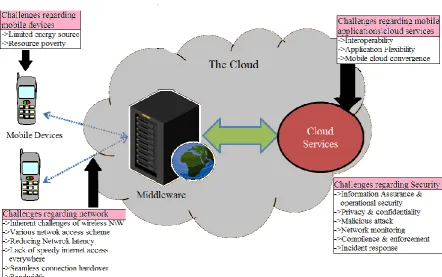
Keeping in mind the end goal to get pervasive and omnipresent environment for distributed computing in portable applications we have to get crosswise over different phases of versatile base, which are in charge of included system dormancy and transmission delay. Proficiency of conveying administrations/applications is should have been expanded keeping in mind the end goal to accomplish objective of access anyplace and with whatever gadget. Utilizing distributed computing idea as a part of versatile world is about supplying portable applications and administrations in the cloud, empowered through cloud administration suppliers and afterward convey it to end-users‟ portable handsets over the Internet when required. So in making remote applications accessible to cell phones by the utilization of distributed computing, principle substances of this course of action are:
Mobile gadget
Network (through which cell phones are getting to cloud)
Mobile Applications
Security
These components have some degree of difficulties or we can say that desires appended to themselves which are examined here.
A. Challenges regarding mobile devices
1) Limited energy source of mobile devices: To change the default, adjust the template as
© 2016, IJCSMC All Rights Reserved 153
smart phones, Wi-Fi represents the less costly path (with 23% less energy consumption) in comparison to GPRS in a web browsing scenario. If we ignore the maintenance of GPRS connection (for example, for non-phone devices like tablets) then the power consumption of GPRS versus Wi-Fi is even starker, with Wi-Fi using just one third of the energy of GPRS.
2) Resource poverty of Mobile Devices: Comparison of desktop pc with any cell phone
demonstrates that on what cost this element of versatility is being accomplished. When contrasted with a settled gadget, cell phones by and large have:
3 times less handling power
8 times less memory
5 times less capacity limit
10 times less system data transfer capacity
So as a rule we can say that this asset lack is one of the real purpose behind the selection of portable distributed computing. Keeping in mind the end goal to beat this restriction of cell phones, assets are added to the cloud foundation and can be utilized at whatever time on necessity, giving a consistent client experience to cutting edge applications. Indeed, even after consistent changes in cell phone performances‟, the difference between the asset imperatives of versatile and altered gadgets will remain and should be represented in the sorts of use chose for portable distributed computing [19].
B. Challenges regarding network
1) Inherent Challenges of Wireless Network: Remote system is base for doing distributed
computing and it has its own particular inborn nature and limitations. These difficulties confuse its outline for cell phones considerably more in contrast with the settled distributed computing. Altered broadband is bolstered by predictable system transmission capacity while remote availability is described by variable information rates, less throughput, longer inactivity and irregular network because of crevices in scope. Endorser portability and wild components like climate are likewise in charge of changing data transfer capacity limit and scope [19].
2) Various Network Access Schemes: For executing distributed computing to cell phones
fundamental necessity is to have an entrance to arrange. In versatile world there are heterogeneous access situation with various access advances like WiMAX, WLAN, 3G, GPRS et cetera, every one with their own particular plans, arrangements, offerings and limitations. Because of the presence of various access plans we require consistent association handover plans (to dodge association disappointment and association restoration) when we move starting with one system access point then onto the next system access point [20].
3) Reducing Network Latency: Component in charge of general postponement reaction of
uses are:
Processing time at the server farm Processing time on the gadget
Network idleness
Data transport time
© 2016, IJCSMC All Rights Reserved 154
4) Lack of Speedy Mobile Internet Access Everywhere:With a specific end goal to get rapid
portable web get to new innovations like HTML5 are being created. They give office of neighborhood storing. Scientists are attempting to show signs of improvement method for getting to portable web other than program. Advancements like OMA's Smartcard Web Server and TokTok are being acquainted just with give a superior access to portable web. OMA's Smartcard Web Server, which is fundamentally a souped-up SIM card that associates specifically with the bearer to give applications to cell telephones. TokTok permits voice empowered access to web administrations like Gmail and Google Calendar. Through these voice-empowered inquiries, versatile applications talk straightforwardly to the administration itself sitting on the edge of the system, staying away from the prerequisite to dispatch a web program and explore through the portable web. Keeping in mind the end goal to determine this availability issue existing with cell phones, the vast majority of the suppliers are putting forth 4G/Long Term Evolution (LTE) administrations. These administrations give points of interest of information stockpiling limit, fitting and play highlights, low inactivity, and they additionally underpins both FDD and TDD utilizing the same stage. As indicated by the necessity, at some point LTE is additionally stacked on pace as it is equipped for giving download top rates of 100 Mbps and transfer of 50 Mbps [21].
5) Seamless Connection Handover: Keeping in mind the end goal to give information
correspondence utilizing cell system versatile administrators are attempting to set up Wi-Fi Aps on road so that offload movement of Wi-Fi frameworks can be lessened, bringing about diminished cell activity blockage. Be that as it may, in this plan fundamental necessity is to give consistent association handover between access systems. Right now executing application is ended or returns mistake when we move starting with one access purpose of system then onto the next access purpose of system or we move from Wi-Fi system to 3G-based cell system because of event of correspondence disappointment and association restoration circumstance. Issue of Communication disappointment is depicted as broken-funnel issue and it can be determined by having correspondence channel with flushing zero window warning. What's more, issue of association restoration is characterized by tie blunder, and can be determined by executing TCP port legacy amid attachment remaking. No extra messages for channel clearing are presented and no alterations are forced on TCP convention stack amid TCP port legacy. Methodology of TCP legacy is free of the inward design of current 3G cell systems as it is absolutely taking into account end-to-end engineering. By forcing Zero window publicizing and TCP port legacy our open system associations can be saved and considerably server attachments likewise [22].
6) Bandwidth: Presently a day getting to online networking locales (e.g., YouTube, Face
© 2016, IJCSMC All Rights Reserved 155
least system inactivity distributed computing confronts challenges because of low transmission capacity of portable system. So an enhanced system transmission capacity is required so information exchange inside the cloud and different gadgets can be moved forward.
C. Challenges related to Mobile Applications
1) Interoperability:Associations that take after Bring-your-Own-Mobile (BYOD) strategy by
and large confronts interoperability challenges [23]. It’s conceivable that there is a various blend of cell phones including iPhone, Android telephones, BlackBerry and others being utilized by workers as a part of an association or a gathering of individuals sharing a system. What's more, in such circumstance as per the way of cloud applications being utilized and working arrangement of cell phone interoperability issue can end up being a noteworthy test in pulling/pushing information over different gadgets [24].BYOD strategy acknowledgment strengths designers to think about an extensive variety of new security and administration includes that must be incorporate with application, giving safe access to organization information [25]. By utilizing connection and area data we can work for upgrading versatile access. Setting mindful administrations misuse information gathered from terminal sensors or system sensors measuring system statues and burden. System administrations and buyer application both utilizations these data.
2) Cloud Application Flexibility: An application will be upheld by certain versatile cloud
framework or not, can without much of a stretch be judged on the premise of its prerequisites against the cloud base attributes along the gadget, system data transfer capacity and idleness vectors.
Diverse applications‟ needs are distinctive for its particular cloud base properties (calculation force, system data transfer capacity, and system inactivity). For instance, an approximately coupled and low-content application like web pursuit will give ideal result on a 3G system with generally low register servers at a „distant‟ server farm. In any case, on the off chance that we discuss an immensely immersive and content-rich application like ongoing face acknowledgment it will require a high-transmission capacity/low-inactivity system like LTE with the goal that substantial picture substance can be exchanged rapidly and flawlessly to the servers running the face acknowledgment calculation and the client confronting gadgets. Sought after applications transmission and dormancy postponement can be minimize by considering „nearby‟ server farms. Furthermore, for an exceptionally immersive application portable cloud framework can go for Wi-Fi offload that diminished dormancy further which is for the most part required by such applications [19].
3) Mobile Cloud Convergence: So as to accomplish point of preference of portability by
© 2016, IJCSMC All Rights Reserved 156
D. Challenges regarding Security
1) Information Security: Since distributed computing essentially manages information
stockpiling and its handling so security is of foremost significance. Presently a day‟s different cloud stages offer hearty inherent efforts to establish safety. SSL and advanced testaments gives a choice to empower outside security [26]. To the extent information security is concerned associations are expected to fuse data confirmation and operational security (IA and OPSEC) approaches and systems. Association wide preparing, training, and mindfulness bundle concentrating on IA and OPSEC issues can likewise be incorporated to guarantee that the arrangements and strategies are taken after totally. Approaches with respect to get to control, verification strategies, record and client administration, encryption, content confirmation, and general interchanges security (COMSEC) ought to be created and consistence measures ought to be taken for implementing them [6]. It is imperative to build up and keep up consumers‟ trust on to the portable stage assurance for giving client protection and information/application mystery from enemy. To the extent cell phones are concerned security remains a key concern. As though a gadget gets stolen or lost, significant information might be traded off. Information abuse from stolen/lost gadgets can be stayed away from by wiping of cell phone remotely. This element is by and large given by the greater part of the portable makers and remote bearers [27]. Cell phones (wireless, PDA, Smartphone and so forth) are helpless against various security dangers like malevolent codes (e.g., infection, worm, and Trojan stallions). Worldwide Positioning System (GPS) of cell phones could likewise raise security issues. Least difficult approach to distinguish security dangers (e.g., infection, worms, and pernicious codes) of any cell phone is by introducing and running security programming projects (like Kaspersky, McAfee, and AVG antivirus programs and so on). In any case, cell phones have restricted preparing force and vitality supply, shielding them from the dangers is more troublesome than that for ingenious gadget (e.g., PC). We can move the danger discovery capacities to mists. This worldview is an augmentation of the current Cloud AV stage that gives an in-cloud administration to malware location. It additionally empowers us to utilize various antivirus motors in parallel by facilitating them in virtualized holders. This methodology upgrades the productivity of recognizing malware furthermore enhances battery lifetime up to 30%. In spite of the fact that putting away a lot of information/applications on a cloud has its own particular
advantages however uprightness, verification and computerized privileges of
information/applications ought to likewise be contemplated [28].
2) Privacy and Confidentiality: There are different strategies and plans, (for example, Fair
© 2016, IJCSMC All Rights Reserved 157
homomorphic cryptography (HC) which guarantees that operations performed on an encoded content results in a scrambled variant of the prepared content [29].
GPS situating gadgets has favored versatile clients for utilizing area based administrations (LBS). Be that as it may, LBS raise a protection issue when versatile clients give private data, for example, their present area and it turns out to be surprisingly more dreadful if a foe knows user‟s some other imperative data. Area trusted server (LTS) gives answer for this issue [30]. Computerized rights administration (DRM) gives another issue of security. Unstructured computerized substance (e.g., video, picture, sound, and digital book) have frequently been pilfered and wrongfully disseminated. To stop the theft and illicit conveyance of these unstructured computerized substance [31] proposed Phosphor, a cloud based versatile advanced rights administration (DRM) plan with a sim card in cellular telephone. It enhances adaptability and decreases the helplessness of its security effortlessly. Be that as it may, this methodology is fundamentally in view of sim card of cellular telephone, so it can't be connected for different sorts of gets to like a portable PC utilizing WiFi to get to these substance [28].
3) Malicious Attacks: All systems are helpless to one or more pernicious assaults. As
additional as outer Web locales are being gotten to malevolent performing artists will have more chances to get to the system and operational information of that association. Executing security controls over all Web 2.0 servers and checking these thorough security controls can lessen the dangers to inward systems and operational information. Furthermore, isolating Web 2.0 servers from other interior servers may encourage alleviate the danger of unapproved access to data through online networking devices and Web locales [6]. A portion of the potential assault vectors lawbreakers may endeavor include:
Denial of Service (DoS) assaults – It has been contended that a cloud is more helpless to a DoS assault; since more than one customer can get to cloud in the meantime, which makes DoS assaults a great deal all the more harming. Twitter has endured a staggering DoS assault in 2009.
Side Channel assaults – In this sort of assault a pernicious virtual machine is put in close closeness of an objective cloud server to bargain the cloud security and afterward a side channel assault is dispatched.
Authentication assaults – Authentication is one of the frail focuses in the event of facilitated and virtual administrations and is by and large been focused on. A client can be validated in number of ways and these components and techniques which are utilized to secure the confirmation procedure are habitually been focused by the assailants.
Man-in-the-center cryptographic assaults – This assault is done when an aggressor places himself between two clients. In this sort of assault aggressor places himself in the correspondence way and after that it is dependent upon him what to do, he can capture and change correspondence [32].
© 2016, IJCSMC All Rights Reserved 158
totalled data. Without sufficient system observing, an association can't guarantee that whether clients are consenting or not its arrangements in regards to the arrival of high-esteem data. Also, programming dialects utilized as a part of Web 2.0 applications (e.g., Java, Ajax, and the JSON information trade arrangement) may make different open doors for malevolent on-screen characters to get to an organization’s back-end system base and do hopeless harm (e.g., get to or degenerate information or applications). Thus, an association utilizing online networking may need to actualize expanded security controls for any different delicate data living on the server’s backend [6].
5) Compliance and Enforcement: For now there is no formal set of standards that should be
followed for events and policies of cloud computing implementation. But still there are numerous regulations concerning storage and usages of data, including Payment Card Industry Data Security Standard (PCI DSS), the Health Insurance Portability and Accountability Act (HIPAA), the Sarbanes-Oxley Act, among others. Regular reporting and audit trails are required for many of these regulations. These regulations are needed to be followed completely and appropriately for corporate data to be moved to the cloud. It may be difficult or unrealistic to use public clouds if our data is subjected to legal restrictions or regulatory compliance. We can expect providers to build and certify cloud infrastructures to address the needs of regulated markets.
Achieving certification may be challenging due to the many non-technical factors, including the current state of general cloud knowledge. There are a large number of security threats; it is not possible to implement preventive measures to all of them. When user executes any application and he is aware of the asperity and nature of potential threats to security associated with its use then he can avoid steps that are more susceptible to security attacks. This makes user education and training crucial in safeguarding networks and data. With the advent of social media, training programs are also need to be augmented to address the additional risks posed by social media. This social media training can be incorporated to the annual security training programs of organizations.
Social media tools and sites can be addressed during existing certification and accreditation procedures, thereby helping to ensure that security standards of organization are upheld. Additionally, on the side of organizations they can develop a mentoring program; take advantage of skills of those employees who have more advanced social media skills in training those for whom this technology is unfamiliar [6]. What type of training does the provider offers to their employees is actually a rather important item, because people will always be the weakest link in security. Knowing how your provider trains their employees is an important item to review.
6) Incident Response: Even after implementing best measures for safeguarding data and
© 2016, IJCSMC All Rights Reserved 159
Figure 1. Challenges regarding Implementation of Cloud Computing in Mobile Applications In case of cloud computing user generally don‟t have the knowledge of location where our cloud services are physically located. But like all physical locations‟ they also faces threats such as fire, storms, natural disasters, and loss of power. So it is also an important aspect to take care about these events. How will the cloud provider is going to respond them, and what guarantee of continued services are they promising? [33]
IV. CONCLUSION
Implementation of cloud computing in mobile applications is going to be a trend in the future since it combines the advantages of both mobile computing and cloud computing, thereby providing optimal services for mobile users. According to Recent researches, by the end of 2013 there will be more than 10 thousand mobile applications that will be executed through cloud computing. That traction will push the revenue of mobile cloud computing to $5.2 billion. Here in this paper we have provided an overview of cloud computing its definitions, constituting elements (that are cloud platform and cloud applications) and finally we have discussed about the challenges of implementing cloud computing in mobile applications and their possible solutions.
REFERENCES
[1] Divya Narain. March 2009. “ABI Research: „Mobile Cloud Computing‟ the Next Big Thing”, http://ipcommunications.tmcnet.com/topics/ip-communications/ articles/59519-abi-research-mobile-cloud-computing-next-big-thing.htm
[2] M. Armbrust, A. Fox, R. Griffith, A. D. Joseph, R. H. Katz, A. Konwinski, G. Lee, D. A. Patterson, A. Rabkin, I. Stoica, and M. Zaharia. 10 February 2009, “Above the Clouds: A Berkeley View of Cloud Computing,” EECS Department University of California, Berkeley. Technical Report
UCB/EECS-2009-28, http://www.eecs.berkeley.edu/Pubs/TechRpts/2009/EECS-2009-28.html.
[3] P. Mell and T. Grance, “The NIST Definition of Cloud Computing,” Version 15, 7 October 2009,
http://csrc.nist.gov/groups/SNS/cloud-computing/cloud-def-v15.doc.
[4] DoD Directive 3020.40, Defense Critical Infrastructure Program, 19 Aug, 2005, p. 13,
© 2016, IJCSMC All Rights Reserved 160
[5] ZTE Communications. March 2011, Vol.9, No.1, „Special Topic:Mobile Cloud Computing and Applications‟ http://ebookbrowse.com/p020110318511856092974-pdf-d100931817
[6] IAnewsletter Vol 13 No 2 Spring 2010. „Cloud Computing: Silver Lining or Storm Ahead‟ http://iac.dtic.mil/iatac 11
[7] Adrian Otto‟s Blog. „What is a Cloud Platform?‟ http://adrianotto.com/2011/02/cloud-platform/
[8] Resources: Internet Marketing Glossary.
http://www.digital-marketing-course.co.nz/resources.php?Glossary-8
[9] Tavis J.Hampton. August 11th, 2011. „A Quick Guide to Cloud Terminology‟, http://www.thehostingnews.com/a-quick-guide-to-cloud-terminology.html
[10] “Amazon elastic compute cloud (EC2).” AWS. [Online]. Available:
http://www.amazon.com/ec2/
[11] Google app engine. [Online]. Available: http://appengine.google.com/ [12] http://www.force.com/why-force.jsp
[13] Microsoft azure. [Online]. Available: http://www.microsoft.com/azure/
[14] E. Marinelli, “Hyrax: cloud computing on mobile devices using MapReduce”, Master thesis, Carnegie Mellon University, 2009.
[15] Fung Po Tso, Lin Cui, Lizhuo Zhang, and Weijia Jia. March 18th, 2011. “Building a Platform to
Bridge Low End Mobile Phones and Cloud Computing Services”
http://wwwen.zte.com.cn/endata/magazine/ztecommunications/2011Year/no1/articles/201103/t20110 318_224547.html
[16] Cloud Computing. October 11th 2008, http://www.reference.com/browse/cloud+computing?s=t [17] API Dashboard at programmable web. http://www.programmableweb.com/apis#topa-1
[18] Jitendra Maan, „Extending the Principles of Cloud Computing in Mobile Domain‟ D.C. Wyld et al. (Eds.): NeCoM/WeST/WiMoN 2011, CCIS 197, pp. 197–203, 2011.© Springer-Verlag Berlin Heidelberg 2011
[19] Kyung Mun, Corporate Technology Strategist, „Mobile Cloud Computing Challenges‟,
http://www2.alcatel-lucent.com/blogs/techzine/2010/mobile-cloud-computing-challenges/
[20] 10th IEEE/ACIS International conference on computer and information science http://wenku.baidu.com/view/caf74ab9c77da26925c5b033.html
[21] Irmee Layo. July 11th ,2011, „Overcoming Challenges in Mobile Cloud Computing‟,
http://cloudtimes.org/2011/07/11/overcoming-challenges-in-mobile-cloud-computing/
[22] Min Choi · Jonghyuk Park · Young-Sik Jeong © Springer Science+Business Media, LLC 2011, „Mobile cloud computing framework for a pervasive and ubiquitous environment‟
[23] Colin Steele. October 2011, “BYOD policy”,
http://searchconsumerization.techtarget.com/definition/BYOD-policy
[24] Roger Collings. April 16th , 2011. “Mobile Cloud Adoption Challenges in the Enterprise”;
http://cloudcomputingtopics.com/2012/04/mobile-cloud-adoption-challenges-in-the-enterprise/ [25] http://www.eweek.com/c/a/Mobile-and-Wireless/BYOD-Policies-Creating-Mobile-Application-Development-Challenges-314028/
[26] Le Guan, Xu Ke, Meina Song, Junde Song. 2011. 10th IEEE/ACIS International Conference on
Computer and Information Science. “A Survey of Research on mobile cloud computing”.
[27] Roger Collings, „Mobile Cloud Adoption Challenges in the Enterprise‟;
© 2016, IJCSMC All Rights Reserved 161
[28] “A Survey of Mobile Cloud Computing: Architecture, Applications, and Approaches”.
Hoang T. Dinh, Chonho Lee, Dusit Niyato, and Ping Wang.
http://onlinelibrary.wiley.com/doi/10.1002/wcm.1203/abstract
[29] Peter Schoo, et.al. „Challenges for Cloud Networking Security‟,
http://www.hpl.hp.com/techreports/2010/HPL-2010-137.pdf
[30] H. Zhangwei and X. Mingjun, “A Distributed Spatial Cloaking Protocol for Location Privacy,” in Proceedings of the 2nd International Conference on Networks Security Wireless Communications and Trusted Computing (NSWCTC), vol. 2, pp. 468, June 2010.
[31] P. Zou, C. Wang, Z. Liu, and D. Bao, “Phosphor: A Cloud Based DRM Scheme with Sim Card,” in Proceedings of the 12th International Asia-Pacific on Web Conference (APWEB), pp. 459, June 2010.
[32] Michael Gregg, „Security Concerns for Cloud Computing‟,
http://viewer.media.bitpipe.com/1078177630_947/1268847180_5/WP_VI_10SecurityConcer nsCloudComputing.pdf