Available Online atwww.ijcsmc.com
International Journal of Computer Science and Mobile Computing
A Monthly Journal of Computer Science and Information Technology
ISSN 2320–088X
IMPACT FACTOR: 5.258
IJCSMC, Vol. 5, Issue. 6, June 2016, pg.129 – 137
Towards a Development of Augmented
Reality for Jewellery App
Er. Revati Mukesh Raspayle
1, Prof. Kavita Kelkar
2¹Student (M.Tech) CSE, Mumbai University, Computer Engineering, K.J SOMAIYA COE Vidyavihar,
Mumbai 400077, India
²Assistant Professor, Mumbai University, Computer Engineering, K.J SOMAIYA COE Vidyavihar,
Mumbai 400077, India 1
[email protected]; [email protected]
ABSTRACT-- This paper gives idea which automatically detect the human face and tries to stick the chosen accessories (either jewellery or eye-glasses) on them using a webcam as an input and displays it to the screen on Augmented Reality [AR].When a person enters the of view of the camera, the camera will start detecting face of the person, and the algorithm of the system will start tracking the face of the person in order to recognize various face feature of that person. Thereafter, whenever the person selects an item from the shopping list, the item will be directly placed on that particular face (body) part. Appling this technique, a lot time is saved to choose the accessories in a virtual display. To achieve this we use HAAR algorithm which takes the responsibility to detect the face detection there by merging the accessory. Here the jewellery are merged using the joints and position of the coordinates. Thus by doing so, the accessories are automatically positioned to the detected human face using an parallel transformation.
KEYWORDS-- Augmented Reality, 3D scanning, Earring models, simulations, Face pose and Scale.
I. INTRODUCTION
Shopping is a time-consuming activity for some people, while for others a much enjoyed one. Many approaches have been tried in the not so distant past to make it possible to simultaneously answer two fundamental shopper concerns: “does it suit” and “does it fit”, therefore reducing much of the guesswork involved in shopping. Augmented reality refers to a wide spectrum of technologies that project computer generated materials, such as text, images, and video, onto users‟ perceptions of the real world. Initially, researchers defined AR in terms of specific facilitating devices, such as head mounted displays (HMDs). Augmented trial room is a digital interactive platform that helps the Shoppers try out glasses and jewelleries quickly. The augmented reality program takes the image of the customer and chooses the desired accessory in front of personal computer which allows the customer to see how they look in it.
that relevant face part and hence the user can changes(try out) various brands and decide whether that particular item suits him/her or not by them experience like manual shopping. The system mainly consists of a single camera and a display showing the output of the virtual mirror.
Implementation of AR by three characteristics:
(a) The combination of real world and virtual elements, (b) Which are interactive in real-time, and
(c) Are registered in the display of virtual objects or information is intrinsically tied to real-world loci and orientation
PROBLEM STATEMENT
This proposed system aims to provide an environment that will help the users to place spurious 2D as well as 3D objects into real world through the use of AR Markers. The proposed system also allows the user to decide, where to place the object in real world. Once the object has been placed in the scene, it will be displayed accurately according to the aspects in the original scene, which is especially challenging in the case of 3D virtual objects. The proposed system solves the problem of viewpoint tracking and virtual object communication.
II. HUMAN FACE DETACTION USING THE HAAR ALGORITHM
HAAR ALGORITHM
The uniqueness of a person by their facial images can be done in a number of different ways such as by capturing an image of the face in the visible spectrum using an inexpensive camera or by using the cardinal patterns of facial heat emission. Facial Recognition in visible light typically model key features from the central portion of the facial image using a wide combination of cameras in visible light system extract features from the pickup images that do not change over time while avoiding slight features such as facial expression or hair.
faces = face_cascade.detectMultiScale(gray, 1.3, 5)
for (x,y,w,h) in faces:
cv2.rectangle(img,(x,y),(x+w,y+h),(255,0,0),2) roi_gray = gray[y:y+h, x:x+w]
roi_color = img[y:y+h, x:x+w]
eyes = eye_cascade.detectMultiScale(roi_gray)
for (ex,ey,ew,eh) in eyes
cv2.rectangle(roi_color,(ex,ey),(ex+ew,ey+eh),(0,255,0),2) cv2.imshow('img',img)
cv2.waitKey(0)
cv2.destroyAllWindows()
SYSTEM DESIGN AND METHODOLOGY
Face Detection
Face detection is a computer technology that determines the locations and sizes of human faces in arbitrary (digital) images. It detects facial features and ignores anything else, such as buildings, trees and bodies. Face detection can be regarded as a more general case of face localization. In face localization, the task is to find the locations and sizes of a known number of faces.
Figure1. Integral image generation. The shaded region represents the sum of the pixels up to position (x, y) of the image. It shows a 3×3 image and its integral image representation.
A face candidate is a rectangular section of the original image called a sub-window. Generally these sub-windows have a fixed size (typically 24×24 pixels). This sub-window is often scaled in order to obtain a variety of different size faces. The algorithm scans the complete image with this window and denotes each respective section a face candidate. The algorithm uses an integral image in order to process. Each feature is classified by a Haar feature classifier. The Haar feature classifiers generate an output which can then be provided to the stage comparator. The stage comparator sums the outputs of the Haar feature classifiers and compares this value with a stage threshold to determine if the stage should be passed. If all stages are passed the face candidate is concluded to be a face.
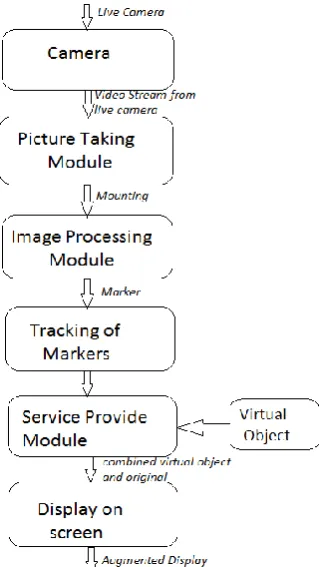
Figure 3: Flowchart of system
1 Camera: A real-world live video is feed as information (input) from the Android phone camera to the Camera device. Displaying this live feed from the Android phone camera is the reality in augmented reality. It takes an input to the Image Capturing Module.
2 Picture taking Module: The information send to Image Capturing Module is the live video feed from the camera of a mobile device. This module analyses the camera feed, by analysing each frame in the video. It generates binary images. Typically the two colours used for a binary image are black and white. These binary images are provided input as information to Image Processing Module.
3 Image Processing Module: These binary images are processed using an image processing technique to detect the AR Marker. Detection of AR Marker is essential to determine the position, where to place the virtual object. Once the AR Marker is detected, its location is provided as an input to the Tracking Module.
4 Tracking of Markers: It calculates the relative posture of the camera in real time. The term posture means the six degrees of freedom (DOF) position, i.e. the 3D location and 3D orientation of an object.
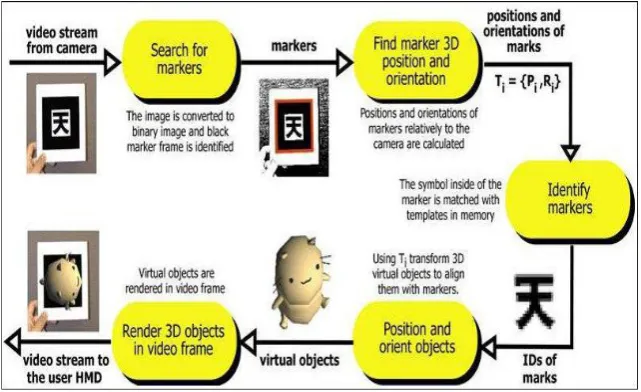
Figure 4: Flow of AR marker to camera
CONVERSION OF 2D to 3D
/* grab a video frame */
if( (dataPtr = (ARUint8 *)arVideoGetImage()) == NULL ) { arUtilSleep(2);
return; }
if( count == 0 ) arUtilTimerReset(); count++;
argDrawMode2D();
argDispImage( dataPtr, 0,0 );
/* detect the markers in the video frame */
if( arDetectMarker(dataPtr, thresh, &marker_info, &marker_num) < 0 ) { cleanup();
exit(0); }
arVideoCapNext();
Why Unity3D:
Unity3D
is a
powerful cross-platform 3D engine and a user friendly development environment. Easy enough for the beginner and powerful enough for the expert; Unity should interest anybody who wants to easily create 3D games and applications for mobile, desktop, the web, and consoles. In our project unity works as platform for face detection. The building of face detection is done in c# language.
Unity 3D is a game engine with a built-in IDE. We chose to use a game engine as the main core of the implementation since they typically handle all of the rendering, the scene-graph, transformations and other important aspects that would have been time consuming to implement ourselves. Other useful features include the ability to code in C# thus making it easily extendable, and the ease of deploying the final product to numerous platforms such as Android and iOS.
Unity is a feature rich multiplatform game engine for the creation of interactive 3D content. It includes an intuitive interface while at the same time allowing low level access for developers. Thousands of assets provided by other content creators can be reused to quickly develop immersive experiences. Because of its intuitive interface, well designed architecture, and ability to easily reuse assets, 3D software can be developed in a fraction of time compared to traditional development. Because of Unity’s widespread use and ease of use, several virtual reality companies now fully support Unity.
Design
Androidstudio
In this section other older tools developed by us, which support the first two phases, are briefly introduced because they will offer insights on future integration. Our framework for multimodal interactions is an Android architecture. Android is an open source and Linux-based operating system for mobile devices such as smart phones and tablet computers. Android programming is based on Java programming language so if you have basic understanding on Java programming then it will be a fun to learn Android application development. The support for the Interaction Designer is improving with projects like The Designers Augmented Reality Toolkit, which offers a collection of extensions to the Macromedia Director multimedia-programming environment, but still there is much work to be done.
Implementation
The actual implementation of Augmented Reality user interfaces is made easier by a few frameworks such as Unity Editor, and Android Studio. Implementation usually takes place in an Integrated Development Environment (IDE).
ZBrush
ZBrush is a digital sculpting tool that combines 3D/2.5D modelling, texturing and painting. It uses a proprietary "pixol" technology which stores lighting, color, material, and depth information for all objects on the screen. The main difference between ZBrush and more traditional modelling packages is that it is more akin to sculpting.
be fed back to earlier phases. Unfortunately this class of tools is also in very short supply for Augmented Reality applications.
USER PERCEPTION
A. Benefits to retailers include:
• Changing rates and increase sales rates by enabling shoppers to easily try on different new accessories online.
• Increase store visits by providing fun and differentiated shopping experience.
B. Advantages:
• Getting fashion advice and recommendations. • Quick preview of new accessories.
• Shopping is made easy and social by shoppers capturing photos of themselves in different virtual environment with accessories and sharing with friends and family via photo sharing through social networks
C. The Innovation:
• Automatic accessories alignment and scaling.
•Automatic face detection and body shape identification. • Fast and easy virtual accessories.
APPLICATION
TryLive for Eyewear is the only fully cross-platform solution available. The mobile application works on smart phones and tablets running iOS and Android. TryLive also offers decision maker and measurement tool for a confident purchase: Comparison of 2 or 4 glasses simultaneously, like in a multiple virtual mirror, which is impossible in the real life.
Figure 6. Snapshot of TryLive
Fitnect implements an interactive AR virtual fitting room which uses the Kinect sensor as a 3D full-body capture device. A Natural Interaction user interface employs floating buttons to allow customers to browse the catalog and virtually try on garments of their choice In addition, uses 3D models of clothes and cloth physics for a more convincing experience.
even motion capture and gesture controls.
Boutique Accessories is proud to be the first online store in Australia to launch a virtual mirror application. This is an augmented reality application to enable Customers to “try on” fashion accessories while browsing the website. Unlike previous technologies, the virtual mirror does not need customers to print out markers to hold in front of the webcam in order to activate the application. The virtual mirror automatically detects the user through the web cam image and, using key points on the face and neck, the jewellery onto the user in the correct position.
Figure7. Boutique Accessories.com
IV. CONCLUSION
In many previous works the human has to adjust himself such that he fits into the given image displayed in the screen. This makes uncomfortable for the user, the size of the human may exceed the given image on the screen and the other checkbox method are also difficult in practical in which the user has to carry the checkbox to fix the points. Thus our proposed system is more reliable than the previous existing systems. In this the human face is detected automatically so that the user may not fit in the given image. face is detected automatically and then the gives earring is merged accordingly to the corresponding coordinates but the depth sensing is impossible in this.
Figure8. Earring in boutique accessories
jewelleries without touching the in the display screen. This VFR application can enhance the way customers shop online and help them to choose the correct item.
ACKNOWLEDGEMENT
Work in this project (Augmented Reality) has been partially under the guidance of Mr. Amit Modak who is the founder of “Achievers Technology” Company. I am very thankful to become a part of that company.
In particular, I am grateful to my project guide Prof. Kavita Kelkar who guide and co-operate me properly. Also thankful to people who suggest me and try to improve my project better.
I would also like to acknowledge the motivation and inspiration that our expert, Prof Bhakti Palker provided me and I am thankful to her for the same. I am also thankful to my family members for their patience and constant encouragement.
R
EFERENCES[1] SiliconIndia, “LensKart.com Launches A Virtual Mirror For Eye Gear”
[2] Virtual Try On Solutions for Glasses, “TURNKEY SOLUTIONS FOR THE EYEWEAR AND EYECARE INDUSTRIES"http://www.trylive.com/solutions/trylive-eyewear-virtualmirror/ overview.
[3] M. Sidhu and L. Kang, “Interactive augmented reality environments for engineering with open systems,” in
Proc. ICOS, 2011, pp. 1–5.
[4] D. Kalkofen, E. Mendez, and D. Schmalstieg, “C omprehensible visualization for augmented reality,” IEEE
Trans. Visualiz.Comput.Graph.,vol. 15, no. 2, pp. 193–204, Mar.–Apr. 2009.
[5] httpsgoogle.com/p/andar/wiki/HowToBuildApplicationsBasedOnAndAR://code. [6] Fitting Reality. [Online]. Available: http://fittingreality.com
[7] http://mobile.tutsplus.com/tutorials/augmented-reality
[8] J. Wright, A.Y. Yang, A. Ganesh, S.S. Sastry, and Y. Ma, “Robust face recognition via sparse representation,” IEEE Transactions on Pattern Analysis and Machine Intelligence, vol. 31, no. 2, pp. 210–227, 2008.
[9] http://mashable.com/follow/topics/augmented-reality/
[10] M.S. Bartlett, J.R. Movellan, and T.J. Sejnowski, “Face recognition by independent component analysis,” IEEE Transactions on Neural Networks, vol. 13, no. 6, pp. 1450–1466, 2002.
[11] Foster, Ian and Kesselman, Carl and Tuecke, Steven, “The Anatomy of the Grid: Enabling Scalable Virtual Organizations,” International Journal of High Performance Computing Applications, vol. 15, no. 3, pp. 200– 222, August 2001.
[12]D.Adams, "Augmented Reality Virtual Mirror: Try BeforeYouBuyOnline", http://www.bitrebels.com/technology/augmented-realityvirtual- mirror-try-before-you-buy-online.
[13] M. Andriluka, S. Roth, and B. Schiele, “Monocular 3D Pose Estimation and Tracking by Detection,” in 2010 IEEE Conference on Computer Vision and Pattern Recognition (CVPR). San Francisco, California. pp. 623-630, 2010.