Full Terms & Conditions of access and use can be found at
https://www.tandfonline.com/action/journalInformation?journalCode=rasr20
African Security Review
ISSN: 1024-6029 (Print) 2154-0128 (Online) Journal homepage: https://www.tandfonline.com/loi/rasr20
Hydropolitics of the Nile: The case of Ethiopia and
Egypt
Joel Okundi Obengo
To cite this article: Joel Okundi Obengo (2016) Hydropolitics of the Nile: The case of Ethiopia and Egypt, African Security Review, 25:1, 95-103, DOI: 10.1080/10246029.2015.1126527
To link to this article: https://doi.org/10.1080/10246029.2015.1126527
Published online: 21 Jan 2016.
Submit your article to this journal
Article views: 1101
View Crossmark data
COMMENTARY
Hydropolitics of the Nile: The case of Ethiopia and Egypt
Joel Okundi Obengo
ABSTRACT
This article analyses the political relationship between Ethiopia and Egypt. It aims to provide an analytical framework to unpack this complex relationship and assess the impacts that the Nile River has on the nature of this relationship. It further identifies geopolitical factors determining the impacts of the Nile River on frameworks of actions and political opportunity structures in which political actors operate. Accordingly, the different combinations of these determinants lead to the formation of political actors and ensuing actions that can fuel conflict, sustain the status quo or build peace. The article seeks to provide tentative answers to the following questions: what can be done or what mechanisms might be used to reduce the risk of conflict? What parties should participate and what will be their roles? And how can modern technology and science contribute to a possible solution?
KEYWORDS
Hydropolitics; Nile River; relationships; Nile basin; Egypt; Ethiopia
Introduction
It is widely recognised in the literature that natural resources play a key role in fostering devel-opment in peaceful societies; yet the political significance of resources may be far more pro-minent in contexts of instability. The transnational nature of politicised resources yields a higher degree of public action across different countries. Different understandings of the rights to natural resources, and responses and counter-responses, may lead to conflict, sustain the status quo or promote peace. However, rarely are the implications of context on infrastructural development openly acknowledged and taken into account. Yet any study of the role of natural resources in conflict-ridden areas in sub-Saharan Africa should account for the role and implications of context. Hence, a first variable in our analysis of the Nile River’s role in heightening tension between upper riparian states and downstream countries is the context within which the analysis operates. Several core contextual questions need to be raised and brought to the fore at the outset. Within this context, this article explores how the Nile River affects the political relationship between Egypt and Ethiopia and the wider Nile River basin.
There is not enough water on this planet for its global population.1Unquestionably it is one of the most important resources upon which humans depend for surviving and thriving, yet it is a resource under increasing pressure because of the growth of the human population, as projected by the World Population Data Sheet July 2012, and the changing patterns of use by that population.2All 264 of the world’s largest river basins–home to about 40% of the world’s population–are shared by more than one nation.3This reality requires that mechan-isms be devised to assure that these waters are managed cooperatively, if water is not to
© 2016 Taylor & Francis
CONTACT Joel Okundi Obengo [email protected]
VOL. 25, NO. 1, 95–103
become a major problem for each nation’s security.4To do so requires the creation of a legal structure to govern cooperation between states. Without such a structure, competition over water could eventually lead to violent conflict.
Under the existing Nile Basin Initiative (NBI) framework, Egypt has a geographic, political and military advantage in accessing and managing Nile River resources and is therefore keen to keep the nineteenth-century agreement. The NBI’s intergovernmental partnership lacks effective mechanisms for enforcing such an agreement and resolving disputes. Various analysts portend that a lack of cooperation will pose grave challenges for Egypt and Ethiopia in the future, in particular for Egypt, where declining fresh water resources will lead to further political instability and human suffering.
The current security challenge involving jihadists in Egypt–particularly in the Sinai Penin-sula, since Islamist president Mohamed Morsi was ousted by then army chief Fattah Al Sissi in July 2013 – makes the resolution of these issues more unlikely in the immediate term; however, there is an opportunity for long-term solutions.5
This paper is designed to provide some tentative answers to the following questions:
. What can be done to de-escalate the bilateral tensions between Egypt and Ethiopia? . What legal framework should govern Nile River resources?
. What role can international organisations like the African Union (AU) and United Nations (UN) play in resolving this issue, given that both Egypt and Ethiopia are members of these two organisations?
In order to frame the solutions, the following assumptions have been taken into consideration in order to address several uncertain variables: that the new Egyptian government has settled down and the sporadic bouts of unrest have subsided; that there will be no ideological shifts in either of the countries; that both countries will recognise and appreciate the international character of the river; and that both countries will appreciate the importance of peace and stability and be willing to collaborate on Nile River issues.
The purpose of this paper is to facilitate debate, identify key issues, and explore potential solutions to challenges relating to the diplomatic relationship between Ethiopia and Egypt with regard to water security.
The Nile River basin
Water resources are an important trans-boundary issue in the region.6With climate change and an increasing population, the management of water resources has become a high-priority issue.7As such, cooperative and equitable development and management of shared water resources, particularly between upstream and downstream countries, is required. Even within individual countries, a lack of information and the mismanagement of available water resources can cause intra-state conflicts and localised wars.
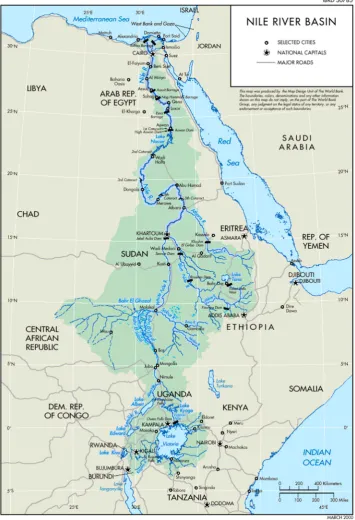
The Nile River presents one of the greatest challenges to international peace and stability in the Nile basin, which includes the countries of Burundi, the Democratic Republic of Congo (DRC), Egypt, Ethiopia, Kenya, Rwanda, Sudan, South Sudan, Tanzania and Uganda (as shown in Figure 1). Eritrea participates as an observer.8 The Nile River is considered to be the longest river in the world; it is the only significant source of water in North Africa and 40% of Africa’s population live in the Nile River basin. The Nile has two major tributaries: the White Nile and the Blue Nile. The White Nile is the longer of the two, rising in the Great
Lakes Region of central Africa. Its most distant source is unknown, located in either Burundi or Rwanda. From there, itflows through Tanzania, Lake Victoria, Uganda, and South Sudan. The Figure 1The Nile River basin
Blue Nile originates from Ethiopia’s Lake Tana,flowing into Sudan from the southeast. In total, Ethiopian headwaters provide 86% of the Nile River waters. The two major tributaries meet near the Sudanese capital of Khartoum andflow north through Egypt and into the Mediterra-nean Sea. Although Egypt consumes 99% of the Nile’s water supply, little water originates within Egypt’s sovereign borders. Egypt heavily depends on the Nile water for irrigation and energy generation. Consequently it has become aware of Ethiopia’s dependence and has recognised the role that water scarcity plays in national instability. Ethiopia is building the Grand Ethiopian Renaissance Dam and is developing its agriculture infrastructure, significantly affecting water quantity and quality.
Historical background
The Nile has always played a major role in the geopolitics of North and East Africa.
Ethiopia and Egypt have had strong cultural, religious or commercial bonds since time immemorial. However, central to this relationship is the Nile River, which intimately links the two countries. The politics of the Nile River basin, however, are full of tension, mistrust, anxiety, mystery and diplomatic confrontation between the upstream and downstream ripar-ian countries. For decades, the region has been locked in proxy conflicts, with the waters of the Nile being a major factor shaping alliances and hostilities.
The complexity of the problem of equitably sharing and utilising the water of the Nile River is underscored by the nature of colonial-era treaties and century-old mistrust between Egypt, Sudan and Ethiopia, who have fought over the Blue Nile basin through shifting alliances and against the backdrop of global politics and local resource realities.9Yacob Arsano has divided the agreements relating to the utilisation of the Nile into three categories, taking the historical sequence into account. These are:
. Agreements between colonial powers: the Anglo–Italian protocol of 1891, the 1906 agreement, the 1925 Anglo–Italian agreement, and the 1934 agreement between Britain and Belgium. . Agreements between colonial powers and regional states: the 1902 Anglo–Ethiopian
agree-ment, the 1929 agreement between Britain and Italy, and the 1952 agreement.
. Agreements between independent states of the basin: the 1959 agreement signed by Egypt and Sudan, the 1993 Ethio–Egyptian agreement, and the Comprehensive Framework Agreement signed among the seven basin countries in 2010.10
The bilateral agreements in thefirst and second categories were primarily initiated by the then colonial powers of the basin. Under British colonial supervision, the 1929 Nile Waters Agreement allocated 48 billion m3 to Cairo. The revised Nile Treaty of 1959 increased Egypt’s share to 55 billion m3, clearing the ground for the construction of the Aswan High Dam, the largest manmade water reservoir on Earth.11While Aswan ended Egypt’s overdepen-dence on the erratic Nileflooding, it infuriated upstream riparian countries, not least Ethiopia. This 1959 agreement created permanent tensions between Egypt and Ethiopia.
The NBI provides riparian countries with the only all-inclusive regional platform for multi-stakeholder dialogue, information sharing and joint planning and management of water and related resources in the Nile basin. The NBI was launched on 22 February 1999 by ministers in charge of water affairs in the Nile basin countries, serving as a transitional institution until the Cooperative Framework Agreement negotiations were finalised and a permanent insti-tution was created. The highest decision-making and policymaking body of the NBI is the
Nile Council of Ministers (Nile-COM).12 Its roles and responsibilities include: providing policy guidance and ensuring adherence to the NBI transitional arrangements; approving pro-grammes and projects; and approving work plans and budgets. The NBI also has the Nile Tech-nical Advisory Committee (Nile-TAC), which is comprised of 20 senior government officials, two from each of the member states, who oversee the work of the NBI. Its roles and responsibilities include: offering technical support and advice to the Nile-COM on matters related to the man-agement and development of the common Nile basin water and related resources; acting as an interface between the Nile-COM and development partners, and between the Nile-COM and NBI programmes and projects; and providing oversight for NBI programmatic activities.
The governments of Sudan and Egypt forged a close working relationship that culminated in the Egyptian endorsement of the construction of the Merowe dam in Nubia, which was opened in 2009. With this endorsement, Egypt did not foresee that the Sudan dam pro-gramme would embolden other riparian countries, particularly Ethiopia. In May 2010, five upstream countries (Ethiopia, Kenya, Uganda, Rwanda and Tanzania) signed the Cooperative Framework Agreement, with Burundi joining the group in 2011. These countries insisted on the equitable utilisation of water rather than those based on historical rights. In 2011, Ethiopia announced that it will press ahead withfive mega dams on the Blue Nile, starting with the Grand Ethiopian Renaissance Dam.
Since the 2011 Arab Spring that swept through many Arab countries in the north, the primary focus of the Egyptian government has been to strengthen security, destabilise terrorist cells and improve the livelihoods of ordinary citizens who actively participated in these civil unrests. Water security, which is becoming an increasingly important threat, is surprisingly being overlooked.
Before 2012, the NBI countries were committed to a long-term strategic plan to preserve Nile water supplies; since then, Ethiopia has largely pursued an independent water manage-ment policy, sometimes roping in other countries while excluding Sudan and Egypt.
Current context
The allocation of Nile water and the building of hydro-infrastructure are central to the region’s long-term economic, ecological and demographic development. If the population growth con-tinues at the current rate, in 40 years Africa (by far the world’s poorest region) will record the largest population growth in the world. At the same time, there is significant pressure on arable land as a result of climate change.
The increase in China’s involvement in the Horn of Africa is further complicating the situation in the Nile River basin.13 China is over-dependent on imported crude oil and is increasingly looking for the resource in this region, based on recent oil exploration and discoveries.14 China is also massively involved in the construction of hydroelectric dams in Africa, providing money, materials and expertise. Sino Hydro, the largest dam builder in the world, has played a significant role in the building of these dams; it is a state-owned enterprise that is run by Chinese party loyalists who are encouraging the construction of major dams in Ethiopia. As such, China has participated significantly in infrastructure in Ethiopia. China uses hydro-diplomacy to eclipse the diplomatic leverage of Western countries in the Horn of Africa.15
member of the Arab League, which directly affects how it responds to trans-boundary water management negotiations, even though it has played a limited role in past water diplomacy efforts in the Nile basin. South Sudan is almost a single-commodity economy. Oil revenues support 98% of the country’s national annual budget. The building of hydro infrastructure in South Sudan could help generate valuable megawatts of power and direct water for irriga-tion in riparian zones, yet it is very expensive and risks triggering tensions with Egypt.
The parties
The international community can play an important role in the negotiations, advocating for collaborative efforts for effective and sustainable water management by all parties.16 Repre-sentatives from the international community should include the United States (US), the UN, and the AU. The UN as an international mediator is particularly effective as it possesses resources and legitimacy.17
Although US influence in Africa has declined in past years, the US continues to have a vital interest in the stability of the region. Since 1993, the US has invested significant resources into Egypt with the aim of promoting regional stability. Past US efforts to support water security in the region have been prominent for a number of reasons, including the deteriorating security environment in the Middle East. The US may support renewed water security efforts by provid-ingfinancial assistance, as well as scientific and technological support. US assistance can serve as an effective means to increase understanding of water security issues, promote regional col-laboration and identify innovative solutions to challenges.
The UN’s position on water security is derived from the international norms outlined in the Helsinki rules on the uses of the waters of international watercourses, also known as the Water-courses Convention, which established guiding principles on the protection, preservation and management of water resources.18Article 33 of the Watercourses Convention provides a fra-mework for dispute resolution between states on water management issues, including nego-tiation, mediation and third-party conciliation mechanisms, and the creation of a joint watercourse institution. Egypt is a party to the Watercourse Convention, while Ethiopia has refused to sign it in part because of the provision that is designed to prevent significant harm to downstream parties. The global legitimacy of the UN as an institution means that it has the greatest leverage in solving the bilateral dispute between Egypt and Ethiopia.19The UN is the place tofind measures that are applicable globally while taking the local context into consideration.
The UN can attempt to integrate the principles contained in the Watercourses Convention into the negotiation process by recognising the territorial integrity of the state parties and allowing equitable utilisation by upper riparians of the river basin while preventing any signifi -cant harm to downstream riparians. The UN needs to support the diplomatic resolution of the parties’conflicting policies and provide innovative solutions focused on sustainability, security, the elimination of irrigation waste, and conformity with international principles. The UN can work with the authorities of both countries as well as with all groups within these two countries.
The US and other permanent members of the UN Security Council have a good working relationship with the two countries, given the extensive business interests with them– particu-larly between China and Ethiopia, and the military partnership between the US and Egypt. Clearly, the political will exists at the international level.20
The AU has played a limited role in past water diplomacy efforts between Egypt and Ethio-pia. The AU Commission has been involved in federating river and lake basin authorities under the aegis of the African Network of Basin Organisations (ANBO). It has developed policy and institutional framework guidelines with regard to cooperation for the sustainable manage-ment of trans-boundary water basins. The Guidelines for the Establishmanage-ment of the Cooperative Framework Agreement for the Integrated Management of Trans-boundary Basins have been developed and disseminated to member states of the AU. Future involvement of the AU in water diplomacy efforts in the region may centre on promoting regional cooperation and pro-viding a forum for discussion. The AU can help facilitate exchange and cooperation among scientific and technological experts, and provide a forum for transparent discussions between the parties. The AU may also help analyse state policies to identify common interests among the parties, which may serve as a starting point for negotiations.
Potential solutions
The role of peace can only be understood in the context of development.21 The following mechanisms are effective in facilitating dialogue and can be utilised by Ethiopia and Egypt to forge working relationships and also to deepen cooperation.
The Nile basin cooperative framework
Endorsed by all of the members of the Nile-COM in February 1995, the immediate objectives of this project were to develop a regional cooperative framework acceptable to all basin countries and to promote the establishment of a framework that will facilitate basin-wide cooperation in integrated water resources planning and management.22The long-term objec-tives are to determine equitable entitlements for each riparian country for the use of Nile waters and to enhance and promote the utilisation of Nile waters for the maximum socio-economic benefit of the inhabitants of the basin; as such, data and information exchange is an important procedural principle for the implementation of equitable and reasonable utilis-ation.23 The Cooperative Framework project essentially facilitates a dialogue/negotiation process between the Nile riparians in accordance with an agreed timetable. In the autumn of 1996, each minister nominated a three-person dialogue team to form the Panel of Experts (PoE) to be involved in the core of the dialogue process.24The PoE developed a Stra-tegic Work Plan and formulated the project document in 1997.
The shared vision programme
Since Nile basin riparian states have divergent interests or stakes and have different expec-tations of Nile basin cooperation, this programme articulates a shared vision and comprises a limited range of effective activities to create a coordination mechanism.25 It is composed of a number of different main activities, including stakeholder involvement and awareness, economic and sectorial analysis, win–win planning and scenario development, applied train-ing, an institutional and legal cooperative framework and capacity-building and human resources development.
should also develop water protocols for the implementation of this policy. This policy should respond to issues that arise as a result of sharing the Nile River between countries with differ-ent social and economic conditions. It should also respond to the differdiffer-ent and uncoordinated approach to water resources management between the two countries.
Conclusion
In February 2015, Egypt, Sudan and Ethiopia reached a preliminary agreement on the Grand Ethiopian Renaissance Dam. This agreement is an important step towards strengthening the bilateral relationship between Egypt and Ethiopia.
Commitment to expanding a mutual understanding in order to enhance the cooperation of Nile basin countries should be a priority for both Egypt and Ethiopia. Their role in the family of Nile basin nations should be active and positive.
Acknowledgements
The author is grateful for the material and moral support of Doreen Matibe, wise counsel of Awuor Ponge of Africa Policy Centre, the encouragement and initial review by fellow students of the University of Geneva/Leiden University Specialization course of Challenges in Global Affairs, preliminary manuscript review of Professor Gabriella Lynch of Warwick University, Dr Harry Verhoven of Georgetown University School of Foreign Service in Qatar, Romi Sigsworth of Institute of Security Studies for the editorial review and Prof Jakkie Cilliers of Institute of Security Studies for his encouragement.
Notes
1. JA Allan,The Middle East water question: hydropolitics and global economy, London: IB Tauris, 2001. 2. Population Reference Bureau, 2013 world population data sheet, www.prb.org/publications/
datasheets/2013/2013-world-population-data-sheet/data-sheet.aspx, (accessed February 2015). 3. Population Reference Bureau, 2012 world population data sheet,
www.prb.org/pdf12/2012-population-data-sheet_eng.pdf, (accessed February 2015).
4. Negotiation simulation water security in the Euphrates-Tigris Basin: exploring options for cooperation briefing packet prepared by Public International Law & Policy Group March 2014. 5. A Nader, Al-Sisi in Ethiopia after years of GERD conflict,Daily News Egypt, 20 March 2015,www.
dailynewsegypt.com/2015/03/22/al-sisi-in-ethiopia-after-years-of-gerd-conflict
6. A Metawie, History of co-operation in the Nile basin,International Journal of Water Resources Devel-opment, 20, 2004.
7. Ibid.
8. H Verhoven,Black gold for blue gold? Sudan’s oil, Ethiopia’s water and regional integration, London: Chatham House, 2011.
9. Ibid.
10. Nile Basin Initiative, Nile Basin Initiative,www.nilebasin.org/index.php/about-us/nile-basin-initiative, (accessed February 2015).
11. United Arab Republic and Sudan agreement (with annexes) for the full utilization of the Nile waters, Treaty Series, vol. XCIII (1959), Cairo: League of Nations, 1959.
12. Nile Basin Initiative, Nile Basin Initiative,www.nilebasin.org/index.php/about-us/nile-basin-initiative, (accessed February 2015).
13. Ibid.
14. Heinrich Böll Foundation, Sudan after separation: new approaches to a new region, 2012,www.ke. boell.org/sites/default/files/sudan_after_separation_web.pdf, (accessed February 2015).
15. Ibid. 16. Ibid.
17. J Bercovitch and SM Lee, Mediating international conflicts: examining the effectiveness of directive strategies,International Journal of Peace Studies, 8:1, 2003.
18. J Bercovitch (ed.),Resolving international conflicts: the theory and practice of mediation, Boulder, CO: Lynne Rienner, 1996.
19. United Nations, UN Watercourses Convention, Article 33, Settlement of disputes, www. unwatercoursesconvention.org/the-convention/part-vi-miscellaneous-provisions/article-33-settlement-of-disputes/, (accessed February 2015).
20. P Kennedy and B Russet, Reforming the United Nations,Foreign Affairs, 74:5, 1995. 21. Ibid.
22. A Carter, Peace movements: international protest and world politics since 1945, London: Longman, 1992.
23. Nile Basin Initiative, The Cooperative Framework Agreement for the River Nile Basin: an overview,
www.nilebasin.org/index.php/about-us/the-nb-cooperative-framework, (accessed February 2015). 24. MM Abseno, The influence of the UN Watercourses Convention on the development of a treaty
regime in the Nile River basin,Water International, 38, 2013.
25. Nile Basin Initiative, Basin cooperation, www.nilebasin.org/index.php/nbi-core-functions/basin-cooperation, (accessed January 2015).
Notes on Contributor