© 2017, IJCSMC All Rights Reserved 318 Available Online at www.ijcsmc.com
International Journal of Computer Science and Mobile Computing
A Monthly Journal of Computer Science and Information Technology
ISSN 2320–088X
IMPACT FACTOR: 6.017
IJCSMC, Vol. 6, Issue. 6, June 2017, pg.318 – 323
Intelligent Socialization Algorithm
Ishrath Jan
1, Naveeda Yaqoob
2, Mudasir Ahmed Muttoo
3¹Department of Computer Science Engineering, SSM College of Engineering and Technology, Srinagar, Kashmir, India ²Department of Computer Science Engineering, SSM College of Engineering and Technology, Srinagar, Kashmir, India ³Department of Computer Science Engineering, SSM College of Engineering and Technology, Srinagar, Kashmir, India
1
[email protected]; 2 [email protected]; 3 [email protected]
ABSTRACT— Reputation has recently attracted the interest of scientists from different disciplines such as distributed artificial intelligence, economics, evolutionary biology, sociology, psychology and computer science. Reputation is not a single and abstract concept but one with multiple parts i.e., reputation is a multi-facet concept. The application of direct encounters or observations or interactions between agents is likely the best way to calculate a reputation but, unfortunately this information is not always available. This is especially the case in large multi-agent systems (computerized systems composed of multiple interacting intelligent agents within an environment) where interaction is meager or scarce. This paper presents a solution to overcome this problem by also considering, in addition to other things, the social relations between agents.
Keywords— Multi-agents Systems, Social Networks, Reputation, Trust, Cooperation.
I. INTRODUCTION
Reputation is nowadays studied and modeled in different fields or disciplines such as: distributed artificial intelligence, evolutionary biology, sociology [10, 5], economics [7, 12], psychology [4, 11] and computer science [6, 3, 18]. Evolutionary biologists have used reputation to explain why self-interested (selfish) individuals cooperate (e.g., Nowak and Sigmund, 1998). Economists have used reputation to explain ―irrational‖ (not based on reason) behaviour of players in repeated economic games (e.g., Kreps and Wilson, 1982). Computer scientists have used reputation to model the trustworthiness of individuals and firms in online marketplace (e.g., Zacharia and Maes, 1999). Reputation is not a single notion but one with multiple parts i.e., reputation is a multi-facet concept. Several notions of reputation have existence in the literature, although they are often not differentiated.
Reputation refers to a perception that an agent has of another agent’s intentions and norms. According to the Oxford English Dictionary, reputation is ―the common or general estimate of a person with respect to character or other qualities‖. This
estimate is inevitably made and updated over time using different information sources. Up to now, the computational trust and reputation models have been studying two different information sources to derive the reputation:
© 2017, IJCSMC All Rights Reserved 319
(ii) the inferences based on information gathered indirectly i.e., information provided by other members of the society about experiences they had in the past to derive indirect reputation [14, 15, 17, 18].
Reputation estimates formed by an evaluator based on direct experiences (seen or experienced by the evaluating agent first hand) is known as direct reputation and reputation estimates that are based on second hand evidence (such as by word-of-mouth) is known as indirect reputation.
Besides the above two information sources, a third source also exists that can be of immense use. The third source of information to derive a reputation is the different types of social relations between the members of a society.
Reputation is a context-dependent quantity. For example, one’s reputation as an engineer should not affect his or her reputation as cook or writer. Formal models for context-dependent reputation have been proposed by Mui, et al., (2001), Sabater, et al., (2001), among others.
Reputation can be considered as a global or personalized quantity. For social network researchers (Katz, 1953; Freeman, 1979; Marsden, et al., 1982; Krackhardt, et al., 1993), prestige or reputation is derived from the underlying social network. An agent’s reputation is globally visible to all other agents in the social network. Personalized or global reputation has been studied by Zacharia and Maes (1999), Sabater, et al., (2001), Yu, et al., (2001), among others.
The study of existing reputation systems such as those in Amazon [1], eBay [2], Free Haven, or Slashdot (c.f., Resnick, et a.,
2000b; Houser and Wooders, 2001; Dingledine, et al., 2001) shows that they concentrate on individual reputation.
Economists have studied group reputation from the perspective of the firm (Kreps and Wilson, 1982; Tirole, 1996; Tadelis, 2000). A group reputation can be modeled as the average of individual reputations of all its members.
Computer scientists, Sabater and Sierra (2001) have studied the social dimension of reputation, which is derived from a group reputation in their model.
II. SOCIAL NETWORK AND REPUTATION
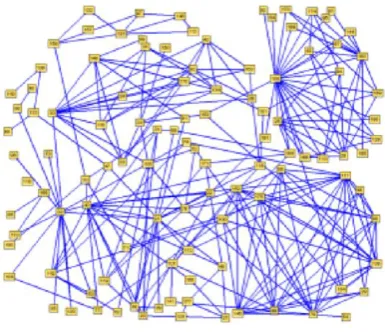
A social network is a representation of the relationships existing within a society. Figure 1 shows a fragment of a social network. Even within the same society several types of social network can be built depending on the social relationship considered: kinship, acquaintanceship, friendship, mutual support, cooperation, and similarity are typical criteria used in establishing the social relationship components of a society. The study of the social structures uses social network analysis to identify social relationships between individuals in a society. Social network analysis came forth as a set of methods that specifically allow an investigation of the relational aspects of these structures. These methods are, therefore, based on the availability of relational data rather than attribute data [16].
Figure 1 Fragment of Social Network
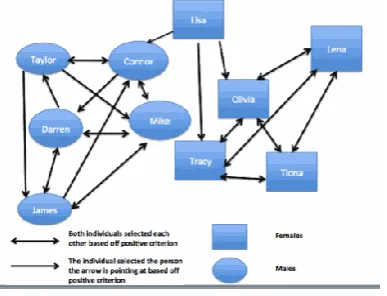
© 2017, IJCSMC All Rights Reserved 320 Figure 2 An Example of a Sociogram
Clearly, more the relational data better the network analysis is. However, the relational data may not be easy to obtain. Sociologists usually obtain these data through public opinion polls and interviews with the individuals. This procedure is, of course, not possible in case of agent societies. In agent societies, each agent has to perform the social network analysis from its own perspective. We assume that each agent owns a set of sociograms that show the social relations in its environment. These sociograms are dynamic and agent dependent.
The location of a given member of a society within a social network can be used to derive some properties about his or her reputation. Experts who are well-known and highly regarded by most other members of the society are easily identified as highly connected nodes in the sociogram.
III. RUNNING EXAMPLE
The assumption for this running example is a shopping mall where agents trade. The purchasers buy one item at a time (it is not possible to buy in bulk) and the factors that are taken into account for each transaction are price, quality and delivery date. First the purchaser selects a marketer. If the marketer wants to bargain with that purchaser, then it sends an offer. The purchaser has then to decide whether to accept the offer or not. If the purchaser accepts, the transaction is done.
The actual result of this transaction may or may not be equal to the initial offer from the marketer. A scammer (swindler) marketer can increase the price, decrease the quality of the product or deliver the product late. On the other hand, the purchaser can decide to pay less or even not to pay at all.
We can distinguish many relationship types between agents in an e-commerce environment and it is beyond the scope of this paper to explain all of them. We will consider just a set of relations that can be found in our scenario (example).
We consider three relation types to illustrate this scenario:
A. Competition (comp)
Competition is, in general, a contest or rivalry between two or more agents. This relation type is detected between two agents that pursue the same goals and require the same (usually limited) resources. In our running example this is the type of relation that could exist between two marketers that sell the same product or between two purchasers that need the same product.
B. Cooperation (coop)
Cooperation is just the opposite of competition. It is the process of working or acting together for common or mutual benefit. This relation type involves exchange of sincere information between the agents and some kind of sensitiveness to help each other if possible. To simplify, we consider that both the competitive and cooperative relation cannot exist between two agents at the same time.
C. Trade (trd)
© 2017, IJCSMC All Rights Reserved 321
As said before, each relation type is represented by a different sociogram and each agent owns a different sociogram for each of the above three relation types. These three sociograms are non-directed graphs with weighted edges. Weights range from 0 to 1 and reflect the intensity of the relation.
In our scenario, the factors that are taken into consideration for each transaction (price, quality and delivery date) determine the reputation types. To illustrate the model, we consider four reputation types for the marketer:
to overcharge: It is the reputation of overcharging the prices specified in contract.
to deliver late: As the name suggest, it is the reputation of delivering the products later than the delivery date specified in the contract.
quality swindler: It is the reputation of delivering the products with less quality than specified in the contract.
swindler: A swindler is a marketer who overcharges the price and/or delivers products with less quality than specified in the contract.
To illustrate the model, we consider the following reputation type for the purchaser:
defaulter: It is the reputation of not paying for the items a purchaser purchases.
IV. THE REGRET SYSTEM
The Regret System is a trust and reputation mechanism designed to take advantage of the social information to improve the calculation of trust and reputation measures. Regret is proposed as a module that extends the capabilities of the agent, adding the possibility to deal with reputation and trust to improve the agent’s behaviour in an e-commerce environment.
Some of the main characteristics of Regret System are:
It takes into account direct experiences, information from third party agents and social structures to calculate trust, reputation and credibility values.
It has a trust model based on direct experiences and reputation.
It incorporates an advanced reputation model that works with transmitted and social knowledge.
It has a credibility module to evaluate the truthfulness of information received from third party agents.
It uses social network analysis to improve the knowledge about the surrounding society.
The Regret System structure is based on the following three dimensions of reputation:
A. Individual Dimension
Individual dimension refers to how a single individual’s notions are estimated by others. In individual dimension, only the direct interaction between an individual and the other members of the society is considered.
B. Social Dimension
Although direct interaction is the most reliable and authentic information source but, unfortunately it is not always available. In such situations, the social dimension of reputation may help. Social dimension refers to notion about individuals based on the reputation of the social group they belong to. In social dimension, an individual also uses the information coming from other members of the society and the social relations.
C. Ontological Dimension
© 2017, IJCSMC All Rights Reserved 322
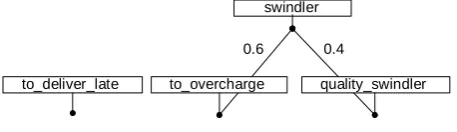
Figure 3 Ontological Structure for a Marketer
In Fig. 3, the reputation of being a swindler is based on the reputations of overcharging prices and delivering products with less quality than specified in the contract.
V. RELATED WORK
The study and modeling of reputation (direct and indirect) is not new. Several scholars and scientists from different fields have worked on the idea of using the opinion of other agents in a society to build a reputation. The work of Michael Schillo, Petra Funk and Michael Rovatsos [15], the work of Bin Yu and Munindar P. Singh [17] and the work of Jordi Sabater and Carles Seirra [14] are good examples of this. They use a trust-net for weighting the other agents’ opinions.
The model proposed by Yu and Singh [17] combines information that comes from agents having a good reputation. Schillo,
et al., [15] consider that the same agents that can provide you with information are also competing with you. Sabater, et al., [14] also consider the social relations between the agents in addition to the previous direct interactions.
Unlike Regret, all the previous models consider reputation as a single concept instead of a multi-facet concept.
VI. CONCLUSIONS
As said before, direct interaction between agents is the most reliable and authentic source of information but, unfortunately it is not always available. Therefore, when the direct interactions or encounters with another agent are scarce, the information coming from other agents may help. This paper presented the social network analysis and how it can be used in a reputation system taking into account the social dimension of reputation. This paper also presented the ontological dimension of reputation that allows to consider several types of reputation at the same time to calculate complex reputation.
The use of social network analysis as part of a reputation system opens a new field for experimentation.
ACKNOWLEDGEMENT
We would like to thank the freedom and support that our HOD Yasmeen Bhat and Syed Irfan have given us for this work.
REFERENCES
[1] Amazon Auctions. http://auctions.amazon.com. [2] eBay. http://www.eBay.com.
[3] A. Abdul-Rahman and S. Hailes. Supporting trust in virtual communities. In Proceedings of the Hawaii Int. Conference on System Sciences, Maui, Hawaii, 2000.
[4] D.B. Bromley. Reputation, Image and Impression Management. John Wiley & Sons, 1993. [5] V. Buskens. The social structure of trust. Social Networks,
(20):265—298, 1998.
[6] C. Castelfranchi and R. Falcone. Principles of trust for mas: Cognitive anatomy, social importance, and quantification. In
Proceedings of the 3th International Conference on Multi-Agent Systems, pages 72—79, 1998.
[7] M. Celentani, D. Fudenberg, D.K. Levine, and W. Psendorfer. Maintaining a reputation against a long-lived opponent.
Econometrica, 64(3):691—704, 1966.
[8] P. Dasgupta. Trust as a commodity. In D. Gambetta, editor, Trust: Making and Breaking Cooperative Relations, pages 49—72. Blackwell, 1998.
[9] P. Hage and F. Harary. Structural Models in Anthropology. Cambridge University Press, 1983. [10] P. Hage and F. Harary. Island Networks. Cambridge University Press, 1996.
quality_swindler 0.4
0.6 to_deliver_late to_overcharge
© 2017, IJCSMC All Rights Reserved 323
[11] M. Karlins and H. Abelson. Persuasion, how opinion and attitudes are changed. Crosby Lockwood & Son, 1970.
[12] R. Marimon, J.P. Nicolini, and P. Teles. Competition and reputation. In Proceedings of the World Conference Econometric Society, Seattle, 2000.
[13] J. Pearl. Probabilistic Reasoning in Intelligent Systems: Networks of Plausible Inference. Morgan Kaufmann, 1988.
[14] J. Sabater and C. Sierra. Regret: A reputation model for gregarious societies. In Proceedings of the Fourth Workshop on Deception, Fraud and Trust in Agent Societies, Montreal, Canada, pages 61—69, 2001.
[15] M. Schillo, P. Funk, and M. Rovatsos. Using trust for detecting deceitful agents in artificial societites. In Applied Artificial Intelligence, Special Issue on Trust, Deception and Fraud in Agent Societies, 2000.
[16] J. Scott. Social Network Analysis. SAGE Publications, 2000.
[17] Bin Yu and M.P. Singh. A social mechanism of reputation management in electronic communities. In Cooperative Information Agents, CIA-2000, Boston, MA, USA, pages 154—165, 2000.
[18] G. Zacharia. Collaborative reputation mechanisms for online communities. Master’s thesis, Massachusetts Institute of Technology, September 1999.