Practical ID-based Encryption for Wireless Sensor
Network
∗Cheng-Kang Chu
Singapore ManagementUniversity
[email protected]
Joseph K. Liu
Institute for InfocommResearch
[email protected]
Jianying Zhou
Institute for InfocommResearch
[email protected]
Feng Bao
Institute for Infocomm Research
[email protected]
Robert H. Deng
Singapore ManagementUniversity
[email protected]
ABSTRACT
In this paper, we propose a new practical identity-based encryption scheme which is suitable for wireless sensor net-work (WSN). We call it Receiver-Bounded Online/Offline Identity-based Encryption (RB-OOIBE). It splits the en-cryption process into two parts – the offline and the on-line part. In the offline part, all heavy computations are done without the knowledge of the receiver’s identity and the plaintext message. In the online stage, only light com-putations such as modular operation and symmetric key en-cryption are required, together with the receiver’s identity and the plaintext message. Moreover, since each offline ci-phertext can be re-used for the same receiver, the number of offline ciphertexts the encrypter holds only confines the number of receivers instead of the number of messages to be encrypted. In this way, a sensor node (with limited computa-tion power and limited storage) in WSN can send encrypted data easily: A few offline ciphertexts can be computed in the manufacturing stage while the online part is light enough for the sensor to process.
We propose an efficient construction for this new no-tion. The scheme can be proven selective-ID CCA secure in the standard model. Compared to previous online/offline identity-based encryption schemes, our scheme is exempt from a high storage requirement, which is proportional to the number of messages to be sent. The improvement is very significant if many messages are sent to few receivers.
1.
INTRODUCTION
A wireless sensor network (WSN) is a wireless network com-posed of a large number of sensor nodes. In WSNs the
∗This is the full version of [7]
scarcest resource is energy. For this reason, algorithmic re-search in WSN mostly focuses on the study and design of en-ergy aware algorithms for data computation. This problem becomes harder in the case of security, as most of the security algorithms are quite heavy. Although symmetric cryptogra-phy maybe one of the approaches to solve the problem due to their small computation requirement, key distribution mat-ter becomes another side effect. Recently, researchers are trying to apply assymmetric cryptography into WSN envi-ronment. Solutions include using online/offline algorithms and stateful public key encryption schemes.
Online/Offline algorithm.“Online/offline” cryptographic algorithm was first introduced by Even, Goldreich and Mi-cali [8], in the context of digital signature. Under this paradigm, the signing process can be divided into two phases. The first phase is calledoffline phase which is executed prior to the arrival of a message and the second phase is called on-line phase which is performed after knowing the message. The online phase should be very fast and require only very light computation, such as integer multiplication or hashing. Other heavier computation such as exponentiation should be avoided in the online phase. This is the basic charac-teristic of online/offline schemes. In this way, online/offline schemes are particularly useful for low-power devices such as smartcard or wireless sensor applications. Those heavy computations are done in the offline phase which can be car-ried out by other powerful devices, or even pre-computed by the manufacturers in the setup stage.
In parallel to online/offline signatures [15, 11, 6, 10], the first online/offline encryption scheme was proposed by Guo, Mu and Chen [9]. Similar to online/offline signature schemes, all heavy computations are done in the offline phase, without knowing the message to be encrypted. In the online phase, only light computations are executed with the knowledge of the plaintext. Nevertheless, there is a slight difference in the definition between online/offline signature and encryption schemes. Let us take a look on the following example. If we split the encryption process in the same way as the signing process, it is trivial to separate some standard encryption, such as ElGamal encryption scheme. In an ElGamal encryp-tion scheme, the sender first computes c1 =gr, c′1 =yr for
receiver. This can be considered as the offline phase, as the message is still yet unknown. After knowing the message, the sender computesc2=m·c′1. As this part only requires a
multiplication, it can be considered as the online part. The ciphertext is (c1, c2). However, it is only suitable for the sit-uation where the sender knows the recipient of the encrypted message in the offline phase, since the offline phase requires the knowledge of the public key of the recipient. We are not interested in this scenario. Instead, we consider a notion that allows the knowledge of the recipient is yet unknown in the offline phase. [9] uses this definition for their scheme, in the context of identity-based encryption.
The above online/offline encryption (where the knowledge of the recipient is unknown in the offline phase) seems useful in many scenarios. However, it may not be practical enough to be used in WSN. As the offline information cannot be re-used, to encrypteverymessage one needs to execute the offline encryption process once. For example, if a sensor node needs to send 1000 encrypted data to the base station during its lifetime, it needs to store 1000 pieces of offline information first. Due to limited storage capacity inside a sensor node, it may not be practical. We call such encryption asmessage-boundedonline/offline encryption (or OOIBE for short).
Stateful Public key Encryption.Bellare et al. [2]
pro-posed a method to significantly speed-up the public key en-cryption (PKE) by simply allowing a sender to maintain a “state” that is re-used across different encryptions. This new type of PKE is calledstateful PKE. This can greatly reduce the computation cost for the sender if it wants to en-crypt messages many times. Moreover, if the sender stores some more information with respect to the receiver’s pub-lic key, it may not need any more exponential computation for encrypting to this receiver. As an efficient construction, Bellare et al. presented a stateful PKE scheme based on the Diffie-Hellman assumption. Stateful encryption can be used in WSNs [1] to reduce the computation cost of sensor nodes, compared with normal public key encryption.
Although stateful public key encryption reduces the compu-tation cost a lot, the encrypter still needs to perform heavy computation at least once for each receiver. That limits the flexibility of its usage. In WSN environment, sometimes a sensor node may need to send data to different recipients, say, different base stations. Thus stateful public key encryp-tion is not yet a perfect soluencryp-tion.
Identity-Based Cryptosystem.Identity-Based (ID-Based)
Cryptosystem, introduced by Shamir [14], eliminates the ne-cessity for checking the validity of certificates in traditional public key infrastructure (PKI). In an ID-based cryptosys-tem, public key of each user is easily computable from an arbitrary string corresponding to this user’s identity (e.g. an email address, a telephone number, etc.). Using its master key, a private key generator (PKG) then computes a private key for each user. This property avoids the requirement of using certificates and associates implicitly a public key (i.e. user identity) to each user within the system. One only needs to know the recipient’s identity in order to send an encrypted message to him. It avoids the complicated and costly certificate (chain) verification for the authentication
purpose. In contrast, the traditional PKI needs an addi-tional certification verification process, which is equivalent to the computation oftwosignature verifications. Identity-based system is particularly suitable for power constrained devices such as sensor nodes or smartcards. The absence of certificate eliminates the costly certificate verification pro-cess. In addition, when there is a new node added to the network, other nodes do not need to have its certificate ver-ified in order to communicate in a secure and authenticated way. This can greatly reduce communication overhead and computation cost.
Both two message-bounded online/offline encryption schemes proposed by [9] are in identity-based setting. The first scheme requires 7 pairing operations in the decryption stage. It is proven secure in the selective-ID model. While for the sec-ond scheme, it is secure in the full security model, though the ciphertext is very large (more than 4700 bits). Recently Liu and Zhou [12] proposed another efficient OOIBE scheme. The ciphertext is just 1248 bits. However, their scheme can be only proven secure in the random oracle model. For state-ful public key encryption, there is only one identity-based solution [13] which is also proven secure in the random ora-cle model only.
1.1
Receiver-Bounded Online/Offline
Identity-Based Encryption
Receiver-Bounded Online/Offline Identity-Based Encryption
(RB-OOIBE) is a practical encryption solution on wireless sensor nodes. It allows a sensor node to encrypt data with
low computation powerandlow precomputation storage. Briefly, the data sender prepares a small number of offline cipher-texts first, say,n. Since computing offline ciphertexts doesn’t require the receiver’s identity, it can be executed in the man-ufacturing stage. Then the data sender can enjoy light en-cryption process on unlimited messages for up tonreceivers. In other words, as long as there are less thannreceivers, the data sender can avoid all heavy computations.
RB-OOIBE gets rid of the shortcomings of online/offline and stateful encryption. Unlike message-bounded online/offline encryption, it doesn’t need to prepare a large amount of offline ciphertexts (one for each encryption). An offline ci-phertext is dedicated to a receiver instead of a message to be encrypted. Unlike stateful encryption, the sender of RB-OOIBE doesn’t need any heavy computation when he en-crypts messages for up tondifferent receivers.
RB-OOIBE is most suitable for WSNs. In the WSN en-vironment, sensitive data are collected and encrypted by a low-power and low-storage sensor node, and then are sent back to one of several connected base stations. In general, lots of sensing data will be sent to the same base station (re-ceiver). The sensor node may store up tonpieces of offline part information in the manufacturing stage, so that it can send unlimited encrypted data to n different base stations without any further heavy computation, while these base station identities can be unknown to the manufacturer.
(or identity) and sends it to the receiver so that they can communicate with each other via the symmetric key cryp-tosystem. We can see that using hybrid cryptosystems, the sender has to perform afullpublic key encryption procedure before communicating to each receiver. Even the sender uses OOIBE to encrypt messages, the receiver is not stateless – it has to keep a key for each sender. Therefore, hybrid cryp-tosystems are not suitable for a large scale network where 1) a low-power device has to send data to multiple recipients; 2) a stateless device has to receive data from many other parties.
1.2
Contribution
In this paper, we propose a new notion ofReceiver-Bounded Online/Offline Identity-Based Encryption(RB-OOIBE). We provide an efficient construction which can be proven selective-ID CCA secure in the standard model. The advantage of our schemes over previous OOIBE schemes is very clear if a sender sends multiple messages to one recipient. Our scheme re-uses most of the previous information including the offline pre-computed data. Only a small offline ciphertext has to be stored on the sensor node. In contrast, other OOIBE schemes require a number of offline information which is proportional to the number of messages to be encrypted. The difference is significant if there are lots of messages to be sent by a sender.
Even for encrypting one message, our scheme is more effi-cient than all OOIBE schemes in the literature. There were only three schemes proposed: two of them were proposed by Guo, Mu and Chen in [9]. We use GMC-1 and GMC-2 to de-note them respectively. The remaining scheme was proposed by Liu and Zhou [12]. We use LZ to denote it. When com-pared to GMC-1 (selective-ID security) and GMC-2 (full se-curity), our scheme enjoys over 50% improvement in storage cost and ciphertext size. Even if we compare our schemes with LZ (which is proven secure only in the random ora-cle model), our scheme also gains efficiency improvement in storage cost and online computation cost.
Note that we don’t need to care about selective-ID security here. Usually, there are at most hundreds of base stations in a wireless sensor network. That means we only need hun-dreds of identities in the system. The simulator can guess the attacking identity in advance, and this will not loosen the security reduction too much in practice.
The rest of the paper is organized as follow. Some mathe-matical and security definitions are presented in Section 2. Our proposed scheme is given in Section 3. In Section 4 we give a performance comparison with previous schemes and we conclude the paper in Section 5.
2.
DEFINITION
In this section we briefly describe the assumptions and def-initions of our construction.
2.1
Bilinear Group
LetG and GT be two cyclic groups of prime order p. Let
e:G×G→GT be a map with the following properties:
• Bilinear: for all g1, g2 ∈ G and a, b ∈ Z, e(g1a, g2b) =
e(g1, g2)ab.
• Non-degenerate: for someg∈G,e(g, g)̸= 1.
We say thatGis a bilinear group if the group operations in
GandGT, and the bilinear map are efficiently computable.
2.2
Complexity Assumption
Our construction is based on the decision Bilinear Diffie-Hellman (BDH) assumption [5, 3]. the decision BDH prob-lem inGis that given a tupleg, ga, gb, gc∈Gand an element
Z∈GT, decide ifZ=e(g, g)abc.
Definition 1. The decision BDH assumption holds inGif no polynomial time algorithm Ahas non-negligible advan-tage in solving the Decisional BDH problem. More precisely, we define the advantage ofAin distinguishing two distribu-tions as
AdvBDHA,G(λ) =|Pr[A(1λ, g, ga, gb, gc, e(g, g)abc) = 1]
−Pr[A(1λ, g, ga, gb, gc, R) = 1]|,
where R ∈R GT and the size of group G depends on the security parameterλ. The decision BDH assumption holds in G if AdvBDHG (λ) = maxA{AdvBDHA,G(λ)} is negligible for any adversaryA.
2.3
Building Block
We introduce three building blocks used in our schemes:
• an IND-CCA secure symmetric encryption scheme. The IND-CCA security of a symmetric encryption scheme
SE=(SEnc, SDec) with key length k is captured by defining the advantage of an adversaryAas
AdvCCAA,SE(λ) = 2·Pr[β′=β:K∈R{0,1}k;
β∈R{0,1};β′← ASEncK,SDecK,ChalK,β(1λ)]−1. In the above, ChalK,β(m0, m1) returns SEncK(mβ). Moreover, A is allowed to issue only one query to the Chal oracle, and is not allowed to query SDecK on the ciphertext returned by it. The symmetric en-cryption scheme is IND-CCA secure ifAdvCCA
SE (λ) =
maxA{AdvCCAA,SE(λ)}is negligible for any adversaryA.
• a collision-resistant hash function.
A hash functionH:{0,1}∗→Zpis collision-resistant if no polynomial time adversaryAhas non-negligible advantage in finding collisions on it. More precisely, we define the advantage ofAas
AdvCOLA,H(λ) = Pr[H(x1) =H(x2)∧x1̸=x2: (x1, x2)← A(1λ)],
where the size of group Zp depends on the security parameterλ. The hash function is collision-resistent if
AdvCOLH (λ) =maxA{Adv
COL
A,H(λ)}is negligible for any adversaryA.
• a secure key derivation function.
the advantage of an adversaryAin distinguishing two distributions as
AdvKDFA,D (λ) = Pr[A(1 λ
, D(x)) = 1]−Pr[A(1λ, r) = 1] where x∈GT, r ∈R {0,1}k and λis the security pa-rameter determiningk. So the key derivation function isKDF-secure ifAdvKDF
D (λ) =maxA{AdvKDFA,D (λ)}is negligible for any adversaryA.
2.4
Receiver-Bounded Online/Offline
Identity-Based Encryption
A receiver-bounded online/offline identity-based encryption (RB-OOIBE) scheme consists of the following algorithms:
• Setup(1λ): on input the security parameter 1λ, out-put the public keyparamand master secret keyM K.
• KeyGen(param, M K, id): on input the public pa-rameter param, the master secret key M K and an identityid, output the secret keyskid.
• Off-Encrypt(param, st): on input the public param-eter param and a state tablest, output the updated state tablest.
• On-Encrypt(param, id, m, st): on input the public parameter param, an identityid, a messagemand a state table st, output the ciphertext C and the (up-dated) state tablest, or ‘⊥’.
• Decrypt(param, skid, C): on input the public param-eterparam, the secret keyskid, a ciphertextC, output the plaintextmor ‘⊥’.
Note that the offline encryption should be performed by powerful devices in the offline phase. In the online phase, one can arbitrarily choose a pre-computed offline ciphertext from the state table and employ it in the online encryption. One offline ciphertext can be dedicated to one recipient only. The encrypter should maintain the state table for recording the usage of offline ciphertexts.
Now we define the CCA security for RB-OOIBE.
Definition 2. The chosen-ciphertext security of an RB-OOIBE scheme is defined by the following game with secu-rity parameterλbetween an adversaryAand a challenger.
1. Setup. Perform Setup(1λ) to get (param, M K) and giveparamtoA.
2. Query phase 1. A may issue queries to the following oracles.
(a) Extract(id): return
skid←KeyGen(param, M K, id).
(b) Encrypt(id, m): return the ciphertextC where (C, st) ←On-Encrypt(param, id, m, st) ,st ←
Off-Encrypt(param, st) and st is the initially empty state table.
(c) Decrypt(id, C): return
m ← Decrypt(param, skid, C), where skid ←
KeyGen(param, M K, id).
3. Challenge. Apresents (m0, m1). Return the challenge ciphertextC∗toAwhere
(C∗, st)←On-Encrypt(param, id, mβ, st), β∈R{0,1} andst←Off-Encrypt(param, st).
4. Query phase 2. Acontinues making queries as inQuery phase 1, except thatAcan’t issueC∗to the decryption oracle.
5. Guess. Aoutputs the guessβ′∈ {0,1}. We sayAwins the game ifβ′=β.
The advantage ofAfor a scheme Π is defined asAdvCCAA,Π(λ) = |Pr[β′ =β]−1
2|. An RB-OOIBE scheme is
IND-ID-CCA-secure ifAdvCCA
Π (λ) =maxA{AdvCCAA,Π(λ)}is negligible for
any adversaryA.
We also define a weaker model: selective-ID CCA security (IND-sID-CCA). The selective-ID security is defined in the same way as full CCA security except thatAhas to decide which id it wants to attack in the beginning of the game. As described before, the selective-ID is not so weak in case only hundreds of identities are used.
Note that our construction and all previous OOIBE schemes have to trust the offline ciphertext generator. That is, the ciphertexts sent by the sensor nodes can be always decrypted by the owner of them.
3.
CONSTRUCTION
We introduce our main scheme Π in this section. The scheme is based on Boneh and Boyen’s IBE [3].
• Setup(1λ). Randomly generate a primep, two groups
G,GT of order p, a bilinear map e and generators
g, g2, h1, h2 ∈ G. Compute g1 = gα where α ∈R Zp. Choose a key derivation function D : GT → {0,1}k, wherekis the block size of a symmetric key encryption
SE=(SEnc,SDec), and a hash functionH :{0,1}∗ →
Zp. Output the public parameter and master secret key:
param= (g, g1, g2, h1, h2, H, D), M K=α.
• KeyGen(param, M K, id). Pick a random value r ∈
Zp. Compute the secret key foridas
skid= (gα2(g
id
1 h1)
r
, gr).
• Off-Encrypt(param, st). Randomly chooses,ˆa,ˆb,cˆ∈R
Zpand compute
(c1, c2, c3, c4, c5) = (e(g1, g2)s, gs,(g1ˆah1)
s
,(g1ˆbh2)
s
, gcs1ˆ)
• On-Encrypt(param, id, m, st). Get C′ from the en-try (id, C′) ∈ st. If there exists no such C′, ran-domly pick an entry (∗, C′) fromstand replace it with (id, C′). If there is no free entry (∗, C′) onst, return ‘⊥’. LetC′= (K, c2, c3, c4, c5,ˆa,ˆb,ˆc−1). Compute
˜
c1=SEncK(m), t1= ˆc−1(id−aˆ) and t2= ˆc−1(σ−ˆb), whereσ=H(c2, c3, c4, c5, t1). Output the final cipher-text
C = (˜c1, c2, c3, c4, c5, t1, t2)
= (SEncK(m), gs,(gˆa1h1)
s
,(gˆb1h2)
s
, g1ˆcs,
ˆ
c−1(id−ˆa),ˆc−1(σ−ˆb)) and the updated state tablest.
• Decrypt(P aram, skid, C). LetC= (˜c1, c2, c3, c4, c5, t1, t2) andskid= (d1, d2). Computeσ=H(c2, c3, c4, c5, t1). Check that
e(c4ct2
5 , g) ?
=e(c2, g1σh2).
If the equation holds, output ‘⊥’. Otherwise, compute
c1=e(c2, d1)/e(c3ct1
5 , d2) and K=D(c1).
Output the message
m=SDecK(˜c1).
3.1
Security
We prove that the scheme is IND-sID-CCA secure.
Theorem 1. Our scheme Π is IND-sID-CCA-secure as-suming the decision BDH assumption holds inG, the sym-metric encryption schemeSE=(SEnc,SDec) with block sizek
is IND-CCA secure, the hash functionHis collision-resistant and the key derivation functionD:GT → {0,1}k is secure. More precisely, we have
AdvCCAΠ2 (λ)≤Adv
DDH
G (λ) +AdvCCASE (λ) +Adv
KDF D (λ) +AdvCOLH (λ) +
qD
p
whereλis the security parameter andqD is the maximum number of queries to the decryption oracle.
Proof. Suppose there is an adversaryAbreaking Π with non-negligible advantage. Given a random decision BDH instance (g, ga, gb, gc, Z), where Z is either e(g, g)abc or a random element of GT, we construct another algorithm B breaking the decision BDH as follows.
• Init. Achooses an identityid∗ ∈ Zp that it intends to attack.
• Setup. B sets g1 = ga, g2 = gb and g3 = gc and chooses a hash function H : {0,1}∗ → Zp and a key derivation function D :GT → {0,1}k. It then picks random valuesλ1, λ2 ∈Zpand definesh1=g−id
∗
1 g
λ1
andh2=g−1σ∗g
λ2, whereσ∗=H(g3, gλ1
3 g−
k1,id∗k3,id∗,
gλ2
3 g−
k2,id∗k3,id∗, gk3,id∗, k1
,id∗) andk1,id∗, k2,id∗, k3,id∗
∈RZp. The parameter (g, g1, g2, h1, h2, H, D) is then sent to A. Sinceg, g1, g2 are randomly chosen, and
h1, h2 are uniformly random, the distribution of the parameter is identical to that in the actual construc-tion.
• Query Phase 1. Banswers the following queries. 1. Extract(id): for anyid̸=id∗,Bchooses a
ran-dom valuer∈Zpand sets the private key forid as
skid= (d1, d2) = (g
−λ1
id−id∗ 2 (g
id
1 h1)
r
, g
−1
id−id∗
2 g
r ).
Let ˜r=r−b/(id−id∗), we can see that
d1=g
−λ1
id−id∗ 2 (g
id
1 h1)r=g
−λ1
id−id∗ 2 (g
id−id∗
1 g
λ1)r
=g2a(g
id−id∗
1 g
λ1)r−id−bid∗ =ga 2(g
id
1 h1) ˜
r ;
d2=g
−1
id−id∗
2 g
r
=gr−id−bid∗ =gr˜.
Since ˜ris uniform inZp, the key is correctly dis-tributed.
2. Encrypt(id, m): forid̸=id∗,Bchooses a fixed random value sforid, and computes the cipher-text as in the actual construction. For id=id∗,
Bcomputes the ciphertext as ˜
c1=SEncK(m), c2=g3, c3=gλ1
3 g−
k1,id∗k3,id∗,
c4=gλ2
3 g−
k2,id∗k3,id∗, c5=gk3,id∗,
t1=k1,id∗, t2=k2,id∗,
wherek1,id∗, k2,id∗, k3,id∗are chosen inSetupphase andK=D(Z). We can see that ifZ=e(g, g)abc=
e(g1, g2)c, this is a valid encryption ofm. 3. Decrypt(id, C): letC = (˜c1, c2, c3, c4, c5, t1, t2).
B first checks the validity of C as in the actual construction. If C doesn’t pass the equation,B responses ‘⊥’. Otherwise, for id ̸= id∗, B gen-erates id’s secret key as inExtractoracle, and then decrypts C. Forid=id∗, Bfirst computes
σ = H(c2, c3, c4, c5, t1). Consider the following case:
– σ̸=σ∗:Bcomputes the private key for (id, σ) as
(d1, d2, d3)
= (g
−λ2 σ−σ∗
2 g
λ1r1(gσ−σ∗
1 g
λ2)r2, gr1, g −1
σ−σ∗
2 g
r2),
where r1, r2 ∈R Zp. We can see that when ˜
r2=r2−b/(σ−σ∗), the private key is of the form:
d1 = g
−λ2 σ−σ∗
2 g
λ1r1(gσ−σ∗
1 g
λ2)r2
= ga
2gλ1r1(gσ−σ
∗
1 g
λ2)r2−σ−bσ∗
= ga
2(g1idh1)r1(gσ1h2)r˜2, d2 = gr1, d3=gr˜2
which is valid. ThenBcomputes
c1=e(c2, d1)/(e(c3ct1
5 , d2)e(c4c
t2
5 , d3))
and
K=D(c1),
– σ = σ∗: B computes K = D(Z) and out-puts the message m= SDecK(˜c1). We can see that if Z = e(g, g)abc =e(g1, g2)c, m is correctly decrypted.
• Challenge. Aoutputs two messages m0 and m1. B randomly chooses a bitβand encrypts mβ underid∗ as inEncryptoracle.
• Query Phase 2. Amakes key extraction, encryption and decryption queries, and B responds as in Query Phase 1.
• Guess. Aoutputs its guess β′. If β′ =β,Boutputs 0; otherwise,Boutputs 1.
Analysis. Now we analyze the advantage ofBin the above game. IfZ=e(g, g)abc, we have
Pr[B(1λ, g, ga, gb, gc, e(g, g)abc) = 1] = Pr[β′=β]. (1) We can see that all values responded byBforExtractand
Encryptqueries have identical distribution to that in the
actual construction. For Decrypt queries, if id ̸= id∗, B just answers as in the actual construction. Ifid=id∗ but
σ̸= σ∗, we have showed that the decryption key is in the right form and thusB’s responses have right distribution. If id =id∗ and σ = σ∗, it means that (c2, c3, c4, c5, t1) is given byBexcept a negligible probability. SoK=D(Z) =
D(e(g, g)abc) = D(e(g1, g2)c) is the correct key for ˜c1. B successfully simulates the game. Equation (1) holds.
Then we consider the case forZ=R∈RGT. We have Pr[B(1λ, g, ga, gb, gc, R) = 1]≤
1 2+Adv
CCA
SE (λ) +AdvKDFD (λ) +AdvCOLH (λ) +qpD. (2)
We first defineRejInvas an event that the decryption oracle rejects all invalid ciphertexts. The following equation holds.
Pr[β′=β|RejInv]≤1 2+Adv
CCA
SE (λ) +Adv
KDF
D (λ). (3) We can see that if the decryption oracle rejects all invalid ciphertexts, the distribution of β is independent from A’s view under the assumption thatSEis CCA-secure andDis KDF-secure. Moreover, we have the following equation.
Pr[¬RejInv]≤AdvCOLH (λ) +
qD
p . (4)
If an invalid ciphertext C = (˜c1, c2, c3, c4, c5, t1, t2) passes the checking equation inDecrypt,Aeither
• finds collisions ofH, or
• adjusts one of the values c2, c4, c5 and t1 so that the equation holds.
The probability that the former happens is bounded by the collision-resistent hash function H, where the probability that the latter happens is 1/p. Considering that there are
qDdecryption queries, Equation (4) holds.
Now from (3) and (4), we get Equation (2):
Pr[β′=β]
= Pr[β′=β|RejInv] Pr[RejInv] + Pr[β′=β|¬RejInv] Pr[¬RejInv]
≤ Pr[β′=β|RejInv] + Pr[¬RejInv]
≤ 1
2+Adv
CCA
SE (λ) +AdvKDFD (λ) +AdvCOLH (λ) + qD
p Then by subtracting (1) from (2), we get the bound in the theorem statement.
4.
PERFORMANCE COMPARISON
There are only 3 existing online/offline IBE schemes, two of them are proposed by Guo, Mu and Chen in [9] and one of them is proposed by Liu and Zhou [12]. We use GMC-1, GMC-2 and LZ to denote them respectively. We also assume that |G| = 160 bits, |q| = 160 bits, |GT| = 1024 bits and message space is 128 bits for the following compari-son. Assume AES is used for the symmetric key encryption, where both the key size and ciphertext size are 128 bits. In order to make it CCA secure, we use another MAC func-tion which adds further 80 bits to the ciphertext. For the online/offline signature scheme used in GMC-1, we adopt Boneh and Boyen’s [4] construction which requires 320-bit offline, 320-bit online signatures and 320-bit public/private keys (by assuming some group elements can be shared be-tween different keys).
Table 1 shows the comparison between our scheme and other OOIBE schemes, in the case of encrypting one single mes-sage. The differences can be summarized as follow:
1. When compared to the scheme in the full security model (GMC-2), both the offline storage and cipher-text size of our scheme are 4 times smaller than GMC-2. Again, as described before, selective-ID security is not really weak in our scenario.
2. When compared to the scheme in selective-ID model (GMC-1), both the offline storage and ciphertext size of our scheme are 2 times smaller than GMC-1. Even if we compare to the random oracle scheme (LZ), our scheme still achieves a smaller offline storage (2 times smaller).
3. In terms of computation requirement, we do not re-quire any point addition operation (M operation) in the online encryption stage for both schemes. Mod-ular computation (mc operation) and symmetric key encryption (SE operation) are much faster than M
operation. Thus the online encryption stages of our scheme is faster than GMC-1 and GMC-2.
4. We also note that schemes in the random oracle are usually more efficient than those in the standard model, due to the weaken security level. However, our scheme achieves similar or even outstanding performance over the random oracle scheme (LZ).
GMC-1 GMC-2 LZ Ours Offline 6E + 2M E 4E + 2M E 4E+ 1M E 3E+ 2M E
computation
Online 1M + 2mc 1M + 2mc 3mc 2mc+SE computation
Offline storage 2944 5056 2624 1248 (bits)
Ciphertext length 2784 4736 1248 1168 (bits)
Number of pairing 7 2 2 4
for decryption
Security model selective-ID full random oracle selective-ID
Table 1: Comparison of computation cost and size for encrypting one message. E: point multiplication inG or exponentiation inGT;M E: multi-point multiplication inG(which costs about 1.3 times more than a single
point multiplication);M: multiplication inGT;mc: modular computation in Zp; andSE: the symmetric key
encryption.
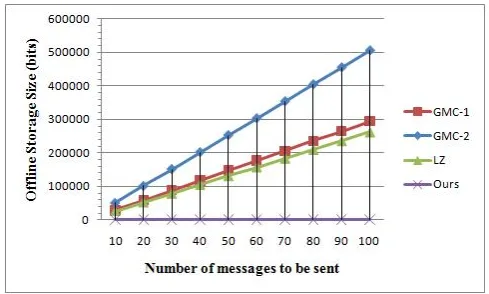
Figure 1: Offline storage size for different numbers of messages to be sent
messages to be encrypted in our schemes, the efficiency gain can be magnified when more messages will be sent, say, 100 messages. So when the number of receivers is limited, our schemes can achieve much better performance when com-pared to previous OOIBE schemes.
Again, even for encrypting one message, our scheme is more efficient than all OOIBE schemes in the literature. Therefore using RB-OOIBE to encrypt messages directly is better than using OOIBE schemes to encrypt a symmetric key and then using this symmetric key to encrypt messages.
5.
CONCLUSION
In this paper, we have proposed a new notion called Receiver-Bounded Online/Offline ID-based Encryption. We also pre-sented a concrete RB-OOIBE construction. The efficiency improvements of our scheme over previous schemes are very clear, especially in the case that many messages are en-crypted for one receiver. In general, a wireless sensor node has three main limitations: energy, computation power and storage. For energy saving, our scheme provides the shortest ciphertext length compared to other OOIBE schemes. By the online/offline property, the sensor node doesn’t need any
heavy computation for encryption. Most importantly, RB-OOIBE saves lots of space required for offline ciphertexts. This makes our scheme really practical for wireless sensor nodes.
6.
REFERENCES
[1] Joonsang Baek, Han Chiang Tan, Jianying Zhou, and Jun Wen Wong. Realizing Stateful Public Key Encryption in Wireless Sensor Network. In
Proceedings of The IFIP TC-11 23rd International Information Security Conference (SEC ’08), pages 95–107. Springer, 2008.
[2] Mihir Bellare, Tadayoshi Kohno, and Victor Shoup. Stateful Public-key Cryptosystems: How to Encrypt with One 160-bit Exponentiation. InProceedings of the 13th ACM Conference on Computer and
Communications Security (CCS ’06), pages 380–389. ACM, 2006.
[3] Dan Boneh and Xavier Boyen. Efficient Selective-ID Secure Identity-Based Encryption Without Random Oracles. InProceedings of Advances in Cryptology -EUROCRYPT ’04, volume 3027 ofLNCS, pages 223–238. Springer, 2004.
[4] Dan Boneh and Xavier Boyen. Short Signatures Without Random Oracles the SDH Assumption in Bilinear Groups.Journal of Cryptology, 21(2):149–177, 2008.
[5] Dan Boneh and Matthew K. Franklin. Identity-Based Encryption from the Weil Pairing. InProceedings of Advances in Cryptology - CRYPTO ’01, volume 2139 ofLNCS, pages 213–229. Springer, 2001.
[6] Xiaofeng Chen, Fangguo Zhang, Willy Susilo, and Yi Mu. Efficient generic on-line/off-line signatures without key exposure. InProceedings of Applied Cryptography and Network Security 2007 (ACNS ’07), volume 4521 ofLNCS, pages 18–30. Springer, 2007. [7] Cheng-Kang Chu, Joseph K. Liu, Jianying Zhou, Feng
Bao, and Robert H. Deng. Practical ID-based
Encryption for Wireless Sensor Network. To appear in ASIACCS ’10, 2010.
Advances in Cryptology - CRYPTO ’89, volume 435 of
LNCS, pages 263–275. Springer, 1989.
[9] Fuchun Guo, Yi Mu, and Zhide Chen. Identity-based online/offline encryption. InProceedings of Financial Cryptography and Data Security (FC ’08), volume 5143 ofLNCS, pages 247–261. Springer, 2008. [10] Marc Joye. An efficient on-line/off-line signature
scheme without random oracles. InProceedings of 7th International conference on Cryptology and Network Security (CANS ’08), volume 5339 ofLNCS, pages 98–107. Springer, 2008.
[11] Kaoru Kurosawa and Katja Schmidt-Samoa. New online/offline signature schemes without random oracles. InProceedings of the Public Key Cryptography (PKC ’06), volume 3958 ofLNCS, pages 330–346. Springer, 2006.
[12] Joseph K. Liu and Jianying Zhou. An efficient identity-based online/offline encryption scheme. In
Proceedings of Applied Cryptography and Network Security 2009 (ACNS ’09), volume 5536 ofLNCS, pages 156–167. Springer, 2009.
[13] Le Trieu Phong, Hiroto Matsuoka, and Wakaha Ogata. Stateful identity-based encryption scheme: faster encryption and decryption. InProceedings of the ACM Symposium on Information, Computer & Communication Security (ASIACCS ’08), pages 381–388. ACM, 2008.
[14] Adi Shamir. Identity-based cryptosystems and signature schemes. InProceedings of Advances in Cryptology - CRYPTO ’84, volume 196 ofLNCS, pages 47–53. Springer, 1984.